A name was already taking shape in my mind, but I couldn’t say it in front of Violet.
Not yet.
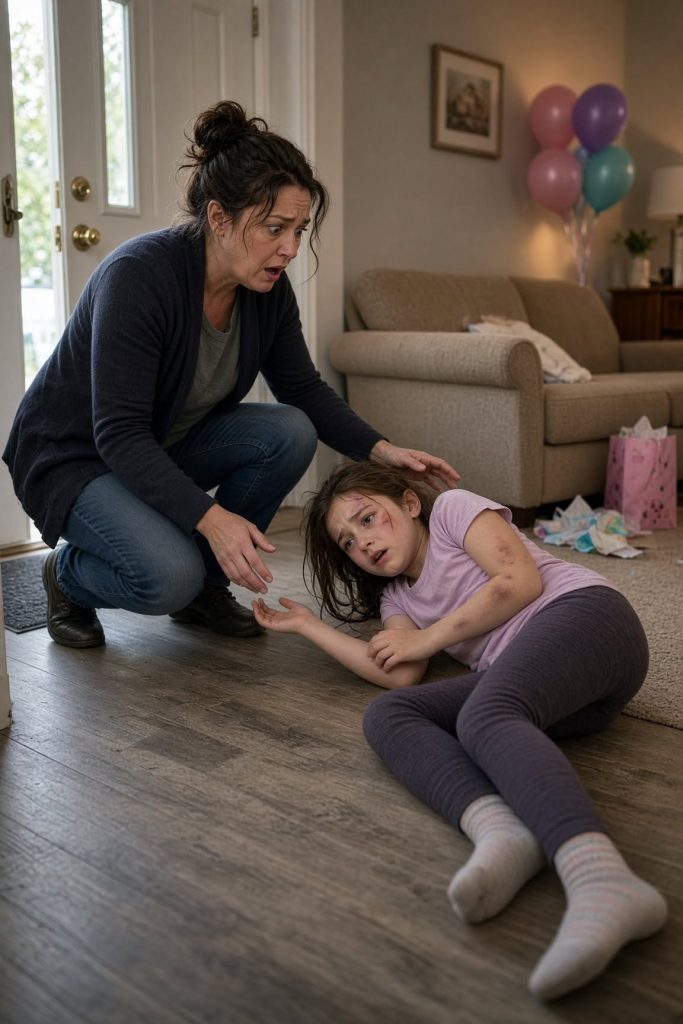
My ten-year-old daughter was sitting beside me bruised and shaken on the floor of our own home, staring at me as if I were the only solid thing left in a room that had stopped making sense. She had just shown me a message sent under my name, written in a voice close enough to mine that she had trusted it.
Whoever sent it knew it was her birthday.
They knew I would be gone.
They knew strangers would be arriving.
They knew our alarm could be turned off with a working household code.
And worst of all, they knew the private nickname I used for Violet when she was frightened.
That detail narrowed the world around us in a way I didn’t want my daughter to understand yet.
She had asked me the simplest question possible.
“So who knew?”
I looked at the phone in my hand instead of answering.
The message thread still carried my name. At a glance, it looked ordinary enough to fool a child who had no reason to suspect someone was borrowing her father’s voice. The first message promised a birthday surprise. Another told her not to be nervous if people she didn’t recognize showed up.
Then came the instruction that mattered.
Turn off the alarm so the surprise wouldn’t be ruined.
Violet had followed it because she believed the message came from me.
That was the part that kept cutting through everything else.
She hadn’t been reckless.
She hadn’t opened the door because someone offered candy or invented a flimsy excuse.
Someone had built trust first.
Someone had used me as the key.
I checked my own phone again even though I already knew what I would find. There was no matching conversation. No outgoing message telling Violet about visitors. No instruction to disarm the system. Nothing that could explain why her phone displayed words carrying my identity while mine showed no record of sending them.
Violet watched every movement of my face.
I realized then that whatever I did next would teach her something.
If I exploded, she would learn that the truth meant losing her father to rage.
If I started throwing accusations at people she knew, she would have to absorb another betrayal before she had even been examined properly.
If I treated her like an evidence source instead of my daughter, she might spend years remembering that the first thing I wanted after finding her hurt was answers.
So I put the questions away for a moment.
I moved closer.
“You did the right thing showing me,” I told her.
Her eyes dropped toward the screen.
The paper gift bag I had brought home was still lying where it had fallen when I first saw her. I had come home early because I thought I was about to surprise my daughter on her tenth birthday.
Instead, that bag had hit the floor before I did.
I had walked into a house so quiet that, for a second, my mind refused to process what my eyes were seeing.
Violet was on the floor.
Her cheek was swollen. Her face was injured. Dark bruising showed along one arm. She was breathing, awake, and frightened enough that when I dropped beside her, her fingers immediately caught my sleeve.
“Dad?”
“I’m here.”
Those two words had become the only ones that mattered.
I called emergency services and put the phone on speaker. Everything inside me wanted action, but action wasn’t the same thing as noise. My training had taught me that the first priority in a dangerous situation is the person who can still be protected.
That person was Violet.
So I stayed beside her.
I kept my voice level.
I asked only what she seemed able to answer.
I didn’t make her repeat herself just because I wanted every detail immediately.
When she whispered, “I didn’t let them in,” I believed her.
“I know.”
Then her gaze shifted toward the hallway.
Toward the alarm panel.
That was the first physical detail that changed the shape of what I thought had happened.
The front door showed no obvious forced entry. The lock wasn’t broken. The frame hadn’t been splintered. There wasn’t the kind of visible damage I would have expected if strangers had simply broken their way inside.
Then I looked at the alarm information.
The system had been disarmed at 4:17 that afternoon using a valid household code.
Not Violet’s code.
I asked whether she had touched the alarm herself before the people arrived.
“No.”
I asked whether they had said anything about how they got in.
Her breathing changed.
She looked down the hallway again before looking back at me.
“They said you sent them.”
My grip tightened around the phone.
I kept my voice steady anyway.
“What else?”
“They knew it was my birthday.”
She swallowed before continuing.
Then she repeated the sentence that turned a frightening attack into something far more personal.
“She told us you’d be gone.”
She.
Not a random guess about my schedule.
Not somebody wandering through the neighborhood and choosing the wrong house.
Someone had apparently supplied information.
Someone knew enough about our lives for strangers to arrive expecting me to be absent and Violet to be available.
At first, the alarm code seemed like the biggest clue.
It wasn’t.
A code could theoretically be overheard, seen, copied, or passed along.
A schedule could be learned.
A birthday could be found out.
But the message on Violet’s phone added something different.
Language.
Whoever created it knew how I talked to her.
That private nickname was not something I used casually. It wasn’t a cute label I threw around in public. It belonged to a smaller part of our lives, the moments when Violet was scared and I was trying to settle her without making her feel embarrassed about being afraid.
She recognized it because it belonged to us.
Someone else recognized its value because they understood what it would make her believe.
That distinction mattered.
The person behind the message didn’t merely know facts about my daughter.
They knew what made her trust me.
I thought back to the moment I entered the house and felt anger take over before reason caught up.
The words that had flashed through my mind had been ugly and absolute.
Traitors will die tonight.
But standing beside Violet, those words already felt like they belonged to a different man than the one she needed.
Anger wanted a target immediately.
A father needed the truth.
Those were not the same mission.
The easiest mistake would have been to decide that the first person who fit the clues had to be guilty. I could feel my mind trying to do exactly that. It wanted to take the name forming in the back of my head and attach every piece of evidence to it until uncertainty disappeared.
But certainty manufactured by rage is still manufactured.
The facts were narrower.
Someone had represented themselves as me.
Someone knew Violet’s birthday.
Someone knew I was expected to be away.
Someone knew a working household alarm code, or had access to somebody who did.
Someone knew the private nickname I used with my daughter.
And according to Violet, the people who entered our home believed a woman had told them I would be gone.
Those facts pointed somewhere.
They did not yet prove everything.
That difference was the only thing standing between a controlled response and a reckless one.
I stopped touching anything I didn’t need to touch. I kept the hallway clear. I left the alarm panel alone after reading what mattered. I didn’t start scrolling through Violet’s phone beyond the message she had shown me, because the device itself had become important.
The phone wasn’t just a phone anymore.
It was the reason she had lowered her guard.
It was also proof that whoever planned this had understood something basic about children: if you want them to accept something frightening, make it sound like it came from the person they trust most.
Violet leaned against me while I held the device.
“It sounded like you,” she had said.
I knew she meant the message.
But I heard something else inside those words.
She needed me to know she hadn’t chosen strangers over common sense.
She had chosen her father.
Someone had weaponized that choice against her.
I wanted to tell her she should never have trusted a message telling her to disable an alarm.
The thought came automatically, the way parental hindsight always arrives with perfect timing after something has gone wrong.
I didn’t say it.
She was ten.
She had been told there was a birthday surprise.
The message carried my name, my tone, and a private word she associated with safety. Whoever sent it had specifically designed the situation to bypass the caution we teach children.
This wasn’t the moment to make her feel responsible for failing a test she didn’t know she was taking.
So when she asked again, “Who knew?” I didn’t give her the name in my head.
Instead, I looked back at the screen.
There were two separate betrayals hidden in that message.
The first was practical.
Information about our home had escaped the boundaries of our home.
The second was personal.
Information about our relationship had escaped with it.
That second betrayal frightened me more.
Schedules can change. Codes can be replaced. Locks can be repaired.
But a child who starts wondering whether her own father’s words are really his can lose something harder to restore.
Trust does not come with a reset button.
That became my real priority.
Not revenge.
Not even the name.
Violet.
I needed her to know that when I said something to her, it was actually me saying it. I needed her to understand that she was allowed to question unexpected instructions, even when they appeared to come from somebody she loved. Most of all, I needed to make sure the person responsible didn’t get a second chance to use our relationship as an entry point.
My anger hadn’t disappeared.
It had become colder.
More useful.
I had spent enough of my life around dangerous people to know that predators benefit when everybody else becomes emotional and sloppy. Panic destroys timelines. Rage contaminates decisions. Assumptions turn into statements, statements turn into stories, and stories can bury the clean facts that existed before anyone started trying to explain them.
So I reduced the night to what I knew.
4:17 p.m.
A valid household code.
My absence.
Violet’s birthday.
A false message carrying my identity.
A private nickname.
And one sentence from the intruders about a woman who had supposedly told them I’d be gone.
That was enough for the moment.
The rest had to be earned.
Violet’s fingers were still hooked into the fabric of my sleeve.
I remembered how hard she had grabbed me when I first reached her, as if she was afraid I might vanish the same way my digital identity had appeared on her phone without me.
I covered her hand with mine.
“I’m not going anywhere,” I said.
I didn’t promise that everything would be fine.
Adults say that too easily when children can clearly see that everything is not fine.
I promised only what I could control.
I would stay.
I would listen.
I would not make her carry the investigation in her head.
And I would not say a name until I knew whether that name belonged to the truth or only to my anger.
The discipline cost me more than I expected.
Because the name forming in my mind wasn’t attached to a stranger.
That was the part I couldn’t tell Violet.
Not while she was sitting injured on the floor.
Not while she was still processing the fact that people had entered her home believing her father had sent them.
Not while the safest voice in her life had just been copied by somebody close enough to understand how it worked.
For the first time since walking through the door, I understood that finding whoever did this would not be the hardest part.
The hardest part might be what the answer would do to my daughter once she learned who had been close enough to know all those things.
I looked once more at the false message.
The wording was familiar without being perfect.
That mattered too.
It didn’t read like a stranger imitating a generic father from a distance. It read like someone assembling me from observation: the birthday reassurance, the instruction framed as a surprise, the private nickname placed exactly where Violet’s fear might have interrupted obedience.
Someone had studied the relationship well enough to reproduce its surface.
But they had missed its center.
They thought being Violet’s father meant knowing the correct words.
It didn’t.
It meant sitting on the floor when she was hurt.
It meant not demanding answers faster than she could give them.
It meant hearing “It sounded like you” and understanding that she was asking for reassurance, not defending herself.
It meant choosing her safety even when every angry instinct begged me to choose retaliation.
That was the difference the person behind the message hadn’t understood.
They could copy my nickname.
They could copy my tone.
They could put my name on a screen.
They could not copy the responsibility attached to it.
The gift bag still lay by the doorway, forgotten.
Hours earlier, I had imagined walking in with it and catching Violet off guard in the good way. Maybe she would laugh. Maybe she’d accuse me of being terrible at keeping secrets. I had expected the evening to become one of those ordinary family memories that eventually gets compressed into a photograph and a story told every birthday afterward.
Instead, her tenth birthday had become a line dividing before from after.
Before, a message from Dad meant Dad.
After, we would have to build something more deliberate.
A way to verify.
A way to question.
A way for Violet to know that love never requires blind obedience, especially when a request feels wrong.
That lesson should not have cost her this much.
But I could at least make sure the cost wasn’t wasted.
I glanced toward the hallway again.
The alarm panel remained where it had been all afternoon, an ordinary piece of plastic on the wall that now carried the timestamp around which everything else revolved.
4:17.
Someone had used legitimate access to make an illegitimate situation look normal.
The fake message had done the same thing emotionally.
That symmetry was impossible to ignore.
The house had not simply been entered.
Trust had been entered first.
And that finally clarified what I needed to do next.
I didn’t need to hunt for a dramatic confession that night.
I didn’t need to make a phone call fueled by fury and announce what I suspected.
I didn’t need to give the person in my head advance warning that I was looking in their direction.
I needed to protect Violet, preserve what already existed, and let the facts narrow the circle without my anger pushing them.
The name could wait.
Truth couldn’t.
I handed Violet’s phone carefully back toward her, but she didn’t take it immediately.
For a second, both of us held the device between us.
The screen still showed the false version of me.
Then Violet released it into my hand.
And I understood the real weight of what she was giving me.
Not just evidence.
Trust.
Someone had stolen my voice to get through our door.
Now I had to prove, by everything I did next, that they had never understood what that voice was supposed to protect.