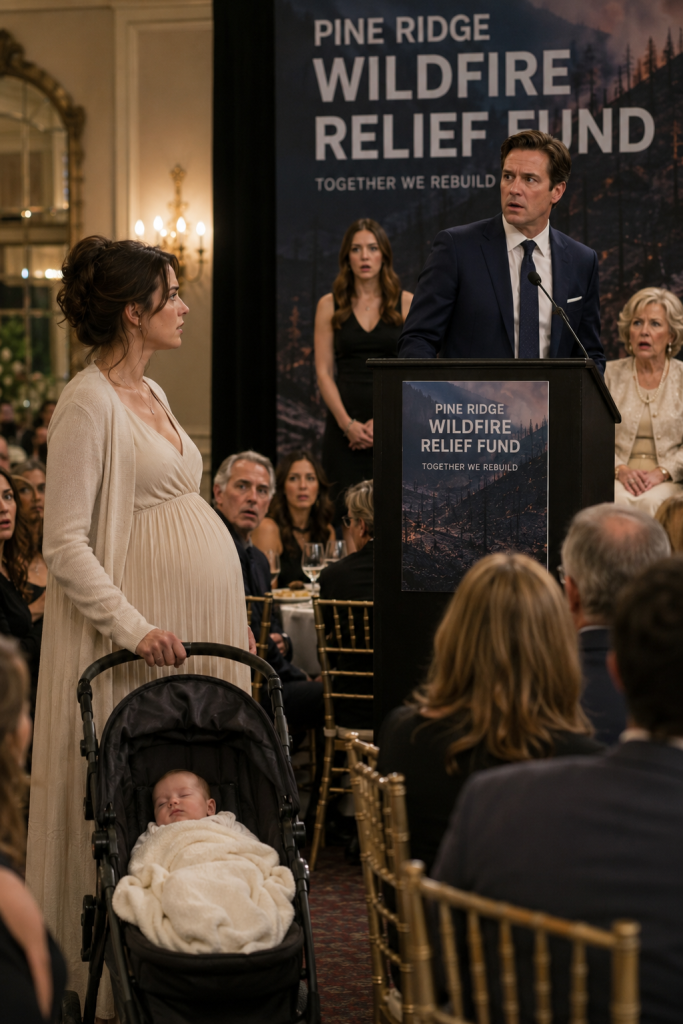
“You didn’t lose me in that fire, Brett. You left me there.”
My voice carried farther than I expected.
It reached the donors seated beneath gold chandeliers.
It reached the reporters standing beside the ballroom doors.
It reached Eleanor Keene, who lowered her tissue but did not lower her chin.
And it reached Tessa Vale, whose hand slowly slipped away from Brett’s arm.
Brett remained beneath the spotlight.
For several seconds, he looked incapable of moving.
Then the public version of my husband returned.
His shoulders softened.
His expression became wounded.
“Natalie,” he said into the microphone, “thank God.”
He placed one hand over his heart.
The audience watched him with sympathy.
He had rehearsed that gesture.
I could tell.
He stepped down from the stage and opened his arms as if I were supposed to collapse into them.
I kept both hands on June’s stroller.
“Don’t touch us.”
Brett stopped.
His smile remained, but only because cameras were pointed at him.
“Natalie, everyone believed you were missing.”
“You drove away while I was begging at the window.”
His eyes flicked toward the reporters.
“This isn’t the place.”
“You made this the place.”
A murmur passed through the ballroom.
Behind Brett, a large screen displayed photographs of burned homes, injured firefighters, and families receiving emergency checks from the Pine Ridge Wildfire Relief Fund.
His face appeared in several photographs.
Brett handing out blankets.
Brett embracing an elderly survivor.
Brett standing before the ruins of our cabin with his head bowed.
The caption beneath that photograph called him a grieving husband.
Eleanor came toward me.
Her silver hair was perfectly styled. Her navy gown glittered beneath the chandeliers.
She looked at June without warmth.
Then she leaned close enough for only me to hear.
“Take the baby and leave before you embarrass yourself.”
I stared at her.
“Your granddaughter has a name.”
Eleanor’s mouth tightened.
“Brett was trying to save lives that night.”
“He saved yours.”
“I am his mother.”
“And I was his pregnant wife.”
Tessa approached more slowly.
She wore a fitted black dress and the diamond bracelet I had once found beneath the passenger seat of our SUV.
Brett told me it belonged to a donor.
Now I understood which donor.
“Natalie,” she whispered, “I didn’t know he would leave you.”
“You got into the car.”
“Eleanor said another vehicle was coming.”
“You looked at me through the window.”
Tessa’s eyes filled with tears.
I felt nothing.
Three months earlier, I might have wanted her apology.
Now I wanted evidence.
A woman in a charcoal suit entered through the ballroom doors.
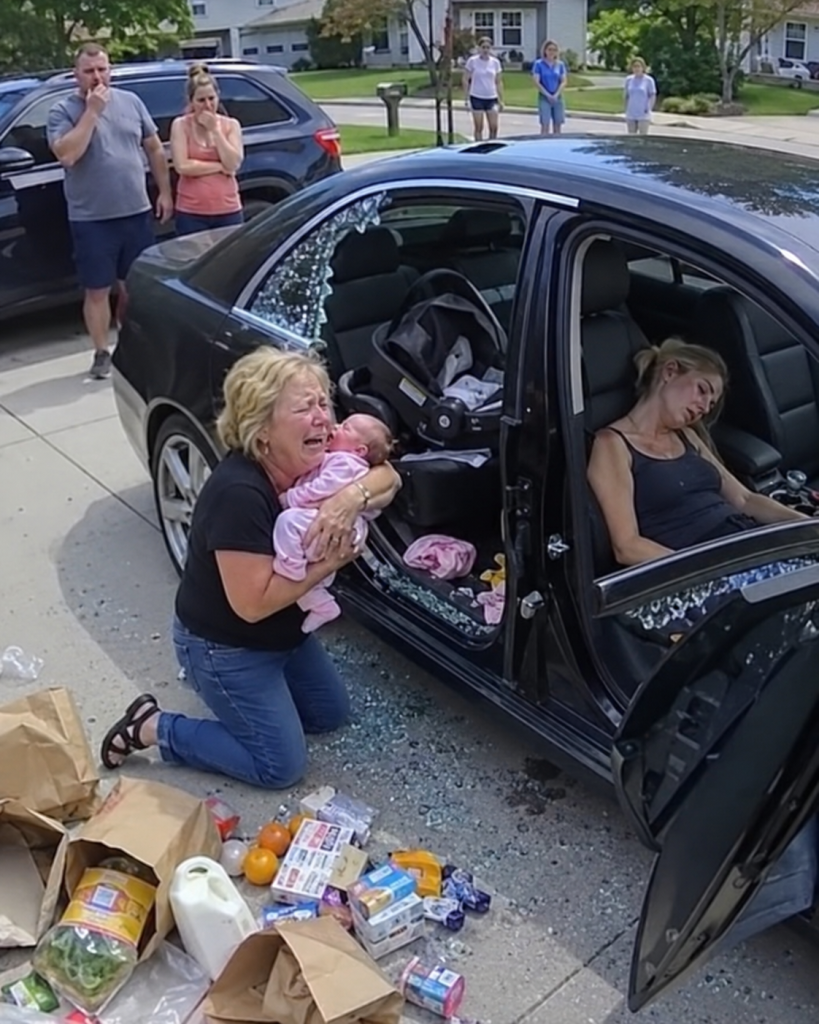
Mara Collins had been the emergency dispatcher who answered my final 911 call.
Beside her walked Daniel Reyes, an investigator with the state attorney general’s charitable fraud division.
Brett recognized them.
His face changed.
Mara pushed a laptop toward the sound technician.
Brett stepped between them.
“You cannot interrupt a private fundraising event.”
Daniel displayed his badge.
“This event stopped being private when it began soliciting public donations.”
The ballroom became completely silent.
Mara connected the laptop to the sound system.
Static filled the speakers.
Then my voice came through.
Thin.
Terrified.
Barely human.
“My husband took the only car. I’m six months pregnant, and the smoke is already inside.”
Several guests turned toward Brett.
On the recording, Mara asked me who had left in the vehicle.
I named Brett.
I named Eleanor.
I named Tessa.
Then came the sound I had forgotten.
My own coughing.
My hand striking the kitchen floor.
And my voice saying, “Please tell my baby I tried.”
I gripped the stroller so hard my fingers went numb.
June stirred beneath the white blanket.
Brett lunged toward the laptop.
Daniel blocked him.
“This recording is evidence.”
“Evidence of what?” Brett demanded. “A family argument during an emergency?”
Mara looked at him with open disgust.
“Evidence that you knowingly abandoned a pregnant woman inside an evacuation zone.”
Eleanor raised her voice.
“My son believed help was nearby.”
“No,” Mara said. “The evacuation road was already closed. Dispatch records prove it.”
Brett turned toward the donors.
“Ladies and gentlemen, my wife suffered severe smoke exposure. She was confused that night.”
I reached beneath June’s stroller and removed a thick envelope.
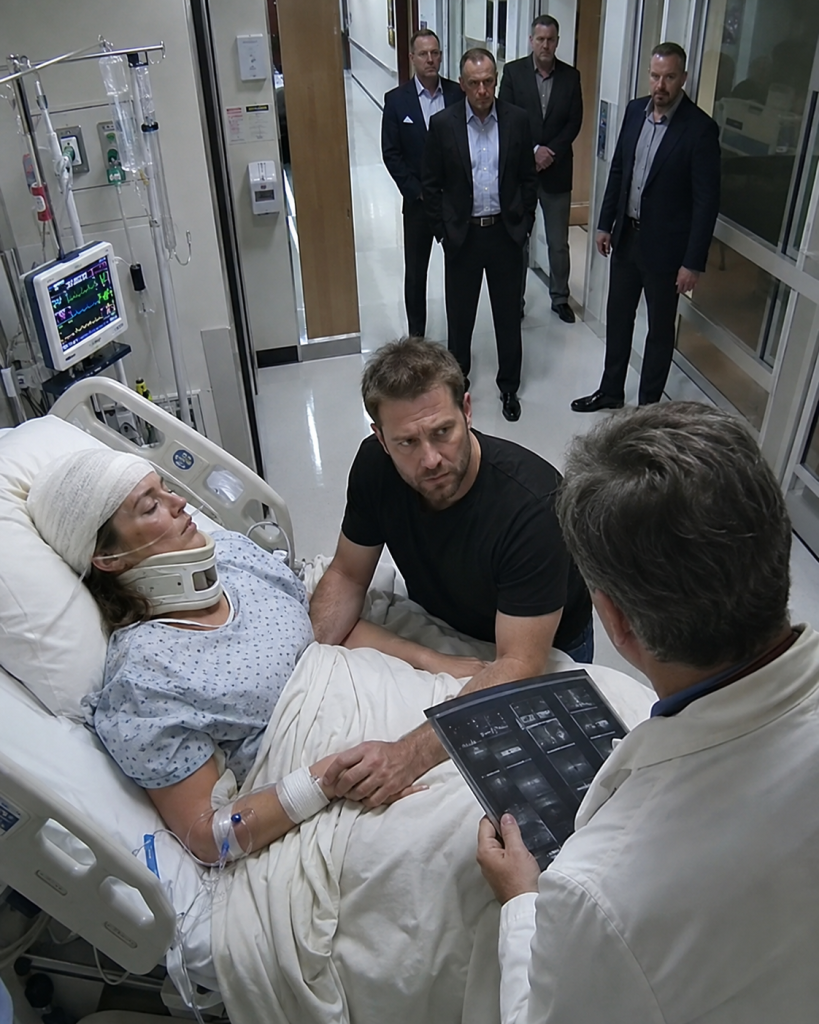
“The hospital tested me for confusion.”
I handed the medical records to a reporter.
“My blood oxygen level was dangerously low, but I remained oriented. I remembered the address. I remembered every person in the SUV. I remembered my husband telling me to call someone while he took the only working phone charger.”
The reporter opened the records.
Cameras began flashing.
Brett’s mask cracked.
“You disappeared,” he snapped. “You refused to contact me.”
“I was placed under protective confidentiality after hospital staff heard the call.”
“You kept my child from me.”
“You left your child in a fire.”
That sentence ended whatever sympathy remained in the room.
Then Daniel Reyes opened his briefcase.
“The abandonment is not the only reason we are here.”
He removed a stack of banking records.
“The Pine Ridge Wildfire Relief Fund has collected approximately one point four million dollars.”
Brett’s expression went still.
Daniel continued.
“Only two hundred and eighteen thousand dollars has reached verified wildfire victims.”
People began rising from their tables.
A donor near the stage shouted, “Where did the rest go?”
Daniel placed the records on the podium.
“More than eight hundred thousand dollars was transferred to a consulting company owned by Ms. Tessa Vale.”
Every eye turned toward her.
Tessa backed away from Brett.
“No.”
Her voice came out as a whisper.
Daniel looked directly at her.
“Vale Community Strategies was registered four months before the fire.”
Tessa shook her head.
“Brett handled the accounts.”
Brett seized her arm.
“Do not say another word.”
She pulled away.
The gesture revealed everything.
Daniel removed one final page.
“Our investigators also found an insurance policy connected to the Keene cabin.”
My heart began pounding.
“The policy was increased substantially six weeks before the wildfire.”
Brett stared at him.
Daniel looked at me.
“The primary beneficiary was not Mrs. Keene.”
The ballroom seemed to tilt.
“Who was it?” I asked.
Daniel turned toward Tessa.
“She was.”
Part 2
Tessa’s knees gave way.
She grabbed the edge of a table before she hit the floor.
“I didn’t know,” she said.
Brett moved toward her.
She recoiled.
“Don’t touch me.”
Eleanor stepped between them.
“This is absurd. Brett would never place insurance in another woman’s name.”
Daniel handed her a copy.
“Your signature appears as a witness.”
For the first time that night, Eleanor had no response.
I watched her eyes move across the page.
The date.
The amount.
Her own signature.
She had known.
Maybe not everything.
Enough.
Brett grabbed the microphone from the podium.
“This is a misunderstanding created by incomplete documents and a vindictive spouse.”
A man at the front table stood.
He was Harold Mercer, a retired judge and one of the fund’s largest donors.
“Did you leave your pregnant wife without transportation?”
Brett’s jaw tightened.
“The fire was moving unpredictably.”
“That was not my question.”
“I made a split-second decision.”
“To take your mistress?”
Tessa began crying.
Brett looked toward the ballroom exits.
Two uniformed officers entered.
Daniel raised a hand.
“At this time, Mr. Keene is not under arrest. We are executing warrants for the fund’s financial records and electronic devices.”
The officers approached the stage.
Brett stepped backward.
“You have no right to seize anything.”
Daniel handed him the warrant.
Brett read only the first page before throwing it onto the podium.
“This event is over.”
“No,” I said. “It’s finally starting.”
He turned on me.
The rage in his face was familiar.
It was the expression he wore behind closed doors whenever I questioned him.
The expression no donor had ever seen.
“You think walking in here with a baby makes you innocent?”
“I never claimed innocence. I claimed survival.”
“You hid my daughter.”
“I protected her.”
“From what?”
I looked at the giant photograph of him standing before our burned cabin.
“From a man who built a public career on the possibility that we were dead.”
A reporter shouted a question.
“Mr. Keene, did you believe your wife had died?”
Brett ignored him.
Another reporter asked, “Why was Tessa Vale listed as the insurance beneficiary?”
Tessa stood.
“Because he told the company Natalie had signed separation papers.”
I stared at her.
“What separation papers?”
Tessa wiped her face.
“He said you were leaving him. He said the cabin would become part of his personal estate.”
“I never signed anything.”
Daniel turned toward Brett.
“Investigators found a notarized marital separation agreement.”
My skin went cold.
“Whose signature was on it?”
“Yours.”
“It was forged.”
Brett laughed once.
“You sign documents without reading them all the time.”
“No, I don’t.”
“You signed the cabin refinancing package.”
“I signed a repair loan.”
“Same appointment.”
The room blurred around me.
Two months before the fire, Brett had brought home a stack of papers.
He said hail damage required a fast refinancing approval.
I remembered June kicking while I signed.
I remembered Eleanor standing beside the kitchen counter, rushing me because dinner reservations were waiting.
I had trusted my husband.
He had converted trust into evidence against me.
Daniel said, “The notary listed on the separation agreement died eighteen months before the signature date.”
Brett stopped smiling.
The officers moved toward the fund’s administrative table and began collecting laptops.
Tessa watched them.
Then she looked at Brett.
“What else did you do?”
“Be quiet.”
“You said the insurance policy was normal.”
“It was.”
“You said Natalie had already left you.”
“She had emotionally.”
I almost laughed.
Even now, he needed me to have abandoned him first.
Tessa removed the diamond bracelet from her wrist and dropped it onto the table.
“I’m done.”
Brett’s voice became low.
“You are not done until I say you are.”
Daniel stepped between them.
“Ms. Vale, I strongly recommend that you speak with counsel before making additional statements.”
“I want to cooperate.”
Brett stared at her.
Tessa pointed toward June’s stroller.
“He told me Natalie would not survive the evacuation.”
The ballroom erupted.
My breath stopped.
“What did you say?”
Tessa looked at me, trembling.
“In the SUV. After we left the ridge. I asked why we weren’t turning back.”
Brett’s face had gone pale.
“He said the road was closed.”
“No.” Tessa shook her head. “You said, ‘By morning, there won’t be anything to go back for.’”
Eleanor slapped Tessa across the face.
The sound cracked through the ballroom.
“You lying little tramp.”
Tessa stumbled.
Daniel caught her arm.
Then Eleanor pointed at me.
“This is your fault. You came here to destroy him.”
I looked at my mother-in-law.
“No. The fire only burned away what was already there.”
June began crying.
The sound changed everything.
The reporters went quiet.
I lifted my daughter from the stroller and held her against my chest.
Brett stared at her.
For the first time, he looked less like a defendant and more like a father seeing what he had lost.
He moved closer.
“She has my eyes.”
I stepped back.
“You don’t get to claim the part of her that resembles you.”
“Natalie.”
“She breathed smoke because of you.”
“I didn’t know the cabin would burn.”
“Did you know the fire was coming?”
Brett’s eyes shifted.
Only for a second.
Daniel saw it.
“So did I,” he said.
He opened another folder.
“Investigators recovered text messages between Mr. Keene and an employee of Black Ridge Timber.”
The company had conducted controlled burns on nearby land.
One of those burns had escaped containment and triggered the Pine Ridge evacuation.
Daniel read aloud.
Tomorrow evening. Wind forecast looks right.
Brett’s number had replied:
Make sure it reaches the east access road.
My entire body went cold.
The wildfire had not simply trapped me.
My husband had helped steer it toward our home.
Part 3
The officers arrested Brett before he reached the ballroom doors.
He did not go quietly.
He shouted that the messages were taken out of context.
He accused Tessa of setting him up.
He threatened Daniel Reyes with lawsuits, political consequences, and the destruction of his career.
Then he looked at me.
The rage disappeared.
His face softened.
“Natalie, tell them this is a mistake.”
That was Brett’s oldest trick.
Cruelty first.
Tenderness when cruelty failed.
I held June closer.
“You told me to call someone.”
His expression hardened again.
The officers placed him in handcuffs.
Eleanor followed them into the lobby, demanding the police chief, the mayor, and three attorneys by name.
Tessa remained beside the stage.
Her cheek was red from Eleanor’s slap.
She looked at the broken relief-fund banner as if it had been a door and she had only just realized what stood behind it.
“I need to tell you something,” she said.
“I have heard enough for one night.”
“It’s about the cabin.”
Daniel looked at her.
“Speak to your attorney first.”
“If I wait, she’ll think I’m protecting him.”
I did not answer.
Tessa took a breath.
“Brett began seeing me eight months ago.”
I already knew that.
Not the date.
The truth.
“He said your marriage was over,” she continued. “He said you stayed because you wanted half his company.”
“Brett did not own a company.”
“He told me he controlled Keene Development.”
Keene Development belonged to Eleanor.
Brett held a ceremonial title and spent money as though it were profit.
Tessa had fallen in love with a fiction built from his mother’s credit.
“He said the wildfire relief fund would become a national charity,” she said. “He promised I would run communications.”
“So you helped him before the fire.”
“Yes.”
Her honesty did not make the answer less ugly.
“Did you know he planned to leave me?”
“No. I swear.”
“You saw me at the car.”
“I thought another neighbor would come.”
“No one came.”
“I know.”
“You did not ask Brett to stop.”
Tessa lowered her head.
“No.”
There it was.
Not murder.
Not innocence.
Cowardice.
Sometimes the people who destroy you are not the ones holding the weapon.
They are the ones who watch it being raised and choose comfort.
Daniel asked her about Black Ridge Timber.
Tessa said Brett had met the company’s regional manager, Wade Carver, at a private club in Denver.
The company was facing massive financial penalties because its land-clearing contract had fallen behind schedule.
A wildfire would erase evidence of illegal dumping and allow the company to blame natural conditions.
Brett offered information about access roads and private properties.
In exchange, Wade promised funding for the relief charity after the disaster.
The charity would then pay consulting fees to Tessa’s company and development fees to Brett.
“And the cabin?” I asked.
Tessa’s eyes lifted.
“Brett said it was overinsured.”
Daniel wrote something down.
“Did he say Natalie would be inside?”
“Not before we arrived.”
My stomach tightened.
“Then when?”
“When he took the keys from her.”
Tessa’s voice shook.
“I told him there was room for Natalie if Eleanor sat in the back.”
I looked toward Eleanor, who was arguing with officers near the lobby doors.
“What did she say?”
“She said stress might make Natalie miscarry anyway.”
The words struck harder than the smoke.
I remembered Eleanor arranging my baby shower.
Eleanor selecting a silver rattle.
Eleanor placing her hand on my belly and telling dinner guests how excited she was to become a grandmother.
All of it had been performance.
Tessa continued.
“Brett said if he brought you, you would ask questions about why we were there.”
“Why were you there?”
“He needed documents from the cabin safe.”
“What documents?”
“Insurance records. Timber maps. The fund’s original accounting ledger.”
Daniel looked at me.
“Was there a safe?”
“In Brett’s study.”
I had never known the combination.
“He told me it held business contracts.”
Tessa said Brett had driven to the cabin that afternoon with Eleanor and her.
The fire had not yet crossed the ridge.
They intended to collect documents and leave before I returned from a prenatal appointment.
But I came home early because the clinic canceled appointments after the first evacuation warning.
They had been trapped by my arrival.
The overnight bag near the door had not belonged to Tessa.
It had contained the records from the safe.
My husband had not abandoned me in a spontaneous act of cowardice.
He had arrived intending to erase evidence.
When the fire advanced faster than expected, he chose the evidence, his accomplices, and himself.
I had simply become another thing he left to burn.
Daniel arranged for Tessa to be taken to a separate interview room.
Before she left, she stopped beside me.
“I am sorry.”
I looked at her.
“You should be.”
She nodded.
“I know.”
That was the only apology I could accept from her.
Not because it repaired anything.
Because she did not ask me to make her feel better.
At nearly midnight, the ballroom had emptied.
Hotel staff removed abandoned glasses and folded table linens around us.
Mara sat beside me while June slept against my chest.
“You did well,” she said.
“I walked into a room.”
“You walked into a room built to celebrate the man who left you to die.”
I looked at the stage.
“What happens now?”
“Brett gets attorneys. The state builds a case. Reporters chase every piece.”
“And me?”
“You go home.”
The word felt strange.
The cabin was gone.
My marriage was gone.
For three months, June and I had lived in a protected apartment arranged through the hospital’s victim advocacy office.
It had white walls, borrowed furniture, and a lock I checked five times each night.
It had never felt like home.
Mara seemed to understand.
“Home doesn’t have to be where you came from,” she said.
Before I could answer, Daniel returned.
His face was grim.
“Brett’s phone has been searched.”
“What did they find?”
“A scheduled email.”
“To whom?”
“You.”
The message had been written the afternoon of the fire.
It was set to send forty-eight hours later.
Natalie,
I am sorry things ended this way. You refused every chance to leave peacefully. I will make sure people remember you kindly.
I read it twice.
Then I handed the phone back.
Brett had written my obituary before he took the keys.
Part 4
The criminal case began moving faster than anyone expected.
Wade Carver, the Black Ridge Timber manager, was arrested the next morning at Denver International Airport.
He had purchased a one-way ticket to Costa Rica.
Investigators found two phones, fifty thousand dollars in cash, and a list of properties marked with evacuation routes.
Our cabin was circled in red.
Black Ridge Timber denied authorizing illegal burns.
The company blamed Wade.
Wade blamed Brett.
Brett blamed everyone.
His attorneys released a statement claiming I had suffered a trauma-related break from reality and had been manipulated by government investigators.
They said our marriage had been unstable.
They said I had threatened to disappear with the baby.
They said Brett had left the cabin only after I refused to enter the vehicle.
The lie was bold enough to frighten me.
For several hours, I questioned my own memory.
That was what Brett had trained me to do.
Then Mara sent me the emergency call again.
Not because she wanted me to relive it.
Because truth can become an anchor when someone has spent years moving the floor beneath you.
I listened to my own voice.
I heard myself begging.
I heard the SUV engine.
I heard Brett shout from outside, “Call someone.”
Then the tires on gravel.
I stopped doubting.
My attorney, Rachel Monroe, filed for divorce, emergency custody, and a protective order.
Brett responded by requesting immediate visitation with June.
He had never held her.
Never sent money for diapers.
Never asked which hospital delivered her.
Yet his petition described him as a devoted father unlawfully deprived of his child.
The custody hearing took place two weeks later.
Brett appeared by video from jail.
He wore a gray detention uniform but spoke as though he were still standing at the fundraiser podium.
“Your Honor, my wife has used a tragic misunderstanding to alienate me from my daughter.”
Judge Alana Brooks looked down at the 911 transcript.
“A tragic misunderstanding?”
“The fire created confusion.”
“Did you take the only vehicle?”
“I believed another vehicle was arriving.”
“Who told you that?”
Brett hesitated.
“My mother.”
Eleanor sat behind his attorneys.
She lifted her chin.
The judge turned to her.
“Mrs. Keene, did you arrange another vehicle?”
Eleanor’s attorney stood.
“My client is not a party to this custody proceeding.”
“She may be a witness.”
Eleanor’s composure slipped.
Rachel placed photographs from the hospital before the court.
My soot-stained clothes.
The oxygen mask.
The red marks where fetal monitors had been strapped around my stomach.
Then she displayed June’s neonatal records.
Low birth weight.
Respiratory monitoring.
Complications connected to prenatal smoke exposure and maternal stress.
Brett looked away from the screen.
The judge noticed.
“Mr. Keene, have you reviewed your daughter’s medical records?”
“My attorneys have.”
“That was not my question.”
“No.”
“Do you know her birth date?”
Silence.
Rachel did not smile.
Neither did I.
Judge Brooks denied visitation and granted me temporary sole custody.
She also prohibited Eleanor from contacting us.
Outside the courtroom, Eleanor ignored the order within ten minutes.
She followed me into the parking garage.
“You think you won?”
Rachel stepped between us.
“You are violating the protective order.”
Eleanor looked past her.
“Brett is still June’s father.”
“A father does not drive away from his child during a wildfire.”
“He panicked.”
“He wrote me a farewell email before the fire reached the cabin.”
For the first time, fear appeared in Eleanor’s eyes.
“You saw that?”
“So did the police.”
Her face tightened.
“Brett was under pressure.”
“From whom?”
She said nothing.
“From you?”
Eleanor’s mouth opened.
Rachel raised her phone and began recording.
Eleanor noticed.
She stepped back.
“You will regret turning against this family.”
I looked at her.
“I was never part of your family. I was an asset you expected to remain quiet.”
She walked away.
But that night, someone entered my protected apartment.
Nothing valuable was taken.
The intruder opened drawers.
Removed files.
Turned June’s crib mattress upside down.
And placed a burned photograph of the cabin on my pillow.
Police arrived within minutes.
The building’s security camera had been disabled.
Only three people knew the address.
Rachel.
Mara.
And the victim-services coordinator.
All three had verified alibis.
Daniel believed someone inside the investigation had leaked my location.
I moved again.
This time, the state placed June and me in a secure guesthouse outside Boulder.
There were cameras at every entrance.
An officer parked nearby at night.
I hated feeling trapped.
But I feared what Brett still controlled from jail.
Three days later, Tessa requested to see me.
Against Rachel’s advice, I agreed.
We met inside the district attorney’s office.
Tessa looked exhausted.
Her hair was unwashed. The polished woman from the ballroom had disappeared.
“I know who broke into your apartment,” she said.
“Who?”
“Eleanor.”
“Do you have proof?”
“No. But I know what she wanted.”
Tessa placed a key on the table.
Small.
Silver.
A bank safe-deposit key.
“Brett gave this to me before the fundraiser.”
“What is inside?”
“He said it was our insurance.”
“Against what?”
“Against Eleanor.”
The box was registered under Tessa’s company.
Investigators opened it that afternoon.
Inside were cash, passports, and a flash drive.
The drive contained recordings of Brett and Eleanor discussing the fire.
In one, Eleanor said, “If Natalie survives, the separation papers will not hold.”
Brett answered, “Then we make sure she doesn’t come back in time to challenge them.”
Another recording captured Eleanor asking whether smoke inhalation could be mistaken for an accidental death.
Brett said, “In a wildfire, everything is accidental.”
I listened from behind the glass wall of the evidence room.
My mother-in-law had not merely defended him.
She had helped plan my disappearance.
The final file was a video.
It showed Eleanor entering my apartment building three nights earlier.
She wore a maintenance uniform.
In her hand was the burned photograph she later placed on my pillow.
Part 5
Eleanor was arrested before sunset.
Unlike Brett, she did not shout.
She walked from her home wearing pearls and a camel coat, surrounded by cameras.
She looked composed until an officer opened the car door.
Then she saw me across the street.
I had not planned to be there.
Daniel had asked me to identify property recovered from her house.
For several seconds, we stared at each other.
She did not apologize.
She mouthed one word.
Ungrateful.
That word released something inside me.
I had spent years trying to earn her approval.
I attended every dinner.
Remembered every birthday.
Changed holiday plans when she demanded it.
When she criticized my clothes, I bought new ones.
When she insulted my job, I reduced my hours to support Brett.
When she questioned whether I was healthy enough to carry a baby, I brought her to medical appointments so she could hear the doctor herself.
Nothing had ever been enough because gratitude was never what she wanted.
Obedience was.
The state charged Eleanor with conspiracy, witness intimidation, fraud, and burglary.
Brett’s attorneys immediately claimed she had manipulated him.
Eleanor’s attorneys claimed Brett had manipulated her.
Mother and son, once inseparable, began tearing each other apart.
The relief fund’s finances produced more victims.
Families who had lost homes had been promised hotel vouchers that never existed.
A firefighter’s widow had been used in promotional photographs but received only a grocery gift card.
An elderly couple signed documents they believed were grant applications. Instead, the documents authorized the fund to use their names and images indefinitely.
I met several victims at the district attorney’s office.
Their stories made my anger sharper.
Brett had not only used my presumed death.
He had used everyone’s grief.
A man named Thomas Avery had lost his wife in the fire.
He brought me a newspaper clipping from the fundraiser’s first press conference.
In the photograph, Brett stood beside the ruins of our cabin.
Thomas said, “He told me he understood what it meant to lose a wife.”
I could not answer.
Thomas looked at June sleeping against my shoulder.
“He didn’t deserve either of you.”
Those words stayed with me.
Not because they condemned Brett.
Because they removed the shame I still carried.
I had wondered whether I should have fought harder at the SUV.
Whether I should have climbed onto the hood.
Whether I should have screamed louder.
Survivors often rewrite disasters until they find a version where they could have controlled someone else’s cruelty.
There was no such version.
Brett made a choice.
I survived it.
The federal government joined the case after investigators linked Black Ridge Timber’s illegal burn to damage across state-owned forest land.
The fire had destroyed forty-seven homes.
Two people died.
Dozens were injured.
Wade Carver accepted a plea agreement.
He admitted ordering workers to ignite brush during dangerous wind conditions.
He also admitted Brett provided access maps and evacuation timing.
In return, Brett expected two million dollars routed through the relief fund.
Wade’s testimony confirmed something worse.
Brett knew the fire might reach our cabin.
“Mr. Keene told me the property would be empty,” Wade said in his recorded interview.
“Did he mention his wife?”
“He said she had a prenatal appointment in town.”
“Did he tell you she returned?”
“Later.”
“When?”
“About twenty minutes before the road closed.”
“What did he say?”
Wade looked down.
“He said it was too late to change the plan.”
The phrase haunted me.
Too late.
Not to save me.
To change the plan.
Brett had treated my life like an inconvenience in a schedule.
The district attorney offered him a plea.
Twenty-eight years.
He refused.
He believed a jury would see him as a frightened husband who made one terrible decision.
He still did not understand that one terrible decision could reveal a thousand earlier ones.
The trial began eleven months after the fire.
By then, June was walking.
She took her first steps in the kitchen of our small rental house while Rachel and I reviewed evidence at the table.
I cried when she reached me.
Not because walking was unusual.
Because every ordinary moment with her felt stolen back from the night Brett expected us to disappear.
I did not bring June to court.
Moments of justice belong to adults.
Children should not be required to watch the people who failed them be punished.
Mara sat beside me.
Thomas Avery sat behind us.
Several wildfire survivors filled the courtroom.
Brett entered wearing a dark suit.
For one dangerous second, he looked like my husband again.
The man who brought me coffee in bed.
The man who painted the nursery yellow.
The man who cried when the ultrasound technician found the heartbeat.
Then he saw me.
His expression changed.
Not remorse.
Possession.
He still believed I belonged to his story.
The prosecution began with the 911 call.
My voice filled the courtroom.
Several jurors cried.
Brett did not.
He wrote notes to his attorney.
When I took the stand, he finally looked directly at me.
The prosecutor asked, “What did the defendant say before he drove away?”
I held Brett’s gaze.
“He said I always made everything worse than it was.”
“Was the danger worse than you believed?”
“Yes.”
“How do you know?”
“Because he knew the fire had been intentionally directed toward our road.”
The prosecutor placed the scheduled farewell email on the screen.
I read the final sentence aloud.
I will make sure people remember you kindly.
The courtroom was silent.
Then the prosecutor asked, “Mrs. Keene, what do you believe he meant?”
I looked at the man who had expected my silence to last longer than my life.
“He meant he had already decided I would not be there to correct him.”
Part 6
Brett’s attorney tried to turn the trial against me.
He asked why I had hidden after the hospital.
Why I had refused to contact my husband.
Why I had waited until the fundraiser to appear publicly.
“You wanted maximum humiliation, didn’t you?” he asked.
“No.”
“You entered while cameras were present.”
“I entered while Brett was collecting money from people using my supposed death.”
“You could have contacted him privately.”
“He left me privately. He lied about me publicly.”
The attorney paced before the jury.
“You prevented a father from knowing his daughter had been born.”
“I prevented a suspect in an attempted killing from locating the person he left behind.”
“Objection,” Brett’s attorney snapped.
The judge allowed my answer to stand.
Then the attorney displayed photographs from our marriage.
Brett and me beside a Christmas tree.
Brett kissing my cheek at a company picnic.
Our hands resting over my pregnant stomach.
“You loved him.”
“Yes.”
“You trusted him.”
“Yes.”
“And now you hate him.”
I looked at the photographs.
“No.”
The attorney seemed surprised.
“No?”
“Hate would require me to keep building my life around him.”
That answer ended his momentum.
Tessa testified next.
She admitted the affair.
Admitted helping create the fund.
Admitted accepting money.
The defense called her a liar trying to avoid prison.
She did not argue.
“I lied for months,” she said. “That is why I know exactly when Brett is lying now.”
Eleanor refused to testify against her son.
Then prosecutors played the recordings from the safe-deposit box.
Her voice filled the courtroom.
If Natalie survives, the separation papers will not hold.
Brett’s voice answered.
Then we make sure she doesn’t come back in time to challenge them.
Eleanor closed her eyes.
Brett stared at the jury.
The state presented bank records, insurance documents, access maps, and Black Ridge Timber messages.
A fire investigator testified that the burn pattern near our property had been intentionally accelerated.
Workers had removed a safety barrier on the east access road.
That barrier would have slowed the fire before it reached Pine Ridge Road.
Brett had emailed its location to Wade.
The most devastating testimony came from a volunteer firefighter named Lucas Grant.
Lucas had found me unconscious near the kitchen.
He described crawling through smoke after hearing something striking the wall.
“That sound was Mrs. Keene,” he said. “She was using a metal pan to make noise because she could no longer shout.”
I had no memory of it.
Lucas carried me through the rear door seconds before part of the roof collapsed.
The prosecutor asked whether he believed I would have survived another five minutes.
“No.”
Brett looked down.
During a recess, his attorney approached Rachel.
Brett wanted to speak with me.
Rachel advised against it.
I agreed anyway.
We met in a secured conference room divided by a table.
Two officers stood near the door.
Brett sat across from me.
Without a jury, his expression was tired.
“Natalie.”
I waited.
“I never wanted June hurt.”
“You knew I was pregnant.”
“I thought someone would reach you.”
“You wrote my farewell email.”
“I was angry.”
“You increased the insurance.”
“My mother handled that.”
“You gave Wade the road maps.”
“He said the burn would stay on timber land.”
“You told him I was at an appointment.”
Brett’s eyes filled.
For years, tears had been his final weapon.
“I made mistakes.”
“You made plans.”
“I loved you.”
“No. You loved being believed.”
His face twisted.
“I was under pressure. The company was failing. Mom had debts. Tessa wanted promises. You were always asking questions.”
“So you left me to die.”
“I panicked.”
“You took the documents.”
He said nothing.
“You had enough control to take the overnight bag. Enough control to take your phone. Enough control to place your mother in front and your mistress in back. You simply did not leave room for me.”
Brett leaned forward.
“If I plead guilty, will you let me see June someday?”
The question stunned me.
Not because he asked.
Because he still believed my daughter was currency.
“That will never be my promise to make. When June is old enough to understand everything, she will decide what she wants.”
“I am her father.”
“You are the reason she almost had no mother.”
His tears stopped.
The old coldness returned.
“You think you’re strong now because people feel sorry for you.”
“No, Brett. I became strong when no one was there to watch.”
I stood.
He called after me.
“You would be nothing without my name.”
I turned at the door.
“June and I survived your name.”
The jury deliberated for nine hours.
They found Brett guilty of conspiracy to commit arson, attempted murder, wire fraud, charity fraud, insurance fraud, and reckless endangerment.
He showed no emotion until the judge revoked his bond permanently.
Then he looked at his mother.
Eleanor looked away.
Part 7
Brett was sentenced to forty-two years in federal prison.
The judge described his actions as “a calculated exploitation of disaster, trust, and human life.”
Wade received twenty-four years.
Eleanor accepted a plea before her own trial.
She received twelve years for conspiracy, fraud, and witness intimidation.
Tessa pleaded guilty to financial crimes.
Because she cooperated and provided the safe-deposit evidence, she received three years in prison followed by supervised release.
Some people said the sentence was too light.
Others said she had helped expose everything.
I stopped measuring justice by whether everyone hurt as much as I had.
No sentence could return the night before the fire.
No prison term could erase June’s medical records.
Justice was not restoration.
It was a boundary drawn by society after private boundaries had failed.
The Pine Ridge Wildfire Relief Fund was dissolved.
Recovered money was placed into a court-supervised fund for verified victims.
I was asked to serve on its oversight committee.
At first, I refused.
I wanted distance from every word connected to the fire.
Then Thomas Avery visited me.
He sat on my porch while June pushed a wooden toy across the floor.
“My wife’s name was Elena,” he said.
I had known she died.
I had never known her name.
“She taught third grade for thirty-one years. The fund used her photograph in advertisements. Brett called her one of Pine Ridge’s lost angels.”
Thomas looked toward the mountains.
“She hated being called an angel. She said it made living women sound less complicated than they were.”
I smiled despite myself.
Thomas handed me a folder.
Inside were proposals for rebuilding homes, funding smoke treatment, and establishing emergency transportation for isolated families.
“He used our dead,” Thomas said. “We can use the money to protect the living.”
I joined the committee.
We renamed it the Pine Ridge Recovery Trust.
No portraits.
No celebrity chairperson.
No donor’s name larger than a survivor’s.
The trust purchased evacuation vans for rural communities.
It funded backup communication systems.
It created an emergency registry for pregnant women, elderly residents, and people without transportation.
The first van entered service on the anniversary of the fire.
I brought June.
She wore yellow rain boots and refused to hold my hand because she had recently discovered independence.
A reporter asked whether the event felt like closure.
“No,” I said.
Closure sounded like a door.
This was a road.
Something built forward.
I legally changed June’s last name to Mercer, my maiden name.
Then I changed mine.
The courthouse clerk asked whether I wanted to restore my former identity.
The phrase stayed with me.
Restore.
As though Natalie Mercer had been waiting beneath Natalie Keene all along.
I signed the papers.
Our new home stood outside Fort Collins, far from Pine Ridge Road.
It was not large.
It had a blue front door, a fenced yard, and two upstairs bedrooms.
The first night we slept there, I placed June’s crib beside my bed.
At midnight, I woke to the smell of smoke.
I grabbed her and ran into the hallway.
There was no fire.
A neighbor was using a backyard smoker.
My knees gave way.
I sat on the floor holding June while she blinked sleepily at me.
Healing was not heroic.
It was embarrassing sometimes.
It was checking locks.
It was crying over harmless smoke.
It was learning that fear could enter a safe room and still not make the room unsafe.
Therapy helped.
So did Mara.
We became friends in the slow way adults become friends after catastrophe.
No promises.
Just consistency.
She brought soup when June was sick.
I attended her retirement ceremony.
Lucas Grant, the firefighter who carried me out, became June’s honorary uncle.
Every year on her birthday, he mailed her something noisy.
Drums.
Bells.
A toy fire engine with a siren loud enough to punish me for surviving.
Thomas became chairman of the recovery trust.
Together, we attended town meetings and argued for better evacuation planning.
People began calling me brave.
I corrected them when I could.
“I was terrified.”
They usually answered, “You did it anyway.”
Maybe that was all bravery had ever meant.
Two years after the trial, I received a letter from Tessa.
I did not open it for three weeks.
When I finally did, the handwriting was small and careful.
Natalie,
There is no apology large enough for what I did.
I watched you beg from that porch, and I chose the seat I had been given.
I told myself I was confused.
The truth is that I was afraid Brett would stop loving me if I challenged him.
I know now that anyone who requires your silence in exchange for love is not offering love.
I will not ask you to forgive me.
I only want June to know that her mother fought for her before she was born, while the rest of us failed.
Tessa
I placed the letter in a sealed box.
Someday June might want to read it.
That choice belonged to her future.
Not my anger.
Brett wrote too.
His first letters were full of blame.
Then regret.
Then religion.
Then memories.
He described our first apartment.
The diner where he proposed.
The yellow nursery.
I returned every letter.
On June’s fifth birthday, one arrived addressed to her.
I called Rachel.
She obtained an order preventing further contact.
Being someone’s biological father did not create an unlimited right to enter her childhood.
Part 8
Ten years after the wildfire, June stood on a stage inside the Pine Ridge Community Center.
She was tall for her age.
Dark-haired.
Sharp-eyed.
Brett’s eyes, people once said.
I had stopped hearing that as an insult.
Her face belonged to her.
The community center had been rebuilt on land where the original relief-fund office once stood.
That day, June was receiving a youth service award for designing emergency backpacks for children during evacuations.
Each backpack contained water, masks, a flashlight, a small radio, and a card where children could write important phone numbers.
It also contained a stuffed animal.
June insisted on that.
“People remember batteries,” she told the planning committee. “They forget kids get scared.”
Mara sat beside me in the front row.
Lucas had driven three hours.
Thomas, now gray-haired and slower, stood near the stage holding the award.
When June’s name was called, the room applauded.
She walked to the microphone.
I expected her to thank the trust and her teachers.
Instead, she looked at me.
“My mom says I was born after a wildfire,” she began. “But that isn’t exactly true.”
The room quieted.
“I was born after my mom survived one.”
My eyes filled.
June continued.
“For a long time, people told our story by talking about the man who left. But my mom taught me that stories should not always belong to the person who caused the damage.”
Mara reached for my hand.
June looked toward the rows of evacuation backpacks.
“So today, I want this story to belong to the people who came back. The dispatcher who stayed on the phone. The firefighter who entered the cabin. The doctors who protected us. The neighbors who rebuilt. And my mom, who stopped asking someone else to choose her.”
The room stood.
I could not.
My legs had forgotten how.
After the ceremony, June and I drove to the overlook above Pine Ridge.
The forest had returned in uneven shades of green.
Young pines stood where blackened trunks once covered the slope.
Nature had not restored the mountain exactly as it was.
It had grown something new through the damage.
June leaned against the railing.
“Do you ever miss Dad?”
The question did not surprise me.
At ten, she knew the outline of the story.
Not every recording.
Not every photograph.
Enough.
“I miss who I believed he was.”
“Is that different?”
“Yes.”
She thought about it.
“Did he ever love us?”
I looked across the ridge.
The answer deserved care.
“I think he loved what we made him feel about himself. That is not the same as loving us safely.”
June nodded.
“Will I ever meet him?”
“When you are an adult, you can decide. I will help you learn everything before you choose.”
“Would it hurt you?”
“Maybe.”
She looked worried.
I touched her cheek.
“But my feelings will not be your prison.”
That was the inheritance I wanted to give her.
Not fear.
Not obedience.
Choice.
We drove past the road where the cabin had stood.
A new family lived there now.
Their house had a metal roof, a wide driveway, and an emergency water tank beside the garage.
I did not stop.
The place no longer belonged to my life.
That evening, June and I returned home.
She dropped her backpack in the hallway and complained about homework.
I made pasta.
She played music too loudly upstairs.
Ordinary sounds filled the house.
Years earlier, Brett believed he could erase us inside smoke and then replace the truth with a speech beneath ballroom lights.
He was wrong.
I did not survive so I could spend the rest of my life proving him guilty.
I survived to build mornings he would never see.
First steps.
Birthday cakes.
School photographs.
Burned pancakes.
Bedtime arguments.
A blue front door opening for people who loved us without requiring us to disappear.
Before bed, June placed her award on the kitchen counter.
The engraved plate read:
For Protecting the People Who Might Be Left Behind.
I stood there long after she went upstairs.
Then I walked to the garage.
On a shelf sat the emergency backpack I had carried for years.
Inside were masks, water, documents, and a copy of the 911 recording.
I had once kept it because I feared someone might make me doubt the truth again.
That night, I removed the recording.
I placed it inside a locked file box with the court records and letters.
Not destroyed.
Not forgotten.
Simply moved out of reach of my daily life.
The past was evidence.
It was no longer an alarm.
I returned to the kitchen and turned off the lights.
Upstairs, June called, “Mom?”
“I’m coming.”
I climbed the steps.
Halfway up, I looked through the front window.
The sky above the mountains was orange.
Sunset.
Only sunset.
My body recognized the color before my mind did.
For one second, I felt the old panic.
Then June called again.
I placed my hand on the railing.
I breathed.
And I kept walking.
Brett Keene had taken the only car.
He had taken the emergency kit.
He had taken the road down the mountain and believed he had taken our future with him.
But he had left one thing behind.
A woman he underestimated.
And inside her, a daughter who refused to disappear.
We had not escaped the fire unchanged.
We had become something it could not consume.