My name is Daniel Harrison, and people usually describe me as a powerful investor before they describe me as a father.
Since losing my wife two years earlier, I had become obsessed with schedules.
Meetings, meals, school pickups, even weekends had assigned times because controlling every minute felt easier than admitting how little control I’d had over losing her.
That afternoon, my black sedan approached Sophie’s school earlier than usual.
I checked my watch, then looked through the tinted window at parents gathering outside. Some talked in groups while others stared at their phones and waited for drivers.
Then I saw Sophie.
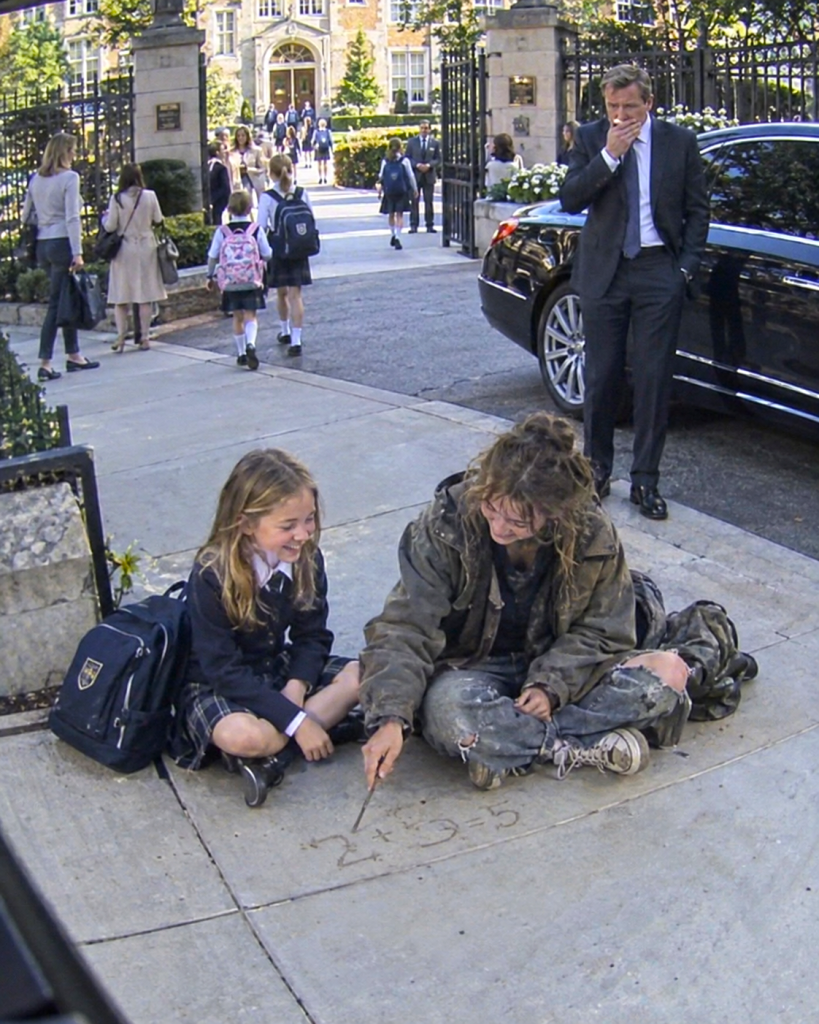
She was sitting on the curb.
And she wasn’t alone.
Beside her sat a teenage girl in oversized, worn clothing. Duct tape covered parts of her old backpack, her sneakers looked several sizes too large, and her thin jacket offered almost no protection from the cold.
I recognized the signs immediately.
She was homeless.
My first instinct was concern, and my hand moved toward the door.
Then I noticed what they were doing.
Sophie had a notebook balanced across her knees while the girl used a small stick to draw numbers and shapes on the pavement.
She was teaching my daughter.
I leaned closer to the window.
The girl pointed at one of the numbers.
“If you move this here, the answer changes. Math is like solving a puzzle. You just have to find the pattern.”
Sophie stared at the pavement.
Then her eyes widened.
“Oh! That’s why I kept getting it wrong!”
She laughed.
Bright.
Unrestrained.
Alive.
Something tightened painfully in my chest.
I hadn’t heard Sophie laugh like that in months.
“Stop the car.”
My driver glanced at me through the mirror.
“Sir?”
“Now.”
The sedan stopped.
I stepped onto the sidewalk without announcing myself, but neither girl noticed me. Sophie was too absorbed in the lesson.
For months, I had hired tutors, counselors, and specialists because Sophie had become painfully quiet after her mother died.
I had spent thousands trying to bring back the little girl who once filled our house with questions and laughter.
Nothing worked.
Yet this stranger with worn sneakers and a stick had done in minutes what money couldn’t.
I moved closer.
The teenager patiently erased a number with her sleeve and drew another problem.
Sophie immediately leaned forward, eager for more.
Then the girl noticed me.
Her smile disappeared.
She quickly stood and grabbed her battered backpack.
Sophie turned around.
“Dad?”
The teenager stepped backward.
“It’s okay,” I said. “I’m Sophie’s father.”
Fear flashed across the girl’s face.
“I wasn’t bothering her.”
“I didn’t say you were.”
She looked toward the street as if preparing to run.
Sophie suddenly grabbed my hand.
“Dad, wait. She helped me with the problem my tutor couldn’t explain.”
I looked from my daughter to the girl.
“What’s your name?”
The teenager hesitated.
Then I noticed something sticking from the torn side pocket of her backpack.
A folded paper.
Across the top was the crest of Sophie’s private school.
And beneath it was a name I recognized.
My stomach dropped.
Because whatever this girl was doing on that sidewalk, she hadn’t arrived there by accident.
PART 2: The homeless girl had a letter from my late wife, and Sophie knew more than I did
There was something in her voice that surprised me. Not defiance exactly. More like she had learned that conversations changed when witnesses disappeared.
I understood.
So I stepped back.
“All right.”
Sophie moved closer to her.
I noticed that too.
The girl took a breath.
“My name is Maya Ruiz.”
“Okay, Maya.”
She watched me carefully.
“You knew Claire Harrison?”
The question hit harder than I expected.
“She was my wife.”
Maya’s expression changed.
Not dramatically.
Her shoulders simply lowered, as if she had been carrying something too long and had finally reached the place where she could put it down.
“Oh.”
She looked at Sophie.
Then back at me.
“I didn’t know.”
“What is the paper?”
Maya slowly pulled it from the backpack.
It wasn’t one page.
There were three folded sheets, softened along the edges from being opened many times.
She handed them to me.
The first was printed on stationery from Sophie’s school.
Northbridge Academy.
At the top was a date from nearly three years earlier.
Beneath it was a recommendation for a student outreach program jointly run by Northbridge and several public schools on Chicago’s West Side.
The student’s name was Maya Elena Ruiz.
And at the bottom, beneath several paragraphs describing Maya as “exceptionally capable,” “quietly persistent,” and “gifted in mathematics,” was a handwritten note.
I recognized Claire’s handwriting before I read a single word.
Daniel never notices handwriting.
That had been one of her favorite accusations.
She used to leave notes in my briefcase.
Remember Sophie’s science fair.
Milk.
Please call your mother.
And once, after I had worked through our anniversary dinner:
You cannot schedule your way out of being human.
I had kept that one.
The handwriting on Maya’s letter was unmistakable.
I read it twice.
Maya deserves a room where people expect something from her.
Not because she needs saving.
Because she has something to give.
—Claire Harrison
I looked up.
“How did you know my wife?”
Maya tucked her hands into the sleeves of her jacket.
“She volunteered.”
“At Northbridge?”
“No. At Franklin Community Center.”
That sounded vaguely familiar.
Claire had volunteered in several places. At least, that was what I had told people at charity dinners when they praised her generosity.
The truth was uglier in a quieter way.
I had rarely asked for details.
“What did she do there?”
“Tutoring. Mostly.”
Maya gave a small shrug.
“She said she was terrible at algebra, so mostly she brought snacks and made everybody explain things to her until we realized we understood them.”
Sophie laughed softly.
“That sounds like Mom.”
I turned toward her.
“You knew about this?”
“No.”
But something in her face made me hesitate.
Not dishonesty.
Recognition.
Maya continued.
“Your wife helped me apply to Northbridge’s Horizon program.”
I knew that name.
Northbridge offered several places each year to high-achieving students from schools with fewer resources. Tuition was covered through donations.
My company had contributed to it.
I had probably approved the contribution in under thirty seconds.
“So you attended Northbridge?”
“For six months.”
“What happened?”
Maya looked toward the school.
“My grandmother got sick. We moved. Then we moved again.”
She said it simply, without inviting pity.
“My mom and I were staying with relatives. After a while there were too many people in one apartment. Then my mom got a job with late shifts, and things got complicated.”
“Are you living on the street?”
Sophie immediately looked at me.
“Dad.”
I heard the judgment in one syllable.
Maya did too.
“It’s okay.”
She adjusted the backpack strap.
“Not exactly. We’re between places.”
That sounded deliberately vague.
I didn’t press her.
Instead I looked again at Claire’s letter.
“If you left Northbridge two years ago, why are you here now?”
Maya stared at the pavement.
For the first time, embarrassment reached her face.
“Because I thought maybe they’d let me come back.”
“Have you spoken to anyone?”
“No.”
“Why?”
A bitter little smile appeared.
“Look at me.”
I did.
And I understood what she meant.
The worn jacket.
The taped backpack.
The shoes.
The certainty that everyone inside those stone buildings would notice those things before noticing her.
Sophie spoke before I could.
“She comes here on Tuesdays.”
My head turned.
“What?”
Sophie’s eyes widened.
Maya closed hers briefly.
“Sophie.”
“You said I shouldn’t lie.”
“I didn’t say tell everything in thirty seconds.”
I stared at my daughter.
“How long have you known Maya?”
Sophie studied her shoes.
“Three weeks.”
Three weeks.
I felt an immediate surge of alarm.
Not anger.
Something more uncomfortable.
The realization that my eight-year-old daughter had an entire corner of her life I knew nothing about.
“How?”
“She was sitting near the library entrance.”
Maya quickly added, “I never approached her.”
“I approached her,” Sophie said.
That sounded exactly like the daughter I remembered from before Claire died.
Curious.
Fearless.
Forever asking strangers what they were reading and dogs what their names were.
“She had a calculus book,” Sophie continued.
I looked at Maya.
“Calculus?”
“Library copy.”
“She was doing problems, so I asked if she could help with fractions.”
Maya almost smiled.
“She asked why anyone needed fractions if calculators existed.”
“I still think that’s a reasonable question.”
Despite myself, I nearly smiled too.
Then I remembered something.
“Sophie, Tuesdays are piano.”
Her expression fell.
“I know.”
“Your driver takes you straight home.”
Silence.
I looked at the school entrance.
Then at Sophie.
“How are you meeting Maya?”
“Our teacher lets us wait in the supervised courtyard after clubs.”
“That doesn’t answer my question.”
Sophie swallowed.
“I stopped going to piano.”
I stared at her.
“For three weeks?”
She nodded.
“And no one told me?”
“I told Ms. Bennett I didn’t want lessons anymore.”
“And the driver?”
“He thinks piano is at school now.”
I closed my eyes for a second.
It was an impressively organized deception for an eight-year-old.
Then I realized what bothered me more.
She had needed to organize it because she expected that simply telling me what she wanted would change nothing.
“Why didn’t you tell me?”
Her answer came quietly.
“Because you would’ve said no before I finished.”
That landed harder than anything else had that afternoon.
Maya looked away, giving us privacy without leaving.
I crouched so Sophie and I were eye level.
“Maybe I would have.”
“You always do.”
“That isn’t fair.”
She looked at me.
And I knew immediately that it was.
Not always.
But often enough.
Piano had been Claire’s idea.
After Claire died, I had kept Sophie in piano because changing anything felt like losing another piece of her.
Same school.
Same bedroom.
Same Saturday pancakes prepared by a chef because I couldn’t make Claire’s.
Same piano lessons.
Same summer house.
I had called it stability.
Perhaps Sophie had experienced it as a museum.
“I don’t like piano anymore,” she said.
“Why?”
“Because Mom used to sit beside me.”
Her voice stayed steady.
That made it worse.
“When I play, I remember the empty chair.”
There was no accusation.
Only truth.
I glanced toward my sedan.
My driver, Thomas, had politely moved several yards away.
The city moved around us.
I realized how absurd we must have looked: an investor in a tailored coat crouching on a sidewalk while his daughter explained something he had paid professionals to discover.
“What do you want to do instead?” I asked.
Sophie hesitated as though the question might be a trick.
“Math club.”
Maya covered a smile with her sleeve.
“Math club?”
“There’s a robotics team too.”
“You told me robots were creepy.”
“Those were vacuum robots. Different category.”
I laughed.
A small sound.
Unfamiliar.
Sophie stared at me.
Then smiled.
And for one strange second, I could almost feel Claire standing somewhere behind us, enjoying the fact that both of us were finally being ridiculous.
I stood.
“Maya, I’d like to help you speak to the school.”
Her expression shut down immediately.
“I’m not asking for charity.”
“I didn’t offer charity.”
“You were about to.”
I started to object.
Then stopped.
She was right.
That had been exactly what I was about to do.
Write a check.
Call the headmaster.
Solve.
Claire had understood something I apparently still didn’t.
Maya deserves a room where people expect something from her.
Not because she needs saving.
Because she has something to give.
“What do you want?” I asked.
Maya seemed surprised.
“To finish school.”
“Here?”
“If I earned it.”
“You already earned a place once.”
“That was before.”
“Before what?”
Her jaw tightened.
“Before I missed a year.”
I looked at her.
“You haven’t been enrolled?”
“Not consistently.”
She explained that moving between temporary housing situations had meant changing districts twice. Records had been delayed. Transportation became difficult. Her mother worked unpredictable hours. Maya had kept studying through library books and free online courses, but official school attendance had become fragmented.
No disaster.
No single dramatic event.
Just small problems accumulating until a bright teenager could disappear between forms, addresses, and requirements.
“Where is your mother?” I asked.
“At work.”
“Does she know you’re here?”
Maya hesitated.
“She knows I’m trying to fix school.”
“That isn’t what I asked.”
“No.”
At least she was honest.
I handed back the papers.
“Then the first thing we do is speak with her.”
Maya shook her head.
“She won’t accept money.”
“I’m beginning to understand that nobody in your family likes my preferred solution.”
Sophie giggled.
Maya’s mouth twitched.
“My mom works hard.”
“I believe you.”
“She doesn’t want people thinking she can’t take care of me.”
“I didn’t say that.”
“But people think it.”
Her voice remained calm.
“She’s trying to get us into an apartment. We’re staying at a women’s transitional residence right now. It’s safe. We have a room. I’m not sleeping outside.”
Relief surprised me.
Maybe she noticed.
“I said I was between places.”
“You did.”
“The jacket is from a donation bin. The shoes too.”
She looked down.
“That doesn’t automatically mean I’m in danger.”
There was another lesson in that sentence.
One I suspected Claire would have enjoyed watching me learn.
“Then I apologize for assuming.”
Maya blinked.
Perhaps adults with expensive coats did not apologize to her often.
Sophie slipped her hand into mine.
“Can Maya come home for dinner?”
Both Maya and I answered simultaneously.
“No.”
Sophie sighed.
“You two are actually very similar.”
That time Maya laughed.
It was quieter than Sophie’s.
But it changed her whole face.
I asked Thomas to drive us to the transitional residence where Maya’s mother was staying.
Maya refused at first.
Then Chicago wind swept down the street hard enough to make Sophie’s scarf fly sideways.
“Fine,” Maya muttered. “But only because your car has heat.”
The residence was in a converted brick building near a church community complex.
Clean.
Modest.
Busy.
A woman at the desk knew Maya immediately and greeted her warmly.
That reassured me more than anything Maya had said.
We waited in a small sitting room while Maya called her mother.
Sophie discovered a shelf of board games.
Thirty minutes later, Elena Ruiz arrived wearing navy work trousers and the exhausted expression of someone who had ended a shift early and feared the reason.
She was younger than I expected.
Maybe thirty-seven.
Her eyes went immediately to Maya.
“Are you okay?”
“I’m fine.”
Then Elena saw me.
Her face changed.
“You’re Daniel Harrison.”
I stood.
“Yes.”
She looked at Sophie.
Then at the papers in Maya’s hand.
And something like recognition passed through her expression.
Not surprise.
Recognition.
“You know who I am?” I asked.
Elena was silent.
Maya looked between us.
“Mom?”
Elena sat slowly.
“I knew your wife.”
Again.
Those words.
I felt the floor shift beneath a life I had believed I understood completely.
“How?”
Elena looked at Claire’s folded letter.
“She helped Maya.”
“I know that part.”
“No.”
Elena raised her eyes to mine.
“I mean after she got sick.”
My chest tightened.
Claire’s illness had lasted eight months.
Eight months of specialists, appointments, private rooms, hopeful percentages that became smaller percentages.
I knew every detail of those months.
Or I had thought I did.
“She continued seeing Maya?”
“Until about three weeks before she died.”
I sat down.
Sophie had stopped looking at the board games.
“What did Mom do?” she whispered.
Elena turned toward her.
Her expression softened.
“She talked about you all the time.”
Sophie froze.
“Really?”
“Constantly.”
“What did she say?”
“That you asked too many questions.”
Sophie smiled.
“She said that too.”
“And that you were brave enough to ask questions adults were embarrassed to ask.”
Sophie moved closer.
Elena looked back at me.
“Claire knew she might not have much time. She was worried Maya would lose the Northbridge opportunity.”
“So she arranged the letter.”
“Yes.”
“Was there more?”
Elena hesitated.
That hesitation told me everything.
“What else did she arrange?”
“I don’t know if she ever completed it.”
“Completed what?”
Elena looked toward Maya.
Maya appeared equally confused.
“Claire said she was setting up something that couldn’t disappear if she did.”
My pulse quickened.
“What?”
“A scholarship fund.”
I stared at her.
“That’s impossible.”
I managed our finances.
Our estate.
Our charitable giving.
There was no fund I didn’t know about.
Elena shook her head.
“She said it wasn’t only for Maya. She wanted a program for students who fell out of private-school scholarship systems because their families lost housing or changed districts.”
“That program doesn’t exist.”
“I know.”
“Then why are you telling me this?”
“Because Claire gave me a name.”
“What name?”
Elena looked toward the window.
“Arthur Bell.”
I knew him.
Arthur Bell had been Claire’s attorney before our marriage.
Afterward, most of our legal work moved to my firm.
I hadn’t spoken to him since Claire’s funeral.
Elena continued.
“She told me if the program ever disappeared, I should contact him.”
“Did you?”
“Six months ago.”
“And?”
“He said he couldn’t discuss anything without you.”
I stood before realizing I had done it.
Sophie looked worried.
I forced myself to sit again.
“Why didn’t he call me?”
Elena shook her head.
“I don’t know.”
Neither did I.
But for the first time since seeing Maya beside Sophie, I understood something.
The mystery wasn’t why Maya had returned to Northbridge.
The real mystery was why Claire had spent the final months of her life building something I had never heard about.
That evening, after Sophie was asleep, I went into the study I had barely changed since Claire died.
I found Arthur Bell’s number.
He answered on the fourth ring.
“Daniel?”
“You know why I’m calling.”
There was a long silence.
Then Arthur exhaled.
“I wondered when this day would come.”
“Did Claire create a scholarship fund?”
Another silence.
“Not exactly.”
“What does that mean?”
“It means your wife left instructions.”
“For money?”
“For you.”
My hand tightened around the phone.
“What instructions?”
Arthur spoke carefully.
“Claire made me promise I wouldn’t give them to you until a specific condition was met.”
My irritation rose.
“What condition?”
“That you asked about Maya Ruiz.”
The room went completely still.
Arthur continued.
“She believed that if you ever asked about Maya on your own, it would mean something in your life had changed enough for you to understand what she was trying to tell you.”
I looked toward the family photograph on my desk.
Claire.
Sophie.
Me.
Taken during a summer when I had still believed time was something wealthy people could purchase in larger quantities.
“What did she leave?”
Arthur’s voice softened.
“A sealed envelope.”
“Where?”
“In my office.”
I looked at the clock.
Nearly ten.
“Can I come tomorrow?”
“Yes.”
I started to hang up.
Then Arthur said my name.
“Daniel.”
“What?”
“There’s something else.”
I waited.
“The envelope isn’t addressed to you alone.”
A strange uneasiness moved through me.
“Who else?”
“To you and Sophie.”
I looked toward the staircase.
My eight-year-old daughter was asleep upstairs, perhaps dreaming of fractions, robots, or a mother whose quiet work had somehow reached forward through two lost years.
“What does it say?” I asked.
“I don’t know. Claire sealed it herself.”
I stared again at the photograph.
For two years, I had believed grief meant protecting the life Claire left behind.
Keeping everything where she had placed it.
Preserving every routine.
Changing nothing.
But somewhere beyond my carefully controlled house, a girl named Maya had been carrying Claire’s handwriting in a torn backpack.
And inside an attorney’s office downtown, another message had been waiting for the moment my daughter finally taught me to ask the right question.
PART 3: Sophie insisted on coming with me to Arthur Bell’s office.
Normally, I would have said no immediately.
It was a school day.
She had assignments.
I had meetings.
There were rules.
Instead, I looked across the breakfast table and asked, “Why do you want to come?”
She seemed suspicious of the question.
“Because Mom wrote it to both of us.”
Reasonable.
I canceled my morning meetings.
Sophie missed three hours of school.
Nothing collapsed.
That discovery alone felt revolutionary.
Arthur’s office occupied the fourth floor of an old building overlooking the river.
He had white hair now, though I remembered it as gray. He greeted Sophie first.
“You look like your mother.”
People said that constantly.
Usually Sophie lowered her eyes.
This time she asked, “Which part?”
Arthur smiled.
“The part that makes people answer questions they were hoping to avoid.”
Sophie considered this.
“Dad says that’s my most exhausting quality.”
“I said persistent.”
“You meant exhausting.”
Arthur laughed and looked at me.
“Yes. Definitely Claire’s daughter.”
He led us into a conference room.
On the table sat a cream-colored envelope.
Claire’s handwriting crossed the front.
For Daniel and Sophie.
Only when Daniel asks about Maya.
My daughter touched the edge of the envelope but didn’t open it.
“Why Maya?”
Arthur folded his hands.
“Your mother believed your father was a good man.”
I raised an eyebrow.
“That sounds like a dangerous beginning.”
“She also believed you solved every problem like a businessman.”
“That sounds more accurate.”
Arthur looked at Sophie.
“Your mother worried that after she died, your father might try to organize grief instead of living through it.”
Sophie looked slowly at me.
I shifted in my chair.
“Apparently your mother discussed me with everybody.”
“She discussed you with affection,” Arthur said.
“That makes it only slightly less concerning.”
Sophie smiled.
Arthur nodded toward the envelope.
“She wanted Daniel to discover Maya without being directed toward her.”
“How could she know that would happen?” I asked.
“She didn’t.”
That surprised me.
“She had no idea whether you would ever ask about Maya. She told me that if you didn’t, I should eventually destroy the envelope.”
Sophie’s eyes widened.
“Destroy it?”
“On your eighteenth birthday.”
She stared at him.
“That’s ten years away.”
“Your mother was patient.”
I remembered that differently.
Claire once returned a toaster because it required four minutes to make toast.
But in matters that mattered, perhaps Arthur was right.
Sophie looked at me.
“Open it.”
I slid one finger beneath the seal.
Inside were two letters.
One addressed to Sophie.
One to me.
There was also a small flash drive.
Arthur stood.
“I’ll give you privacy.”
When he left, neither Sophie nor I moved.
Finally she said, “Can I read mine first?”
“Yes.”
She unfolded the page.
Claire had written in blue ink.
Sophie read silently for several seconds.
Then smiled.
Then frowned.
Then smiled again.
I tried not to watch.
It was difficult.
Eventually she lowered the paper.
“She says you’re going to pretend you aren’t reading my face.”
“I’m not pretending anything.”
“She says you will.”
I sighed.
“What else?”
“That’s private.”
“Of course.”
She folded the letter carefully.
Then looked at mine.
“You should read yours.”
Claire’s letter began without ceremony.
Daniel,
If you are reading this, you asked about Maya.
That means either an extraordinary coincidence occurred, or Sophie did something you did not schedule.
I stopped.
Sophie leaned toward me.
“What?”
“Nothing.”
“Mom made fun of you, didn’t she?”
“Yes.”
She looked pleased.
I kept reading.
Claire wrote that during the final year before her diagnosis, she had become involved with Franklin Community Center.
There she met Maya, then thirteen.
Maya was brilliant at mathematics but had started missing enrichment programs because her family had moved twice.
Claire helped her apply to Northbridge.
But the experience showed Claire something she had never considered.
Scholarships often paid tuition.
They did not always solve transportation.
Uniforms.
Activity fees.
Technology.
Changes of address.
Temporary housing.
The hundred small obstacles that could turn an opportunity into something impossible to hold.
Claire had wanted to establish what she called a Continuity Fund.
Not a scholarship.
A support structure.
Something designed to help already-admitted students remain in programs when ordinary family instability interrupted their education.
Then she became ill.
Her letter continued.
I could have finished this without you.
I had enough personal assets.
Arthur could have established a small fund.
But I decided not to.
That sentence annoyed me instantly.
Even dead, Claire had a talent for making me argue with paper.
She explained why.
Because the fund was not really the unfinished thing.
You are.
I stopped reading.
Sophie watched me.
“Bad?”
“No.”
“Sad?”
I considered.
“Accurate.”
I continued.
Claire wrote that she had spent years watching me turn love into provision.
A better home.
A better school.
Better vacations.
Better doctors.
A larger college account.
Everything measurable.
Everything secure.
You love by building walls against uncertainty, she wrote.
I love that about you.
But Sophie cannot live inside a wall.
She needs a father who sometimes sits on the floor.
I stared at the sentence until the words blurred slightly.
There was no accusation in it.
That somehow made it harder.
Near the end, Claire explained the condition involving Maya.
If I ever encountered Maya naturally, asked who she was, listened long enough to discover the problem, and contacted Arthur myself, then Claire wanted me to decide whether the Continuity Fund should exist.
Not because she had ordered it.
Because I had finally seen the need.
The final paragraph was shorter.
If Sophie is beside you, ask her what she wants.
Not what I wanted for her.
Not what you planned.
What she wants.
She is going to become someone neither of us gets to design.
Please let her.
I lowered the letter.
Outside the window, morning traffic moved beside the river.
Sophie sat quietly.
“What do you want?” I asked.
She blinked.
“Right now?”
“Yes.”
“A cinnamon roll.”
I stared.
She laughed.
“You asked.”
“Your mother would be proud.”
“I know.”
After a moment she became serious.
“I want to stop piano.”
“Okay.”
“I want robotics.”
“Okay.”
“I want to keep seeing Dr. Patel, but not every week.”
I paused.
Dr. Patel was her grief counselor.
“Why?”
“Because sometimes I don’t have anything to say, and then I feel like I’m failing therapy.”
“You can’t fail therapy.”
“That’s what she says.”
“Then maybe every other week.”
Sophie nodded.
“And I want you to pick me up sometimes.”
That one caught me off guard.
“I do.”
“You send Thomas.”
“Thomas is my driver.”
“He’s nice.”
“He is.”
“But he isn’t you.”
There it was.
A sentence so simple no consultant could improve it.
“How often?”
She shrugged.
“Sometimes.”
“I can do sometimes.”
“And I want Maya to go back to school.”
I smiled faintly.
“That part isn’t our decision.”
“Can we help?”
“Yes.”
“How?”
That was the question Claire had apparently spent years trying to teach me to ask.
“First we listen.”
That afternoon, we met Maya and Elena at Northbridge.
Not in the headmaster’s ceremonial office.
At Maya’s request, we met with Ms. Aisha Bennett, the school’s student support coordinator.
I knew her name because Sophie had mentioned her repeatedly.
I had never met her.
That fact embarrassed me.
Ms. Bennett was in her early forties, calm, observant, and unimpressed by expensive suits.
She greeted Maya warmly.
“I remember you.”
Maya looked startled.
“You do?”
“You corrected a geometry answer key in front of Mr. Collins.”
Maya looked uncomfortable.
“It was wrong.”
“It was extremely wrong.”
Sophie whispered, “I knew I liked her.”
Ms. Bennett reviewed Maya’s records.
There were problems.
Credits missing.
Attendance gaps.
Residency documentation.
But there were also solutions.
Northbridge could not simply restore Maya’s former place.
However, she could sit for placement examinations.
Several credits might be recovered through testing.
A partner public school could provide interim enrollment while the Horizon committee reviewed her case.
Transportation assistance was available through an existing city program nobody had told Elena about.
Every obstacle that had looked like a wall became, under patient examination, a series of doors.
Not easy doors.
But doors.
Elena sat with a folder open on her lap.
“What will this cost?”
“Nothing for the placement tests,” Ms. Bennett said.
“And if she returns?”
“If the Horizon committee approves reinstatement, tuition is covered.”
“What about books?”
Ms. Bennett hesitated.
That hesitation told me Claire had been right.
“Some materials are covered.”
“Some?”
“There can be additional costs.”
Elena looked at me immediately.
I said nothing.
She seemed surprised.
Ms. Bennett continued explaining.
When the meeting ended, Maya had three forms, two appointment dates, and a reading list.
Outside, she looked at me.
“You didn’t say anything.”
“You asked me not to solve it for you.”
“I didn’t think you’d actually listen.”
“I’m experimenting.”
Sophie grabbed Maya’s sleeve.
“He listened to me twice today.”
“A historic week.”
Elena smiled.
For the first time, I saw where Maya got hers.
Then Elena became serious.
“Mr. Harrison, can I speak to you?”
We stepped several feet away.
She looked through the glass doors at Maya and Sophie.
“They’re getting attached.”
“I know.”
“Maya hasn’t had many things stay.”
I understood the warning.
“You think Sophie might disappear from her life.”
“I think families like yours move differently from families like ours.”
There was no resentment in her tone.
Only caution.
“You can change schools. Travel. Move houses. Hire someone. Stop coming to a community center.”
She looked directly at me.
“Maya remembers people who stop coming.”
Claire.
The name hung between us without being spoken.
“My wife didn’t choose to stop.”
“I know.”
“But it still hurt Maya.”
“Yes.”
I absorbed that.
Grief had made me selfish in ways I had never recognized.
I thought Claire’s death belonged most deeply to Sophie and me.
But perhaps loss was never organized so neatly.
Claire had occupied dozens of lives.
Some briefly.
Some quietly.
All of them had lost someone too.
“I won’t promise something I can’t guarantee,” I said.
Elena nodded.
“That’s all I wanted.”
Over the next month, our lives changed in small ways.
Sophie joined robotics.
She was terrible at building.
Excellent at arguing about design.
Her team created a machine intended to move plastic blocks across a table.
On its first test, it spun in a circle for forty-three seconds and drove directly into a chair.
Sophie declared it “an important data-gathering phase.”
I picked her up myself every Thursday.
The first time, she climbed into the car and asked, “Do you have a meeting?”
“No.”
“Did somebody cancel?”
“No.”
She stared at me.
“You came because you wanted to?”
“Yes.”
She looked out the window so I wouldn’t see her smile.
I saw it anyway.
Maya studied.
Constantly.
At the library.
At the community center.
Sometimes in Northbridge’s supervised study room with permission from Ms. Bennett.
Sophie occasionally sat nearby doing third-grade homework and asking questions no teenager should be forced to answer.
“Why is zero times anything zero?”
“Because multiplication is repeated addition.”
“But what if zero is lonely?”
“Sophie.”
“What?”
“Numbers don’t have feelings.”
“That seems like an assumption.”
Maya passed her mathematics placement exam at the highest level available.
English was more difficult.
Not because she lacked ability, but because her interrupted attendance had left gaps in assigned literature.
She passed that too.
History came next.
Then science.
Each result brought her closer.
Meanwhile, Arthur and I began examining Claire’s Continuity Fund proposal.
She had done more work than I realized.
There were notes.
Draft budgets.
Meetings with administrators.
Research on why students withdrew from scholarship programs.
She had even outlined a pilot structure.
All unfinished.
But thoughtful.
One evening I sat at the kitchen table reading Claire’s notes while Sophie ate cereal for dinner.
Our chef had gone home.
I had forgotten to arrange anything.
A year earlier, that would have felt like failure.
Sophie called it “breakfast night” and asked if we could do it again.
I found one note from Claire written across a printed spreadsheet.
Daniel will hate this budget.
She had circled a transportation estimate.
Beside it:
Which probably means I’m right.
I laughed aloud.
Sophie looked over.
“Mom again?”
“Your mother had very little respect for my financial judgment.”
“Wasn’t that your job?”
“Exactly.”
Then I turned the page.
A name appeared in Claire’s handwriting.
Elaine Porter.
Northbridge Academy.
Beside it was a question mark.
I knew Elaine Porter.
She was now chair of Northbridge’s board.
I had seen her at fundraisers.
She had personally thanked me for several donations.
Claire’s note read:
E.P. concerned Continuity Fund could “encourage unsuitable family dependence.”
Need another route.
I stared at the sentence.
It was dated three months before Claire died.
I read the surrounding notes.
Claire had apparently proposed the fund informally to Northbridge.
Someone had rejected it before it reached the full board.
I called Arthur.
“Did Claire ever tell you why Northbridge didn’t create the program?”
“She said there was resistance.”
“From Elaine Porter?”
A pause.
“I believe so.”
“Why?”
“You should ask her.”
I disliked that answer.
But Claire had built this entire mystery around making me ask people questions, so perhaps I should have expected it.
Two days later, I requested a meeting with Elaine.
She welcomed me into her office with practiced warmth.
“Daniel. Always good to see you.”
I placed a copy of Claire’s notes on the table.
Her expression changed.
Only slightly.
But enough.
“You remember this.”
Elaine looked at the page.
“Yes.”
“Why was it rejected?”
She leaned back.
“It wasn’t rejected.”
“Claire believed it was.”
“It never became a formal proposal.”
“Why?”
Elaine was quiet.
Then she stood and closed the office door.
“I made a mistake.”
That was not what I expected.
She returned to her chair.
“At the time, the school was struggling with several scholarship initiatives. Donations were down. Families were complaining about rising fees. Claire proposed support for transportation, temporary housing transitions, counseling, technology, uniforms.”
“All things students needed.”
“I know that now.”
“But you didn’t then?”
Elaine’s face tightened.
“I thought the school’s responsibility ended with education.”
“And now?”
“Now I think education becomes meaningless if the student cannot reliably reach it.”
I studied her.
“What changed?”
“Maya left.”
The answer surprised me.
Elaine looked toward the window.
“She wasn’t the only one. Two other Horizon students withdrew that year. Neither lacked academic ability.”
“Then why didn’t you restart Claire’s proposal?”
“Because Claire died.”
“That doesn’t answer the question.”
Elaine looked at me.
“No. It doesn’t.”
She opened a drawer.
“I tried later.”
She placed a folder on the desk.
Inside were budget requests.
Emails.
Meeting notes.
Rejected grant applications.
For nearly eighteen months, Elaine had quietly attempted to reconstruct parts of Claire’s idea.
“I didn’t know enough,” she said. “Claire understood community organizations. I understood boards.”
“Why didn’t you contact me?”
“I thought you wanted nothing connected to her final months.”
My reaction must have shown.
Elaine continued gently.
“You stopped attending every event she had supported. Franklin. Literacy Chicago. The family housing fundraiser.”
I had.
I had told myself I was too busy.
The truth was simpler.
Those places contained people who knew versions of Claire I could no longer bear to encounter.
“I assumed you wanted distance.”
“I did.”
“And I respected it.”
That word hurt.
Respected.
Sometimes people allowed us to disappear because they thought disappearance was what we had chosen.
I looked again at the folder.
Then I noticed a recent email clipped to the back.
The date was only two weeks earlier.
Subject: HORIZON REINSTATEMENT REVIEW — MAYA RUIZ.
I looked up sharply.
“You knew Maya had applied?”
“Yes.”
“Why didn’t you tell me?”
“Because it isn’t your application.”
Again, I found myself corrected.
Elaine folded her hands.
“There’s something else you should know.”
I waited.
“The committee meets Friday.”
“To decide Maya’s reinstatement?”
“Yes.”
“And?”
Elaine hesitated.
“The academic review is excellent.”
“But?”
“Another requirement may prevent her return.”
“What requirement?”
Elaine slid a document toward me.
Northbridge required every Horizon student to have a designated local educational sponsor.
Not a financial sponsor.
An adult responsible for continuity meetings, emergency academic planning, and school communication if housing or work instability temporarily made a parent unavailable.
Maya’s previous sponsor had been Claire.
I stared at the page.
“Can Elena serve?”
“She already is her parent. The program requires someone additional.”
“Why?”
“Because it was created for families facing unstable schedules or housing changes.”
“Can Ms. Bennett?”
“School employees cannot.”
I understood before Elaine said anything else.
“Maya needs someone.”
“Yes.”
“Does she know?”
“Not yet.”
“Does Elena?”
“The committee planned to discuss it with them Friday.”
I looked through the glass wall into the school courtyard.
Students crossed between buildings carrying backpacks.
Among them I spotted Sophie beside Maya, walking toward the library.
Sophie was talking with both hands.
Maya was laughing.
Claire’s letter returned to me.
Do not save people.
Stay.
I had thought the Continuity Fund was the decision Claire had left me.
Suddenly I wondered whether I had misunderstood.
Perhaps the real question was smaller.
Harder.
More personal.
Money required almost nothing from me.
A signature.
A transfer.
A meeting.
But becoming someone Maya could list on a school form meant making a promise to a teenager whose life had already taught her not to trust promises easily.
And before I could decide whether I was capable of making it, Maya looked through the courtyard window and saw me holding the sponsor form.
Her smile disappeared.
She understood immediately.
And from the expression on her face, I knew she had already decided what her answer would be.
PART 4 – ENDING: Maya waited until Sophie went into robotics practice before approaching me.
“You don’t have to do that.”
We were standing in the Northbridge corridor outside the library.
Students passed around us.
I folded the sponsor form.
“I haven’t offered.”
“You were going to.”
“Apparently everyone can predict me now.”
“I’ve had practice.”
She shifted her backpack higher.
The duct tape had been replaced.
Not by a new backpack.
Maya had repaired the old one carefully with black fabric tape from the community center.
For some reason, I liked that.
“Why don’t you want me to?” I asked.
She looked toward the library doors.
“Because Sophie likes me.”
“I’m aware.”
“And you’re doing all this because of her.”
“Partly.”
“And because of your wife.”
“Partly.”
“So if I say yes, I’m basically becoming some family project.”
There was no hostility in her voice.
Only fear dressed as logic.
“No.”
“You’re starting a fund.”
“We’re considering starting a fund.”
“You’re meeting with the board.”
“Yes.”
“You’re paying lawyers.”
“Arthur would be deeply offended if he heard you suggest I pay him promptly.”
Maya almost smiled.
I continued.
“The fund has nothing to do with whether I become your educational sponsor.”
“It obviously does.”
“No.”
She folded her arms.
“Then why you?”
Fair question.
I looked through the nearby window.
Across the courtyard, Sophie’s robotics team was gathering around a table.
I could see her arguing enthusiastically with another child while Ms. Bennett attempted to redirect them toward the robot.
“Because I know what it’s like to believe stability means nothing changing.”
Maya said nothing.
“I spent two years keeping my house exactly the same because I thought change meant losing Claire again.”
“That’s different.”
“Of course it is.”
I looked back at her.
“But I think I understand a little about wanting something permanent so badly that you stop trusting temporary things.”
Her expression softened.
Only slightly.
“You could change your mind.”
“Yes.”
That answer surprised her.
I could have promised I never would.
Once, I probably would have.
Instead I said, “People can always change their minds.”
“That isn’t comforting.”
“No.”
“But I can tell you what I’m choosing now.”
She waited.
“I’m choosing to be available.”
“For school meetings?”
“For school meetings.”
“Emergency calls?”
“Yes.”
“Teacher conferences?”
“Yes.”
“What if I fail something?”
“I own businesses. I’m familiar with disappointing quarterly results.”
“That is the most businessman answer possible.”
“I’m working on it.”
She looked down.
“What if I get accepted somewhere else later?”
“Then you go.”
“What if I don’t want Northbridge?”
“Then you don’t stay.”
“What if my mom doesn’t agree with you about something?”
“Based on my experience with your mother, I assume she’ll tell me.”
That finally earned a real smile.
Then Maya became serious again.
“I don’t want Sophie thinking I’m replacing anyone.”
I understood immediately.
Claire.
“You aren’t.”
“And I don’t want her thinking I’m her sister.”
“All right.”
“She told somebody in math club I was practically her sister.”
I closed my eyes.
“I’ll speak to her.”
“She also told them I’m a genius.”
“Less concerning.”
“It’s inaccurate.”
“You scored ninety-eight on the advanced placement exam.”
“I missed two points.”
“You may need professional help.”
She laughed.
It was the first time we spoke without Claire’s ghost standing entirely between us.
Not absent.
Just no longer directing every sentence.
That evening, Elena joined us at our house.
It was the first time she and Maya had visited.
Sophie tried to give an official tour.
“This is the kitchen. Dad knows where almost nothing is.”
“I know where things are.”
She opened a drawer.
“Where are the spoons?”
I pointed confidently.
She opened it.
Dish towels.
Maya laughed.
Elena tried not to.
Our house, which had seemed painfully quiet for two years, suddenly contained overlapping voices.
Sophie asked Maya to see her room.
Maya looked at Elena.
“Door stays open,” Elena said.
“Mom.”
“Door.”
“Fine.”
They disappeared upstairs.
Elena and I remained in the kitchen.
“I heard about the sponsor requirement,” she said.
“I was going to call you.”
“I know.”
“How?”
“Maya called me immediately.”
I nodded.
“You should decide.”
“We should decide.”
“She’s your daughter.”
“And you’d be taking responsibility.”
I appreciated the distinction.
We sat at the kitchen island.
Elena looked around.
There were still photographs of Claire everywhere.
I had stopped seeing how many.
“You loved her a lot.”
“Yes.”
“She talked about you.”
“So I’ve discovered.”
Elena smiled.
“She worried about you.”
“That too.”
“Not because she thought you were cold.”
I looked at her.
“People probably think that.”
“Some.”
“I am sitting here.”
“You asked.”
Fair.
Elena continued.
“Claire said you felt responsible for everything.”
“That sounds more accurate.”
“She said if the weather changed during a vacation, you acted personally betrayed.”
“That happened once.”
“She said three times.”
“I object to the credibility of a witness who isn’t available for cross-examination.”
Elena laughed.
Then her expression softened.
“She thought you’d be lost without her.”
I stared at the countertop.
“She was right.”
“But she also thought Sophie would pull you back.”
Upstairs, we heard Sophie shout, “That is not cheating!”
Maya shouted back, “You changed the rules!”
Elena smiled.
“Seems like she had help.”
I looked toward the ceiling.
“Yes.”
Then I showed Elena the sponsor form.
“I won’t sign unless you want me to.”
She read it carefully.
“This doesn’t give you authority over medical decisions?”
“No.”
“Or where Maya lives?”
“No.”
“It’s school continuity only?”
“Yes.”
“And either of us can end it?”
“Yes.”
She turned the page.
“What does Maya want?”
“She’s considering it.”
“Then we wait.”
That sentence was unusually difficult for me.
But I did.
Friday morning, the Horizon committee met.
I was not present.
Neither was Elena.
Maya asked to speak for herself.
She entered the room with Ms. Bennett and her repaired backpack.
For forty minutes, I sat in a coffee shop across the street with Sophie.
I checked my watch twelve times.
“Dad.”
“What?”
“You’re doing the thing.”
“What thing?”
“The control thing.”
“I’m checking the time.”
“You checked it thirty seconds ago.”
“I doubt that.”
She started counting.
At forty-three seconds, my hand moved instinctively toward my watch.
Sophie pointed.
“See?”
I put both hands flat on the table.
“This is intolerable.”
She drank her hot chocolate.
“You need a hobby.”
“I have hobbies.”
“Name one.”
I thought.
“Work.”
“That’s not a hobby.”
“Reading financial reports.”
“That is worse than work.”
“Golf.”
“You hate golf.”
“I own golf clubs.”
“That isn’t the same.”
She had me there.
At 10:17, my phone rang.
Maya.
I answered.
“Well?”
“You’re not supposed to sound more nervous than me.”
“I’m not nervous.”
Sophie leaned toward the phone.
“He’s very nervous!”
“Sophie.”
Maya laughed.
Then silence.
A long silence.
My chest tightened.
“Maya?”
“I got in.”
I stood.
Sophie jumped up.
“You got in?”
People looked at us.
For perhaps the first time in my adult life, I did not care.
Maya was laughing on the phone.
“Yes.”
“When do you start?”
“Monday.”
Sophie hugged me around the waist.
I heard another voice near Maya.
Elena.
Crying a little.
Laughing too.
Then Maya said, “There’s something else.”
My old instinct returned instantly.
“What happened?”
“Nothing bad.”
I exhaled.
“The committee approved the sponsor form.”
“You signed it?”
“Mom signed her section.”
“And you?”
“I told them I wanted to.”
Something inside me loosened.
Not triumph.
Not the satisfaction of solving a problem.
Something quieter.
Trust offered carefully.
I knew enough now not to treat it casually.
“I’ll sign this afternoon.”
“Okay.”
“Maya?”
“Yeah?”
“Congratulations.”
A pause.
“Thanks, Mr. Harrison.”
Sophie shouted toward the phone.
“Tell her she has to call you Daniel now!”
“No, she does not.”
“Yes, she does!”
Maya laughed again.
“See you Monday.”
The line ended.
Sophie looked up at me.
“Can we celebrate?”
“I have a meeting at noon.”
Her face fell.
I pulled out my phone.
Then stopped.
“What kind of celebration?”
Her eyes brightened.
“Pizza.”
“Reasonable.”
“And cake.”
“Less reasonable.”
“And Maya and Elena.”
“Obviously.”
“And Thomas.”
I smiled.
“Definitely Thomas.”
“And Dr. Patel.”
I stared at her.
“Your therapist?”
“She likes cake.”
“Does everyone you know need to attend?”
Sophie thought.
“Ms. Bennett.”
I canceled my noon meeting.
That evening, seven people sat around our dining table eating pizza from cardboard boxes.
Our formal dining room had hosted executives, politicians, foundation directors, and investors.
It had never felt as important as it did with tomato sauce on the linen napkins.
Thomas told Sophie embarrassing stories about my inability to use the navigation system in my own car.
Ms. Bennett and Elena discussed transportation schedules.
Maya pretended not to be nervous about Monday.
Dr. Patel arrived with a small plant as a gift.
“For new beginnings,” she said.
Sophie examined it.
“What kind?”
“A pothos.”
“Does Dad have to remember to water it?”
Everyone shouted, “No.”
Even me.
Later, after everyone left, Sophie found me gathering plates.
“You’re cleaning.”
“I am capable of basic domestic tasks.”
“You put a fork in the trash.”
I looked down.
I had.
She rescued it.
“Mom would be shocked.”
“Your mother had very limited confidence in me.”
Sophie leaned against the table.
“Can I show you my letter now?”
Claire’s letter.
I stopped.
“Only if you want to.”
She took it from her pocket.
The paper had already been folded and unfolded enough to soften the creases.
“She wrote that I shouldn’t spend my life trying to make you happy.”
I smiled faintly.
“That sounds like Claire.”
“She said you’d probably spend enough time trying to make me happy for both of us.”
“That also sounds like Claire.”
“She said neither one works.”
I waited.
Sophie read the line aloud.
“Love isn’t making somebody happy all the time. It’s making enough room for them to become themselves.”
She looked at me.
“What does that mean?”
I thought about piano lessons.
Robotics.
Maya.
My untouched study.
The Continuity Fund.
The way Claire had lived an entire life beside mine that I had never completely understood.
“It means I’m supposed to help you grow without deciding exactly what you grow into.”
“Like the plant?”
“Hopefully with fewer watering requirements.”
She smiled.
Then she looked around the dining room.
“Are we going to make Mom’s fund?”
“Yes.”
She brightened.
“You decided?”
“I did.”
The plan we eventually created was different from Claire’s original proposal.
That felt important.
We didn’t preserve it like one of her photographs.
We allowed it to change.
Elaine Porter joined the planning committee.
So did Elena.
Ms. Bennett represented Northbridge.
Franklin Community Center appointed two staff members.
And, after considerable argument about whether teenagers should attend meetings with “people who enjoy saying the phrase operational framework,” Maya joined as the first student adviser.
She was devastatingly effective.
At our third meeting, one donor suggested providing branded backpacks for participating students.
Maya raised her hand.
“Could we use that money for transit cards instead?”
The room became quiet.
The donor nodded slowly.
“Yes.”
Maya looked at me afterward.
“Was that rude?”
“No.”
“You made a face.”
“That was pride.”
“Oh.”
She considered.
“It looks a lot like indigestion.”
Within a year, the Continuity Initiative supported twenty-three students across four Chicago schools.
It covered ordinary things.
Train passes.
Replacement laptops.
Exam fees.
Temporary tutoring after a school transfer.
Uniform replacements.
Short-term transportation during family moves.
Nothing dramatic.
That was precisely the point.
Lives did not always change because someone performed a grand rescue.
Sometimes they changed because a sixteen-year-old could still get to school after her mother’s shift changed.
Maya stayed at Northbridge.
She did not instantly become the best student in every subject.
She struggled with French.
She hated chemistry labs.
She received a C on one history paper and spent two days acting as though civilization had ended.
She also became captain of the math team.
The following year, she helped coach younger Horizon students.
Sophie remained convinced this made her “basically famous.”
Elena eventually secured a permanent apartment closer to her job.
It was small.
Sunny.
The first time we visited, she apologized because she had only four chairs.
I remembered how often I had confused abundance with comfort.
We ate takeout sitting partly on the floor.
Nobody cared.
As for Sophie, she abandoned robotics after eighteen months.
My old self might have called that quitting.
Instead I asked what she wanted next.
“Drawing.”
So she took art classes.
Six months later, she wanted swimming.
Then astronomy.
I stopped needing every interest to become an achievement.
Some things could simply be tried.
Dr. Patel told me that was progress.
I informed her I disliked being professionally evaluated in casual conversation.
She informed me that was also progress.
Two years after the afternoon I first saw Sophie sitting on the sidewalk, Northbridge held a small event celebrating the Continuity Initiative.
I almost didn’t attend.
Not from grief this time.
Because Maya was giving the speech, and she had threatened to mention me.
She stood at the podium wearing the Northbridge uniform she once thought she would never wear again.
Elena sat in the front row.
Sophie sat beside her, now ten years old and somehow already rolling her eyes like a teenager.
Maya spoke about interruptions.
Not tragedies.
Interruptions.
A bus route disappearing.
A parent changing shifts.
A family staying with relatives.
A laptop breaking during an already difficult month.
“Sometimes people think students leave opportunities because they weren’t ready for them,” she said. “Sometimes the opportunity just wasn’t built to survive real life.”
I looked toward Elaine.
She nodded.
Maya continued.
“Mrs. Harrison understood that before most people did.”
For a moment, her voice softened.
“She also understood something else.”
Maya looked directly at me.
I immediately disliked where this was going.
“She understood that Mr. Harrison would eventually figure it out.”
People laughed.
Sophie laughed loudest.
I shook my head.
Maya smiled.
“It took him a while.”
More laughter.
“But he did.”
Then she looked toward Sophie.
“Mostly because his daughter doesn’t let people stay confused forever.”
Applause filled the room.
Sophie turned red.
Afterward, while everyone gathered for photographs, I walked outside.
The same sidewalk was there.
The same curb.
I could still picture Maya in oversized shoes drawing numbers with a stick.
Sophie came outside.
“You escaped.”
“I’m standing ten feet from the door.”
“That counts.”
She sat on the curb.
After a second, I sat beside her.
My coat probably cost more than the car parked nearest us.
The sidewalk was cold.
I didn’t care.
Sophie picked up a small twig.
“Want a math lesson?”
“No.”
“You need one.”
“I employ people for math.”
“That’s why you’re bad at it.”
She drew a fraction on the pavement.
I looked at her.
“You know, the first time I saw you sitting here, I thought I needed to protect you.”
“From Maya?”
“From everything.”
She considered this.
“Did it work?”
“No.”
“Good.”
I laughed.
She rested her head against my arm.
Through the school windows, I could see Maya talking to Elena.
Elaine was showing something to Ms. Bennett.
Arthur Bell had somehow found the dessert table.
Life had not become perfect.
Grief had not disappeared.
Claire was still gone.
There were mornings when her absence arrived unexpectedly.
A song.
A handwriting sample.
The smell of coffee made the way she liked it.
But grief no longer required us to keep every room unchanged.
A month earlier, Sophie and I had finally packed Claire’s clothes.
Not all of them.
We kept her favorite blue sweater.
Sophie wore it sometimes even though the sleeves hung past her hands.
We moved the piano to the community center.
A little boy there was learning on it now.
The empty chair beside it no longer waited in our house.
I had worried letting these things go would feel like losing Claire again.
Instead it felt like letting her belongings continue moving through the world.
Much like her ideas had.
Sophie drew another equation.
“This one is easy.”
“I doubt that.”
“You just find the pattern.”
I looked at her.
Those were almost exactly the words Maya had spoken two years earlier.
Math is like solving a puzzle.
You just have to find the pattern.
Maybe life was not like that.
There was no reliable pattern.
No equation that guaranteed people we loved would stay.
No schedule that could prevent loss.
No amount of money that could buy certainty.
But there were choices.
Listen.
Ask.
Stay when staying mattered.
Leave room for people to become themselves.
I picked up another stick.
“Show me.”
Sophie smiled.
And patiently, while people passed behind us on the Chicago sidewalk, my daughter began teaching me.