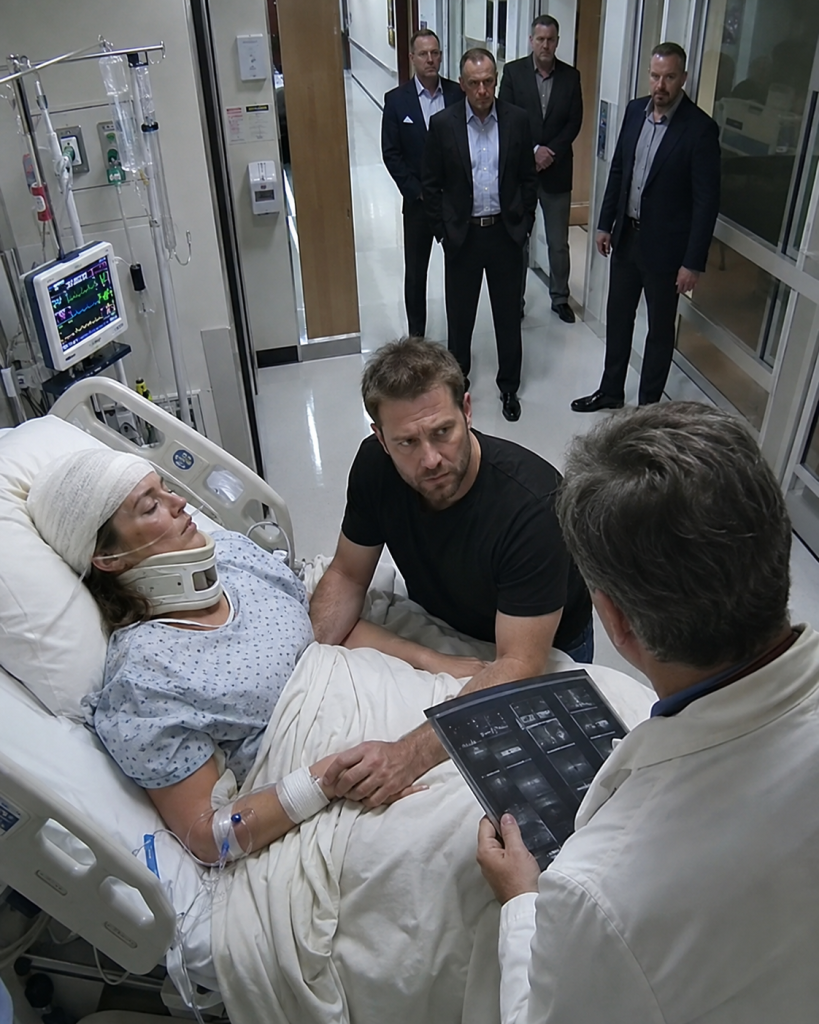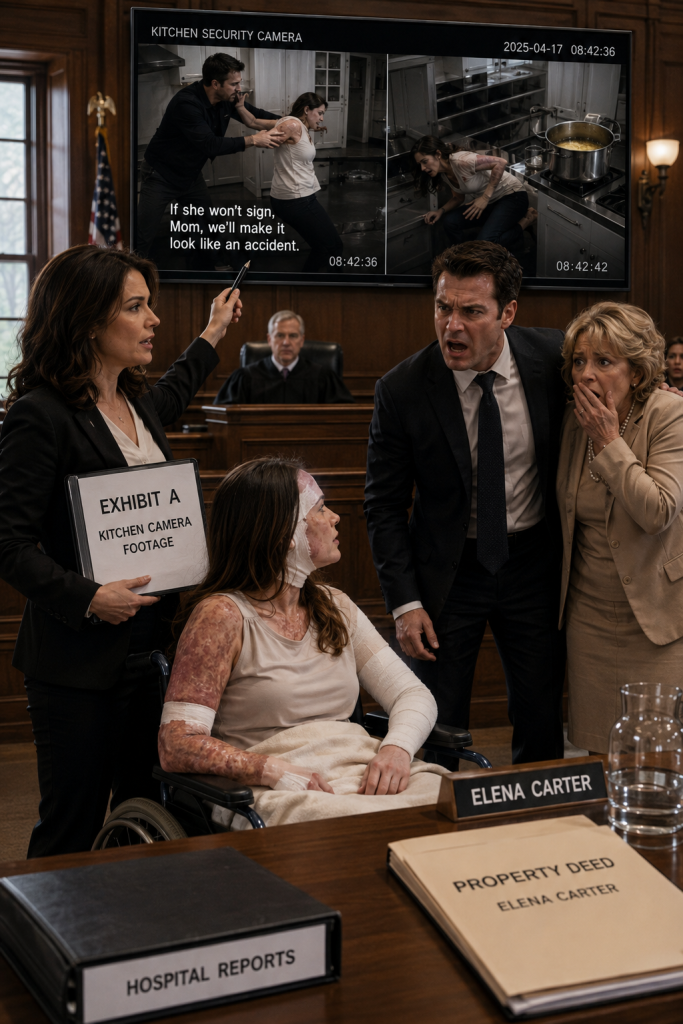
So when Sarah told me she would hold the recording until morning, I understood there was another reason.
“What aren’t you telling me?” I asked.
There was a pause.
“You’re tired.”
“Sarah.”
Another pause.
Then she exhaled.
“The recording confirms what you remembered. But there are other things on it too.”
I sat up a little straighter against my pillows.
“What things?”
“Conversations.”
“Between Julian and Evelyn?”
“Yes.”
“About the house?”
“Yes.”
Something in the way she answered made my fingers go cold.
“How much?”
“We’ll talk tomorrow.”
“I don’t want to wait until tomorrow.”
“I know.”
“Then tell me.”
Sarah was quiet for several seconds.
“Elena, your father did more than install a backup recorder.”
I stared at the darkened rehabilitation room.
Outside my window, the parking lot lights glowed pale yellow through the rain.
“What does that mean?”
“It means I found a file your father left with instructions that I was not to open unless there was a dispute concerning the house.”
I forgot about the recording.
“What file?”
“Come to my office when you’re discharged.”
“Sarah—”
“Not because I’m keeping something from you. Because I think your father intended you to hear this in the house.”
“The house?”
“Yes.”
I closed my eyes.
My father’s house.
I still couldn’t think those words without seeing his hands.
Large hands, always carrying something.
A mug of coffee.
A wrench.
A stack of library books.
An absurd grocery bag containing six different kinds of mustard because the store had put them on sale.
He had raised me in that house after my mother died when I was twelve. Every room contained some small evidence of him.
The pencil marks on the pantry frame recording my height.
The brass hook beside the door where he hung his keys.
The cracked blue tile behind the kitchen sink that he always said he would replace and never did.
And now the kitchen had become the one place in the world I could not imagine entering.
“I don’t know if I can go back there,” I whispered.
Sarah’s voice softened.
“You don’t have to decide tonight.”
But I already knew that wasn’t true.
There are decisions we make slowly, with lists and conversations and careful weighing of consequences.
And then there are decisions that wait inside us until the moment we finally admit they’ve already been made.
I was going home.
Not for Julian.
Not even for the recording.
For my father.
And for myself.
I was discharged nine days later.
Sarah picked me up herself.
She arrived in a navy sedan that had belonged to her husband before he traded it for something newer. Sarah disliked buying cars.
“Depreciating metal boxes,” she called them.
She brought a soft cardigan because the morning was cooler than forecast, a thermos of coffee, and exactly one question.
“Office or house?”
“House.”
She nodded as though I had chosen between two equally ordinary lunch restaurants.
That was one of the things I loved about Sarah.
She never congratulated people for doing hard things.
She simply helped them do them.
The drive took forty minutes.
I watched familiar streets pass the window.
The bakery where Dad bought cinnamon rolls on Sunday mornings.
The pharmacy where I had once worked during college.
The narrow park with the duck pond.
Nothing had changed.
That felt almost offensive.
When something alters the entire shape of your life, part of you expects the rest of the world to acknowledge it.
A closed road.
A darkened sky.
A sign.
Instead, traffic lights changed normally.
People walked dogs.
A woman in running clothes waited for a bus while drinking from a paper cup.
Life continued with its astonishing indifference.
Sarah turned onto Willow Lane.
My father’s house appeared at the end of the block.
White siding.
Green shutters.
A maple tree leaning slightly toward the garage.
My throat tightened.
Sarah slowed.
“You can change your mind.”
“I know.”
She pulled into the driveway.
I stayed seated.
The house looked smaller than I remembered.
For weeks, it had existed in my thoughts as something enormous—a battlefield, a crime scene, an inheritance, a marriage, a promise.
But from the driveway it was simply a two-story house with an aging roof and a porch Dad had rebuilt twice.
“Julian isn’t here?” I asked.
“No.”
“He hasn’t been allowed inside?”
“Not since I secured the property.”
I looked toward the detached garage.
The side door had been replaced.
Sarah followed my gaze.
“Police photographed everything after the break-in.”
“Did they find anything?”
“No useful prints. Whoever entered wore gloves or was careful.”
“Julian?”
“We don’t know.”
“You think it was him.”
“I think assumptions are dangerous when evidence can do the work for us.”
Dad used to say that too.
I glanced at her.
“You two really did spend too much time together.”
The corner of her mouth lifted.
“That man objected to adjectives in contracts as if they were a moral failing.”
For the first time that morning, I laughed.
It hurt my shoulder.
It was worth it.
Sarah got out first.
When I stepped onto the driveway, my legs felt uncertain.
Not weak exactly.
Just unfamiliar.
I walked slowly toward the porch.
Three steps.
Then the front door.
Sarah handed me the key.
“You open it.”
My hand trembled only once.
Inside, the house smelled faintly of lemon cleaner and old wood.
The living room looked almost exactly as I had left it, except Julian’s belongings were gone.
The leather briefcase that had always rested beside the sofa.
His running shoes by the stairs.
The charcoal coat he never hung properly.
Their absence did not make the room feel empty.
It made the room feel larger.
I stood in the entryway and listened.
The refrigerator hummed.
Somewhere above us, the heating system clicked.
A clock ticked in the dining room.
The quiet was different from hospital quiet.
Hospital quiet was never truly silence. There were machines, carts, distant doors, footsteps.
This was the quiet of a place waiting.
Sarah touched my elbow.
“We don’t need to go into the kitchen.”
“Yes, we do.”
I surprised myself by saying it.
My body reacted before my mind did.
My breathing shortened.
My hands tightened.
But I walked.
The kitchen doorway was ten feet away.
Eight.
Five.
Two.
Then I was there.
The stove had been cleaned.
The stockpot was gone.
The breakfast table remained beneath the window.
One chair was slightly angled away from it.
Evelyn’s chair.
I looked at the tile floor.
For a few seconds, everything inside me seemed to separate.
The room I remembered.
The room in front of me.
The father who had taught me to make pancakes at that stove.
The husband who had turned the same room into something else.
I pressed my palm against the doorframe.
Sarah waited behind me.
“I thought coming back would make it worse,” I said.
“And?”
“It makes it smaller.”
She looked at me.
“What does?”
“The memory.”
I swallowed.
“It was huge in rehabilitation. It filled everything.”
I took one more step into the kitchen.
“But this is just a room.”
Sarah nodded.
“A room can become yours again.”
I didn’t answer.
I wasn’t ready to believe that yet.
But I wanted to.
That was enough.
We went to the garage next.
The concealed recorder had been mounted inside a false wooden panel behind Dad’s old workbench.
The panel now hung open.
The recorder was gone.
Its absence left a clean rectangular outline in the dust.
I stared at it.
“Who knew it was here?”
“Your father.”
“Me.”
“Eventually.”
“You.”
“I knew there was a backup system. I didn’t know the exact location.”
“Did Julian?”
“You tell me.”
I thought carefully.
After Dad installed the kitchen camera, Julian had complained about it constantly.
He called it paranoid.
Then invasive.
Then insulting.
Finally, about six months before Dad died, Julian claimed he had disconnected it.
Dad checked.
He didn’t argue.
He simply installed the backup.
That had been his way.
Dad rarely confronted people immediately.
He preferred observation.
“If Julian knew about the recorder,” I said, “he probably learned after Dad died.”
“Possibly.”
“From paperwork?”
“Possibly.”
Sarah sat on the edge of Dad’s workbench.
“There is another possibility.”
I looked at her.
“Someone told him.”
My first thought was Evelyn.
But Evelyn had never liked my father.
She considered him stubborn and provincial, mostly because he had never been impressed by her.
She wouldn’t have known his security system.
“Who?”
“That,” Sarah said, “is one of the things we’re going to determine.”
She reached into her bag and removed a thick cream envelope.
My name was written across it.
Not printed.
Written.
I recognized the handwriting immediately.
Dad.
I stopped moving.
“Where did you get that?”
“My office safe.”
“When?”
“He gave it to me eight months before he died.”
Eight months.
He had still been driving then.
Still making his own coffee.
Still insisting the ache in his chest was indigestion.
“What did he say?”
“That if anyone ever challenged your ownership of this house, I was to bring you here and give you this.”
I took the envelope.
It was heavier than I expected.
Inside were several folded pages and a small brass key.
I held the key in my palm.
“What does it open?”
“I don’t know.”
“You didn’t ask?”
“Your father said you’d know.”
I almost smiled.
“That sounds like him.”
I unfolded the letter.
Elena,
If Sarah is giving you this, somebody has decided this house belongs to them more than it belongs to you.
It doesn’t.
I stopped reading.
My vision blurred.
Sarah looked away, giving me privacy without leaving.
I started again.
You may think I left you this house because it belonged to your mother and me.
That’s part of it.
But mostly, I left it to you because everyone deserves one place where they do not have to earn permission to stay.
I know you.
You’ll try to be fair.
You’ll worry about being difficult.
You’ll ask whether keeping something makes you selfish.
So I’m going to save you time.
It doesn’t.
Keep the house if you love it.
Sell it if you don’t.
Paint it purple.
Turn it into a library.
Give it away when you’re ninety.
But make the decision yourself.
I laughed through tears.
Sarah smiled.
“Purple would upset the historical committee.”
“Dad knew that.”
“Thereby improving the suggestion.”
I looked back at the letter.
There was more.
There is something else.
When your mother died, I nearly sold this place.
You don’t know that.
You were twelve, and I thought everything in these rooms would hurt you.
Then one night you found me packing dishes into boxes.
You asked where we were going.
I told you somewhere new.
You said, “But Mom knew where everything was here.”
I never forgot that.
So we stayed.
Not because houses are sacred.
They’re not.
Because sometimes continuity is a form of kindness.
I needed these rooms to remember who I had been before grief.
Maybe someday you will too.
I lowered the pages.
For a while, neither Sarah nor I spoke.
I remembered that night.
Not clearly.
Just cardboard boxes.
Dad standing in the kitchen.
His face looking exhausted in a way I had not understood then.
I remembered asking whether my mother would know where to find us if we moved.
He had told me yes.
Of course she would.
I had believed him.
I had forgotten the rest.
“There are two more pages,” Sarah said quietly.
I continued.
I have also learned something about Julian that concerns me.
My breath caught.
Sarah’s expression changed.
She already knew this part.
I kept reading.
I do not know whether he is dishonest with you.
I know he has been dishonest with me.
Three months ago, Julian asked me privately whether I would consider transferring partial ownership of the house to you both as a married couple.
I told him no.
He said you had asked him to speak with me.
I asked you later, indirectly.
You had no idea.
I stared at the page.
The garage seemed to tilt.
“He asked Dad for part of the house?”
Sarah nodded.
“Your father told me shortly afterward.”
“Why didn’t either of you tell me?”
“Keep reading.”
I did.
I considered telling you immediately.
Instead, I asked Sarah what she thought.
She told me something I didn’t enjoy hearing: if I confronted you with suspicion but no evidence, I might force you into defending Julian instead of evaluating him.
She’s irritating when she’s right.
Sarah cleared her throat.
“Your father could be unnecessarily editorial.”
I kept reading.
So I watched.
Not secretly in the dramatic sense. I simply paid attention.
Julian began asking questions about my will, taxes, your inheritance, and whether the house had debt attached.
None of those questions is wrong by itself.
Together, they concerned me.
Then something stranger happened.
A mortgage broker called me.
He said he was following up on my inquiry about refinancing.
I had made no inquiry.
The broker apologized and said he must have confused me with someone else.
Maybe he did.
Maybe he didn’t.
I requested a copy of whatever file had produced the call.
Sarah helped.
The final page was only half full.
Enclosed with this letter is the key to the bottom drawer of my desk.
There is a folder inside labeled ORCHARD.
Don’t decide what it means before you read it.
Facts first.
Conclusions second.
I hope you never have to open it.
Love,
Dad
I folded the letter carefully.
“His desk is upstairs,” I said.
Sarah nodded.
“Study.”
I looked at the brass key.
My fingers had started trembling again.
But this time it wasn’t fear.
It was something more complicated.
Sadness.
Anger.
Gratitude.
And beneath all of them, a question.
How much had my father seen before I had been willing to see anything at all?
Dad’s study was at the front of the second floor.
Julian hated it.
He said it was dark, cluttered, old-fashioned.
I loved it for exactly those reasons.
Books crowded the shelves.
A faded rug covered the floor.
Dad’s desk sat beneath the window, scarred from decades of use.
After he died, I had cleaned the room but changed nothing.
Julian had wanted to turn it into a home office.
I kept saying later.
Later had quietly become never.
The bottom drawer of the desk had always been locked.
I assumed it held insurance policies or old tax records.
The brass key fit perfectly.
The lock clicked.
Inside were hanging folders.
Receipts.
Property records.
My parents’ marriage certificate.
An envelope containing old photographs.
And at the back, a blue folder.
ORCHARD.
I pulled it out.
Sarah brought a chair beside mine.
The first page was a photocopy of an email.
From Julian.
To a mortgage broker.
Subject: Property Equity Options.
I read it twice.
The message was courteous.
Professional.
Almost ordinary.
Julian described the property as “a family residence expected to transfer fully to my wife in the near future.”
He asked how much equity might be available after transfer.
He wanted to know whether a spouse could qualify for a loan against inherited real estate.
A reply from the broker explained that ownership structure mattered.
There were more emails.
Questions about refinancing.
Joint title.
Spousal consent.
Investment loans.
One line made me stop.
If Elena remains sole owner, what options exist for accessing the property value without requiring a sale?
I looked at Sarah.
“How did Dad get these?”
“The broker contacted him because Julian apparently submitted your father’s address and property information before ownership had transferred.”
“Why would Julian do that?”
“That’s a question for Julian.”
“No.”
My voice came out firmer than I expected.
“I mean, I know the obvious answer. Money. But he had a good job. We weren’t struggling.”
“People don’t always want money because they need groceries.”
I turned another page.
This one wasn’t from the broker.
It was a handwritten note from Dad.
Ask Elena whether Julian has investment losses.
I stared at it.
“Investment losses?”
Sarah leaned closer.
“Did Julian invest?”
“He handled our retirement accounts.”
“Anything else?”
“He talked about buying rental properties. But we never did.”
“Do you know whether he traded privately?”
“No.”
That answer bothered me more than it should have.
Not because married people must share every detail of every decision.
But Julian and I had discussed money endlessly.
At least, I thought we had.
We budgeted.
We compared insurance plans.
We discussed vacations.
He criticized every nonessential purchase I made, from expensive shampoo to art supplies.
And yet I suddenly realized that I had never actually seen the full picture of his personal accounts.
I had trusted him when he said everything was fine.
Because that’s what trust is, I had believed.
Not checking.
Not questioning.
Giving someone room.
Now I wondered whether I had confused trust with absence.
Sarah turned over the next page.
A bank statement.
Not ours.
Julian’s.
There were several large transfers to something called CEDAR HILL CAPITAL.
One for twenty-five thousand dollars.
Another for forty thousand.
Then twelve thousand.
Then another eighteen.
I did the arithmetic in my head.
“Ninety-five thousand.”
Sarah nodded.
“Over fourteen months.”
“Where did he get that much?”
“That is another question.”
I thought of our joint account.
Our salaries.
The savings we had discussed.
None of it fit.
The final document was a letter from Dad to Sarah.
Sarah already knew it.
She let me read.
Sarah,
I believe Julian may have financial problems Elena does not know about.
I do not yet have enough information to say whether he intends to involve the house.
If anything happens to me before I clarify this, make sure she receives the Orchard file only if ownership becomes disputed.
Do not frighten her with possibilities.
Give her facts.
Elena loved her mother fiercely and lost her early.
Since then, she has sometimes mistaken keeping peace for keeping people.
Those are not the same.
I covered my mouth with my hand.
Not because the sentence hurt.
Because it was true.
Too true.
I had always hated conflict.
As a child, I apologized first after arguments with friends.
At work, I volunteered for extra assignments because saying no made me feel selfish.
When Julian became irritated, I changed plans.
When Evelyn criticized my cooking, my clothes, my work schedule, I laughed.
When Julian called my father’s concerns intrusive, I defended my husband.
I had believed compromise was evidence of love.
Maybe sometimes it was.
But compromise required two people moving.
I had been the only one stepping aside.
Sarah closed the folder.
“Elena.”
“I know.”
“What?”
“I was about to blame myself.”
She said nothing.
“I was going to say I should have noticed.”
“Would that help you understand anything?”
“No.”
“Then don’t use guilt as a substitute for investigation.”
I let out a tired laugh.
“That sounds like Dad too.”
“I stole it from him.”
We sat in silence.
Then I asked the question that had been growing since the garage.
“Sarah, why was Dad investigating Julian’s finances?”
“He wasn’t exactly investigating.”
“He obtained bank statements.”
“Those arrived later.”
“How?”
“I don’t know.”
I turned toward her.
She looked genuinely uneasy.
“You don’t know?”
“No.”
“Then where did Dad get them?”
“That is what I hoped the Orchard file would explain.”
I looked back at the statement.
At the bottom was a mailing address I had not noticed.
It wasn’t our house.
It was an apartment building across town.
“Sarah.”
She leaned over.
I pointed.
“That isn’t our address.”
“No.”
“I know this building.”
“You do?”
I nodded slowly.
“Evelyn used to live there.”
Evelyn had moved out of the apartment three years earlier.
At least, that was what Julian told me.
She had complained that the stairs bothered her knees and relocated to a newer development on the north side.
I had helped her pack.
But the address on Julian’s bank statement was her old apartment.
Why would his mail still go there?
I opened the next statement.
Same address.
The next.
Same.
“Maybe he never updated it,” I said.
Sarah gave me a patient look.
I sighed.
“I’m doing it again.”
“Doing what?”
“Explaining something before I understand it.”
“That instinct probably served you well in many parts of your life.”
“Not this one.”
“Not this one.”
There was no drama in her agreement.
That helped.
We spent the next two hours making copies.
The original documents went into Sarah’s bag.
I kept Dad’s letter.
Before leaving the study, I opened the old photograph envelope.
Most were pictures I had seen before.
Mom in the garden.
Dad holding me as a baby.
My seventh birthday.
Then I found one I didn’t remember.
My parents stood in front of the house.
Mom looked about thirty.
Dad younger.
Between them stood another man.
Tall.
Thin.
Dark hair.
He was holding a folder.
On the back, Dad had written:
Closing day.
May 14.
With Michael.
“Who’s Michael?” I asked.
Sarah looked at the photograph.
Her expression shifted.
“Michael Vale.”
“You know him?”
“Knew him.”
“Who was he?”
“Your father’s business partner.”
I frowned.
“Dad didn’t have a business partner.”
“He did before you were born.”
I stared at her.
“How have I never heard this?”
“The partnership ended a long time ago.”
“What kind of business?”
“Construction.”
Dad had owned a small renovation company when I was little.
By the time I was ten, he had scaled it back to consulting.
I knew that.
I had never heard of Michael.
“Why is he in the closing-day picture?”
“I don’t know.”
Sarah studied the image.
“Your father bought the house around the same time their partnership dissolved.”
“Did Michael have something to do with it?”
“Possibly.”
That word again.
Possibly.
The entire day seemed built from it.
Possible hidden debts.
Possible lies.
Possible connections.
Nothing certain except that my father had known enough to worry.
I slipped the photograph behind his letter.
“Can we find him?”
“Michael?”
“Yes.”
Sarah hesitated.
“I haven’t heard his name in years.”
“That wasn’t my question.”
She smiled faintly.
“No. It wasn’t.”
I spent my first night back at the house alone.
Sarah strongly suggested I stay with her.
I declined.
Not because I was brave.
I simply needed to know what the house felt like when nobody else was in it.
For years, Julian’s routines had filled every evening.
Television after dinner.
Phone calls.
Doors closing.
His footsteps overhead.
Even silence around him had contained expectation.
Would he be in a good mood?
Would he criticize something?
Would Evelyn call?
Would the subject of the house come up again?
That night I made soup.
Not on the stove.
I wasn’t ready for that.
I heated a container in the microwave and ate at the dining room table.
Then I opened windows.
All of them.
Even though it was cold.
Fresh air moved through the rooms, carrying the smell of damp leaves and distant wood smoke.
I changed the sheets in the bedroom.
Julian had taken most of his clothes.
A few shirts remained in the closet.
I folded them into a box.
Not angrily.
Not ceremonially.
Just carefully.
For the first time, I understood that endings could be quiet.
No speeches.
No dramatic final moment.
Sometimes a marriage ended because one person placed three shirts into a cardboard box and realized she no longer wondered whether the other person would return for them.
I slept badly.
But I slept.
The next morning I made coffee in Dad’s old machine.
Then I called my bank.
Then our accountant.
Then the company managing Julian’s retirement account.
By noon, I had learned something surprising.
Most of our joint finances were exactly as I believed them to be.
Mortgage-free house.
Healthy savings.
Retirement accounts.
No hidden withdrawals from our shared funds.
Julian’s financial problems, if they existed, were somewhere else.
That should have comforted me.
Instead, it made the mystery sharper.
Where did ninety-five thousand dollars come from?
I called Sarah.
She answered immediately.
“I found Michael Vale.”
“That was fast.”
“He wasn’t hiding.”
“Where is he?”
“Vermont.”
“Of course.”
“Why of course?”
“I don’t know. Michael Vale sounds like a man who lives in Vermont.”
Sarah laughed.
“He owns a furniture restoration shop.”
“Can we talk to him?”
“I already did.”
I sat up straighter.
“And?”
“He remembers your father. He remembers the house.”
“And?”
“He says the house was originally supposed to belong to both of them.”
I looked around the kitchen.
“What?”
“Don’t jump ahead.”
“I am very clearly already ahead.”
“Michael said he and your father bought several distressed properties together in the late eighties. Renovated them. Sold them.”
“I knew Dad renovated houses.”
“He and Michael were partners.”
“What happened?”
“The partnership ended after your father met your mother.”
“That sounds ominous.”
“According to Michael, it wasn’t.”
I waited.
“He says they simply wanted different lives.”
“Then why was the house supposed to belong to both of them?”
“Because this property was their last project.”
I looked around again.
“Our house?”
“Yes.”
“They were going to renovate it and sell it?”
“That was the original plan.”
“What changed?”
“Your mother.”
Despite everything, I smiled.
“That also sounds like Dad.”
“Apparently she walked through the house while they were repairing it and said she loved the kitchen window.”
I turned.
Morning light fell across the breakfast table.
Mom’s window.
I remembered her growing herbs there.
Basil.
Mint.
Rosemary.
“Michael sold his share to Dad.”
“For how much?”
“One dollar.”
I blinked.
“What?”
“He transferred his interest for one dollar.”
“Why?”
“Because your father had covered more of the renovation costs, and Michael wanted out of the business.”
“That simple?”
“Mostly.”
“Mostly?”
Sarah paused.
“Michael said there was one condition.”
I waited.
“He told your father that if the house ever stopped being your family’s home, he wanted the option to buy it back before it went on the open market.”
I looked at the ceiling.
“Is that legally binding?”
“That’s what I’m checking.”
“Would Dad have remembered?”
“Absolutely.”
“Then why didn’t he mention it in his will?”
“Maybe because he didn’t consider inheritance a sale.”
That made sense.
But something still bothered me.
“Sarah, why does this matter now?”
“I don’t know yet.”
“You called him because of the picture.”
“Yes.”
“And he just happened to mention this old agreement?”
“He didn’t just mention it.”
My fingers tightened around my mug.
“What?”
“He still has a copy.”
The agreement arrived by email that afternoon.
It was six pages long.
Old.
Scanned poorly.
The signatures were clear.
Thomas Arden.
My father.
Michael Vale.
The language was mostly what Sarah expected from a contract written nearly forty years earlier between two men who had tried to save money by drafting parts of it themselves.
Then she found the clause.
If Thomas Arden or his heirs elect to sell the Willow Lane property outside the immediate family, Michael Vale or his heirs shall receive thirty days to match any bona fide written offer.
A right of first refusal.
I read it several times.
“So Julian couldn’t simply force a sale to someone else?”
Sarah shook her head.
“Not without dealing with this.”
“Did he know?”
“That is the interesting question.”
We were sitting at my dining room table with papers spread around us.
Rain tapped against the windows.
I looked toward Dad’s study.
“He searched Dad’s documents.”
“Maybe.”
“He must have.”
“Maybe.”
“Sarah.”
She raised her hands.
“All right. It’s plausible.”
“Thank you.”
“But we still need evidence.”
I picked up Dad’s letter again.
Then something occurred to me.
“The garage.”
“What about it?”
“The person who broke in didn’t take tools. Didn’t take Dad’s expensive drill set. Didn’t take anything except the recorder.”
“As far as we know.”
“What if they were looking for something else too?”
Sarah’s expression sharpened.
“The agreement.”
“Or Orchard.”
We both looked upstairs.
The file had been locked inside Dad’s desk.
Julian knew the desk existed.
He might even have known it was locked.
But if he had searched the house after Dad’s death, he hadn’t found the key.
Dad had given it to Sarah months earlier.
“Then why take the recorder?” Sarah asked.
“Because he knew that existed.”
“Or thought it might.”
I leaned back.
A strange clarity settled over me.
For weeks, I had thought the recording was the center of everything.
Proof of one terrible decision.
But now it felt like one part of a longer story.
The argument about selling the house.
Julian’s financial questions.
His private investment transfers.
The old mailing address.
Dad’s concern.
The break-in.
Michael’s agreement.
All of them circled the same thing.
The house.
But maybe not for the reason I thought.
“Cedar Hill Capital,” I said.
Sarah looked up.
“What?”
“That company on Julian’s statements.”
“We’ll look into it.”
“No.”
I stood carefully.
“I’ve heard that name.”
“You have?”
“I think so.”
“Where?”
I walked to the hallway closet.
Inside were old boxes I had avoided sorting after Dad died.
Tax documents.
Holiday decorations.
Photo albums.
I pulled out a gray file box labeled MISC.
Sarah joined me on the floor.
“What are we looking for?”
“I don’t know.”
“Excellent investigative method.”
“I learned from the best.”
We went through envelopes.
Receipts.
Old warranties.
A brochure for a furnace installed fifteen years earlier.
Then I found it.
A Christmas card.
Thick cream paper.
Embossed lettering.
CEDAR HILL DEVELOPMENT GROUP
Across the bottom was a handwritten message.
Tom,
Still think Willow Lane was the best deal we ever made.
M.V.
Sarah and I stared at it.
“M.V.,” I whispered.
“Michael Vale.”
“But his business was construction.”
“Once.”
I turned the card over.
There was a printed company address.
Burlington, Vermont.
Sarah took out her phone.
“I thought Cedar Hill Capital was an investment company.”
“So did I.”
She began searching through her notes.
Then she stopped.
“Elena.”
“What?”
“The bank statements say Cedar Hill Capital LLC.”
“And?”
“The Christmas card says Cedar Hill Development Group.”
“Different company?”
“Maybe.”
I looked at the initials again.
M.V.
A coincidence.
Possibly.
But I had become tired of coincidences.
Michael called me that evening.
His voice was deeper than I expected.
Warm.
Careful.
“Elena Arden.”
“Yes.”
“You sound like your mother.”
The sentence went through me like a soft current.
“You remember her?”
“Everybody remembered Claire.”
I smiled.
“That sounds like her too.”
There was silence.
Then Michael said, “Sarah told me you’ve had a difficult year.”
“She didn’t tell you details?”
“No.”
I appreciated that.
“I’ve been learning some things about Dad.”
“That could take awhile.”
“You were close?”
“Once.”
“What happened?”
“We got older.”
“That simple?”
“No.”
His sigh crackled through the phone.
“Most simple answers are what people say when the real answer is too long.”
I waited.
Michael continued.
“Your father and I were friends from the time we were nineteen. We worked construction together. Started buying houses nobody wanted. Your dad could look at a collapsing porch and see a dining room full of people.”
“That sounds like him.”
“He was infuriatingly optimistic about wood.”
I laughed.
Michael did too.
Then his voice softened.
“When he met your mother, he changed. Not in a bad way. His priorities changed.”
“And yours didn’t.”
“Exactly.”
“So you sold him your share of this house.”
“For a dollar.”
“Why a dollar?”
“Because I owed him.”
“For what?”
Michael was quiet.
“That’s another long answer.”
“I have time.”
“Your father covered a debt for me.”
I looked toward the stack of financial documents.
“What kind of debt?”
“Business mistake.”
“What kind?”
“A foolish one.”
He hesitated.
“I borrowed against one property to fund another. Then the market turned. I could have lost both.”
“Dad helped you.”
“He saved me.”
“So you gave him your share.”
“I gave him what should already have been his.”
My pulse quickened.
“Michael, do you know Cedar Hill Capital?”
The silence changed.
Not longer.
Heavier.
“Yes.”
“What is it?”
“Why are you asking?”
“My husband transferred money to it.”
Nothing.
“Michael?”
“How much?”
“Almost a hundred thousand dollars.”
“When?”
“Over about fourteen months.”
Michael exhaled slowly.
“Then we need to be careful.”
My stomach tightened.
“About what?”
“Cedar Hill Capital isn’t mine.”
“But Cedar Hill Development—”
“Was mine. Years ago.”
“Then who owns the other company?”
“I don’t know who owns it now.”
“Now?”
“The name was used before.”
I sat down.
“By whom?”
“My son.”
I froze.
“You have a son?”
“Yes.”
“What is his name?”
“Daniel.”
I had never heard that name.
“Did Dad know him?”
“He met him twice.”
“What does Daniel do?”
“Finance. Property investment. At least, he used to.”
Michael sounded reluctant now.
Not secretive exactly.
Sad.
“What happened?”
“He and I haven’t spoken in four years.”
“Why?”
“Business.”
The same word again.
A whole history hidden inside one word.
“Michael, did Daniel ever have anything to do with this house?”
“No.”
He answered too quickly.
“Are you sure?”
Another pause.
“Not directly.”
“What does that mean?”
“I need to find something before I answer.”
“I’ve had enough people deciding when I should receive information.”
“That isn’t what I’m doing.”
“It feels like it.”
“You’re right.”
His voice lowered.
“I’m sorry.”
That apology surprised me.
Then he said, “Daniel knew about the agreement between your father and me.”
I looked at the old contract.
“How?”
“He found a copy in my files.”
“When?”
“About six years ago.”
“Why would he care?”
“He believed the clause might make the property useful in a development assembly.”
“A what?”
“If a developer wants to buy several neighboring parcels for one project, a single holdout property can become valuable.”
I stood and walked to the kitchen window.
From there, I could see over the hedge to the neighboring roofs.
“Development?”
“Did anyone ever approach your father about buying the house?”
I remembered something.
A letter.
Maybe two.
I had thrown them away.
Real estate investors sent letters constantly.
Cash offer.
Fast closing.
No repairs required.
“I don’t know.”
“Ask Sarah to check local planning records.”
“Why?”
“Elena.”
His voice had become very gentle.
“Because I think your husband may not have wanted your house.”
I gripped the edge of the counter.
“What?”
“I think he may have wanted what was underneath it.”
Sarah returned the next morning.
By then, she had slept approximately four hours and consumed enough coffee to frighten a cardiologist.
She placed a map on the dining room table.
Not a modern street map.
A zoning map.
My house sat near the center.
Around it were colored blocks representing parcels.
Willow Lane.
Hawthorne Street.
The old pharmacy.
A vacant laundromat.
Two houses behind mine.
“What am I looking at?”
“A proposed mixed-use redevelopment district.”
“When?”
“First discussed seven years ago. Shelved twice. Revived eighteen months ago.”
“Eighteen months.”
Around the time Julian’s transfers to Cedar Hill Capital began.
Sarah tapped a group of parcels.
“Most of these have quietly changed ownership in the last three years.”
“To whom?”
“Several LLCs.”
“Cedar Hill?”
“Not directly.”
“Of course not.”
“But two of the companies share the same registered agent.”
“Who?”
She slid a printed page toward me.
Daniel Vale.
I stared at the name.
Michael’s son.
“Does Michael know?”
“I don’t know.”
“And our house?”
“Your house sits here.”
She pointed.
“Right between two sections already controlled by companies connected to Daniel.”
I studied the map.
“So if someone bought our property—”
“They could connect the parcels.”
“Making all of them more valuable.”
“Potentially.”
“How much more?”
“Enough that Julian’s interest in selling may have had less to do with marital finances than we thought.”
I sat back.
The room felt suddenly too quiet.
Not frightening.
Clarifying.
For months Julian had spoken as though selling the house were practical.
Responsible.
Necessary.
He said property taxes would rise.
Repairs would become expensive.
We could invest the proceeds.
Move somewhere newer.
Build a future.
Every argument had sounded personal.
Now another possibility emerged.
Maybe he had known there was a buyer.
Maybe he had known the value.
Maybe he had known things about my inheritance before I did.
“What does the divorce petition say about the house?” I asked.
“That’s another interesting part.”
Sarah opened her legal pad.
“He isn’t claiming ownership directly.”
“What is he claiming?”
“That marital funds increased the property’s value through improvements.”
“What improvements?”
“Kitchen renovation. Roof repairs. Landscaping.”
“Dad paid for the roof.”
“I know.”
“The kitchen cabinets were my money.”
“I know.”
“The landscaping was six bags of mulch and Julian complaining for three weekends.”
“I know.”
Despite myself, I laughed.
Sarah smiled.
Then she became serious again.
“He may not expect to win a large ownership interest.”
“Then why claim one?”
“To create leverage.”
“For what?”
“A settlement.”
The answer settled between us.
He wanted me to sell.
Not necessarily because he expected the house.
Because he wanted the transaction.
I looked at the map again.
“Can we prove he knew Daniel?”
“That’s the next question.”
My phone rang.
Unknown number.
I almost ignored it.
Then I remembered how many calls from doctors and attorneys still arrived from unfamiliar numbers.
I answered.
“Hello?”
“Elena?”
A woman’s voice.
Older.
Uncertain.
“Yes?”
“This is Margaret Lane.”
I knew the name.
She lived three houses down.
Or she had.
Mrs. Lane used to bring my father tomatoes every August.
“Mrs. Lane?”
“I wasn’t sure I had the right number.”
“You do.”
“I heard you were back home.”
“I am.”
She hesitated.
“I have something that belongs to your father.”
I stood.
“What?”
“A letter.”
“When did he give it to you?”
“He didn’t.”
That made no sense.
“Then how—”
“It came to my house by mistake almost two years ago.”
“Why didn’t you give it to him?”
“I tried.”
Her voice became embarrassed.
“But Thomas had already gone into the hospital.”
Dad’s final hospitalization.
“I brought it over later. Julian answered the door.”
My grip tightened around the phone.
“What happened?”
“He told me he’d take it to your father.”
“But you still have it.”
“Yes.”
“Why?”
“Because I didn’t believe him.”
I looked at Sarah.
She was watching me carefully.
Mrs. Lane continued.
“Your father had once told me that if anything important ever came for him and he wasn’t home, I should only give it to you.”
“What was the letter?”
“I don’t know. I never opened it.”
“Who sent it?”
There was a rustle of paper.
Then she read the return address.
My heart began beating faster before she finished.
Cedar Hill Capital LLC.
I closed my eyes.
“Mrs. Lane, do you still have the envelope?”
“Yes.”
“Please don’t give it to anyone.”
“I won’t.”
“Sarah and I will come get it.”
There was a pause.
“Elena?”
“Yes?”
“Your father was worried.”
I swallowed.
“About the letter?”
“I don’t know. About something.”
“What did he say?”
“It was a few weeks before he went to the hospital.”
Her voice softened with memory.
“He was fixing the latch on my gate. I asked whether he was all right because he seemed distracted.”
I waited.
“He said, ‘Margaret, have you ever known someone to become interested in a thing only after learning what it was worth?’”
A chill moved through me.
“What did you say?”
“I said yes. People do that all the time.”
“And Dad?”
“He said, ‘That’s what I’m afraid of.’”
Mrs. Lane lived in a small yellow bungalow with blue flowerpots on the porch.
She cried when she saw me.
Not dramatically.
She simply held my hand between both of hers and said, “Your father adored you.”
Sometimes the simplest kindness is the one that breaks through.
I had heard condolences.
Legal language.
Medical explanations.
Statements.
Advice.
But hearing my father’s elderly neighbor say he adored me nearly undid me.
We sat in her living room.
She brought out the envelope from a desk drawer.
It was still sealed.
My father’s name was on the front.
THOMAS ARDEN.
Below it, the Willow Lane address.
In the upper corner:
CEDAR HILL CAPITAL LLC.
Sarah photographed the envelope.
“Would you mind writing a brief statement about when you received this?”
Mrs. Lane nodded.
“Of course.”
I turned the envelope over.
The seal was intact.
“Can I open it?”
Sarah considered.
“It was addressed to your father. You’re the executor of his estate.”
I slid my finger beneath the flap.
Inside was a single sheet of paper.
No letterhead.
No formal greeting.
Just three paragraphs.
Mr. Arden,
Following our recent discussion, this confirms that our client remains interested in acquiring your property as part of a larger assemblage.
The current proposed purchase price is $640,000, subject to inspection and title review.
We understand you are unwilling to sell. Should your position change, please contact our office. We also ask that you treat the proposed acquisition plan as confidential while negotiations with neighboring owners continue.
I stopped.
Six hundred forty thousand dollars.
At the time, similar houses on our street sold for less than half that.
Sarah read over my shoulder.
“At least we know what Dad knew.”
“And Julian?”
“Not yet.”
There was one more line.
At the bottom, handwritten in blue ink.
Daniel—
Do not contact my daughter or her husband regarding this property.
My decision is final.
T.A.
I looked at Sarah.
“This isn’t the copy they sent Dad.”
“No.”
“It has Dad’s handwriting.”
“Yes.”
“How did it end up back with Cedar Hill?”
“Maybe he returned it.”
“Then why was it mailed to him again?”
Neither of us spoke.
Mrs. Lane looked between us.
“Is something wrong?”
“I don’t know yet,” I said.
And for once, I didn’t try to explain more than I knew.
That evening, I sat alone at Dad’s desk.
The Orchard file lay open.
Beside it were the development map, Michael’s contract, and the letter from Cedar Hill.
For the first time, the scattered pieces felt close to forming something complete.
Dad discovered Julian asking about equity.
Dad received a large purchase offer from a company connected to Michael’s estranged son.
Julian began moving money into a similarly named investment company.
Someone later wanted the house sold badly enough that every conversation became an argument.
But one piece still made no sense.
If Julian was secretly connected to Cedar Hill, why transfer his own money into it?
Investment?
Fee?
Debt?
And where had the money come from?
My phone buzzed.
A message from Sarah.
I found the source of one transfer. Call me.
I called immediately.
“What did you find?”
“The first twenty-five thousand didn’t come from Julian’s salary.”
“Then where?”
“A personal loan.”
“From a bank?”
“No.”
“Who?”
Sarah hesitated.
“Evelyn.”
I leaned back.
His mother.
Of course she knew more than I thought.
“What about the rest?”
“Still tracing.”
I remembered Evelyn at the breakfast table.
Her constant remarks about the house.
Too large.
Too old.
Too expensive to maintain.
A burden.
Dead money.
I had assumed she wanted Julian to have access to my inheritance because she believed marriage meant everything should be shared.
Maybe that had only been part of it.
“What was Evelyn investing in?” I asked.
“We don’t know yet.”
“Does she own part of Cedar Hill?”
“I’m checking.”
I looked down at Dad’s letter.
Facts first.
Conclusions second.
“I want to talk to Michael again.”
“Why?”
“Because something still bothers me.”
“What?”
“The right of first refusal.”
“Go on.”
“If Daniel knew about it, then Cedar Hill couldn’t just buy the house from Dad without dealing with Michael’s rights.”
“Correct.”
“Unless Michael waived them.”
“Correct.”
“Did he?”
“I haven’t seen a waiver.”
I stood and walked to the window.
The maple branches moved gently in the wind.
“What if that was the real problem?”
“Meaning?”
“Dad wouldn’t sell. Michael had rights. Daniel needed both issues solved.”
Sarah was silent.
Then she said, “There’s another possibility.”
“What?”
“The right of first refusal passes to Michael’s heirs.”
“So?”
“So if Michael owns it now, Daniel might eventually inherit it.”
I frowned.
“That doesn’t help him now.”
“No.”
“Unless—”
I stopped.
“What?” Sarah asked.
I remembered Michael’s hesitation when I asked whether Daniel had anything to do with the house.
Not directly.
“What if Daniel already tried to buy Michael’s rights?”
Sarah’s voice sharpened.
“I’ll ask.”
“No. I will.”
I called Michael.
He answered on the second ring.
“Elena.”
“Did Daniel ever ask you to sell him your rights to this house?”
Silence.
Then Michael said, “Yes.”
My pulse quickened.
“When?”
“Five years ago.”
“What did you tell him?”
“No.”
“Why?”
“Because they weren’t worth anything unless your family wanted to sell.”
“But Daniel thought they were.”
“Yes.”
“How much did he offer you?”
“Fifty thousand dollars.”
I closed my eyes.
“Did you tell Dad?”
“Immediately.”
“And?”
“Thomas laughed.”
Despite everything, that sounded exactly right.
“What did he say?”
“That if Daniel wanted to pay fifty thousand dollars for the privilege of being told no twice, he was free to waste his money.”
I smiled.
Then something colder settled beneath the humor.
“Michael, did Daniel ever meet Julian?”
Another pause.
Too long.
“I don’t know.”
“That’s not convincing.”
“I saw a photograph once.”
“What photograph?”
“Daniel sent it to me.”
“When?”
“About two years ago.”
“What was in it?”
“My son was at a charity golf event.”
I waited.
“There were several men in the picture.”
“And Julian?”
“One of them looked like the man in the photograph Sarah sent me yesterday.”
My throat tightened.
“What photograph did Sarah send you?”
“Your wedding photo. So I’d know who your husband was.”
I sat completely still.
Michael continued.
“I wasn’t certain. I still am not.”
“Do you still have Daniel’s picture?”
“I may.”
“Can you look?”
“Yes.”
I heard movement.
A drawer opening.
Paper shifting.
Then Michael went quiet.
“What?” I asked.
“Elena.”
“What?”
“I found it.”
My heart thudded.
“Is Julian in the picture?”
“Yes.”
For several seconds, I couldn’t speak.
“How close are they standing?”
“Close enough that Daniel has an arm around his shoulder.”
“When was it taken?”
Michael read the date printed on the back.
“June eighteenth, two years ago.”
I knew that date.
Not because it was important to me.
Because Julian had been away that weekend.
He told me he was attending a medical charity fundraiser with colleagues.
That part, apparently, had been true.
What he hadn’t told me was who else was there.
“Send it to me,” I said.
“I will.”
“Michael?”
“Yes?”
“There’s something else you should know.”
“What?”
“Julian transferred money to Cedar Hill Capital.”
Michael said nothing.
Then, very quietly, “My son’s company has never accepted private investors.”
I gripped the phone.
“What does that mean?”
“It means if Julian transferred money to a company using that name, we need to know exactly which Cedar Hill Capital received it.”
The answer arrived the next afternoon.
Sarah came to the house carrying a folder and an expression I had learned to take seriously.
“Sit down.”
“I hate when people say that.”
“I know.”
We sat at the dining room table.
She opened the folder.
“There are two Cedar Hill Capital entities.”
“Two?”
“One was registered in Vermont nine years ago. Daniel managed it for real estate acquisitions.”
“And the other?”
“Registered in our state eighteen months ago.”
I stared at her.
“Who owns it?”
“Technically, an LLC.”
“Sarah.”
She slid the registration document across the table.
The organizer’s name was listed near the bottom.
Evelyn Mercer.
Julian’s mother.
I read it twice.
Then a third time.
“Evelyn?”
“Yes.”
“Why would she create a company using Daniel’s company name?”
“That’s what we don’t know.”
“Is Daniel involved?”
“Not according to the registration records.”
I looked at the transfer statements.
Julian had not been sending money to Daniel Vale.
He had been sending money to his mother’s company.
“What was the company for?”
“Registered purpose: real estate investment and consulting.”
“Did it own anything?”
“One asset.”
My stomach tightened.
“What?”
Sarah placed a property record on top of the stack.
A small commercial lot.
Two streets behind my house.
One of the parcels on the redevelopment map.
I looked at her.
“So Evelyn invested too.”
“Apparently.”
“And Julian gave her money.”
“Apparently.”
“Why hide it?”
“That is something he will eventually have to explain.”
I studied the map again.
The picture was becoming clearer, but not simpler.
Evelyn had money in the redevelopment area.
Daniel controlled neighboring parcels.
Julian knew Daniel.
Dad’s house stood between them.
If my property sold as part of an assembly, the surrounding land might rise significantly in value.
That meant Julian and Evelyn had more than an abstract interest in my decision.
They had a financial one.
I expected anger.
Instead I felt something quieter.
Disappointment.
Not only in Julian.
In the life I had believed I was living.
I thought our arguments had been about money in the ordinary married sense.
Security.
Fairness.
Future plans.
Maybe they had been about an undisclosed investment instead.
Trust didn’t collapse all at once.
It dissolved backward.
Old conversations changed shape.
Old explanations sounded different.
Things I had dismissed became clues.
Evelyn asking whether the vacant pharmacy had sold.
Julian suddenly knowing zoning terminology.
The two of them discussing traffic patterns on Willow Lane.
A dinner conversation where Julian mentioned that “commercial buyers sometimes pay irrational premiums.”
At the time, I had barely listened.
Now I remembered everything.
“Sarah.”
“Yes?”
“The night before Dad died, Julian went to see him.”
She became still.
“How do you know?”
“Julian told me.”
“What did he say the visit was about?”
“He said Dad wanted help changing a setting on his phone.”
“Did that sound believable?”
“Then? Yes.”
“And now?”
I looked toward Dad’s study.
“Now I want to know whether Dad left anything else.”
We searched for three hours.
Desk drawers.
File cabinets.
Books.
Old calendars.
Nothing.
Near sunset, I sat on the floor beside Dad’s desk, exhausted.
Sarah leaned against the window.
“We may be looking for something that doesn’t exist.”
“I know.”
I picked up Dad’s old planner.
He used paper calendars until the end.
Most entries were ordinary.
Dentist.
Tax appointment.
Dinner with Elena.
Call plumber.
On the week he died, there was an entry for Thursday evening.
J.M. 6:30.
Julian Mercer.
I showed Sarah.
“So he did meet him.”
“Yes.”
Below it, in Dad’s handwriting, was another note.
Bring garage copy to S.V. Friday.
Sarah Vance.
“You never got it.”
“No.”
“What garage copy?”
“I don’t know.”
We stared at each other.
The recorder had been in the garage.
But Dad’s note predated the incident by months.
“Could it have been something else?” I asked.
Sarah nodded slowly.
“Possibly.”
There was that word again.
But this time, possibility felt less like uncertainty.
It felt like a door.
I turned the planner page.
Nothing.
Then a folded slip of paper fell from the binding.
Not a letter.
A receipt.
From a storage facility across town.
Unit 214.
Paid annually.
My father’s name.
I looked at Sarah.
“Did you know he had a storage unit?”
“No.”
The most surprising part wasn’t the unit.
It was the renewal date.
Three weeks before Dad died.
He had paid for one more year.
And written one sentence across the bottom of the receipt.
If Julian comes asking, he knows more than he should.
I read it aloud.
Sarah’s face lost all color.
Then she pointed to the line beneath it.
A line I had nearly missed.
Three words.
Ask him why.
Not Julian.
Another name.
Daniel Vale.