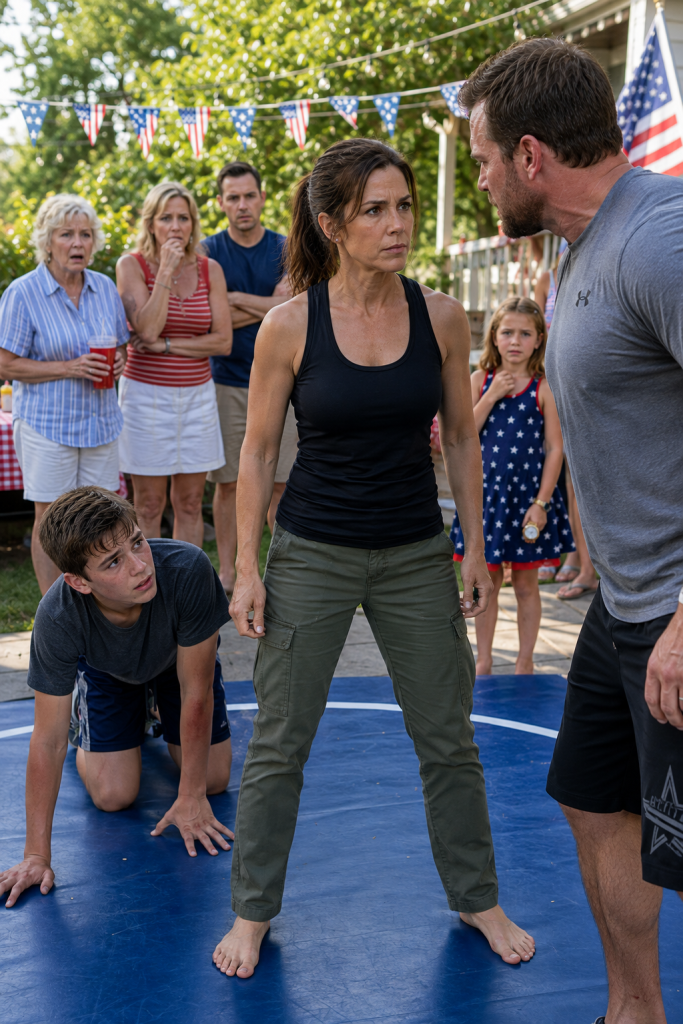
My brother-in-law shoved my thirteen-year-old son onto the backyard wrestling mat so hard that Caleb’s palms smacked the canvas before his knees caught up with the fall.
The sound cut through my mother’s backyard like a board snapping in half. The grill hissed beside the patio. Charcoal smoke hung in the July heat. Somewhere beyond the subdivision, a firework cracked early, sharp and hollow, while my nine-year-old daughter sucked in one small breath behind my hip.
For a second, nobody moved.
Derek Vaughn stood over my son with a grin that made my stomach tighten. He had always been the kind of man who mistook volume for strength and cruelty for leadership. A former supply corporal, he talked about discipline like he had invented it, then left everyone else to clean up whatever mess his pride made.
He clapped once, loud enough to make Caleb flinch. “Come on, Caleb,” Derek said, looking around the yard for an audience. “If you want to grow up, you have to stop folding every time somebody touches you.”
Caleb pushed himself upright. His cheeks were red, but he did not cry. That almost hurt worse.
My daughter, Emma, pressed closer to my side and whispered, “Mom, why does Uncle Derek always do that?”
The question landed harder than the shove.
Because I had allowed it. Because I had smiled through every joke so my mother’s blood pressure would stay calm. Because every Fourth of July cookout, Thanksgiving dinner, birthday party, and family emergency had taught Derek that I would swallow disrespect if it kept my sister from having to choose between her husband and the truth.
My name is Laurel Bennett. I am forty-four years old, a retired United States Marine Corps lieutenant colonel, and for twenty-two years I let my family believe my career had been safe, quiet, and mostly paperwork.
I let them call me lucky. I let them call me dependable. I let them call me the one who always had money when somebody’s roof leaked, car died, tuition bill came due, or tax notice showed up at the worst possible time.
I never told them about the missions. I never showed them the scars under my left shoulder blade. I never corrected the jokes when they turned into family tradition.
Silence feels noble until people start using it as permission.
That afternoon, we were in my mother Elaine’s backyard in Richmond, Virginia, under cheap strings of patio lights and paper flags taped to the fence. A small American flag hung from the back porch rail. Red plastic cups sweated on the glass table. Hamburger buns sat open near the grill while cousins pretended to laugh because laughing was easier than stepping between Derek and a child.
My mother sat with her iced tea in both hands, worried but still. My sister Mallory fussed with the buns, eyes down, like bread needed more defending than my son. My husband stood near the patio steps—silent.
Derek slapped both hands onto the mat and looked right at me. “Come on, Laurel. Since you’re so concerned, maybe you want to teach the boy how it’s done.”
A couple of cousins chuckled into their cups. Someone’s chair scraped the concrete, then stopped.
Derek widened his stance, puffing himself up for the whole backyard. “Don’t worry,” he said. “I’ll go easy on the office Marine.”
Mallory looked down at the hamburger buns. My mother said, “Derek, don’t start.”
But she did not say, Laurel, you do not deserve that. She had never said it when he joked about my “printer-jam combat experience.” She had never said it when he called my retirement easy money. She had never said it when he bragged about paying for family repairs I had quietly funded from my own account because Mallory begged me not to embarrass him.
At 4:18 p.m., Caleb’s left palm was still pressed flat to the mat. Later, I would remember that detail with the kind of clarity that feels like evidence:
-
The pale scrape near his wrist.
-
The grass stuck to one knee.
-
The way he would not look at me because shame had already convinced him he had done something wrong.
A child learns what he is allowed to endure by watching which adults stay quiet. That decided it.
I stepped forward. “You want a round?” I asked.
Derek’s grin spread like he had been waiting years for me to give him permission. “Finally,” he said. “I thought the paperwork department might be too delicate.”
The yard froze again. My mother’s iced tea stopped halfway to her mouth. Mallory’s hand crushed the plastic bread bag until it crackled. One cousin stared at the grill lid like the answer might be hiding in the smoke.
Nobody moved.
I took off my watch and handed it to Emma. “Stand with your grandmother.”
Her fingers closed around the watch. “Mom?” “I’m all right, sweetheart.”
Derek rolled his neck and stepped onto the mat like a man walking into a story where he already knew the ending. He expected fear. He expected hesitation. He expected the same quiet woman he had mocked for years to back away because the family was watching.
I gave him none of that.
I placed one bare foot on the edge of the mat, looked at my son, then looked at Derek.
And for the first time all afternoon, Derek’s smile changed. Not gone. Not yet. But thin enough that everyone in that backyard saw the moment he realized I was not stepping onto that mat to argue… I was stepping onto it to finish what he had started.
Derek laughed once, but it came out wrong. Too loud. Too fast. The kind of laugh men use when the room has shifted and they are trying to drag it back with noise. “Careful, Laurel,” he said, bouncing on his heels. “Wouldn’t want you to file a complaint with HR.”
I did not answer. I only rolled my shoulders once and watched his feet.
-
Left heel heavy.
-
Right knee stiff.
-
Hands too high.
Pride makes people predictable, and Derek had more pride than balance.
Caleb stood behind me now, breathing through his nose, one hand wrapped around his scraped wrist. Emma still held my watch like it was something breakable.
Then my husband finally spoke. “Laurel,” he said quietly, “maybe don’t.”
Not Derek, stop. Not Caleb, are you okay? Not even Everybody calm down. Just: Maybe don’t.
That was when Mallory’s face folded. She turned away from the grill, one hand pressed to her mouth, and for the first time all day she looked less embarrassed for Derek than afraid of what he had just invited.
A new sound cut through the backyard—my phone vibrating on the patio table. Emma looked at the screen before anyone else did. “Mom,” she whispered. “It says Colonel Harris.”
Derek’s eyes flicked toward the phone.
My old commanding officer’s name sat glowing under the paper plate, bright as a warning he did not understand.
I looked at Derek, lowered my hands, and said—
Part 2: The Fall of the Paperwork Marine
“Hold that thought, Derek.”
I stepped over to the table, picked up the vibrating phone, and answered it without taking my eyes off him.
“Colonel Bennett,” I said. My voice wasn’t loud, but it had a clear, flat tone that made the chatter in the yard die completely.
“Laurel,” Colonel Harris’s voice boomed softly through the speaker, crisp and authoritative. “Sorry to interrupt your holiday. The Pentagon just finalized the sign-off on the Silver Star upgrade for your operation in Ramadi. We need your confirmation for the ceremony date.”
“Understood, sir,” I replied calmly. “Can I call you back in five minutes? I’m currently handling a minor disciplinary issue in the backyard.”
“Copy that, Colonel. Don’t go too hard on ’em.”
I tapped the screen and laid the phone face down on the glass table. The silence in the yard was heavy enough to crush a bone.
Derek’s eyes were wide, his chest still puffed out, but the confidence was draining out of his face like water from a cracked bucket. He looked at my husband, then at my mother, searching for someone to laugh and break the spell. Nobody did.
“Silver Star?” Derek stammered, trying to muster a smirk, though his lip trembled slightly. “What, did they start giving those out for filing reports under fire?”
I didn’t answer. I stepped back onto the mat.
He lunged first—an awkward, heavy-handed tackle fueled purely by bruised ego and the desperate need to save face in front of the family. It was loud, slow, and reckless.
I didn’t flinch.
As he closed the distance, I pivoted my hips, grabbed his extended wrist, and swept his lead leg. Gravity and his own momentum did the rest. With a sickening thud that shook the wooden frames of the porch, Derek slammed back-first into the canvas.
Before he could catch his breath, I drove my knee lightly into his chest, pinning his shoulder down, and locked his wrist in a leverage hold that froze him in place.
He gasped, a high, desperate sound.
“You’re right about one thing, Derek,” I whispered down at him, close enough that only he could hear. “You do need discipline. But you’ve been taking it out on a child because you knew he couldn’t fight back.”
I applied just enough pressure to make him wince, then let go and stood up cleanly.
Derek scrambled backward like a crab, clutching his arm, his face flushed bright purple. He looked around the yard, waiting for someone to jump to his defense.
Mallory stared at him in shock, her mouth open. My mother sat frozen, her iced tea forgotten. And my husband slowly lowered his head, unable to meet my eyes.
Part 3: The Cracks in the Foundation
“Get up,” Mallory said softly.
Derek blinked, looking up at his wife. “Mallory, did you see what she—”
“I said get up, Derek!” Mallory’s voice cracked, sharp and shrill, breaking twenty years of quiet compliance. She wasn’t looking at me; she was staring at her husband with a mixture of disgust and deep, suffocating humiliation. “Get up and go to the car.”
“Mallory, I was just messing with the kid—”
“He’s thirteen!” she screamed, tears finally spilling over her mascara. “He’s a child, Derek! And you’ve been making us all act like monsters just to protect your precious ego!”
Derek opened his mouth to argue, but the look in her eyes stopped him. For the first time since he had married into this family, he had no audience. No one laughed. No one offered a sympathetic smile.
He stood up, brushing dirt off his knees, grabbing his jacket off the lawn chair with a violent tug, and walked toward the side gate without another word. The slam of the wooden latch echoed through the quiet yard.
Mallory didn’t follow him. She sank into a lawn chair and buried her face in her hands, her shoulders shaking with silent sobs.
My mother slowly set her glass down on the table. Her hands were trembling. She looked at me, really looked at me, as if seeing the scars under my skin for the very first time.
“Laurel…” my mother whispered, her voice fragile. “Why didn’t you ever tell us?”
“Because you wanted peace, Mom,” I said, standing straight beside my children. “And I thought giving you peace meant taking the hits for everyone else.”
I turned my head toward my husband, who was still standing near the patio steps, isolated from the rest of us.
“And you,” I said, my voice dangerously calm. “‘Maybe don’t’? That was all you had to say?”
Mark shifted his weight, looking away. “Laurel, I was just trying to keep the peace. You know how Derek gets—”
“He shoved your son,” I cut in, the words cold as ice. “And your instinct wasn’t to protect Caleb. It was to tell me to sit back down so things wouldn’t get awkward.”
Mark had no answer. The silence between us stretched long, wide, and permanent.
Part 4: The Debt Accounted For
Ten minutes later, the backyard was emptier, but the weight in the air remained heavy. Mallory sat at the patio table, wiping her eyes with a paper towel, while Caleb and Emma sat beside my mother on the porch swing.
I walked over to the table, pulled out my phone, and opened my banking app. I set the screen in front of Mallory.
“What’s this?” Mallory asked, her voice raspy.
“That’s the ledger,” I said quietly. “For the last six years, every time Derek bragged about fixing the roof, paying for Mom’s medical co-pays, or clearing your credit card debt… the money came from that account. My account.”
Mallory stared at the figures on the screen, the dates, the transfer notes. The color completely drained from her face.
“He told me… he said he got a bonus at work,” she whispered, tears fresh in her eyes. “He swore he was taking care of us.”
“He was taking credit for my silence,” I replied. “I paid it because I loved you, Mallory. But every dollar I transferred made him bolder. It made him think he was the man of this family while he dragged my son into the dirt.”
Mallory covered her face again, but this time, her grief was stripped of excuses. “I’m so sorry, Laurel. God, I am so sorry.”
“Don’t apologize to me,” I said, turning my eyes toward the porch. “Apologize to Caleb.”
Mallory stood up slowly, walked over to the swing, and dropped to her knees in front of my son. She took Caleb’s scraped hand into hers, weeping softly, asking for forgiveness from a thirteen-year-old boy who was only now beginning to realize that the adults around him were human—and deeply flawed.
Behind me, I heard footsteps on the concrete. Mark was standing near the door, holding his car keys.
“Are we going home?” he asked quietly, his voice hollow.
I looked at him—the man who had stood silent while our son was thrown to the ground, the man who preferred quiet compliance over courage.
“The kids and I are staying here tonight,” I said plainly. “You can go home alone, Mark. We’ll talk about where we go from here on Monday.”
He stared at me, opening his mouth to protest, but the Look—the one earned over twenty-two years of service, leading Marines through hell and back—stopped him cold. He nodded once, turned, and walked out the door.
Part 5: The Lesson
By 7:00 p.m., the July heat had finally broken into a soft evening breeze. The grill was cold. The plastic cups were piled neatly in the trash bin.
My mother sat on the porch, holding a cup of warm tea, watching the twilight settle over the grass. She looked older, smaller, but the false tension that had held her shoulders tight for years seemed to have finally vanished.
Caleb was sitting on the edge of the mat, nursing a cold pack on his wrist. Emma sat beside him, handing him a paper cup of water.
I walked over and sat down on the canvas next to my son.
“How’s the arm?” I asked.
“It’s fine, Mom,” Caleb said, keeping his eyes on his sneakers. Then he paused, his jaw tightening. “I’m sorry I got pushed down. I tried to stay up, but—”
“Stop,” I interrupted gently, placing a hand on his shoulder.
He looked up at me, his brown eyes bright with lingering guilt.
“You didn’t do anything wrong, Caleb,” I said, making sure he heard every single word clearly. “Never apologize for being caught off guard by someone who abuses their power. But remember this afternoon.”
“Remember what?” he asked softly.
“Silence doesn’t fix a bully,” I told him, looking into his eyes and then over at my daughter, who was listening closely. “Politeness won’t make a cruel person kind. For twenty years, I let people think I was weak because it was easier than making a scene. And all it did was teach Derek that he could hurt the people I love.”
I reached into my pocket, pulled out my silver rank insignia—a small leaf I had carried in my pocket since the day I retired—and pressed it into Caleb’s palm.
“From now on, in this family, we don’t hide who we are to make weak men feel comfortable,” I said softly. “You stand tall. You speak the truth. And if someone throws you down… you make damn sure you get back up.”
Caleb looked down at the silver leaf in his hand, his fingers slowly curling around it. A small, genuine smile finally touched his lips.
“Yes, Ma’am,” he said quietly.
I smiled back, pulled both of my children close under the Virginia sky, and watched the paper flags flutter softly in the evening wind. The peace in the yard wasn’t quiet anymore—it was earned.