A week before his 18th birthday, he ate my pancakes and said, “You’re nothing to us but the estate, Grandma. Die already so we can split it.”
I did not cry.
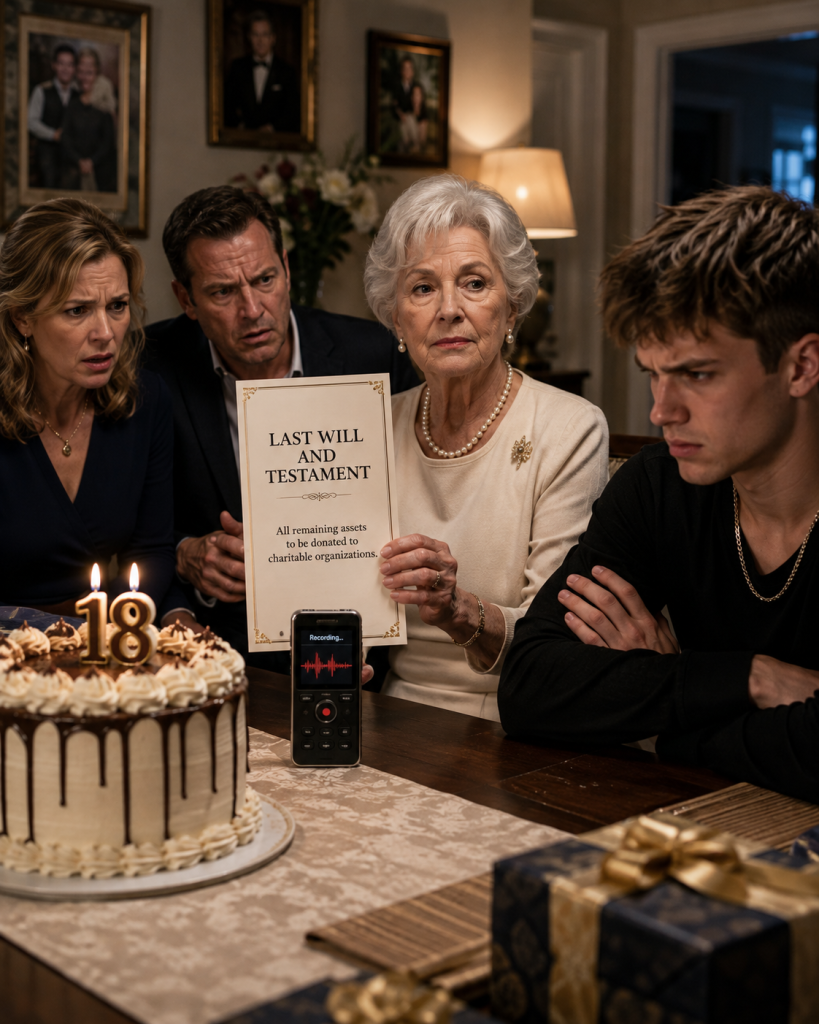
At his birthday dinner, I placed my digital recorder beside the cake and slid over a new will leaving my house and remaining savings to charity.
His father went pale.
The morning he said it, the kitchen still smelled like butter, vanilla, and blueberries. I was standing at the stove, making the pancakes Axel had loved since he was little, while he sat in my late husband’s chair scrolling through his phone.
Harold used to sit there with coffee and read the paper aloud to me, but that morning our grandson used the same chair like a throne and spoke about my death as if he were checking the weather.
I asked him to repeat himself because some part of me still wanted to believe I had heard wrong. Axel looked up with the bored impatience of a boy waiting for a waitress to move faster.
He said his mother and father already talked about how much easier life would be once I was gone, because a nursing home would waste money that could go toward his car, college, and everything else he deserved.
The pancake burned black in the pan while I stood there with the spatula in my hand.
I had paid for that boy’s braces, cleats, private school, and first car. I had sent his parents money every month because Livia cried that the mortgage was too much and Quentyn promised it was only temporary. I kept giving because I thought family meant showing up, even when it hurt.
What Axel did not know was that I carried a small digital recorder in my apron pocket. I started using it after Harold died, mostly for meetings with doctors and lawyers, because grief had taught me that memory can be challenged when a widow is alone.
My thumb found the button while Axel kept talking, and his own voice saved every word he thought I was too old to defend.
Three days later, I heard the rest.
I had gone to Livia’s house with papers for a refinancing they wanted me to help pay for, and I stepped into the foyer when nobody answered the door. From the kitchen, Quentyn was saying they could not wait twenty years for me to die naturally. Livia worried long-term care would eat the estate, and Axel wanted to know how much he would really get.
I stood against the wall with my hand over my mouth while my son-in-law explained his plan. He had been building a medical file, mentioning my memory to a new doctor, collecting little moments that could be twisted into proof I was confused. Once I was in assisted living, he said, they could get power of attorney, control my accounts, and preserve the estate for the family.
The estate.
That was what they called the money Harold and I had earned over a lifetime. They did not know most of it had already gone to them, one emergency at a time, because I had never wanted them to feel ashamed for needing help. I drove home that night with two recordings, a shaking heart, and the clearest mind I had had in years.
By Monday, my financial adviser had heard the recordings.
By Tuesday, my estate attorney had drafted new documents.
By Wednesday, a geriatric psychiatrist had signed a report saying I was fully competent.
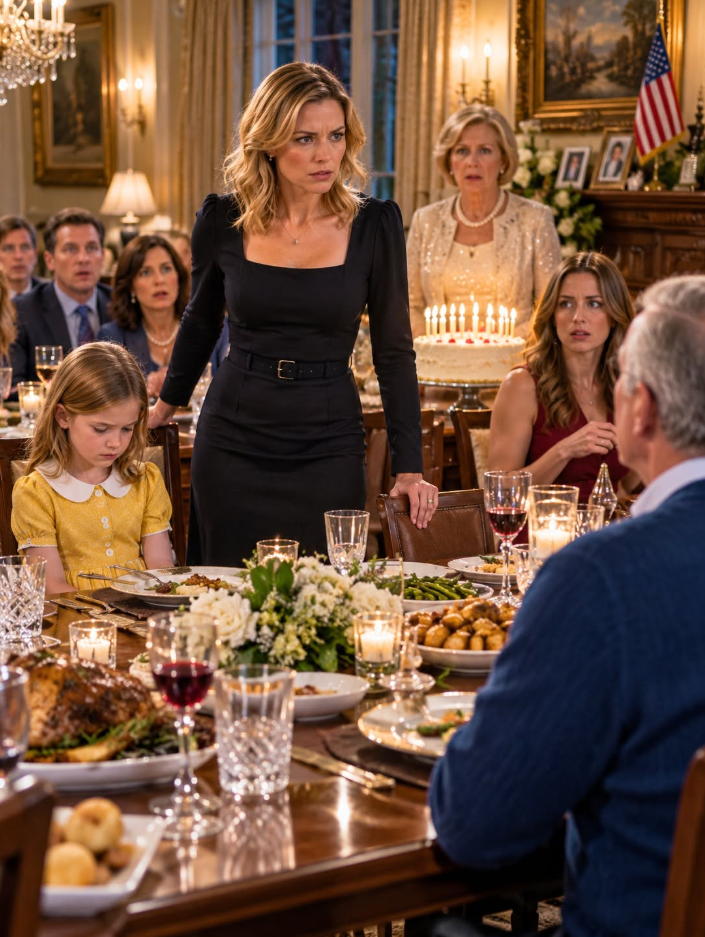
By Friday evening, Axel’s birthday cake was on my dining room table, and the three people who had planned to bury me alive were sitting in my house with forks in their hands.
Livia smiled too brightly. Quentyn asked how my money meeting had gone. Axel stared at the hallway, waiting for the gift he thought would buy his dream car.
I cut the cake slowly, wiped the knife clean, and set my recorder beside the candles.
Then I pressed play.
Part 2
Quentyn’s voice filled the dining room first, smooth and cold, explaining how they could “encourage” me into assisted living and then claim I was not mentally competent to handle my own accounts.
Livia stopped smiling before the first sentence ended. Axel’s fork hovered above his cake, and for once, the boy who always had an answer did not even blink.
I let the recorder play long enough for them to hear themselves talk about my life like it was an old car they could trade in. Then I stopped it and placed a manila envelope on the table.
Inside were:
Copies of the recordings
The doctor’s report
The trust papers
The new will that removed every relative who had mistaken my kindness for weakness
Livia whispered that I had misunderstood. Quentyn tried to stand and use his business voice on me, but his hand slipped against the tablecloth.
I told them:
The monthly support ended that night.
The professional guardian would step in if I ever needed help.
The rest of my estate would go to charities that fed children instead of adults who waited for widows to die.
That was when Axel finally spoke. He did not apologize.
He pointed at the envelope and said, “You can’t do this. That’s supposed to be ours.”
I picked up the second recording—the one from my kitchen—and his face changed before I pressed play.
Part 3: The Broken Mask
The sound of his own voice echoing in the dining room was a different kind of punishment.
It wasn’t Quentyn’s calculated scheme or Livia’s quiet desperation—it was the flat, brutal arrogance of an seventeen-year-old boy who thought he was untouchable. “You’re nothing to us but the estate, Grandma. Die already so we can split it.”
Axel’s hand jerked, knocking his water glass over. A dark, cold wave spread across the white tablecloth, soaking into the fresh slice of chocolate cake I had cut for him. Nobody reached for a napkin.
“Turn it off, Mom,” Livia choked out, her face flushed red with a sudden, ugly shame. “Please. Turn it off.”
I reached out and pressed stop. The quiet that returned to the house was heavy, absolute, and utterly clear.
“That was Tuesday,” I said softly, my voice barely louder than a whisper, yet it cut through the room like iron. “While the butter was melting in the pan. The same pan I used to make your breakfast every Saturday morning after your grandfather died.”
Axel stared down at his ruined cake, his jaw working as he tried to swallow hard. His cool, bored demeanor—the mask he had worn for two years to act like his father—was rapidly crumbling.
“You listened to us,” Quentyn said. The panic in his eyes had turned into something sharp and ugly. He leaned over the table, his knuckles turning white as he gripped the wood. “You set us up. You brought us into your home and recorded us like a criminal prosecution. Is this what Harold taught you? To spy on your own family?”
“Harold taught me to protect what we built,” I said, looking him dead in the eye. “And Harold loved a family that loved him back. You are not that family, Quentyn.”
“Mom, think about what you’re doing!” Livia sobbed, her hands flying to her face. “Axel is a boy! He doesn’t know what he’s saying! He repeats things he hears, he’s stressed about college—”
“He is seventeen years and three hundred and sixty-four days old,” I corrected her. “At midnight, he becomes an adult in the eyes of the law. And tonight, he learned the cost of his words.”
Quentyn snatched the manila envelope off the table, tearing the metal clasp as he yanked out the documents. He flipped through the pages with frantic speed, searching for a legal loophole, a flaw, a soft spot in my armor. But my attorney was not a cheap family lawyer. He was a ruthless estate specialist whom Harold had trusted for thirty years. Every trust was revoked. Every power of attorney was dissolved.
“A psychiatric evaluation?” Quentyn spat, staring at the seal from Dr. Aris. “You went behind our backs to a shrink?”
“I went to an independent doctor to ensure that when you eventually try to drag me into court, claiming I’m senile, a judge will read this report and realize the only illness in this family is your greed.”
Quentyn’s face darkened, a vein pulsing near his temple. “We can contest this. You can’t disinherit your only daughter and grandson without a battle. We will sue you for every dime, Mom. You’ll spend the rest of your life in courtrooms.”
I looked at my daughter, who was trembling, and then at my son-in-law, whose arrogance had finally blinded him completely.
“You could try,” I said evenly. “But if you file a single motion against my estate, my attorney has instructions to release both audio recordings to your firm’s ethics board, Quentyn. And to the school board where Livia works as a counselor.”
Quentyn froze. The color drained from his lips, leaving him looking hollow and defeated.
“You wouldn’t,” he whispered.
“Try me,” I replied. “I have nothing left to lose except my peace, and I have already bought that back tonight.”
Part 4: The Reckoning
They did not finish the cake.
Within ten minutes, Quentyn was packing up their coats in silence, his movements jerky and panicked. Livia lingered by the dining room doorway, looking at me with eyes full of a strange, bitter sorrow—not for the loss of me, but for the loss of the cushion that had saved them from their own bad financial choices for fifteen years.
“You’re throwing us away,” she whimpered, her hands trembling around her purse straps. “After everything…”
“I didn’t throw you away, Livia,” I said, standing by the fireplace, my hands resting calmly over Harold’s old pocket watch. “I stood in this house for five years, leaving the door wide open, waiting for a daughter who wanted to visit her mother, not a bank. You threw yourselves away the moment you decided my life was an obstacle to your comfort.”
She opened her mouth to argue, but no words came out. She turned and walked out the front door, the screen door swinging shut behind her with a dull thud.
Quentyn followed without a word, his shoulders hunched, his head low.
Only Axel remained sitting at the table.
He hadn’t moved since the recording stopped. The kid who always had a snappy comeback, who walked around my living room like he owned the walls, looked small in his oversized designer shirt—a shirt I had bought him for Christmas.
“Axel,” I said softly.
He flinched. He slowly lifted his head, his eyes glassy with tears he was desperately trying to hold back. For the first time in years, he didn’t look like his father’s apprentice. He looked like the seven-year-old boy who used to scrape his knees in my backyard and ask me to kiss the pain away.
“Are you… are you really taking away my college fund?” he asked, his voice cracking on the last word.
“The money in that trust was created by your grandfather,” I said, walking slowly over to the table and leaning against the chair opposite him. “He worked sixty hours a week in a steel mill so his children and grandchildren wouldn’t have to break their backs. He gave it with love, Axel. But you told me I was nothing to you but a dead woman holding a checkbook.”
“I was angry,” he stuttered, tears finally spilling over his cheeks. “I was just… dad said—”
“Your father taught you to be cruel, but you chose to obey him,” I cut in gently, but firmly. “You are old enough to understand that words have weight. When you cut someone, you cannot expect them to hand you a prize while they bleed.”
He wiped his face with the back of his sleeve, looking down at his hands. “What am I supposed to do now?”
“You’re going to grow up,” I told him. “You’re going to get a job. You’re going to apply for financial aid. You’re going to learn what an hour of hard work feels like, and maybe—just maybe—you’ll learn to respect the people who give you a roof over your head.”
I reached into my pocket, pulled out a small, velvet box, and set it next to his plate, right beside the stained paper documents.
“Happy eighteenth birthday, Axel.”
He looked at the box, but didn’t open it. He knew what was inside. It was Harold’s silver compass, the one he had promised to give Axel when he came of age.
“I don’t want your money,” I said quietly. “I wanted your love. But since you couldn’t give me that, I will settle for your respect.”
Axel stared at the compass for a long moment. He didn’t yell. He didn’t fight back. He slowly picked up the box, stood up from the chair, and walked out into the cold night air, leaving the front door open behind him.
Part 5: A House Made of Light
The house was quiet again.
I didn’t sweep the floor right away. I didn’t wash the blue-stained cake plate or wipe the spilt water off the mahogany table. Instead, I walked over to the front porch, pulling a woolen sweater over my shoulders against the chill of the evening breeze.
Down at the bottom of the driveway, the taillights of Quentyn’s car flickered once, then vanished into the darkness of the suburban road. They were gone. The monthly checks were gone. The illusions of a happy family were gone.
I sat down on the porch swing—the same swing Harold and I had built during our second year of marriage. The wood squeaked comfortably under my weight, a familiar, steady rhythm in the quiet night.
For five years, I had lived in fear. I had feared the day I would become too old to care for myself, feared the silent resentment of my daughter, feared the subtle nudges toward a life confined to four sterile walls while strangers managed my life. I had turned myself into a ghost in my own home, tiptoeing around their demands, paying for their peace while sacrificing my own.
I reached into my sweater pocket and pulled out the small recorder.
I looked at the little red light that had saved me. I held it for a long moment, feeling the cold plastic in my palm, and then I pressed the master reset button.
Delete all files? the little screen asked.
I pressed Yes.
The whispers of my son-in-law, the bitter complaints of my daughter, and the cold words of my grandson disappeared into nothingness. I didn’t need them anymore. I didn’t need proof of their betrayal to justify my freedom.
The next morning, the sun broke through the oak trees in the backyard, pouring golden light across the kitchen floor. The smell of burnt pancakes was gone, replaced by the crisp, clean scent of fresh pine air flowing through the open windows.
My financial adviser called at nine to confirm that the new trust had been finalized. The local children’s shelter and the community library would receive the entirety of the estate upon my death. They would use it to build classrooms, buy books, and feed children who had nothing.
At ten, a team from the local garden center arrived to help me clear out the overgrown flowerbeds Harold had loved so much. By noon, we were planting fresh roses—red, yellow, and white—along the front fence.
I spent the afternoon sitting in the kitchen, drinking hot tea from Harold’s favorite mug.
For the first time since my husband died, the silence in the house didn’t feel like emptiness. It felt like space. Space to breathe, space to read, space to live without waiting for permission from people who only loved my shadow.
They thought they were planning my funeral. But as I watched the breeze move through the trees in my yard, knowing every square inch belonged to me and my peace, I smiled.
They had come to divide an estate. But all they had left behind was a woman who had finally remembered how to live.