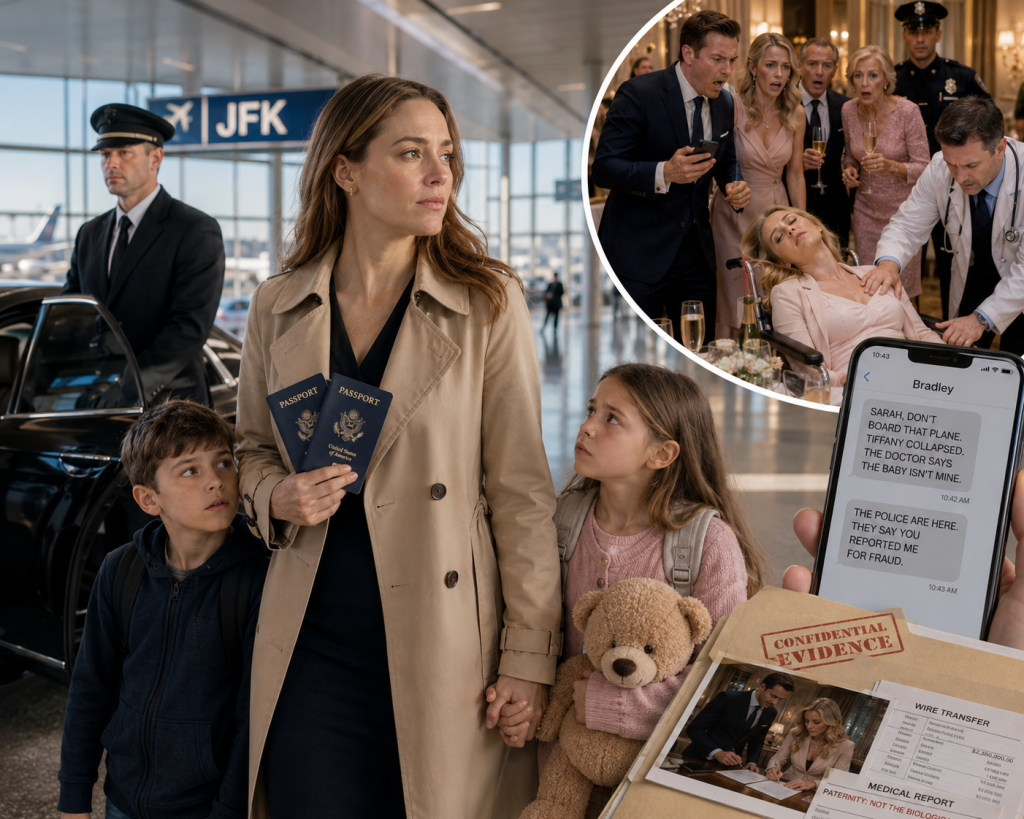
The automatic doors of JFK slid open in front of me, and for a moment the world seemed too bright.
Fluorescent lights reflected off polished floors. Suitcases rolled over tile in every direction. Families hurried past with boarding passes clutched between fingers, children tugging sleeves, voices rising and falling in a dozen languages.
Connor stood close to my side, his backpack hanging off one shoulder. Madison held my hand with both of hers, as if the airport itself might carry her away if she loosened her grip.
“Mom,” Connor said softly, “are we really leaving today?”
I looked down at my son.
At nine years old, Connor had already learned to ask questions carefully. Too carefully. He had inherited Bradley’s gray eyes but none of his coldness. His were open and worried, searching my face for the truth before I said it.
“We are,” I told him.
Madison leaned against my coat. “Will our rooms be big?”
A small laugh escaped me before I could stop it. After months of swallowing every emotion until it turned into something hard inside my chest, her question was so wonderfully normal that it nearly broke me.
“I don’t know yet,” I said. “But your grandfather said there’s a garden.”
“A real garden?” she asked.
“A real one.”
“With flowers?”
“I think so.”
“With snails?”
Connor made a face. “Why would you want snails?”
Madison ignored him. “Can I name them?”
I crouched in front of them, lowering myself until I was eye level with both of my children. Around us, travelers flowed like water, but for a few seconds we were still.
“We’re going somewhere new,” I said. “And I know that can feel scary. It feels scary to me, too.”
Connor’s brows pulled together. “Are you scared?”
“I’m nervous,” I admitted. “But I’m also sure.”
That was the difference.
Fear had kept me quiet for years. Certainty was what had finally moved my feet.
My phone buzzed again.
Bradley.
I didn’t answer.
Then Brittany.
Then Bradley’s mother, Elaine.
Then an unknown number.
I turned the phone face down in my palm and stood.
“Come on,” I said gently. “Let’s check in.”
We had barely taken three steps before a woman in a navy blazer approached us from near the airline counters. She was in her fifties, with silver-streaked dark hair pulled neatly back and the composed posture of someone used to solving other people’s crises.
“Sarah Bennett?” she asked.
My stomach tightened.
“Yes.”
She offered a small, reassuring smile and held out a leather folder. “I’m Margaret Ellis. I work with your father’s legal team in New York. He asked me to meet you here before your departure.”
I glanced instinctively at the children.
Margaret noticed.
“This is not an emergency,” she said calmly. “Your flight is still scheduled. Your father only wanted to make sure you had everything you needed.”
“Does he always send people instead of calling?” I asked before I could soften the words.
Margaret’s expression did not change, but something in her eyes warmed. “When he thinks a phone call won’t be enough.”
It was the sort of answer Harrison Cole would give. Practical. Controlled. Infuriating.
I had not spoken to my father properly in almost seven years.
Not since Bradley convinced me that Harrison’s silence meant indifference.
Not since I convinced myself that pride was easier to carry than disappointment.
Margaret handed me the folder. “There are copies of the children’s immigration documents, emergency contacts in London, and temporary housing details. Your father also included a note.”
I stared at the folder for a second too long before accepting it.
“Thank you.”
She nodded. “There is one more thing.”
Of course there was.
Margaret lowered her voice. “Bradley’s attorney has filed an urgent motion.”
The airport noise seemed to dim around me.
“What kind of motion?”
“He’s attempting to block international travel for the children.”
My hands went cold.
Connor looked up at me. “Mom?”
I forced my face to stay calm. “It’s okay.”
Margaret turned slightly, shielding the children from the conversation without making it obvious. “The paperwork was filed twenty minutes ago. It’s rushed, and frankly, not well supported. Your custody agreement grants you primary physical custody and permits relocation for employment and family support, provided notice was given.”
“I gave notice through my attorney last week,” I said. “He didn’t even respond.”
“We have that record.”
“Then can he stop us?”
“Not lawfully, based on the current order,” Margaret said. “But he may try to create confusion at the airport.”
I understood what she meant.
Bradley did not have to win in court to hurt me. He only had to delay us long enough to make the children frightened, to make me look unstable, to turn our clean escape into another scene he could narrate later.
A scene where Sarah overreacted.
Sarah was dramatic.
Sarah tried to take his children.
For ten years, Bradley had never needed to shout to be believed. He only had to speak first.
My phone buzzed again.
This time, the text came from Elaine.
How could you do this to him today?
I stared at the words until they blurred.
Today.
As if this day belonged to Bradley and Tiffany.
As if the children and I were only inconvenient details in his celebration.
Margaret must have read something in my face. “You don’t have to respond.”
“I know,” I said.
But knowing and doing were different things.
I opened the message thread with Bradley.
There were thirteen unread messages.
SARAH PICK UP.
THIS IS SERIOUS.
TIFFANY IS HYSTERICAL.
THE DOCTOR IS WRONG.
WHY DID YOU SEND POLICE TO THE CLINIC?
YOU DON’T UNDERSTAND WHAT YOU’VE DONE.
PLEASE.
That last word stopped me.
Bradley rarely said please.
In our marriage, please had been replaced by expectations. He didn’t ask me to host dinners for his clients; he said they were coming. He didn’t ask me to forgive missed birthdays; he said things came up. He didn’t ask me to shrink my life until it fit around his ambitions; he behaved as though any other choice would be unreasonable.
Please meant he had lost control of the room.
I put the phone away.
“Let’s get the kids checked in,” I said.
Margaret walked with us to the priority counter. The children watched the suitcases disappear behind the belt with quiet fascination. Madison waved goodbye to her purple suitcase as if it were leaving for camp.
The simple innocence of it steadied me.
Whatever Bradley had done, whatever Tiffany had hidden, whatever my father had uncovered, Connor and Madison were not evidence. They were not leverage. They were not symbols of victory or loss.
They were children.
They needed breakfast. They needed kindness. They needed one adult who would not make them responsible for adult pain.
After security, Margaret stayed with us until we reached the lounge entrance.
“Your father will meet you at Heathrow,” she said.
I looked at her sharply. “He’s coming himself?”
“He is already in London.”
Of course he was.
A man like Harrison Cole did not rush. He positioned.
Margaret hesitated. “Sarah, I know this is not my place, but he has wanted to reach out many times.”
I almost smiled. “But he didn’t.”
“No,” she said. “He didn’t.”
The honesty surprised me.
“He thought giving you space was respect,” Margaret continued. “I suspect it felt more like abandonment.”
I swallowed.
Years ago, when I first brought Bradley home, my father had disliked him immediately. Not loudly. Harrison was never loud. He had simply observed Bradley across a dinner table, asked three pointed questions about his business, and then taken me aside afterward.
That man enjoys being admired more than he enjoys being known.
I had been twenty-seven and deeply in love.
I told my father he didn’t understand Bradley.
My father said, “I hope you’re right.”
When he refused to invest in Bradley’s first major project, Bradley called it humiliation. Over time, every distance between my father and me became evidence in Bradley’s story.
Your father thinks you’re weak.
Your father wants to control you.
Your father never respected our marriage.
Eventually, I stopped answering Harrison’s calls because it was easier than defending them.
Then the calls stopped.
I told myself he had given up.
Maybe we both had.
“Thank you, Margaret,” I said.
She gave my arm a brief, professional squeeze. “Call me if anyone approaches you before boarding.”
Inside the lounge, Madison discovered a tray of miniature muffins and treated it as proof that London would be wonderful. Connor sat across from me, pretending to play a game on his tablet while clearly watching my face.
“Dad’s mad,” he said.
I looked at him.
He did not ask it like a question.
I set my tea down. “Your dad is having a difficult day.”
“Because we’re leaving?”
“Partly.”
Connor’s jaw tightened. “He didn’t want us at his new baby thing.”
The words were quiet, but they hit with precision.
I had tried to protect them from the details. I had failed in the way all parents fail when adults are careless within earshot of children.
“Connor—”
“I heard Aunt Brittany,” he said. “At Grandma’s house. She said Tiffany’s baby was his second chance.”
Madison stopped peeling the paper from her muffin.
My heart folded in on itself.
“A second chance at what?” Madison asked.
Connor looked down. “Nothing.”
I reached across the table and took his hand.
“Listen to me,” I said. “Adults sometimes say things that are more about their own feelings than the truth. You and Madison are not anyone’s failed first chance. You are not practice. You are not old family. You are my children, and nothing about this move changes how much you are loved.”
Connor did not cry.
That almost made it worse.
He just nodded once, like a boy accepting instructions he would try hard to follow.
Madison slid half of her muffin toward him. “You can have the top part.”
Connor looked at it.
“The top is the best part,” she added.
He took it, and that small exchange nearly undid me.
My phone buzzed again, this time with a call from my attorney, Denise Alvarez.
I stepped a few feet away, keeping the children within sight.
“Tell me we can still board,” I said as soon as I answered.
“You can still board,” Denise replied. “But Bradley is making noise.”
“What kind of noise?”
“He claims you concealed the relocation plan.”
“I didn’t.”
“I know. I have the email receipts. He also claims you’re emotionally unstable.”
A bitter laugh rose in my throat. “Of course.”
“And,” Denise added carefully, “he is claiming you fabricated the fraud allegations out of jealousy over Tiffany’s pregnancy.”
I looked through the glass wall of the lounge at planes waiting on the tarmac.
“Denise, I didn’t even submit the report about the baby.”
“I know.”
“Then how did he find out?”
There was a pause.
That pause turned the air around me thin.
“Denise?”
“The clinic contacted him after their own testing revealed inconsistencies,” she said. “That part didn’t come from us.”
I closed my eyes.
Somewhere across the city, Tiffany was sitting in a private room under soft lighting, surrounded by flowers and people who had treated her baby as a coronation. And suddenly all of them had questions she could not answer.
I did not feel triumph.
That was the strange part.
For months, I had imagined Bradley being forced to face the truth. I thought it would feel like justice. Instead, I felt only tired. Sad, even. Not for him, exactly, but for the ruin people created when they mistook desire for destiny.
“What about the financial evidence?” I asked.
“The forensic accountant has enough to file a formal complaint. Some of the transfers appear to have passed through a company tied to Tiffany’s brother.”
“Tiffany has a brother?”
“Older. Nathan Vale. Small-time developer, a few lawsuits, nothing dramatic. But he may be the reason Harrison’s people caught the property purchase.”
I opened my eyes.
“Why?”
“Because Nathan tried to secure financing from Cole International two years ago. Your father’s team flagged him then.”
The past was beginning to rearrange itself in front of me, one hidden connection at a time.
“Sarah,” Denise said, “there’s something else. Bradley’s attorney is asking for a settlement conference tomorrow.”
I frowned. “We finalized the divorce this morning.”
“They’re trying to reopen financial disclosures.”
“Because he got caught?”
“Because he knows he got caught.”
A boarding announcement echoed faintly overhead, not ours yet.
“What do you recommend?”
“Board the plane,” Denise said. “Get the children settled. Do not answer Bradley, Brittany, Elaine, Tiffany, or anyone connected to them. Once you land, we’ll coordinate with London counsel.”
“And if Bradley comes here?”
“Airport security already has a copy of the custody order. Margaret handled it.”
I looked back at my children.
Madison was drawing something on a napkin. Connor was watching a plane taxi away, his expression older than it should have been.
“I don’t want them dragged through this,” I said.
“Then don’t let Bradley set the pace,” Denise replied. “That’s what he wants. Panic makes people sloppy. You have documents. You have custody. You have time.”
Time.
For years, time had belonged to everyone else. Bradley’s meetings. Bradley’s dinners. Bradley’s moods. His mother’s expectations. His sister’s commentary. Tiffany’s arrival. Even my grief had been scheduled around school pickups and unpaid bills.
Now, for the first time in a decade, time felt like something I could reclaim.
After I ended the call, I returned to the table.
Madison held up her napkin. “This is our London house.”
The drawing had a crooked roof, six flowers taller than the windows, and three smiling stick figures in the garden.
Three.
Not four.
Connor noticed too, but neither of us said anything.
“It’s beautiful,” I told her.
She beamed.
Then my phone vibrated with one more message.
Not from Bradley.
From Tiffany.
I stared at the name, surprised it was even still in my contacts. She had entered my life as “Tiffany – Bradley office” years ago, back when she was supposedly helping him coordinate client events. I had cooked dinner for her once. She had complimented the wallpaper in my kitchen and asked where I got Madison’s little ceramic bunny on the windowsill.
A week later, Madison’s bunny disappeared.
At the time, I told myself children misplace things.
Now I wondered how long Tiffany had been collecting pieces of my life before deciding she deserved the whole thing.
The message contained only four words.
Please hear me out.
I did not respond.
Then another message appeared.
Bradley doesn’t know everything.
My thumb hovered over the screen.
I hated that it worked.
I hated that curiosity could still cut through exhaustion.
A third message arrived.
Your father does.
The lounge seemed to tilt.
I looked toward the windows, toward the gray runway and the planes lining up like enormous birds ready to flee.
My father.
Again.
I typed nothing. I called Margaret instead.
She answered immediately.
“Has something happened?”
“Tiffany just messaged me,” I said. “She says my father knows something Bradley doesn’t.”
Margaret was silent.
Not confused.
Not surprised.
Silent.
“What does that mean?” I asked.
“I’m not certain.”
It was a careful answer.
Too careful.
“Margaret.”
She exhaled softly. “Sarah, your father asked that certain information be delivered in person after you land.”
My pulse quickened. “Information about Tiffany?”
“I believe it concerns several people.”
“That’s not an answer.”
“No,” she agreed. “It isn’t.”
For a moment, I wanted to be angry at her. It would have been easier than admitting I was afraid. But Margaret was only the messenger. Harrison had always liked messengers. Letters. Lawyers. Assistants. Drivers. Anyone who could carry truth close enough to touch without forcing him to place it directly in someone’s hands.
“I’m tired of being protected by silence,” I said.
“I understand.”
“Does he?”
Margaret did not answer.
The boarding call for our flight appeared on the screen across the lounge.
London Heathrow.
On time.
I watched the letters glow in calm blue light.
“We’re boarding,” I said.
“Then board,” Margaret replied. “Whatever Tiffany is trying to do, she chose her timing for a reason.”
I knew that.
Bradley used pressure like a tool. Tiffany used vulnerability. Elaine used guilt. Brittany used ridicule.
My father used silence.
And I was done letting other people’s methods determine my choices.
I gathered the children’s things.
“Ready?” I asked.
Madison tucked the napkin drawing into her backpack. “Will Grandpa like me?”
The question struck me gently but deeply.
“He already does,” I said.
“But he doesn’t know me.”
“No,” I admitted. “Not yet.”
Connor adjusted his backpack. “Why didn’t we see him before?”
There it was.
The question I had avoided because I had no clean answer.
Because Mom was proud.
Because Dad lied.
Because Grandpa was stubborn.
Because sometimes adults build walls and then forget their children are standing behind them.
“We made mistakes,” I said. “Grown-up mistakes. But he wants to know you now, and I think we should give him the chance to show us who he is.”
Connor considered that.
“Does Dad get chances too?”
I looked at my son for a long moment.
“Yes,” I said quietly. “But chances are not the same as pretending nothing happened.”
He nodded.
This time, I saw him understand.
Not completely. He was too young for completely.
But enough.
We boarded early. Madison insisted on the window seat, Connor took the middle, and I sat on the aisle. As the cabin filled, my phone continued to buzz until I turned it off entirely.
For one breath, I worried that doing so made me irresponsible.
Then I realized how deeply Bradley had trained me to confuse availability with duty.
The plane pushed back from the gate.
Madison pressed her forehead to the window. “We’re moving.”
“Yes,” I whispered.
Connor gripped the armrest as the engines grew louder.
I reached for his hand.
The city blurred past.
Then the plane lifted.
New York fell away beneath us, sharp and glittering and distant.
For the first time all day, I cried.
Not loudly. Not dramatically.
Just tears slipping down my face while my children stared out at the clouds, believing perhaps that their mother was watching the view.
Somewhere below, Bradley’s world was unraveling.
But mine was not beginning with his destruction.
Mine was beginning because I had finally chosen to leave.
By the time we reached cruising altitude, Madison had fallen asleep with her mouth slightly open and one hand tucked under her cheek. Connor watched a movie without really watching it. I opened the leather folder Margaret had given me.
The first documents were exactly what she said they were.
Copies of visas.
School recommendations.
Temporary residence details.
A townhouse in Kensington.
I paused at the address.
Not a hotel. Not a corporate apartment.
A home.
There was a photograph clipped to the page: pale brick, black door, white-trimmed windows, and window boxes full of purple flowers. A small iron gate guarded the front steps.
Behind that page was a handwritten note.
Sarah,
I have made many errors. Some came from pride, some from restraint, and some from believing that watching from a distance was less harmful than interfering. I was wrong.
You do not owe me forgiveness upon arrival. You do not owe me warmth, explanations, or trust.
You and the children will have safety first. The rest can take as long as it takes.
Dad
I read it twice.
Then a third time.
There was nothing poetic about it. Nothing dramatic. But my father had never wasted words, and the ones he chose pressed gently against years of old hurt.
You do not owe me forgiveness.
Bradley had always demanded forgiveness as if it were proof of loyalty. Elaine expected it as payment for keeping peace. Brittany mocked the need for it. Tiffany performed innocence until forgiveness felt like a trap.
My father, for all his failures, was the first person in years to say I could take my time.
I folded the note carefully and placed it back in the folder.
Behind it was a sealed envelope with my name on it.
Not Sarah Bennett.
Sarah Cole.
My maiden name.
I touched the ink.
The envelope was heavy, and there was a handwritten line beneath my name.
Open only when you are alone.
I looked at my sleeping daughter, then at my son, who had finally leaned back and closed his eyes.
I did not open it.
Not yet.
Hours passed in the strange suspended world of flight. Meals came and went. Lights dimmed. The children slept. I drifted in and out of uneasy dreams where Bradley stood in the doorway of our old penthouse holding Madison’s missing ceramic bunny, asking why I had left without saying thank you.
When the plane finally descended through layers of cloud, morning light spread over London in soft gray bands.
Madison woke just in time to see the city appear beneath us.
“It looks like a storybook,” she whispered.
Connor leaned across her to see. “It looks old.”
“Old can be beautiful,” I said.
He glanced at me. “Like Grandpa?”
Despite everything, I laughed.
He smiled for the first time all day.
At Heathrow, we moved through immigration with surprising ease. Harrison’s paperwork was meticulous. Of course it was. Outside baggage claim, a tall man in a dark overcoat stood near the arrivals barrier.
For a second, I saw the father of my childhood.
The man who taught me how to ride a bicycle in the courtyard of our Boston home, jogging beside me in shirtsleeves and polished office shoes.
Then I saw the years between us.
More silver in his hair. Deeper lines around his mouth. A stiffness in his shoulders that had not been there before.
Harrison Cole looked powerful to strangers.
To me, in that moment, he looked afraid.
Madison spotted him first. “Is that Grandpa?”
He heard her.
Something changed in his face. The controlled expression cracked just enough for longing to show through.
“Yes,” I said. “That’s Grandpa.”
We walked toward him.
For a moment, no one spoke.
Then Harrison crouched, despite the obvious discomfort it caused his knees, so he could meet the children at their level.
“Connor,” he said. “Madison. I’m very glad you’re here.”
Madison tilted her head. “Do you have snails in your garden?”
Harrison blinked.
Connor looked embarrassed. “She wants to name them.”
A slow smile spread across my father’s face.
“I haven’t counted,” he said, “but I suspect we can make inquiries.”
Madison considered this a satisfactory answer and stepped forward to hug him.
Harrison froze for the smallest fraction of a second.
Then his arms came around her carefully, as if she were something precious and breakable.
Connor did not hug him.
He offered his hand.
Harrison accepted it gravely. “A pleasure.”
Connor nodded, pleased despite himself.
Only then did my father look at me.
“Sarah.”
“Dad.”
There were entire years inside those two words.
He did not try to hug me. I was grateful and hurt by that at the same time.
“The car is outside,” he said. “You must be exhausted.”
“We are.”
As we walked, Harrison kept pace beside the children instead of beside me. He answered Madison’s questions about double-decker buses, explained to Connor that football in England meant soccer, and solemnly agreed that jet lag sounded like a disease but was not contagious.
I watched him with them and felt something loosen in my chest.
Not forgiveness.
Not yet.
But maybe the first fragile shape of possibility.
The Kensington townhouse was exactly like the photograph, except warmer. Inside, sunlight fell across wooden floors. Fresh flowers stood in a blue vase on the entry table. The kitchen smelled faintly of bread, butter, and something cinnamon.
Madison ran from room to room in wonder.
Connor tried to look unimpressed, but when he found the small back garden, his face lit up before he could stop it.
“There’s a goal,” he called.
Sure enough, a small soccer goal stood at the far end of the garden.
I looked at Harrison.
He cleared his throat. “Margaret mentioned he played.”
Played.
Not used to play.
Not before Bradley forgot practices and fees became inconvenient.
Connor ran outside.
Madison followed, shouting that she had found a snail and it looked like an Oliver.
For the first time in what felt like years, my children’s voices filled a house without tension following behind them.
Harrison and I stood in the kitchen, alone.
The silence was enormous.
He removed his gloves slowly. “Tea?”
I almost laughed. “That’s where you want to start?”
“No,” he said. “But it’s the only place I know how.”
That honesty disarmed me more than an apology would have.
I sat at the kitchen island while he prepared tea with the concentration of a surgeon.
“Why now?” I asked.
His hand paused on the kettle.
“I tried before.”
“You sent birthday cards through your office.”
“I called.”
“Then you stopped.”
His jaw tightened. “Bradley answered once.”
I went very still.
“When?”
“Five years ago. You were pregnant.”
The room shifted.
“I lost that baby,” I said quietly.
“I know.”
My throat closed. “You knew?”
“Not until later.”
I remembered that time as a blur of white sheets, hospital smell, and Bradley telling me it was better not to tell anyone until I felt stronger. I remembered staring at my phone and wanting my mother, who had been gone since I was nineteen. Wanting my father. Wanting someone who would sit beside me without trying to turn grief into inconvenience.
Bradley told me he had called Harrison.
He told me Harrison said, These things happen.
It had been the last piece of ice between us.
“My God,” I whispered.
Harrison turned toward me.
His face had gone pale.
“What did he tell you?” he asked.
I shook my head. The words would not come.
My father gripped the counter. “Sarah.”
“He said you didn’t care.”
Harrison closed his eyes.
For a moment, the powerful financier disappeared entirely. In his place stood an old man carrying a grief he had not been allowed to share.
“I came to New York,” he said.
“What?”
“I flew in the next morning. Bradley refused to let me see you. He said you had asked for no visitors. He said my presence would distress you.”
I stood so quickly the stool scraped against the floor.
“No.”
“I waited at the hospital for four hours.”
“No,” I said again, because the truth had nowhere to go.
Harrison’s voice lowered. “A nurse finally told me you had been discharged.”
I pressed both hands over my mouth.
That day came back in fragments.
Bradley helping me into the car.
Bradley turning my phone off because I needed rest.
Bradley telling me no one had come.
I had believed him because pain made belief easier than questions.
Outside, Madison laughed. Connor shouted something about a goal.
Inside, another part of my marriage collapsed backward in time.
Harrison did not move toward me.
Maybe he wanted to. Maybe he knew better.
“I should have pushed harder,” he said.
I lowered my hands. “Yes.”
He accepted it.
No defense.
No explanation.
Just a small nod.
“Yes,” he said.
That was when I began to cry again.
Not the quiet tears from the plane, but the deep, uneven kind that came from places I thought had turned to stone.
My father stood across from me, helpless.
Then he walked slowly around the island and stopped a few feet away.
“May I?” he asked.
Such a small question.
Such an unfamiliar courtesy.
I nodded.
He embraced me gently, and for several seconds I did not hug him back. Then my hands gripped the back of his coat, and I was twenty-seven again, nineteen again, seven again, all the versions of myself who had missed him without knowing how to return.
“I’m sorry,” he said.
I believed him.
That did not fix everything.
But it mattered.
Later, after the children had eaten toast and fruit and fallen asleep in their new rooms before noon, Harrison and I sat in the study at the back of the house. Rain tapped softly against the windows. London seemed to exhale around us.
On the desk between us lay the sealed envelope from the plane.
“You told me to open it alone,” I said.
“I hoped you would wait until the children were settled.”
“They are.”
He nodded.
I opened it.
Inside was a single photograph and three pages of documents.
The photograph showed Tiffany much younger, perhaps nineteen or twenty, standing outside a hospital entrance in a pale blue sweater. Beside her was a woman I did not recognize at first.
Then recognition slid coldly through me.
Elaine.
Bradley’s mother.
Younger, but unmistakable.
They were not posing like strangers.
Elaine’s arm was around Tiffany’s shoulders.
“What is this?” I asked.
Harrison leaned back, his face grim.
“Tiffany did not enter Bradley’s life recently.”
I looked up.
“She knew him before?”
“She knew his family before,” Harrison said. “Particularly Elaine.”
The documents beneath the photo included old payments from a trust I had never heard of. Monthly transfers. Small at first, then larger. Paid to Tiffany Vale for nearly eight years.
My mouth went dry.
“Elaine was paying her?”
“Yes.”
“Why?”
“That is what I have not fully confirmed.”
I read the names again, hoping they would rearrange into something less impossible.
“They acted like Tiffany was new,” I said. “Like she was some unexpected blessing.”
“I know.”
“Bradley acted like—”
I stopped.
Bradley had acted surprised by many things over the years.
But Bradley’s surprise was often performance.
My phone, now connected to the townhouse Wi-Fi, began receiving messages in a flood. Missed calls. Voicemails. Texts.
One from Denise stood out.
Call me when you can. Bradley is claiming Tiffany targeted him. Tiffany is claiming Elaine arranged everything.
I looked slowly at my father.
“What did Elaine arrange?”
Before he could answer, the study door opened.
Connor stood there in socks, hair messy from sleep, holding something small in his hand.
“Mom?” he said. “I found this in Madison’s backpack.”
My stomach dipped.
“What is it?”
He came forward and placed it on the desk.
A little ceramic bunny.
White, with one chipped ear.
Madison’s missing bunny.
I stared at it, unable to speak.
Connor pointed to a tiny folded slip of paper tied around its neck with thread.
“I didn’t open it,” he said.
My father’s expression hardened.
With careful fingers, I untied the thread and unfolded the note.
There were only two lines, written in neat, unfamiliar handwriting.
Ask Harrison what happened to your mother’s shares.
Then ask him why Bradley was chosen.
Outside, rain streaked the glass.
Inside, my father went completely still.