PART 2
“You never gave me the chance.”
Sylvie’s words did not sound accusing.
That made them worse.
If she had shouted, I could have defended myself. If she had thrown every cruel sentence from our divorce back at me, I could have reached for anger and worn it like armor.
But she only looked tired.
Tired enough that the sharpness I remembered had softened around her eyes. Tired enough that even holding the twins seemed to require every ounce of strength she had left.
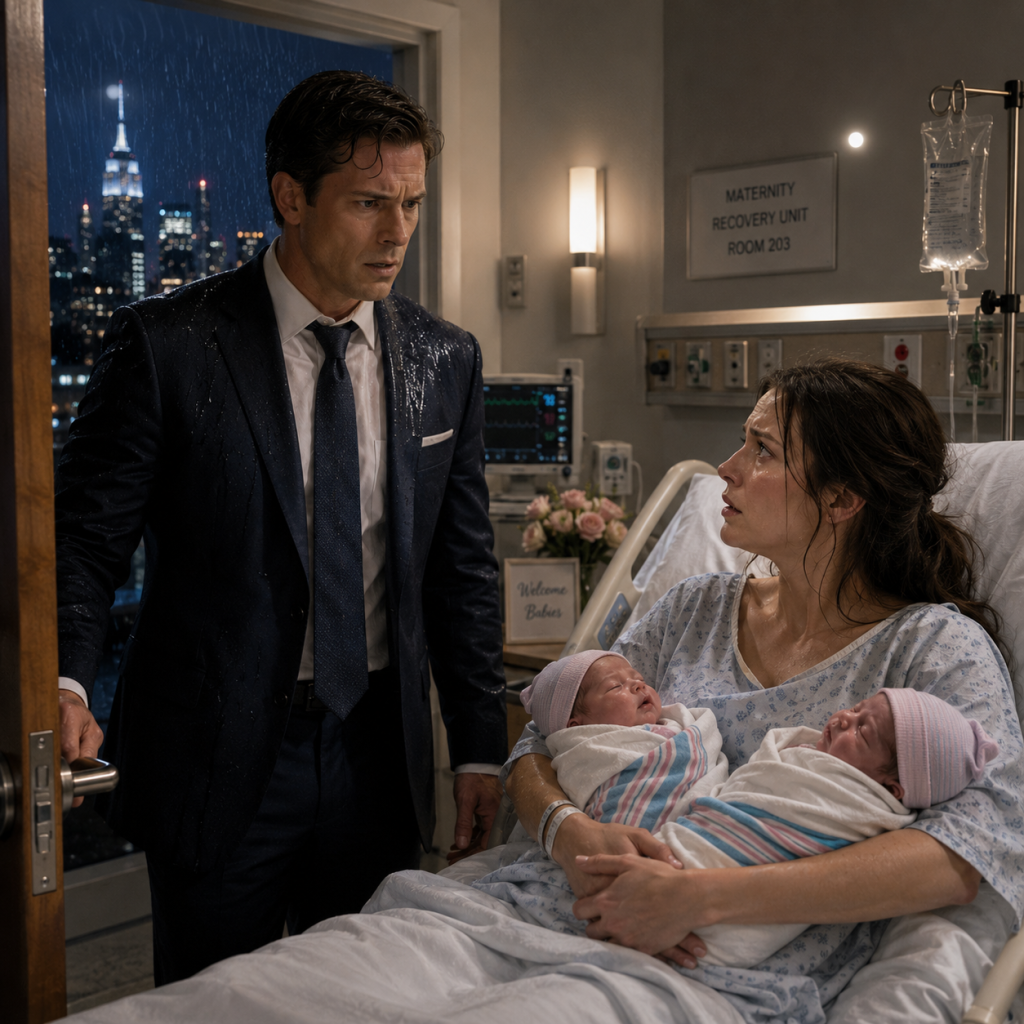
I stepped farther into the room and closed the door behind me.
The latch clicked quietly.
“What do you mean?” I asked.
Sylvie looked down at the infants in her arms.
One of them stirred, making a small sound like a question. Instinctively, she adjusted the blanket around him.
The tenderness of the gesture struck me harder than the sight of the babies themselves.
For seven months, I had trained myself not to think of Sylvie as my wife.
I had repeated the word ex until it lost all edges.
Ex-wife.
Former partner.
A closed chapter.
Yet here she was, holding two newborns as if she had crossed an entire ocean without me.
“They were born this afternoon,” she said.
I could barely hear her over the blood rushing in my ears.
“And you’re telling me they’re mine?”
“I’m telling you what I should have told you months ago.”
“You said I’m already their father.”
“You are.”
My throat tightened.
There were a hundred questions I could have asked.
Instead, the ugliest one came first.
“How do I know?”
Sylvie went very still.
The boy in her left arm slept on, unaware that his first hour with me had already been stained by suspicion.
Sylvie lifted her gaze.
“You don’t.”
Two words.
No fury. No insult.
Only a quiet acknowledgment of the man I had become.
She shifted carefully and nodded toward the clear bassinet beside the bed.
“Take her.”
I stared at the smaller baby.
The girl.
A pink knitted cap covered most of her dark hair. Her face was scrunched with the solemn displeasure of someone already unimpressed by the world.
“I don’t know how.”
“You’ll learn.”
“Sylvie.”
“My arms are shaking, Damon.”
That moved me.
Not the command.
Not the challenge.
The admission.
I crossed the room.
Every negotiation I had ever survived seemed simple compared with the act of sliding my hands beneath a seven-pound child.
“Support her head,” Sylvie said.
“I know that.”
“No, you don’t.”
“I’ve seen people hold babies.”
“That isn’t the same thing.”
I almost snapped back.
Then the girl opened her eyes.
Gray-blue.
Unfocused.
Trusting only because she did not yet understand that trust could be misplaced.
Something inside me faltered.
I lifted her from Sylvie’s arm.
She weighed almost nothing.
And somehow everything.
Her tiny body settled against my chest, one fist pressing into my shirt. I became aware of my heartbeat, too loud, too fast, as if she might hear the panic in it.
“There,” Sylvie whispered. “You’re doing fine.”
I looked at her.
The woman I had accused of manipulation was watching me hold her daughter with an expression so raw that I had to look away.
“What’s her name?”
“Lila.”
The baby shifted.
“Lila,” I repeated.
“And that’s Noah.”
My eyes moved to the boy resting against Sylvie.
Noah.
Lila.
Names chosen without me.
I told myself I had no right to feel wounded by that.
The feeling arrived anyway.
“Why didn’t you tell me?”
Sylvie exhaled slowly.
“I tried.”
“No, you didn’t.”
“I called you three times the week after I learned I was pregnant.”
“My assistant said you wanted to revisit the settlement.”
“Your assistant assumed that. I never said it.”
“You had my private number.”
“You changed it.”
“I changed it because someone leaked it.”
“I emailed you.”
“I never saw anything.”
“I sent a certified letter.”
That stopped me.
“What letter?”
“The one your legal department returned unopened.”
My jaw tightened.
“That doesn’t happen.”
“It did.”
I wanted to dismiss her.
Instead, I remembered the months after the separation. The endless meetings. The lawyers. The carefully controlled information. The way every message from Sylvie had been summarized for me before it reached my desk.
I had wanted distance.
I had instructed my staff to protect my time.
I had not asked what they were protecting me from.
“When did you find out?” I asked.
“Eleven days after the divorce was finalized.”
The girl in my arms gave a faint sigh.
Seven months divorced.
Newborn twins.
I counted backward, though I already knew.
“You were pregnant before we signed.”
“Yes.”
“Did you know?”
“No.”
“You expect me to believe that?”
Sylvie’s expression changed for the first time.
Not anger.
Pain.
“I expected you to know me better than that.”
The sentence landed precisely where it was meant to.
For twelve years, I had known how she took her coffee, which songs she played when she was anxious, and the exact crease that appeared between her brows when she was trying not to cry.
Yet during our final months, I had believed the worst version of every silence.
Maybe because believing the worst had been easier than admitting how afraid I was.
The door opened.
A nurse entered carrying a clipboard.
She looked from Sylvie to me, then smiled at the baby in my arms.
“I see Dad made it.”
Neither of us corrected her.
The nurse checked Sylvie’s blood pressure, adjusted the monitor, and examined Noah’s hospital band.
“Your discharge is still scheduled for tomorrow afternoon,” she said. “But only if you rest tonight.”
“I will.”
The nurse gave her a skeptical look.
“You said that two hours ago.”
“She’ll rest,” I said.
The nurse glanced at me.
Sylvie did too.
The old Damon Vexley had arrived without invitation. The one who expected compliance because he had spoken.
I softened my voice.
“I’ll make sure she has help.”
Something passed through Sylvie’s face.
She thanked the nurse.
After the door closed, I placed Lila carefully in the bassinet.
My arms felt strangely empty without her.
“Who called me?” I asked.
“I don’t know.”
“You didn’t?”
“No.”
“Then who knew I should come?”
“My doctor. Two nurses. My attorney.”
“Your attorney has my private number?”
“Not unless she obtained it from someone else.”
I moved toward the window.
Rain streamed down the glass, blurring Manhattan into streaks of gold and white.
Nothing about this made sense.
Not the anonymous call.
Not the returned letter.
Not the fact that my ex-wife had carried twins through almost an entire pregnancy while I heard nothing.
I had built a company on information.
I knew when a factory supervisor in Ohio delayed a report by six hours.
I knew when a competitor purchased a patent through a shell corporation in Singapore.
I knew when a senator’s aide requested language changes before the aide had officially sent the email.
Yet I had not known my own children existed.
That was not a failure of intelligence.
It was a failure of attention.
“What happened to us?” I asked.
Sylvie gave a quiet, humorless laugh.
“You came here to ask that now?”
“I came here because someone told me to.”
“Exactly.”
I turned.
“What is that supposed to mean?”
“It means you didn’t come because you wondered whether I was all right.”
“I didn’t know you were here.”
“You haven’t known anything about me for seven months.”
“We were divorced.”
“We were still people.”
I had no answer.
She looked down at Noah.
“When your company began the trial expansion, everything changed. You stopped coming home. When you did come home, you were still in meetings. You slept with your phone on the nightstand and answered it before you answered me.”
“You knew what the expansion required.”
“Yes. I knew what the company required. I stopped knowing what you required from me.”
“That isn’t fair.”
“No,” she said softly. “It wasn’t.”
I realized she was not arguing.
She was agreeing.
That hurt more.
“I supported you,” I said.
“You paid for everything.”
“That is support.”
“It can be.”
I folded my arms.
“What did you want?”
“A husband.”
“I was your husband.”
“You were a provider. A protector. A problem-solver.” She paused. “You stopped being someone I could reach.”
The rain beat harder against the window.
I remembered the night she left our penthouse.
No dramatic scene.
No thrown glass.
She packed one suitcase and placed her wedding ring on my desk.
I had followed her into the foyer and asked whether this was really what she wanted.
She had said, “I don’t know what I want anymore. I only know I have disappeared inside this marriage.”
I had heard criticism.
Failure.
Rejection.
I had not heard loneliness.
“You asked for the divorce,” I said.
“I asked for a separation.”
“Your lawyer filed.”
“After you told me there was no point dragging it out.”
I remembered saying it.
I had been standing in the conference room at the Vexley headquarters, surrounded by attorneys. Sylvie had called, asking whether we could meet before making anything final.
I had looked at my schedule.
I had said, “There’s no point dragging this out.”
At the time, I thought I was protecting my pride.
Now the words sounded like a door slamming.
“I thought you wanted out,” I said.
“I thought you wanted me gone.”
A silence formed between us.
Not empty.
Crowded with every question we had never asked.
Noah began to fuss.
Sylvie tried to lift him higher, but exhaustion crossed her face.
“Give him to me,” I said.
She hesitated.
The hesitation offended me until I understood it.
She did not know whether I was staying.
I held out my arms.
“Sylvie.”
This time, she handed me our son.
He was heavier than Lila and less interested in being quiet. His face reddened as he complained, his small mouth opening in outrage.
“What do I do?”
“Walk.”
“That’s all?”
“Sometimes.”
I began pacing beside the bed.
Noah did not calm.
“Try holding him closer.”
I adjusted him awkwardly.
His cries softened.
“Like that,” Sylvie said.
I looked down.
His hair was almost black.
Mine had been the same in childhood photographs.
That resemblance proved nothing, but my chest tightened anyway.
“Why twins?” I asked.
Sylvie blinked. “What?”
“Do twins run in your family?”
“On my mother’s side.”
“I didn’t know that.”
“You never asked.”
The old accusation was absent.
That made it impossible to ignore.
I continued walking.
Noah’s breathing slowed.
After a few minutes, he fell asleep against me.
I had negotiated hospital acquisitions involving hundreds of millions of dollars. I had testified before congressional committees and defended my company against claims that could have destroyed everything I built.
None of it had ever given me the quiet sense of accomplishment I felt when my son stopped crying.
My son.
The phrase frightened me.
It also fit too easily.
“What do you want from me?” I asked.
Sylvie looked out the window.
“I don’t know.”
“You called me their father.”
“You are their father.”
“That isn’t what I asked.”
“I know.”
She rubbed her thumb over the edge of the blanket covering her legs.
“I don’t want money.”
“They will have whatever they need.”
“I knew you would say that.”
“Because it’s true.”
“They need more than that.”
I looked down at Noah.
“Are you asking me to come back?”
Sylvie’s eyes snapped to mine.
“No.”
The speed of her answer should have relieved me.
It didn’t.
“We were unhappy,” she continued. “A baby does not repair a marriage. Two babies certainly don’t.”
“They are not a repair.”
“No. They’re people. They deserve better than being treated like evidence that we should pretend nothing happened.”
I returned Noah to the bassinet.
“What are you asking, then?”
“For you to decide whether you want to know them.”
The question stunned me.
“You think I might not?”
“I think you didn’t want to know anything connected to me.”
“That is different.”
“Is it?”
“Yes.”
She studied me.
I had the uncomfortable sense that she was not evaluating what I said, but whether I believed it.
“I want to know them,” I said.
The answer came before strategy, before caution.
“I don’t know what that looks like yet. I don’t know what you expect. But I want to know them.”
Sylvie looked toward the twins.
Her shoulders lowered slightly.
“Then we start there.”
I pulled a chair closer to the bed.
“Tell me everything.”
“Everything?”
“The pregnancy. The doctors. What I missed.”
Her mouth tightened.
“That’s seven months.”
“I’m not leaving.”
The words came out with more force than I intended.
Sylvie’s gaze lifted to mine.
“No,” she said. “You usually don’t leave. You disappear while standing in the same room.”
I absorbed that without defense.
Then I removed my phone from my pocket, turned it off, and placed it on the windowsill.
It was a small gesture.
For me, it felt enormous.
Sylvie noticed.
“You have never turned that off.”
“I have now.”
“Your board may declare an emergency.”
“They’ll survive.”
For the first time that night, she almost smiled.
She began with the pregnancy test.
She had taken it alone in the bathroom of a small apartment in Brooklyn Heights. The divorce had been final less than two weeks. She had been feeling sick in the mornings but assumed it was stress.
When the test turned positive, she sat on the tile floor for nearly an hour.
“I called you,” she said.
“I know.”
“No, you know now. At the time, I heard your assistant say you were unavailable.”
“What did you tell her?”
“That it was personal and urgent.”
“And she still didn’t connect you?”
“She said all contact needed to go through legal counsel.”
Anger rose inside me.
Not at Sylvie.
At the machine I had built around myself.
“Who was it?”
“It doesn’t matter.”
“It matters to me.”
“It shouldn’t matter more than the fact that you created a system where someone believed that was what you wanted.”
I leaned back.
She was right.
I hated that.
She told me about the first ultrasound.
The doctor had turned the monitor toward her and said there were two heartbeats.
She had laughed and cried at the same time.
She had driven home with no memory of the streets between the clinic and her apartment.
She tried again to reach me.
Then she mailed the letter.
When it came back unopened, something in her gave up.
“Why didn’t your lawyer contact mine?”
“She did.”
I frowned.
“When?”
“Five months ago.”
“My attorney would have told me.”
“Would he?”
I stood.
“What are you saying?”
“I’m saying my attorney received a reply.”
“What reply?”
Sylvie opened the drawer beside the bed and removed a folded document.
She handed it to me.
The letter carried the official stationery of Pierce, Calder & Rowe, the firm that had handled my divorce.
It was addressed to Sylvie’s attorney.
Mr. Vexley does not wish to reopen personal communication with Ms. Vexley. Any unverified claims regarding pregnancy, paternity, or future financial obligations should be addressed through formal legal channels after the birth.
My hands tightened around the paper.
“I never authorized this.”
Sylvie looked at me quietly.
“I assumed you did.”
“Who signed it?”
“Your lead counsel.”
Martin Pierce.
A man I had trusted for nine years.
The same man who had negotiated acquisitions, settlements, and the divorce agreement.
The signature was unmistakable.
“I never saw this,” I said.
“I believe you.”
Her answer surprised me.
“You do?”
“I didn’t before tonight.”
“What changed?”
“You turned off your phone.”
I glanced toward the windowsill.
Such a small thing.
Such damning evidence of how rarely I had ever chosen presence.
“I need to call Pierce.”
“No.”
“Sylvie—”
“Not tonight.”
“He kept my children from me.”
“We don’t know that.”
“He sent this without authorization.”
“We know that. We don’t know why.”
“What possible reason could justify it?”
“None.” Her voice remained calm. “But going after him now will not answer the questions that matter most.”
“What questions?”
“Whether you are going to stay in this room because of them or because you are angry someone made a decision for you.”
The words stopped me.
I looked at the twins.
Lila slept with one hand beside her face. Noah had turned his head toward her, though the bassinets were separate.
They were here.
Whatever had happened behind the scenes, they were not a crisis to manage.
They were children.
My children.
I sat down again.
“I’ll stay.”
Sylvie nodded.
The next hour passed differently.
A nurse brought formula and showed me how to prepare a bottle. Sylvie planned to nurse, but the babies had arrived slightly early, and the doctor wanted to make sure they were getting enough.
I listened with the concentration I usually reserved for regulatory briefings.
The nurse noticed.
“You’ll get it wrong sometimes,” she said.
“I prefer not to.”
She laughed.
“That preference won’t help you much.”
Sylvie smiled into her pillow.
I fed Lila first.
She latched onto the bottle with surprising determination, her tiny fingers closing around mine.
I watched her drink.
Something shifted inside me.
Not the dramatic transformation people described in speeches or advertisements.
Something quieter.
A loosening.
A recognition.
For years, I had believed love was a responsibility expressed through outcomes. Safety. Stability. Access. Solutions.
But Lila needed nothing from me in that moment except stillness.
And stillness was the one thing I had never learned to give.
When she finished, the nurse showed me how to burp her.
I held her against my shoulder.
Sylvie watched from the bed.
“You look terrified,” she said.
“I am managing risk.”
“She weighs six pounds.”
“Exactly. She appears structurally vulnerable.”
Sylvie laughed.
A real laugh.
The sound pulled me backward through time.
To a restaurant in SoHo, fourteen years earlier, when she had laughed because I pretended not to know what karaoke was.
To our first apartment, where the radiator clanged all night and she danced barefoot in the kitchen.
To a version of us that had existed before success became an excuse for distance.
I looked at her.
She stopped laughing.
The room became quiet again.
“I missed that,” I said.
“What?”
“You.”
Her eyes dropped.
“Damon.”
“I know.”
“No, I don’t think you do.”
“I’m not asking you to come back.”
“Good.”
“I’m saying I missed you, and I was too angry to understand that was what I was feeling.”
She looked at the ceiling.
“I missed you too.”
The confession was so soft I almost thought I imagined it.
Then she added, “I also missed who I was before I began measuring every day by whether you noticed me.”
Shame moved through me.
“I noticed you.”
“Sometimes.”
“More than you think.”
“Not in the ways that mattered.”
Lila made a small noise against my shoulder.
I held her more carefully.
“What would have mattered?”
Sylvie met my eyes.
“Coming home when you said you would.”
I said nothing.
“Asking why I stopped painting.”
I had forgotten she once painted every weekend.
“Knowing I was scared when my mother got sick.”
I remembered sending the best specialist in the city.
I did not remember sitting beside Sylvie after the diagnosis.
“Turning toward me instead of solving me,” she said.
The sentence settled heavily.
“I don’t know how to do that.”
“I know.”
There was no cruelty in her voice.
Only truth.
“I can learn,” I said.
“For them?”
“For myself.”
Her expression softened.
“That might be a better reason.”
Near midnight, the hospital dimmed the corridor lights.
The twins slept.
Sylvie drifted in and out, waking whenever one of them stirred.
I stayed in the chair between the bed and the bassinets.
My phone remained off.
At some point, she opened her eyes and found me watching the babies.
“You can go home,” she said.
“I told you I’m staying.”
“You haven’t slept.”
“Neither have you.”
“I gave birth today.”
I glanced at her.
“That seems like an unfair advantage in this argument.”
A faint smile appeared.
“Use the couch.”
“There is no couch.”
“The recliner.”
“This chair is sufficient.”
“You hate being uncomfortable.”
“I’m discovering many things tonight.”
She closed her eyes again.
A few minutes later, she said, “The divorce wasn’t because I stopped loving you.”
I did not move.
“I know.”
“No, you didn’t.”
“No,” I admitted. “I didn’t.”
“I left because loving you had started to feel like waiting outside a locked door.”
The words were not dramatic.
They did not need to be.
“I thought if I worked hard enough, built enough, protected enough, I could give you a life no one could take away.”
“You gave me a beautiful life.”
“It wasn’t enough.”
“It wasn’t shared.”
I looked toward the rain-dark window.
“My father left when I was twelve.”
Sylvie opened her eyes.
I rarely spoke about him.
She knew the outline. Bankruptcy. Shame. Disappearance.
Not the rest.
“He emptied our accounts,” I said. “My mother found out when the mortgage payment failed. One morning, he was gone. No note.”
“I know.”
“No. You know he left. You don’t know that I promised myself I would never become a man whose family could be destroyed by a lack of money.”
Sylvie watched me.
“So I built Vexley.”
“Yes.”
“And somewhere along the way, you began treating money as proof that you were staying.”
I nodded.
It was the clearest explanation of my life anyone had ever given me.
“You were always terrified of becoming him,” she said. “You never noticed you were leaving in a different way.”
I looked at her.
She did not turn away.
“I’m sorry,” I said.
The words felt inadequate.
They were still true.
Sylvie’s eyes glistened, but she did not cry.
“I’m sorry too.”
“For what?”
“For waiting until I was already gone to tell you how lonely I was.”
Silence returned.
But it was not the same silence as before.
This one felt less like a wall.
More like a room we had finally agreed to enter.
At three in the morning, Noah began crying.
I stood before Sylvie could move.
“I have him.”
He needed changing.
The nurse had demonstrated once.
I approached the task with misplaced confidence and immediately discovered that newborns did not respect preparation.
Sylvie laughed so hard she had to press a hand against her abdomen.
“This is not funny.”
“It is absolutely funny.”
“He moved.”
“He’s a baby.”
“He waited until I removed the diaper.”
“Strategic timing. He may be yours after all.”
I looked at her.
She covered her mouth, but the laughter continued.
For the first time in months, perhaps years, I laughed too.
Quietly at first.
Then fully.
Noah stopped crying and stared up at me as if offended by the noise.
The three of us remained like that for a moment—two exhausted adults, one disapproving infant, and the fragile possibility that the end of something did not have to mean the end of everything.
By dawn, the rain had stopped.
Manhattan appeared pale and washed clean beyond the window.
Sylvie slept.
Both babies rested in their bassinets.
I turned on my phone.
Sixty-three messages appeared.
Fourteen missed calls.
Most were from the board.
Six were from Martin Pierce.
The final message had arrived at 5:12 a.m.
Call me before you speak to Sylvie about the twins. There are facts you do not know.
I read it twice.
Then deleted nothing.
A few minutes later, a pediatrician arrived to examine the babies.
She introduced herself as Dr. Lena Ortiz and spoke in the calm, efficient manner of someone accustomed to anxious parents.
“Both are doing well,” she said. “They arrived at thirty-six weeks, so we’ll continue monitoring their temperature and feeding, but I’m pleased.”
I nodded.
Sylvie had woken and was listening carefully.
“Any complications?” I asked.
“Nothing unexpected.”
“Genetic concerns?”
The question changed the room.
Sylvie looked at me.
The doctor glanced between us.
“Not based on the screening we’ve done.”
“I want full testing.”
“Damon,” Sylvie said.
“I’m not questioning paternity.”
“You were twelve hours ago.”
“I was wrong.”
The admission surprised both of us.
I continued, “My company’s work involves hereditary conditions. I want a complete baseline. For both children.”
Dr. Ortiz nodded slowly.
“That can be discussed with their primary pediatrician. Some tests are appropriate. Others may create more anxiety than useful information.”
“I’m willing to pay for anything necessary.”
“This is not about payment,” she said.
I almost smiled.
Apparently hospitals were full of people unimpressed by my bank account.
When the doctor left, Sylvie adjusted the blanket over her legs.
“You said you were wrong.”
“Yes.”
“You don’t know that.”
“I know you.”
“You thought you knew me before.”
“That was the problem. I stopped checking whether what I believed was true.”
She looked toward Lila.
“I had a paternity test done during the pregnancy.”
I stared at her.
“Why?”
“Because after I received that letter from your lawyer, I thought you might demand one. I wanted to be prepared.”
“Where are the results?”
“With my attorney.”
“And?”
“They confirmed you are the father.”
I should have felt relief.
Instead, I felt grief.
She had spent months preparing to prove the truth to a man who had once promised to trust her with his life.
“I’m sorry,” I said again.
“I know.”
The door opened before either of us could say more.
A woman in a navy suit stepped inside.
She was in her mid-forties, composed, with dark hair pinned neatly at the nape of her neck.
Sylvie’s attorney.
“Eva,” Sylvie said.
Eva Marlowe stopped when she saw me.
“Mr. Vexley.”
“Who called me?”
Her expression did not change.
“I did.”
Sylvie sat straighter.
“You?”
“Yes.”
“Why anonymously?” I asked.
“Because I believed you might ignore the call if I identified myself.”
That was probably true.
I disliked her for being right.
“How did you get my private number?”
“From someone who thought you deserved one final opportunity to show up.”
“Who?”
Eva looked at Sylvie.
“I would rather discuss that privately.”
“No,” Sylvie said. “Whatever this is, he stays.”
The words affected me more than they should have.
Eva placed a leather folder on the table.
“I came because there is a problem with the divorce agreement.”
I felt the old instincts return.
“What kind of problem?”
“One that affects the children.”
Sylvie frowned.
“The agreement said nothing about children.”
“Exactly.”
Eva opened the folder.
“Three weeks ago, while preparing a supplemental custody filing in anticipation of the birth, I reviewed the communications exchanged between our offices. Several messages did not match the records in my archived system.”
I stepped closer.
“What does that mean?”
“It means correspondence was altered.”
The letter from Martin Pierce came back to me.
“By whom?”
“I don’t know yet.”
Eva removed several printed emails.
One was the message Sylvie’s office had sent informing my attorneys of the pregnancy.
Another was the response.
In the copy Eva had originally received, the reply stated that I disputed any claim of paternity and would seek sole custody if genetic testing confirmed I was the father.
I felt the room turn cold.
“I never said that.”
“I believe you,” Eva replied.
“Why?”
“Because this version does not exist in the server archive of your law firm.”
She produced a second copy.
This one was recovered from the backup server.
It contained a different reply.
Mr. Vexley has not been informed of this message. Per instruction from senior counsel, all communication regarding Ms. Vexley is being held pending internal review.
“Senior counsel,” I said.
“Martin Pierce,” Eva answered.
Sylvie looked from the papers to me.
“Why would he keep it from you?”
“I don’t know.”
My phone rang.
Pierce.
I declined the call.
It rang again.
Eva closed the folder.
“There is more.”
She removed a photocopy of a financial record.
“Two months before the divorce was finalized, a private investigator was hired to document Mrs. Vexley’s movements.”
I looked at Sylvie.
Her face had gone pale.
“You were followed?”
“I didn’t know.”
“Who hired him?”
“The invoice was paid through a Vexley Pharmaceuticals consulting account.”
“That is impossible.”
Eva slid the record toward me.
The authorization code belonged to my executive office.
Not to Pierce.
Not to legal.
To me.
My signature appeared at the bottom.
I knew instantly it was a forgery.
Close.
Professional.
But wrong in one small detail.
I always crossed the final stroke of the V in Vexley.
This signature did not.
“I didn’t authorize this.”
Eva nodded.
“I suspected as much.”
“What did the investigator find?”
“Very little. Appointments. Meetings with counsel. Visits to her mother’s grave.”
Sylvie looked away.
I wanted to reach for her.
I did not know whether I had earned that right.
“Why does this affect the children?” she asked.
Eva’s expression became careful.
“Because the investigator’s full report was not in the file.”
“What was missing?” I asked.
“A photograph.”
She placed it on the table.
The image showed Sylvie leaving a medical clinic five months earlier.
She was visibly pregnant.
Standing beside her was Martin Pierce.
They appeared to be arguing.
I looked at Sylvie.
Her eyes widened.
“I never met him there.”
“Are you certain?” Eva asked.
“Yes.”
I studied the photograph.
Something about it was wrong.
The lighting.
The angle.
The way Pierce’s shoulder overlapped Sylvie’s coat.
“Composite,” I said.
Eva nodded. “Our forensic consultant believes so.”
“Someone created fake evidence that Sylvie was secretly meeting my attorney.”
“For what purpose?” Sylvie asked.
Eva looked at me.
“To make Mr. Vexley believe the two of you were coordinating against him.”
I felt the pattern forming.
Messages withheld.
Letters forged.
A pregnancy concealed.
Evidence manufactured.
Someone had not merely allowed our marriage to collapse.
Someone had carefully widened every crack.
“Who had access to my office authorization codes?” I asked.
“Your executive staff,” Eva said. “Possibly legal. Possibly senior finance.”
The list was not long.
That did not make it easier.
Sylvie leaned back against the pillows.
“Why would anyone care whether we stayed married?”
No one answered.
Because there were many possible reasons.
Control of the company.
Inheritance provisions.
Board influence.
Personal resentment.
But none of them explained the anonymous call that brought me here.
Someone had hidden the truth.
Someone else had decided I should finally see it.
Eva handed Sylvie a sealed envelope.
“This arrived at my office yesterday.”
“From whom?”
“No return address.”
Inside was a copy of the twins’ prenatal paternity report.
Across the top, in red ink, someone had written:
ASK DAMON WHO BENEFITS IF HIS HEIRS NEVER EXIST.
I read the sentence twice.
The room was silent except for the soft hum of the monitors.
Sylvie looked at me.
“What does that mean?”
I thought of the Vexley family trust.
A document I had not reviewed in years.
My mother had established it after my father disappeared. Under its terms, if I died without children, a controlling block of Vexley Pharmaceuticals shares would pass to the charitable foundation overseen by the company’s three senior trustees.
One of those trustees was Martin Pierce.
The second was my chief financial officer.
The third was my mother.
But my mother had suffered a stroke eighteen months earlier and no longer took part in company decisions.
That left two men with an enormous interest in whether I had heirs.
I sat down slowly.
“There is a trust.”
Sylvie waited.
“If I die without children, control of a large portion of the company passes elsewhere.”
“Elsewhere where?”
“To trustees.”
Eva’s eyes narrowed.
“Who?”
Before I could answer, my phone buzzed with a voicemail notification.
Pierce again.
This time, I played it.
His voice filled the room.
“Damon, do not sign anything. Do not agree to paternity acknowledgment until we speak. You are being manipulated, and Sylvie is not telling you why she disappeared during the final month of your marriage.”
The message ended.
I looked at her.
Sylvie’s face had lost all color.
“What final month?” Eva asked.
Sylvie said nothing.
I remembered.
Three weeks before she asked for separation, she had gone away for four days.
She told me she needed space.
I had not asked where she went.
At the time, I was too proud.
Now I understood that something had happened during those four days.
“Sylvie,” I said. “Where did you go?”
Her hands tightened around the blanket.
“I went to see your mother.”
I stared at her.
“My mother was already in rehabilitation.”
“I know.”
“She could barely speak.”
“She spoke to me.”
“What did she say?”
Sylvie looked toward the bassinets.
Then back at me.
“She told me your father did not leave your family.”
The room seemed to narrow.
I heard every sound at once.
The heating vent.
The monitor.
Lila’s soft breathing.
“What are you talking about?”
“She said he was forced out.”
“By whom?”
Sylvie’s voice dropped.
“By the same people who now control your company if you die without an heir.”
I stood motionless.
My father’s disappearance had shaped every decision I made.
Every fear.
Every ambition.
I had built my life around the belief that he abandoned us.
“Why didn’t you tell me?”
“I tried.”
“No. Not about the pregnancy. About this.”
“I came home from seeing your mother and found you with Pierce and the board. You told me you were too busy. The next morning, an envelope appeared under our apartment door.”
“What envelope?”
Her eyes filled with tears.
“It contained photographs of you entering a hotel with another woman.”
I stared at her.
“I never—”
“I know that now.”
“Who was she?”
“Your director of clinical strategy.”
“Elaine Cho? We were meeting investors.”
“There were no investors in the photographs.”
“They could have been cropped.”
“They were.”
The answer came from Eva.
She had opened another file.
“Mrs. Vexley gave me the photographs during the divorce. We recently had them analyzed. Several figures were removed from the background.”
I looked at Sylvie.
“You thought I was having an affair.”
“I thought you had already left the marriage.”
“And you never asked me?”
Her eyes flashed.
“I had been asking you to look at me for two years.”
The words silenced me.
I could not defend how easily the lie had worked.
Not because the evidence was convincing.
Because our marriage had become lonely enough to make betrayal believable.
Noah stirred.
Sylvie reached toward him.
I moved at the same time.
Our hands touched above the bassinet.
Neither of us pulled away immediately.
Then Eva’s phone rang.
She answered, listened, and stepped into the hallway.
I looked at Sylvie.
“Why did my mother tell you?”
“She said she was afraid to speak to you directly.”
“My own mother?”
“She believed your phone and office were monitored.”
“That sounds paranoid.”
“So did everything else until tonight.”
I could not argue.
“What exactly did she say about my father?”
“That he discovered someone was using Vexley’s early research division to hide illegal payments. He threatened to go public. A week later, he vanished.”
“Illegal payments to whom?”
“She didn’t know. Or she wouldn’t say.”
“And Pierce?”
“She warned me not to trust him.”
I closed my eyes.
Martin Pierce had been my mentor.
My counsel.
The man who stood beside me when I took Vexley public.
The man who had once told me that loyalty mattered more than affection because loyalty could be measured.
Perhaps that had been the warning.
Eva returned.
Her face was tense.
“That was my office.”
“What happened?” Sylvie asked.
“Someone attempted to access the original paternity records overnight.”
I felt every muscle in my body tighten.
“Were they successful?”
“No. The records are encrypted and stored off-site.”
“Who tried?”
“We traced the login to a terminal at Vexley Pharmaceuticals.”
I reached for my phone.
“Which terminal?”
Eva looked at me.
“Your mother’s office.”
The answer made no sense.
That office had been locked since her stroke.
Only two people had access.
Me.
And her longtime personal assistant, Miriam Hale.
Miriam had worked for our family for twenty-six years.
She was the closest thing I had to an aunt.
She had attended my wedding.
She had held Sylvie’s hand at my mother’s bedside.
She had given me the anonymous warning about the trust years ago.
Or had she?
My phone rang again.
Not Pierce.
Miriam.
I answered.
Her breathing was uneven.
“Damon,” she said. “Are you with Sylvie?”
“Yes.”
“And the babies?”
“They’re here.”
A pause.
Then a sound that might have been relief.
“Thank God.”
“Miriam, someone used my mother’s office to access the paternity records.”
“I know.”
I turned away from the bed.
“What do you mean you know?”
“Because I used it.”
Sylvie watched me.
Eva stepped closer.
“Why?”
“To confirm the records had not been altered.”
“Why would they be altered?”
“Because Martin knows the children exist.”
My hand tightened around the phone.
“Where are you?”
“At your mother’s apartment.”
“I’m coming there.”
“No. Listen to me first.”
“Miriam—”
“Your mother did not have a stroke.”
The room went utterly still.
I stopped breathing.
“What?”
“She was poisoned slowly over several months.”
I gripped the edge of the windowsill.
“That is impossible.”
“It was made to look like vascular decline. She discovered the trust records had been changed. She intended to warn you.”
My mind rejected every word.
Doctors.
Scans.
Specialists.
I had hired the best people available.
“How do you know?”
“Because she told me who did it.”
“Who?”
Before Miriam could answer, the line crackled.
Then another voice came through.
Male.
Calm.
Familiar.
“Damon,” Martin Pierce said. “You need to stop asking questions you are not prepared to answer.”
The call ended.
I stared at the phone.
Behind me, one of the twins began to cry.
I turned.
Sylvie had already lifted Lila, holding her close.
Her face was frightened, but steady.
I looked at her, at Noah, at the two lives I had nearly been denied the chance to know.
For the first time, the battle ahead did not feel like a matter of pride, reputation, or corporate control.
It felt personal in a way nothing ever had.
Then the door opened.
A hospital orderly stood outside with a bouquet of white lilies.
“For Mrs. Vexley,” he said.
Sylvie frowned.
“No one knows I’m here.”
Eva took the card before the flowers entered the room.
There was no name on the envelope.
Only a message.
She read it once.
Then looked at me.
“What does it say?” I asked.
Eva handed me the card.
The handwriting was neat and unmistakable.
My mother’s.
Damon,
Do not trust the paternity report.
The children are yours.
But not for the reason you think.
END OF PART 2 – LIKE, SHARE AND COMMENT “THE ENTIRE STORY” IF YOU WANT TO READ THE FULL STORY