I Took My 5-Year-Old Triplets to My Millionaire Ex-Husband’s Wedding… And The Second His Family Saw Them, The Whole Mansion Went Dead Silent
PART 2: The Three Little Ghosts of Bradford Manor
For several long seconds, nobody moved.
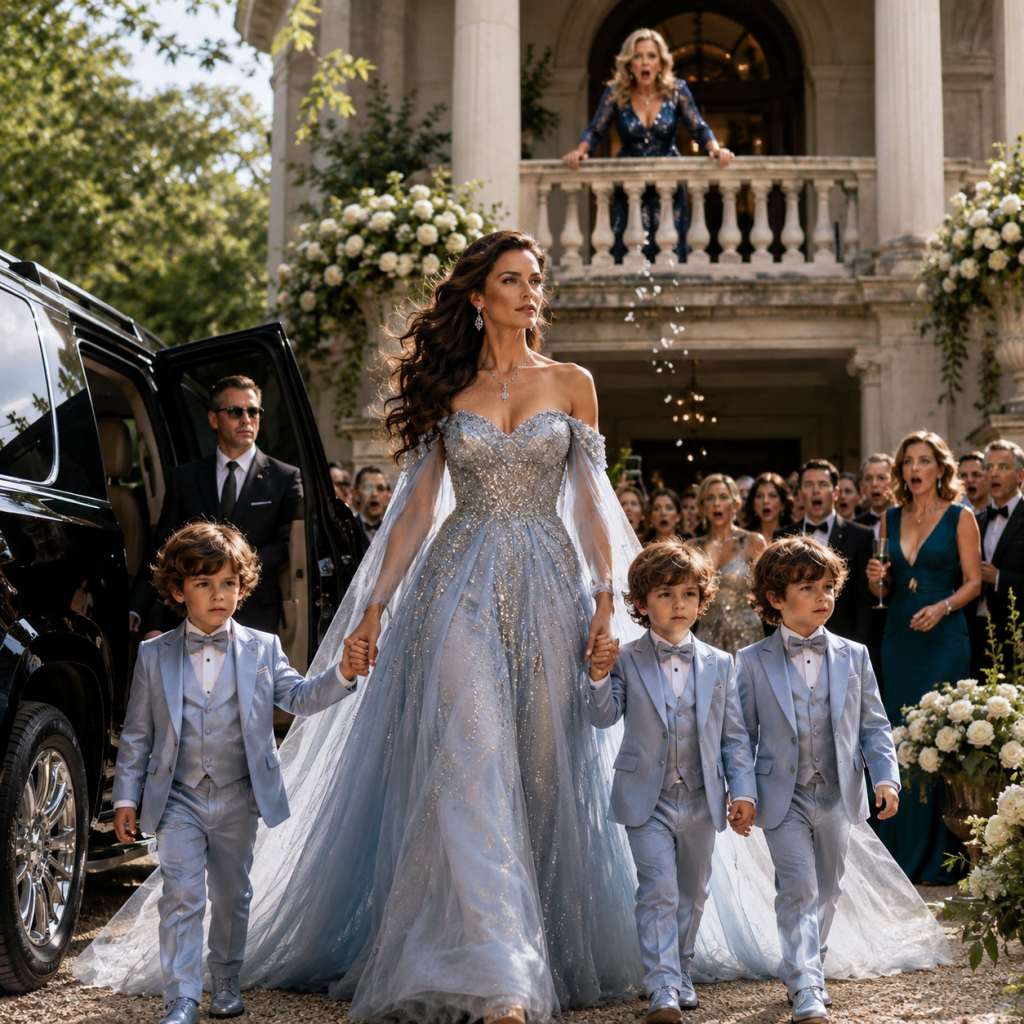
The string quartet stopped in the middle of a trembling note. Champagne glasses froze halfway to painted lips. Even the wedding photographers lowered their cameras, as if some invisible hand had pressed pause on the entire estate.
Because the resemblance was impossible to deny.
Leo had Garrett Bradford’s sharp gray eyes.
Owen had Garrett’s quick, devastating smile.
And Wyatt, quiet and observant, stood with his chin slightly lifted in the exact same way Garrett had when he was thinking too hard and pretending not to care.
From the balcony above, Vivian Bradford gripped the marble railing so tightly her knuckles turned white.
“No,” she whispered.
Then louder.
“No.”
Guests turned toward her.
The bride, Audrey Kensington, stood near the altar in an ivory gown that glittered like frozen sunlight. Her smile had disappeared. She looked from the boys to Garrett, then to me, then back again, as if her mind refused to assemble the pieces.
“What is she talking about?” Audrey asked.
No one answered.
Because Garrett himself had gone completely pale.
His gaze remained fixed on my sons.
Not on me.
Not on his bride.
On them.
I watched realization spread across his face like a storm crossing a bright sky.
The timing.
The ages.
The eyes.
The truth.
Five years ago, in the final months of our marriage, Garrett had believed every lie his mother fed him. Vivian convinced him I had left because I wanted freedom, attention, money, and revenge. She painted me as unstable, ambitious, heartless.
She never told him I was pregnant.
I took my sons’ hands and walked calmly toward the ceremony.
Every step echoed across the lawn.
Leo held my left hand. Owen held my right. Wyatt walked slightly ahead, brave as a knight marching into a castle, though I felt the tiny tremble in his shoulders.
Vivian finally descended the grand staircase.
For the first time since I had known her, she looked frightened.
“You shouldn’t have come here,” she hissed.
I smiled.
“You invited me.”
Her eyes dropped to the boys. For one instant, her face changed. Something almost human flickered there. Shock. Hunger. Possession.
Then it vanished.
“What do you want?” she asked.
The question made me laugh softly.
Because even now, Vivian Bradford thought everyone had a price.
“I didn’t come for anything,” I replied. “I came because my sons deserve to know where they came from.”
Across the lawn, Garrett finally stepped forward.
His voice sounded broken.
“How old are they?”
“Five.”
The answer struck him like a physical blow.
Audrey staggered backward. A bridesmaid caught her arm. Several guests began whispering openly now. A senator’s wife covered her mouth. A well-known CEO leaned toward his husband and murmured something that made both their eyes widen.
Then Leo looked up at Garrett.
His small voice carried through the impossible silence.
“Mama,” he asked, “is that our father?”
The gasp that swept across the estate was almost violent.
Garrett’s face crumpled.
He looked at me as though I had stabbed him and saved him at the same time.
Before I could answer, an elderly man near the front row stood slowly. He wore a charcoal suit, silver spectacles, and the grave expression of someone who had waited a very long time for one particular moment.
Arthur Bell, the Bradford family attorney.
He opened a leather briefcase with trembling hands and removed a sealed envelope.
The wax seal bore the crest of Garrett’s late grandfather, Theodore Bradford.
Arthur’s voice rang out, thin but steady.
“There is something Mr. Garrett Bradford must hear.”
Vivian spun around.
“Arthur, not now.”
But the old attorney ignored her.
He held up the envelope. Written across the front, in Theodore Bradford’s unmistakable handwriting, were seven words:
For Garrett’s children, when they are found.
A second silence fell.
This one was colder.
Garrett stared at the envelope.
“What is that?” he asked.
Arthur looked not at Garrett, but at Vivian.
“The truth your mother buried.”
Vivian’s face drained of color.
And I knew then, with a sudden chill moving down my spine, that even I did not know the whole story.
PART 3: The Letter That Split the Empire
Theodore Bradford had been dead for six years.
In life, he had been the only member of the Bradford family who never treated me like an intruder.
He was stern, yes. Old-fashioned. Difficult. But he had eyes that noticed everything, and a voice that could silence a room without cruelty. During my marriage to Garrett, he had called me “girl” in public and “the only person in this house with a spine” in private.
I remembered one winter evening when he found me crying in the library after Vivian had humiliated me at a charity dinner.
He had offered me a handkerchief and said, “Never let a cold room convince you that you are the one without warmth.”
At the time, I thought it was only kindness.
Now Arthur Bell was holding a letter that suggested Theodore had seen far more than I ever imagined.
Vivian moved quickly toward him.
“I said not now.”
Arthur stepped back.
“With respect, Mrs. Bradford, your authority over this family ended the moment you violated Theodore Bradford’s final instructions.”
Garrett looked at his mother.
“What is he talking about?”
Vivian’s lips parted, but nothing came out.
Arthur broke the seal.
The sound was small.
The effect was enormous.
The entire garden seemed to lean forward.
Arthur unfolded the letter and began reading.
“My dear Garrett,
If this letter is being opened, then one of two things has happened. Either you have become the father I always hoped you would be, or someone has kept your children from you long enough for the truth to become unavoidable.”
Garrett’s shoulders stiffened.
Arthur continued.
“I write this because I do not trust your mother to tell the truth when reputation is at stake. I have watched her turn fear into a family tradition. I have watched her confuse control with love. And I have watched her treat your wife, Seraphina, as an enemy because she could not be owned.”
My throat tightened.
I had not expected to hear my name.
Not like that.
Not here.
Arthur’s voice shook slightly, but he kept reading.
“Before my death, I discovered that Seraphina was pregnant. I also discovered that Vivian had obtained this information through private medical channels she had no right to access.”
A roar of whispers exploded through the guests.
Audrey’s father, Senator Kensington, straightened sharply.
“Medical channels?” he repeated.
Vivian’s face hardened.
“This is absurd.”
Arthur did not stop.
“I confronted Vivian. She denied nothing. She told me the child would be better raised under Bradford supervision and that Seraphina would be removed from the family if necessary. I warned her that if she harmed the girl, disinherited Garrett’s child, or manipulated my grandson further, I would protect the next generation from beyond the grave.”
Garrett turned slowly toward Vivian.
“You knew?”
Vivian’s expression remained carved from ice.
“I knew she was unstable.”
Garrett’s voice dropped.
“You knew she was pregnant?”
Vivian did not answer.
That silence was worse than any confession.
Garrett took a step back, as though the woman before him had become a stranger.
Arthur read the final lines.
“To my great-grandchildren: if the Bradford name ever feels like a cage, know this — it was meant to be a shield. I leave to you, equally, the controlling shares of Bradford Holdings that remain under my personal trust. Until you are of age, their mother, Seraphina Vale, shall act as trustee. Not Vivian. Not Garrett. Seraphina.”
The world tilted.
I heard someone cry out.
Vivian made a sound I had never heard from her before.
Not rage.
Not grief.
Panic.
Garrett stared at Arthur.
“Controlling shares?”
Arthur folded the letter.
“Yes. Your grandfather placed them in a locked trust before his death. They activate upon legal confirmation of your biological children.”
Audrey laughed once, sharp and disbelieving.
“So this wedding was never just a wedding.”
No one answered her.
But she understood.
Everyone did.
The Bradford family empire had been crumbling for years. Vivian needed Garrett’s marriage to Audrey Kensington to secure political influence, rescue failing investments, and maintain the illusion of power.
But Theodore Bradford had moved the real power elsewhere.
To three five-year-old boys wearing velvet tuxedos.
To me.
The woman they had thrown away.
Vivian stepped toward me, her voice low and venomous.
“You planned this.”
I met her eyes.
“No, Vivian. You planned this. I survived it.”
Owen tugged my hand.
“Mama, why is Grandma angry?”
The word struck Vivian visibly.
Grandma.
For a moment, she looked at Owen with something like longing. But then Leo moved closer to me, and her face closed again.
Garrett heard it too.
He looked down at the boys, then at me.
“Seraphina,” he said quietly, “please tell me their names.”
There was pain in his voice.
Real pain.
For years, I had imagined this moment. I had imagined screaming at him. I had imagined making him feel every lonely night, every doctor’s appointment I attended alone, every birthday candle he never saw.
But when the moment came, all I saw was a man who had lost five years in a single breath.
I swallowed.
“Leo Theodore Vale. Owen James Vale. Wyatt Alexander Vale.”
Garrett closed his eyes.
Theodore.
I had given one of our sons his grandfather’s name.
When he opened his eyes, they were wet.
Audrey stepped forward.
“Garrett.”
He turned to her, as if remembering she existed.
The bride’s face was pale, but her posture remained proud.
“Did you know?” she asked.
“No.”
She searched his expression.
For the first time that day, someone believed someone else without needing proof.
Audrey removed the engagement ring from her finger.
Vivian snapped, “Audrey, don’t be dramatic.”
Audrey looked at Vivian with cold disgust.
“You invited his ex-wife to humiliate her. Instead, you exposed your own fraud in front of half of Washington and Chicago.”
Senator Kensington walked to his daughter’s side.
“This wedding is over.”
A ripple moved through the crowd.
Vivian turned sharply.
“You cannot do this.”
Audrey lifted her chin.
“I just did.”
Then she looked at me.
There was no warmth in her eyes, but there was no hatred either.
“I’m sorry,” she said.
It was simple.
Unexpected.
And somehow enough.
She walked down the aisle alone, her father beside her, her veil trailing over crushed rose petals.
The guests began standing. Some left quickly, eager to escape scandal. Others lingered, hungry for more.
Vivian remained in the center of the lawn, surrounded by collapsing arrangements of white roses and shattered plans.
Garrett moved toward my sons, then stopped himself.
He looked at me first.
“May I?”
That question broke something in me.
Because the old Garrett would not have asked.
I nodded once.
He crouched slowly, so his eyes were level with theirs.
“Hi,” he said, voice trembling. “I’m Garrett.”
Leo studied him carefully.
“Are you our dad?”
Garrett inhaled sharply.
“Yes,” he whispered. “I am.”
Owen tilted his head.
“Where were you?”
The question landed harder than any accusation.
Garrett looked at me.
Then back at Owen.
“I didn’t know about you,” he said. “But I should have. And I’m very sorry.”
Wyatt, silent until then, asked, “Are you going to take us away from Mama?”
Garrett’s face changed instantly.
“No,” he said firmly. “Never.”
I believed him.
And that frightened me more than Vivian ever had.
Because hatred had kept me strong.
But this?
This was complicated.
PART 4: The Woman Who Built a Kingdom From Ashes
The wedding guests were escorted out through the garden gates by staff who had been trained for elegance, not disaster.
By sunset, the estate that had glittered with wealth and ambition looked like the abandoned stage of a play no one wanted to finish. White roses drooped in the heat. Champagne sat untouched in crystal flutes. A seven-tier wedding cake leaned slightly beneath a canopy of melting sugar flowers.
Inside the mansion, we gathered in Theodore Bradford’s old study.
I had not entered that room in six years.
The smell hit me first: leather, cedar, old paper, and the faint trace of pipe tobacco that had clung to Theodore’s jackets. The shelves still rose from floor to ceiling. The same bronze clock ticked above the fireplace. The same oil portrait of Garrett’s great-grandfather glowered down at everyone like judgment had a face.
Vivian stood near the window, rigid.
Garrett sat opposite me, elbows on his knees, looking like a man who had walked into his own life and found it rearranged by strangers.
The boys sat together on the rug with a plate of cookies Arthur had somehow found in the kitchen. Leo was trying to appear serious. Owen was eating frosting first. Wyatt watched every adult with quiet suspicion.
Arthur placed several documents on the desk.
“The trust requires DNA confirmation,” he said. “But legally, the path is clear. Theodore anticipated resistance.”
Vivian laughed bitterly.
“Of course he did. He always loved dramatic gestures.”
Arthur looked at her.
“He anticipated you.”
That silenced her.
Garrett rubbed a hand over his face.
“Mother, I need to hear you say it.”
Vivian did not move.
“Say what?”
“That you knew Seraphina was pregnant.”
Her gaze flickered toward me.
“She was going to ruin you.”
Garrett stood.
“No. Say the words.”
Vivian’s voice sharpened.
“You were twenty-nine years old and about to inherit a collapsing company. You were married to a woman with no pedigree, no protection, and no understanding of what our family required.”
I almost smiled.
There it was.
The Bradford religion.
Bloodline. Reputation. Control.
Garrett’s jaw tightened.
“You told me she left because she didn’t love me.”
Vivian turned on him.
“You were weak for her.”
“I loved her.”
The words fell into the room like glass.
My heart gave a painful, involuntary twist.
Vivian saw it.
Of course she saw it.
“She would have dragged you down,” she said. “I did what was necessary.”
“No,” Garrett said. “You stole my children from me.”
Vivian’s face cracked for one second.
Then she looked at the boys.
“They are Bradfords.”
I stood so fast my chair scraped the floor.
“They are children.”
My voice came out colder than I expected.
“They are not assets. Not heirs. Not tools. Not replacements for your failed empire. They are five years old. They love pancakes shaped like dinosaurs. Leo cries when he sees injured birds. Owen thinks socks are optional. Wyatt sleeps with a stuffed fox named Captain.”
Wyatt immediately frowned.
“Mama.”
I glanced at him.
“Sorry, sweetheart. Classified information.”
Garrett’s mouth twitched despite everything.
Vivian did not smile.
“You cannot keep them from their family.”
“I kept them from you,” I said. “And I would do it again.”
The room went still.
Vivian stepped closer.
“You think money makes you powerful now?”
“No,” I replied. “I learned power when I had nothing.”
I had never told Garrett the whole story.
Not because I was ashamed.
Because remembering it still felt like pressing a bruise.
But now, in Theodore’s study, with my sons listening and Garrett looking at me like he could barely breathe, I finally spoke.
“I left Chicago with two suitcases and a pregnancy test hidden in my coat pocket. I slept in a rented room above a bakery because it was all I could afford. I built websites at night while morning sickness made me shake so badly I had to type between waves of nausea. I pitched clients while sitting on the bathroom floor. I gave birth early because my blood pressure spiked, and I held three babies in a hospital room with no husband, no family, and no guarantee I could keep the lights on.”
Garrett’s face went gray.
“Seraphina…”
“No,” I said. “You need to hear this.”
He lowered his eyes.
“I fed them before I fed myself. I answered client emails at three in the morning with one baby asleep on my chest and two beside me. I lost accounts because I refused meetings when one of them was sick. I gained better accounts because I refused to quit. I became rich because I had to become unbreakable.”
The boys had gone quiet.
I softened my voice.
“And every year, on their birthday, I wondered whether telling you would protect them or endanger them.”
Garrett whispered, “I would never have let her take them.”
I looked at him.
“You let her take me.”
The truth hit him visibly.
He had no defense.
Only regret.
Wyatt stood and crossed the rug. He climbed into my lap without asking. I wrapped my arms around him. A moment later, Leo joined us. Then Owen, still holding half a cookie.
Garrett watched his sons curl around me as if I were home itself.
That was when he finally understood.
Fatherhood was not blood.
Not at first.
It was presence.
It was the thousand small things he had missed.
Vivian’s phone rang.
She ignored it.
It rang again.
Then Arthur’s phone buzzed. He checked the screen and frowned.
“What is it?” Garrett asked.
Arthur looked up.
“There are reporters at the gate.”
Vivian’s eyes flashed.
“Already?”
Arthur’s expression darkened.
“More than reporters. Someone leaked the letter.”
Everyone turned toward Vivian.
For once, she looked genuinely confused.
“It wasn’t me.”
Then Garrett’s phone lit up.
He answered.
A man’s frantic voice spilled through the speaker.
“Garrett, the board is calling an emergency meeting. The trust news is everywhere. Shares are moving. Investors are panicking. And there’s another problem.”
Garrett closed his eyes.
“What problem?”
The man hesitated.
“Someone just released documents showing Vivian diverted company funds into private accounts for years.”
Vivian went perfectly still.
Arthur whispered, “Dear God.”
Garrett turned slowly toward his mother.
“What did you do?”
Vivian lifted her chin.
But her silence told us the storm had only begun.
PART 5: The Bradford Name Burns at Midnight
By midnight, the Bradford estate was surrounded.
News vans lined the road beyond the iron gates. Their lights flashed blue and white against the dark trees. Helicopters thudded faintly overhead. Reporters called out questions whenever someone passed near the windows.
“Mrs. Bradford, did you hide your son’s children?”
“Garrett, did you abandon your triplets?”
“Seraphina Vale, are you taking control of Bradford Holdings?”
My sons slept upstairs in a guest suite guarded by my security team. I had not planned to stay in that mansion overnight, but once the reporters arrived, leaving with three exhausted children became impossible.
So the house that had once thrown me out now had to shelter me.
There was poetry in that.
I stood in the upstairs hallway after checking on the boys, listening to their soft breathing through the cracked door. Leo slept sprawled sideways. Owen had kicked off every blanket. Wyatt clutched Captain the fox under his chin.
Behind me, Garrett spoke quietly.
“They’re beautiful.”
I turned.
He stood a few feet away, jacket gone, tie loosened, devastation carved into his face.
“Yes,” I said.
He swallowed.
“I missed their first steps.”
“Yes.”
“Their first words.”
“Yes.”
“Their birthdays.”
“Yes.”
Each answer was a blade.
I did not soften them.
He deserved the truth.
But then he said, “What was the first thing they said?”
And something in his voice made me answer.
“Leo said ‘moon.’ Owen said ‘more.’ Wyatt said nothing for a long time, and then one day he pointed at me and said ‘mine.’”
Garrett’s eyes filled.
A faint smile touched my mouth despite myself.
“He was very possessive.”
“I can see that.”
We stood in silence.
For a moment, the years between us felt less like a wall and more like a river — wide, dangerous, but not impossible to cross.
Then Garrett said, “I know sorry isn’t enough.”
“It isn’t.”
“I know I failed you.”
“You did.”
He nodded, accepting each word.
“I believed her because it was easier than fighting her. Because if you were the villain, then I didn’t have to admit I was a coward.”
The honesty startled me.
The Garrett I had known could apologize charmingly. Smoothly. Beautifully.
This was different.
This cost him something.
“I won’t ask you to forgive me tonight,” he said. “I won’t ask for anything. But I am asking for the chance to know them. However slowly you decide. Whatever boundaries you choose.”
I studied him.
“And Vivian?”
His face hardened.
“She will not touch them. She will not influence them. She will not come near them unless you allow it.”
“I won’t.”
“Then she won’t.”
Downstairs, voices rose.
Arthur appeared at the end of the hallway, breathless.
“Garrett. Seraphina. You need to come.”
We followed him to the study.
Inside, Vivian stood before the fireplace like a queen refusing to acknowledge the revolution. Across from her stood three members of the Bradford Holdings board, their faces grim. On the desk lay printed financial reports, bank transfers, shell company records.
Arthur looked older than he had that afternoon.
“The documents appear authentic,” he said.
Garrett picked up a page.
His hand tightened.
“Thirty-eight million dollars?”
Vivian said nothing.
One board member, a woman named Elaine Porter, spoke sharply.
“Over nine years. Hidden through consulting payments, renovation budgets, and overseas entities.”
Garrett stared at his mother.
“Why?”
Vivian finally laughed.
“Why? Because men like Theodore built empires and left women to smile in pearls beside them. I preserved what he was too sentimental to protect.”
“You stole from the company.”
“I protected the family.”
“You destroyed the family.”
Vivian’s eyes flashed.
“I made you.”
Garrett looked at her for a long moment.
“No. You trained me to obey you. Seraphina made me want to be better. And when I chose obedience over courage, I lost everything that mattered.”
Vivian flinched.
It was small, but I saw it.
So did Garrett.
Elaine turned to me.
“Ms. Vale, if DNA confirms the trust terms, your sons’ shares will shift control. Until then, the board can vote to suspend Vivian’s authority pending investigation.”
Vivian’s gaze snapped to me.
“You are enjoying this.”
I answered honestly.
“No.”
She looked surprised.
I stepped closer.
“I wanted you exposed. I wanted truth. I wanted my sons safe. But this?” I gestured around the room. “This is ugly. You did that. Not me.”
For the first time, Vivian’s composure fractured.
“You think you’re different from me because you cry prettier?”
Garrett moved, but I raised a hand.
Vivian stepped toward me.
“You built a company. Congratulations. You think that makes you noble? You think motherhood makes you holy? Power changes everyone, Seraphina. One day those boys will grow up, and you will do exactly what I did. You will hold too tightly because losing them will terrify you.”
Her words found a place I did not want touched.
Because fear had shaped me too.
Fear of losing them.
Fear of Garrett.
Fear of the Bradford name.
But then I thought of Leo asking about his father. Owen offering cookies to strangers. Wyatt worrying someone would take him from me.
“No,” I said quietly. “I will love them enough to let them become themselves.”
Vivian’s mouth twisted.
“Naive.”
“Maybe,” I said. “But they won’t have to run from me to survive.”
That landed.
Vivian turned away.
Elaine gathered the documents.
“The board vote is at nine in the morning.”
After they left, Garrett sank into Theodore’s chair.
The mansion groaned around us, old wood settling in the dark.
Then a soft voice came from the doorway.
“Daddy?”
Every adult froze.
Leo stood there in blue pajamas, rubbing one eye.
Garrett looked as though the word had stopped his heart.
Leo glanced at me, unsure.
“I had a bad dream.”
I crossed toward him, but Leo’s gaze stayed on Garrett.
“Can he come too?” he asked.
Garrett did not move.
He waited for me.
The power of that waiting almost undid me.
I nodded.
Together, we walked upstairs.
Leo climbed into bed between his brothers. Garrett stood awkwardly beside the mattress until Owen woke enough to mumble, “You can sit.”
So Garrett sat.
On the edge of a bed too small for all the history pressing into that room.
Leo reached out and touched his sleeve.
“Are you staying?”
Garrett’s voice broke.
“Yes. As long as your mother says it’s okay.”
Wyatt opened one eye.
“Mama decides.”
Garrett nodded solemnly.
“Mama decides.”
And for the first time in years, inside the cold mansion that had once swallowed my happiness, I almost felt warm.
PART 6: The Bride Who Saved the Enemy
Morning arrived with thunder.
Rain lashed the windows, turning the estate grounds silver and gray. The wedding flowers had collapsed overnight, their white petals scattered across the lawn like confetti from a celebration no one remembered fondly.
At breakfast, the boys ate pancakes in Theodore’s formal dining room while Garrett watched them with awe so naked it hurt to see.
Owen poured syrup until the pancake disappeared.
Garrett leaned forward.
“Is that enough syrup?”
Owen considered.
“No.”
Leo whispered to Wyatt, “He doesn’t know pancake rules.”
Wyatt nodded gravely.
“He is new.”
Garrett heard them and smiled.
It was the first real smile I had seen from him since arriving.
Then the doors opened.
Audrey Kensington stepped inside.
Every conversation stopped.
She was no longer wearing her wedding gown. Instead, she wore a navy dress, her blonde hair pulled back, her face pale but composed.
Garrett stood immediately.
“Audrey.”
She held up a hand.
“I’m not here for an apology speech.”
Her eyes moved to me.
“I’m here because we have a problem.”
I set down my coffee.
“What problem?”
Audrey placed a tablet on the table. A paused video filled the screen. The headline beneath it made my stomach tighten.
SERAPHINA VALE ACCUSED OF SECRETLY USING CHILDREN TO SEIZE BILLIONAIRE FAMILY COMPANY
Garrett cursed under his breath.
Audrey tapped the screen. A commentator appeared, speaking dramatically about revenge, manipulation, and “questionable timing.” Photos of me stepping from the SUV with my sons played on loop.
Vivian had not leaked the letter.
But someone else was shaping the story.
Audrey sat without being invited.
“My father’s media team traced the first coordinated posts. They came from accounts linked to a crisis firm.”
Garrett frowned.
“Whose firm?”
Audrey looked at him.
“Your mother’s.”
Vivian entered at that exact moment.
Her expression did not change, but her fingers tightened around the back of a chair.
Audrey smiled coldly.
“You always did enjoy an entrance, Vivian.”
Vivian’s voice was smooth.
“You should be with your father.”
“My father is busy deciding how loudly to separate our family from yours.”
That struck.
Vivian’s eyes narrowed.
“Then why are you here?”
Audrey glanced toward the boys. Her expression softened, just barely.
“Because children should not be used as shields in adult wars.”
For the first time, I truly saw Audrey Kensington.
Not as the woman who almost married my ex-husband.
Not as Vivian’s chosen replacement.
But as someone who had also been placed on a chessboard without being asked.
Audrey turned to me.
“I was told you were unstable. Bitter. Obsessed with Garrett. I believed some of it because believing it made my life simpler.”
I said nothing.
She continued.
“I was wrong.”
Owen raised his hand.
“Are you still wearing your wedding shoes?”
Audrey blinked.
Then, unexpectedly, she laughed.
“No.”
“Good,” Owen said. “Mama says uncomfortable shoes make people mean.”
Audrey looked at me.
“She’s not wrong.”
Despite everything, I smiled.
Audrey grew serious.
“There’s more. Vivian’s team is preparing to file an emergency petition claiming the boys are at risk because of sudden media exposure and corporate conflict.”
The room chilled.
Garrett turned on his mother.
“You wouldn’t.”
Vivian’s face remained calm.
“I would protect Bradford heirs from instability.”
I stood slowly.
There it was.
The thing I had feared for five years.
The reason I ran.
Not imagination.
Not paranoia.
A plan waiting for opportunity.
Garrett moved between Vivian and the table.
“They are not your heirs.”
Vivian looked at him with disappointment.
“You are emotional.”
“No,” he said. “I am awake.”
Audrey opened a folder.
“My father’s attorneys owe me a favor. I also have copies of prenuptial negotiations where Vivian repeatedly referred to any potential Bradford grandchildren as ‘dynastic assets.’”
Vivian’s nostrils flared.
“You recorded private discussions?”
Audrey’s smile vanished.
“You taught me to protect myself.”
The words hit the room like thunder.
Arthur arrived minutes later. By noon, a legal firewall surrounded my sons so tightly Vivian could not approach them without triggering immediate consequences. My own attorneys joined remotely. Garrett signed a sworn statement acknowledging paternity probability and affirming that I had been the boys’ sole caregiver and decision-maker.
He did it without hesitation.
When he finished signing, he slid the papers toward me.
“For what it’s worth,” he said, “I choose them over the Bradford name.”
I looked at the signature.
Then at him.
“You should have chosen love sooner.”
“I know.”
This time, the words did not sound like defense.
They sounded like mourning.
That afternoon, the board voted unanimously to suspend Vivian from all executive authority pending investigation. The news broke within minutes.
Vivian watched it happen from Theodore’s study, standing perfectly still while the empire she had killed herself to control slipped from her hands.
No one cheered.
Not even me.
Because ruin, when seen up close, did not look like justice.
It looked like an old woman alone in a room full of portraits.
At dusk, I found Vivian in the conservatory.
Rain tapped softly against the glass ceiling. The air smelled of wet leaves and orchids.
She did not turn.
“Have you come to gloat?”
“No.”
“Then why?”
I looked at the woman who had haunted my nightmares for half a decade.
“I want to understand.”
Vivian laughed without humor.
“How sentimental.”
“Why did you hate me so much?”
She was silent for a long time.
When she finally spoke, her voice was quieter.
“Because Garrett loved you in a way no Bradford man ever loved his wife. Carelessly. Openly. As if love could be chosen over duty.”
I stared at her.
“My husband never loved me,” she said. “Theodore respected me. That was different. Respect leaves you standing beside a man. Love makes him turn toward you. Garrett turned toward you.”
I felt no triumph.
Only sadness.
“So you punished me for being loved?”
Vivian turned.
Her eyes were bright, but no tears fell.
“I punished you because I knew he would become weak.”
“No,” I said. “You punished everyone because you were lonely.”
Her expression twisted.
For a moment, I thought she might slap me.
Instead, she whispered, “Get out.”
I did.
But as I walked away, I heard the smallest sound behind me.
Not a sob.
Not quite.
But something close.
PART 7: The Father at the Window
DNA results came three days later.
There was no surprise.
Garrett Bradford was the biological father of Leo, Owen, and Wyatt Vale.
The announcement should have settled everything.
Instead, it opened every door at once.
Theodore’s trust activated. My attorneys moved fast. Bradford Holdings entered restructuring. Vivian’s financial investigation expanded. Reporters camped outside my Chicago building. Old friends called with sympathy that sounded suspiciously like curiosity.
And Garrett began showing up.
Not dramatically.
Not with gifts too large or promises too polished.
He showed up at school pickup with coffee for me and three small umbrellas shaped like animals because rain was in the forecast. He showed up at Leo’s soccer practice and cheered for both teams because he did not yet understand sports-parent loyalty. He showed up at Owen’s preschool art display and stared at a crooked purple elephant as if it belonged in a museum. He showed up at Wyatt’s quiet request to visit the planetarium and listened carefully while Wyatt explained Saturn’s rings.
He made mistakes.
So many mistakes.
He bought toys that made too much noise. He let Owen eat ice cream too close to dinner. He called bedtime “flexible” once and never made that mistake again. He asked Leo too many questions when Leo needed silence. He reached for Wyatt’s hand too quickly and watched my smallest son step behind me.
But he learned.
That was the dangerous part.
A villain would have been easier.
A monster could be hated cleanly.
Garrett was neither.
He was a man who had failed us, and then began doing the slow, humiliating work of becoming worthy of standing near what he had lost.
One evening, a month after the ruined wedding, he arrived at my penthouse with a cardboard box under one arm.
“What’s that?” I asked.
“My childhood.”
The boys attacked the box instantly.
Inside were model trains, baseball cards, a cracked wooden boat, and an old stuffed bear missing one eye.
Owen lifted the bear.
“He looks tired.”
Garrett smiled.
“He is. His name is Mr. Churchill.”
Wyatt inspected him carefully.
“Captain can fix him.”
And just like that, Captain the fox and Mr. Churchill became allies.
Later, after the boys fell asleep in a pile of blankets during movie night, Garrett and I stood by the windows overlooking Chicago.
The city glittered beneath us, alive and endless.
“You built all this,” he said.
I looked around my home.
“Yes.”
“I’m proud of you.”
The words entered softly.
Still, they hurt.
I wanted to say I did not need his pride.
But the truth was more complicated.
Once, I had wanted this man to see me.
Then I survived without being seen.
Now he was looking, and I no longer knew what to do with it.
“Garrett,” I said, “we are not going back.”
He nodded.
“I know.”
“I’m not the woman you married.”
“I know.”
“I don’t know if I can ever love you again.”
His face tightened, but he nodded again.
“I know.”
I turned toward him.
“Then why do you keep looking at me like that?”
He exhaled slowly.
“Because I never stopped.”
My heart went painfully still.
He did not move closer. He did not touch me. He did not try to turn confession into pressure.
He simply stood there, telling the truth too late.
“I loved you badly,” he said. “Weakly. Lazily. I loved you when it was easy and failed you when it became hard. That doesn’t deserve reward. But it is still true.”
I looked out at the city.
Below us, traffic moved like veins of light.
“I hated you,” I admitted.
“I know.”
“For years.”
“I deserve that.”
“No,” I said softly. “You deserved anger. But hatred became a house I lived in. And I don’t want my sons growing up inside it.”
Garrett’s voice was quiet.
“What do you want?”
I thought of the invitation. The estate. The silence when my sons stepped into the sun. Vivian’s shattered glass. Audrey’s unexpected courage. Theodore’s letter. The nights I had survived alone.
“I want peace,” I said.
Garrett looked at the sleeping boys.
“Then I’ll help you build it. Even if there’s no place for me inside.”
That was when my phone rang.
Arthur Bell’s name appeared on the screen.
I answered.
His voice sounded strained.
“Seraphina, I need you and Garrett at the Bradford estate tomorrow morning.”
“What happened?”
Arthur hesitated.
“It’s Vivian.”
Garrett straightened.
“What did she do?”
Arthur’s silence stretched.
Then he said, “She disappeared.”
The next morning, Garrett and I arrived at the estate under a sky the color of steel.
Vivian’s bedroom had been left immaculate. Her jewelry remained. Her passport was gone. So were several files from Theodore’s private archive.
But on her dressing table lay a single envelope.
My name was written across it.
Inside was a note.
Seraphina,
You were right about one thing. They should not have to run from their mother to survive.
I have spent my life mistaking possession for protection. Perhaps Theodore knew me better than I knew myself.
Do not misunderstand me. I am not asking forgiveness. I would not know what to do with it.
But there is one final truth buried in this house, and unlike the others, it may save the family instead of destroying it.
Find the blue room.
V.B.
Garrett frowned.
“The blue room?”
Arthur’s face changed.
“I haven’t heard that name in decades.”
“What is it?” I asked.
Arthur looked toward the hallway.
“Theodore’s first wife called the east archive that. It was sealed after a fire before Garrett was born.”
Garrett stared at him.
“There’s a sealed room in this house no one told me about?”
Arthur gave a tired smile.
“Garrett, this house is mostly secrets held together by stone.”
We found the east archive behind a paneled wall in a corridor lined with hunting paintings.
The air inside was stale. Dust covered everything. Blue wallpaper, faded almost gray, peeled at the corners. Metal filing cabinets stood against one wall. A child’s rocking horse sat near the window, one runner cracked.
At the center of the room was a locked trunk.
Arthur opened it with a key from Theodore’s desk.
Inside were letters.
Hundreds of them.
And a ledger.
Garrett lifted the first page.
His brow furrowed.
“What is this?”
Arthur took it and went pale.
“My God.”
I moved closer.
The ledger contained names. Dates. Account numbers. Transfers.
Not stolen money.
Hidden money.
Theodore Bradford had secretly been funding scholarships, medical bills, housing grants, and small businesses for decades. Quietly. Privately. Under Vivian’s management at first, then without her after she began redirecting funds.
At the bottom of the trunk lay a final document.
Arthur unfolded it.
His eyes filled.
“The Bradford Foundation,” he whispered. “Theodore drafted it but never filed.”
Garrett read over his shoulder.
“He wanted the company converted into a family-controlled philanthropic trust?”
Arthur nodded.
“With the heirs as future stewards.”
I looked around the blue room.
At the dust.
At the forgotten rocking horse.
At the evidence of a different legacy buried beneath greed.
Vivian had not disappeared to destroy us.
She had left us the map to something better.
But the shock was not over.
Behind the foundation papers lay one photograph.
A young Vivian stood beside Theodore, holding a baby girl.
On the back, in Theodore’s handwriting, were the words:
Eleanor Bradford. Born 1984. Loved. Lost.
Garrett went still.
“I had a sister?”
Arthur closed his eyes.
“Yes.”
The room seemed to breathe around us.
And suddenly, Vivian Bradford became something more complicated than a monster.
She became a mother who had lost a child and spent the rest of her life trying to control death by controlling everything else.
It did not excuse her.
But it explained the shape of her fear.
Garrett sat heavily on the trunk.
“No one told me.”
Arthur’s voice was soft.
“She died as an infant. Vivian never recovered. Theodore forbade the household from speaking of it because he thought silence would help.”
I thought of Vivian’s words in the conservatory.
Love makes him turn toward you.
Maybe no one had turned toward her when she broke.
Maybe she had frozen because no one taught her how to grieve.
Garrett covered his face.
I sat beside him.
Not as his wife.
Not yet even as his friend.
But as someone who understood what children could do to a heart.
After a while, I said, “We should build the foundation.”
He looked at me.
“For the boys?”
“For them. For Theodore. For every person this family hurt while protecting its name.”
Garrett nodded slowly.
“And Vivian?”
I looked at the photograph.
“Let her be lost for now.”
PART 8: The Wedding That Finally Happened
One year later, no one recognized the Bradford estate.
Not because the mansion had changed.
The stone walls still stood. The lake still flashed silver beyond the gardens. The chandeliers still caught sunlight and scattered it across polished floors.
But the silence was gone.
Children ran across the lawn.
Not just my children.
Hundreds of them.
The estate had become the headquarters of the Bradford-Vale Foundation, a place for foster youth scholarships, family legal aid, medical grants, and housing programs for women rebuilding their lives after being cornered by powerful people.
Theodore’s blue room had been restored as a library.
The rocking horse had been repaired.
Wyatt insisted that Captain the fox approved.
Bradford Holdings survived, but not as Vivian had imagined. It became smaller, cleaner, steadier. Garrett stepped down as public face of the company and took a quieter leadership role in the foundation. I remained trustee of my sons’ shares and expanded my own company until no one could call my success an accident without sounding foolish.
Audrey Kensington became a senator’s chief policy advisor and later introduced legislation protecting medical privacy in family court disputes.
She sent the boys birthday gifts.
Owen still believed she had excellent taste in shoes.
Vivian Bradford did not return for eleven months.
When she did, she came alone.
No announcement.
No lawyers.
No pearls.
She appeared one afternoon at the foundation garden, thinner than before, dressed in a simple gray coat. I saw her from the terrace while Leo, Owen, and Wyatt planted tulip bulbs with Garrett.
For a long moment, she watched them.
Then she turned to leave.
I followed.
“Vivian.”
She stopped.
Her face was older. Less armored. Not soft, exactly. Vivian Bradford would never be soft. But something in her had been sanded down by solitude.
“I only wanted to see them,” she said.
I studied her.
“You could have asked.”
Her mouth trembled faintly.
“I did not think I had that right.”
“You don’t,” I said.
She nodded once.
The old Vivian would have attacked.
This one accepted the wound.
“But,” I continued, “rights are not the same as chances.”
Her eyes lifted to mine.
“I won’t let you hurt them.”
“I know.”
“I won’t let you control them.”
“I know.”
“And I won’t teach them to hate you just because it would be easy.”
Something broke across her face.
Not dramatically.
Quietly.
Like ice splitting under spring sun.
Garrett saw us and walked over, the boys trailing behind him.
Vivian looked at her son.
For a moment, neither spoke.
Then she said, “I am sorry.”
Garrett’s jaw tightened.
The words were too small for what she had done.
Everyone knew it.
But sometimes the smallest key is the only one that fits the first lock.
Garrett nodded.
“I’m not ready.”
Vivian closed her eyes.
“I understand.”
Leo stepped forward.
He had grown taller that year. More confident.
“Are you our grandma?”
Vivian looked at me first.
I gave the smallest nod.
“Yes,” she said carefully. “I am.”
Owen narrowed his eyes.
“Are you still mean?”
Garrett choked.
Wyatt whispered, “Owen.”
But Vivian surprised us.
“Yes,” she said.
Owen considered this.
“Are you trying not to be?”
Vivian’s lips parted.
Then she nodded.
“Yes.”
Owen looked at Leo and Wyatt.
“She can help plant tulips. But not the red ones. Those are mine.”
And just like that, Vivian Bradford was given a plastic shovel and a patch of damp earth.
She knelt in the garden wearing her gray coat and planted bulbs beside the grandchildren she had once tried to claim like property.
She did not deserve the moment.
But the boys deserved a world where people could become better without pretending the past had vanished.
That evening, after the boys fell asleep, Garrett found me in the blue room library.
A storm moved quietly over the lake. Rain traced silver lines down the windows.
He stood in the doorway.
“Do you remember the first time we danced?”
I smiled despite myself.
“At your father’s retirement gala. You stepped on my dress.”
“I apologized beautifully.”
“You blamed the floor.”
“It was a suspicious floor.”
I laughed.
Garrett’s expression softened.
The years had changed him. Fatherhood had humbled him. Regret had carved patience into him. He no longer filled every room like he owned it. He entered carefully now, as if every place had to invite him.
“I have something for you,” he said.
I raised an eyebrow.
“That sounds dangerous.”
“It’s not a ring.”
My heart reacted anyway.
He noticed, and his smile faded gently.
“I know better.”
He handed me a folded document.
It was not romantic.
Not at first glance.
It was a legal agreement.
I read it slowly.
Garrett had transferred his personal remaining voting power in Bradford Holdings into a protected structure overseen jointly by me, Arthur, and an independent ethics board until the boys came of age.
“You’re giving up control,” I said.
“I’m returning what never should have been used as a weapon.”
I looked up.
“Why?”
“Because I love our sons more than I love power.” He paused. “And because I love you enough not to ask love from you as payment.”
The rain whispered against the glass.
I had spent years imagining revenge.
Then I had received it and discovered revenge was only a door.
Beyond it was the harder thing.
Choosing what kind of life came next.
I looked at Garrett Bradford, the man who had broken my heart, lost five years, and spent one year trying to become someone our children could trust.
“I don’t want our old marriage back,” I said.
“Neither do I.”
“I don’t want the mansion, the name, the performance, the perfect photographs.”
“Good.”
“I don’t want to be rescued.”
He smiled faintly.
“You never needed rescuing.”
“No,” I said. “I needed someone willing to stand beside me without trying to own the ground.”
Garrett’s eyes searched mine.
“I can do that.”
“I know,” I whispered.
That was the surprising part.
I knew.
Six months later, there was another ceremony at the Bradford estate.
But this one had no senators trading influence beneath chandeliers. No socialites whispering behind champagne flutes. No seating chart designed as punishment. No Vivian arranging humiliation like flowers.
There were children from the foundation throwing petals in completely wrong directions.
There was Audrey Kensington in a blue suit, laughing beside Arthur Bell.
There was Vivian Bradford seated in the second row, not because she had been banished, but because Owen had declared the first row “too splashy” after he placed a bubble machine near the aisle.
There were three little boys in matching suits standing beside Garrett.
Leo held the rings with grave importance.
Owen waved at everyone.
Wyatt kept one hand tucked in mine until the music began.
And there was me.
Not in emerald armor this time.
In a simple ivory dress that moved softly in the lake breeze.
Garrett stood beneath an arch of wildflowers, looking at me as if he knew exactly how close he had come to losing the entire world.
When I reached him, Leo whispered loudly, “Don’t mess it up.”
The guests laughed.
Garrett looked down at his son.
“I won’t.”
Then he looked at me.
“I won’t,” he said again.
Our vows were not grand.
We did not promise perfection.
We promised truth.
We promised patience.
We promised that love would never again be silent in the face of fear.
When Garrett kissed me, the boys cheered like fireworks.
Vivian cried without hiding it.
Arthur pretended not to.
And somewhere in the restored blue room, Theodore Bradford’s final letter sat framed beneath glass, no longer a weapon, but a reminder:
Never let a cold room convince you that you are the one without warmth.
Years later, people would still talk about the wedding that died the moment three little boys stepped out of a black SUV.
They would call it the scandal of the decade.
They would call it the fall of Vivian Bradford.
They would call it the day an empire changed hands.
But they would be wrong.
Because that was not the day everything ended.
That was the day my sons walked into a mansion built on secrets and brought the truth with them.
That was the day Garrett Bradford lost a bride and found his children.
That was the day I stopped being the woman they threw away and became the woman who returned holding the future by both hands.
And the ending no one predicted?
It was not revenge.
It was not ruin.
It was not even the second wedding beneath wildflowers and rain-washed skies.
The true ending was this:
Three boys grew up knowing they were loved more than any name, fortune, mansion, or legacy.
A broken father learned how to stay.
A frozen grandmother learned how to kneel in the dirt and plant tulips.
And I, Seraphina Vale, finally understood that surviving was only the beginning.
Living happily was the victory.
THE END