This is the chronicle of my own coup d’état, though the world initially mistook it for a domestic tragedy.
At 1:00 a.m., my doorbell rang not with a polite chime, but with a frantic, desperate rhythm, like a bullet hitting glass. When I pulled open the heavy oak door of my home in Phoenix, Arizona, I forgot every crime scene I had ever survived in my twenty-three years as a detective.
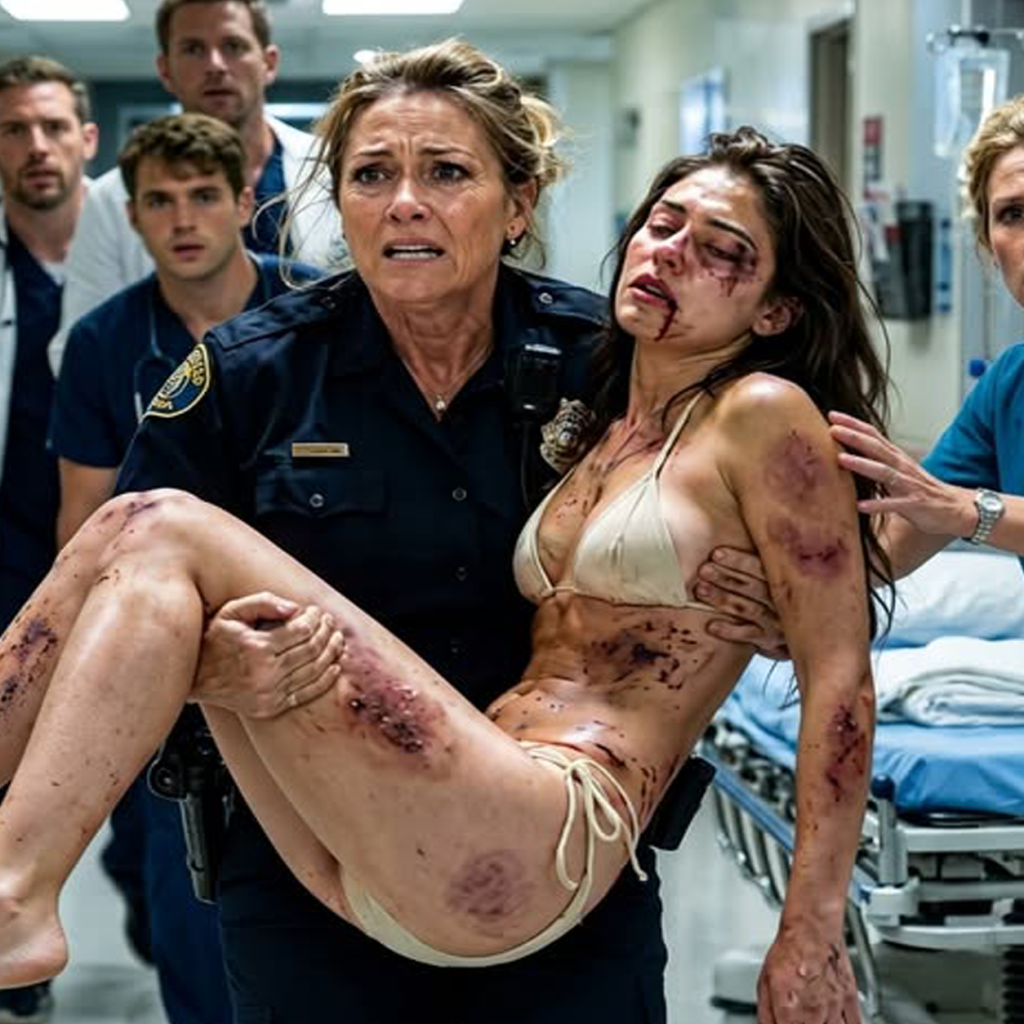
My daughter, Emma, stood on my porch. She was twenty-seven, barefoot, and shaking so violently her knees knocked together. Her lip was split, a jagged tear welling with dark blood. One eye had swollen into a terrifying, mottled purple. Rainwater ran through her tangled hair and down the collar of her torn gray sweatshirt.
Behind her, the Arizona night stretched black and empty, the desert wind dragging dust across my driveway. I reached for her, and she collapsed into my arms like a frightened child. I knew violent men. I knew their voices, their patterns, their apologies. But nothing prepares you for the suffocating realization that one of those monsters married your daughter.
“Tyler?” I asked, my voice dangerously flat.
I wrapped my arms around her trembling shoulders, preparing to pull her inside and lock the world away. But before I could pull her across the threshold, the blinding glare of halogen headlights cut through the darkness.
A massive black SUV roared down my quiet suburban street, its tires screeching as it violently jumped the curb and slammed into park right on my front lawn.
The driver’s side door flew open. Tyler stepped into the rain. He wore a tailored suit that cost more than my first car, his tie perfectly knotted, his jaw clenched with an arrogant, untouchable rage. He didn’t look like a man who had just beaten his wife. He looked like a CEO inconvenienced by a malfunctioning asset.
“Emma,” Tyler commanded, his voice cutting through the thunder. “Get in the car. You’re having an episode. We are going home.”
I didn’t step back. I gently pushed Emma behind me, into the safety of the foyer, and stepped out onto the rain-slicked porch. The cold wind bit through my robe, but I didn’t feel it. I reached behind the small of my back, my hand wrapping around the cold, familiar grip of my service revolver—the Smith & Wesson I had kept oiled and loaded since the day I retired.
“Take one more step onto my property, Tyler,” I said, raising the weapon just enough for the porch light to catch the steel barrel. “And you will leave in a body bag. That is not a threat. It is a biological guarantee.”
Tyler froze halfway up the walkway. The arrogant smirk faltered, replaced by a flash of genuine, calculating caution. He looked at the gun, then up at my eyes. He realized he wasn’t dealing with a terrified mother; he was dealing with a veteran cop who knew exactly where to aim.
“You’re making a mistake, Lisa,” Tyler sneered, raising his hands in mock surrender. “You think you can protect her? I own half the judges in this county. I own the police chief. You’re a retired old woman with arthritis and a hero complex. When I’m done with you, you won’t even have a pension.”
“Get off my lawn,” I ordered, thumbing back the hammer. The metallic click was loud enough to echo.
Tyler slowly backed away, never breaking eye contact. He climbed back into his SUV. “I’m coming for her,” he shouted through the open window. “And there isn’t a damn thing you can do to stop me.”
He threw the car in reverse and sped off into the storm.
I backed into the house, slamming the door and sliding the deadbolt, the chain, and the secondary floor lock. I turned to Emma, my heart hammering against my ribs.
She was sitting on the floor, clutching her torn sweatshirt. But she wasn’t just shivering anymore. She reached into the lining of her sports bra and pulled out a sleek, titanium USB drive.
“I didn’t just run, Mom,” Emma whispered, her swollen eye welling with tears. “I went into his safe when he passed out. I took it. All of it.”
My breath hitched. “What is on it, Emma?”
“Everything,” she said, her voice shaking. “The shell companies. The bribes to the city council. The money he stole from the domestic violence charities. But… it’s encrypted.”
Before I could process the magnitude of what she had stolen, the lights in the house flickered violently. A loud, mechanical clack echoed from the side yard.
Instantly, the entire house plunged into absolute, suffocating darkness. The hum of the refrigerator died. The Wi-Fi router blinked out.
He hadn’t left. He had just circled the block to cut the main power line.
We are trapped.
Total darkness is a physical weight. It presses against your eardrums and makes the air feel thick.
“Mom?” Emma whimpered in the pitch black.
“Stay low. Don’t move,” I whispered, operating entirely on muscle memory. I reached into the hall closet by feel, retrieving my tactical flashlight and a secondary magazine for my revolver. I kept the light off. If Tyler had men surrounding the house, a flashlight beam sweeping across the windows would just make us targets.
I crept through the house, pulling the heavy blackout curtains shut over every window, checking every lock. Through a sliver in the living room blinds, I saw the shadows. Two men in dark raincoats were standing at the edge of my backyard, pacing near the tree line. Tyler had called his fixers. They were waiting for us to panic, to run out the back door into their arms.
“We need to decrypt this drive,” I whispered, guiding Emma into the windowless interior bathroom. I locked the door and finally clicked on the flashlight, setting it on the sink so it cast a harsh, pale glow over us. I handed her my personal, battery-powered laptop.
“He’ll break down the doors,” Emma panicked, her hands trembling so badly she could barely open the laptop.
“My doors are reinforced steel, honey. They’ll hold for an hour. But we need to know exactly what we have before we call for an extraction. We need leverage.”
Emma plugged the titanium drive into the port. A stark, black prompt box appeared on the screen, demanding a 12-character password.
“Emma, focus,” I said, gripping her shoulders. “You did his bookkeeping. You know how his mind works. What is the password?”
“He changes it,” she cried, hyperventilating. “He’s obsessed with security. He uses random generators.”
“No,” I said firmly, channeling years of interrogating narcissists. “Men like Tyler don’t trust machines with their deepest secrets. They trust their own ego. What is his ultimate pride? What is the thing he believes makes him invincible?”
Emma squeezed her eyes shut, trying to push past the trauma. “He… he always bragged about buying Judge Carter. He called him his most expensive pet.”
“Try Carter,” I said.
She typed it. Access Denied. You have 2 attempts remaining before auto-wipe.
“Dammit,” I hissed. “Think, Emma. Not a person. A concept. What does he say to you when he hits you? What does he say to make you feel small?”
A tear sliced through the dried blood on her cheek. She stared at the screen, her breathing shallow. “He tells me… he tells me he is a king. That he makes the world, and I just live in it.”
She hovered her bruised fingers over the keyboard.
“He calls himself the Kingmaker,” she whispered.
She typed it. Kingmaker123.
Access Granted.
Thousands of folders populated the screen. PDF invoices, offshore wire transfers, ledgers detailing millions of dollars siphoned from city contracts and funnelled into private, untraceable accounts. It was a digital map of a criminal empire. It was a RICO case handed to me on a silver platter.
I pulled out my cell phone. “I’m calling Captain Miller,” I said. “He was my partner for ten years. He runs the local precinct now. He’ll send a SWAT unit to extract us.”
I dialed the number. Miller answered on the second ring. I quickly explained the situation, the armed men outside, the evidence.
“Sit tight, Lisa,” Miller said, his voice reassuringly gruff. “I’m two blocks away. I’ll pull up quietly to the front. When you see my cruiser’s lights flash twice, you and Emma run out the front door.”
“Thank you, David,” I breathed, feeling a massive wave of relief.
I guided Emma back to the front hallway. We crouched below the window sill, waiting in the dark. Five minutes later, the silhouette of a police cruiser pulled into my driveway, its headlights off. The red and blue lightbar flashed exactly twice.
“Let’s go,” Emma whispered, reaching for the doorknob.
“Wait,” I snapped, grabbing her wrist. Something felt wrong. The hairs on the back of my neck stood up. I peeked through the peephole.
Captain Miller stepped out of his cruiser. He didn’t draw his weapon. He didn’t take cover. He casually walked up my driveway and stopped halfway.
From the shadows of the hedges, Tyler stepped out.
My stomach plummeted into an icy abyss. I watched as Captain Miller, my trusted partner of ten years, smiled, shook Tyler’s hand, and pointed directly at my front door, nodding.
Tyler hadn’t been lying. He owned the local police.
If we walk out that door, we are dead.
Betrayal is a physical trauma. It feels like a blade sliding smoothly between your ribs.
I backed away from the door, my mind racing. The men sworn to protect us were the ones handing us over to the wolves.
“Mom?” Emma asked, seeing the absolute horror on my face. “Is it Captain Miller?”
“We can’t use the front,” I whispered, grabbing her hand and pulling her toward the back of the house. “Miller is with him. They’re going to say I went crazy, that I shot at them, and they had to return fire. They’re going to execute us and take the drive.”
Emma let out a stifled sob.
“Quiet,” I ordered. “We are going out through the storm cellar.”
I led her into the pantry, pulled up the heavy rug, and unlatched the trapdoor I had installed years ago for monsoon season. We descended into the damp, earth-smelling darkness. At the far end of the cellar was a heavy steel grate that opened up into a dry arroyo—a deep, overgrown drainage ditch that ran behind my neighborhood, leading straight into the unforgiving Arizona desert.
I pushed the grate open. We crawled out into the pouring rain and the sharp, scratching brush of the desert scrub.
“Run,” I commanded.
We ran. We ran through the mud, the thorns tearing at our clothes. Emma’s bare feet were bleeding, but she didn’t stop. We scrambled up the banks of the arroyo two miles away, emerging near a desolate, neon-lit truck stop on the edge of the highway.
We huddled behind a rusted dumpster, shivering violently. I pulled out a prepaid burner phone I always kept in my emergency go-bag. I couldn’t trust anyone in the local system. I needed federal fire.
I dialed a number I hadn’t used in five years.
“Marisol Vega,” a sharp, professional voice answered. Marisol was a rookie I had mentored during my final years on the force. She was brilliant, incorruptible, and she had taken my advice to leave local politics and join the FBI. She was now a Special Agent operating out of the Phoenix field office.
“Marisol. It’s Lisa,” I gasped, the rain pouring down my face.
“Lisa? My God, it’s 3:00 a.m. What’s wrong?”
“I have a massive interstate fraud, money laundering, and public corruption case. I have the digital ledgers. And right now, the primary suspect and the local police captain are actively hunting me and my daughter to silence us.”
The line went dead quiet for three seconds as Marisol shifted from friend to federal agent. “Where are you?”
“The Flying J truck stop off Exit 42. I need an extraction, Marisol. Clean. No local PD.”
“I’m dispatching a federal armored transport. Ten minutes,” she said. Then, she paused. “Lisa… I just ran your daughter’s name through the county database to check for active warrants. Tyler’s lawyers just filed an emergency, expedited petition. It was fast-tracked by Judge Carter.”
My chest tightened. “A petition for what?”
“A declaration of total mental incompetency. They’re claiming Emma is a danger to herself, suffering from severe psychosis. The hearing is scheduled for 9:00 a.m. today. If Emma doesn’t show up in court to contest it, Judge Carter will grant Tyler full, irrevocable medical conservatorship by default.”
“He’s trying to lock her in a psychiatric facility,” I breathed, the sheer evil of the strategy washing over me. “If she’s declared legally incompetent, she can never testify against him. The USB drive evidence becomes fruit of a poisoned tree from a mentally unfit witness.”
“Exactly,” Marisol said grimly. “I need 24 hours to verify this USB data and get a federal judge to sign RICO arrest warrants for Tyler and the local officials. But if Emma loses her legal rights at 9:00 a.m., Tyler’s private medical contractors will legally kidnap her before I can act.”
I looked at my daughter, huddled in the freezing rain, bruised and broken.
“So what do we do?” I asked.
“To buy me the time I need,” Marisol said, her voice heavy with regret. “You and Emma have to walk straight into that local courtroom tomorrow morning. Unarmed. Unprotected. And you have to stall a judge who is already paid to destroy you.”
We have to walk directly into the lion’s den.
The Maricopa County Courthouse felt less like a hall of justice and more like an opulent, marble slaughterhouse.
At 8:45 a.m., Emma and I walked through the heavy double doors of Courtroom 4B. I had given Emma my spare trench coat to hide her torn clothes, but her face—the swollen, purple eye, the stitched lip from the hospital we had visited under an alias hours prior—spoke volumes. She looked terrified, but she walked with her head held high. She did not look broken.
Tyler was already sitting at the petitioner’s table. He wore a sharp navy suit, looking every bit the respected, grieving husband. Beside him sat his mother, Diane, dabbing at dry eyes with a lace handkerchief. Behind them sat a team of four expensive lawyers, whispering like vultures.
Tyler looked up as we entered. His smug smile widened. He glanced out the window of the courtroom doors. Parked illegally on the curb outside was a white, private medical transport van. He had the ambulance waiting to haul my daughter away the moment the gavel fell.
Judge Carter entered, a man with silver hair and eyes that lacked any semblance of a soul. He sat behind the elevated bench, looking down at us with absolute disdain.
“Let’s make this quick,” Judge Carter barked, shuffling his papers. “This is an emergency petition for medical conservatorship regarding Emma Prescott. Counsel, proceed.”
Tyler’s lead lawyer stood up. “Your Honor, my client is desperately concerned for his wife’s deteriorating mental health. Mrs. Prescott has a long, documented history of emotional instability and paranoia. Last night, she suffered a violent psychotic break, stole company property, and fled into a storm. We believe her mother, a former officer with unresolved PTSD, is enabling and manipulating her delusions. We request immediate medical guardianship to get Mrs. Prescott the psychiatric confinement she desperately requires.”
Tyler lowered his head, rubbing his temples in fake, cinematic sorrow. I almost admired the sheer sociopathy of the performance.
“Objection, Your Honor,” I said, standing up. I had no lawyer. I had only the truth. “I have certified medical photographs and a forensic nurse’s report taken at 4:00 a.m. today. Emma is not suffering from a psychotic break. She is suffering from blunt force trauma inflicted by her husband.”
“Overruled,” Judge Carter snapped immediately, waving his hand dismissively. “You are not a medical professional, Ms. Prescott, nor are you licensed counsel. I will not have wild, unfounded domestic allegations muddying a mental health hearing.”
“It is relevant evidence of coercive control!” I argued, my voice echoing off the mahogany walls.
“One more outburst and I will have the bailiff remove you, leaving your daughter to represent herself,” Judge Carter warned, his eyes flashing with a dark, bought-and-paid-for threat.
I slowly sat down, my nails digging into my palms until they bled. The fix was in. It was a kangaroo court, a legal execution performed in broad daylight.
Emma stood up. Her hands were shaking, but she placed them flat on the defense table to steady herself.
“He told me,” Emma began, her voice trembling but gaining strength with every word, “that if I ever tried to leave, he would take my money, my house, and my name. He told me that no one would ever believe a hysterical, bruised wife over a wealthy, respected businessman. He beat me, Your Honor. And now he is using this court as a weapon to lock me away so I can never tell anyone what he really is.”
The courtroom was dead silent. Even Tyler’s lawyers looked momentarily uncomfortable.
Judge Carter stared at her, utterly unmoved. He picked up his pen and signed the document in front of him.
“The respondent’s paranoid testimony only further proves her detachment from reality,” Judge Carter declared loudly. “I find clear and convincing evidence that Emma Prescott is a danger to herself and lacks the capacity to make medical decisions. Full medical and financial conservatorship is hereby granted to her husband, Tyler Prescott.”
Tyler stood up, a victorious, predatory grin spreading across his face. He signaled to the back of the courtroom. Two burly orderlies in white scrubs stepped through the doors, carrying heavy canvas restraints.
“Take her,” Tyler ordered them.
Emma screamed, backing into the corner of the room. I stepped in front of her, balling my fists, ready to fight them bare-handed, knowing it was hopeless. We were legally buried alive.
Judge Carter raised his wooden gavel to finalize the order. “Court is ad—”
Before the gavel could strike the sounding block, a sound like a bomb detonating shook the walls.
The heavy oak doors of the courtroom didn’t just swing open; they were violently violently kicked off their brass hinges.
The aftermath of the trial was not merely a legal victory; it was a swift, brutal, and entirely surgical decimation of everything the Henderson family mistakenly thought they owned.
Judge Davis didn’t just grant me full, unmitigated physical and legal custody of Leo. She issued permanent, ironclad restraining orders against both Ryan and Carol. But the legal system, once awakened, wasn’t nearly finished with them.
Victoria handed the trial transcripts and the forged bank documents directly to the District Attorney’s office. The frozen Chase Bank accounts triggered a massive, unavoidable internal audit. The fraudulent two-hundred-thousand-dollar loan was instantly voided, but the underlying debt Carol had so desperately tried to pay off—a towering mountain of toxic, high-interest loans tied to violent, underground gambling syndicates—came calling to collect.
Without my salon income to artificially inflate their lifestyle and shield them from consequence, the Henderson house of cards violently, spectacularly collapsed. Within four short months, the bank foreclosed on the brick colonial. The house that supposedly carried the undeniable superiority of “Henderson blood” was seized by the state, padlocked with a heavy steel chain, and auctioned off to a faceless corporate buyer.
Ryan narrowly avoided federal prison by pleading guilty to a lesser charge of identity theft, a plea deal that resulted in five years of strict, suffocating probation and mandatory financial restitution he could never realistically afford. Carol, however, faced the absolute, unfiltered wrath of her creditors.
Two years passed.
I didn’t waste a single second of my precious time watching their kingdom burn. I was too busy building my own.
With Diana’s unwavering partnership, I took out a legitimate, clean business loan—approved entirely on the merit of my own flawless credit score. We completely gutted an old, brick-walled warehouse in the trendy downtown arts district. We spent countless midnights covered in plaster dust and paint, transforming the cavernous space into a sprawling, high-end beauty studio. We named it The Sovereign Salon.
The grand opening was a vibrant, champagne-soaked affair. The massive space was flooded with warm, natural light, buzzing with upbeat music, the clinking of crystal glasses, and the energetic hum of a dozen talented stylists working under my direct employment.
I stood near the polished marble reception desk, wearing a impeccably tailored emerald power suit, holding a delicate flute of sparkling cider. Leo, now a bright, confident seven-year-old whose eyes no longer held that terrifying, practiced caution, was running around handing out custom-branded cookies to the wealthy clients. He was safe. He was radiantly happy. He finally knew his true worth.
Through the massive floor-to-ceiling glass windows of the salon, I saw a solitary figure standing on the rainy, darkened sidewalk outside.
It was Ryan.
He looked at least a decade older. He was wearing a faded, oversized canvas jacket, his posture deeply hunched against the damp, biting chill. His face was gaunt, unshaven, and shadowed with profound regret. He looked exactly like what he was: a broken, defeated man who had foolishly gambled away a kingdom for a miserable scrap of pride.
I handed my glass to Diana and walked to the heavy glass door, pushing it open. I didn’t invite him inside the warmth. I stood firmly on the threshold, the golden light of my thriving empire spilling out onto his scuffed, muddy boots.
“Lauren,” Ryan said, his voice raspy, utterly devoid of all its former, suffocating arrogance. “The place looks… incredible. You really did it.”
“Yes,” I said smoothly, my voice betraying zero emotion. “I did.”
He swallowed hard, shivering slightly in the damp, freezing air. “I came because I wanted to apologize. For everything. I know it’s too late, and I know I don’t deserve it, but I need you to know that I regret it every single day of my miserable life.”
I didn’t offer a forgiving smile. I didn’t offer absolution. I just watched him drown.
“Things are… exceptionally bad, Lauren,” Ryan whispered, staring down at the wet pavement as if he couldn’t bear the intensity of my gaze. “The bank took absolutely everything. Megan couldn’t handle the poverty; she took the baby and moved back to Ohio to live in her sister’s basement. And my mother…”
He choked on a bitter, hollow laugh.
“She’s living in a single-room occupancy motel off the interstate,” he continued, his voice breaking. “No kitchen. No living room. No dignity. She sits on a stained twin bed all day, screaming at the peeling wallpaper, because there is absolutely no one left for her to order around. No one left to abuse. No one to serve her.”
He looked up at me, his red, bloodshot eyes pleading for a drop of sympathy, for some small, lingering acknowledgment of our shared history.
“She has nothing but leftovers now,” he said, the irony thick and choking.
I looked at the man who had passively watched his mother hand my innocent son a lint-covered piece of garbage. I looked at the man who had tried to steal my hard-earned future and lock me in a permanent cage of financial servitude.
“Tell Carol something for me,” I said, my voice ringing with an absolute, chilling clarity that cut straight through the ambient noise of the rain.
Ryan looked up, his breath catching, desperate for any final word I would offer.
“Tell her I hope she chokes on the bones.”
I stepped backward into the brilliant, warm light of The Sovereign Salon. I pulled the heavy glass door shut, locking it with a sharp, definitive click, leaving Ryan standing entirely alone in the cold, unforgiving dark.
I turned my back on my past and walked to the rear of the salon, stepping into my private, soundproofed office. On the center of the mahogany conference table sat a massive, steaming silver platter I had ordered catered specifically for tonight’s celebration.
Three whole, magnificent Maine lobsters, bright crimson and dripping in warm, golden garlic butter.
Leo ran excitedly into the office, his eyes lighting up at the sheer size of the feast. He scrambled into the leather chair beside me, eagerly grabbing a metal cracker tool, his face split into a massive, unburdened grin.
“Ready, Mom?” he asked, his voice filled with pure, unadulterated joy.
I picked up the largest, most succulent claw. I broke the hard shell open with a satisfying crack, extracting the flawless, pristine meat, and placed it directly onto my son’s clean porcelain plate.
“Yes, baby,” I smiled, feeling the profound, unbreakable weight of absolute freedom settle beautifully into my soul. “We are finally ready to eat.”
If you want more stories like this, or if you’d like to share your thoughts about what you would have done in my situation, I’d love to hear from you. Your perspective helps these stories reach more people, so don’t be shy about commenting or sharing.