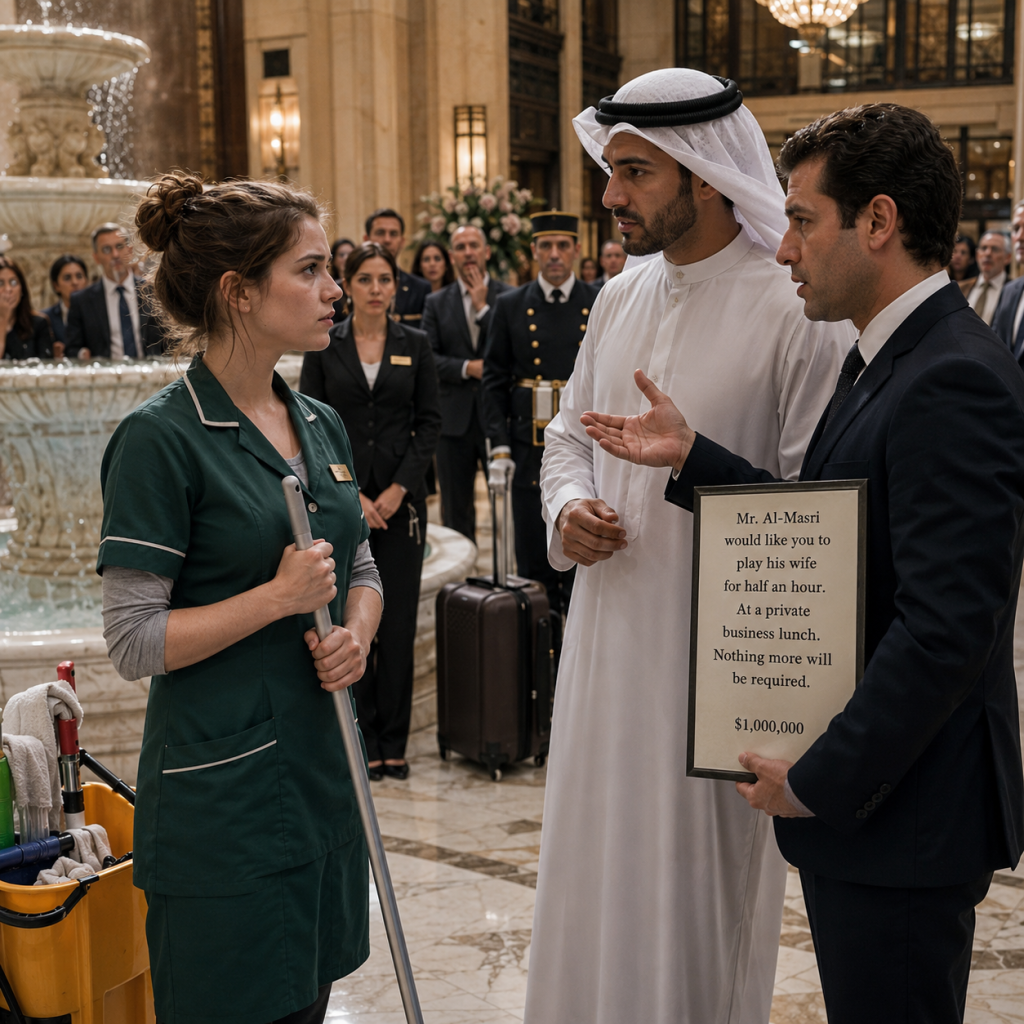
“No. My name is Naseem Haddad. I advise Mr. Zayd Al-Masri.”
She had heard the name by then. Everyone in the hotel had. Zayd Al-Masri, twenty-seven, billionaire developer from Abu Dhabi, heir to a family empire that built airports, hospitals, luxury districts, and entire stretches of cities most people only saw in travel magazines. He had arrived in New York to finalize a massive waterfront redevelopment deal with American investors.
Naseem lowered his voice. “Mr. Al-Masri has a private lunch in less than an hour. The man he is meeting is old-fashioned. He insisted on a family-style lunch. Mr. Al-Masri’s wife was expected to attend, but she could not travel.”
Natalie waited.
Naseem looked uncomfortable for the first time.
“He would like you to sit beside him and play the part of his wife for the lunch. Thirty minutes. Perhaps forty. You would not need to say much. In return, he is prepared to pay you one million dollars.”
The lobby went still.
Natalie slowly turned her eyes to Zayd Al-Masri.
He was standing near the fountain now, watching her. Calmly. Not smiling. Not assuming anything.
That mattered.
Because men who assumed yes were the easiest men in the world to disappoint.
Natalie looked back at Naseem.
“I’ll answer him directly.”
Naseem blinked. “Excuse me?”
“I said I’ll answer him directly.”
“Mr. Al-Masri speaks English.”
“Then he can hear me.”
Naseem hesitated, then stepped aside.
Natalie walked toward Zayd in her dark green uniform, her hair pinned at the nape of her neck, her hands smelling faintly of lemon cleaner.
Every person in the lobby pretended not to stare.
She stopped in front of the billionaire.
“I understand the offer,” she said. “But I have conditions.”
A guard shifted.
The front desk manager’s mouth opened slightly.
Zayd’s eyebrow moved, just barely.
“Conditions,” he repeated.
His voice was lower than she expected.
“Yes,” Natalie said. “First, I need the whole role. Not ‘sit there and smile.’ I need to know who I am supposed to be, how we met, how long we’ve been married, who will be at the table, what they care about, what they might ask, and why you need a wife there badly enough to offer a stranger a million dollars.”
Naseem stared at her.
Natalie continued.
“Second, I will not lie about anything that could damage someone innocent. No fake pregnancy. No fake charity scam. No pretending to endorse something harmful. Third, my supervisor needs to approve my leaving the shift. I won’t get fired because a billionaire had an emergency.”
For one second, nobody breathed.
Then Zayd Al-Masri smiled.
Not politely.
Not publicly.
Genuinely.
“Anything else?” he asked.
Natalie held his gaze.
“Yes. One million isn’t enough.”
Somewhere behind her, someone made a sound like a swallowed cough.
Zayd’s smile widened by half an inch.
“How much?”
“One point five.”
Naseem looked as if he had just watched someone step onto a frozen lake in April.
Zayd studied her for a long moment.
“Why?”
“Because that’s what I need.”
“For what?”
“That is not part of the role.”
The fountain kept murmuring.
The billionaire looked at the cleaner. The cleaner looked back.
Finally, Zayd said one word to Naseem in Arabic.
Naseem exhaled.
“Agreed.”
Part 2
Ten minutes later, Natalie was standing in the presidential suite on the thirty-second floor, looking at a navy dress laid across a cream sofa.
The suite was larger than the entire house she grew up in. Floor-to-ceiling windows framed Central Park in gold and red October leaves. A grand piano sat near the windows, untouched and gleaming. The air smelled like cedar, roses, and money that never had to announce itself.
Naseem placed a folder on the coffee table.
“Your name is still Natalie,” he said. “That makes this easier. You met Zayd three years ago in London at a cultural benefit. You married eighteen months ago. No children. You divide your time between Abu Dhabi, London, and New York. You support the Noor Foundation, which funds mobile eye clinics for children in underserved regions. Noor means light.”
“Real foundation?” Natalie asked.
“Yes.”
“Good.”
He looked up.
“I told you,” she said. “No fake charity scams.”
Naseem almost smiled.
He handed her photographs and names.
“Thomas Caldwell. Sixty-four. American real estate developer. Built half the luxury skyline in Chicago before moving into infrastructure. Conservative. Values family, legacy, loyalty. His wife, Margaret Caldwell. Quiet, observant, very involved in children’s hospitals. Their financial partner, Victor Leland, may join late. He cares about numbers and control.”
“What’s the deal?”
“A waterfront redevelopment in New Jersey. Housing, transit, retail, medical center, public parkland. Very large. Very political.”
“Why does Caldwell care if you have a wife?”
Naseem glanced toward Zayd, who stood at the window.
Zayd answered himself.
“Because he does business with families. Not companies.”
Natalie looked at him. “And your real wife?”
“There is no real wife.”
Silence entered the room.
Naseem looked down at the folder.
Natalie’s face did not change. “So the lie begins earlier than you said.”
“Yes,” Zayd replied.
“Why not tell Caldwell you’re unmarried?”
“Because six weeks ago, my uncle told him I was married.”
“By mistake?”
“No.”
Natalie understood. “To make you seem more stable.”
Zayd nodded once. “And less young.”
That was the first honest thing he had said that cost him something.
Natalie respected it.
“Fine,” she said. “Then we keep it narrow. I won’t invent a romance novel. If they ask personal questions, I answer simply.”
“Can you do that?”
“I clean hotel rooms for a living. I know more about rich marriages than most divorce lawyers.”
Naseem covered his mouth with his hand.
Zayd stared at her, then laughed once. The sound surprised everyone, including him.
Twenty minutes later, Natalie stepped out of the marble bathroom in the navy dress.
It fit almost perfectly.
Not glamorous. Better than glamorous. Simple, elegant, expensive in a way that whispered. She had pinned her brown hair into a low knot and used only mascara, concealer, and a muted lipstick from the makeup kit left beside the sink.
She looked into the mirror before leaving the bathroom and felt a strange shock.
She did not look like a different woman.
She looked like a woman people had failed to see.
Zayd turned when she entered.
For once, his expression was not controlled quickly enough.
“Will this work?” Natalie asked.
“Yes,” he said. “It will work.”
Naseem reviewed the final details in the elevator.
“Caldwell likes directness. Margaret likes sincerity. Leland likes leverage. Do not discuss politics unless asked. Do not mention religion. Do not over-explain.”
Natalie looked at Zayd. “Does he always talk this much?”
“Only when nervous,” Zayd said.
“I am never nervous,” Naseem said.
The elevator doors opened.
The private dining room of the Whitmore Grand was all ivory walls, tall windows, polished silver, and autumn flowers arranged as if every stem had signed a contract. Thomas and Margaret Caldwell were already seated near the window.
Thomas Caldwell stood when they entered. He was large, silver-haired, broad-shouldered, with a face weathered by construction sites despite the custom suit. Margaret was smaller, graceful, with sharp blue eyes and a soft gray dress.
“Zayd,” Thomas said warmly. “Good to see you.”
“And you, Thomas.”
Then Zayd turned.
“My wife, Natalie.”
There it was.
The lie.
Small enough to fit in a sentence. Large enough to change the temperature of the room.
Natalie stepped forward and offered her hand to Margaret first.
“It’s lovely to meet you.”
Margaret’s eyes moved over her face, her posture, her hands. Women like Margaret did not miss details. For three seconds, Natalie felt more inspected than she ever had in uniform.
Then Margaret smiled.
“Natalie. That’s a beautiful name. Where are you from originally?”
“Ohio,” Natalie said.
“Oh, truly? My mother was from outside Columbus.”
“Then she knew real winters.”
Margaret laughed. “She said the same thing every year.”
The first wall came down.
Lunch began carefully. Thomas talked about building as if it were a moral act.
“My father used to say if you pour a bad foundation, the building tells the truth eventually.”
Zayd nodded. “My father said something similar. Numbers can lie for a quarter. Concrete cannot.”
Thomas liked that. Natalie saw it happen. Trust, with men like him, arrived through recognition.
Margaret turned to Natalie while the men discussed zoning approvals.
“Naseem mentioned you work with a foundation.”
“Noor,” Natalie said. “It means light. The foundation supports mobile eye clinics for children who might not otherwise get screened early enough.”
Margaret’s expression changed.
“My granddaughter has amblyopia,” she said quietly. “Lazy eye. We caught it before kindergarten, thank God.”
“That matters,” Natalie said. “Early treatment can make a huge difference. The problem is, many families don’t get that first screening until the window is already closing.”
Margaret leaned in. “You know this well.”
“I read a lot.”
“What made you interested?”
Natalie paused.
A safe lie would have been easy. A charming lie even easier.
Instead, she said, “Because preventable loss bothers me.”
Margaret looked at her for a long time.
“That may be the most honest answer I’ve heard at one of these lunches.”
Across the table, Zayd heard it. Natalie knew because his hand stilled beside his water glass.
The lunch found its rhythm.
Then Victor Leland arrived.
He was forty-eight, compact, immaculate, with quick eyes and a smile that never reached them. He apologized without sounding sorry and sat beside Thomas with a leather portfolio.
“Zayd,” he said. “Good to finally meet the man everyone says is patient until the contract appears.”
Zayd smiled. “Patience is useful. Contracts are clearer.”
Victor laughed. “Good. Then let’s be clear.”
The business conversation sharpened. Deposit percentages. Operating control. Veto rights. Construction phases. Public subsidies. Private risk.
Natalie listened without appearing to listen.
That was another thing cleaning had taught her. People revealed more when they thought you were background.
Victor wanted control of hiring. Zayd refused operational interference but offered quarterly reporting and veto rights over major strategic decisions. Thomas watched the exchange like a man weighing steel beams. Margaret watched Natalie.
Then Thomas suddenly turned to her.
“Natalie, forgive me for dragging you into the men’s mud, but what do you think of New York?”
Victor’s eyes flicked toward her with polite disinterest.
Zayd’s expression did not change.
Natalie set down her glass.
“I think New York is honest in a rude way,” she said.
Thomas laughed. “That’s a new one.”
“It doesn’t promise comfort. It promises motion. You either move with it or get pushed. I like that.”
“Ohio didn’t have motion?”
“Ohio had roots,” Natalie said. “New York has velocity. People need both, but not always in the same season.”
Thomas looked delighted. “That’s good. Roots and velocity.”
Victor finally looked at her properly.
Margaret smiled as if she had been waiting.
Thomas continued, “And what does Zayd give you?”
It was the first dangerous question.
Natalie felt the room narrow.
She could have said love. Support. Adventure. Any pretty word.
Instead, she looked briefly at Zayd, then back at Thomas.
“Perspective,” she said. “He sees scale before I do. I see details before he does. Between us, fewer things get missed.”
The silence after that was not awkward.
It was impressed.
Zayd said nothing, but something changed in his face. Not softness exactly. Recognition.
Victor leaned back.
“A useful marriage, then.”
Natalie turned to him.
“The best ones are.”
Margaret laughed into her napkin.
Thomas slapped the table once. “I like her.”
The deal did not get signed at lunch. Deals of that size never did. But by the time coffee arrived, the thing that mattered had happened.
Thomas Caldwell trusted Zayd Al-Masri.
And, more dangerously, he trusted the woman beside him.
When the lunch ended, Thomas shook Zayd’s hand with both of his.
“We’ll have our lawyers clean up the language,” he said. “But I think we’re there.”
Margaret hugged Natalie at the door.
It was quick and unexpected.
“If Noor ever expands work here,” she whispered, “call me. I mean it.”
Natalie took the card she offered.
That, at least, was real.
Back in the presidential suite, Natalie removed the black heels and stood barefoot on the carpet. Her feet ached. Her head ached more.
“I’ll change and return the dress,” she said.
“Keep it,” Zayd replied.
She turned. “No.”
He blinked. “No?”
“I accepted payment for work. Not gifts.”
“It is clothing bought for the work.”
“Then donate it to someone who needs interview clothes.”
Naseem looked fascinated.
Zayd studied her. “You negotiate even after winning.”
“I didn’t win. I completed a job.”
“And did it better than anyone I could have hired.”
“You didn’t have time to hire anyone qualified.”
“I had time to notice someone qualified.”
That stopped her.
For a moment, the city hummed behind the glass.
Zayd said, “Why one point five million?”
“Tuition.”
“For what?”
“International relations. I started college and left. I’m going back.”
“Where?”
“Columbia if I get in. Maybe NYU. Maybe somewhere less impossible.”
“Why international relations?”
Natalie looked at the windows, at the park burning red below.
“Because the world is huge,” she said. “And I’m tired of only seeing the parts people like me are allowed to clean.”
Naseem looked down.
Zayd did not.
His face became very serious.
“I was born with doors open,” he said. “You were not. That is not because I deserved more.”
“No,” Natalie said. “It isn’t.”
“I respect people who know what a door costs.”
“Then pay what you agreed and let me open mine.”
He nodded slowly.
“You’ll have the money today.”
“I know.”
“And if you need a reference?”
She almost laughed. “From my fake husband?”
“From a businessman who watched you save a negotiation.”
“That sounds less illegal.”
For the second time that day, he laughed.
Part 3
The money arrived before midnight.
Not in cash. Not in some dramatic suitcase. A wire transfer, clean and documented, labeled consulting services, with tax paperwork Naseem sent in an email so thorough Natalie wondered if he slept.
She sat on the edge of her narrow bed in Queens and stared at the number until it stopped looking real.
Then she opened her blue notebook.
Get stable.
Go back to school.
Understand the world.
For the first time, the second line did not look like a wish.
It looked like a task.
By morning, the hotel had already turned the story into myth.
In one version, Natalie had slapped the billionaire.
In another, she had demanded ten million.
In another, she had secretly been a princess, a federal agent, a runaway heiress, or Zayd’s real wife testing him.
The truth was less flashy and more dangerous.
She had asked for the whole role.
She had set terms.
People hate that story because it cannot be dismissed as luck.
The internet got hold of it two days later when someone leaked lobby security gossip to a luxury travel account. No footage, no names at first. Just a post.
A billionaire asked a hotel cleaner to pretend to be his wife at lunch. She said yes only after demanding a raise and a full briefing. The deal went through.
By Friday, everyone had an opinion.
Some called her greedy.
Some called her brilliant.
Some said he had exploited her.
Some said she had exploited him back.
Natalie did not comment. She worked her shifts, submitted applications, and studied for entrance exams on the subway with one hand wrapped around the pole.
Zayd sent one message three days after the lunch.
Naseem says Columbia’s spring transfer process is brutal. He is pessimistic. I told him pessimism is his hobby.
Natalie stared at the text.
Then typed back.
Tell Naseem I’ve handled worse than application portals.
Zayd replied six minutes later.
He laughed. He denies it.
That was how it began.
Not with flowers. Not with declarations. With messages about deadlines, books, zoning politics, and once, at 1:12 a.m., a photograph of a hotel fountain in London with the caption:
This one also leaks.
Natalie laughed so hard she woke one of her roommates.
She got into Columbia’s School of General Studies the following spring.
When the acceptance email arrived, she was in the laundry room of the Whitmore Grand folding towels still warm from the dryer. She read it once. Then again. Then she sat on a plastic bin and covered her mouth with both hands.
Mrs. Klein found her there.
“Ward, are you sick?”
Natalie held out the phone.
Mrs. Klein read the email, blinked twice, and said, “Well. Don’t sit on the clean towels.”
Then she hugged her so fast Natalie barely had time to react.
That night, Natalie called home.
Her mother cried openly. Her father got on the phone last, as always.
“You got in?” he asked.
“I got in.”
“Columbia?”
“Yes.”
A long pause.
Then Frank Ward said, “Good.”
That was all.
But Natalie heard everything inside it.
She kept working at the hotel for another year while taking classes. Her life became a brutal arrangement of shifts, lectures, reading, papers, and sleep stolen in pieces. She learned to write essays in break rooms. She learned to eat dinner from vending machines without hating herself. She learned that belonging at an Ivy League school did not arrive all at once. Some days she felt brilliant. Some days she felt like an intruder with a borrowed ID.
Professor Elaine Mercer changed that.
Mercer taught Middle Eastern politics with the kind of sharpness that made lazy students afraid and serious students better. On the third week of class, Natalie challenged her interpretation of a Gulf infrastructure agreement.
Professor Mercer stopped mid-sentence.
“What’s your name?”
“Natalie Ward.”
“Have you worked in the region?”
“No.”
“Then why are you reading source documents most graduate students avoid?”
Natalie thought about lying, then decided against it.
“Because summaries usually hide the interesting parts.”
Mercer stared at her.
After class, she said, “Come to office hours.”
By the end of the semester, Natalie had a mentor.
By the end of the year, she had a research assistant position.
By the end of the second year, she no longer worked in housekeeping.
Her last day at the Whitmore Grand was quieter than she expected. Mrs. Klein gave her a card signed by the staff. The bellman who had seen the original lobby moment wrote, Never forget us when you’re running the world.
Natalie cried in the employee locker room, which annoyed her because she had promised herself she would not.
Zayd was in New York that week.
They met for coffee in Bryant Park, because Natalie refused every restaurant he suggested.
“You are very difficult to impress,” he said.
“I’m impressed by coffee that costs less than six dollars.”
“This coffee cost seven.”
“Then you overpaid.”
He smiled.
They had seen each other only four times in two years, always publicly, always with enough distance to let both of them pretend this was friendship built from curiosity. But the messages had become part of her days. He sent her articles. She sent back arguments. He asked what Americans meant when they said “circle back.” She asked why every Gulf development proposal used the word “vision” fourteen times.
They became, slowly and inconveniently, necessary.
That afternoon, he walked with her under the yellow leaves.
“Thomas Caldwell asked about you,” Zayd said.
“About Noor?”
“About you. Margaret too. She says you never called.”
“I had nothing real to offer yet.”
“You always say that.”
“Because it’s usually true.”
He stopped walking.
“Natalie.”
She turned.
People moved around them. A cyclist cursed at a cab. A child dropped a pretzel and screamed as if betrayed by God. The city continued being rude and alive.
Zayd looked at her the way he had looked at her in the lobby years earlier.
“I am building a children’s vision center in Newark with the Caldwell Foundation,” he said. “Noor will fund mobile screening units. Margaret insisted. She said the idea came from you.”
Natalie could not speak for a moment.
“That lunch was fake,” she said finally.
“No,” Zayd replied. “The marriage was fake. Not everything else.”
The center opened eighteen months later.
Natalie stood at the ribbon-cutting in a cream suit she had bought herself, with her parents in the front row. Her father wore a tie too wide for the decade and looked uncomfortable but proud. Her mother cried before anyone said a word.
Children from Newark public schools would receive free eye screenings there. Mobile vans would travel to rural counties and low-income neighborhoods. The Caldwell Foundation funded equipment. Noor funded operations. Columbia sent public health interns. Natalie, still a student, had helped design the outreach model.
During the ceremony, Margaret Caldwell squeezed her hand.
“You did call eventually,” Margaret said.
“When I had something real.”
Margaret smiled. “Honey, you were real the first day.”
The story resurfaced online after the center opening.
This time, reporters had names.
Former hotel cleaner who once pretended to be billionaire’s wife helps launch children’s vision center.
The headlines were ridiculous, but useful. Donations came in. Volunteers signed up. Parents booked screenings. A six-year-old boy named Mateo got referred for urgent treatment after a mobile exam caught a serious condition early.
Natalie kept his thank-you drawing on her refrigerator.
It showed a woman in a blue dress holding a flashlight.
Years passed the way important years do, slowly while you are inside them and suddenly when you look back.
Natalie graduated with honors. Then she earned a master’s degree in international affairs, focusing on infrastructure partnerships and soft power in the Gulf. Professor Mercer told her to consider a PhD. Natalie told her to stop trying to ruin her sleep.
Zayd expanded his work in the United States, but not carelessly. Natalie argued with him about community benefit agreements, local hiring, and the difference between investment and extraction.
“You enjoy disagreeing with me,” he told her once.
“I enjoy being right.”
“You are not always right.”
“No. But you remember the times I am.”
He did.
Their love did not arrive like a movie. It arrived like trust. Like a door opening every time it was knocked on. Like someone remembering how you took your coffee and also how you thought about public transportation policy.
When Zayd proposed, it was not in a ballroom or on a yacht or beside a fountain.
It was in the public library.
The same branch where Natalie had once read journals she could not afford.
He placed the ring on top of her old blue notebook and said, “I know you do not like gifts without purpose. So this is not a gift. It is a question.”
Natalie looked at the ring, then at him.
“Do I get the whole role?”
Zayd laughed softly. “Yes.”
“Who will be there?”
“Too many relatives.”
“How long is the commitment?”
“I hope longer than thirty minutes.”
“What are the conditions?”
“That we tell the truth when lying would be easier. That you keep arguing with me. That I keep listening. That neither of us becomes impressed with money.”
Natalie’s eyes filled.
“And my condition?” she asked.
“Name it.”
She touched the blue notebook.
“We keep building things that would have helped the people we used to be.”
Zayd’s face changed.
“Agreed,” he said.
They married in May, in New York, in a ceremony that mixed cultures carefully and imperfectly, which made it beautiful. Her father walked her down the aisle and whispered, “Don’t trip,” because that was the only way he could survive the emotion. Her mother carried tissues in both sleeves.
Naseem gave a toast so dry and elegant that half the room missed the jokes.
“Many people believe this began with a business lunch,” he said. “This is incorrect. It began with a woman asking for terms. I advise all powerful men to fear such women. They tend to improve everything.”
Years later, people would still ask Natalie about that day in the lobby.
They always wanted the same version.
The fairy tale.
The cleaner and the billionaire.
The dress.
The money.
The shocking offer.
She would let them have a little of it because stories need doors people are willing to open. But when young women asked her privately what really changed her life, Natalie never said the money.
She said, “I asked to understand the role before I played it.”
That answer disappointed some people.
It saved others.
Because the world will offer desperate people strange bargains. Smile here. Sit there. Pretend this. Accept less. Be grateful. Don’t ask questions. Don’t make powerful people uncomfortable.
Natalie had been holding a mop when her bargain came.
She had lemon cleaner on her hands and rent due in nine days.
She could have said yes to one million dollars before Naseem finished the sentence.
Instead, she asked who she was supposed to be.
That was the action that shocked everyone.
Not greed.
Not beauty.
Not luck.
A woman who had been treated like background demanded the full script.
And once she had it, she changed the ending.
On a quiet May afternoon many years later, Natalie stood beneath a blooming tree outside her apartment in Manhattan, on the phone with her mother.
“Are you happy?” Linda asked suddenly.
Natalie looked across the street, where Zayd was crouched beside their little daughter, helping her pick up fallen petals from the sidewalk. The girl had his dark eyes and Natalie’s serious expression, which made strangers nervous and teachers delighted.
“Yes,” Natalie said. “I’m happy.”
“No,” her mother said. “I mean, are you a happy person?”
Natalie smiled.
The petals moved in the wind like tiny pieces of spring.
“Yes, Mom,” she said. “I think I am.”
Her mother was quiet for a second.
“I knew,” Linda said.
Natalie laughed, because of course she did.
On the shelf inside their apartment, the old blue notebook still stood between a framed photo of the Newark vision center and a dried red leaf Natalie had picked up the day she left the Whitmore Grand with one point five million dollars and her future folded into her pocket.
The leaf had gone thin and translucent with time. Its veins looked like a map of a country that did not exist anywhere on earth.
Or maybe it did.
Maybe it was the country where people are not mistaken for their uniforms.
Where a cleaner can become a scholar.
Where a lie told at lunch can lead to something truer than anyone planned.
Where a billionaire can learn that money opens doors, but respect is what lets someone walk through them standing tall.
And where everything can begin beside a leaking fountain, at 1:17 on a Tuesday afternoon, when a man with too much power asks a woman with too much dignity to play a role.
And she says yes.
But only after she writes the terms herself.
THE END