At 2:07 A.M., My Grandson Called Me From the Dark. By Dawn, I Learned the Monster in That House Was Not the One I Expected.
PART 1
At seventy-one years old, I thought I had already heard every kind of fear a human voice could carry.
Then my phone rang at 2:07 in the morning, and my eight-year-old grandson whispered my name like it was the last safe word left in the world.
“Grandpa,” Ethan breathed.
I sat straight up in bed.
The house around me was still, my old ceiling fan turning slow circles above my head, the kind of quiet that belongs only to retired men and empty rooms. My wife, Margaret, had been gone six years by then, and most nights the silence felt like a companion I had learned to live beside.
But that night, the silence cracked open.
“Ethan?” I said. “Buddy, what’s wrong?”
For a moment, I heard only his breathing. Thin. Shaking. Desperate not to become a sob.
Then something crashed in the background.
A man’s voice followed, low and furious.
I could not make out the words, but I knew the tone. I had heard it during my years as a deputy sheriff, standing in living rooms where families pretended nothing was wrong while fear sat at the dinner table with them.
“Ethan,” I said carefully, already reaching for my glasses. “Where’s your mother?”
He did not answer.
Then, barely louder than the hum of the line, he whispered, “Grandpa… please come.”
The call ended.
I did not think. Thinking comes later, when the danger has already chosen its shape.
I threw on jeans, grabbed my truck keys, and ran out into the San Antonio night with my shirt half-buttoned and my heart pounding like it belonged to a much younger man.
Emily’s house was twenty-three minutes away if I drove like a responsible citizen. I made it in sixteen.
As the headlights swept across her front yard, my stomach tightened. The porch light was off. The front door stood open by three inches.
No one leaves a door like that by accident at two in the morning.
I stepped out of the truck, my old knees complaining, my hands steady in the way they only become when something terrible is waiting. I pushed the door open and entered.
The house smelled of stale beer, dust, and something broken.
“Emily?” I called.
No answer.
Then I heard Jason.
“I told you not to call him.”
The voice came from the kitchen.
I moved down the hallway, past framed photos I had given Emily: Ethan in a Little League uniform, Emily on her college graduation day, Jason smiling beside them like a man who had practiced kindness in a mirror.
“I told you,” Jason said again, “your father has no business in this house.”
Then Emily cried out.
Not loudly.
That made it worse.
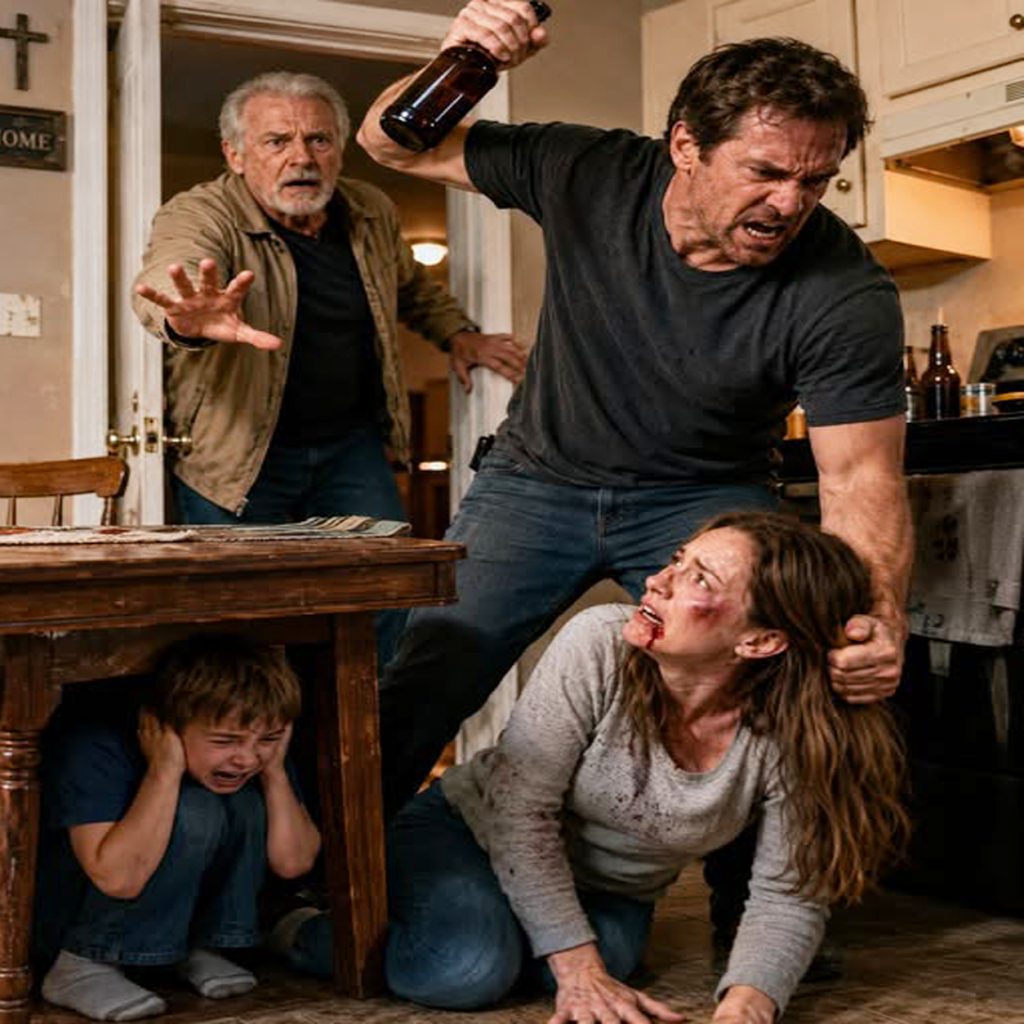
I stepped into the kitchen and saw my daughter on the floor, one hand against her mouth. Ethan was under the table, small and folded in on himself. Jason Carter stood above them holding a beer bottle, his face flushed and his eyes empty in that cold, familiar way.
For one long second, nobody moved.
Emily looked at me.
Not surprised.
Relieved.
That look broke something in me.
Jason turned slowly. “What are you doing here, old man?”
I looked at my daughter, then my grandson.
“Come with me,” I said. “Both of you.”
Jason laughed, but there was uneasiness behind it. “No one’s leaving.”
Emily tried to rise. Jason reached for her arm.
I stepped forward.
“Take your hand off my daughter.”
He stared at me as if he had forgotten I was once a man people listened to when I spoke softly.
“Or what?” he said.
I did not answer him. I looked at Ethan.
“Buddy,” I said, “crawl to me.”
The boy hesitated.
Jason’s head snapped toward him. “Don’t you move.”
That was when I saw it.
Not the fear. I had already seen that.
I saw the small silver key hanging around Jason’s neck.
Emily saw me notice it, and all color drained from her face.
“Dad,” she whispered. “Don’t.”
Jason’s smile returned.
Slow. Ugly. Certain.
“You want to know what’s behind the locked door, Robert?” he asked. “Go ahead. Ask your daughter why she never left.”
PART 2
Some people imagine family secrets as dusty letters in drawers or old photographs tucked inside Bibles.
They are wrong.
Sometimes a family secret is a locked hallway door, a silver key, and a daughter who has learned to flinch before a question is even asked.
Jason stood between me and that hallway with the smug confidence of a man who believed everyone in the room had something to lose except him.
Emily struggled to her feet.
“Dad,” she said again, softer this time. “Please take Ethan outside.”
Her voice had changed. The fear was still there, but beneath it was something else.
Shame.
I hated that most of all.
“Emily,” I said, “what is behind that door?”
Jason laughed. “Tell him, sweetheart.”
Ethan had crawled from under the table and pressed himself against my leg. I placed one hand on his shoulder. He was trembling so badly I could feel it through his pajama shirt.
Emily looked at her son, then at me.
“Jason has papers,” she said. “Videos. Recordings. Things he said would destroy us if I left.”
“What things?”
She shook her head.
Jason took a lazy step toward me. “Your daughter isn’t the angel you think she is.”
I looked at him, and a strange calm settled over me.
Men like Jason need anger. They feed on it. Anger makes you sloppy.
So I gave him none.
“Then show me,” I said.
His smile flickered.
Emily whispered, “Dad, no.”
But Jason, drunk on power more than liquor, pulled the key from his neck.
“You want the truth?” he said. “Fine.”
He marched down the hallway and unlocked the last door on the left.
I followed with Ethan clutching my hand and Emily behind us, crying without sound.
The door opened.
Inside was not a bedroom.
It was an office.
A secret one.
The windows were covered. A desk sat against the wall with two monitors, a printer, stacks of folders, and a locked metal cabinet. On one shelf were old phones, hard drives, and labeled envelopes.
My first thought was that Jason was running some kind of business.
My second thought was colder.
This was not chaos. This was control.
Jason swept his hand toward the folders. “There. You happy?”
I stepped closer.
The labels were names.
Emily Mitchell Carter.
Robert Mitchell.
Ethan Carter.
Margaret Mitchell.
My dead wife’s name sat on one of Jason’s folders.
A chill moved through me so sharp I nearly stepped back.
“What is this?” I asked.
Emily covered her mouth.
Jason leaned against the desk. “Insurance.”
I opened the folder with my name on it.
Inside were copies of old police reports from my years as a deputy. Newspaper clippings. Photos of my house. Bank statements.
Then I found something that stopped my breathing.
A photograph of Margaret.
Not from before she died.
From the week she died.
She was standing outside St. Luke’s Pharmacy, wearing her blue cardigan, one hand on her purse. The angle was distant, as if someone had been watching her from a parked car.
My knees weakened.
“Where did you get this?”
Jason’s face changed.
Only for a second.
But I saw it.
Before he could speak, Ethan tugged my hand.
“Grandpa,” he whispered, pointing to the metal cabinet. “Mommy cries when he opens that.”
Emily stepped forward. “Ethan, baby, don’t.”
Jason lunged for the boy.
I moved first.
I shoved Ethan behind me and planted myself between them.
Jason’s face twisted. “You have no idea what you’re touching.”
“Then educate me.”
His eyes darted toward Emily.
And there it was again.
Not just anger.
Fear.
For the first time that night, I realized Jason Carter was not the biggest secret in that house.
He was guarding one.
I reached for the cabinet handle.
Locked.
Jason’s voice dropped. “Robert, I’m warning you.”
I turned to Emily. “Do you know where the key is?”
She stared at the cabinet like it was a grave.
Then she walked past Jason, reached behind a loose baseboard near the floor, and pulled out a smaller brass key.
Jason went pale.
“You stupid woman,” he hissed.
Emily did not look at him.
She handed me the key.
“I should have given you this years ago,” she said.
PART 3
Inside the cabinet were the bones of a life I thought I had buried.
There were envelopes, flash drives, printed emails, medical records, and one old manila folder sealed with brittle tape.
On the front, in black marker, were two words:
MARGARET MITCHELL.
For six years, I had carried my wife’s death like a stone in my chest.
Margaret had died after what doctors called a sudden cardiac event. She had been sixty-four, still strong enough to plant tomatoes in March, still stubborn enough to argue with the television news every evening.
The day she died, she had gone to the pharmacy. She never made it home awake.
The doctors said sometimes life ends without warning.
I believed them because grief leaves a man too tired to suspect betrayal.
My fingers shook as I opened the folder.
Inside were prescription records, notes from a doctor I had never met, and a photocopy of a life insurance policy.
Margaret’s life insurance policy.
But I had never seen that version.
The beneficiary had been changed six months before her death.
Not to me.
Not to Emily.
To a company called Carter Household Holdings.
Jason’s company.
The room tilted.
Emily whispered, “I found that two years ago.”
I looked at her. “Why didn’t you tell me?”
Jason answered before she could.
“Because she knew what would happen.”
Emily’s eyes filled. “He said I signed things. He said he had proof I helped him. He said if I went to the police, they’d think I was part of it.”
“Part of what?” I asked, though my heart already knew.
Emily pressed her hands together like a child praying.
“When Mom got sick,” she said, “Jason told me he had a friend who could help with medication costs. I signed some forms because I thought it was for assistance. I was pregnant. I was exhausted. I trusted him.”
Jason snorted. “Don’t act innocent.”
She turned on him then, and for the first time that night, my daughter’s voice sharpened.
“I trusted my husband,” she said. “That was my mistake. Not a crime.”
I stared at the papers. There were dates. Signatures. Transfers.
But something did not fit.
Jason had married Emily five years ago.
Margaret died six years ago.
Before the wedding.
Before Ethan.
Before Jason was family.
I looked at him.
“How did you even know my wife?”
Jason said nothing.
A sound came from the doorway.
Ethan had picked up one of the old phones from the shelf. The screen had flickered to life.
“Grandpa,” he said, “there’s a video.”
Jason moved like a snake.
“No!”
He reached for the phone, but Emily stepped in front of him. He shoved past her, and I caught his wrist before he reached Ethan.
For an old man, I still had some strength left.
“Play it,” I told Ethan.
The video opened in a dimly lit room. At first the image shook. Then it steadied.
Margaret’s voice filled the office.
My wife’s voice.
“Robert,” she said on the recording, “if you are seeing this, then I was right to be afraid.”
I stopped breathing.
Emily began to sob.
On the screen, Margaret sat at our old kitchen table. Her blue cardigan was buttoned wrong, the way it always was when she was distracted.
“There is something wrong with Jason Carter,” she continued. “He has been asking about Emily. About our finances. About your pension. He thinks I do not notice when people lie, but I was married to a deputy for forty-two years. I notice everything.”
Jason backed toward the hallway.
I did not take my eyes off the screen.
Margaret leaned closer to the camera.
“I found a copy of a policy I never signed. My signature is there, but it is not mine. If anything happens to me, find the woman named Linda Vale. She knows who Jason really is.”
The video ended.
For a moment, no one spoke.
Then Jason bolted.
PART 4
A younger man might have chased Jason down the hallway.
I did not.
At seventy-one, you learn that doors can be locked, roads can be watched, and men who run often leave behind the thing that ruins them.
I pulled Ethan close and told Emily to call 911.
Her hands shook so badly she dropped the phone twice.
Jason’s truck roared to life outside. Tires screamed against pavement, and then he was gone into the black Texas morning.
“Let him run,” I said.
Emily stared at me. “Dad, he’ll come back.”
“No,” I said, looking at Margaret’s folder. “This time, he’s the one who should be afraid.”
The police arrived within minutes. Two officers entered first, then a detective named Angela Reyes, a woman in her fifties with tired eyes and a voice that did not waste words.
She listened.
She photographed the room.
She bagged the drives, the papers, the old phones, and the folder with Margaret’s name.
When she watched Margaret’s video, her face changed.
Not shock.
Recognition.
“You know something,” I said.
Detective Reyes looked at me for a long moment. “I know the name Linda Vale.”
Emily sat at the kitchen table wrapped in a blanket. Ethan had fallen asleep against her, his small hand still gripping her sleeve.
“Who is she?” I asked.
Reyes lowered her voice.
“Linda Vale was a court clerk in Bexar County. She disappeared nine years ago after reporting forged legal documents connected to insurance fraud, guardianship theft, and property transfers targeting older adults.”
Older adults.
The words landed hard.
Margaret and I had spent a lifetime saving carefully. Paying the mortgage. Building something modest but honest. Men like Jason did not see that as a life.
They saw it as prey.
“Was Jason involved?” I asked.
“We suspected a man using several names,” Reyes said. “Jason Carter may be one of them.”
Emily closed her eyes.
I sat beside her.
“Tell me everything,” I said.
So she did.
It came out slowly at first, then all at once.
Jason had begun controlling her after Ethan was born. First the money. Then the phone. Then her friends. He told her I was too old to help, too proud to understand, too fragile to survive scandal.
“He said if I left,” Emily whispered, “he would send the documents to the police. He said he’d make it look like I helped steal from Mom before she died.”
I felt old then.
Not because of my age.
Because my daughter had suffered under my roofline, within driving distance, and I had mistaken her silence for distance.
“I should have pushed harder,” I said.
Emily shook her head. “I hid it well.”
“No,” I said. “He taught you to.”
Detective Reyes left two officers outside the house and took Emily and Ethan’s statements. By dawn, she had issued alerts for Jason’s truck.
But Jason was not found that day.
Or the next.
For three days, Emily and Ethan stayed at my house. Ethan slept with the hallway light on. Emily woke from nightmares apologizing for things no one blamed her for.
On the fourth morning, Detective Reyes came to my door.
She was not alone.
Beside her stood a woman with silver hair, a narrow face, and eyes that looked as if they had spent years watching exits.
“Mr. Mitchell,” Reyes said, “this is Linda Vale.”
The woman took one step into my living room and looked at the photograph of Margaret on the mantel.
Then she whispered, “She tried to save me.”
PART 5
Linda Vale was not dead.
She had been hiding.
For nine years, she had moved from town to town under a different name, afraid of a network that stole from widows, retirees, and families too ashamed or confused to fight back.
“Jason was never the leader,” Linda told us, sitting at my kitchen table with both hands wrapped around a cup of coffee she never drank. “He was a collector. A charming man who entered families, found the weakness, gathered signatures, and passed everything upward.”
“Upward to who?” I asked.
Linda looked at Detective Reyes.
Reyes nodded once.
Linda turned back to me.
“To someone you know.”
The room seemed to shrink.
Emily sat beside me, pale but steady. Ethan was in the den watching cartoons, close enough for us to hear him laugh softly when something silly happened on screen.
That laugh kept me anchored.
Linda opened a folder she had brought with her.
Inside were photographs.
Old ones.
Jason with different hair.
Jason at a courthouse.
Jason beside older couples I did not recognize.
Then Linda placed one final photo in front of me.
My throat closed.
It was Margaret.
Standing outside church.
Beside her was a man in a gray suit.
My pastor.
Reverend Daniel Whitcomb.
For twenty years, Daniel had prayed over our meals, buried my wife, counseled Emily, baptized Ethan, and sat beside me after Margaret died with one hand on my shoulder telling me God had called her home.
I stared at the photograph.
“No,” I said.
Linda’s voice softened. “I’m sorry.”
Detective Reyes leaned forward. “Whitcomb used grief ministries, senior outreach programs, and church records to identify targets. People with insurance, pensions, property, and adult children under stress. Jason did the personal work.”
I could not speak.
The betrayal was too large to hold.
A stranger can rob you and remain a stranger.
But a man who prays at your wife’s funeral while hiding the truth—there is no language for that.
Emily covered her mouth. “He counseled me after Jason started changing.”
Linda nodded. “That was how they kept you trapped. Jason frightened you. Whitcomb comforted you. Between the two of them, you never had room to breathe.”
The twist was not that evil had entered our family.
The twist was that it had been welcomed through the front door, wearing Sunday shoes and carrying a Bible.
Detective Reyes set a small recorder on the table.
“We need one thing,” she said. “Jason will not stay gone. Men like him come back for what they think belongs to them. If he contacts you, we can trace him.”
“He’ll contact me,” Emily said quietly.
I turned to her. “No.”
She met my eyes. “Dad, I ran from him for years. I won’t run from him anymore.”
That evening, Jason called from a blocked number.
Emily answered on speaker.
“Where are my files?” he demanded.
Her voice trembled once, then steadied.
“Gone.”
“You stupid—”
“No,” she interrupted. “Listen to me. You used my mother. You used my son. You used me. And you made one mistake.”
Jason laughed. “What mistake?”
Emily looked at me, and for the first time in years, I saw my daughter again. Not the frightened woman Jason had made small, but the girl who used to climb oak trees and argue with umpires at Little League games.
“You forgot I was Robert Mitchell’s daughter,” she said.
The line went silent.
Then Jason said, “Tell the old man to check his mailbox.”
The call ended.
We all froze.
I walked outside with Detective Reyes beside me.
Inside the mailbox was a plain envelope.
No stamp.
No return address.
Inside was one photograph.
Margaret, Emily, and Ethan as a baby.
On the back, written in black ink, were five words:
SHE WAS NOT THE FIRST.
Beneath the photograph was a flash drive.
Detective Reyes plugged it into an evidence laptop at my kitchen table.
A video opened.
Jason appeared on screen, younger, nervous, sitting across from Reverend Whitcomb.
Whitcomb’s voice was calm.
“Margaret is becoming a problem,” he said.
Jason swallowed. “She suspects too much.”
Whitcomb leaned closer.
“Then we move the timeline.”
Emily gasped.
My hands curled into fists.
But then the video continued.
Whitcomb stood and walked out of frame.
A woman entered.
For one impossible second, I thought grief had finally broken my mind.
Because the woman on the screen was my wife.
Margaret.
Alive.
Healthy.
Angry.
She looked directly at Jason and said, “If you touch my family, I will destroy every one of you.”
The recording ended.
I could not move.
Emily whispered, “Dad?”
Detective Reyes stared at the screen, stunned.
Linda Vale began to cry.
“She survived,” Linda said. “I knew it. I knew she had a plan.”
The front door opened behind us.
A voice I had mourned for six years said softly, “I’m sorry it took me so long to come home.”
I turned.
Margaret stood in the doorway wearing a dark coat, older and thinner, but alive.
My wife.
My Margaret.
Emily made a sound like a child and ran to her mother.
I stayed where I was, unable to trust my own eyes.
Margaret looked at me with tears streaming down her face.
“Robert,” she said, “I had to disappear because Whitcomb had men inside the department, inside the courts, everywhere. If they believed I was dead, they would stop watching me. I have spent six years building the case they thought no old woman could build.”
Behind her, two federal agents stepped into the house.
Detective Reyes smiled for the first time.
Then my phone rang again.
A video call.
Unknown number.
I answered.
Jason’s face appeared, wild and cornered.
“You think you won?” he spat.
Margaret stepped beside me and leaned into the camera.
“No, Jason,” she said calmly. “I think you finally called the wrong house.”
The agents moved at once.
Reyes’s radio crackled.
“We have him.”
Emily covered her face and sobbed.
Ethan ran in from the den, stopped dead, and stared at Margaret.
She knelt, opening her arms.
“Hi, sweetheart,” she whispered. “I’m your Grandma Margaret.”
Ethan looked at me.
I nodded, crying too hard to speak.
He ran to her.
And in that moment, as my wife held the grandson she had watched from the shadows and my daughter stood free for the first time in years, I understood the truth.
The dead had not returned.
The living had finally stopped hiding.
By sunrise, Reverend Whitcomb was in custody, Jason was arrested two counties away, and the files from that locked room became the key to exposing one of the largest elder-targeting fraud rings Texas had ever seen.
But none of that mattered most.
What mattered was the small boy asleep on my couch that morning, his hand wrapped around Margaret’s, no longer afraid of the dark.
And every year after that, at exactly 2:07 a.m. on the anniversary of the call, I woke up, walked down the hall, and checked on my family.
Not because I feared the nightmare would return.
But because sometimes the smallest whisper in the dark is the sound that saves everyone.