Part 1: A Dinner My Daughter Would Never Forget
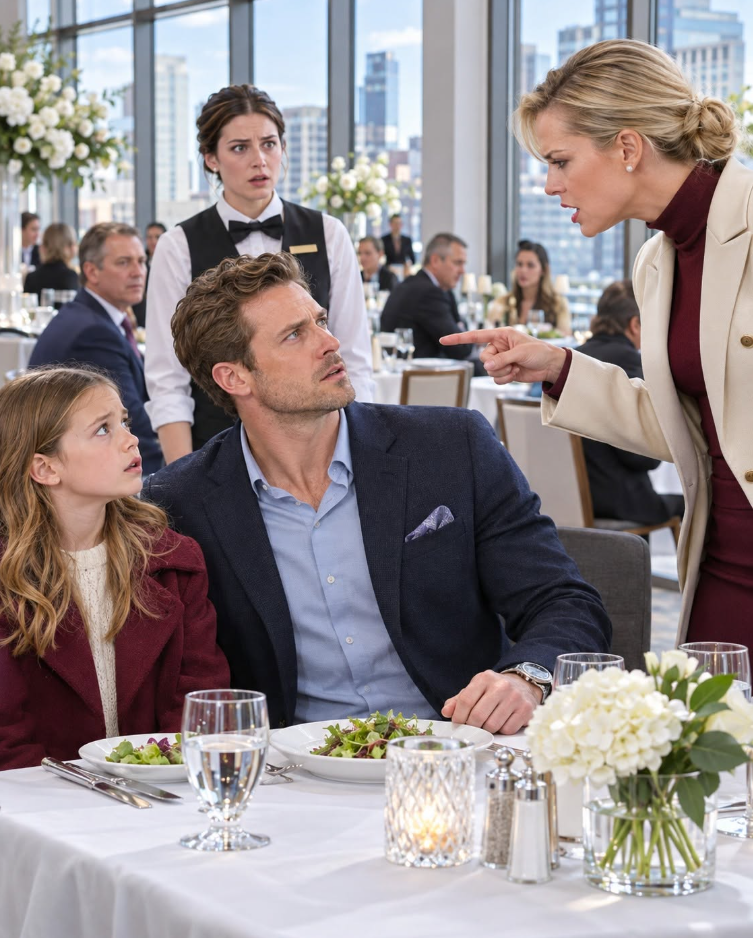
I was helping my eight-year-old daughter, Maisie, cut her grilled chicken when a woman in an elegant black blazer approached our table.
She glanced at my faded jeans, studied my rain-stained work boots, and offered a smile that carried very little warmth.
“Sir, we generally reserve this dining area for a different class of clientele.”
Maisie stopped coloring her children’s menu. Her little fingers tightened around the blue crayon she was holding.
“Daddy, are we not supposed to be here?”
Something inside me changed when I heard those words.
Until then, I had been willing to overlook the woman’s attitude, finish our dinner, and go home. But watching my daughter question whether we belonged somewhere because of what I was wearing was something I couldn’t ignore.
I placed my silverware beside my plate.
“Of course we belong here, sweetheart. We haven’t done anything wrong.”
The woman crossed her arms impatiently.
She clearly believed I was an ordinary working man who had wandered into a restaurant beyond his means.
What she didn’t realize was that I owned 62 percent of the company responsible for her paycheck.
And there was a very specific reason I had arrived dressed like an ordinary customer.
Part 2: The Reason Behind My Unexpected Visit
My name is Warren Ashford.
Three years earlier, after my wife passed away, I had withdrawn from the public side of Ashford Hospitality Group, a business my family had spent decades developing.
Although I remained the majority shareholder, I rarely attended corporate celebrations, restaurant openings, or industry conferences.
Raising Maisie had become my greatest responsibility.
As time passed, fewer employees recognized me, particularly those who had joined the company recently.
That anonymity proved useful when troubling reports began reaching our corporate headquarters.
For seven consecutive weeks, customers and employees had complained about The Copper Elm, one of our most profitable upscale restaurants in downtown Minneapolis, Minnesota.
Families reported being directed toward undesirable tables despite better seating being available. Employees described management instructions that encouraged them to favor wealthy-looking guests.
Some customers believed their clothing had determined the quality of service they received.
The reports were concerning, but we needed reliable evidence before taking action.
Rather than announcing an official inspection, I decided to experience the restaurant as an ordinary guest.
Only two people at headquarters knew about my visit.
The restaurant’s general manager wasn’t among them.
Part 3: Apparently, We Didn’t Look Wealthy Enough
The woman’s name tag identified her as Meredith Sloane, General Manager.
“We’re expecting several important reservations shortly,” she explained.
I looked around the dining room. At least six beautifully arranged tables remained empty.
“It looks like you have plenty of room.”
Meredith’s expression hardened.
“Availability isn’t the only consideration. Our guests expect a particular atmosphere.”
Once again, her attention drifted toward my boots.
Maisie noticed.
I could see her becoming increasingly uncomfortable, and that bothered me more than Meredith’s words.
“Are you suggesting that my daughter and I are somehow disturbing that atmosphere?”
Instead of answering, Meredith took out her phone and contacted security.
“Please remain available. I may require assistance in the main dining room.”
Maisie reached across the table and slipped her small hand into mine.
I gently squeezed it before retrieving my own phone.
Meredith watched with an amused expression, perhaps assuming I was checking my bank account.
Instead, I opened our company’s private messaging system and contacted Tessa Caldwell, our chief legal officer.
“The Copper Elm. Bring the entire investigation file. Meet me at the entrance in fifteen minutes.”
I returned my phone to my pocket.
“Are you ready to leave now?” Meredith asked.
I looked directly at her.
“Actually, I think we still have something to discuss.”
Part 4: The Waitress Who Refused to Forget Her Kindness
Our server, a young woman named Audrey Keaton, arrived carrying the chocolate cake Maisie had ordered.
Despite her nervous expression, she greeted my daughter with genuine kindness.
“Here’s your dessert, sweetheart. I hope you like it.”
Maisie smiled and thanked her.
Before Audrey could return to the kitchen, Meredith called her name loudly enough for several nearby customers to turn around.
“Audrey! Didn’t I tell you that this table needed to be cleared?”
Audrey stopped.
“Their dessert was already prepared, and they haven’t finished dinner.”
“You don’t get to decide which instructions are worth following.”
Audrey lowered her eyes.
Watching an employee being embarrassed in front of paying customers made me wonder how often similar conversations happened behind closed doors.
“Is that how you normally speak to your staff?” I asked.
Meredith ignored my question.
I turned toward Audrey instead.
“How long have you worked here?”
“Four years, sir.”
Meredith immediately interrupted.
“You don’t need to answer his questions.”
Four years was significant. Audrey had worked at The Copper Elm before Meredith became its manager, back when the restaurant consistently received outstanding customer service reviews.
“Why shouldn’t she answer?” I asked.
Meredith straightened her shoulders.
“Because this is my restaurant.”
I nearly smiled.
“Managing a restaurant and owning one aren’t quite the same thing.”
She had no idea how much those words would matter a few minutes later.
Part 5: She Gave Me Exactly Two Minutes
Meredith finally abandoned any attempt to appear welcoming.
“Customers like you occupy valuable tables, order inexpensive meals, and expect the same attention as guests who spend thousands of dollars here.”
Maisie looked down at her plate.
No eight-year-old should ever be made to feel embarrassed because her father ordered an ordinary dinner.
Meredith contacted security again before delivering her final warning.
“You have two minutes to leave voluntarily. Otherwise, security will accompany you outside.”
At that moment, my phone vibrated.
Tessa had sent a message.
“We’re in the lobby.”
I stood slowly.
Meredith appeared satisfied, believing she had finally convinced me to leave.
“Two minutes?” I replied. “That should be more than enough.”
I turned toward Audrey.
“Have employees been instructed to tell certain customers that no tables are available, even when there are empty seats?”
Audrey’s eyes widened.
“How did you know about that?”
Meredith immediately ordered her to remain quiet.
I continued.
“And have managers been moving customers between serving sections to influence employee sales figures?”
Audrey hesitated before finally nodding.
“Yes, sir. That’s been happening.”
Meredith stepped closer.
“Those are confidential business matters. You have no right to ask about them.”
“I’m quite familiar with the company’s confidentiality policies,” I replied.
For the first time that evening, Meredith looked uncertain.
“Who exactly are you?”
Before I could introduce myself, two familiar figures entered the dining room.
Part 6: The People She Never Expected to See
Tessa approached our table carrying a leather document case.
Meredith recognized him immediately.
“Mr. Baines? I wasn’t informed that you were visiting tonight.”
Russell barely acknowledged her before turning toward me.
“Mr. Ashford, we’ve brought the documents you requested.”
Meredith’s confident expression disappeared.
She looked from Russell to Tessa, then slowly turned toward me.
“Mr. Ashford?”
I extended my hand.
“Warren Ashford. I own 62 percent of Ashford Hospitality Group.”
Audrey covered her mouth in surprise.
Meredith remained completely still.
At precisely that moment, the two security officers she had requested arrived beside our table.
“Ma’am, which customer needs to be escorted outside?” one of them asked.
Meredith couldn’t seem to find an answer.
I glanced toward the empty tables before looking back at her.
“I don’t believe my daughter and I will be leaving just yet.”
The woman who had spent the evening questioning whether I belonged in her restaurant suddenly found herself facing questions of her own.
Part 7: What the Documents Revealed
Tessa opened her case and began arranging documents across the table.
Over seven weeks, headquarters had received eleven formal customer complaints and nineteen internal employee reports concerning the restaurant.
The records included reservation changes, questionable incentive calculations, employee statements, and written instructions encouraging staff to prioritize customers expected to spend more money.
Meredith immediately objected.
“You planned this whole thing to make me look bad.”
I shook my head.
“Nobody instructed you to judge my daughter and me. Nobody asked you to embarrass your employee. Those were your choices.”
Tessa then presented another document.
During the previous six months, eighty-three transactions had been recorded as complimentary meals supposedly issued to resolve customer complaints.
Their combined value exceeded $18,000.
However, many of the complaints associated with those transactions had never been made.
A significant number of the complimentary meals had instead been provided to Meredith’s friends, relatives, and personal acquaintances.
“You can’t prove I personally authorized those meals,” Meredith insisted.
Tessa placed another sheet beside the transaction records.
“Every one of these approvals was processed using your management credentials.”
Meredith’s expression changed.
Her explanation had suddenly become much more difficult.
But the most troubling information that evening came from someone who had spent years quietly serving customers.
Part 8: The Employee Who Finally Found Her Voice
“Mr. Ashford, there’s something else you should know.”
Audrey stepped forward.
Meredith immediately tried to interrupt her, but this time Audrey continued speaking.
Three months earlier, a senior server named Spencer Duvall had noticed unusual complimentary meal records.
Concerned about what he had discovered, he photographed several documents and intended to contact headquarters.
The following day, employees were informed that Spencer had resigned.
According to Audrey, there was considerably more to his departure.
“He told me he was being pressured to leave. He was worried management would hold him responsible for the financial discrepancies if he continued asking questions.”
Tessa began taking notes.
Around us, several employees had stopped what they were doing.
Their expressions revealed something that no financial report could adequately explain.
They had been afraid.
I had stepped away from daily operations because my daughter needed me, and I would never regret putting her first.
However, I now understood that trusting others to manage our restaurants didn’t remove my responsibility for what happened inside them.
These employees worked for a company carrying my family’s name.
They deserved better.
Part 9: The People Who Really Built the Restaurant
Meredith attempted to defend her decisions by explaining that headquarters expected stronger financial results.
“Revenue improved after I arrived. I’m the reason this restaurant became successful.”
Audrey surprised everyone by responding.
“We’re the reason it’s successful.”
Her voice trembled slightly, but she didn’t stop.
“The cooks who prepare every meal, the servers who remember our regular customers, the hosts who solve reservation problems, and the employees who stay late when we’re short-staffed. All of us helped build this restaurant.”
Several employees nodded.
Nobody applauded or celebrated. They simply stood a little straighter.
For the first time that evening, they no longer appeared afraid to be heard.
I turned toward Russell.
“Meredith is to be suspended immediately while the investigation is completed.”
Meredith stared at me.
“You came here intending to remove me.”
“I came here to discover whether the complaints were true. You had every opportunity to welcome us, respect your employees, and follow company procedures.”
I looked toward the documents.
“What happened tonight was the result of your own decisions.”
Part 10: The Security Officers Changed Direction
Meredith collected her handbag and prepared to leave.
Before she reached the entrance, Tessa reminded her that her company laptop, corporate phone, and restaurant keys needed to remain on the premises during the investigation.
One of the security officers politely requested her keys.
Meredith placed them on the table.
Minutes later, the same officers she had summoned to remove me accompanied her toward the restaurant entrance.
Maisie watched quietly until Meredith disappeared.
Then she turned toward me.
“Daddy, do you really own this restaurant?”
“I own a large part of the company that operates it.”
“So you’re the manager’s manager?”
Audrey laughed softly.
“Something like that,” I answered.
Maisie glanced toward Audrey.
“But she’s not going to lose her job, is she?”
“No, sweetheart. She isn’t.”
My daughter smiled and finally returned to her chocolate cake.
Of everything that had happened that evening, her concern for Audrey was what made me proudest.
Part 11: Changing More Than One Manager
The following day, we located Spencer.
He had retained photographs, emails, and copies of transaction records that supported Audrey’s account.
The completed investigation identified more than $24,000 in questionable expenses, altered gratuity records, and improperly withheld employee bonuses.
Yet another discovery concerned me even more.
Twenty-seven employees had recognized that something was wrong, but only three had attempted to report their concerns.
The others had remained silent because they worried about their jobs.
Removing one manager would not solve a problem that had been allowed to develop over months.
We introduced a genuinely anonymous employee reporting system, required additional authorization for large complimentary meals, and improved the way employee bonuses were calculated.
We also eliminated individual sales targets that encouraged servers to judge customers according to their potential spending.
Audrey assisted Russell with restaurant operations for thirty days.
Four months later, she became The Copper Elm’s general manager.
Spencer returned to the company as a member of our employee training team.
As for me, I started visiting our restaurants regularly again.
Sometimes I arrived wearing a tailored suit. Other times, I wore the same kind of jeans and work boots that had caused Meredith so much concern.
There is a great deal you can learn about people when they don’t realize you’re the person in charge.
Part 12: Six Months Later, We Returned to the Same Table
Six months after that unforgettable dinner, Maisie and I returned to The Copper Elm and requested our original table.
As we were finishing our meal, a family entered the restaurant.
The father wore work pants with dried paint on one knee. His wife carried a sleeping little boy, while their older daughter held a worn backpack.
The father hesitated near the entrance.
Audrey, now wearing an elegant forest-green blazer and a general manager’s name tag, approached them.
“We came directly from work,” the man explained awkwardly. “Is it all right that we’re dressed like this?”
Audrey smiled without even glancing at his clothes.
“You’re here to enjoy a meal with your family. We’d be delighted to have you.”
Maisie watched as Audrey personally welcomed them into the dining room.
Then she turned toward me.
“Daddy, this place feels nicer now.”
I smiled and raised my glass of water.
“It certainly does, sweetheart.”
Outside, rain fell across the streets of Minneapolis. Inside, people wearing expensive suits sat near families dressed in jeans, sneakers, uniforms, and work boots.
Everyone received the same warm welcome.
That evening reminded me that owning a successful business means very little if the people inside it have forgotten how to treat others.
True leadership isn’t measured by how employees behave when their employer is standing nearby.
It’s measured by the kindness, honesty, and respect they demonstrate when they believe nobody important is watching.
A Message Worth Remembering
Never measure another person’s worth by the clothes they wear, the work they do, or the money you believe they possess, because every human being deserves to be treated with dignity.
The clearest reflection of someone’s character is often found in how they treat ordinary people who appear to have nothing valuable to offer them in return.
A position of authority should inspire someone to become more compassionate and responsible, rather than giving them an excuse to make others feel small or unwelcome.
Children quietly absorb the behavior of the adults around them, which is why every act of kindness can become a meaningful lesson they carry throughout their lives.
A business may appear successful on paper, but its greatest achievement should be creating an environment where customers feel welcome and employees feel respected, valued, and heard.
Never underestimate the courage of an ordinary employee who chooses to speak the truth, because that single decision may create meaningful change for countless other people.
Real leaders understand that accepting responsibility for uncomfortable truths is far more important than protecting their reputation, their position, or the appearance of success.
When people are given the freedom to express their concerns without fear, they can help transform an unhealthy workplace into a community built on trust and mutual respect.
The most meaningful victories are not about embarrassing those who underestimated us, but about ensuring that nobody else has to experience the same unfair treatment.
Always offer others the kindness you would want your own children to receive, because respect should never depend on someone’s wealth, appearance, influence, or social position.