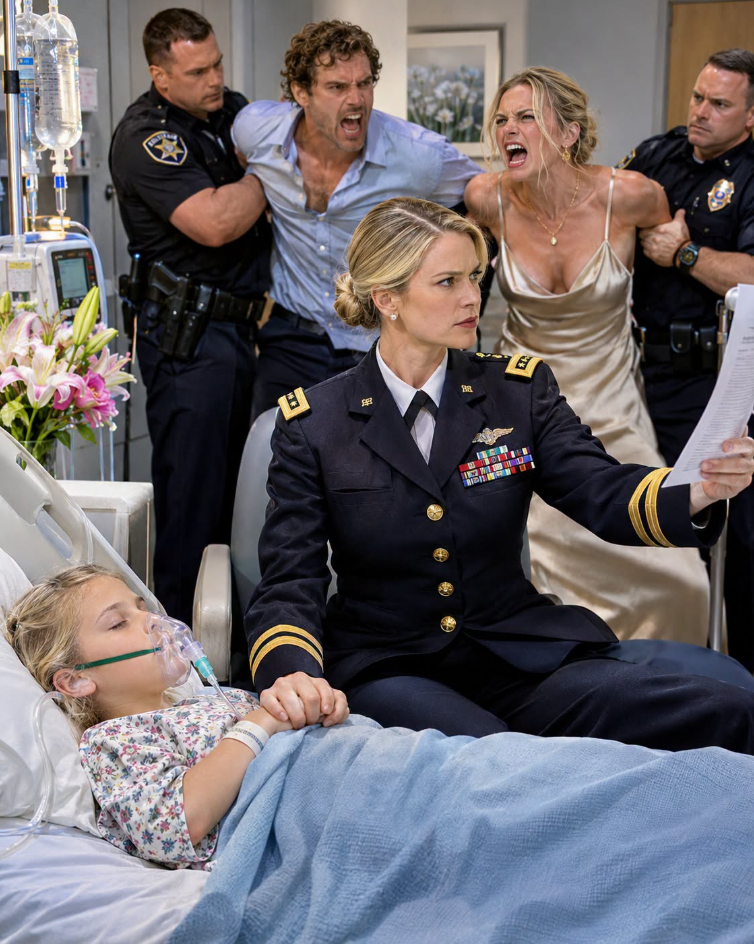
PART 1 — The Signal Only We Understood
My twelve-year-old daughter had spent nine days unconscious in a hospital before I finally made it home from my military assignment overseas. My former husband looked worn down, as though he had nearly surrendered to despair. His girlfriend surveyed my Army uniform and said, “You can travel halfway around the world for your country, but you couldn’t be here when your own daughter needed you.” I passed her without a reply and carefully gathered my daughter’s hand into mine. Then her fingers squeezed twice. Six years before, we had invented a private signal that meant, I’m still here. I had returned desperate to reach my little girl. I had no idea that understanding what happened on the night of her accident would change our family forever.
The call came while I was completing a logistics assignment overseas. Scott, my ex-husband, sounded oddly removed from what he was telling me. “Rebecca, there’s been an accident. Lily is in the hospital. The doctors are taking care of her.” I asked immediately how it had happened. “She was riding in a car. There was a collision. That’s all I know right now.” His answer offered very little, but terror left me with no room to examine it. All I could think about was my daughter lying in a hospital bed while I remained thousands of miles away.
After my plane landed in Raleigh, North Carolina, I headed straight to the hospital in Durham. Proper sleep had become something I barely remembered. My uniform was creased, my hair was gathered into a loose bun, and I could not steady my hands. I knew how I must have looked, but appearances meant nothing to me then. Neither exhaustion nor the long journey mattered anymore. There was only one thing I needed: to see Lily and be close enough to touch her.
Vanessa noticed me and let her gaze travel from my face to the insignia on my uniform. “Well, look who finally made it,” she said. Scott turned. “Rebecca.” I moved toward Lily’s room, unwilling to spend another moment outside it, but Vanessa had more to say. “You always had time for your career. It’s interesting how you suddenly found time to be a mother.” I stopped. For a moment, all the answers I could have given crowded together inside me.
She knew nothing about the nights I had spent studying photographs of my daughter. She did not know how often my decisions had been shaped by wanting Lily to have a secure future. She certainly could not measure what it had cost me to miss birthdays, school performances, and the unremarkable afternoons I would have loved to share. Yet explaining any of that would do nothing for the child beyond the door. “I’m here for my daughter. That’s all that matters right now.” With that, I went inside.
Seeing Lily in that bed was worse than anything I had managed to imagine. White blankets seemed to swallow her small frame. Someone had brushed her chestnut hair back from her forehead, leaving the faint mark near her temple visible. Equipment surrounded the bed, and my eyes kept returning to the numbers on the monitor. I lowered myself into the chair and took her hand. “Hey, sweetheart. It’s Mom.” My voice faltered. “I’m sorry it took me so long to get here. But I’m here now, and I’m not going anywhere.” I smoothed her hair back, trying to take in the reality of being beside her at last.
Then her fingers pressed against my palm. Once, and then a second time. I went still. Six years earlier, when Lily was six, a summer thunderstorm had knocked out the power at our house. Terrified and shaking, she had climbed into my lap without being able to speak. I had held her little hand and squeezed twice. “Whenever you’re scared and can’t find the words, squeeze my hand twice,” I told her. “It will mean you’re still here with me.” Now, beside her hospital bed, I had felt that same unmistakable signal.
She had practiced it that evening until she knew it by heart. Afterward, those two squeezes became a language belonging only to us. We used them before school presentations, through difficult conversations, and whenever words were not quite enough to reassure one another. I leaned toward her. “Lily, sweetheart, if you can hear me, squeeze my hand again.” Several seconds passed without a response. Then her fingers closed gently against mine, twice. I raised my free hand to my mouth. “Oh, baby. I hear you.” I called for a nurse immediately.
Monica, the nurse who came in, listened while I explained what I had felt. She examined Lily and did not brush aside my account. “Sometimes patients make movements that aren’t fully intentional,” Monica explained kindly. “But I’m going to document what you’ve noticed and ask the doctor to evaluate her.” I was grateful for her care. She was not promising an answer she could not give, but neither was she asking me to pretend those two squeezes had meant nothing.
A neurologist assessed Lily later that afternoon. He explained that her condition remained complex and that a single response could not establish the extent of her awareness. Still, the repeated movements warranted further observation. “Recovery after a serious brain injury can be unpredictable,” he told me. “We need to remain careful, but there are reasons to continue evaluating her progress.” He offered no certainty. Even so, for the first time since the call, fear was no longer the only feeling I could recognize. There was hope, too.
That evening, as I went through Lily’s admission paperwork, one detail caught my attention. The collision had happened at about 10:40 on a Tuesday night. Earlier that same evening, Scott had sent a message saying Lily was already in bed and everything was quiet. I read it again, then returned to the time recorded in the documents. She had school the next morning. Why had she been in a car so late? And why had I heard nothing about that from him?
When Scott came back into the room, I asked the question I could no longer leave alone. “Scott, who was driving the car?” He paused before answering. “Vanessa.” I stared at him. “Why was Lily with Vanessa at almost eleven o’clock at night?” His gaze shifted toward the corridor. “It’s complicated, Rebecca.” The words did nothing to explain why our daughter had been on the road after he told me she was asleep.
“Then explain it to me.” Scott lowered his eyes. “Vanessa was supposed to pick her up from a friend’s house. I thought they would be home earlier.” I listened, but the explanation did not settle what was troubling me. Something was missing from the account he had given. I had arrived at the hospital afraid of everything I did not know about Lily’s recovery. Now there was another uncertainty I could not ignore: what had really happened that night? And I intended to find out.
PART 2 — What Lily Remembered
The following morning, I called the officer handling the accident report. His name was Officer Brennan, and he told me the investigation had not yet concluded. Near an intersection, the vehicle had moved out of its lane and hit a roadside barrier. Thankfully, no other drivers had suffered serious injuries. His explanation gave me more information than I had received before, but it did not yet account for everything that had happened before the collision.
“We’re reviewing witness statements and other available information,” he said. “If we discover anything relevant to your daughter’s care or the circumstances of the accident, we’ll keep you informed through the appropriate process.” I thanked him. There was a process underway, and I understood that answers could not simply be demanded into existence. But I could ask Scott to stop giving me fragments. I needed a complete explanation from the person who had told me our daughter was safely asleep.
We sat together in a quiet hospital waiting area. For several minutes, neither of us said anything. Eventually, Scott admitted that he and Vanessa had been arguing that evening. “I was working late,” he said. “Vanessa was upset because she thought I was avoiding her calls.” The explanation brought the conversation closer to what I needed to understand, though it made the circumstances harder to hear. Their disagreement had not happened somewhere separate from Lily’s life. Our daughter had been caught in the middle of it.
“And Lily was in the car while all this was happening?” He nodded. “I didn’t realize how late it had gotten.” I looked at him, trying to understand how that answered the question hanging between us. “You told me our daughter was safely asleep.” He replied, “I didn’t want you worrying while you were overseas.” The words wounded me more deeply than he seemed to realize. His decision had not protected me. It had left me without important information about my own child.
“Scott, I am her mother. You don’t protect me by keeping important things from me.” He turned his eyes away. During our marriage, difficult situations had often exposed the same difference between us. I wanted problems faced through honest conversation. Scott tended to step around uncomfortable truths until avoiding them was no longer possible. But this was no longer a dispute about how our marriage had worked. Whatever had happened between us belonged behind the needs of the little girl recovering in that hospital.
Over the next several days, I spent as much time beside Lily as the hospital’s visiting arrangements permitted. I read books she loved, played recordings of her school choir, and described the flowers beginning to open outside our house. At other times, I said very little and simply held her hand. Slowly, the responses that had first given me hope became more consistent. I watched her carefully, grateful for each change while remembering the doctors’ warnings that progress would take time.
One afternoon, her eyelids moved while I was reading to her. I stopped in the middle of the passage. “Lily?” Her eyes opened a little. I pressed the call button, and the medical team came to assess her responses. There was still no promise of a quick recovery. The doctors continued to remind me that patience would be necessary. But she was starting to respond to voices she knew, and that change meant more to me than I could put into words.
Several days afterward, she whispered something I had been desperate to hear. “Mom.” I bent closer, almost afraid to breathe. “I’m right here, sweetheart.” A tear slid down her face. “You came.” I kissed her forehead. “Of course I came. I will always come when you need me.” Speaking had exhausted her, so I asked nothing more. I stayed beside her while she drifted back to sleep. For the first time since the accident, I let myself picture the day I might bring her home.
As her strength improved, Lily began working with therapists on speech, movement, and concentration. Some days offered encouragement. Others left her worn out and frustrated. The doctors explained that memories might return in pieces and that there could be gaps. I did not want her feeling that she had to produce an account of the accident for me or anyone else. Her recovery mattered more than satisfying my questions, and I wanted her to speak only when she felt ready.
Several weeks into that recovery, she raised the subject herself. “Mom, can I tell you something?” I put my book aside. “You can tell me anything.” She turned her face toward the window. “I remember being in Vanessa’s car.” I waited without interrupting. “She was talking to Dad on the phone. They were arguing.” Her fingers twisted the edge of the blanket. “I asked her if we could just go home. She said we were almost there.” I reached for her hand, listening as the night I had been trying to understand began to emerge through my daughter’s own words.
“You don’t have to talk about it if you’re tired.” Lily shook her head. “I remember her phone falling. She looked down to pick it up. Then the car moved really fast to one side.” My chest tightened. “Do you remember anything after that?” She answered, “Not much.” I brushed her hair away from her forehead. “Thank you for telling me, sweetheart. You did nothing wrong.” More than anything, I needed her to understand that remembering the accident did not make her responsible for it.
She looked at me anxiously. “Is Vanessa going to be mad at me?” That question broke my heart. Even after everything she had endured, Lily was worrying about an adult’s reaction to her telling the truth. “No, Lily. You are not responsible for anyone else’s choices. The adults will take care of this.” Later, following guidance from her medical team, I passed her recollection to the investigating officer. It would be considered with the other evidence, not treated as though it stood alone.
Gradually, the gaps in the account began to close. The investigation established that Vanessa had been distracted behind the wheel. Phone records and information from witnesses supported important elements of what Lily remembered. Vanessa had been in a tense telephone conversation with Scott shortly before the crash. At a crucial moment, she had taken her attention off the road. The consequences of that distraction had altered my daughter’s life.
After learning what the investigation had established, Scott came to talk to me. Exhaustion showed plainly on his face. “Rebecca, I should have told you everything from the beginning.” I let the words sit between us before answering. He continued, “I thought if I kept things calm, it would be easier for everyone.” I looked at him. “Keeping things calm and hiding the truth aren’t the same thing.” He nodded. “I know that now.”
“Lily needed us to put her first. Not our pride, not our arguments, and not what other people might think.” Tears filled his eyes. “I let her down.” I could see his regret, and I did not doubt that it was real. But regret could not undo the collision or erase the work Lily now faced. It could not become a substitute for behaving differently. Whatever happened next, our daughter needed more from him than an acknowledgment of what he should have done.
“Then show her that you can do better,” I said. “Start by being honest with her and showing up when she needs you.” Scott ended his relationship with Vanessa. After the investigation, she accepted legal responsibility through the appropriate court process. The outcome brought driving restrictions, financial penalties, and court-ordered community service. I did not celebrate. The truth had finally been acknowledged, but it could not answer the question that mattered most to me: what would Lily’s life be like from here?
PART 3 — Two Squeezes, and Whatever Comes Next
None of what had happened felt like a victory. I had never wished to watch another person’s life unravel. What I wanted was the truth recognized and my daughter safe. The investigation and court process addressed responsibility, but they did not make Lily’s recovery simple. That work continued in the ordinary hours of our lives, through the encouraging moments and the ones that reminded us how much had changed.
Recovery followed no straight path. Some mornings, Lily woke smiling and determined to manage everything without help. On other afternoons, she cried because fastening her shoes took longer than before. A familiar word sometimes escaped her. A short walk could leave her exhausted. I learned to recognize accomplishments I might once have passed over without thinking. Progress was not always large or easy to see, but it mattered even when it arrived quietly.
I cried when she crossed the therapy room on her own for the first time. When she finally laughed at one of my awful jokes, my own laughter grew so helpless that her therapist joined in. Later, she returned to school for a brief visit, and I waited outside the classroom as she greeted her friends. Nervousness showed on her face, but so did happiness. Watching her there, I understood how much could be held inside a moment that might once have seemed completely ordinary.
I had arranged a transfer from my previous military assignment to a position that kept me nearer home. It was not the route I had once pictured for my career, but my priorities were different now. One evening, Lily asked, “Mom, did you change your job because of me?” I sat beside her on the couch. “I made some changes because I want to spend more time with you.” Concern crossed her face. “But you love being in the Army.”
I smiled. “I do. And I’m proud of my service. But loving my work doesn’t mean I can’t make room for the people I love most.” She considered that before resting against my shoulder. “I’m glad you’re home more.” I put an arm around her. “Me too, sweetheart.” There was no need to pretend I had stopped caring about my work. Making more room for Lily did not erase my pride in serving. It reflected what I wanted our lives to look like now.
Scott began changing his behavior as well. He attended parenting counseling and respected the visitation arrangements set up around Lily’s recovery. In the beginning, she was guarded with him. Sometimes she would not speak. At other times, she asked questions that were difficult for him to answer. He continued to come. He helped with her physical therapy exercises and learned how to support her when she felt overwhelmed. Their relationship did not mend all at once, but slowly it began moving in a healthier direction.
I could not promise myself that I would ever trust Scott as I once had. That was different from deciding what opportunity Lily should have with her father. I wanted her to be able to build a healthy relationship with him, as long as he continued placing her well-being first. The changes needed to remain more than temporary expressions of remorse. Trust could not be demanded simply because he wanted another chance; it depended on what he kept choosing to do.
Almost a year after the accident, Lily suggested that we grow sunflowers in the backyard. “I want something tall and bright,” she told me. “Something we can see from the kitchen window.” So we bought seeds, gardening gloves, and a pair of small watering cans. Mrs. Whitfield, our neighbor, helped prepare the soil. The idea belonged to Lily, and together we gave those seeds a place to grow.
By late summer, the sunflowers stood above her head. Their yellow petals faced the sunlight and filled the yard with brightness. They were exactly the tall, cheerful flowers she had wanted to see from the kitchen. Nearly a year had passed since the accident, and recovery still carried challenges, but the backyard now held something she had chosen and helped bring into being.
One Saturday afternoon, I came upon Lily on the porch steps, painting a wooden birdhouse. Scott had helped her build it during a weekend visit. She was concentrating on a strip of blue around the roof when I sat down next to her. “That looks beautiful.” She smiled. “It’s a little crooked.” I looked at her work. “Most good things have a few imperfections.” A quiet laugh escaped her, and for a while we sat together watching the sunflowers shift in the breeze.
Then she lowered her head onto my shoulder. “Mom, do you think I’ll ever be exactly like I was before?” I looked at her, wishing there were an easy answer I could honestly give. She had made remarkable progress, but some things were still difficult. Telling her that everything would certainly return to its former shape would not help her face the life she was actually living.
“I don’t know if everything will feel exactly the same,” I answered. “But I do know that you’re growing stronger, and we’ll keep working through whatever comes next.” She sat quietly for a moment. “Sometimes I miss how easy things used to be.” I drew her closer. “I know, sweetheart. It’s okay to miss those things.” I did not want her to believe that being grateful for progress meant she had to hide her sadness about what remained hard.
She raised her face toward mine. “But I’m happy I’m here.” Tears gathered in my eyes. “I’m happier than I can ever explain.” Then she slid her hand into mine and pressed twice. It was the signal we had created six years earlier in the middle of a thunderstorm. It was the same signal I had felt in the hospital, when so much was uncertain and I had been desperate for any way to reach her.
I answered with two squeezes of my own. Lily smiled. “You remembered.” I kissed her hair. “Lily, there are some things a mother never forgets.” We remained on the steps as the afternoon light began to soften. The birdhouse, the flowers, and the warmth of her hand belonged to a life that was not exactly the one we had known before. Yet she was beside me, and we were learning how to live it together.
For a long time, I had thought of strength as being ready for whatever challenge appeared. My military training had given me discipline, perseverance, and a deep understanding of responsibility. Lily had shown me another kind of strength. Sometimes it meant remaining beside a person you love, holding their hand, and refusing to let fear make every decision about the future. There was no perfect preparation that could remove all uncertainty. There was only the choice to keep showing up.
Our family had not become perfect, and questions about the future remained. But Lily was laughing again. She was planning for school, selecting books at the library, and talking about places she hoped to visit one day. Each evening before bed, she still reached for my hand. Two gentle squeezes carried the quiet promise we both understood: I’m still here. I always gave her the same answer. So am I.
Love is not always expressed through an extraordinary sacrifice or a dramatic promise. Sometimes its clearest expression is the decision to stay beside someone through difficult days, even without knowing how those days will end. A parent cannot prevent every hardship a child will encounter. What we can offer is reassurance, comfort, and the certainty that a child belongs and does not have to face overwhelming moments alone. A familiar voice, a gentle touch, or a private tradition can hold more meaning than the most carefully arranged speech.
When recovery is difficult, patience becomes one of the most important gifts we have to give. It reminds the person we love that their value has nothing to do with how quickly old abilities return. Honesty matters just as much. An uncomfortable truth can provide the ground on which understanding and accountability begin. Responsibility requires more than saying we are sorry. It asks us to acknowledge our decisions, accept their consequences, and make real changes for the people who rely on us.
Children should never have to carry adult disagreements as their own burden. They deserve to speak about what happened to them without fearing another person’s anger. And while forgiveness or reconciliation may become possible, neither should be forced before consistent actions have made a relationship dependable, respectful, and safe. Life may not settle back into its former shape, but compassion and steady support can make room for forms of happiness that matter just as deeply.
Hope, I had learned, does not always announce itself loudly. Sometimes it arrives through the smallest movement of a child’s fingers, reminding us that love offered during frightening days can become something that carries us forward. Lily and I still had our signal. We still had the promise beneath it. What we did not have—and what no one could yet tell us—was what tomorrow would ask of us next.