PART 2
I didn’t answer her.
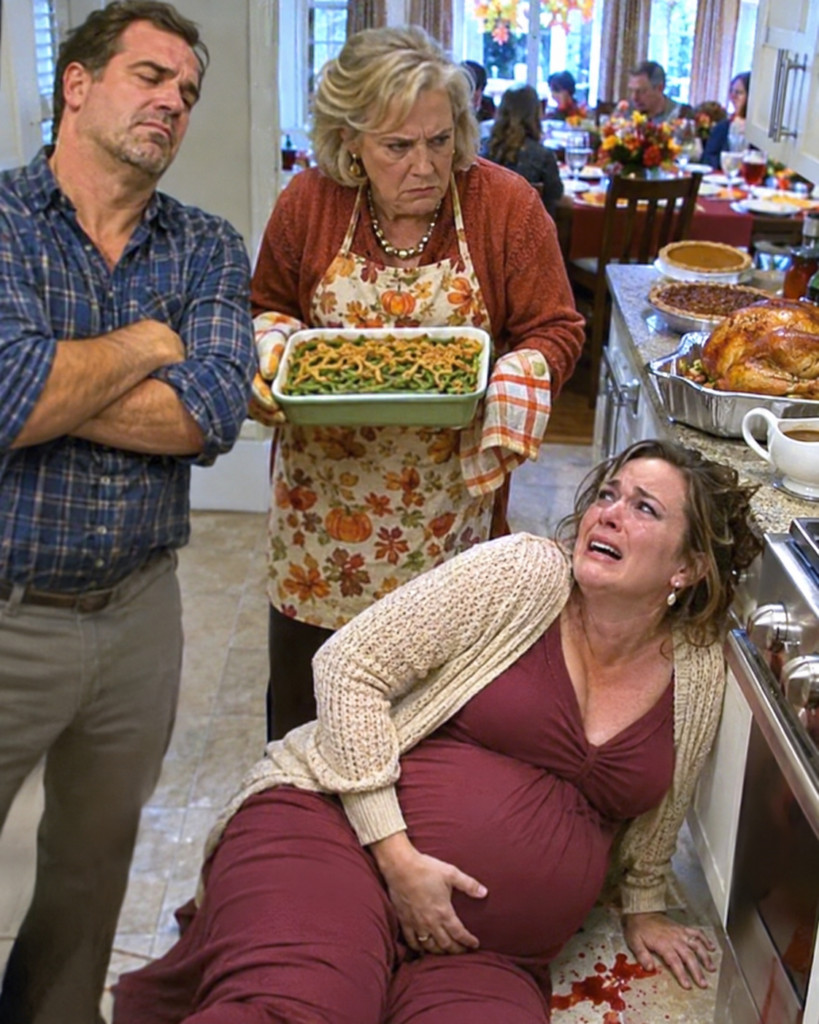
I just lay on the kitchen floor on my left side, holding my belly, listening for sirens. Velma set down her casserole on the counter. She looked at the blood on the floor for a long moment.
Then something in her face changed.
She knelt down next to me. Slowly. Like her knees hurt.
“How long have you been bleeding?” she asked quietly.
“Twenty minutes. I asked Gareth to take me to the hospital. He said to finish the gravy.”
Velma closed her eyes.
The ambulance arrived four minutes later. The paramedics came running through the front door, past twenty relatives in the living room, past the football game, past my husband standing there with a beer in his hand.
“Ma’am, we’re going to take you right now.”
At the hospital, the doctor did an ultrasound. Her face went serious.
“Your placenta is separating from the wall of your uterus. It’s called a placental abruption. Your baby isn’t getting enough oxygen. We need to deliver her right now.”
They rushed me into surgery.
My daughter was born at 2:47 p.m. on Thanksgiving Day.
Three pounds, one ounce.
She didn’t cry at first. They took her straight to the NICU. I didn’t get to hold her.
When I woke up from the anesthesia, the doctor was sitting next to my bed.
“Your daughter is alive,” she said. “She’s very small, and she’s going to need help breathing for a while. But she’s a fighter.”
I sobbed.
“You called 911 at exactly the right time,” the doctor said. “With an abruption like yours, another thirty minutes and we probably would have lost her. And you might have lost too much blood yourself.”
Thirty minutes.
The time left on the turkey.
That evening, Velma came to my hospital room. Alone. She sat in the chair next to the bed for a long time without saying anything.
Then she spoke.
“Thirty-four years ago,” she said, “I was pregnant with my second child. It was Thanksgiving. I was cooking for twenty people. I started bleeding.”
She stared at her hands.
“I told my husband. He said to finish dinner. He said I was being dramatic. I listened to him. I served the turkey. Then I went to the hospital.”
Her voice broke.
“I lost her. A baby girl. Gareth was two. He doesn’t remember. We never talked about it.”
She looked at me with tears running down her face.
“When I saw you on that kitchen floor today, I saw myself. And I heard my son say the same words his father said to me.”
I didn’t know what to say. I just reached out and held her hand.
Gareth came to the hospital later. His mother stood up and walked to the door before he could speak.
“Sit down,” she told him. “I need to tell you about your sister.”
I don’t know everything she said. But when Gareth came out of that hallway an hour later, his eyes were red, and he couldn’t look at me.
“I’m sorry,” he whispered. “I’m so sorry. I almost let it happen again.”
Our daughter spent nine weeks in the NICU.
When Velma asked what we would name her, I told her I wanted to name her after the sister Gareth never knew.
Velma covered her mouth with both hands.
“Iolanthe,” she whispered. “We were going to call her Iolanthe.”
So that’s her name.
Gareth went to counseling. Every week. He changed. Slowly. Not because I asked him to. Because he finally understood what his father’s words had cost his mother.
The next Thanksgiving, everyone came to our house again. Twenty-three people.
But I didn’t cook a single thing.
Velma did. With her four daughters-in-law. And Gareth. And all his brothers, who had never touched a stove in their lives.
They made me sit in the best chair in the living room with my baby on my lap and my feet up.
At dinner, before we ate, Velma stood up and raised her glass.
“This year, I’m thankful for my granddaughter,” she said. “And for a mother who was brave enough to put her baby before the turkey.”
Then she looked at me.
“Something I never did.”
Everyone was quiet.
Then Iolanthe, nearly one year old, banged her spoon on her high chair and shrieked with laughter.
Everyone laughed with her.
The gravy was lumpy that year. Gareth made it.
It was the best Thanksgiving I’ve ever had.
THE END.