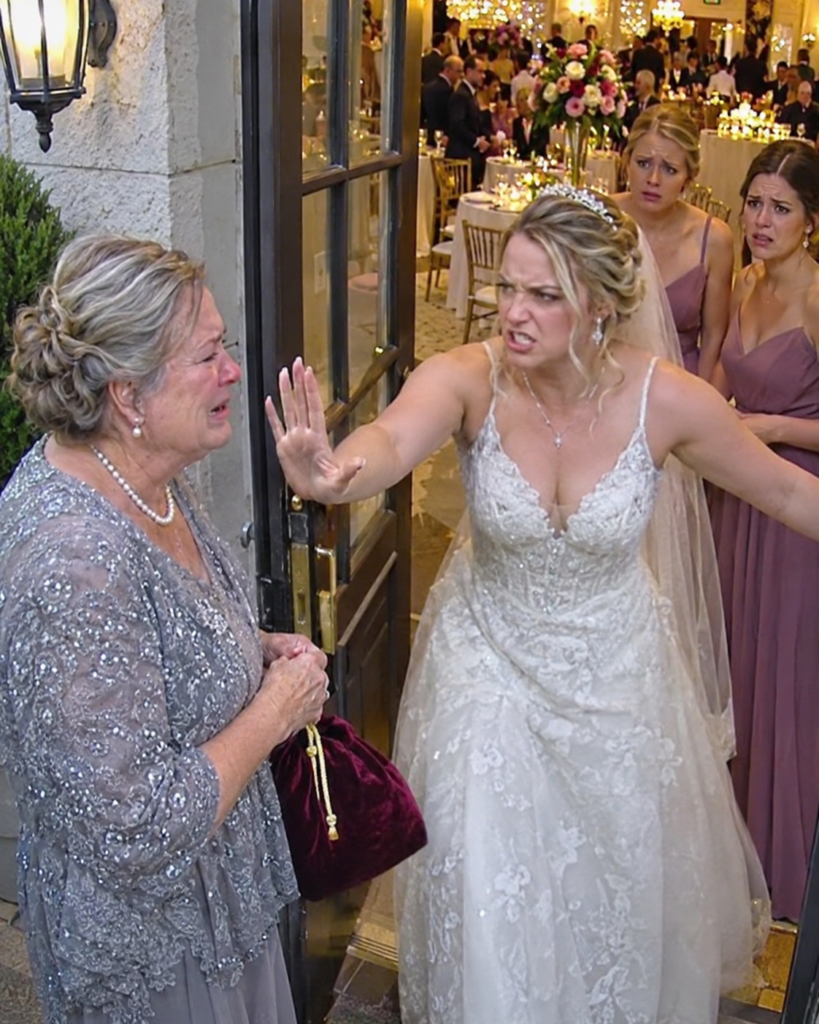
Behind her, the Hudson Valley estate glowed with glass, stone, candles, white flowers, and expensive silence. Two bridesmaids stood close enough to hear every word, pretending to admire the arrangements while their eyes slid toward my face. I had been there for four seconds.
Four seconds after a fourteen-hour trip from Anchorage. Four seconds holding a small velvet gift bag with my late husband’s cufflinks inside. Four seconds before my son’s new wife looked at me and made it clear I was not part of the family picture.
“Her family only,” Joselyn said again, slower this time. “Please leave.”
She wore a champagne-colored dress and the kind of calm smile people use when they already believe the room belongs to them.
I looked past her shoulder.
Music drifted from inside. Guests moved under warm lights. Somewhere in that beautiful house, my only son was getting ready to celebrate the first night of his marriage.
I waited for him to appear.
He did not.
The gift bag suddenly felt heavier in my hand.
I could have asked for him. I could have raised my voice. I could have told everyone standing near that door that I had paid more for that venue than some people pay for a house down payment. I could have made the kind of scene wedding planners are hired to prevent.
Instead, I said, “Of course.”
That was all.
The bride blinked, almost disappointed that I did not argue.
I turned around and walked back down the flagstone path in the pearl-gray dress I had saved for my son’s wedding. The car service driver was still parked near the gate. When he saw my face, he opened the door without saying a word.
The whole ride back to the hotel, I held the velvet bag in my lap.
I did not cry until the door closed behind me.
The next morning, I flew home with the cufflinks still in my purse.
For six days, my son did not call to ask why I had left. He did not ask what had happened at the door. He did not ask whether I had made it back to Anchorage safely.
Then my phone rang.
His name lit up my screen while I was sitting in my home office with a legal pad, cold coffee, and the closing checklist for the company I had built after his father died.
“Hey, Mom,” Bryce said, light and hurried, like we were picking up from an ordinary week.
I sat very still.
“Hi, sweetheart.”
“So, look,” he said. “The Hollander estate billing department has been calling me. There’s an outstanding balance. It’s $74,000.”
I did not move.
He kept going.
“Joselyn and I talked about it, and as my mother, it’s your duty. You need to handle it.”
There it was.
Not disappointment.
Not confusion.
Not an apology.
A bill.
And a word.
Duty.
I stared at the yellow legal pad in front of me. My pen had stopped halfway through the word “transition.” Outside, my neighbor’s snowblower growled in the driveway, even though there was no snow on the ground yet.
“Bryce,” I said carefully, “let me look into it.”
“You don’t need to look into it,” he said. “It’s a wedding bill. You’re the mother of the groom.”
The phrase did not sound like him.
It sounded polished.
Rehearsed.
Placed in his mouth by someone standing close enough to hear the call.
“I said I’ll look into it,” I repeated.
He sighed.
That small sigh did more damage than the bill.
It was the sound of a son deciding his mother was being difficult.
“Fine,” he said. “But it’s getting bad. They’re talking about collections. Joselyn is really stressed.”
Joselyn is really stressed.
I looked at the phone.
Six days earlier, Joselyn had turned me away from the doorway of a venue I had quietly paid for as a gift. Six days earlier, she had told me I never mattered. Now my son was calling because she was stressed.
I hung up.
For a minute, I just sat there.
Then the math lit up in my head.
The venue was already paid.
I had the wire confirmation. I had the email. I had the handwritten thank-you note from the owner of the estate sitting on a shelf in my office. I had paid the full venue cost months before the wedding because I wanted my son to feel proud, not indebted.
So what was $74,000?
I called the estate owner.
She answered on the second ring.
“Oh, honey,” she said softly. “I was hoping you’d call.”
That was when the air in the room changed.
I reached for a clean page on the legal pad.
“What happened at that wedding?” I asked.
There was a pause long enough to make my stomach go cold.
Then she said, “Desiree, sit down. I need to tell you what happened after you were sent away.”
PART 2: THE SECRET BEHIND THE $74,000 BILL
Cecilia did not begin with the bill. Instead, she asked me something strange.
“Desiree, are you alone right now?”
I looked toward my office door.
“Yes. Why?”
“Because what I’m about to tell you might change how you see your son.”
My fingers tightened around the pen. Outside, the afternoon sky had turned gray. A thin wind rattled the windowpanes.
“Cecilia, please. Just tell me.”
She drew a long, unsteady breath.
“Your son knew you were turned away.”
For several seconds, I heard nothing. Not the wind. Not the clock. Not even my own breathing.
“What do you mean, he knew?”
“He was standing near the upstairs window. He watched you leave.”
My stomach twisted.
“Are you certain?”
“I saw him, Desiree.”
I closed my eyes. A terrible image filled my mind.
Bryce standing behind a beautiful window. Watching his mother walk away. Watching the woman who raised him carry his father’s wedding gift back outside. And doing absolutely nothing.
“Did he say anything?”
Cecilia hesitated.
“Yes.”
I opened my eyes.
“What?”
“He asked whether you had gone.”
My hand began trembling.
“And when security confirmed you’d left, he told them everything was fine.”
I stared at the legal pad. The word transition blurred before me.
Everything was fine.
Those three words kept circling my mind. I remembered a different Bryce. A little boy afraid of thunderstorms. A child who climbed into my bed whenever the Anchorage winds became too loud. He would press against my shoulder.
“Mommy, don’t let anything happen to us.”
And I would promise him safety. Now that little boy was thirty-three. And apparently my humiliation was perfectly fine.
“There’s more,” Cecilia whispered.
I swallowed.
“Go ahead.”
“Joselyn changed the reception arrangements afterward.”
“What arrangements?”
“The seating chart, the announcements, everything.”
I slowly straightened.
“What happened to my seat?”
“Your place card was removed.”
I waited. Cecilia continued.
“The original arrangement placed you beside Bryce. At the family table.”
I remembered approving that seating arrangement. I had seen the preliminary floor plan. One long table beneath crystal chandeliers. Bryce and Joselyn seated in the center. Her parents on one side. Me on the other. A little silver card bearing my name.
DESIREE MALLORY.
I had imagined sitting there proudly. Maybe crying during the speeches. Maybe smiling when Bryce caught my eye. Instead, my chair had disappeared.
“Who took it away?” I asked.
“Joselyn instructed the coordinator.”
“And Bryce?”
“He approved the revised chart.”
Something inside me became very quiet. Not calm. Something colder than calm. A realization settling into place.
This was not a misunderstanding. It was not a bride feeling overwhelmed. It was not a confused wedding coordinator.
My exclusion had required decisions. Several of them. And my son had participated.
I looked toward the photograph beside my desk. Aaron stood beside fourteen-year-old Bryce. They were holding enormous silver salmon. Both wore the same ridiculous grins. That picture had been taken three months before Aaron died. For nineteen years, I treasured it. Now I couldn’t look at Bryce’s face.
“Why didn’t you call me?” I asked.
Cecilia’s voice softened.
“I wanted to.”
“Then why didn’t you?”
“Because I didn’t know what happened until the ceremony had already started.”
She explained the terrible sequence. The gate attendant had noticed my departure. The receptionist reported an unexpected guest issue. By the time Cecilia received the message, the wedding procession was beginning.
She went directly to the coordinator. The coordinator said everything was handled. Then Cecilia found Bryce.
“He told me you weren’t feeling well.”
I pressed my palm against my forehead.
“He said that?”
“Yes. He said the long flight exhausted you. That you’d decided to return to your hotel.”
I almost laughed. It would have been easier. Easier to believe exhaustion had stopped me. Easier than explaining what actually happened.
“Did you believe him?”
“Not entirely.”
“Why?”
“Because I knew how much you sacrificed.”
My gaze moved toward the filing cabinet. Inside were invoices, contracts, financial statements. And one small blue folder.
The Hollander Estate Wedding.
A gift I had prepared lovingly. A gift nobody had requested in writing. A gift I never expected repaid.
Cecilia’s family owned the Hollander Estate. She had inherited it from her parents. For thirty years, she’d hosted weddings there. We’d become friends through a business conference.
When Bryce announced his engagement, I asked whether her venue was available. She offered me the property at a generous personal rate. I insisted on paying fairly.
The agreed package cost $96,000. I wired the entire amount. It included the ceremony location, the main reception hall, the original catering package, the flowers, and overnight accommodations. I had even covered the service charges. Every dollar was documented. Cecilia had sent confirmation personally.
So when Bryce mentioned $74,000, I knew something was wrong.
“What exactly is that balance?” I asked.
Cecilia’s tone changed. Now she sounded like a businesswoman.
“It’s additional spending.”
“Additional to what I paid?”
“Yes.”
“How much additional spending?”
“Seventy-four thousand, two hundred sixteen dollars.”
I wrote the figure down.
$74,216.
“What did they buy?”
“Several upgrades, last-minute additions, and services beyond the original contract.”
I felt my jaw tighten.
“Tell me everything.”
She began reading.
Twenty-eight thousand dollars for an imported glass reception pavilion.
Fourteen thousand eight hundred dollars for premium champagne and private bar service.
Eleven thousand six hundred dollars for late-night catering and additional staff.
Nine thousand four hundred dollars for luxury guest accommodations.
The remaining amount covered fireworks, transportation changes, and property repairs.
I listened without interrupting. At the end, Cecilia fell silent.
“Fireworks?” I repeated.
“Yes.”
“I remember the estate rules.”
“You’re correct.”
“Fireworks weren’t included.”
“They required special arrangements.”
“And property repairs?”
“One display damaged the garden irrigation system.”
I leaned back. A celebration had become an expensive performance. And someone expected me to finance it.
“Who requested these additions?”
“Joselyn.”
“Who approved them?”
“Both Joselyn and Bryce signed the addendum.”
I wrote their names beneath the amount. Then I drew one line.
“Then the invoice belongs to them.”
“Yes,” Cecilia answered. “But that isn’t the whole problem.”
I closed the pen. Something in her voice warned me.
“What else?”
“They tried assigning the balance to you.”
I sat forward.
“Without asking me?”
“Yes.”
“How?”
“They submitted a payment authorization.”
I looked at the blue folder again.
“What authorization?”
“An amendment naming you as guarantor.”
I went completely still.
“I never signed any amendment.”
“I know.”
“You know?”
“Desiree, I remember every conversation we had. You specifically limited your contribution to the original wedding package.”
I nodded, though she couldn’t see me. That was true. I had made the distinction deliberately. Not because I wanted control. Because I understood expensive celebrations. Costs could expand rapidly. I wanted Bryce and Joselyn to make decisions about their own spending. They had assured me they understood.
Cecilia cleared her throat.
“There’s a signature on the document.”
I stared at my empty coffee cup.
“Whose?”
“Yours.”
The room seemed to tilt. I stood so quickly my chair rolled against the wall.
“Cecilia.”
“I’m listening.”
“I didn’t sign anything.”
“I believe you.”
“Where did they get my signature?”
“That is what I need to understand.”
I walked to the window. The mountains were hidden beneath clouds. An airplane crossed the distant sky. For a moment, I imagined boarding it. Flying back to New York. Walking directly into Bryce’s house. Demanding answers.
But I had learned something during nineteen years of running a company. Anger makes noise. Evidence makes decisions possible.
“Send me everything,” I said.
“All the contracts?”
“Every page.”
“Desiree, some documents contain private information.”
“Send whatever I’m legally entitled to receive. And preserve everything else.”
She paused.
“You sound like your old business self.”
I almost smiled. That woman had survived worse days. She’d buried a husband. Raised a grieving teenager. Started a company with borrowed equipment. Worked through winters that broke machinery. And negotiated with people who assumed a widow couldn’t understand logistics.
I knew how to remain steady. I had simply forgotten to use that steadiness with family.
“Please don’t contact Bryce yet,” Cecilia said.
“Why?”
“I want to review one additional matter.”
“What matter?”
“The security footage.”
My pulse quickened.
“From the entrance?”
“Yes.”
I remembered Joselyn’s expression. The bridesmaids pretending not to listen. The warmth behind the glass doors. My velvet gift bag. My four seconds of welcome.
“Do you have footage of that?”
“The exterior cameras cover the entrance.”
“And the upstairs windows?”
“One camera covers the upper landing.”
I slowly returned to my chair.
“Preserve it.”
“I already have.”
For the first time that afternoon, I felt something resembling gratitude.
“Thank you.”
“Desiree?”
“Yes?”
“I’m sorry.”
Those words almost undid me. Not because Cecilia owed an apology. But because someone finally offered one. The person responsible hadn’t called. The person who watched hadn’t apologized. Yet a woman who owned the building was trying to repair what she could.
“You didn’t turn me away,” I said.
“I know.”
“Please don’t carry their shame.”
She was quiet. Then she said something I remembered.
“You were always welcome in my house.”
My eyes filled.
“Thank you, Cecilia.”
We ended the call. I remained sitting for several minutes. Then I opened the bottom desk drawer.
Inside was a stack of photographs. Aaron and Bryce at the fishing dock. Bryce graduating from high school. Bryce wearing an oversized blue sweater. And one image from his fifth birthday. He stood between Aaron and me, his face covered with chocolate frosting. His little hands were wrapped around ours.
I touched the photograph.
“Where did we lose each other, sweetheart?”
The empty office offered no answer.
That evening, I drove across Anchorage. The streets shone beneath light rain. Mountains rose beyond the city. I parked outside a small brick building where my attorney maintained her office.
Naomi Singh had represented my company for nearly fifteen years. She was fifty-six, relentlessly practical, and blessed with almost supernatural patience. She also knew my family. She’d attended Bryce’s college graduation. She’d helped Aaron’s estate through probate.
When I called and requested a meeting, she didn’t ask me to explain. She simply opened her calendar.
Now she stood beside her reception desk, wearing a dark green sweater.
“Desiree.”
She took one look at me.
“What happened?”
I handed her the wedding folder.
“My son sent me a bill.”
She led me into her office. No dramatic questions. No exaggerated sympathy. Just the steady kindness of someone who understood when silence was necessary. Her office smelled of paper and cedar. A photograph of her daughters stood beside a worn legal dictionary.
I sat opposite her desk. Then I told her everything. The flight. The bride. The doorway. The empty place at the reception. And the call about duty.
Naomi listened without interrupting. Only once did she close her eyes. That was when I repeated Joselyn’s words.
You never mattered to him.
When I finished, Naomi opened the folder.
“First, I need you to understand something.”
I watched her.
“Being someone’s mother does not automatically make you responsible for their wedding debts.”
I nodded.
“I know.”
“Good.”
She turned another page.
“And paying the original venue bill doesn’t authorize unlimited additional spending.”
“I know that too.”
“Then why do you look guilty?”
The question startled me. I glanced toward the window.
“I keep thinking I should’ve done something.”
“Something like what?”
“Asked for Bryce at the door.”
“And if he refused to come?”
I said nothing.
“Or if he came and agreed?”
My throat tightened. Naomi leaned forward.
“Desiree, you are judging yourself for not preventing someone else’s cruelty.”
I rubbed my palms together.
“I’ve always fixed things for him.”
“I know.”
“Sometimes before he even asked.”
“I know that too.”
“He was so young when Aaron died.”
Her expression softened.
“Fourteen.”
I nodded.
“Fourteen years old.”
I remembered that terrible winter. Aaron had been returning from Fairbanks. A highway collision took his life. One ordinary phone call divided our family into before and after.
Bryce had refused to attend school. He stopped speaking at dinner. For months, he slept with his father’s old flannel shirt.
I took unpaid leave initially. Then the bills began arriving. Aaron’s small repair business had outstanding equipment loans. Our savings weren’t enough. The insurance helped with immediate expenses. It couldn’t support us forever.
I began organizing regional cargo deliveries. One truck became three. Three became ten. Eventually, Northern Reach Logistics became a respected Alaska transportation company.
I worked constantly. Mornings, evenings, holidays. Sometimes I missed school events. Sometimes I fell asleep over paperwork. And every missed moment felt like another injury to Bryce.
“I kept trying to make it up,” I whispered.
Naomi waited.
“Birthdays. Vacations. Cars. College.”
“And afterward?”
“Rent when his first job disappeared. Help when he changed careers. Money when he wanted to move.”
I gave a tired laugh.
“He didn’t have to ask directly. I could hear it in his voice.”
Naomi folded her hands.
“Did he ever learn to solve problems without you?”
I wanted to say yes. I really did. Bryce had a respectable job in commercial real estate. He lived in a beautiful apartment. He knew how to negotiate contracts. He could manage difficult clients. But whenever life became uncomfortable, he called me. And I made discomfort disappear.
“Sometimes,” I answered.
Naomi didn’t challenge the word. She simply let it sit between us. Then she asked a harder question.
“When he called about this bill, did he ask whether you were okay?”
I shook my head.
“Did he mention your trip?”
“No.”
“Did he acknowledge the wedding?”
“Only the balance.”
Naomi lowered her gaze.
“Then let’s begin with the documents.”
We spent the next hour reviewing the original venue agreement. Everything was exactly as I remembered. A fixed wedding package. Paid in full. No open-ended guarantee. No obligation to cover upgrades.
My signature appeared on the final page. Naomi studied it carefully.
“Do you recognize this signature?”
“Yes. That’s mine.”
She nodded.
“Good.”
Then my phone chimed. An email from Cecilia.
Subject: Wedding Documentation.
I opened the attachments. The first contained the additional invoice. The second showed signed upgrade agreements. The third was a payment authorization.
Naomi leaned beside me. I enlarged the final page. My name appeared beneath one paragraph.
DESIREE MALLORY. GUARANTOR.
Beneath it was a signature. It looked almost exactly like mine. Almost.
My stomach became painfully tight.
“That’s not my signature.”
Naomi examined the screen.
“What makes you certain?”
“I never write the final loop that way.”
I pointed at the last letter.
“And look at the first D.”
She adjusted her glasses. I reached inside my purse. My checkbook was still there. I wrote my name on a blank page. Naomi compared the examples.
“They’re similar,” she said.
“That’s what frightens me.”
“Similar doesn’t mean authentic.”
I stared at the digital signature. Someone had taken my name. And used it like a blank check.
Naomi saved the documents securely.
“Don’t confront anyone yet.”
“Why?”
“Because we need the complete history.”
She opened another file.
“The document appears to be electronic.”
“Yes.”
“Electronic signatures can have audit trails. Who created it? What account submitted it? What date was it signed?”
She made several notes.
“We’ll request the records.”
I watched her pen move.
“Could Bryce have done this?”
Naomi stopped writing.
“Do you want my professional answer or my personal one?”
“Both.”
“Professionally, we don’t know yet.”
“And personally?”
She looked at me.
“I hope not.”
That was worse than reassurance. Because hope meant possibility.
I left her office after sunset. The air had turned colder. Across the parking lot, a streetlamp flickered over wet pavement. I sat inside my car, both hands resting on the steering wheel.
Then my phone buzzed. A message from Bryce.
Mom, did you handle the venue?
No hello. No question. No curiosity about the trip. Just the venue.
I stared until the screen dimmed. Then I typed:
I’m reviewing the documents.
Three dots appeared. Disappeared. Returned. Finally, another message arrived.
Joselyn says the owner is being difficult.
I read it twice. The owner. Cecilia, who had protected their wedding. Cecilia, who had offered generous terms. Cecilia, who was keeping records. Apparently she had become difficult.
Another text followed.
Can you just pay it and move on?
I placed the phone face down. I didn’t answer. Instead, I drove home.
My house stood on a quiet street lined with birch trees. Aaron and I had bought it when Bryce was seven. It wasn’t extravagant. Three bedrooms. A stone fireplace. A kitchen with uneven cabinet doors. I could afford something much larger.
But this house held our history. Aaron had built the porch railing himself. Bryce had carved his initials beneath the kitchen table. There were scratches on the hallway floor from the dog we once owned. I loved those imperfections. They were proof that people had lived there.
I hung my coat beside the door. Then I went into the kitchen. On the refrigerator hung a photograph from Bryce’s engagement party. Joselyn smiled at the camera. Bryce stood behind her, his arms around her waist. I stood beside them. My smile looked genuine. Because it had been.
I remembered that afternoon clearly. The party took place at a waterfront restaurant in New York. Joselyn’s parents had arrived late. Her mother inspected the flower arrangements. Her father complained about the champagne. Joselyn seemed nervous around them. I assumed it was wedding stress. When I complimented her dress, she gave me a tight smile.
“Thank you, Desiree.”
She never called me Mom. That was perfectly fine. I never expected her to.
But she had a habit of making small comments about Alaska. How remote everything must be. How provincial Anchorage probably seemed. How difficult it must be living so far from real culture.
I laughed them off. I told myself she was young. I told myself sophistication sometimes looked awkward. I told myself Bryce loved her. And that was enough.
Now I studied the photograph. Joselyn’s hand rested over Bryce’s. On her wrist gleamed a diamond bracelet I’d never noticed. Her mother wore a matching one. I remembered overhearing their conversation.
“Make sure everything looks expensive.”
Her mother had said it casually. As though appearances were the foundation of a successful marriage. At the time, I smiled. Now I understood something.
Some families measured love through presence. Others measured it through display. I had financed a beautiful display. And somehow become unsuitable for the picture.
I removed the photograph from the refrigerator. Not angrily. Not dramatically. I slipped it into a drawer. Then I made myself soup.
For the first time in days, I ate dinner at my own table. Alone. And strangely, I wasn’t lonely.
The next morning brought a surprise. At 8:17, an unfamiliar number called. I almost ignored it. Then something made me answer.
“Hello?”
A young woman’s voice trembled.
“Mrs. Mallory?”
“Yes.”
“My name is Claire Bennett.”
The name sounded familiar.
“I was at Bryce’s wedding.”
I sat down.
“One of the bridesmaids?”
“Yes.”
I remembered her immediately. A tall woman with dark hair. She had stood beside Joselyn when I was turned away.
“What can I do for you, Claire?”
There was silence. Then she said,
“I owe you an apology.”
My eyes closed.
“For what?”
“For standing there.”
She took an uneven breath.
“I heard everything Joselyn said. I saw your face. And I did nothing.”
I looked toward the window. The birch branches moved in the wind.
“You were a wedding guest.”
“I was more than that. I’ve known Joselyn since college.”
Her voice cracked.
“I should have said something.”
I surprised myself by answering gently.
“Why didn’t you?”
Claire hesitated.
“Because I was afraid of her.”
That answer was so honest I couldn’t immediately respond.
“Joselyn has a way,” she continued. “She makes people feel like disagreement means losing your place in her life.”
I listened.
“And I’ve spent years pretending that doesn’t bother me.”
She explained that the wedding preparations had become increasingly difficult. Joselyn changed bridesmaid dresses twice. She demanded expensive jewelry. She criticized anyone who questioned costs. And she spoke about my absence long before the ceremony.
I gripped the phone.
“What do you mean?”
“Three weeks before the wedding, she told us you wouldn’t fit.”
“Fit where?”
“In the photographs.”
For a moment, I couldn’t understand. Claire continued quietly.
“She said the wedding had a certain image. Her family’s friends were attending. Investors, clients, people with connections.”
I looked at my hands. Hands that had loaded delivery boxes. Hands that had repaired broken equipment. Hands that had signed payroll checks. Hands that held Aaron’s hand while he lay in the hospital. Apparently those hands weren’t elegant enough for a wedding photograph.
“Did Bryce know?” I asked.
Claire inhaled sharply.
“That’s why I’m calling.”
I waited.
“Two nights before the wedding, we had dinner at the estate.”
I remembered the rehearsal dinner. I wasn’t invited. Joselyn said it would be intimate. Only immediate local family. Which apparently didn’t include me.
“Bryce was there?” I asked.
“Yes.”
“And?”
“Joselyn brought up the seating arrangements.”
Claire’s voice lowered.
“She said you might create tension. That your presence would distract guests.”
I could hear her struggling.
“Bryce didn’t disagree.”
My chest tightened.
“What did he say?”
“He said you could be emotional.”
I closed my eyes.
“That you might embarrass yourself.”
I pressed my hand against my mouth. Claire hurried onward.
“I don’t think he expected her to actually send you away. At least, that’s what I hoped.”
“Did anyone object?”
“One of the groomsmen did.”
“Who?”
“Miles.”
The name struck something tender. Miles Turner. Bryce’s best friend since childhood. He had practically lived in our kitchen. Aaron taught both boys to fish. I had taken Miles to school when his own mother was ill.
“What did Miles say?”
“He asked how Bryce could exclude the woman who paid for everything.”
I felt tears sting my eyes.
“And Bryce?”
Claire went silent.
“Claire.”
Her next words came slowly.
“He said your money wasn’t the issue. You’d already offered it.”
I breathed through my nose.
“Then what was the issue?”
“He said he wanted one perfect day. Without difficult family history.”
The words landed heavily. Difficult family history. Was that what I had become? A reminder of grief? Of hard winters? Of the imperfect life we’d survived?
Claire continued.
“Miles got angry.”
“What happened?”
“He left the dinner early.”
I remembered Miles. A freckled boy with muddy sneakers. A teenager who called me Aunt Desiree. A young man who helped carry Aaron’s coffin at the funeral. I could imagine his anger. But I couldn’t imagine Bryce’s indifference.
“Why are you telling me this now?”
Claire took another breath.
“Because Joselyn called me yesterday.”
“And?”
“She wanted me to confirm that you voluntarily skipped the wedding.”
My pulse quickened.
“Confirm it to whom?”
“Some relatives. Maybe the venue. I’m not sure.”
“What did you say?”
“I told her I wouldn’t lie.”
I sat still.
“She became furious.”
“I’m sorry.”
“Don’t be. I’m finally embarrassed that it took me this long.”
I thanked Claire. Then she said something unexpected.
“Mrs. Mallory, there’s one more thing.”
“What?”
“Joselyn has been telling people that her parents paid for the wedding.”
I slowly turned toward my desk.
“Her parents?”
“Yes.”
“Both of them?”
“She says the Hollanders gave them a family discount through her father.”
I nearly laughed. Cecilia had never met Charles Bristol before the wedding planning process.
“That’s interesting,” I said.
“Do you want me to correct her?”
I considered the question. For years, I’d preferred anonymity. I never wanted my generosity to become a performance. But someone had begun rewriting reality.
“Not yet,” I said. “Just tell the truth if you’re asked.”
“I will.”
We stayed on the phone longer. Claire told me about the ceremony. The string quartet. The enormous flower arch. The bride’s entrance. She described Bryce standing at the altar. And I realized something painful. I had spent six days trying not to imagine his wedding. Yet I was desperate for details.
“Did he look happy?” I asked.
Claire’s answer was careful.
“He looked relieved.”
That word stayed with me. Relieved. Not joyful. Not overwhelmed. Relieved. Like someone who had survived a difficult performance.
Before hanging up, Claire said,
“You deserved to see your son married.”
My throat tightened.
“Thank you.”
When the call ended, I pressed the phone against my chest. Then I cried. Not because Claire hurt me. Because she’d given me something my own son had withheld. A truthful account.
That afternoon, Naomi called. She’d received preliminary electronic records.
The authorization document had been submitted two days before the wedding. The request came through a wedding-planning account controlled by Joselyn. The signature graphic had been uploaded separately. And the agreement contained an unusual attachment.
“What attachment?” I asked.
“A copy of your driver’s license.”
I stood.
“My license?”
“Yes.”
I felt cold.
“How would she have that?”
Naomi paused.
“Did you ever send identification to Bryce for financial documents?”
I searched my memory. Years earlier, Bryce had needed assistance with a rental application. I’d agreed to be a temporary guarantor. He needed proof of my identity. I had emailed him a scanned license. That was in 2021. Five years ago.
I went to my computer. Searched my sent messages. And found the old email.
Subject: Apartment Application Documents.
Attached was my license. There was also a signed guarantor form. My handwriting. My address. My signature.
I stared at the old attachments.
“Oh, God.”
“What?” Naomi asked.
“I think I know where she got it.”
I explained the apartment application. Naomi asked me to forward it. Then she made one thing clear.
“We’re dealing with potential forgery. We need to preserve the evidence.”
“Do I call the police?”
“First, let’s secure your accounts and review the complete records. Then we’ll determine the proper reports.”
I looked at my computer. Every password suddenly felt vulnerable.
“Could she have accessed my email?”
“We don’t know. But change your passwords anyway.”
For the next hour, I worked through my accounts. Banking. Credit monitoring. Business records. My personal email. I contacted the financial institutions. Requested additional verification. Asked my accountant to review any unusual transfers or credit applications.
By evening, nothing suspicious had appeared. Yet I no longer felt secure. Not because money had disappeared. Because my son knew enough about me to make someone else’s deception possible.
That night, I couldn’t sleep. I walked through the quiet house. The kitchen clock read 1:43. I made tea. Then I opened the velvet bag.
Aaron’s cufflinks lay inside. Heavy silver. Small engraved mountain peaks. On the reverse, his initials.
A.M. Aaron Mallory.
He wore them at our wedding. I remembered helping him fasten them. His hands were shaking.
“Are you nervous?” I’d whispered.
“Terrified,” he answered.
“About marrying me?”
“About being this lucky.”
We laughed. Then he kissed my forehead. For nineteen years after his death, I remembered that moment whenever the world became too difficult.
Now I held the cufflinks under the kitchen light. I had planned to give them to Bryce before the ceremony. Inside the bag was another item. A folded letter. I had written it on the airplane. It wasn’t long. Just memories of his father. A reminder that marriage required kindness. And one sentence I believed completely.
Love is not proved by grand gestures. It’s proved by daily choices.
I unfolded the page. Read it slowly. Then folded it again. I wasn’t ready to destroy it. And I wasn’t ready to deliver it. I placed everything back inside.
At 2:16, my phone rang. Bryce.
I watched the screen. A familiar instinct rose immediately. Answer. Comfort him. Solve whatever had happened.
I let the phone ring. He called again. Then a third time. Finally, a message arrived.
Mom, we need to talk.
I waited. Another appeared.
Joselyn is crying because of you.
I put the phone down. A third message followed.
This is getting ridiculous.
I switched the screen off. Then I sat at my kitchen table. For the first time in years, I allowed my son to be unhappy without trying to fix it.
The next morning, Cecilia called again. She sounded exhausted.
“Desiree, I reviewed the footage.”
I closed my office door.
“What did you find?”
“Enough that I think you should come see it.”
“Can you send it?”
“Our attorney recommends preserving the original and providing copies through counsel.”
“Is something wrong with the footage?”
“No.”
“Then why do you sound worried?”
She paused.
“Because it shows more than I expected.”
I looked at the calendar. My company transition meeting was scheduled for Friday. Our buyers were preparing final documents. The employee ownership agreement would be signed within weeks. For years, I’d dreamed of that day. Northern Reach would remain independent. My employees would gain ownership. And I would finally slow down.
Now my personal life was threatening to consume every waking thought.
“I can fly tomorrow,” I said.
“Desiree, you don’t have to.”
“Yes, I do.”
“Why?”
I looked at Aaron’s photograph.
“Because I need to stop imagining what happened and learn what did.”
Naomi agreed to accompany me. We booked seats on the earliest flights. Before leaving, I met my chief financial officer.
Marisol Reyes had worked beside me since Northern Reach owned four trucks. She was forty-eight, sharp-eyed, and fiercely loyal. Her father had driven our first refrigerated route. When I told her about the wedding, she set down her coffee. Then she said nothing. That frightened me more than anger. Finally, she whispered,
“He made you leave?”
I nodded.
“And now he wants seventy-four thousand dollars?”
“Yes.”
She stared across my desk.
“I remember when he broke his arm.”
I blinked.
“What?”
“He was eleven. You were negotiating the airport contract.”
I remembered. Bryce fell while riding his bicycle. Aaron was still alive then. Marisol had driven us to the hospital because my truck wouldn’t start.
“You canceled the biggest meeting we’d had all year,” she said.
“He needed me.”
“Exactly.”
She leaned forward.
“And now he’s treating you like an invoice.”
I looked away. Marisol’s expression softened.
“I’m sorry.”
“Everyone keeps apologizing except him.”
The words escaped before I could stop them. We sat quietly. Then she opened the transition documents.
“Let’s make sure your company stays completely separate from this mess.”
We reviewed access permissions. Banking authority. Corporate guarantees. Outstanding contracts. Bryce had never been an officer. He had no authority over company accounts. But years earlier, I’d listed him as an emergency contact. He also possessed old family financial records.
Marisol suggested replacing several credentials. Not because we had proof of a business-related threat. Because proper safeguards were sensible. I agreed.
Before I left, she stopped me.
“Desiree?”
“Yes?”
“When you come back, I want you to take a real vacation.”
I laughed weakly.
“That’s your professional advice?”
“No. That’s my friend’s advice.”
She smiled.
“Go somewhere nobody asks for a check.”
For the first time that week, I smiled back.
The flight to New York felt endless. Naomi sat beside me, reviewing documents on her tablet. I watched clouds move beneath the plane. Every hour brought me closer to a place I’d wanted to forget.
At the airport, a driver waited. Cecilia had arranged transportation. We drove north through autumn countryside. Trees flashed gold and crimson. Stone walls bordered narrow roads. Beautiful houses stood behind iron gates.
As the estate came into view, my stomach tightened. There it was. The long driveway. The pale stone building. The gate where I’d been waiting. And the entrance where Joselyn had told me to leave.
The flagstone path looked smaller now. Six days earlier, it had felt endless.
Cecilia met us inside. She wore a simple navy dress. Her silver hair was tied back. When she saw me, she crossed the room quickly. Then she hugged me. I hadn’t expected that. I stood stiffly at first. Then held her tightly.
“I’m so sorry,” she whispered.
I nodded against her shoulder. Naomi quietly stepped aside.
Cecilia guided us into a private office. A laptop waited on the table. Beside it were printed contracts. Two glasses of water. And a sealed evidence folder.
Her attorney joined us. He explained what could be shared. He confirmed the venue had preserved the relevant security recordings. He also confirmed something important. The additional invoice remained assigned to the contracting wedding parties. Neither Cecilia nor her staff had accepted the disputed authorization.
My relief lasted only seconds. Because then Cecilia opened the recording.
The screen showed the front entrance. A timestamp appeared in one corner. I recognized my gray dress immediately. There I was. Standing with the velvet gift bag.
Joselyn approached from inside. Even without clear audio, her posture was unmistakable. She blocked the doorway. I watched myself remain still. Then turn. Then walk away.
My throat closed. I had lived that moment. Watching it was somehow worse. I could see how small I looked. How carefully I held my shoulders. How I avoided looking back.
Naomi reached for my hand. I let her take it.
Cecilia paused the recording.
“Do you need a moment?”
I shook my head.
“Keep going.”
She changed camera views. Now we saw the upper landing. A wide window overlooked the entrance. Two men stood nearby. One wore a dark suit. The other wore a groom’s jacket.
Bryce. My son.
I recognized him instantly. His shoulders. His hands. The way he leaned forward when concentrating on something. He was watching the entrance below. Watching me.
His friend Miles stood beside him. They exchanged words. Miles turned sharply toward Bryce. Then pointed toward the staircase. Bryce shook his head. Miles moved as though to leave. Bryce caught his arm. They argued.
No audio reached us. But their faces told enough. Finally, Miles pulled away. He disappeared toward the stairs. Bryce stayed beside the window. And watched my car drive away.
I couldn’t speak. Cecilia stopped the video.
Naomi looked at me.
“Desiree?”
I raised one hand. Not yet. Please. Not yet.
I needed to breathe. I needed to remember that I was sitting in a room. Not standing beneath that window. Not waiting for my little boy to come running after me.
Cecilia quietly offered water. I took one sip. Then another.
“What happened to Miles?” I asked.
“He confronted Bryce downstairs.”
“About me?”
“Yes.”
“What did Bryce say?”
Cecilia’s gaze dropped.
“According to the coordinator, he said this wasn’t the time.”
I looked at the frozen image. Bryce stood beside the window. Hand resting against the glass.
“He had time,” I whispered.
Nobody answered.
“He had time to stop me.”
Tears spilled down my cheeks.
“He could’ve called.”
Naomi squeezed my hand.
“He could’ve done anything.”
I wiped my face. Then sat straighter.
“Show me the documents.”
Cecilia slid the folder toward Naomi. The authorization contained my name. My old address. A digital signature. And an identification copy.
We reviewed each page slowly. Naomi compared the suspicious signature with the genuine 2021 apartment form. The resemblance was striking. The first capital letter matched exactly. So did an unusual curve in the middle of my surname.
Naomi enlarged both signatures. Then aligned them on the screen. They were identical. Not merely similar. Identical down to the smallest irregularity. My signature had been copied.
Cecilia covered her mouth.
“I was afraid of that.”
Naomi’s voice became very controlled.
“This is strong evidence the signature was reused.”
I felt something inside me harden. Someone had taken a document I signed to help my son. Then transformed that act of trust into permission I never gave.
Cecilia turned to another page.
“There is a witness acknowledgment.”
I looked down. Beneath the copied signature was a second handwritten name.
BRYCE MALLORY.
I stopped breathing. Naomi examined the page.
“Desiree?”
I couldn’t answer. Because I knew that handwriting. I had seen it on birthday cards. On school assignments. On notes left beside the refrigerator. On the first letter Bryce wrote me after leaving for college.
I recognized the slanted capital B. The rushed final Y. The uneven spacing. It was my son’s handwriting.
Beside it appeared a simple declaration. He had witnessed his mother’s authorization.
I stared at the statement. The room seemed to disappear. All I could see was the name he’d written. And the lie it supported.
My son had not simply watched me leave. He had signed his name beneath mine. Confirming a signature I never made. Then demanded seventy-four thousand dollars as though motherhood made the debt mine.
Naomi touched my shoulder.
“We’ll verify the document history.”
I barely heard her. Cecilia said something about legal procedures. I couldn’t absorb the words. Instead, I remembered another piece of paper.
Bryce was six years old. He had written his first Mother’s Day card. The letters were crooked. The drawing looked like three potatoes. But the words were beautiful.
I LOVE YOU, MOM. I WILL ALWAYS TAKE CARE OF YOU.
I’d kept that card for twenty-seven years. Now another document carried his handwriting. And this one threatened everything between us.
I looked at Naomi. Then at Cecilia. Finally, I asked the question I had been avoiding for days.
“Was my son trying to deceive me, or did he actually believe I would never say no?”
Nobody answered. Because the signature offered one answer. But his phone call offered another. And together, they were far worse.
Then Cecilia’s attorney cleared his throat.
“Mrs. Mallory, there’s another communication we haven’t discussed yet.”
I turned slowly.
“What communication?”
He opened the final document.
“It was sent before your flight.”
My heart began pounding.
“Before I came to New York?”
“Yes.”
“From whom?”
He looked at Cecilia. Then back at me.
“From Bryce.”
I stared at him. He placed the printed email before me. The subject line contained four words.
ARRIVAL PLAN FOR MY MOTHER.
My hands began to shake. Because the message was dated three days before my son’s wedding. Three days before I reached that doorway. Three days before Joselyn rejected me.
And beneath Bryce’s name was a sentence that destroyed the last explanation I’d been protecting.
“Please make sure my mother is not admitted to the ceremony. She already knows her contribution is covered.”
PART 3: THE PRICE OF A MOTHER’S SILENCE
I read the sentence eleven times. Each reading hurt differently. The first felt impossible. The second felt cruel. By the fifth, I understood that someone had planned my humiliation. By the eleventh, there was no escaping it.
My son had wanted me gone. Not because Joselyn surprised him. Not because a coordinator misunderstood instructions. Not because I arrived unexpectedly.
He had arranged it. Three days before my flight. Three days before I packed the pearl-gray dress he’d complimented. Three days before I carefully wrapped his father’s silver cufflinks. Bryce had already decided I was unwanted at his wedding.
I lifted the paper. “Is this authentic?”
Cecilia’s attorney nodded. “It came through the wedding coordination system.”
“Could Joselyn have sent it?”
“The account belonged to Bryce.”
I looked at Naomi. She understood my question immediately.
“We’ll request technical verification,” she said. “But the message itself is significant.”
I stared at the date. The exact time. The ordinary subject line. There was nothing emotional about it. No anger. No argument. Just an administrative instruction.
Please make sure my mother is not admitted to the ceremony.
Like asking someone to move a delivery. Or adjust a lighting fixture. Or remove an unwanted flower arrangement.
I placed the document on the table. For a long time, nobody spoke.
Then I asked Cecilia, “Was he ever going to tell me?”
She looked heartbroken. “I don’t know.”
I turned toward the window. Beyond the glass, workers were preparing the gardens for winter. A young man carried flowerpots toward a storage shed. Everything outside continued normally. I wondered how the world could remain so ordinary when something inside me had collapsed.
Naomi gently closed the folder. “Desiree, we should leave.”
I shook my head. “Not yet.”
“Are you sure?”
“There is something I need to understand.” I looked at Cecilia’s attorney. “The email says I already knew.”
“Yes.”
“I didn’t.”
He nodded.
“Then why would Bryce write that?”
Nobody could answer.
I turned to Cecilia. “Did you ever speak with him about whether I was invited?”
She thought carefully. “We discussed the seating plan.”
“When?”
“Approximately six weeks before the wedding.”
“And what did he say?”
“He approved the family table.”
“Did he mention any conflict?”
“No.”
I looked down again. Six weeks earlier, my son planned to seat me beside him. Three days before the ceremony, he wanted me excluded. Something had happened. Or someone had persuaded him. But persuasion did not erase responsibility. I knew that much. Still, I wanted the truth. I wanted every ugly piece of it.
“Please show me the complete email chain.”
Cecilia’s attorney opened another file. There were several messages.
The first came from Joselyn. She complained about seating arrangements. She said my attendance might create an uncomfortable family atmosphere. She requested a revised guest list.
The coordinator replied politely. The venue required direct confirmation for removing an immediate family member. Especially someone listed as a primary sponsor.
Then came Bryce’s response. He confirmed the change. He said I’d been informed. He asked that nobody contact me. And he repeated his instruction. I should not be admitted.
I read those messages slowly. By the end, my hands had stopped trembling. That frightened me. I had expected outrage. Instead, I felt an enormous distance opening. It was as though Bryce stood on the other side of glass. I could see him. I knew his face. But I could no longer reach him.
“Did the venue agree?” I asked.
Cecilia looked ashamed. “The coordinator accepted his assurance.”
“He said I knew.”
“Yes.”
“And nobody checked with me?”
“No.” She swallowed. “That was our mistake.”
I considered that. There had been many mistakes. Some careless. Some deliberate. But only one person had the power to hurt me in precisely this way. My son.
I returned the documents. “Thank you for telling me.”
Cecilia reached across the table. “What are you going to do?”
I looked at Naomi. Then I answered. “I’m going to hear him explain it.”
We left the estate shortly afterward. The sky had turned an autumn blue. A wind swept leaves across the driveway. As our car passed the front entrance, I saw the flagstone path again. I remembered walking down it alone. But this time, I didn’t imagine Joselyn standing behind me. I imagined Bryce at the window. And that changed everything.
At the hotel, Naomi ordered dinner. Neither of us had eaten since morning. I sat beside the window while she arranged the documents. Below us, traffic moved through town. People carried shopping bags. Couples walked hand in hand. A little boy chased his father toward a parked car. I watched the father turn. He caught the child in his arms. The boy laughed.
And suddenly I remembered Bryce at six. We were visiting a winter carnival. Aaron was working late. Bryce insisted on riding a small carousel. The wooden horse frightened him. He reached toward me.
“Mommy!”
I ran beside the moving platform. Held his hand through every rotation. When the ride stopped, he hugged me so tightly I could barely stand.
“Were you scared?” I asked.
He shook his head. “Not when you were there.”
I turned away from the hotel window. Naomi noticed my expression. She didn’t ask. Instead, she placed a bowl of soup on the table beside me.
“Eat something.”
I tried. The soup tasted like nothing.
After a while, Naomi spoke. “We have two separate problems.”
I looked up. “The financial document and the family betrayal.”
She nodded. “They require different decisions.”
“What do you mean?”
“The financial issue needs evidence and safeguards. The family issue needs boundaries.”
I stirred my soup. “And an explanation?”
“Perhaps.” She sat opposite me. “But don’t confuse explanation with excuse.”
I watched her carefully.
“Bryce may tell you why he behaved badly. That doesn’t mean the reason justifies it.”
I nodded.
She continued. “Likewise, he may sincerely regret hurting you. That doesn’t automatically repair the damage.”
I looked toward the folder. “How do you repair something like this?”
Naomi was quiet. Then she answered. “Slowly, if both people are willing. And sometimes, not completely.”
The truth of that frightened me. For nineteen years, I’d treated our relationship as indestructible. Whatever happened, whatever Bryce said or did, I believed mother and son would always find their way back. Now I was confronting a possibility I’d never allowed myself to consider. Love could survive. Trust might not.
That evening, I called Bryce. He answered immediately.
“Mom. Finally.”
I closed my eyes. “Hello, Bryce.”
“Did you pay the bill?”
There it was again. The same question. The same expectation. I looked at Naomi. She sat quietly across the room.
“No,” I said.
His tone sharpened. “Why not?”
“Because I don’t owe it.”
He laughed once. A short, disbelieving sound. “Mom, seriously?”
“Yes.”
“Joselyn says you promised.”
“Joselyn is mistaken.”
“She has paperwork.”
“So do I.”
Silence. Then his voice changed. “What paperwork?”
“The original contract. The upgrade agreements. The payment authorization.”
He didn’t respond.
I continued. “And the email you sent three days before the wedding.”
The silence became absolute. I heard a faint sound behind him. A door closing. Then Bryce spoke very softly.
“What email?”
I looked at the document. “The one instructing the venue not to admit me.”
He exhaled. “Mom—”
“Did you send it?”
“It’s complicated.”
“That’s not an answer.”
He became defensive. “Joselyn was under a lot of pressure.”
“Did you send it?”
“Look, I didn’t want drama.”
I felt a sharp pain in my chest. “Was my attendance drama?”
“That’s not what I meant.”
“Then explain.”
He was silent. I waited.
Finally, he muttered, “You don’t understand how things were.”
“Help me understand.”
“Her parents had expectations.”
“What expectations?”
“Certain people were attending. Important people.”
I looked at Naomi. She watched my face. “Was I not important?”
“Mom, don’t twist my words.”
“I asked a simple question.”
He sighed. That familiar sigh. The one that made me feel like an unreasonable woman. “Joselyn was worried you’d be uncomfortable.”
“Why?”
“Because of the atmosphere.”
“What atmosphere?”
“It’s a very different crowd.”
I stared at the wall. A different crowd. Apparently I’d raised enough money to make the wedding possible, but not enough refinement to stand among the guests.
“Bryce,” I said quietly, “do you remember our first apartment?”
“What?”
“The one above the bakery.”
He sounded confused. “Of course.”
“Do you remember the bathroom ceiling leaking?”
“Mom, what does that have to do—”
“Do you remember eating pancakes for dinner because I couldn’t afford groceries?”
He stopped speaking.
“Do you remember me driving all night to deliver cargo before your science fair?”
“Mom.”
“I arrived wearing work boots. Your teacher asked if I was maintenance.”
“Please.”
“You took my hand anyway.” My voice began trembling. “You told your friends I was your mother. You were proud of me.”
He said nothing.
“What changed, Bryce?”
There was a long pause. Then he whispered, “I didn’t want you feeling out of place.”
I almost laughed. “You didn’t want me feeling out of place, so you made certain I had no place.”
He inhaled sharply. “That’s unfair.”
“Is it?”
“Joselyn didn’t mean it like that.”
“Don’t speak for her.” I looked at my notes. “Did you watch me leave?”
Silence.
“Bryce?”
“Yes.” The word was barely audible.
I closed my eyes. “Why didn’t you come downstairs?”
“I thought you’d understand.”
Those words nearly broke me. “Understand what?”
“That it wasn’t personal.”
I covered my mouth. Not personal. My only son’s wedding. My late husband’s cufflinks. The seat beside the groom. The years of raising him alone. And somehow, none of it was personal.
When I spoke again, my voice sounded unfamiliar. “You watched me leave, Bryce. You knew why I was leaving. Then you let six days pass before calling about a bill.”
He began speaking quickly. “I was overwhelmed. The honeymoon arrangements were a mess. Everyone kept asking questions. Joselyn was upset. I didn’t know what to say.”
“You could’ve said you were sorry.”
He went quiet. Then he answered, “I didn’t think you wanted to talk.”
I looked at the ceiling. “I was waiting for my son.”
He breathed unevenly. For one hopeful second, I thought he might finally understand.
Then another voice appeared. “Bryce, give me the phone.”
Joselyn. My stomach tightened. There was muffled movement. Then her voice filled my ear.
“Desiree, this needs to stop.”
I sat straighter. “Hello, Joselyn.”
“I understand you’re upset. But you’re making everything much worse.”
“Am I?”
“Yes.”
“You refused me entry to your wedding.”
She scoffed. “Our wedding had boundaries.”
“Apparently.”
“We needed a peaceful environment.”
“And my presence threatened that?”
“You know there has always been tension.”
I thought carefully. “There was no disagreement between us before the wedding.”
She laughed. “That’s your version.”
“Then tell me yours.”
“You always made Bryce feel guilty.”
I blinked. “For what?”
“For not staying in Alaska. For not joining your company. For wanting a different life.”
I looked at Aaron’s cufflinks resting on the hotel desk. “I encouraged him to leave Alaska.”
“You say that now.”
“I paid for his education in Boston.”
“Money isn’t emotional support.”
The words hung between us. I took a slow breath.
“On that point, we agree.”
She hesitated.
I continued. “Money cannot replace kindness. And it cannot purchase respect.”
Joselyn’s tone hardened. “Then stop using it against us.”
“I haven’t asked for repayment.”
“No, but you keep reminding everyone that you paid for the wedding.”
“Who have I reminded?”
She didn’t answer.
“Joselyn?”
“You’ve been talking to people.”
“I’ve spoken with the venue owner about a disputed financial obligation.”
“And Claire?”
I understood immediately. Claire had refused to lie. Now Joselyn was angry.
“Claire contacted me,” I said.
“Well, she’s always been dramatic.”
I looked at Naomi. She raised one eyebrow.
“Joselyn,” I said calmly, “did you use my signature on the additional payment authorization?”
Silence. Then a sharp inhale. “What?”
“Did you submit a document bearing my copied signature?”
Her voice changed. “That paperwork was handled by our planner.”
“Did you authorize it?”
“You agreed to cover the wedding.”
“I agreed to one specific package.”
“You knew weddings have extra expenses.”
“That doesn’t authorize forging my signature.”
“Don’t use that word.”
“Which word?”
“Forging.”
I waited.
She lowered her voice. “You’re making a serious accusation.”
“Yes.” I felt surprisingly steady. “That’s why I’m asking directly.”
A long silence followed. Then Joselyn said, “Bryce told me you’d never object.”
I looked toward the window. “And did he tell you to copy my signature?”
She hesitated. “Everything was supposed to be covered.”
“That wasn’t my question.”
Bryce said something in the background. I couldn’t hear the words. Joselyn snapped at him. Then she returned to me.
“You are his mother. You’ve always helped him. Why are you suddenly being cruel?”
I closed my eyes. There it was. The belief beneath every conversation. My money was available. My presence was optional. My feelings were inconvenient. And refusal was cruelty.
“Joselyn,” I said, “I will not pay this bill.”
She gasped. “You can’t be serious.”
“I am.”
“The venue could take legal action.”
“Then you’ll need legal advice.”
“You’re destroying our marriage.”
“No,” I answered. “I’m declining responsibility for your spending.”
She made a sharp sound. Then Bryce returned to the phone.
“Mom, please.”
I waited.
“Can we work something out?”
“What do you mean?”
“Maybe you pay half.”
I stared into the distance. Half. Even after everything, he was negotiating. As though the only unresolved question was how much I would transfer.
“Bryce, do you understand why I’m hurt?”
“Of course.”
“Tell me.”
He hesitated. “Because of the wedding.”
“Because of what happened at the wedding?”
“Yes.”
“And who made it happen?”
Another silence. Finally, he whispered, “I did.”
I closed my eyes.
He continued. “I agreed to the guest list. I sent the email. I should’ve handled it differently.”
For a moment, hope flickered.
Then he added, “But we still need help.”
I felt the hope disappear. “Good night, Bryce.”
“Mom, wait.”
“I love you.”
He stopped speaking.
“But I won’t be paying that bill.”
I ended the call. Then I sat motionless until Naomi crossed the room. She didn’t ask what I felt. She already knew.
The following morning, we returned to Anchorage. I left New York without seeing Bryce. That hurt. But it was a different hurt from the one I’d carried there. Before, I felt abandoned. Now I felt awake.
The first thing I did at home was open Aaron’s old toolbox. It sat beneath the basement stairs. Inside were rusted wrenches, electrical tape, and handwritten labels. Aaron had organized everything meticulously. Every drawer had its purpose. Every missing tool was noticed.
I found his old measuring tape. The yellow metal was scratched. His initials appeared near the clip. I held it for a long time.
Then I remembered something he once said. It happened when Bryce was thirteen. He’d borrowed his father’s truck keys without permission. He only moved the truck a few feet along our driveway. But he lied about doing it.
Aaron discovered the truth. I expected him to shout. Instead, he sat beside Bryce at the kitchen table.
“Son,” he said, “mistakes cost something.”
Bryce stared at his shoes.
“Sometimes they cost money. Sometimes they cost time. But lies cost trust.”
Bryce began crying.
Aaron placed a hand on his shoulder. “You can earn back money. Trust takes longer.”
I remembered watching them. Thinking how fortunate our son was to have a father like Aaron. Then Aaron died the following winter. And I became so afraid of losing Bryce emotionally that I stopped enforcing consequences. I fixed what he broke. Explained away what he avoided. Softened every uncomfortable lesson. Perhaps I had confused protection with refusing to let him struggle.
I placed the measuring tape back. Then closed the toolbox. I could not change his childhood. I could only change what happened now.
Over the next several days, Naomi worked with Cecilia’s attorney. The additional charges were documented. The couple had requested them. Both had signed the upgrade agreements. The disputed guarantee carried my copied signature. And Bryce’s witness acknowledgment had been submitted with the same file.
Naomi sent a formal notice. I disputed the authorization. I requested preservation of the records. I made clear I accepted no liability. She also advised me about reporting suspected identity misuse.
We followed those procedures carefully. No accusations on social media. No dramatic public threats. Just documents, dates, and evidence. For once, I wasn’t rushing to protect Bryce from consequences. That felt unnatural. Almost cruel.
But Naomi reminded me, “Accountability isn’t the same as revenge.”
I wrote those words on a card. Placed it beside my computer. Then returned to work.
Northern Reach was approaching the most important transition in its history. For years, I’d considered selling the company. Several large corporations made offers. One proposed buying our fleet and eliminating several local positions. Another wanted our warehouse properties. A third planned to relocate operations. Each offer promised substantial money. But none respected what we’d built.
Then Marisol suggested employee ownership. A group of longtime managers could acquire a controlling interest gradually, supported by outside financing. It wasn’t the easiest arrangement. It required months of negotiations. Audits. Meetings. Regulatory reviews. But it preserved jobs. It kept decision-making in Alaska. And it honored the people who’d helped me build the company.
I intended to remain an adviser during the transition. For the first time in decades, I looked forward to having time. Time to garden. Time to visit old friends. Time to sit beside the ocean without checking my phone. I had even imagined visiting Bryce and his new wife. Maybe spending Christmas together. Maybe meeting grandchildren someday. Those dreams now felt uncertain. But the company’s future did not.
At our Thursday meeting, Marisol presented the closing schedule. Six employees sat around the table. People who’d carried Northern Reach through snowstorms and economic downturns. Tomas, our maintenance director, had been with us seventeen years. Ellen managed the warehouse. Raj oversaw flight-related cargo compliance. And young Sophia, our newest operations supervisor, had recently become a mother.
They discussed financing and transition dates. I listened. Then something extraordinary happened. I realized everyone at that table was contributing rather than demanding. Nobody expected me to solve everything alone. They questioned each other respectfully. They took responsibility. They considered the consequences.
I looked around the room. This was the family I’d built professionally. Not through blood. Through shared effort and trust.
At the end, Tomas approached me. He held a folder of maintenance reports. “Desiree, can I ask something?”
“Of course.”
“Are you really going to retire?”
I smiled. “Eventually.”
He looked relieved. “Good.”
I laughed. “Good that I’m retiring?”
“No. Good that you’re staying involved.” His eyes became serious. “My father worked here until he died. You gave him a chance when nobody else would hire him.”
I remembered Tomas’s father. A quiet man named Rafael. He had arrived in Anchorage with little money and enormous determination. He worked hard. Loved his family. Never missed a shift without calling.
“He earned that chance,” I said.
Tomas shook his head. “Maybe. But someone had to offer it.” He hesitated. “We want you to know what you’ve meant to this place.”
My throat tightened. I’d spent days questioning my worth because my own son rejected me. Now a man I’d employed for years was telling me it mattered.
I thanked him. Then returned to my office.
There was a voicemail waiting. From Bryce. I pressed play.
“Mom, it’s me. I know you’re angry. Joselyn and I have been talking. We think everybody needs to calm down. Her parents want to have a meeting. Maybe we can sort this out.” He paused. “Please call me. I don’t want this becoming legal.”
I listened twice. Then forwarded it to Naomi.
She called minutes later. “Do you want the meeting?”
I thought about it. Part of me wanted to refuse. Another part wanted answers. Not about the invoice. I knew enough about that. I wanted to understand my son. Why he’d chosen appearances over love. Why he’d watched me walk away. Why he still believed my money belonged to his emergencies.
“Yes,” I said. “But on neutral ground. And with you present.”
Naomi agreed.
The meeting was arranged for the following Wednesday at a conference room in Manhattan. Cecilia’s attorney would attend remotely. Bryce and Joselyn would bring counsel if they chose. Her parents also insisted on attending. I didn’t object. By then, I had learned that difficult conversations became clearer when witnesses were present.
On Monday, another surprise arrived. It was a handwritten letter. The envelope carried a New York postmark. Inside were three pages. The signature read Miles Turner. My hands trembled as I unfolded them.
Dear Aunt Desiree.
I stopped there. Nobody had called me that in such a long time. I kept reading.
Miles apologized for not reaching me sooner. He explained that Bryce had avoided his calls since the wedding. He described the rehearsal dinner. The seating argument. The moment he’d confronted Bryce. He admitted he’d become angry.
Then he wrote something that made me cover my mouth.
I went downstairs to find you. But by the time I reached the entrance, your car was already leaving. I tried calling Bryce afterward. He told me to let it go. I couldn’t.
Miles described leaving the reception early. He hadn’t wanted to celebrate after what he’d witnessed. He said Aaron would have been heartbroken.
Then came the final paragraph.
You were there for me when my mother was hospitalized. You packed my lunches. You drove me to school. You never once made me feel like I was someone else’s child. I should have stood beside you. I’m sorry I didn’t get there sooner.
I read the letter three times. Then I called him. He answered with a trembling voice.
“Aunt Desiree?”
“Miles.”
“Oh, thank God.”
I smiled through tears. “Are you all right?”
He laughed shakily. “I’m supposed to ask you that.”
We spoke for nearly an hour. He told me about his life. His teaching job. His engagement. His little house outside Boston.
Then he grew quiet. “I need to tell you something.”
“Go ahead.”
“Bryce hasn’t been himself for a long time.”
I leaned back. “What do you mean?”
“He’s always worried about appearances now.”
I listened.
“Where he lives. What he drives. Who he knows. Whether Joselyn’s friends approve.”
I thought about the wedding. “Has he always been like that?”
“No.” Miles answered firmly. “He used to be proud of Alaska. He used to tell everyone what you accomplished.”
That hurt more than I expected. “What changed?”
Miles sighed. “I think he started believing that being successful means never looking ordinary.”
I remembered Bryce’s childhood. Wealth had surrounded him only later. For years, we bought secondhand furniture. Vacations meant fishing trips. Birthdays meant homemade cake. He hadn’t seemed ashamed then.
“When did you notice?” I asked.
“After he met Joselyn’s family.”
I didn’t respond.
Miles continued carefully. “I’m not saying she’s responsible for every decision he made. He chose those things himself.”
I appreciated that.
“But they made him feel like he had something to prove.”
I closed my eyes. “Apparently I didn’t fit the proof.”
Miles was quiet. Then he said, “You were the best part of his story.”
I began crying again. Not loudly. Just quietly, helplessly. Miles waited until I could speak.
“Thank you,” I whispered.
Before hanging up, he added, “If you ever need someone to tell the truth about that weekend, I’ll do it.”
I thanked him. Then I placed his letter beside Aaron’s photograph. For the first time, I understood why the truth mattered. Not because I needed everyone to condemn my son. Because I needed to stop questioning what I had witnessed.
The Wednesday meeting arrived. Naomi and I flew to New York. This time, I packed one suitcase. Inside were business clothes. Comfortable shoes. And a simple navy coat. I deliberately left the pearl-gray dress behind. It belonged to a day I no longer wanted to relive.
The conference room occupied the eighteenth floor of an office building. Floor-to-ceiling windows overlooked Manhattan. A long polished table stood beneath recessed lights. Pitchers of water waited at both ends. The room smelled faintly of coffee.
Naomi arrived early with me. She arranged the relevant documents. Then she looked directly at me.
“Remember what we discussed.”
I nodded. “No arguments about my worth.”
“Exactly.”
“No promises made under pressure.”
“Good.”
“And if I need to leave?”
“We leave.”
I appreciated her calm.
At eleven precisely, the door opened. Bryce entered first. He wore a tailored charcoal suit. His hair was neatly styled. He looked tired. Older somehow.
Behind him came Joselyn. She wore cream-colored trousers and a gold watch. Her expression tightened when she saw me.
Then her parents entered. Charles Bristol was tall, silver-haired, and carefully polished. Virginia wore a pearl necklace and carried an expensive handbag. A young attorney followed them.
Introductions were awkward. Bryce approached me. For a moment, he seemed uncertain. Then he leaned toward me.
“Hi, Mom.”
I stood. “Hello, Bryce.”
He hugged me briefly. I returned the embrace. But something was missing. The ease. The familiarity. The knowledge that we were safe together.
He stepped back. “You look good.”
“Thank you.”
Joselyn didn’t approach. Instead, she studied the documents. “Is all that really necessary?”
Naomi answered before I could. “It’s helpful to have complete records.”
Charles cleared his throat. “Let’s not turn this into a courtroom.”
I looked at him. “Then perhaps we should start with honesty.”
His expression changed.
We sat. For several minutes, the conversation remained painfully polite. Charles spoke about unfortunate misunderstandings. Virginia mentioned wedding stress. Joselyn said everyone had been emotional. Bryce stared at his hands.
Finally, I placed one document in the center of the table. “The original venue agreement.”
Nobody moved.
I placed another beside it. “The upgrade addendum.”
Then the third. “The disputed payment authorization.”
Joselyn shifted in her chair.
I looked at each person. “I paid the original package in full. I did not authorize additional spending. I did not sign this guarantee.”
Charles leaned forward. “My daughter was assured that your contribution would cover everything.”
“By whom?”
He glanced toward Bryce.
My son looked up. “I told her Mom was helping.”
I nodded. “I was helping.” I pointed at the original agreement. “Here is the help I provided.”
Virginia spoke sharply. “Surely you understand that weddings sometimes exceed their budgets.”
“Of course.”
“Then why punish the children?”
I studied her. “Are Bryce and Joselyn children?”
Virginia blinked. “They’re newlyweds.”
“They’re both adults.”
Charles frowned. “There’s no need for hostility.”
I kept my voice steady. “Then let’s discuss the document.”
Naomi explained the signature comparison. She described the old application form. The identical strokes. The electronic submission history. The separate witness acknowledgment.
The young attorney examined the evidence. His expression became increasingly serious.
Joselyn crossed her arms. “This is absurd.”
Naomi looked at her. “What specifically is inaccurate?”
Joselyn opened her mouth. Then closed it.
Charles leaned back. “We should avoid speculative accusations.”
Naomi nodded. “That’s why we’re reviewing documentation.”
I turned toward Bryce. “Did you witness me sign this?”
His face drained of color. “No.”
The answer was immediate. Simple. Undeniable.
I nodded. “Then why did you sign a statement saying you had?”
He swallowed.
Joselyn placed a hand on his arm. “Bryce, don’t answer that.”
I looked at her. “He’s thirty-three years old. He can answer his mother.”
Bryce stared at the document. His fingers trembled. “I thought you had agreed.”
I waited.
“Joselyn said you agreed.”
“That wasn’t my question.”
He looked up. “I know.”
“Did you see me sign?”
“No.”
“Did you speak to me before signing that statement?”
“No.”
“Then why did you sign?”
His eyes filled. “Because I didn’t think it mattered.”
The room fell silent. I felt the words settle. Didn’t think it mattered. Not the truth. Not my consent. Not the risk to my finances. He thought my signature was a formality. My permission was assumed. My refusal was unimaginable.
I looked away briefly. Then returned my gaze to him. “It mattered, Bryce.”
He nodded slowly. “I know that now.”
Joselyn interrupted. “This is ridiculous. Nobody intended to hurt you financially.”
I turned toward her. “Then why not ask me?”
She frowned. “Because you were already covering the venue.”
“Why not ask?”
“Because Bryce said—”
“Why not ask me directly?”
Her expression hardened. “Because you would’ve made it complicated.”
The answer stunned the room. Even Charles stopped moving.
I leaned back. “There it is.”
Joselyn’s cheeks flushed. “I didn’t mean—”
“Yes, you did.” I spoke quietly. “You knew I might say no. So you chose not to ask.”
She stared at me.
I continued. “And when I arrived at the wedding, you made certain I couldn’t object publicly.”
Bryce shook his head. “Mom, that’s not why—”
I turned toward him. “Then tell me why.”
He looked desperately uncomfortable. I waited.
Finally, he whispered, “I was ashamed.”
The words struck me unexpectedly. “Ashamed of what?”
He stared at the table. “Of being dependent on you.”
I felt my breath catch.
He continued slowly. “Joselyn’s family kept talking about independence and success. They assumed I paid for everything.”
Charles shifted. “That isn’t entirely accurate.”
Bryce ignored him. “I didn’t want people thinking my mother funded our wedding.”
I looked at him. “So you accepted my money privately and rejected me publicly?”
He flinched. “Mom—”
“That’s what happened.”
He looked down. “Yes.”
The acknowledgment was almost unbearable. I wanted to reach across the table. Take his hand. Tell him he didn’t need to impress anyone. Tell him his father had loved him when he owned nothing. Tell him I never expected wealth to make him worthy.
But he was no longer a child. And my comforting him would erase the lesson again.
Instead, I asked, “Why didn’t you tell me?”
He whispered, “Because you would’ve been hurt.”
I stared at him. “So you chose to hurt me without giving me a choice.”
His eyes filled. Nobody spoke.
Then Virginia cleared her throat. “Perhaps we should discuss a reasonable settlement.”
I turned toward her. “A settlement of what?”
“The remaining balance.”
I almost smiled. Even now. Even after the admission. They wanted to return to the money.
Charles opened a leather folder. “We’re prepared to propose an arrangement.” He slid a paper toward me.
I didn’t touch it. “What arrangement?”
“A private family agreement.”
Naomi reached for the document. She scanned it. Then her expression changed. “Desiree, don’t sign this.”
I wasn’t planning to. “What is it?”
Naomi looked toward Charles. “This attempts to characterize the disputed balance as an unconditional family gift.”
Charles adjusted his tie. “We’re trying to avoid unnecessary conflict.”
Naomi continued reading. “It also asks Mrs. Mallory to acknowledge responsibility for the charges.”
I looked at Charles. “Why would I acknowledge something untrue?”
He leaned forward. “Because sometimes preserving family harmony requires a little flexibility.”
I thought about Aaron. His hands. His voice. The way he taught Bryce that honesty mattered more than comfort.
Then I looked at Charles. “Family harmony built on a lie isn’t harmony.”
His expression hardened. “You’re being remarkably stubborn.”
I nodded. “I’ve been called worse.”
Joselyn made an irritated sound. “This is exactly what I meant. Everything has to be about you.”
I turned toward her. “Your wedding was about you.”
She opened her mouth.
I continued. “I accepted that. I paid for the celebration. I brought a gift. I asked for nothing.” My voice began trembling. “Not recognition. Not control. Not repayment.”
I looked at Bryce. “I only wanted to witness one of the happiest days of my son’s life.”
He began crying. Real tears. Quiet and helpless.
But I couldn’t stop. “You took that from me. And after taking it, you asked me to pay more.”
No one moved.
I looked down at the agreement. Then pushed it back. “I won’t sign this.”
Charles’s jaw tightened. “Then we may have to consider other avenues.”
Naomi answered calmly. “Your attorney can contact me.”
The young lawyer beside Charles looked deeply uncomfortable. He leaned toward his client. Whispered something. Charles frowned. Their conversation became tense.
Finally, the attorney spoke aloud. “I recommend we end discussions of this particular agreement.”
Joselyn stared at him. “What?”
He maintained his composure. “There are unresolved factual issues that need proper review.”
I understood what he meant. The signature. The witness statement. The emails. The documents spoke clearly enough.
Charles stood abruptly. “We didn’t come here to be threatened.”
I remained seated. “Nobody threatened you.”
He looked at Naomi. “I know how these things work.”
Naomi met his gaze. “Then you understand why records matter.”
He gathered his papers. Virginia followed. Joselyn rose slowly. Then she leaned toward me. Her voice was low.
“Do you realize what you’re doing to your son’s marriage?”
I looked at her. “Yes.”
She seemed surprised.
I continued. “I’m allowing two adults to face the consequences of decisions they made together.”
Her face tightened. “You’re going to regret this.”
I didn’t answer.
She turned toward Bryce. “Come on.”
He remained seated.
“Bryce.”
He stared at his hands. “Go ahead,” he said.
She stopped. “What?”
“I need a minute with Mom.”
Joselyn looked furious. But Charles took her arm. After a tense silence, they left the conference room. Their attorney followed.
Naomi gathered her notes. “Would you like privacy?”
I nodded.
She stepped outside. The door closed. And for the first time since his wedding, I was alone with my son.
Bryce looked devastated. His eyes were red. His hands shook. He looked younger. Painfully familiar.
“Mom,” he whispered.
I waited.
“I’m sorry.”
Two words. Words I’d wanted for weeks. Yet hearing them didn’t heal anything immediately.
“Why now?” I asked.
He looked confused. “What?”
“Why apologize now?”
“Because I hurt you.”
“You knew that six days ago.”
His face crumpled. “I know.”
“You knew when you watched me leave.”
He nodded.
“You knew when you called about money.”
Another nod.
“So what changed?”
He covered his face. “I saw the video.”
I went still. “What video?”
“Miles sent it to me.”
I stared at him. “The entrance footage?”
“Yes.” He lowered his hands. “I watched you standing there. I watched you turn around.” His voice cracked. “You looked so alone.”
I swallowed. “I was.”
He began crying again. “I didn’t understand what it looked like.”
I felt something painful rise. “Bryce.”
He looked at me.
“You shouldn’t have needed a video to understand that rejecting your mother hurts.”
He nodded. “I know.”
I sat quietly.
Then he said something unexpected. “I was angry with you.”
I studied him. “For what?”
He wiped his eyes. “For years.”
My heart tightened. “Why?”
He stared out the window. “Because Dad died and everything became about surviving.”
I felt cold.
He continued. “You were always working. Always exhausted. Always worried about the company.”
I remembered those years. The impossible schedules. The missed school performances. The nights I fell asleep before Bryce finished his homework.
“I know,” I whispered.
“I used to wait for you to come home before dinner.”
My chest tightened.
“Sometimes you called and said you’d be late.”
Tears filled my eyes. “I remember.”
“And I hated it.”
I nodded. “You were allowed to.”
He looked startled.
I continued. “You were a grieving child. You needed your mother. And sometimes I couldn’t be there.”
He wiped his face. “I know you were working for us.”
“Yes.”
“But I still felt abandoned.”
I closed my eyes. That truth hurt. But I could hear it. I could accept it.
“I wish you’d told me.”
“I tried once.”
I searched my memory. “When?”
“I was sixteen. After the school concert.”
Suddenly, I remembered. The concert I’d missed because a delivery truck broke down. Bryce had stood in the kitchen, his face red with anger. He shouted that my company mattered more than he did. I’d been exhausted. I told him everything I did was for his future. Then I wrote him a check for a new guitar. I remembered his expression. He had looked disappointed. Not excited. Not grateful. Just disappointed.
“Oh, Bryce.” My voice broke. “I gave you money when you needed me to listen.”
He began crying harder. I reached toward him. Then stopped. He noticed. The pause hurt us both.
“I thought being successful would prove I didn’t need you,” he said.
I wiped my eyes. “So why did you keep asking for money?”
He laughed bitterly. “Because it was easier.”
We sat in silence. For the first time in years, we were having a conversation that wasn’t about solving a problem. It was about understanding one.
Then I asked, “Did Joselyn know you felt this way?”
He nodded. “I told her everything.”
“And she used it against me?”
He looked away. “She said you controlled me by making me dependent.”
I breathed slowly. “Did she suggest excluding me?”
“Yes.”
“Did she force you?”
He shook his head. “No.”
I appreciated that admission.
He looked directly at me. “I chose it.”
I nodded. “That matters.”
He wiped his face again. “Mom, I don’t know how to fix what I’ve done.”
I thought carefully. “Start by telling the truth.”
“I am.”
“Not only to me.”
He looked confused. “What do you mean?”
“To everyone you lied to.”
His expression changed.
I continued. “Tell the venue what happened. Correct the false authorization. Stop telling people I volunteered to leave. And accept responsibility for the bill.”
He swallowed. “Seventy-four thousand dollars.”
“Yes.”
“We don’t have that kind of cash.”
I looked at him. “Then you’ll need to negotiate.”
He stared at me. “You really won’t help?”
The question hurt more than expected. I looked toward the window. Then back at my son.
“Not with this debt.”
His eyes filled again.
“But I still love you.”
He nodded weakly.
I continued. “You need to learn that those two truths can coexist.”
For several minutes, we sat quietly. Then Bryce reached inside his jacket. He removed his phone. Placed it on the table.
“There’s something else.”
My stomach tightened. “What?”
He opened a message thread. Then turned the screen toward me. It showed a conversation with Joselyn. Dated two days before the wedding. I recognized her name. And the first message.
She had written: Your mother will embarrass us.
Bryce replied: She paid for the venue.
Joselyn answered: Then she’s done her part.
I felt my chest tighten. He scrolled further. More messages appeared. Joselyn insisted my presence would undermine the wedding’s image. Bryce resisted briefly. Then agreed.
I read every word. Slowly. Carefully.
At the end, he looked at me. “I wanted you to know I didn’t invent the whole thing.”
I stared at him. “Bryce.”
He waited.
“That doesn’t make it better.”
His face fell. “I know.”
But I wasn’t finished. “You’re showing me that someone questioned your mother’s worth, and you decided not to defend her.”
He closed his eyes. “Yes.”
“That’s what I needed to understand.”
I stood. He stood too.
“Mom, please.”
I looked at him. “What?”
“Are we going to be okay?”
I wanted to promise him. Every part of my old self wanted to say yes immediately. Instead, I answered honestly.
“I don’t know yet.”
He looked devastated. But I couldn’t lie.
“Trust takes time, Bryce.”
He nodded. Then he whispered, “Dad used to say that.”
I felt tears spill again. “Yes.”
“He used to say lies cost more than mistakes.”
I smiled sadly. “He did.”
Bryce stepped closer. “Can I hug you?”
I hesitated. Then opened my arms. He held me tightly. For a moment, he was my little boy again. But the moment passed. And I knew something had changed forever.
I could love him. Without carrying him. I could forgive eventually. Without pretending nothing happened. And I could walk away. Even while wishing he would follow.
When the meeting ended, Naomi met me in the hallway. She studied my face.
“How are you?”
I considered lying. Then decided against it. “Heartbroken.”
She nodded. “And?”
I took a breath. “Stronger than I expected.”
We returned to the hotel. That evening, Bryce sent a message.
I’m going to speak with Cecilia. I’m going to tell the truth.
I read it. Then answered. Thank you.
No promises. No declarations. Just acknowledgment.
The following morning, Cecilia called to confirm that Bryce had contacted her. He admitted the witness acknowledgment was not based on anything he saw. He also acknowledged the wedding add-ons were chosen by him and Joselyn.
Cecilia sounded relieved. But cautious. “He wants to discuss a payment arrangement.”
I looked at the morning light. “That’s his responsibility.”
“Yes.” She hesitated. “Desiree, there may be another complication.”
My stomach tightened. “What kind?”
“Joselyn is disputing his account.”
I sat down. “Disputing what?”
“She says Bryce wasn’t authorized to accept responsibility on her behalf.”
I stared at the wall. “But she signed the upgrades.”
“Yes.”
“And requested them?”
“Yes.”
“Then what is she disputing?”
“Apparently everything.”
I closed my eyes.
Cecilia continued. “Her attorney is reviewing the contracts. Her father is involved. Things may become unpleasant.”
I took a slow breath. “Keep me informed if anything concerns my identity.”
“I will.”
We ended the call.
Before noon, a message arrived from Claire. It contained a screenshot. Joselyn had posted publicly. The photograph showed her wedding reception. Crystal chandeliers. White roses. An enormous tiered cake.
The caption was carefully written. It spoke about difficult family relationships. About emotional manipulation. About people who promised support and withdrew it at the last minute. She never mentioned my name. She didn’t need to.
Several comments already identified me. One called me selfish. Another called me controlling. Someone wrote that mothers shouldn’t use money to punish their children.
I stared at the screen. Then put the phone down. I had spent a lifetime avoiding public fights. Now a woman who rejected me was inviting strangers to judge me.
Naomi called minutes later. “Have you seen the post?”
“Yes.”
“Don’t respond.”
“I wasn’t planning to.”
“Good.” She paused. “Would you like us to send a formal notice?”
I thought about it. “Only if the statements become specific or cause identifiable harm.”
Naomi agreed. We would document everything. But I would not wage a public war over my family.
That afternoon, I flew home. Again. As the plane climbed above New York, I looked down at the city. Somewhere beneath the clouds my son was facing consequences. I didn’t know whether he would become a better man. I couldn’t control that. But I could control what I allowed into my life.
At home, Marisol met me with a folder of company documents. The transition was moving forward. Our financing had been approved. The employee group had completed its review. Final signatures were scheduled. For the first time in weeks, I felt genuine excitement.
That evening, I invited Marisol and two longtime friends for dinner. We ate roast chicken. Talked about books. Laughed over stories from our twenties. Nobody mentioned the wedding until dessert.
Then Marisol asked quietly, “Did Bryce apologize?”
I nodded.
“Did you believe him?”
I considered that. “I believe he’s ashamed.”
“And is that enough?”
“Not yet.”
She smiled sadly. “That’s fair.”
After they left, I washed the dishes slowly. The house felt peaceful. Not entirely happy. But peaceful.
I was drying the final glass when my phone rang. Naomi. It was almost eleven. She never called that late unless something serious had happened.
I answered immediately. “Naomi?”
Her voice was tense. “Desiree, are you sitting down?”
I looked toward the kitchen table. “Yes.”
“I just received an urgent message from the attorney representing the venue.”
My pulse quickened. “What happened?”
“Joselyn’s lawyer delivered new documents.”
I closed my eyes. “Another demand for the bill?”
“No.” Her voice lowered. “Something much more concerning.”
I sat completely still. “Tell me.”
“It’s a document concerning your company.”
My breath caught. “Northern Reach?”
“Yes.”
I gripped the phone. “What kind of document?”
“A purported family financing agreement.”
I stood abruptly. “I never signed anything like that.”
“I know.” Naomi paused. “That’s precisely why I’m calling.”
I walked toward my office. The floor felt unsteady beneath me. “What’s in it?”
She took a breath. “It claims you promised to advance Bryce four hundred thousand dollars from the proceeds of your company transition.”
I stopped moving. Four hundred thousand dollars. The room seemed suddenly smaller.
“That’s impossible.”
“I know.”
“Where did they get that number?”
“We don’t know yet.”
I reached my desk. “Who signed it?”
Naomi hesitated. “Your name appears on the agreement.”
I stared at Aaron’s photograph. “And Bryce?”
“Yes.”
My voice became a whisper. “Did he know?”
“We need to establish that.”
I gripped the desk.
Then Naomi said something that made my blood run cold. “Desiree, the document wasn’t created yesterday.”
I couldn’t breathe. “What?”
“It was dated before the wedding.”
“How long before?”
“Five weeks.”
I stared at the calendar. Five weeks. Before the seating chart changed. Before the email excluding me. Before the copied wedding guarantee.
Naomi continued. “And there’s one final detail.”
I closed my eyes. “What?”
“The agreement contains a clause that could affect the company sale if anyone tries enforcing it.”
I felt the floor disappear beneath me. Because suddenly the wedding wasn’t the beginning of the deception. It was only the part I’d seen. And somewhere in New York, my son and his new wife had been making plans for my money long before they decided I wasn’t welcome at their table.
PART 4: THE DAY I FINALLY CHOSE MYSELF
I didn’t sleep that night. Not even for an hour. I sat beneath the office lamp, staring at the newly received agreement.
Four hundred thousand dollars. A number large enough to change someone’s life. A number my son apparently believed he could claim without asking.
But it wasn’t the amount that kept me awake. It was the date. Five weeks before his wedding. Five weeks before the humiliation. Five weeks before the demand for more money. The document suggested that my generosity had become part of someone else’s financial plan.
I studied the signature. It resembled mine. Again. The same carefully reproduced loops. The same copied final stroke. I knew immediately that something was wrong.
But Naomi reminded me that suspicion was not proof. We needed records. We needed dates. We needed to understand who had prepared the document and what they intended to accomplish.
At dawn, I made coffee, then sat beside the kitchen window. The first light touched the mountains. A delivery truck moved along our street. Somewhere, someone was beginning work. Someone was taking responsibility. Someone was earning a living honestly.
I thought about Northern Reach. About the workers who trusted me. About the families depending on our payroll. And I felt anger rise. Not the helpless anger I’d felt outside the wedding. This was different. Clearer. Someone had reached beyond my family and placed my life’s work at risk. I couldn’t allow that.
At seven, I called Marisol. She answered immediately.
“Desiree?”
“We need an emergency meeting.”
Her tone changed. “What’s wrong?”
“I’ll explain at the office.”
She didn’t hesitate. “I’ll be there.”
By eight-thirty, we were sitting in the conference room. Naomi joined by video. Our corporate finance adviser attended too. I placed the disputed agreement on the center of the table.
Marisol read it, then looked at me.
“Is this real?”
“No.”
“Did you authorize any advance?”
“Absolutely not.”
She turned another page. Her expression darkened. “This refers to the employee sale.”
“Yes.”
“How did Bryce know these details?”
The question made me pause. I’d told him the broad plan—that I intended to reduce my ownership, that employees would eventually hold control, and that I hoped to retire gradually. But I hadn’t shared confidential figures. Not the closing terms. Not the precise financing structure. Not the legal arrangements.
Marisol tapped the document. “These details are incomplete.”
Naomi nodded from the screen. “And some are inaccurate.”
Our adviser explained that the disputed agreement did not automatically create an enforceable claim, nor did it establish any security interest in the business. But an unsupported claim could still cause delays and unnecessary costs if someone attempted to enforce it. We needed to protect the transaction.
I listened carefully, then asked the only question that really mattered to me.
“Can we keep the employees safe?”
Marisol nodded. “Yes.”
Naomi added, “We have time to respond properly.”
I took a breath. “Then let’s do that.”
For the next three hours, we reviewed every relevant record: board resolutions, ownership documents, personal financial disclosures, and historic correspondence. There was no approved family advance. No company guarantee. No authorized security interest. No payment instruction to Bryce. The disputed agreement existed outside every proper channel. That was reassuring, but someone had still created it, and I needed to know why.
Naomi contacted the attorney who had forwarded the document and requested its provenance. Who prepared it? Who possessed the original? Who sent it to the venue’s counsel? Why was it being mentioned in a dispute over wedding expenses?
The answers arrived slowly, and each one revealed another layer of desperation. Charles Bristol had introduced the alleged agreement during discussions about the wedding debt. He claimed the family financing arrangement would provide money to resolve outstanding obligations. The supposed advance was not a payment promised to the venue; it was presented as a source of anticipated funds for Bryce and Joselyn. Charles had insisted that the money would arrive soon, appearing to believe my company’s transition would make the cash available. When the venue requested documentation, the disputed agreement was produced. Cecilia’s attorney immediately questioned it, then forwarded it to Naomi.
I sat back. For the first time, the pieces began fitting together: the wedding expenses, the false guarantee, the demand for $74,000, and now a much larger alleged promise. Someone had been spending against money I never agreed to provide.
That afternoon, Bryce called. I almost answered immediately—old habits were powerful—but I let the first call pass. Then I sent a message: I have questions about a document. Naomi will arrange a conversation.
His reply arrived seconds later. What document?
I looked at the screen, then typed: The $400,000 agreement.
Three dots appeared. Disappeared. Returned. Finally, he wrote: Mom, I can explain.
I stared at those words. They had become painfully familiar. Every problem required an explanation. Every explanation arrived after discovery. Every discovery came with another demand.
I didn’t answer. Instead, I forwarded the message to Naomi. She arranged a video meeting for the following morning. Bryce would attend with his attorney. Joselyn was invited, and she declined. Charles declined too. That told me something. Not everything, but something.
The next morning, I sat in my office with Naomi beside me. Bryce appeared on the screen wearing an old blue sweater. I recognized it immediately; I’d bought it for him during his first winter in Boston, and he used to wear it constantly. Seeing it now felt deliberate. Perhaps he wanted comfort. Perhaps he wanted to remind me of the boy I’d raised. But I couldn’t return to that boy. I had to speak with the man.
“Hello, Mom.”
“Hello, Bryce.”
His eyes looked exhausted. “I’m sorry about all this.”
Naomi spoke gently. “Bryce, we’re here to understand the financing document.”
He nodded. “I know.”
“Did you sign it?”
He looked down. “Yes.”
I closed my eyes briefly.
Naomi continued. “Did you see your mother sign it?”
“No.”
“Did she authorize the proposed advance?”
He swallowed. “Not directly.”
I opened my eyes. “Not directly?”
Bryce looked toward the camera. “Mom, you told me I’d always have a place in whatever you built.”
I stared at him. “When did I say that?”
“Years ago.”
“Do you remember the context?”
He hesitated. “Not exactly.”
I did. Suddenly, I remembered. It was the night Bryce graduated from college. We were sitting beside the fireplace. He worried about finding work. I told him that if things failed, he could always return to Alaska. There would always be a place for him in our home, and if he wanted, he could learn the family business. That was the promise: a place to return, a chance to work—not an unconditional claim to hundreds of thousands of dollars.
“Bryce,” I said, “I offered you an opportunity. I didn’t promise you an inheritance while I was still alive.”
He flinched. “I know.”
“Then why sign the agreement?”
He rubbed his forehead. “Joselyn and I were planning things.”
“What things?”
“The apartment. Some investments. Eventually a bigger home.”
I waited.
“And her father said we needed more liquidity.”
There it was. Charles Bristol. The man who wore expensive suits. The man who discussed prestige. The man who believed family harmony required my financial surrender.
“What did he propose?”
Bryce looked ashamed. “He said we could structure a family advance.”
“From whom?”
“From you.”
“Without talking to me?”
He didn’t answer.
I leaned toward the camera. “Bryce.”
He looked up.
“Did you ever intend to ask?”
His eyes filled. “Yes.”
“When?”
“After the wedding.”
I sat back. “So you signed first.”
He nodded. “And planned to ask afterward.”
Another nod.
“Did you believe I couldn’t refuse?”
He looked devastated. “I thought you’d help.”
I breathed slowly. “That’s not the same thing.”
He wiped his face. “I know.”
Naomi asked about the document’s creation. Bryce explained that Charles introduced him to a financial consultant who drafted preliminary paperwork. Joselyn handled most correspondence, and Bryce signed what he was given. He claimed he didn’t realize the agreement contained my signature until the dispute began.
Naomi made careful notes without accusing him blindly. She asked for records: emails, messages, the consultant’s contact details, and versions of the documents. Bryce agreed to provide them.
Then I asked one more question. “Did Joselyn know I hadn’t signed the agreement?”
He went silent. I waited. Finally, he answered, “She said she’d spoken with you.”
My heart sank. “When?”
“Before the wedding.”
“That’s impossible.”
He nodded. “I know that now.”
I looked at the screen. “Did you ask me?”
“No.”
“Did you verify anything?”
“No.”
He began crying. “Mom, I believed her.”
I felt a familiar urge to comfort him immediately, but I resisted. “Bryce, believing someone doesn’t eliminate your responsibility.”
He nodded. “I understand.”
“Do you?”
He looked up. “Yes.”
I studied him, then said something I’d needed to say for years. “Your father and I spent our marriage making decisions together. We didn’t always agree. Sometimes we argued terribly. But neither of us used the other’s name without permission.”
His face crumpled. “I know.”
“Marriage is not blind obedience.”
He wiped his eyes. “And love isn’t permission to lie.”
A long silence followed. Then Bryce whispered, “I think I’ve ruined everything.”
I answered carefully. “You’ve damaged things. That’s different.” He looked at me. “Damaged things can sometimes be repaired. But only when someone stops pretending they aren’t broken.”
For the first time, he didn’t ask me for money. He didn’t propose a compromise. He didn’t blame Joselyn. He simply nodded. Then he said, “I’ll give Naomi everything.”
And this time, he did.
Over the following week, his attorney supplied the records. Messages showed Charles encouraging the proposed financing arrangement. Emails showed Joselyn requesting language that assumed my approval. The consultant’s drafts contained warnings that my signature and authorization were required. One message was especially revealing: the consultant wrote that the agreement could not proceed without my consent, and Joselyn responded that consent was forthcoming. But no direct consent existed. No meeting. No phone call. No signed original. When the suspicious signature appeared, the consultant had not verified it personally, so further review was necessary to determine who supplied the image.
Naomi worked carefully with the appropriate professionals and authorities. The matter was serious, but she never promised dramatic results. Evidence had to be examined properly. People had to be heard. Responsibility had to be established. I appreciated that. I didn’t want anyone punished for something they hadn’t done. I wanted the truth, and protection against further misuse.
Meanwhile, the venue dispute continued. Bryce began negotiating repayment, and Cecilia agreed to discuss a structured arrangement rather than demand immediate payment. The balance remained owed by the contracting parties, and nothing in the records made me responsible for it. That distinction mattered—not because I couldn’t afford the amount, but because the money had been spent without my permission. Paying it would have repeated the same lesson I’d taught for years: spend first, ask later, and Mother will rescue everyone. This time, I refused.
Several days later, Joselyn contacted me directly. Her message was long, angry, and full of accusations. She claimed I had humiliated her, said I was ruining her future, and accused me of manipulating Bryce. Then came a familiar sentence: A real mother would never do this.
I stared at the screen. For a moment, anger surged. I wanted to list everything I’d done: the sleepless nights, the medical bills, the tuition payments, the wedding gift, the flights, the years. But then I realized that defending my motherhood to Joselyn would accomplish nothing. I didn’t need her permission to know what kind of mother I’d been.
So I wrote one response—a short one:
I will not accept financial responsibility for agreements I did not authorize. All legal and financial communication should go through my attorney. I hope you and Bryce resolve your obligations responsibly.
Then I sent it and stopped replying. The relief was almost physical. For the first time, I didn’t spend an entire evening trying to convince someone that I deserved basic respect.
The next morning, I took a walk along the waterfront. The air was cold. The mountains looked pale beneath the clouds. Fishing boats rocked against their moorings. A few gulls circled overhead. I walked slowly, letting the wind sting my cheeks.
I thought about the wedding: the doorway, the gift bag, the car ride, the hotel room where I cried. Then I thought about something else: the company, my friends, the quiet life still waiting. I had been so focused on losing a place at my son’s wedding table that I’d forgotten how many places still welcomed me.
That realization stayed with me. When I returned home, I made a decision. I would no longer organize my future around the possibility that Bryce might need something. I would finish the company transition. I would protect my savings. I would travel. I would build a life that wasn’t waiting beside the phone. And if Bryce wanted to become part of that life again, he would have to meet me as a responsible adult—not as a permanent emergency.
The closing ceremony took place three weeks later. We gathered in Northern Reach’s warehouse. Nothing extravagant: a few rows of folding chairs, coffee in paper cups, a banner made by the employees, and several families who brought homemade food. Marisol stood beside the podium. Our longtime workers sat together, their spouses and children filling the seats. I looked at their faces—people who’d worked through blizzards, missed holidays to keep essential supplies moving, and helped turn a struggling small operation into a company we respected.
My throat tightened. Marisol introduced me, and the room filled with applause. I stepped toward the microphone. For a moment, I couldn’t speak. Then I looked at Tomas, at Ellen, at Raj, at Sophia holding her baby, and I found my voice.
“Nineteen years ago, I didn’t know whether this company would survive its first winter.” Several people smiled. “We had unreliable equipment, a small bank account, and more determination than experience.” Laughter moved through the room. “I thought success meant keeping every problem from reaching my family.” My voice softened. “But I’ve learned something different.” I looked around. “Success also means knowing when to trust other people to carry their responsibilities.”
Marisol wiped her eyes.
I continued. “That’s what today represents. Not an ending. A transition.” I smiled. “The company belongs increasingly to the people who built it.”
The applause began quietly, then grew. I could barely see through the tears in my eyes.
When the formal documents were completed, Marisol handed me a small package.
“What is this?”
“A gift.”
I laughed. “You weren’t supposed to buy anything.”
She smiled. “Open it.”
Inside was a framed photograph of the earliest Northern Reach delivery truck standing outside our first warehouse, with Aaron’s old toolbox sitting nearby. In the photograph, a much younger version of me was smiling beneath a snow-covered awning. I’d forgotten that picture existed. Behind it was a handwritten note signed by dozens of employees: Thank you for building something that gave us a future.
I pressed the frame against my chest, then cried openly. Nobody seemed embarrassed. Nobody asked me to stop. Nobody suggested my emotions were inappropriate for the occasion. Instead, they applauded. And I understood something that brought me unexpected peace: the life I’d built wasn’t a failure because one relationship was wounded. It was still a life. A full one. A meaningful one. One worth protecting.
That evening, I returned home exhausted—happy, sad, and grateful all at once. There was a small package waiting near the front door with no return address. I carried it inside and opened it carefully.
Inside was a photograph of Aaron and Bryce taken the summer before Aaron died. They stood beside our old fishing boat, both laughing. On the back, someone had written a message in handwriting I recognized as Miles’s. The note was simple: I found this while cleaning Dad’s garage. Thought it belonged with you.
I held the photograph for a long time, then placed it beside the framed company picture. Two parts of my life. Both filled with love. Both marked by loss. Neither erased by what came afterward.
Over the next month, the financial investigations progressed. The unauthorized wedding guarantee was formally disputed and rejected. The proposed family financing agreement did not interfere with the completed company transition, and no enforceable company obligation had been established by those papers. Counsel continued reviewing the disputed signatures and related conduct. I cooperated where necessary, but I refused to turn every day into another confrontation.
The venue handled its outstanding balance through direct negotiations with Bryce and Joselyn. Cecilia kept me informed only when necessary. I didn’t ask her to punish them more harshly, nor did I ask her to excuse them. The debt was theirs, and so was the responsibility. Eventually, Bryce arranged a payment plan for his share of the agreed obligations, while Joselyn continued disputing certain charges through her attorney. The arrangements were not simple and required months of discussions, but none required my checkbook. That was the point.
One evening, Bryce called again. I was sitting beside the fireplace with a book resting on my lap, and the house smelled of cinnamon tea. I answered.
“Hello, Bryce.”
“Hi, Mom.” His voice sounded different—less hurried, less demanding. “I hope I’m not interrupting.”
I looked at the book. “No. I’m reading.”
He paused. “What book?”
I told him, and he asked what it was about. We spoke briefly about the story, then he became quiet.
“Mom, I wanted you to know something.”
I waited.
“Joselyn and I are separating.”
My heart tightened. “I’m sorry to hear that.”
He exhaled. “I don’t know if it’s permanent.”
I listened.
“We’ve been arguing for weeks. About the money. About the wedding. About what happened to you.”
I set my book aside. “Bryce, you don’t owe me details about your marriage.”
“I know.” He paused. “But I owe you honesty.”
I waited.
He continued. “I kept telling myself that everything was her fault.”
My stomach tightened. “And?”
“And then I read the messages again.”
I closed my eyes.
“The ones I sent.” He breathed unevenly. “I agreed to keep you away. I watched you leave. I signed papers I shouldn’t have signed. I called you about money.” His voice cracked. “Nobody forced me to do those things.”
Tears rose in my eyes, and I didn’t interrupt.
“I was selfish, Mom.” He paused. “And I was a coward.”
I looked toward Aaron’s photograph as the fire flickered across the glass.
“I don’t know how to make it right,” Bryce said.
I answered slowly. “You can’t give me that wedding day back.”
“I know.”
“You can’t undo the doorway.”
“I know.”
“But you can decide who you become after it.”
He was quiet, then whispered, “That’s what I’m trying to do.”
For the first time, I believed he understood that an apology wasn’t the final step—it was the beginning.
We spoke for another twenty minutes. He told me he’d begun counseling, working through his resentment about Aaron’s death and examining the habits that led him to avoid conflict and shift responsibility. I listened. I didn’t offer money. I didn’t offer to fix his marriage. I didn’t tell him what to do.
When the conversation ended, he said something I’d almost forgotten. “I love you, Mom.”
My throat tightened. “I love you too, sweetheart.”
Then he added, “I don’t expect you to solve this.”
I smiled through tears. “Good.”
He gave a small laugh, and for the first time in months, it sounded like Bryce—not the polished version, not the frightened husband, not the demanding son, just Bryce: the boy I knew, the man he might still become.
Winter arrived early in Anchorage. Snow settled along the birch branches, and the mountains disappeared beneath heavy clouds. I began making small changes to my daily routines. I stopped checking my phone the moment I woke. I spent mornings walking. I took a photography class. I visited friends I’d neglected. I even booked a trip to Italy with Marisol and her sister. For the first time in nineteen years, I traveled without a business reason—no conference, no supplier meeting, no emergency—just pleasure.
We walked through old streets, ate pasta beside crowded squares, visited museums, and laughed over terrible attempts at Italian. One afternoon in Florence, I stood before a beautiful painting with warm colors and figures that seemed almost alive. Marisol stood beside me.
“What are you thinking?”
I smiled. “That I should’ve done this sooner.”
She took my arm. “You’re doing it now.”
I looked at her, then back at the painting. “Yes.” I whispered it again. “I am.”
During the trip, Bryce sent occasional messages—nothing demanding: photographs of his apartment, updates about work, questions about Italy. Sometimes we spoke; sometimes I answered later. Neither of us treated delayed replies as proof of rejection. That felt new, healthy, and strangely peaceful.
In December, Naomi called with another update. The disputed documents had been examined, and the relevant parties had provided additional records. The copied signature had been traced through the electronic submissions, and the evidence supported my account that I had not authorized either arrangement. The legal consequences for those involved would be addressed through appropriate processes. I didn’t ask for theatrical punishment; I wanted a clear record, my name protected, and no further unauthorized obligations. Those goals were being addressed. The company transition remained secure, my personal accounts were protected, and the wedding balance was no longer being directed toward me. For the first time, the financial cloud began lifting.
Then Christmas approached. In past years, I’d mailed Bryce elaborate gifts—expensive watches, designer coats, electronics he mentioned casually—often spending weeks choosing them. This year, I did something different. I bought him a small book about responsibility and forgiveness. Inside the cover, I wrote:
I hope this year brings you peace, honesty, and the courage to build a life you respect. Love, Mom.
Then I mailed it. No check. No luxury gift. No attempt to purchase closeness. Just words, and love.
Christmas morning, Bryce called while I was making coffee.
“Merry Christmas, Mom.”
“Merry Christmas, sweetheart.”
He sounded emotional. “I got your book.”
“Do you like it?”
“Yes.” A pause. “Especially what you wrote.”
I smiled. “I’m glad.”
He cleared his throat. “I got you something too.”
“Oh?”
“It’s not expensive.”
I laughed softly. “That’s perfectly fine.”
He hesitated. “It’s actually something Dad made.”
My heart stopped for a second. “What?”
“I found it in an old box.” He explained that while sorting belongings, he discovered a wooden picture frame Aaron had carved years earlier, holding a photograph of the three of us standing beside our first fishing boat. Bryce had cleaned the wood, repaired a loose corner, and mailed it to Anchorage.
“It should arrive tomorrow,” he said.
Tears filled my eyes. “Thank you.”
He became quiet, then asked, “Mom, do you still have Dad’s cufflinks?”
I looked toward the hallway where the velvet bag rested inside my bedroom drawer. “Yes.”
He took a breath. “Could I see them someday?”
I closed my eyes. “Of course.”
He hesitated. “I don’t deserve them.”
I answered carefully. “They’re not a reward, Bryce.” He said nothing. “They were your father’s. They belong to your history.”
His voice cracked. “I wish I’d asked you to come upstairs that day.”
So did I, but I didn’t say it. Instead, I answered, “I wish you had too.”
We sat in silence, then he whispered, “Maybe next year we can spend Christmas together.”
I looked toward the window as snow fell softly outside. “Maybe,” I said. And this time, the word wasn’t a promise made to avoid hurting him—it was an honest possibility, something we could work toward, something neither of us could demand.
The winter passed slowly. Bryce continued counseling, maintained the payment arrangement, cooperated with the review of the disputed financial documents, began rebuilding his savings, and stopped asking me to rescue him from every difficulty.
Joselyn and he eventually divorced. The decision was theirs. I didn’t celebrate it, send flowers, or tell anyone that I’d been right about her. A marriage ending is painful, even when the relationship caused harm. Bryce had loved her, and that love didn’t disappear just because the marriage failed. He needed space to grieve, and I needed to resist turning his grief into another problem I was supposed to solve.
When he called during difficult nights, I listened. Sometimes we talked for an hour; sometimes only ten minutes. I offered sympathy—not money, not instructions, not control. And gradually, our conversations began changing. He asked about my days, remembered my photography class, wanted to see pictures from Italy, and asked how Marisol was doing. He even called Cecilia to apologize for the wedding complications. She told me afterward that he sounded sincerely ashamed, though she also told him that responsibility mattered more than embarrassment. I was grateful that people who cared about my son were finally allowing him to face difficult truths.
By the following spring, we were speaking more comfortably—not every day, not even every week, but when we spoke, the conversations felt real.
One evening, Bryce asked whether he could visit. I sat outside on the porch, where the air smelled of wet earth and snow still lingered in the shadows.
“Visit Anchorage?” I asked.
“Yes.”
“When?”
“Whenever you’re comfortable.”
That answer surprised me. He didn’t announce a date or book a ticket expecting me to rearrange my life. He asked, and he waited.
I looked toward the garden where Aaron’s old wooden bench stood beneath the birch tree—a bench I’d recently repaired, painted the worn boards of, and planted flowers nearby.
“Late June might work,” I said.
Bryce sounded relieved. “Really?”
“Yes.”
“Thank you, Mom.”
I smiled. “You’ll need to arrange your own travel.”
He laughed softly. “I already expected that.”
Something in my chest loosened. Good. He was learning.
When June arrived, the mountains turned green, wildflowers appeared beside the roads, and the long Alaska evenings returned. I drove to the airport on a bright Saturday afternoon—not because Bryce demanded it, but because I wanted to.
I waited near the arrivals area as families stood with signs, children ran toward relatives, and travelers embraced. For a moment, I remembered another arrival: a wedding trip, a fourteen-hour flight, an unwelcome doorway.
Then Bryce appeared wearing jeans and a simple jacket, carrying one small suitcase. He stopped when he saw me. For a second, neither of us moved. Then he walked toward me.
“Hi, Mom.”
I smiled. “Hello, sweetheart.”
He looked nervous, almost like a teenager. “Is it okay if I hug you?”
I opened my arms. “Yes.”
He held me tightly. I felt him trembling, then realized I was trembling too. We stayed that way for several seconds—no audience, no elegant reception, no expensive flowers, just a mother and her son standing in an airport.
When we finally stepped apart, his eyes were wet. “I missed you.”
“I missed you too.”
We drove home through the city as he noticed familiar streets, commented on new buildings, and asked about old neighbors. At one intersection, he pointed toward a bakery.
“Is that still open?”
I laughed. “Yes.”
“Remember when Dad bought those terrible cinnamon rolls?”
I smiled. “He loved those cinnamon rolls.”
“They tasted like cardboard.”
We laughed together. For a brief moment, the years between us disappeared—not because the past was erased, but because we had remembered something good.
At home, Bryce carried his suitcase inside and stopped in the hallway. The house looked mostly unchanged: the stone fireplace, the uneven cabinets, the scratches on the floor. He ran one hand along the kitchen table, then knelt. I watched him look beneath it where his childhood initials—B.M.—remained carved unevenly into the wood.
He laughed quietly. “I can’t believe you kept this table.”
I smiled. “Your father built it.”
Bryce touched the letters. “I remember getting in trouble for this.”
“You certainly did.”
He looked up. “Dad made me sand the edges.”
“Yes.”
“And then he said the table had character now.”
I laughed. “That’s exactly what he said.”
Bryce stood slowly, his expression changing. “I miss him.”
I felt tears sting my eyes. “So do I.”
We spent that evening quietly. I made salmon, and he helped prepare vegetables. We talked about work; he told me about his counseling, and I told him about photography. Nothing was forced. Nothing was perfect. But there was no demand, no performance, no invisible bill waiting.
After dinner, we sat beside the fireplace. Bryce looked toward Aaron’s photograph, then asked, “Can we talk about the wedding?”
My stomach tightened, and I nodded. “Yes.”
He drew a slow breath. “I’ve spent months trying to understand what I did.”
I waited.
“I kept thinking the worst part was the money.” He shook his head. “But it wasn’t.”
I looked at him. “What was it?”
He swallowed. “I made you feel unwanted.”
My throat tightened.
He continued. “I made you travel all that way for a day I knew I wasn’t allowing you to share.” Tears filled his eyes. “And then I asked you for money as though nothing had happened.”
I felt tears on my cheeks.
He lowered his head. “I was ashamed of needing help. So I pretended I didn’t need you. Then I demanded more help.” He laughed bitterly. “It doesn’t even make sense.”
I answered softly. “People sometimes behave terribly when they’re trying to hide shame.”
He nodded. “But that’s not an excuse.”
“No.”
He looked at me. “I’m sorry, Mom.”
I breathed slowly. “For the wedding. For the documents. For making you think your only value was financial.” His voice broke. “And for letting you walk away.”
I closed my eyes. Those words reached somewhere deep—somewhere that had remained wounded since the wedding doorway. I opened my eyes again. “Thank you for saying that.”
He wiped his face. “Can you forgive me?”
I studied him—my son, older now, still imperfect, still capable of hurting people, but finally willing to look directly at his mistakes.
“I can forgive you,” I said.
He began crying.
“But Bryce, forgiveness doesn’t mean we pretend it never happened.”
He nodded quickly. “I know.”
“We’ll need time.”
“Yes.”
“We’ll need honesty.”
“Yes.”
“And I need you to respect my boundaries even when they disappoint you.”
He looked directly at me. “I will.”
I believed he meant it. Whether he would always succeed was something life would reveal, but this was a beginning—a genuine one.
Then I stood. “There’s something I want to show you.”
He looked confused. “What?”
I walked into my bedroom, opened the dresser drawer, and removed the velvet bag that had waited untouched for months. I carried it into the living room, and Bryce recognized it immediately, his eyes widening.
“Mom.”
I sat beside him. “These were your father’s.”
He opened the bag carefully. The silver cufflinks gleamed beneath the lamplight. He touched one, then the other, his hands beginning to shake.
“I remember these.”
I smiled through tears. “He wore them at our wedding.”
Bryce nodded. “And at my graduation?”
“Yes.”
“He let me hold them once.”
I laughed softly. “He was very protective of them.”
Bryce turned one over and saw the engraved initials A.M. He pressed his thumb against the tiny letters, then found the folded note. He looked at me. “What’s this?”
“A letter I wrote you on the flight to your wedding.”
He froze. I nodded. “I brought it with me.”
His face crumpled. “Mom, I—”
“Read it.”
He unfolded the paper and his eyes moved slowly across my handwriting. I watched him reach the part about his father’s kindness, then the sentence I’d written months earlier: Love is not proved by grand gestures. It’s proved by daily choices.
He pressed the letter against his chest and began sobbing—not quietly, not politely, but like someone who finally understood the cost of what he’d lost. I moved closer, placed my hand on his back, and let him cry. For once, I didn’t try to make his pain disappear immediately. I simply stayed.
After a while, he looked at me. “Why did you keep this?”
I considered the question. “Because I wrote it with love.”
He wiped his eyes. “Even after everything?”
“Yes.” I smiled sadly. “Your behavior changed what I trusted. It didn’t erase every good memory.”
He stared at the cufflinks, then whispered, “I wish Dad had been there.”
I took a slow breath. “So do I.”
He looked toward Aaron’s photograph. “Do you think he’d forgive me?”
My eyes filled. “I think he’d expect you to become better than your worst decision.”
Bryce nodded, then looked down. “That’s what I want.”
I placed my hand over his. “Then start tomorrow. And keep choosing it.”
We sat together until the fire burned low. No grand speeches followed. No miraculous solution. Just quiet, and the beginnings of trust.
The next morning, Bryce woke before me. When I entered the kitchen, coffee was brewing, and he stood beside the stove wearing one of Aaron’s old aprons. I stopped in the doorway.
“What are you doing?”
He smiled nervously. “Making breakfast.”
I looked at the pan: pancakes, several slightly burned. I laughed. “Those look familiar.”
He grinned. “Remember when we ate pancakes three nights in a row?”
I smiled. “During the hard years.”
He nodded. “I used to think you made them because you were busy.”
I considered that. “Sometimes.”
He looked at me. “Now I know it was because money was tight.”
I nodded.
He turned toward the stove. “I’m sorry I didn’t understand.”
I walked closer. “You were a child. Understanding finances wasn’t your responsibility.” He looked relieved, then I added, “But understanding kindness is your responsibility now.”
He nodded. “I know.”
We ate breakfast together. The pancakes weren’t perfect, but they tasted wonderful.
Afterward, we drove to the cemetery. Aaron’s grave stood beneath tall trees, the grass bright green and wildflowers moving in the breeze. Bryce carried a small bouquet, and I carried fresh water. We walked side by side.
When we reached the headstone, Bryce knelt, placed the flowers carefully, and stayed still. For a long time, neither of us spoke. Finally, Bryce whispered, “Hi, Dad.”
My throat tightened.
He touched the stone. “I messed up.”
I closed my eyes.
“I hurt Mom.” His voice broke. “Really badly.” He paused. “But I’m trying to do better.”
A breeze moved through the trees. Bryce wiped his eyes. “I wish I could ask you what to do.”
I knelt beside him, placed my hand on the stone, then said softly, “I think he’d tell you to keep your promises.”
Bryce looked at me, and I smiled through tears. “He always believed people could learn from mistakes.”
My son nodded. “Then I will.”
We remained there quietly—two people grieving the same man, two people remembering him differently, two people learning how to speak honestly again.
Later that afternoon, Bryce asked to visit the company. I hesitated, then agreed. Northern Reach was different now: the employees had taken on greater ownership and responsibility, Marisol led daily operations, and my role had become advisory. When we arrived, she greeted Bryce politely. He looked nervous.
“Hi, Marisol.”
“Hello, Bryce.”
He swallowed. “I owe you an apology too.”
She raised an eyebrow. “For what?”
“For the trouble I caused Mom.”
Marisol studied him, then nodded. “Your mother has been through a lot.”
“I know.”
“And she’s earned some peace.”
He looked at me. “Yes.”
Marisol’s expression softened. “Then help her keep it.”
I smiled. That was Marisol—no dramatic lecture, just the truth.
We walked through the warehouse. Bryce recognized old equipment, greeted Tomas, spoke with Ellen, and asked questions about the transition. For the first time, he seemed genuinely interested in what the employees had built—not in its sale value, not in what he might receive, but in the work itself.
At the loading dock, he stopped beside an old photograph showing Aaron and me standing beside our first truck. Bryce studied it, then turned toward me. “I used to hate this place.”
The admission surprised me. “Why?”
“Because I thought it stole you.”
I nodded slowly. “And now?”
He looked around. “Now I understand that it helped keep us alive.”
Tears filled my eyes. He continued. “That doesn’t erase the times I needed you.”
“No.”
“But I can see both things now.”
I smiled. “So can I.”
We stood together beneath the warehouse lights. For years, I’d thought I needed Bryce to admire my success. Now I understood I only needed him to see me as a person—not a source of money, not a childhood disappointment, not an obligation. A person.
That afternoon, we returned to the house, and Bryce helped me repair a loose board on the porch. He used Aaron’s old toolbox, worked carefully, asked questions, and laughed when he dropped a screw. By sunset, the board was secure.
We sat on the porch steps as the mountains glowed pink in the distance. Bryce looked at the railing. “Dad built this.”
“Yes.”
“He would’ve hated that loose board.”
I laughed. “He certainly would.”
Bryce smiled, then grew quiet. “Mom?”
“Yes?”
“Thank you for not giving up on me.”
I looked toward the mountains and thought about the wedding, the humiliation, the financial documents, the difficult conversations, and the many nights when I wondered whether we would ever speak again. Then I turned toward him.
“Bryce, I didn’t give up on you.” His eyes filled. “But I did stop giving up on myself.”
He looked down, then nodded. “I understand.”
I believed him—not because he sounded perfect, not because he’d become someone else, but because he was finally listening. And that was more valuable than any expensive wedding gift.
The rest of his visit passed peacefully. We cooked, walked beside the water, and visited familiar places. Sometimes we laughed; sometimes difficult memories surfaced. We didn’t rush past them. We spoke. We listened.
And when it was time for him to return to New York, I drove him to the airport. At the departure entrance, he hugged me tightly.
“I’ll call when I land.”
I smiled. “Only if you’re not exhausted.”
He laughed. “I want to.”
I nodded. “Then I’ll look forward to it.”
He stepped away, then reached into his bag and showed me the velvet pouch—the cufflinks. I’d finally given them to him, not as proof that everything was forgotten, but because they belonged to a family history larger than one terrible day.
He held the pouch carefully. “I’ll take care of these.”
I smiled. “I know.”
Then he walked toward security. Halfway there, he turned around, raised one hand, and smiled. I waved back. This time, he didn’t watch me leave from behind a distant window. He looked directly at me, and I knew he saw me—not perfectly, not completely, but more clearly than before.
I drove home beneath the summer sky as the road curved toward the mountains and music played softly on the radio. I wasn’t thinking about invoices, or lawyers, or wedding photographs. I was thinking about dinner, the flowers I wanted to plant, my next photography trip, and the books waiting beside my chair. My life was mine again.
Several months later, Cecilia sent me a photograph showing the Hollander Estate covered in autumn leaves—the same building, the same entrance, the same flagstone path. She wrote a short message: I hope you’ll visit someday when this place can hold a happier memory for you.
I looked at the picture. For a moment, I felt the old pain, then something changed. I realized the building had never been my enemy; the people who hurt me had made choices there, but the place itself still held beauty.
I answered Cecilia: Perhaps next spring. Then I added: Thank you for helping me find the truth.
She replied almost immediately: You were always welcome.
I smiled, then placed the phone aside.
That evening, I lit the fireplace, made a cup of tea, and opened the photo album. There was Bryce at five, Bryce at fourteen, Bryce graduating, Bryce standing beside Aaron. And now, a new photograph from his visit: the two of us sitting on the porch steps, laughing at something neither of us could remember afterward. I placed it beside the others—not because every wound had disappeared, but because a new memory deserved a place too.
The wedding would always be part of our family story. I couldn’t change that. I couldn’t recover the moment when my son exchanged vows, sit in the chair that had been removed, or hear the speeches and watch his first dance. Those losses were real, but they no longer defined everything. I had learned that love could survive a boundary, that forgiveness could exist without surrender, that motherhood did not require endless financial sacrifice, and that dignity wasn’t something another person could grant or remove—it was something I could protect.
I looked at Aaron’s photograph. His familiar smile seemed warm. For a moment, I imagined him sitting beside me, holding my hand, telling some terrible joke, asking whether I’d finally remembered to take care of myself.
I smiled through tears. “Yes, Aaron,” I whispered. “I finally did.”
Outside, the evening wind moved through the birch trees. The house was quiet. The fireplace glowed. My phone rested on the table. A message arrived from Bryce: Just wanted to say good night, Mom. Love you.
I smiled, then typed back: Good night, sweetheart. Love you too.
I placed the phone down. And this time, I didn’t wait for another call, worry about another bill, or wonder what someone might demand tomorrow. I simply picked up my book, settled into my favorite chair, and listened to the quiet house breathe.
For nineteen years, I’d believed being a good mother meant never allowing my son to face the world without me. Now I understood something gentler: being a good mother sometimes meant loving him enough to let him stand on his own, and being a whole woman meant remembering that my own life mattered too.
I had flown fourteen hours to attend my son’s wedding. I had been turned away. I had come home carrying a gift I couldn’t give. But the journey that followed had brought me somewhere unexpected—back to myself: not a bank account, not a burden, not an unwanted guest, but a mother, a widow, a businesswoman, a friend, and a woman who had survived heartbreak without allowing it to steal the rest of her life.
And as the fire settled into embers, I realized I no longer needed a place at someone else’s table to know where I belonged.
I was already home.