My name is Maeve. I’m thirty-four years old, a logistics dispatch manager, and a single mother to my ten-year-old daughter, Fallon.
For most of my life, I had one role in my family.
The dependable daughter.
The one called when bills went unpaid.
When someone needed a ride.
When a crisis became too expensive, too embarrassing, or too complicated for anyone else to handle.
And almost every crisis had the same name attached to it.
Sutton.
My younger sister.
Our mother Blythe’s golden child.
Sutton called herself a lifestyle influencer.
Online, her life looked perfect.
Designer clothes.
Brunches.
Champagne.
Luxury hotel mirrors.
Filtered sunsets.
Captions about abundance, confidence, and “protecting your peace.”
What her followers never saw were the overdue notices.
The maxed-out cards.
The frantic calls asking me for money.
The promises to pay me back.
Or the drinking.
Especially the drinking.
I had spent years cleaning up after Sutton while Mom explained that I needed to be more understanding.
“She’s sensitive.”
“She’s finding herself.”
“She just needs support.”
Meanwhile, if I struggled, I was told to handle it.
That Saturday evening, Mom pressured me into bringing Fallon over for dinner.
I refused twice.
She kept calling.
“Maeve, we’re still family.”
“It’s only dinner.”
“Sutton wants to see Fallon.”
That last sentence should have been enough to make me stay home.
Instead, I gave in.
The moment Fallon and I stepped inside Mom’s suburban house, something felt wrong.
The air itself seemed tense.
Music played too loudly from the living room.
There were half-empty glasses on the counter.
And Sutton was already drinking.
She sat at the kitchen island with a bright orange screwdriver in front of her, scrolling through her phone and laughing at something only she understood.
When she saw me, she looked me up and down.
“Wow.”
I set my handbag on a chair.
“What?”
“You still dress like a dispatcher.”
I ignored her.
That was another skill I had perfected.
Fallon stayed close beside me.
She had never been completely comfortable around Sutton.
Children notice things adults train themselves to excuse.
We made it through dinner somehow.
Mostly because I kept changing the subject.
Sutton mocked my job.
I ignored it.
She joked that my life was boring.
I ignored that too.
Then she turned her attention to Fallon.
“Come with me.”
My daughter looked at me.
“Where?”
Sutton smiled.
“Ice cream.”
It sounded harmless.
Until she picked up her phone.
“I need content.”
She held the camera toward Fallon.
“We’ll go somewhere cute. You can wear that little denim jacket. I’ll get some shots.”
I looked at the drink beside her.
Then at her eyes.
Glossy.
Unfocused.
“No.”
Sutton blinked.
“What?”
“She’s not going anywhere with you.”
Her smile disappeared.
Mom immediately stepped in.
“Maeve, don’t start.”
“I’m not starting anything.”
I moved slightly in front of Fallon.
“Sutton has been drinking.”
Sutton laughed.
“Oh my God.”
“You’re not driving my daughter.”
“I said we’re getting ice cream.”
“And I said no.”
The kitchen went quiet.
Sutton stared at me.
There was something ugly in her expression now.
Not disappointment.
Not embarrassment.
Rage.
“You always do this.”
“Do what?”
“Act like you’re better than everyone.”
“No.”
I kept my voice level.
“I’m acting like her mother.”
That was when Sutton snapped.
Her hand moved toward the table.
There was a ceramic bowl filled with hot potato chowder near her elbow.
Before I understood what she was doing, she grabbed it and hurled it toward me.
I turned instinctively.
The bowl struck the wall beside me and shattered.
Hot liquid splashed across my cheek, shoulder, and blouse.
Fallon screamed.
For half a second, everything stopped.
Then instinct took over.
“Fallon, front door. Now.”
I grabbed her hand.
We ran.
Behind us, Mom shouted my name.
Not Sutton’s.
Mine.
As though I were somehow the one causing the emergency.
We reached the entryway.
I grabbed the deadbolt.
Then Sutton came running.
She slammed the interior security latch shut before I could open the door fully.
My heart dropped.
“Sutton, move.”
She reached for the latch key.
Then shoved it into her pocket.
And smiled.
Not normally.
Not rationally.
“Now you’re staying.”
Fallon grabbed my arm.
“Mom.”
“It’s okay.”
I stepped between my daughter and my sister.
“Give me the key.”
Sutton came at me instead.
She shoved me backward.
My shoulder struck the heavy hardwood credenza.
The back of my head clipped the edge hard enough to make my vision flash white for a second.
I heard Fallon crying.
That sound cut through everything.
“Run to the kitchen!”
She hesitated.
“Fallon, go!”
My daughter ran.
Sutton grabbed at me again, trying to stop me from following.
I struggled to stay between her and the hallway.
“Call 911!” I shouted.
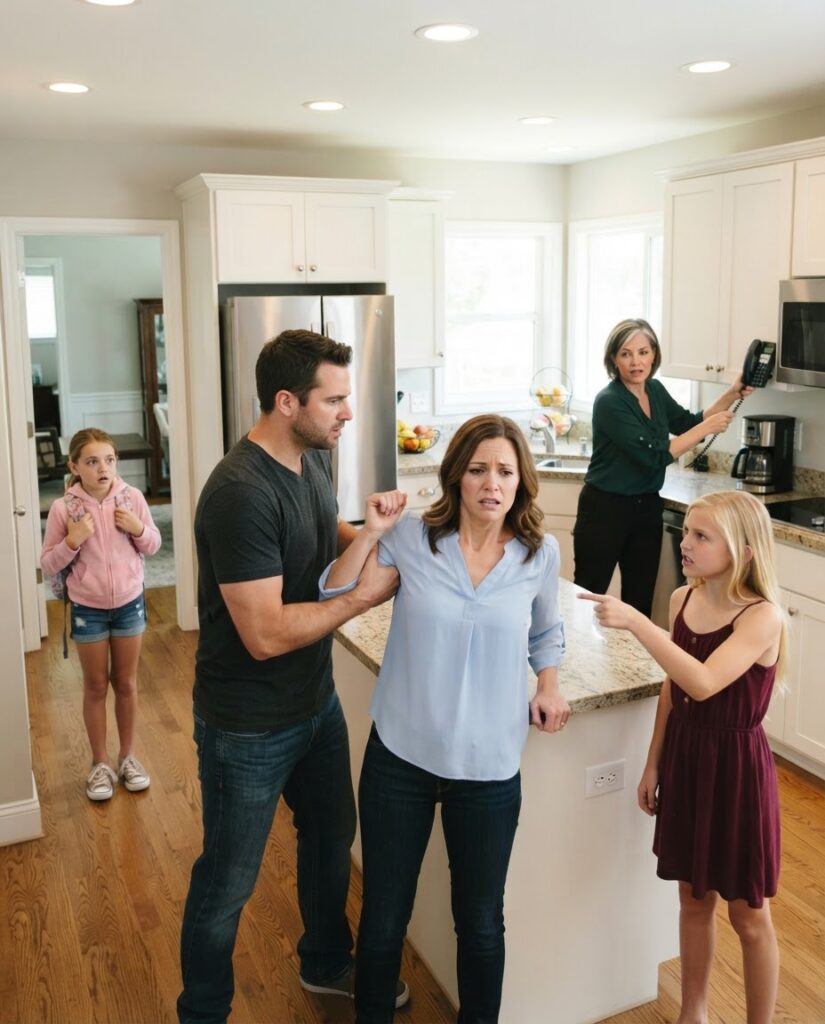
Fallon reached the kitchen counter.
The landline was there.
She grabbed the receiver with both hands.
Then my mother appeared.
Blythe moved faster than I had seen her move all evening.
But not to protect her granddaughter.
She kicked my cell phone across the tile floor.
It slid beneath the breakfast table.
Then she grabbed the landline cord.
“Mom, don’t!”
She pulled.
The cord snapped free from the wall.
Fallon froze.
The receiver remained in her hands.
Dead.
Completely useless.
I stared at my mother.
There are moments when your mind refuses to accept what your eyes are seeing.
This was one of them.
Blythe looked down at my ten-year-old daughter.
My little girl.
Her own granddaughter.
And instead of comforting her, she leaned closer.
“Dial 911,” she said coldly, “and you’re next.”
Fallon’s face changed.
Fear took over completely.
Something inside me did too.
For years, I had forgiven.
Excused.
Paid.
Fixed.
Kept quiet.
I had told myself family was complicated.
That Mom enabled Sutton because she didn’t know what else to do.
That Sutton was troubled, reckless, selfish—but still my sister.
That somewhere underneath all of it, there had to be a line they would never cross.
I was wrong.
The moment my mother threatened my daughter, that line disappeared.
Every shred of loyalty I had spent my life protecting disappeared with it.
I stopped thinking about peace.
Stopped thinking about keeping the family together.
Stopped thinking about what would happen to Sutton.
There was only Fallon.
Getting her out.
Getting her somewhere safe.
And making sure nobody in that house ever had the opportunity to frighten her again.
What none of them understood was that while they thought they had trapped us inside that house, I had already taken precautions they knew nothing about.
And Fallon was much smarter than they believed.
Part 2
Darkness crept along the edges of my vision as Sutton leaned all her weight onto my crushed throat, her eyes dilated with drunken fury.
Every survival instinct screamed inside my chest. Digging my fingernails into her wrists, I threw my hips upward with my last ounce of adrenaline, driving my work boot viciously into Sutton’s shin.
She shrieked, her grip loosening just enough for a desperate gasp of oxygen to pierce my burning lungs.
“Run, Fallon! Out the back patio! Run to Mr. Henderson!” I choked out.
My daughter bolted through the kitchen door into the night, barefoot across the gravel toward the neighbor’s porch.
Sutton swung a heavy brass candlestick into my temple, and my world dissolved into pure black.
I regained consciousness in an emergency room bed to the sterile beeping of monitors.
The diagnostic sheet clipped to my rail read like a crime report: two cracked ribs, a severe concussion, and deep tracheal contusions.
Detective Vaughn of the local precinct stood at my bedside, pen poised over an incident notebook.
What he told me next turned my blood to ice.
Mom and Sutton had already given their sworn statements to responding officers.
With terrifying composure, my mother claimed that I had suffered a paranoid psychotic break, thrown hot soup around the dining room, slipped on the grease, and violently clawed my own neck while falling.
They told police Fallon had accidentally tripped over the telephone cord in sheer panic.
They were spinning a narrative to have me labeled an unfit parent.
When Mom showed up at my hospital room later that afternoon, there were no tears of concern, no remorse.
Instead, she leaned over my bruised face and demanded I sign a statement recanting any allegations against Sutton.
“Sutton is securing a major brand sponsorship,” Mom whispered coldly. “A police record will ruin her entire future. You have always been strong, Maeve. Take the blame for this.”
That was the exact moment the dutiful daughter died.
The following morning, I discharged myself against medical advice and initiated total tactical warfare.
I immediately changed every deadbolt on my house, revoked Mom and Sutton from Fallon’s school emergency release forms, and retained a family attorney to file emergency restraining orders.
Then came the financial strike.
At my logistics firm, my director, Declan, helped me run asset searches through our commercial analytics network.
What we uncovered was an absolute bomb: Sutton’s lifestyle business was a fraudulent shell drowned in over $40,000 of delinquent credit lines.
Far worse, Mom’s prestigious home was not paid off.
Desperate to fuel Sutton’s luxury delusions, Mom had taken out a massive $185,000 secondary mortgage, transferring every cent directly into Sutton’s accounts.
That secondary loan was sitting at ninety-two days delinquent, teetering on imminent foreclosure.
My logistics firm managed an affiliated distress-debt investment portfolio.
With twenty years of disciplined savings, my company retirement rollover, and a modest inheritance untouched from my grandfather totaling $250,000, I moved swiftly.
Under Declan’s guidance, I established an anonymous LLC and outright purchased the delinquent note on Mom’s house directly from the lender at a steep default discount.
Within forty-eight hours, I legally owned the debt holding Mom’s suburban mansion hostage.
Just as the legal trap was closing, Sutton attempted a monstrous counterstrike.
Knowing a protective order was imminent, Sutton deliberately smashed her own hand in a heavy car door, broke two fingers, punched herself in the jaw, and flagged down a patrol cruiser, claiming I had hired street thugs to assault her outside a boutique.
She thought she had constructed an ironclad felony retaliation claim that would put me behind bars and force me to surrender custody of Fallon.
Part 3
Sutton believed her dramatic stunt would shatter my life, but she fundamentally underestimated who she was dealing with.
When Detective Vaughn arrived at my corporate office to question me about the alleged assault, I did not panic.
I simply escorted him to our security command center.
Our facility was fortified with high-definition, time-stamped surveillance covering every workstation.
The footage proved beyond a shadow of a doubt that I had been seated at my dispatch console thirty miles away during the exact moment of the alleged ambush.
Even better, Detective Vaughn subpoenaed the municipal traffic cameras directly overlooking the retail parking lot where Sutton claimed she was attacked.
The crystal-clear recording captured Sutton standing beside her open sedan door, intentionally slamming the heavy metal frame onto her own left hand, crying out in pain, and striking her own cheek with a closed fist.
Detective Vaughn stepped into the corridor, visibly disgusted.
Within two hours, Sutton was handcuffed in her hospital gown and arrested on felony charges of filing a false police report, evidence fabrication, and malicious perjury—all while already facing aggravated assault charges for choking me.
Bail was denied.
Mom, unraveling from Sutton’s arrest, completely lost her composure.
Blaming Fallon for exposing their secret, Mom showed up at my daughter’s elementary school during afternoon recess, screaming through the front administrative doors and demanding staff hand Fallon over to her.
The school instantly locked down.
Detective Vaughn and three squad cars arrived within minutes.
Mom was thrown against the administrative counter and cuffed on charges of criminal trespass, violating a protective order, and witness intimidation.
Six weeks later, the courtroom hammer fell with devastating finality.
Sutton accepted a plea deal that sentenced her to three years behind bars.
As Mom sat in the observation gallery, weeping over her golden child’s ruin, my real estate attorney stepped forward and handed her a formal legal packet.
Mom glanced down at the documents, her face draining of all color.
The paperwork showed that her delinquent secondary mortgage had been acquired by an independent LLC—and that a formal thirty-day eviction notice had been issued.
For the first time, I walked past the gallery railing, looked directly into her stunned eyes, and spoke:
“I own this note, Mom. And I am evicting you.”
Mom refused to accept reality.
On the final night before sheriff deputies were scheduled to lock out the premises, headlights flashed across my suburban driveway.
I heard frantic rattling at my front door.
Mom stood on my porch in the cold drizzle, desperately trying to force her old emergency brass key into my deadbolt.
When it failed to turn, she began pounding violently against the reinforced glass panel, sobbing hysterically.
“Maeve, please! I have nowhere to go! You’re my daughter, you can’t throw your own mother into the street!” she wailed, tears streaming down her hollow cheeks.
I stood in my lit hallway, holding Fallon safely behind me.
Looking through the storm glass, my voice was entirely devoid of anger, replaced by unyielding calm.
“That key doesn’t work anymore,” I said through the intercom. “And it never will again.”
I hit the button, alerting the patrol unit already parked around the corner.
The next morning, county deputies escorted Blythe from the premises, placing her meager belongings in cardboard boxes on the curb.
With her credit ruined and relatives cutting contact after learning of her physical abuse of a child, she was forced to move into an aging roadside trailer court on minimal state assistance.
When Sutton’s name flashed on the prison commissary phone system, begging me for money, I terminated the call and blocked the correctional facility’s access code permanently.
When the housing market peaked the following spring, I liquidated the foreclosed property, netting a clean profit of several hundred thousand dollars.
I funneled $300,000 directly into an irrevocable college trust fund for Fallon.
Today, our home is filled with quiet laughter, warm dinners, and an unshakable peace.
The cycle of cruelty broke the day I refused to be their victim.