PART 2 — THE HOUSE BY THE SEA
My hands trembled as I unfolded the rest of Carl’s letter.
For several seconds, the words refused to settle into meaning. They floated in front of me like pieces of a puzzle I had spent my entire life assembling incorrectly.
Then I forced myself to read.
“When you were born, your mother was terrified. She believed the people searching for her would eventually find you, so she asked me to protect you from a distance.”
I stopped breathing.
My mother had d/i/e/d when I was six.
At least, that was what everyone had told me.
I still remembered the funeral.
Rain tapping against black umbrellas. My father gripping my hand too tightly. A polished wooden coffin I had not been allowed to approach. Adults whispering that it was better I remember her as she had been.
Beautiful.
Laughing.
Alive.
For twenty-three years, I had carried that final image with me.
Now a d/e/@/d man was telling me it had been a lie.
I looked across the enormous mahogany table at Mr. Bennett.
Carl’s lawyer did not move.
He was a narrow man in his sixties, gray-haired and carefully dressed, with the exhausted patience of someone who had spent his life delivering information people did not want to hear.
“You knew?” I whispered.
Mr. Bennett hesitated.
“That depends on what you mean.”
“My mother.”
His eyes lowered toward the letter.
“I knew Carl believed she was alive.”
Believed.
The word scraped against me.
“That isn’t what I asked.”
“No.”
“Then answer me.”
Mr. Bennett removed his glasses and polished them slowly.
“Yes,” he said. “I knew.”
The room suddenly felt too small.
I stood so quickly my chair struck the floor.
“You knew my mother was alive?”
“I knew there was evidence suggesting—”
“Twenty-three years!”
My voice cracked.
“You let me believe she was d/e/@/d for twenty-three years.”
“I met you for the first time three days ago.”
“But Carl knew!”
“Yes.”
“And he said nothing.”
Mr. Bennett remained silent.
I wanted to hate Carl.
It should have been easy.
The strange terminally ill man I had met through the hospice volunteer program. The man whose final request had been so absurd that I had initially laughed when he asked me.
Marry me.
Not romantically.
Not physically.
Just a ceremony.
A white dress.
A ring.
A promise beside his hospital bed.
He had claimed he wanted to experience one beautiful thing before his illness took the last of his strength.
I had refused twice.
Then I had seen the loneliness in his face.
So I agreed.
Three days later, Carl had d/i/e/d.
And now I was learning that he had not been a lonely stranger at all.
He had been my uncle.
My mother’s younger brother.
I lowered myself back into the chair.
There was still more.
My fingers tightened around the paper.
Carl’s handwriting grew increasingly uneven toward the bottom of the page.
“I know you will be angry with me, Emma. You have every right to be. But your mother made me promise that you would never learn the truth until I could guarantee that knowing it would not place you in danger.”
Danger.
I stared at the word.
“When she disappeared, she believed leaving you behind was the only way to keep you safe.”
My stomach twisted.
Disappeared.
Not d/i/e/d.
Not taken from me.
Left me.
The realization hurt more than I expected.
I continued reading.
“I watched you from a distance. I paid your school fees when your father struggled. I covered the hospital expenses after your accident when you were eleven. I arranged the scholarship that allowed you to attend university. I even convinced an old friend to hire you for your first job.”
Memories rose one after another.
My father sitting at the kitchen table with an unopened hospital bill, crying when he thought I was asleep.
Then, mysteriously, the debt vanished.
The scholarship competition I had almost not entered.
The anonymous donor who supposedly admired my essay.
My first employer telling me someone had “strongly recommended” me, though he would never say who.
All those moments I had called luck.
None of them had been luck.
They had been Carl.
My eyes burned.
“Why didn’t he just tell me?” I asked.
Mr. Bennett’s voice softened.
“Because he promised your mother.”
I laughed bitterly.
“A promise mattered more than my entire life?”
“To Carl?”
He considered the question.
“Yes.”
That answer made me look at him.
Mr. Bennett continued.
“Your uncle believed promises were debts. Once made, they were absolute.”
“Then why reveal everything now?”
“Because he was running out of time.”
I glanced toward Carl’s letter.
The final paragraph contained only three sentences.
“Forgive me if you can. Hate me if you must. But whatever happens next, do not trust the story you were given about your family.”
Below it was Carl’s signature.
Nothing else.
I placed the letter down.
“That’s it?”
“For that letter.”
Mr. Bennett opened his briefcase.
“There is more.”
He removed a photograph.
I almost refused to take it.
Something inside me already knew that whatever came next would divide my life into two halves: everything I had believed before this moment, and everything I would be forced to believe afterward.
Mr. Bennett slid the photograph across the table.
It had faded slightly with age.
Three teenagers stood in front of a lake.
Carl was immediately recognizable, despite being perhaps sixteen. Same sharp cheekbones. Same mischievous eyes.
Beside him stood my mother.
Young.
Maybe seventeen.
Her dark hair blew across her face while she smiled at whoever was holding the camera.
Between them stood a little girl.
Perhaps four years old.
I stared at her.
There was something uncomfortable about her face.
Something familiar.
Then I realized what it was.
Her eyes.
She had my eyes.
Not similar eyes.
Mine.
Same unusual gray-green shade.
Same slightly uneven shape.
Same tiny dark spot beneath the left iris.
I looked at Mr. Bennett.
“Who is she?”
He didn’t answer immediately.
“Her name was Rose.”
“Was?”
He folded his hands.
“She disappeared.”
“When?”
“Thirty-one years ago.”
My mind began calculating.
Eight years before I was born.
“Who was she?”
Mr. Bennett looked toward the photograph.
“Carl’s younger sister.”
I stared at him.
“My mother had a sister?”
“Yes.”
“No.”
The word came out automatically.
“My mother only had one sibling. Carl.”
“That is what you were told.”
The room became very quiet.
Outside the lawyer’s office, I could hear the faint ringing of telephones and someone laughing in the corridor.
Normal sounds.
An ordinary afternoon.
Meanwhile, my childhood was being dismantled sentence by sentence.
“What happened to Rose?”
“Nobody knows.”
“You just said she disappeared.”
“Yes.”
“People don’t simply disappear.”
“Sometimes they do.”
“Was she kidnapped?”
His expression changed.
Only slightly.
But I noticed.
“You know something.”
“I know rumors.”
“What rumors?”
Mr. Bennett pushed his glasses higher on his nose.
“Your grandparents were involved with people who had considerable influence.”
“What kind of influence?”
“The kind that makes records vanish.”
I felt cold.
“Criminals?”
Mr. Bennett ignored the word.
“That period of Carl’s life is complicated.”
“How complicated?”
He reached into the briefcase again.
This time he removed a thick brown envelope.
“Before we discuss that, Carl instructed me to explain the marriage.”
My face burned.
Of all the impossible things happening, somehow the ceremony felt suddenly ridiculous.
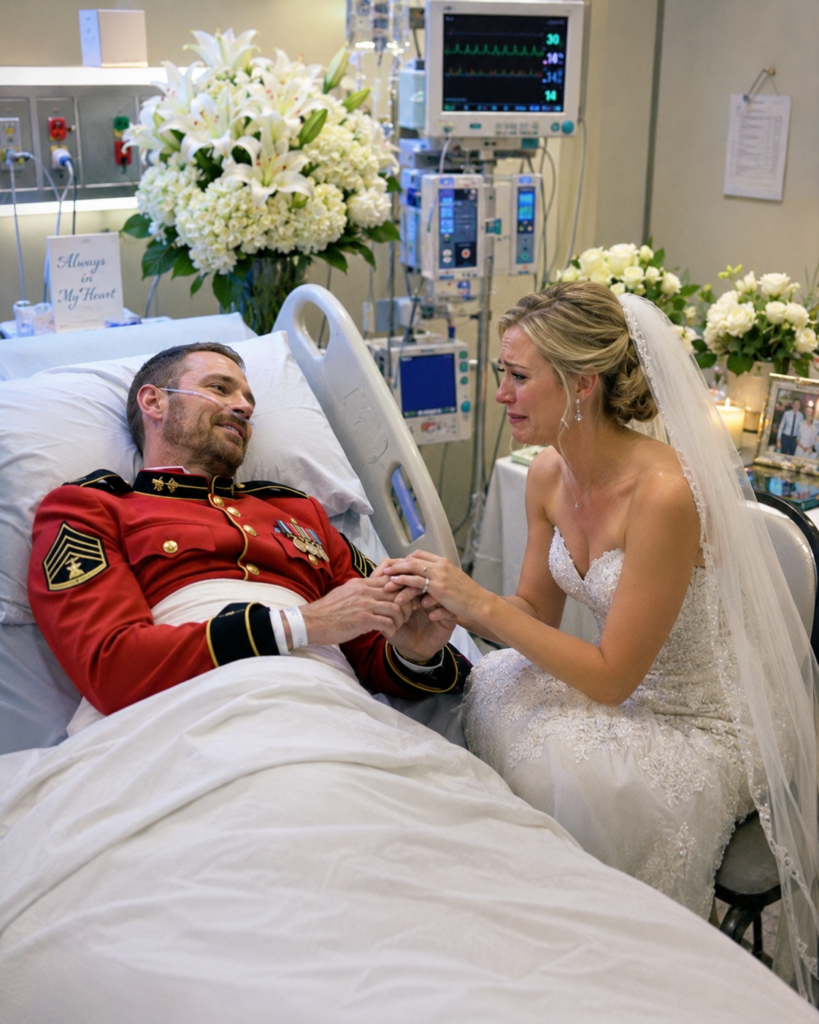
I remembered Carl lying in the hospice bed wearing a dark suit several sizes too large for his weakened body.
He had smiled when I entered wearing the simple white dress.
“You actually came,” he had whispered.
“You sound surprised.”
“I’ve spent most of my life being surprised by you.”
At the time, I had assumed he meant my kindness.
Now I understood.
He had watched me grow up.
He had known exactly who I was.
During the ceremony, Carl had cried.
I had believed they were tears of gratitude.
Maybe they had been something else.
“Why did he marry me?” I asked.
“He didn’t.”
I frowned.
“I stood beside his bed. There was an officiant.”
“There was a ceremony.”
“He gave me a ring.”
“Yes.”
“I signed documents.”
“Ceremonial documents.”
My mouth fell open.
“The marriage was never legally registered?”
“No.”
“Then what was the point?”
Mr. Bennett opened the brown envelope.
“Protection.”
He removed a property deed.
Then another document.
Then another.
I watched the papers accumulate in front of me.
The first was ownership of a coastal estate in Maine.
The second concerned a private trust.
I read the number twice.
Then a third time.
“No.”
Mr. Bennett said nothing.
“This says thirty-eight million dollars.”
“Yes.”
“There has to be a mistake.”
“There isn’t.”
“I don’t have thirty-eight million dollars.”
“You do now.”
I pushed the document away.
My hands had started shaking again.
“Carl had this kind of money?”
“Not exactly.”
“What does that mean?”
“The trust belonged to your mother.”
The shaking stopped.
I looked at him.
“What?”
“She transferred control to Carl shortly before she disappeared. Carl protected it for you.”
I stared down at the papers.
Millions.
An estate.
A secret family.
A supposedly d/e/@/d mother.
Nothing made sense.
“Why would pretending to marry me protect anything?”
“Because Carl believed certain people were monitoring his estate.”
“Who?”
“He never named them.”
“That’s convenient.”
“He expected someone to challenge his will.”
“Why?”
“Because they believed the trust belonged to them.”
“And the fake marriage?”
Mr. Bennett leaned forward.
“To create noise.”
I blinked.
“What?”
“Carl knew that after his d/e/@/th, anyone watching would investigate the mysterious woman he had apparently married days earlier. They would assume the inheritance passed to you because you were his wife.”
“But it didn’t.”
“No.”
“You’re saying he wanted them to believe the money was his.”
“Yes.”
“When it was actually my mother’s.”
“Yes.”
I sat back.
The plan was absurd.
And brilliant.
Carl had built a false explanation around me.
A dying man’s strange marriage.
An unexpected inheritance.
A scandal dramatic enough that nobody would immediately search for another explanation.
Unless they knew.
A terrible thought came to me.
“Did the people he was hiding from know who I was?”
Mr. Bennett’s silence answered before his mouth did.
“Carl hoped they didn’t.”
“Hoped?”
“He believed your identity had remained hidden.”
“That isn’t an answer.”
“No,” he admitted. “It isn’t.”
I stood and moved toward the window.
The city stretched beneath me.
Cars moved along the streets like tiny insects.
Millions of people lived down there.
People with normal families.
Normal childhood photographs.
Normal mothers who were either alive or d/e/@/d.
I pressed my forehead against the cool glass.
“I want to see her.”
Mr. Bennett didn’t pretend not to understand.
“Your mother?”
“Yes.”
“That may not be possible.”
I turned around.
“She’s alive.”
“We believe so.”
“You said you knew.”
“I know she was alive recently.”
My heartbeat accelerated.
“How recently?”
Mr. Bennett slowly opened the final envelope.
He removed another photograph.
Unlike the first, this one was glossy and new.
A woman stood outside a large gray house overlooking the ocean.
Her hair was mostly silver now.
She wore a long coat.
Her face was thinner.
Older.
But I knew her instantly.
My mother.
The photograph slipped from my fingers.
For a moment I was six years old again.
Sitting on the kitchen floor.
Waiting for footsteps that never returned.
“Mom.”
The word escaped before I could stop it.
I bent and picked up the picture.
There was a date printed in the corner.
Six weeks ago.
My mother had been alive six weeks ago.
Six weeks.
While I went to work.
While I bought groceries.
While I complained about my landlord.
While I sat beside Carl at the hospice and listened to him tell stories.
She had been somewhere beneath the same sky.
Alive.
I turned the photograph over.
Five words were written on the back.
Please come before they find me.
I stared at the handwriting.
I remembered it.
Birthday cards.
Lunchbox notes.
My name written inside children’s books.
The same looping E.
The same strange way she crossed her t’s.
“What does this mean?”
Mr. Bennett stood.
“I think you should go to the estate.”
“When?”
“Immediately.”
I laughed without humor.
“You spend an hour telling me my entire life is a lie, then casually suggest I drive to some mysterious house?”
“I didn’t say drive.”
He glanced toward his watch.
“There’s a car downstairs. Your flight leaves in two hours.”
I stared at him.
“You already booked a flight?”
“Carl booked it.”
“When?”
“Three months ago.”
I felt something strange crawl down my spine.
“He knew exactly when he was going to d/i/e?”
“No.”
“Then how could he book my flight?”
Mr. Bennett looked uncomfortable.
“He changed the reservation repeatedly.”
That sounded more like Carl.
Meticulous even while dying.
I picked up my handbag.
Then stopped.
“What happens if I don’t go?”
Mr. Bennett looked at the photograph of my mother.
“Then you may never learn why she disappeared.”
That was enough.
The estate stood on a cliff above the Atlantic.
I arrived shortly after midnight.
Wind pushed against the rented car while waves crashed against black rocks far below.
The house was larger than it appeared in the photograph.
Three stories of gray stone.
Dozens of dark windows.
A tower at one end.
Not abandoned.
But not welcoming either.
The iron gate opened before I touched the intercom.
That bothered me.
I drove slowly along the winding path.
Every instinct told me to turn around.
Instead, I parked beside the entrance.
The front door opened.
An elderly woman appeared.
“Emma.”
She knew me.
I remained beside the car.
“Who are you?”
“My name is Margaret.”
“Where is my mother?”
Margaret’s expression changed.
“Inside.”
My heart slammed against my chest.
For twenty-three years I had imagined seeing my mother again.
Sometimes in dreams.
Sometimes while half awake.
Sometimes in crowded train stations when a stranger’s hair resembled hers.
Nothing prepared me for walking through that door.
The house smelled of cedar and ocean air.
Paintings covered the walls.
Most were landscapes.
One stopped me.
Three children stood beside a lake.
My mother.
Carl.
And Rose.
The same photograph rendered in oil.
“Emma?”
A voice came from the staircase.
I froze.
Slow footsteps descended.
A woman appeared.
Silver hair.
Thin shoulders.
Gray-green eyes.
My mother’s eyes.
My eyes.
For several seconds neither of us moved.
Then she whispered my name.
I wanted to run to her.
I wanted to scream.
I wanted to demand twenty-three years back.
Instead, I stood perfectly still.
“You’re alive.”
Tears filled her eyes.
“Yes.”
“You let me think you were d/e/@/d.”
Her mouth trembled.
“Yes.”
“You left me.”
“Emma—”
“You left me.”
She descended another step.
“I had no choice.”
“There is always a choice.”
“You don’t understand.”
“Then explain it.”
My mother looked toward Margaret.
Something passed silently between them.
Then Margaret disappeared into another room.
My mother approached slowly.
“I loved you every day.”
I stepped backward.
“Don’t.”
She stopped.
“You don’t get to say that first.”
Pain crossed her face.
“Fair enough.”
“What happened?”
She looked toward the windows.
“Not here.”
“This is your house.”
“No.”
I frowned.
“Then whose is it?”
She looked directly at me.
“Yours.”
Before I could answer, the lights went out.
Darkness swallowed the room.
My mother grabbed my wrist.
“Don’t make a sound.”
I heard Margaret somewhere in the hallway.
Then a metallic click.
A door locking.
Another click farther away.
My mother’s grip tightened.
“What’s happening?” I whispered.
“They found us.”
Headlights appeared beyond the front windows.
Several vehicles.
Moving slowly up the driveway.
My stomach dropped.
“Who?”
My mother pulled me toward the staircase.
“The people Carl spent his entire life hiding you from.”
“Who are they?”
She stopped.
Even in darkness, I could see her face.
Terrified.
“You’re asking the wrong question.”
“Then what’s the right one?”
She led me upstairs.
“Ask why they want you.”
We reached the second floor.
Behind us, something heavy struck the front door.
Once.
Twice.
Then again.
My mother hurried toward the tower.
At the end of the corridor was a narrow room filled with boxes.
She pushed aside a bookcase.
Behind it was a steel door.
“What is this?”
“A room Carl built.”
She entered a code.
The door opened.
Inside was a small office.
No windows.
One desk.
One computer.
And hundreds of photographs pinned across the walls.
I stepped inside.
Then stopped.
Every photograph was of me.
At school.
At university.
Walking to work.
Shopping.
Sleeping on an airplane.
Sitting beside Carl at the hospice.
Some had clearly been taken from enormous distances.
Others had been taken frighteningly close.
“What the hell is this?”
My mother closed the steel door.
“These are only the photographs Carl managed to collect.”
“Collect from who?”
“The people watching you.”
My skin went cold.
“How long?”
“Your entire life.”
I looked around the room.
Twenty-nine years documented in secret.
Then I noticed something.
At the far end of the wall was a photograph dated before I was born.
A hospital room.
My mother lay in bed.
Beside her stood Carl.
And beside Carl—
Rose.
The missing sister.
Older.
Alive.
Holding a newborn baby.
I moved closer.
“That’s Rose.”
My mother said nothing.
My eyes lowered toward the infant.
There was a label attached to the hospital bassinet.
EMMA.
My breath disappeared.
“No.”
My mother began crying.
I turned slowly.
“Why is Rose holding me?”
She covered her mouth.
“Mom.”
The pounding downstairs suddenly stopped.
Absolute silence filled the house.
I barely noticed.
“Why is Rose holding me?”
My mother’s answer came as a whisper.
“Because I didn’t give birth to you.”
Everything inside me went still.
I stared at her.
“No.”
“Emma—”
“You’re my mother.”
“Yes.”
“You said—”
“I raised you.”
“That isn’t what I asked.”
She closed her eyes.
I turned back toward the photograph.
Rose.
The woman with my eyes.
The missing sister nobody had ever mentioned.
Holding me as a newborn.
“No.”
My voice sounded small.
My mother approached.
“Rose was nineteen when she disappeared.”
“You said she disappeared eight years before I was born.”
“That was the story Carl created.”
“Why?”
“To protect her.”
“From who?”
My mother looked toward the steel door.
Then toward the photographs.
“From our father.”
My grandfather.
A man I had been told d/i/e/d before I was born.
Another supposed d/e/@/th.
Another possible lie.
“What did he want?”
“You.”
A sound came from the other side of the steel door.
Three knocks.
Slow.
Deliberate.
My mother went white.
The computer on the desk suddenly powered on.
Neither of us had touched it.
The screen flickered.
A video appeared.
Carl.
Recorded weeks before his d/e/@/th.
He looked thinner than I remembered.
His voice emerged from the speakers.
“Emma, if you’re watching this, then your mother has finally told you about Rose.”
I moved toward the screen.
Carl smiled sadly.
“But she still hasn’t told you everything.”
My mother rushed toward the computer.
“Turn it off.”
I stepped between her and the desk.
“No.”
“Emma!”
Carl continued.
“You have spent your entire life believing Helen was your mother.”
Helen.
The woman standing behind me.
“You are about to learn that Rose gave birth to you.”
My knees weakened.
“But even that is not the truth.”
Behind me, Helen gasped.
“Carl, you bastard.”
The video continued.
“Rose carried you, yes. But she was not your biological mother.”
I stared at the screen.
My mind could no longer keep pace.
Then Carl leaned closer to the camera.
“If Helen is beside you, ask her what happened on October seventeenth, twenty-nine years ago.”
I turned.
Helen looked terrified.
“What happened?”
She shook her head.
“Nothing.”
“Helen.”
“Emma, please.”
“WHAT HAPPENED?”
A voice answered from outside the steel door.
“Your birthday.”
I froze.
Helen backed away.
“No.”
The voice belonged to a woman.
Then another series of knocks came.
Three.
Pause.
Two.
Pause.
Three.
Helen stared at the door like she had seen a ghost.
“Rose.”
My heart stopped.
The supposedly missing woman was standing on the other side.
Alive.
The computer screen changed.
Carl’s face disappeared.
A document replaced it.
BIRTH CERTIFICATE.
My name appeared at the top.
Emma Grace Mercer.
Date of birth.
October seventeenth.
Mother—
The line was blacked out.
Father—
Also blacked out.
Then another image appeared.
A laboratory report.
DNA ANALYSIS.
Three names were listed.
CARL MERCER.
HELEN MERCER.
ROSE MERCER.
Beneath them was one final name.
EMMA.
The relationship probability beside all three siblings was the same.
0%.
I stared.
“That’s impossible.”
Helen began shaking.
Outside the door, Rose spoke again.
“Open it, Helen.”
“No.”
“You can’t keep lying to her.”
Helen grabbed my shoulders.
“Listen to me. Whatever she tells you, don’t believe her.”
“Why?”
“Because Rose is the reason Carl spent his entire life running.”
The voice outside laughed softly.
“Still blaming me?”
Helen stepped back.
The computer changed again.
This time a photograph appeared.
An infant.
Me.
Wrapped in a white blanket.
Standing behind the hospital bassinet was a man.
Tall.
Silver-haired.
Watching the camera.
I recognized him.
My stomach dropped.
“No.”
I had seen that face before.
Not in old family photographs.
Not in Carl’s belongings.
Three months earlier, I had met him at work.
He had introduced himself as Daniel Voss.
A wealthy investor considering purchasing the company where I worked.
He had shaken my hand.
Looked into my eyes.
And smiled.
“You look exactly like someone I knew a very long time ago,” he had said.
At the time, I thought nothing of it.
Now Carl’s recorded voice returned.
“If you recognize the man in this photograph, leave the house immediately.”
Helen whispered, “Oh God.”
Carl continued.
“Because if Daniel Voss has already met you, then everything we did failed.”
A sound came from downstairs.
The front door opened.
No crash.
No forced entry.
Simply opened.
Helen stared toward the ceiling.
“How?”
Footsteps entered the house.
Slow.
Calm.
Unhurried.
The steel door had protected us from strangers.
But whoever had entered was not behaving like a stranger.
A man’s voice echoed faintly from downstairs.
“Emma?”
I knew that voice.
Daniel Voss.
Helen gripped my arm.
“There’s another exit.”
She pushed a hidden panel beside the computer.
A narrow tunnel appeared.
“Go.”
“What about you?”
“GO!”
The steel door beeped.
Someone was entering the access code.
Helen shoved me toward the tunnel.
I stumbled inside.
The hidden panel began closing.
Through the narrowing gap, I saw Helen turn toward the steel door.
It opened.
Rose stood there.
For the first time, I saw the woman from the childhood photograph as she was now.
Older.
Elegant.
Gray-green eyes.
My eyes.
Except now I knew they were not truly mine.
Rose looked past Helen.
Straight at me.
“Emma!”
The panel nearly closed.
Then Rose shouted something that made me freeze.
“Carl is alive!”
The panel sealed.
Darkness.
I stood alone inside the tunnel.
My breath echoed against the walls.
Carl was alive?
Impossible.
I had seen his body after he d/i/e/d.
I had attended the funeral.
I had watched the coffin lowered.
Unless—
Another funeral.
Another closed coffin.
Another carefully constructed lie.
A light suddenly appeared ahead.
Someone stood at the far end of the tunnel.
A man.
Thin.
Weak.
Leaning heavily on a cane.
My heart began pounding.
He stepped into the light.
Carl.
Pale.
Exhausted.
Alive.
He looked at me with the same familiar, mischievous eyes.
Then he smiled.
“I’m sorry about the funeral,” he said. “It was necessary.”
I could only stare.
Carl glanced toward the sealed door behind me.
“They told you Rose gave birth to you, didn’t they?”
I nodded.
“And Helen told you Rose is dangerous?”
Another nod.
Carl sighed.
“Of course she did.”
“Who am I?”
His smile vanished.
“That,” he said, “is why everyone is here.”
Footsteps sounded behind us in the tunnel.
Carl reached into his coat.
Not for a we/@/pon.
For a small silver key.
He pressed it into my palm.
“Whatever happens next, don’t give this to Daniel.”
“What does it open?”
“The room beneath the house.”
“What room?”
Carl looked past me.
His expression changed.
Someone was approaching.
Then he whispered the words that made every lie before them suddenly seem insignificant.
“The room where the real Emma has been waiting for twenty-nine years.”
PART 3 — THE HOUSE AT THE EDGE OF THE SEA
I read the five words until they seemed to separate from the photograph.
Please come before they find me.
My mother.
Alive.
The woman whose f/u/neral I remembered in fragments—the black dress someone had buttoned crookedly around my six-year-old body, the rain against the church windows, the closed casket I had been too frightened to approach—was standing beneath sunlight in a photograph taken less than three months ago.
I looked at Mr. Bennett.
“This isn’t possible.”
His expression barely changed.
“I’m afraid ‘possible’ is about to become a very flexible word for you.”
I shoved the photograph toward him.
“I watched them bury my mother.”
“No,” he said gently. “You watched them bury a coffin.”
Something cold moved through me.
“You knew?”
“I knew Carl had a sister who was alive. I did not know where she was until six months ago.”
“Carl knew?”
“Yes.”
The answer hurt more than I expected.
For ten days, I had sat beside Carl as his breathing became shallower. I had made tea he barely touched. I had held his hand during the nights when his c/@/ncer pain became unbearable.
He had looked at me as though I mattered.
And all that time he had known my mother was alive.
“Why didn’t he tell me?”
Mr. Bennett glanced toward Carl’s letter.
“Because he was afraid you would go looking before it was safe.”
“Safe from whom?”
“That is what your mother intends to explain.”
He opened his briefcase again.
I nearly laughed.
Every time that thing opened, my life became less recognizable.
This time he removed a set of old-fashioned brass keys.
“The coastal property is called Greyhaven.”
“I’ve never heard of it.”
“You weren’t supposed to.”
“Where is it?”
“About four hours north.”
He placed the keys beside the photograph.
“Carl instructed me to drive you there tonight if you agreed.”
I stared at him.
“Tonight?”
“He was very specific.”
“And if I refuse?”
“Then I leave the keys, the trust documents, and this.”
Another envelope.
I closed my eyes.
“Of course there’s another envelope.”
For the first time, Mr. Bennett almost smiled.
“This one contains nothing dramatic. Only directions.”
“That might be the most comforting thing anyone has said to me all day.”
I went upstairs and packed without knowing what to bring.
Jeans. Sweaters. Toothbrush.
My hands moved automatically while my mind remained trapped in the same impossible loop.
Carl was my uncle.
My mother was alive.
The marriage had never been registered.
Someone had been looking for us.
And somewhere four hours north stood a house worth millions that apparently belonged to me.
Before leaving, I returned to the living room.
Carl’s chess set was still on my coffee table.
Two nights before his d/e/@/th, he had insisted I take it.
“You’re terrible at chess,” I had told him.
“That’s because I enjoy losing to you.”
“You beat me every time.”
“Exactly.”
I suddenly remembered something else.
His final game.
Carl had moved his king into the corner and tapped the board.
“The safest place isn’t always where everyone thinks it is.”
At the time, I thought the medication had made him confused.
Now I picked up the white king.
Something rattled inside.
My heart stopped.
“Mr. Bennett?”
He turned.
I twisted the base.
It unscrewed.
A tiny brass key fell into my palm.
Mr. Bennett went pale.
“That wasn’t in my instructions.”
That frightened me more than anything else.
We drove north beneath a darkening sky.
By the second hour, the city had disappeared behind us. The road narrowed into forests, then wound beside cliffs where the ocean slammed against black rocks.
Mr. Bennett barely spoke.
I kept Carl’s chess-piece key clenched in my fist.
At 10:17 p.m., we passed through a rusted iron gate.
Greyhaven appeared beyond the trees.
It wasn’t a house.
It was a fortress disguised as one.
Three stories of dark stone stood above the ocean, with tall windows, ivy-covered walls and a tower rising from its eastern side.
One window glowed.
Someone was waiting.
The front door opened before we reached it.
A woman stood beneath the porch light.
Her hair was almost completely silver.
She was thinner than the woman in my childhood photographs, and time had carved lines beside her mouth.
But I knew her immediately.
Not because of the photograph.
Because of her eyes.
My eyes.
For twenty-six years, I had imagined what I would say if I could speak to my mother again.
I had imagined running into her arms.
Instead I stood frozen on the gravel.
She whispered my name.
“Emily.”
My throat closed.
She took one step toward me.
I stepped backward.
Her face crumpled.
“You’re alive,” I said.
“Yes.”
“You let me think you were d/e/@/d.”
Tears filled her eyes.
“Yes.”
“For twenty-six years.”
“I know.”
“You missed everything.”
“I know.”
“My graduations. My birthdays. When I broke my leg. When I got my first apartment. Every Christmas.”
“I know.”
“You knew where I was?”
She nodded.
Something inside me cracked.
I slapped her.
The sound echoed beneath the porch.
Mr. Bennett looked away.
My mother didn’t move.
“I deserved that,” she whispered.
I hated that answer.
I wanted her angry.
I wanted her to defend herself so I could stay furious.
Instead she touched her cheek and said, “You look exactly like your father when you’re angry.”
I stared at her.
“My father?”
She closed her eyes.
Then another voice came from inside the house.
“Claire, bring her in.”
A man’s voice.
Old.
Weak.
But unmistakably commanding.
My mother stiffened.
Mr. Bennett looked startled.
“Who is that?”
She didn’t answer him.
She looked only at me.
“There are three things Carl never told you because he believed I should.”
I swallowed.
“What things?”
She glanced into the dark hallway.
“The first is why I disappeared.”
Her hand trembled.
“The second is why Carl protected you.”
Then she looked directly into my eyes.
“And the third is that the man you were told was your father…”
She paused.
“…wasn’t your father at all.”
The man inside called again.
“Claire.”
My mother moved aside.
At the end of the hallway, beneath the chandelier, stood an elderly man leaning on a cane.
I had never seen him before.
Yet he was staring at me as if he had spent his entire life waiting for this moment.
“Emily,” he said.
His voice broke.
“My granddaughter.”
PART 4 — THE FAMILY THAT ERASED ME
I did not enter Greyhaven because I trusted anyone inside it.
I entered because I was tired of standing in the cold while strangers rearranged my childhood.
The elderly man remained beneath the chandelier.
“My name is Arthur Vale.”
I recognized the surname.
Not from my family.
From newspapers.
Vale Maritime.
Vale Hotels.
Vale Foundation.
Vale Industries.
The name appeared on museums, hospitals, universities and office towers.
Arthur Vale had once been one of the richest men in the country.
I looked at my mother.
“No.”
She nodded slowly.
“Arthur is my father.”
“And Carl?”
“My brother.”
I stared at the old man.
“So Carl…”
“Was my son,” Arthur said.
His voice softened.
“And your uncle.”
The enormous coastal estate suddenly made sense.
The millions made sense.
Nothing else did.
Arthur invited us into a library overlooking the ocean.
Portraits covered the walls.
Generations of serious people in expensive clothes stared down at me.
Then I saw a young woman in one painting.
She had my face.
Not exactly.
But enough.
“My grandmother?” I asked.
Arthur smiled sadly.
“Eleanor. You have her eyes.”
“Apparently I have everyone’s eyes.”
Nobody laughed.
Good.
I wasn’t joking.
My mother poured tea but spilled half of it onto the tray.
“Start at the beginning,” I said.
She sat opposite me.
“When I was twenty-one, your grandfather planned for me to eventually run the family company.”
Arthur looked toward the fire.
“I believed she was brilliant.”
“She was,” my mother said. “But I hated everything the company represented.”
Arthur flinched.
She continued.
“I wanted to teach. I wanted a normal life. So I left.”
“And met my father?”
She nodded.
“His name was Daniel Hart.”
That name I knew.
It was on my birth certificate.
“He worked for Vale Maritime,” she said.
My stomach tightened.
“What happened?”
“At first, I believed we were in love.”
Her voice changed.
“Then Daniel discovered something inside the company.”
Arthur’s grip tightened around his cane.
“In the late nineties,” he said, “one of our subsidiaries was being used by executives to hide financial cr/i/mes. Illegal transfers. Smuggling. Bribery.”
Mr. Bennett shifted beside me.
Arthur continued.
“I didn’t know until Carl found evidence years later.”
My mother stared at the fire.
“Daniel knew much earlier.”
“Was he involved?”
“No.”
Her answer came instantly.
“He wanted to expose them.”
“And they found out?”
“Yes.”
I understood before she said more.
The air seemed colder.
“Daniel d/i/ed?”
My mother nodded.
“His car went over a bridge.”
“Accident?”
She looked at me.
“No.”
I stopped breathing.
“The people responsible made it look like one.”
Arthur’s face hardened.
“The investigation was buried.”
My mother continued.
“Daniel had already sent me copies of what he discovered. After his d/e/@/th, I panicked. I thought they would come for me.”
“And me.”
“Yes.”
She covered her mouth.
“You were six.”
The room blurred.
“So you faked your d/e/@/th.”
“It was Arthur’s idea.”
I looked at him.
Arthur didn’t deny it.
“A private security adviser told us there had been inquiries about Claire’s daughter.”
“Me.”
“Yes.”
“You could have taken me with you.”
My mother broke.
“I tried.”
The words tore from her.
“I packed your clothes. I had passports ready. Carl was going to drive us across the border.”
“What happened?”
“There was an @tt/@ck on Carl’s apartment the night before we planned to leave.”
I turned toward Mr. Bennett.
Even he seemed not to know that.
My mother wiped her tears.
“Carl survived, but we knew they were watching him. If you disappeared with me, they would know I had survived too.”
“So you abandoned me?”
“I hid you.”
“No. You abandoned me with strangers.”
“With your grandmother’s closest friend.”
A memory surfaced.
Aunt Margaret.
Not really my aunt.
The woman who raised me until I left for college.
She had always said my mother made her promise to care for me.
I had thought she meant before the supposed accident.
“She knew?”
“Only that I was alive.”
I stood.
Twenty-six years of grief suddenly had nowhere to go.
Every night I had cried for my mother.
Every birthday candle I had blown out wishing she could see me.
Every time I had envied girls shopping with their mothers.
She had been alive.
Somewhere.
Watching.
“How?”
My mother looked confused.
“How did you watch me?”
She rose and walked toward an old cabinet.
Inside were dozens of photo albums.
She brought out the first.
My first school play.
Another.
My tenth birthday.
Another.
High-school graduation.
College.
My first hospice fundraiser.
My hands shook.
“Who took these?”
“Carl.”
Of course.
Carl.
Always Carl.
“He visited Margaret every few months,” my mother said. “Sometimes he watched from a distance. Sometimes she sent photographs.”
I opened another album.
There I was at seventeen, crying outside a school gym after my first breakup.
Someone had taken the photograph through a windshield.
I closed the album.
“This isn’t comforting.”
“I know.”
“Did Carl think it was?”
“No.”
My mother sat beside me.
“He hated the secrecy.”
“Then why maintain it?”
“Because two years ago, someone started searching for me again.”
Mr. Bennett leaned forward.
“Who?”
Arthur answered.
“My eldest son.”
Everyone fell silent.
I stared at him.
“You have another son?”
“Yes.”
“Carl’s brother.”
“Yes.”
“My uncle.”
“Yes.”
His name came from my mother in a whisper.
“Victor Vale.”
I knew that name too.
Current chairman of Vale Industries.
Philanthropist.
Billionaire.
A man whose face appeared on magazine covers.
My mother’s expression turned cold.
“Carl believed Victor was connected to the people who caused Daniel’s d/e/@/th.”
“Believed?”
Arthur spoke.
“I spent twenty years refusing to believe it.”
“And now?”
Arthur looked suddenly ancient.
“Now I know my son was worse than I imagined.”
He reached into his jacket and placed a flash drive on the table.
“Carl found this.”
“What is it?”
“Copies of financial records, private correspondence, recordings and contracts.”
My mother took my hand.
“Enough to destroy Victor.”
I pulled away.
“Then give it to the authorities.”
“We intend to.”
“Then why am I here?”
Arthur and my mother exchanged a look.
I hated that look already.
“Because,” Arthur said, “the files are encrypted.”
“So?”
“The password was divided between Carl and Claire.”
My mother shook her head.
“Carl changed his half before he d/i/ed.”
Mr. Bennett suddenly looked at the white chess king protruding from my coat pocket.
We all followed his gaze.
I slowly removed it.
Then the tiny brass key.
My mother went completely still.
“Where did you get that?”
“Inside Carl’s chess piece.”
She stood so quickly her chair tipped backward.
“Oh, Carl.”
“What?”
She was staring toward the eastern tower.
“That key opens his room.”
“Carl had a room here?”
“He grew up here.”
We climbed three flights of stairs.
At the top, a narrow corridor ended at a wooden door.
The brass key turned perfectly.
The room smelled faintly of cedar.
Nothing had been disturbed.
A child’s telescope stood beside the window.
Books lined the shelves.
And on the desk sat another chessboard.
Only one piece remained.
A black queen.
Under it was a note.
My name was written on the front.
I opened it.
**Emily, if you’re reading this, then you found the king. Good. You finally won a game.**
Despite everything, I laughed through my tears.
Then I read the next line.
Do not trust the person who brought you to Greyhaven.
My laughter disappeared.
Behind me, Mr. Bennett whispered:
“What does it say?”
I slowly folded the note.
And for the first time that night, I wondered why Carl’s lawyer had been so eager to drive me here.
PART 5 — CARL’S LAST GAME
I turned around.
Mr. Bennett stood in the doorway.
My mother was beside him.
Arthur remained downstairs because the stairs were too difficult for him.
“What did Carl write?” Bennett asked.
I forced my face into neutrality.
“A joke about chess.”
He watched me carefully.
“What kind of joke?”
“That I finally beat him.”
My mother smiled through her sadness.
“That sounds like Carl.”
Bennett didn’t smile.
He stepped closer.
“Anything else?”
“No.”
For several seconds, nobody moved.
Then he nodded.
“Perhaps we should search the room.”
That was exactly what I did not want him to do.
Carl’s message echoed inside my head.
**Do not trust the person who brought you to Greyhaven.**
There was only one person who had brought me.
Mr. Bennett.
But why?
He had revealed the truth.
He had delivered Carl’s documents.
He had brought me to my mother.
Unless that was exactly what Carl expected him to do.
I glanced at the black queen.
Something was carved beneath its base.
Three tiny letters.
**E.M.H.**
My initials.
Emily Margaret Hart.
I picked it up.
Bennett noticed.
“What’s that?”
“A chess piece.”
“I can see that.”
His tone was different now.
Sharper.
My mother looked between us.
“Is something wrong?”
“No,” I said quickly.
Bennett answered at the same time.
“Not at all.”
We went downstairs.
Dinner had been prepared but nobody ate much.
Every sound made me jump.
Silverware against porcelain.
Wind against windows.
The old clock in the hall.
At 1:00 a.m., Arthur retired.
My mother showed me to a bedroom across from hers.
“You should sleep.”
“That seems ambitious.”
She gave a sad smile.
“I suppose it does.”
Before leaving, she hesitated.
“Emily?”
“Yes?”
“I know you have no reason to forgive me.”
I said nothing.
“I just need you to know that there wasn’t a single day when I didn’t think about you.”
“That doesn’t give those days back.”
“I know.”
The pain on her face was real.
That made everything harder.
After she left, I locked the door.
Then I examined the black queen.
Unlike the king, its base did not unscrew.
I remembered something Carl always did when he was thinking during our games.
He rotated his queen.
Quarter turn left.
Half turn right.
Quarter turn left.
I copied the movement.
Click.
The base opened.
Inside was a rolled strip of paper.
Numbers.
**3-1-18-12 / 14-5-22-5-18 / 20-18-21-19-20-5-4 / 2-5-14-14-5-20-20**
A simple alphabet code.
I translated it.
**CARL NEVER TRUSTED BENNETT**
My stomach dropped.
Beneath it was another line.
**THE LIBRARY. SECOND SHELF. RED BOOK. PAGE 214.**
I waited until the hallway was silent.
Then I slipped downstairs.
Moonlight filled the library.
Second shelf.
Red book.
There were twelve.
“Thanks, Carl,” I whispered.
Then I remembered how he arranged books at home.
By height, not alphabetically.
The shortest red book was a collection of Shakespeare’s plays.
Page 214 had been cut hollow.
Inside was a digital recorder.
I pressed play.
Static.
Then Carl’s voice.
Healthy enough to sound like the man I had known months earlier.
“If Emily is hearing this, I’m gone.”
I covered my mouth.
“Emily, I’m sorry. There were things I couldn’t tell you while I was alive because every person who knew the whole truth became a target.”
A pause.
“I trusted Bennett once.”
My skin prickled.
“He helped me build the trust. He prepared the documents. But six weeks ago I discovered someone had accessed confidential files from his office.”
Footsteps sounded in the hallway.
I froze.
Carl continued.
“I don’t know whether Bennett betrayed me willingly or whether someone compromised him.”
The footsteps came closer.
“But if he takes you to Greyhaven, assume Victor knows where you are.”
The library door moved.
I shut off the recorder.
A shadow appeared.
“Emily?”
My mother.
I nearly collapsed from relief.
“What are you doing?”
I locked the door behind her.
“Listen.”
We played the recording together.
By the end, my mother’s face had lost all color.
“Bennett is staying in the east guest room.”
“Is he?”
“He said he was.”
“Check.”
We did.
The room was empty.
His luggage was still there.
He wasn’t.
We ran to Arthur’s room.
Also empty.
The bed had not been slept in.
My mother whispered, “Dad?”
Then every light in Greyhaven went out.
Darkness swallowed the corridor.
Somewhere below us, glass shattered.
My mother grabbed my hand.
“Carl built a safe room.”
“Where?”
“Tower.”
We ran.
Halfway up the stairs, a light appeared beneath us.
A flashlight.
Someone was climbing.
“Claire?” Bennett called.
My mother stopped.
“Keep moving,” I whispered.
“Claire, it’s me.”
He sounded frightened.
“Victor is here.”
My mother turned.
I grabbed her.
“No.”
Another voice came from below.
“Bennett?”
He shouted again.
“We need to get out!”
Then a loud crash.
The flashlight spun across the stairs and vanished.
My mother gasped.
We reached the tower room.
Inside was an old observatory.
The telescope pointed toward the sea.
I searched the walls.
“Where’s the safe room?”
“I don’t remember.”
Of course.
Carl had loved puzzles.
Even during a family emergency, apparently.
I looked at the telescope.
Then at the chess queen.
King.
Queen.
Tower.
Chess.
“Rook.”
“What?”
“The tower is a rook.”
I searched the stone base.
One brick had a tiny chess symbol carved into it.
I pressed.
The wall opened.
Inside was a narrow chamber containing monitors, emergency supplies and a communication system.
We locked ourselves in.
One monitor showed security-camera feeds.
Front gate.
Kitchen.
Library.
Hallway.
Then we saw Arthur.
He was sitting calmly in the main hall.
Across from him stood a tall man in an immaculate dark coat.
Victor Vale.
Even through grainy security footage, he looked exactly like his photographs.
Elegant.
Controlled.
Handsome despite being nearly seventy.
He poured himself a drink.
Arthur said something we couldn’t hear.
Victor smiled.
Then Bennett stumbled into view.
His forehead was bleeding.
Victor turned toward him.
My mother whispered, “He really didn’t know.”
Bennett had not brought Victor willingly.
He had been followed.
Victor raised a hand.
Two men entered behind him.
I saw the outline of a we/@/pon beneath one man’s coat.
My mother squeezed my arm.
On the screen, Victor faced the security camera.
Then he looked directly into it.
And smiled.
He knew we were watching.
He lifted a piece of paper.
My mother leaned closer to the screen.
“What is that?”
I knew.
My trust agreement.
Victor pointed toward the camera.
Then toward Arthur.
The message was obvious.
Come down.
Or something would happen to him.
My mother whispered, “We have to go.”
“No.”
“He has my father.”
“And Carl warned us.”
“That’s my father.”
“And you’re my mother.”
She stared at me.
The words hit both of us.
My mother.
It was the first time I had called her that since arriving.
Her eyes filled.
“Emily…”
“Don’t make me lose you twice.”
A strange sound came from the console.
Beep.
A computer had activated automatically.
A video appeared.
Carl.
He was sitting in the same chair where I had first met him.
“Hello, Em.”
My knees nearly gave way.
“If you’re seeing this, then Victor came to Greyhaven.”
My mother stared at the screen.
Carl smiled faintly.
“And knowing my brother, he probably thinks he has already won.”
Then Carl leaned toward the camera.
“Good.”
His smile widened.
“That means he finally stepped exactly where I needed him.”
PART 6 — THE TRAP BENEATH GREYHAVEN
Carl looked thinner in the recording.
His c/@/ncer had already changed him, but his eyes were bright.
Almost mischievous.
“If Victor is inside Greyhaven,” he continued, “do nothing for ten minutes.”
My mother stared at the countdown that suddenly appeared on the screen.
09:59.
09:58.
“What did he do?”
I almost laughed.
“Something dramatic, apparently.”
Carl continued.
“Victor has spent thirty years surviving because he never personally touched anything that could connect him to the cr/i/mes committed around him.”
My mother’s jaw tightened.
“He used intermediaries. Lawyers. Consultants. Executives who suddenly vanished or took the blame.”
The screen divided into several camera feeds.
Victor paced downstairs.
Arthur appeared calm.
Bennett sat against a wall holding a cloth to his forehead.
“Six months ago,” Carl said, “I learned Victor had begun looking for Claire again. I also learned why.”
Another document appeared onscreen.
A will.
Arthur’s will.
“He knew Dad planned to transfer controlling shares of Vale Industries into a family trust.”
My mother whispered, “What?”
Carl answered as if he could hear her.
“Claire, Dad changed his will.”
Arthur had apparently intended to divide ownership.
Forty percent to Carl.
Forty percent to my mother.
Twenty percent to Victor.
But Carl’s share would pass to me.
Meaning my mother and I together would control eighty percent.
Victor would lose the company.
“Victor doesn’t care that I’m d/y/ing,” Carl said. “He cares what happens afterward.”
The countdown reached eight minutes.
“Dad doesn’t know this next part.”
Arthur glanced upward on the security feed, almost as though he sensed his son speaking.
“I discovered Victor was not searching for Claire to harm her.”
My mother frowned.
“Then why?”
Carl smiled sadly.
“He needed her signature.”
My mother stiffened.
“On what?”
A document appeared.
Share transfer authorization.
“If Claire voluntarily transfers her future interest in the trust to Victor, he keeps control.”
“So why would I sign?”
“He would threaten someone you loved.”
My mother looked at me.
Victor’s plan became clear.
Me.
Carl had known.
The strange ceremony.
The trust.
My supposed marriage.
All of it had been designed around Victor’s expectations.
Carl continued.
“Victor monitors probate filings. Legal marriages. Inheritance transfers. He believes Emily became my wife.”
I whispered, “He thinks I inherited as a spouse.”
“Exactly.”
Carl’s pre-recorded voice continued.
“What he doesn’t know is that the marriage was never registered.”
My mother suddenly understood.
“The trust…”
“Yes.”
I stared at the documents on the monitor.
The money had never depended on my being Carl’s wife.
It had been established years earlier because I was his niece.
The fake marriage had been bait.
Carl had deliberately created the appearance of a last-minute inheritance.
Victor would assume I possessed something Carl had hidden.
Carl spoke again.
“Victor thinks Emily has the encryption key.”
I held up the black queen.
“I do.”
“No,” Carl said from the recording.
I blinked.
My mother stared.
Carl smiled.
“You have a chess piece.”
I opened my mouth.
“You arrogant—”
My mother laughed.
Actually laughed.
The sound was so unexpected that I joined her.
Even in the middle of terror, Carl had tricked me one final time.
“The real files were never encrypted,” he said.
The monitor displayed a server directory.
“They were copied automatically to six legal firms, three investigative journalists and a federal financial-cr/i/me unit.”
My mother covered her mouth.
“Then why hasn’t anything happened?”
“Because they are waiting for one thing.”
The countdown reached five minutes.
“A confession.”
Downstairs, Victor suddenly looked toward one of the cameras again.
Carl continued.
“My evidence proves what Victor covered up. It proves bribery, fraud, trafficking of stolen assets and obstruction.”
A long pause.
“But Daniel’s d/e/@/th is different.”
My mother stopped breathing.
“I never found proof Victor ordered it.”
Her eyes hardened.
“I found evidence that he knew afterward and helped conceal it.”
The countdown reached four minutes.
“So I built Greyhaven a new security system.”
My mother whispered, “Oh, Carl.”
“Every room is recording audio and video.”
I stared at the feeds.
Victor was talking to Arthur downstairs.
Not just video.
Audio.
I pressed the speaker icon.
Victor’s voice filled the room.
“You should have signed the company over to me twenty years ago.”
Arthur replied, “So you could finish destroying it?”
Victor laughed.
“My greatest mistake was believing Carl was harmless.”
Arthur looked directly at him.
“No. Your greatest mistake was believing kindness was weakness.”
Victor’s face changed.
“Where is Claire?”
“Safe from you.”
“And the girl?”
“Her name is Emily.”
Victor slammed his glass down.
“I don’t care what her name is.”
My mother flinched.
Arthur remained calm.
“You should.”
Victor leaned close to him.
“She has something that belongs to me.”
“What?”
“Carl’s files.”
Arthur smiled.
“Then you’re afraid.”
Victor’s composure cracked.
“I built that company while Carl played hero and Claire ran away.”
“You inherited a company.”
“I protected it.”
“You corrupted it.”
Victor laughed bitterly.
“Do you know what protection costs?”
Then Arthur said the one thing that changed everything.
“Did you protect it from Daniel too?”
Silence.
My mother gripped the desk.
Victor stared at Arthur.
“Daniel was going to destroy us.”
“He was going to expose criminals.”
“He would have destroyed everything.”
“What did you do?”
Victor smiled.
“Nothing.”
Arthur leaned back.
Victor added, “I merely told the right people what Daniel had discovered.”
My mother stopped breathing.
My stomach twisted.
Victor continued.
“I didn’t push his car off that bridge.”
“But you knew what they would do.”
Victor said nothing.
Arthur’s voice shook.
“You knew.”
Victor turned toward the window.
“I knew they would solve the problem.”
My mother collapsed into the chair.
I wrapped my arms around her.
Below us, Arthur whispered:
“Your sister loved him.”
Victor’s face showed no regret.
“She chose him over this family.”
“No,” Arthur said. “She chose decency over you.”
Victor turned sharply.
The countdown reached:
00:12.
00:11.
00:10.
Carl’s video reappeared beside the security feed.
“If Victor says enough,” he said, “the system sends everything.”
00:05.
00:04.
00:03.
Victor suddenly looked upward.
Perhaps he heard something.
00:02.
00:01.
**TRANSMISSION COMPLETE.**
I exhaled.
My mother cried into both hands.
Downstairs, phones began ringing.
Victor looked toward Bennett.
“What did you do?”
Bennett smiled weakly.
“For once?”
He glanced at the camera.
“Nothing.”
Sirens sounded far beyond the estate gates.
Victor’s face changed.
For the first time, the elegant billionaire looked frightened.
But instead of running toward the front door, he turned toward Arthur.
He grabbed the old man.
One of his men moved toward the staircase.
My mother jumped up.
“Dad.”
The monitor showed Victor dragging Arthur toward a side corridor.
“Where does that go?”
My mother went pale.
“The cliff path.”
We ran.
Carl had won his game.
But Victor wasn’t finished playing.
PART 7 — THE SECRET MY MOTHER TOOK TO THE CLIFF
Rain had begun by the time we reached the cliff path.
Victor stood near the stone railing with Arthur.
The ocean thundered below.
One of Victor’s men had fled.
The other was nowhere in sight.
Bennett stumbled behind us, still pressing a towel to his forehead.
“Stop!” he shouted.
Victor turned.
Arthur stood beside him, breathing heavily.
My mother stepped forward.
“Let him go.”
Victor laughed.
“Claire.”
For twenty-six years, my mother had hidden from this man.
Now she walked toward him.
“You took enough from me.”
Victor’s expression hardened.
“I took nothing. You threw everything away.”
“You knew about Daniel.”
“I knew he was a liability.”
“He was the father of my child.”
Victor glanced at me.
“No.”
One word.
But my mother froze.
Arthur turned toward Victor.
“What do you mean, no?”
Victor smiled.
My mother whispered, “Don’t.”
He looked delighted.
“Oh, she never told you?”
“Victor.”
“Tell me what?” Arthur demanded.
My mother’s face had gone completely white.
Victor looked directly at me.
“Daniel Hart was not your biological father.”
The rain seemed to stop.
Maybe the entire world did.
I looked at my mother.
She was crying before I asked.
“Is that true?”
“Yes.”
Arthur stared at her.
“Claire?”
“I was going to tell her.”
“When?”
“Tonight.”
Victor laughed.
“Everyone in this family waits until someone’s d/e/@/d before telling the truth.”
The cruelty of it made my skin burn.
“Who was he?” I asked.
My mother opened her mouth.
Victor answered first.
“Someone Carl knew very well.”
My heart pounded.
“Stop playing games.”
Victor smiled.
“Ask your mother why Carl spent his entire adult life protecting you.”
A horrible thought entered my head.
I rejected it immediately.
Carl was my uncle.
My mother saw my expression.
“No. No, Emily. Not Carl.”
Relief hit so hard I nearly staggered.
Victor looked disappointed that his little trick had failed.
My mother took another step toward me.
“Your biological father was named Thomas Reed.”
I had never heard the name.
“He and Carl were best friends.”
She wiped rain from her face.
“They met at university.”
“What happened to him?”
Her expression shattered.
“He d/i/ed before you were born.”
I swallowed.
“How?”
“A sailing accident.”
Victor laughed softly.
My mother turned on him.
“Don’t.”
I looked between them.
“Another accident?”
Arthur whispered, “Claire…”
My mother nodded.
“It wasn’t an accident.”
I felt almost numb now.
“How many people in my life secretly didn’t d/i/e the way I was told?”
“Thomas discovered the same network Daniel later uncovered.”
Understanding came slowly.
“Daniel knew I wasn’t his daughter?”
“Yes.”
“And he still raised me?”
“He loved you from the moment you were born.”
My chest ached.
“Then he was my father.”
My mother began to cry.
“Yes.”
That answer mattered more than biology.
Victor sneered.
“Touching.”
Arthur suddenly pulled away from him.
“You knew about Thomas too?”
Victor said nothing.
“Did you?”
“I knew Carl was investigating.”
Arthur stared at his eldest son.
“You let me believe Carl was irresponsible. Paranoid.”
“Carl was obsessed.”
“Because his best friend was gone.”
Victor’s control finally broke.
“Because Carl always needed someone to save!”
His voice exploded through the storm.
“Thomas. Claire. Emily. Even you.”
He pointed at Arthur.
“He spent his entire life cleaning up everyone else’s messes and you loved him for it!”
Arthur looked stunned.
Victor stepped toward him.
“And what did I get? I ran the company. I made the decisions. I protected our name.”
“You protected yourself,” Arthur said.
Victor’s expression twisted.
A flash of distant lights appeared through the trees.
Authorities approaching.
Victor saw them.
Then he did something none of us expected.
He laughed.
A terrible, exhausted laugh.
“You think Carl won?”
He reached inside his coat.
Bennett lunged forward.
Victor pulled out not a we/@/pon, but a small remote.
My mother gasped.
“What is that?”
Victor pressed the button.
Somewhere beneath Greyhaven, an alarm screamed.
Arthur stared toward the house.
Victor smiled.
“Carl liked contingency plans.”
“So do I.”
Smoke began rising from the east wing.
“No!” my mother screamed.
The evidence.
Carl’s room.
The recordings.
Bennett grabbed Victor.
They struggled.
The remote fell.
Arthur stumbled backward.
I caught him.
Victor tore free.
Then dozens of emergency lights activated across the property.
Sprinklers exploded inside Greyhaven.
The smoke quickly thinned.
Victor stared.
A speaker mounted beneath the stone arch crackled.
Carl’s voice came through it.
“Victor, if you’re hearing this, you pressed the red button.”
Even Victor froze.
Carl sounded amused.
“I knew you would.”
My mother began laughing through her tears.
Victor looked around wildly.
“The alarm doesn’t destroy anything,” Carl continued.
“It locks every exterior gate.”
A metallic clang echoed from the property entrance.
“And because you probably enjoy dramatic gestures, I labeled the emergency test remote as though it controlled the archive.”
Victor’s face collapsed.
Carl added:
“You really should have played more chess.”
Even Arthur laughed.
Within minutes, Victor was surrounded.
He did not scream.
He did not fight.
His final expression toward us was almost empty.
As he was led away, he stopped beside me.
“Carl used you.”
I looked at him.
“No.”
“He manipulated everything.”
“Maybe.”
“He chose your hospice.”
That surprised me.
Victor smiled faintly.
“You still don’t understand.”
Then he disappeared into the rain.
Hours later, Greyhaven became quiet.
Statements were taken.
Bennett apologized so many times I eventually told him to stop.
His office had indeed been compromised; investigators later confirmed that one of his assistants had secretly copied Carl’s files.
By sunrise, Arthur was asleep.
My mother and I sat in the kitchen.
Neither of us spoke for a long time.
Finally I asked:
“Victor said Carl chose my hospice.”
She nodded.
“He did.”
“So our meeting wasn’t fate.”
“No.”
“Carl arranged it.”
“Yes.”
“Why pretend otherwise?”
“He wanted you to know him as Carl.”
“Not as the millionaire uncle?”
She smiled sadly.
“Exactly.”
I looked toward the ocean.
“There’s something else.”
My mother stiffened.
“What?”
“Victor said I still didn’t understand.”
She hesitated.
Then stood.
“Come with me.”
We returned to Carl’s room.
Morning light filled it.
My mother opened a drawer beneath his childhood desk.
Inside was a sealed envelope.
She handed it to me.
On the front, Carl had written:
**ONLY AFTER VICTOR IS GONE.**
I opened it.
Inside was one photograph.
Three young men stood on a sailboat.
Carl.
Daniel.
And Thomas Reed.
On the back, Carl had written:
**Three fathers. One daughter.**
I frowned.
Then I noticed something behind the photograph.
A hospital bracelet.
Mine.
From the day I was born.
And beneath it, a DNA report.
I unfolded it.
Read the result.
Read it again.
My mother whispered, “Emily?”
I looked at her.
“You said Thomas was my biological father.”
“Yes.”
I held up the report.
“No.”
Her face emptied.
Because according to the paper in my hand…
Thomas Reed could not have been my father.
And Carl had known that too.
PART 8 — THE MAN WHO WAS NEVER IN THE PHOTOGRAPH
For several seconds my mother simply stared at the DNA report.
“That’s impossible.”
“So far, that sentence hasn’t helped us much.”
She took the paper.
I watched her read it.
Probability of biological paternity: excluded.
Thomas Reed was not my father.
My mother sat down.
“I don’t understand.”
“You told me Thomas was my biological father.”
“I believed he was.”
“Believed?”
Her hands shook.
“I was twenty-three, Emily. Thomas and I had been together. Then we separated. I met Daniel months later.”
She looked horrified.
“When I discovered I was pregnant, the dates…”
“Pointed to Thomas?”
“Yes.”
“Daniel knew?”
“I told him from the beginning.”
“And he stayed.”
“He loved us.”
That part, at least, remained true.
I sat at Carl’s desk.
“Then who is my father?”
My mother shook her head.
“I don’t know.”
But Carl had known something.
**Three fathers. One daughter.**
Thomas.
Daniel.
Carl?
No.
Carl wasn’t my biological father.
The marriage ceremony would have been disturbing enough already, even if fake.
And the DNA report clearly listed Thomas.
Why test Thomas unless Carl was trying to eliminate possibilities?
I searched the envelope again.
Nothing.
Then I remembered Carl’s games.
Nothing was ever just what it appeared to be.
I held the photograph toward the window.
Light passed through it.
Faint handwriting appeared along the white border.
Heat-sensitive ink.
“Of course,” I muttered.
My mother almost smiled.
“What?”
“Your brother was exhausting.”
That time she did laugh.
We found a desk lamp.
After a minute above the warm bulb, more words appeared.
**Emily — go home. The answer was with you before you ever met me.**
Home.
“My apartment?”
My mother stared at me.
“What would be there?”
I thought of Carl’s visits.
Meals.
Tea.
Board games.
The chess set.
Then something else.
My childhood boxes.
After Aunt Margaret d/i/ed several years earlier, I had inherited everything stored in her attic.
I had never gone through most of it.
Two days later, after giving statements and watching the Vale scandal spread across every television screen in the country, I returned home.
My mother came with me.
It was the first time she had entered the apartment where I had lived for four years.
She stopped beside the doorway.
“You have Margaret’s lamp.”
“Yeah.”
“I gave her that.”
I looked at it.
One ordinary yellow lamp.
Suddenly my apartment felt like a museum filled with objects carrying secret histories.
We opened boxes.
Schoolbooks.
Birthday cards.
A stuffed rabbit.
My mother held it against her chest.
“I bought this.”
I remembered sleeping with it every night until I was thirteen.
“You did?”
She nodded.
“Carl delivered it.”
I sat beside her.
Neither of us spoke.
Forgiveness had not arrived like a dramatic sunrise.
It came in tiny moments.
A lamp.
A stuffed rabbit.
The way she remembered that I hated peas.
The way I noticed she still tapped her fingers when nervous, exactly as I did.
We kept searching.
At the bottom of the final box lay an old VHS tape.
A label read:
**EMILY — AGE 2**
We found a repair shop that converted it digitally.
That evening we watched it on my television.
The image flickered.
A toddler version of me ran through a garden.
My mother appeared in the background.
Young.
Laughing.
Then Daniel entered.
He lifted me into the air.
I began crying immediately.
My mother laughed.
“You hated being lifted.”
Onscreen Daniel kissed my forehead.
Then another man walked into frame.
My mother gasped.
I paused the video.
“Who is that?”
She stared.
“I haven’t seen him in thirty years.”
“Who?”
“Michael.”
“Michael who?”
“Michael Bennett.”
I slowly turned toward her.
“No.”
“Not your lawyer.”
She shook her head.
“His brother.”
My stomach dropped.
Mr. Bennett’s older brother had been part of my parents’ life?
The video resumed.
Michael Bennett crouched beside me.
Tiny Emily reached for him.
He smiled.
My mother covered her mouth.
“I forgot he was there that summer.”
“What summer?”
“The summer before Daniel and I married.”
She looked at me.
Then understanding appeared on her face.
“No.”
“What?”
She stood.
“No, no…”
“Mom.”
She paced.
“Thomas and I had already separated. I was devastated. There was a party at Greyhaven.”
She stopped.
“Michael was there.”
I stared.
“Were you together?”
“Once.”
Silence.
“Did Carl know?”
“I never told anyone.”
Yet apparently Carl had suspected.
The DNA report eliminated Thomas.
Carl’s clue pointed home.
The video showed Michael.
And Mr. Bennett had been in my life for years without me ever realizing his family connection.
I called him.
He arrived an hour later.
When I showed him the video, he nearly dropped his glasses.
“My brother.”
“You knew he knew my mother?”
“No.”
“Where is he?”
Bennett looked confused.
“Michael?”
“Yes.”
“He lives in Vermont.”
My pulse raced.
“He’s alive?”
“Very much so.”
For once, the mysterious person in my family history was actually alive without having faked a f/u/neral.
“Call him.”
Bennett did.
Michael answered on the fourth ring.
His face appeared on video.
Older.
White-haired.
Gentle eyes.
He looked at Bennett first.
Then at my mother.
His expression changed.
“Claire?”
My mother couldn’t speak.
Then he saw me.
Everything disappeared from his face.
He leaned toward the camera.
“Oh.”
That single word told me more than any DNA report.
Michael arrived three days later.
He brought no lawyers.
No documents.
Just an old leather suitcase.
When I opened the door, he stood there shaking.
“You look like my mother.”
Apparently I had inherited the entire world’s eyes and everyone’s grandmother’s face.
I laughed.
He looked terrified that he had offended me.
“Sorry.”
“No. Come in.”
The DNA test took a week.
We didn’t need it.
But we did it anyway.
99.98 percent probability.
Michael Bennett was my biological father.
He cried when he read the result.
Then he handed me the leather suitcase.
Inside were letters.
Dozens.
All addressed to my mother.
Never sent.
“I wrote them after you disappeared,” he told her.
My mother picked one up.
“Why didn’t you send them?”
“Nobody knew where you were.”
“And before that?”
Michael looked ashamed.
“You married Daniel. I thought telling you how I felt would only complicate things.”
My mother sat perfectly still.
“How you felt?”
Michael smiled with tears in his eyes.
“I loved you.”
She stared.
“For thirty years?”
“Thirty-two.”
The room became very quiet.
I slowly looked at Mr. Bennett.
He was smiling.
Then I looked at my mother.
Her cheeks had turned pink.
After everything—secret identities, false f/u/nerals, millions of dollars, hidden recordings and a billionaire uncle who had nearly destroyed our family—the most shocking thing I had witnessed was my sixty-year-old mother blushing.
Six months passed.
Victor’s confession at Greyhaven triggered investigations across multiple companies. The evidence Carl had preserved led to convictions for fraud, obstruction, financial cr/i/mes and the long-covered conspiracy surrounding Daniel’s d/e/@/th.
Arthur resigned from every remaining company position.
Then he did something nobody expected.
He transferred his controlling shares into an independent employee trust.
Not to me.
Not to my mother.
Not to himself.
When reporters asked why, he gave a simple answer.
“My family spent too long confusing ownership with love.”
Greyhaven remained mine.
So did Carl’s private trust, although I used part of it to create the Carl Vale Hospice Foundation.
The foundation offered financial support to families caring for people with terminal i/llnesses.
Carl would have hated having his name on anything.
That was precisely why I did it.
My mother moved into a cottage near Greyhaven.
Michael moved to the same town three months later.
Pure coincidence, he claimed.
Nobody believed him.
One afternoon, I found them sitting on the beach sharing a thermos of coffee.
Their hands were touching.
I pretended not to notice.
My mother called after me.
“Emily!”
I turned.
She looked nervous.
Michael looked worse.
“We wanted to tell you something.”
I stared at their hands.
“Please don’t tell me you’re secretly related too. I’ve reached my limit.”
Michael burst out laughing.
My mother threw a seashell at me.
They married the following spring.
Quietly.
No press.
No society guests.
No enormous church.
My mother wore blue.
Michael cried before she even reached him.
Arthur walked her down the aisle.
Mr. Bennett served as his brother’s best man.
And I stood beside my mother.
For years I had imagined what it would feel like to have her beside me on important days.
I never imagined I would be beside her on one of hers.
After the ceremony, I walked alone toward the cliffs.
I carried Carl’s chess set.
I had restored it and placed the missing black queen and white king back where they belonged.
The wind was warm.
Below me, waves broke against the rocks.
I thought about the first afternoon I met Carl.
He had been sitting in an old armchair wearing ridiculous green socks.
“You’re the hospice volunteer?” he had asked.
“Yes.”
“You look nervous.”
“I’m not.”
“You’re holding your clipboard upside down.”
I had laughed.
And that had been the beginning.
Or so I thought.
Now I understood there had been no single beginning.
Maybe it started with Carl and my mother as children racing through Greyhaven.
Maybe with Carl meeting Thomas.
Maybe with Daniel choosing to raise a little girl who wasn’t biologically his.
Maybe with Aunt Margaret saying yes when asked to protect me.
Maybe with Michael loving my mother from afar.
Or maybe family was never one straight line.
Maybe it was hundreds of choices, some beautiful and some terrible, crossing until they became a life.
I placed the chessboard on the stone wall.
There was one final envelope beneath it.
I had discovered it that morning inside the carrying case.
Carl’s handwriting.
**FOR EMILY — WHEN YOU FINALLY STOP LOOKING FOR SECRETS.**
I laughed.
“You couldn’t resist, could you?”
I opened it.
There was no confession.
No hidden fortune.
No shocking family revelation.
Just a letter.
**Em,**
**If you found this, then I hope the worst is over.**
**I owe you an apology. Probably several hundred.**
**I manipulated our meeting. I lied about who I was. I asked you for something outrageous because I needed Victor to believe you had become legally connected to me.**
**But one part was true.**
I swallowed.
**When I asked you to marry me, I really did want to leave this world knowing I was not alone.**
My vision blurred.
**I had spent decades watching your life from a distance. I knew your school grades, your jobs, your apartments, your terrible first car and the fact that you once tried to dye your hair purple and accidentally made it orange.**
I laughed aloud.
I had almost forgotten that.
**But I didn’t know you.**
**Not really.**
**Then you walked into my house with soup I didn’t want and told me my living room smelled like an old library.**
I wiped my face.
**For the first time, I got to meet my niece as herself.**
**Not as someone I had to protect.**
**Not as Claire’s daughter.**
**Not as an heir.**
**Just Emily.**
The ocean wind lifted the page.
I held tighter.
**Those months were some of the happiest of my life.**
**You thought you were taking care of a d/y/ing man.**
**What you never realized was that you gave me something I had spent years believing I no longer deserved.**
**A normal life.**
**Tea.**
**Bad soup.**
**Board games.**
**Arguments about movies.**
**Someone knocking on my door because she wanted to see me, not because of what my surname could buy.**
My tears fell onto the paper.
**So here is the final truth.**
**I didn’t marry you because I needed you to become family.**
**You already were.**
**I did it because for ten ridiculous days, I wanted to pretend I was ordinary enough to have someone beside me who would miss me when I was gone.**
**And you did.**
**That was more than enough.**
I stopped reading.
For several minutes I could only listen to the waves.
Then I forced myself to continue.
**There is one last thing.**
I groaned.
“Carl.”
**Relax. It isn’t another secret relative.**
I laughed through my tears.
**Look inside the white king one more time.**
I unscrewed it.
Something had been hidden beneath a false lining.
A tiny folded paper.
I opened it.
One sentence.
**TURN AROUND.**
I froze.
Then turned.
A man stood several yards behind me.
I recognized him immediately.
Not from my family.
From the hospice.
His name was Noah.
He had volunteered on Thursdays.
I had spoken to him maybe five times.
Tall, awkward, funny in the quiet way that caught you by surprise.
“What are you doing here?”
He lifted both hands.
“I can explain.”
My eyes narrowed.
“Oh, absolutely not.”
He laughed.
“Carl asked me to come.”
“Of course he did.”
“Six months ago.”
“Of course.”
“He gave me a letter and told me to deliver it today.”
I stared at the sky.
“Carl, wherever you are, this is becoming obnoxious.”
Noah approached and held out an envelope.
I opened it.
Inside were two tickets to Italy.
I looked at Noah.
“No.”
He laughed.
“There’s a note.”
I read it.
**Emily, you have spent most of your life taking care of other people. Go somewhere. Eat too much. Get lost. Do something Margaret would disapprove of.**
Then, underneath:
**Noah has wanted to ask you out for eight months. He is apparently incapable of doing it without assistance. I therefore leave him to you as my final unfinished project.**
I looked slowly at Noah.
His face had become bright red.
“I told him not to write that.”
“You told Carl something?”
“He interrogated me.”
“That sounds like him.”
“He said he was evaluating my intentions.”
“Oh my God.”
“He made me play chess.”
“Did you win?”
“No.”
“Then you passed.”
Noah smiled.
“How?”
“Carl never trusted anyone who claimed they could beat him.”
We stood beside the cliff while my mother’s wedding music drifted faintly from Greyhaven.
“So,” Noah said, “about Italy…”
I held up one ticket.
“This could be wildly inappropriate.”
“Very.”
“My uncle arranged my first date after his d/e/@/th.”
“Also very strange.”
“He might have prepaid the hotel.”
“He definitely prepaid the hotel.”
I groaned.
“Separate rooms?”
Noah nodded quickly.
“Very separate.”
“Good.”
A pause.
Then I smiled.
“When do we leave?”
His expression brightened.
“Tuesday.”
That startled me.
“Tuesday?”
“He said you’d say yes.”
I looked at Carl’s letter.
“He was incredibly annoying.”
Noah nodded.
“I liked him.”
“So did I.”
Behind us came laughter.
My mother was walking along the path with Michael.
Arthur followed more slowly, arguing with Mr. Bennett about champagne.
Four people who, one year earlier, I either believed were d/e/@/d or didn’t know existed.
I looked back at the ocean.
For most of my life, I believed losing someone meant their story ended.
Carl taught me otherwise.
Sometimes people leave behind money.
Sometimes secrets.
Sometimes regrets.
And sometimes, if you are very lucky, they leave behind a door.
You still have to choose whether to open it.
I folded Carl’s letter carefully.
Noah glanced at the chessboard.
“Want to play?”
“You’re terrible.”
“You’ve never played me.”
“Carl told me.”
His mouth dropped open.
“He discussed me with you?”
“No.”
“Then how do you know?”
I moved the white pawn forward.
“Because if you were good, he wouldn’t have recommended you.”
Noah laughed and sat opposite me.
Behind us, my mother called my name.
I turned.
She was smiling.
Not from a photograph.
Not from across a hidden distance.
Here.
Alive.
Beside people who had finally stopped hiding from one another.
I looked at Carl’s empty chair in my imagination.
For a moment, I could almost see him there in his ridiculous green socks, pretending not to be pleased with himself.
“You won,” I whispered.
Then I reconsidered.
“No.”
I moved my queen.
“I did.”
The wind carried laughter across Greyhaven.
The house that had once existed to protect secrets became filled with open doors.
My mother found the love she thought she had lost thirty years ago.
Arthur spent his remaining years funding scholarships anonymously because, as he told me, “Carl would haunt me if I put the Vale name on another building.”
Mr. Bennett never again delivered an envelope without first saying, “Nothing shocking inside.”
Noah and I went to Italy.
We got lost twice.
Missed a train.
Argued about pizza.
And somewhere outside Florence, beneath strings of lights in a tiny courtyard, he kissed me.
Three years later, we married at Greyhaven.
This time, the marriage was real.
My mother helped me choose the dress.
Michael cried.
Arthur cried louder.
Mr. Bennett checked the paperwork four separate times.
And on the chair that should have belonged to Carl, I placed a white chess king and a pair of ridiculous green socks.
There were no secrets left.
At least, none that mattered.
When the ceremony ended, Noah leaned toward me.
“Your uncle would’ve loved this.”
I looked toward the sea.
“Yes.”
Then I smiled.
“But he’d probably complain about the cake.”
Noah laughed.
Everyone did.
And for the first time in my life, when I looked around at my family, I did not wonder who might disappear tomorrow.
I simply loved the people who were there today.
Because Carl’s final gift had never been the estate.
It wasn’t the millions.
It wasn’t even the truth.
His final gift was something much harder to leave behind.
He gave me back my mother.
He gave Arthur a chance to repair what remained of his family.
He gave Michael the courage to return.
He gave Noah the push he needed to walk into my life.
And somehow, through one absurd fake wedding arranged in a quiet living room by a d/y/ing man in green socks, Carl had turned the loneliest branches of our family into something whole again.
I once agreed to marry a stranger because I thought it was his final wish.
I believed I was giving a lonely man peace before he d/i/ed.
I had no idea he had spent my entire life quietly protecting me.
No idea he was my uncle.
No idea my mother was alive.
No idea the richest family I had ever read about was mine.
No idea the fake ceremony was part of a trap decades in the making.
And no idea that after uncovering every terrible secret Carl left behind, his final surprise would be the simplest one.
A future.
Mine.
I closed my eyes and listened to the ocean.
Somewhere in the laughter, the wind and the distant clinking of glasses, I could almost hear Carl saying what he always said before moving the first chess piece.
“Your turn, Em.”
So I opened my eyes.
And lived.
THE END