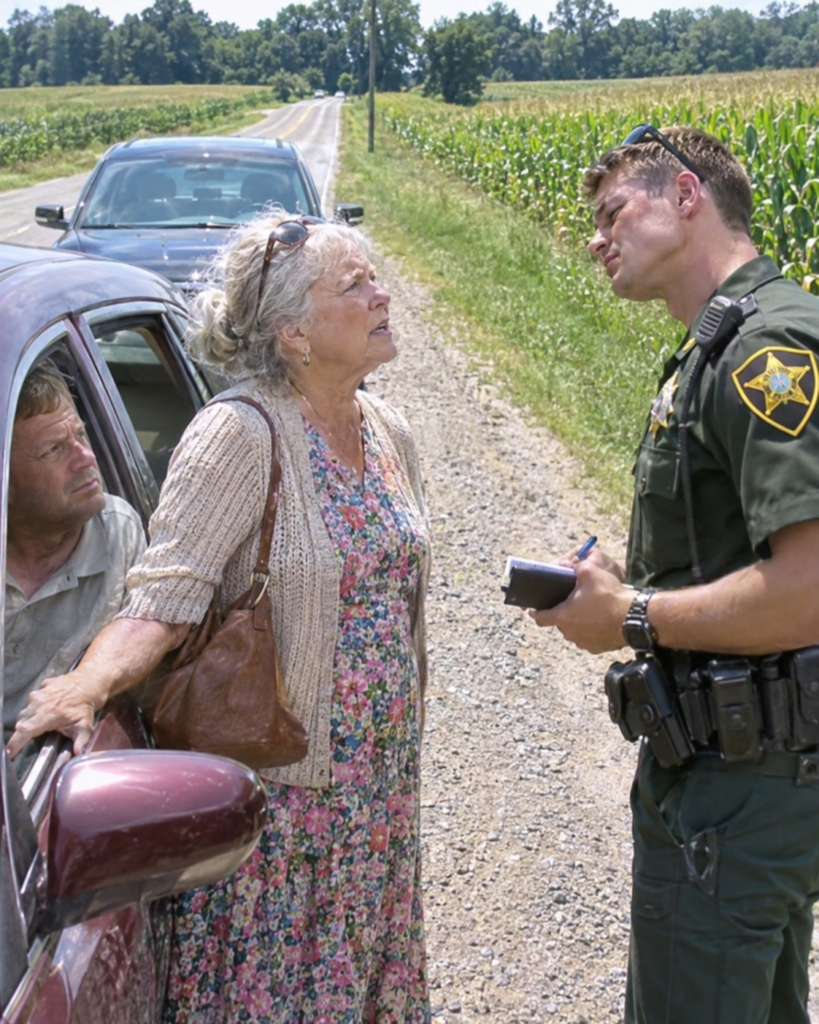
A deputy pulled my 71-year-old mother over on County Road 6, stood her on the shoulder in the August sun for forty minutes, and laughed that her license looked homemade.
So she asked him, very politely, to press the button on his radio and say her name.
It was ninety-one degrees.
No shade for a mile.
Corn on both sides, tall as a hallway.
I was in the passenger seat with a pan of lemon bars on my lap.
Mom drives forty-eight in a fifty-five.
Always has.
He walked up with his sunglasses on.
“License and insurance.”
No hello.
She handed him the yellow paper the courthouse gives you.
Her new card hadn’t come in the mail yet.
He held it up to the sun with two fingers.
“Did you print this at the library, hon?”
Then he laughed.
A small laugh, through his nose.
“Step out of the vehicle, ma’am.”
She stepped out.
Flowered dress. Handbag on her arm.
“Stand at the back where I can see you.”
I said she was seventy-one.
He bent down to my window.
“Sir, you stay in that seat.”
“Sit still, Jeffrey,” my mother said.
So I sat.
He went back to his truck.
Engine running. Windows up.
Ten minutes.
Twenty.
I watched her in the side mirror.
She never leaned on the car.
The trunk was too hot to touch.
At thirty minutes, she asked if she could wait inside.
“You can sit when I tell you,” he said.
The powdered sugar on the bars had melted clear.
Here is what I’m ashamed of.
My mother worked nights in the courthouse basement for thirty-four years.
I used to tell people she just answered phones.
I said it like an apology.
So I sat there thinking she was nobody to this kid.
An old woman with a paper license.
At forty minutes, he came back with his ticket book.
He said he was calling a tow truck too.
That’s when she spoke.
“Deputy, may I ask one thing first?”
“You can ask.”
“Would you press the button on your radio and say my name?”
“Only my name. Shirley Hagen.”
He grinned at me through the back window.
“You think you’re somebody?”
“No,” she said. “I don’t think that at all.”
I wanted to crawl under the dashboard.
He did it for the joke.
Thumb on the shoulder mic.
“Got a lady on a homemade license wants her name said on the air.”
“Says it’s Shirley Hagen.”
He laughed again.
Then the radio went quiet.
Not busy quiet.
The other kind.
A blackbird sat on the fence wire.
The corn moved.
Then a woman’s voice came back, careful and slow.
“Fourteen, say that name again.”
He rolled his eyes and reached for the button.
My mother leaned in toward his shoulder first.
Would you have stayed in that seat because she told you to, or gotten out of the car?
Part 2
My mother leaned toward the deputy’s shoulder before he could press the button again.
“That’s enough, son. Just listen.”
He frowned.
“Ma’am, step back.”
But the voice on the radio came again.
“Fourteen, this is Dispatch. Confirm the full name.”
He lifted the microphone.
“Shirley Hagen. That’s what she said.”
There was a pause.
Then the dispatcher spoke.
“Deputy, remove your sunglasses and look at the identification document again. You’re speaking to Shirley Ann Hagen?”
He glanced at my mother.
“That’s what the paper says.”
“Then you need to put your ticket book away immediately.”
His smile disappeared.
“Why?”
The dispatcher didn’t answer right away.
Instead, another voice came over the radio.
An older man’s voice.
“Fourteen, this is Sheriff Coleman. Do not move that woman another inch. Do you understand?”
The deputy straightened.
“Yes, sir.”
“Do you know who you’re standing in front of?”
He looked at my mother again.
She simply adjusted the strap of her handbag.
“No, sir.”
“Then perhaps you should ask the courthouse what happened to the woman who spent thirty-four years protecting that building and everyone working inside it.”
My stomach tightened.
The deputy swallowed.
The sheriff continued.
“Shirley Hagen was the senior court records administrator. She handled sealed judicial documents, evidence transfers, and emergency court orders. She trained half the clerks in this county. Three sheriffs served during her career. Every one of them knew her.”
The deputy’s face had gone pale.
My mother finally spoke.
“I retired six years ago, Sheriff. I believe the young man has simply forgotten his manners.”
There was a short silence.
Then Sheriff Coleman said something I’ll never forget.
“Shirley, I’m sorry. I’m sending someone to your location.”
The deputy lowered his radio.
“Ma’am, I didn’t know—”
My mother interrupted him.
“That’s precisely the problem.”
He stared at her.
She continued.
“You didn’t know who I was, so you decided I wasn’t worth treating with respect.”
I looked down at the lemon bars.
The powdered sugar had completely disappeared.
For thirty-four years, my mother had worked behind the scenes, making sure other people’s lives weren’t destroyed by missing documents, careless signatures, or people who thought their authority made them untouchable.
And I had spent most of my adult life describing her job as answering phones.
I suddenly felt ashamed.
A black SUV pulled onto the shoulder behind us.
The sheriff stepped out.
He was an older man with silver hair, and he walked straight toward my mother.
“Shirley.”
She smiled.
“Hello, Robert.”
He shook her hand, then looked at the deputy.
“Give me your badge and your report.”
The deputy hesitated.
“Sir, I was just checking a document.”
“No. You were humiliating an elderly woman because you thought she couldn’t do anything about it.”
Then the sheriff turned toward me.
“Are you Jeffrey?”
I nodded.
He glanced at the pan on my lap.
“Are those lemon bars?”
I almost laughed.
“Yes, sir.”
My mother sighed.
“They were supposed to be for the retirement luncheon.”
The sheriff looked at her.
“Whose retirement luncheon?”
She reached into her handbag and pulled out a folded invitation.
“Mine. The courthouse is celebrating the opening of the new records archive today.”
The sheriff smiled.
“Then I suppose we’d better get you there.”
But before we left, my mother asked him one question.
“Robert, did you ever find out what happened to the original evidence files from the old courthouse investigation?”
The sheriff’s expression changed.
He looked at her for a long moment.
“Why are you asking about those now?”
She glanced at the deputy, then back at him.
“Because I think someone should remind this young man that a uniform doesn’t make a person important.”
She paused.
“And a piece of paper doesn’t make a person legitimate. Sometimes, the truth is in the records.”
The sheriff slowly nodded.
“Then I think we need to talk.”
I had no idea what she meant.
Not yet.
But I was about to learn that my mother had kept something far more important than old courthouse paperwork.
Part 3 (The Ending)
We followed the sheriff to the courthouse.
The deputy stayed behind with another officer while an internal investigation was opened.
I carried the lemon bars.
My mother walked beside me, holding her handbag with both hands.
She didn’t look angry.
She didn’t look frightened.
She looked like a woman who had finally decided it was time to stop keeping a secret.
Inside the courthouse, the sheriff led us into a conference room.
Three judges were waiting.
So was the county attorney.
One of them stood immediately when he saw my mother.
“Shirley. We heard what happened.”
She waved her hand.
“Let’s not make a ceremony out of it.”
The sheriff closed the door.
Then he placed a thick folder on the table.
“Before we discuss today’s incident, I need to ask you something. Did you bring the original?”
My mother opened her handbag.
I expected to see her wallet or a tissue packet.
Instead, she pulled out a small sealed envelope.
It was old, yellowed at the edges, and marked with a handwritten date from thirty-four years earlier.
She placed it on the table.
The county attorney stared at it.
“Is that the original certification?”
My mother nodded.
I looked between them.
“Mom, what is going on?”
She finally turned toward me.
“Jeffrey, do you remember when I used to work late and you complained that I missed your school events?”
I nodded.
“I remember.”
“I wasn’t just filing papers. I was documenting evidence in a corruption investigation involving several county officials. Some of the people involved had powerful friends. I was instructed to preserve the original records because copies were disappearing.”
She touched the envelope.
“This was the final chain-of-custody certification. Without it, several cases would have collapsed.”
The sheriff leaned forward.
“Shirley refused to let those records disappear. She personally documented every transfer and secured the originals under the court’s retention rules.”
I stared at my mother.
“Why didn’t you ever tell me?”
She looked down.
“Because I wanted you to have a normal childhood. I didn’t want you growing up worrying about people who might come looking for those records.”
The county attorney carefully opened the envelope.
Inside was a signed certification, accompanied by a list of evidence transfers and official court references.
He read the first page.
Then the second.
His expression became serious.
“These records could resolve questions that have remained open for decades.”
My mother nodded.
“That’s why I kept them.”
I finally understood.
The woman that deputy had ordered to stand in the August heat wasn’t some helpless old lady carrying a suspicious piece of paper.
She was the person who had helped preserve the integrity of that courthouse for more than three decades.
And she had never once demanded recognition for it.
The sheriff looked at her.
“Shirley, the county board has already approved a formal recognition ceremony. We were going to announce your contribution this afternoon.”
She shook her head.
“I don’t need a plaque, Robert.”
“Then what do you want?”
She thought for a moment.
“I want the department to review how officers treat people who don’t look important. Elderly drivers. People waiting for replacement documents. People who are nervous, confused, or simply unable to afford an attorney.”
The room went quiet.
Then she added:
“And I want that deputy to understand that the next person he humiliates might not have a sheriff who knows their name.”
The county attorney nodded.
“We can make that part of the department’s training review.”
The sheriff agreed.
The deputy was subsequently placed under administrative investigation. The department reviewed the stop, the delay, and his conduct. He was required to undergo additional training, and the incident was formally documented.
My mother never asked for his job.
She never demanded an apology in public.
She simply wanted him to understand what his badge was supposed to represent.
Later that afternoon, we attended the retirement luncheon.
Someone had placed a small photograph of my mother on a table beside a framed certificate.
The sheriff stood up and introduced her.
He spoke about her thirty-four years of service, her attention to detail, and the countless people whose lives had been protected because she refused to take shortcuts.
Everyone applauded.
I sat in the back, looking at the woman who had raised me.
For years, whenever someone asked what my mother did, I said she worked in the courthouse.
Sometimes, I even said she answered phones.
That afternoon, I walked to the microphone.
I hadn’t planned to speak.
But I couldn’t sit there without saying something.
“My mother spent thirty-four years making sure people were treated fairly when they walked into that building,” I began.
“Today, I watched someone treat her as if she didn’t deserve the same respect.”
I looked directly at her.
“Mom, I’m sorry I spent so many years making your work sound smaller than it was. I thought you were just doing a job. I never understood how many people depended on you doing it right.”
Her eyes filled with tears.
Then she smiled.
“Jeffrey, I never needed you to be impressed by my job. I just needed you to be proud of me.”
I couldn’t speak for a moment.
After the luncheon, we finally brought the lemon bars home.
The powdered sugar was gone, and they had been sitting in a hot car for most of the afternoon.
My mother took one bite and laughed.
“Well, they’re not winning any baking awards.”
I laughed too.
Then I asked her something I’d wanted to ask since the traffic stop.
“Why didn’t you tell that deputy who you were right away?”
She looked out the passenger window.
“Because, sweetheart, if someone only treats you with respect after discovering your title, your money, or your connections, they haven’t learned respect at all.”
She turned toward me.
“Everyone deserves to be treated like a human being before anyone knows their name.”
I thought about that deputy standing beside his patrol car.
I thought about the radio going silent.
And I thought about my mother, standing alone in ninety-one-degree heat, refusing to beg someone for basic dignity.
Then I reached over and took her hand.
For thirty-four years, she had spent her life making sure the records told the truth.
That day, she taught me something no courthouse could ever put in a file.
A person’s worth is never determined by the piece of paper they carry, the car they drive, or the uniform they wear.
And sometimes, the quietest person on the side of the road is the one who understands justice better than everyone else.