PART 1 — The Wish He Chose
My twelve-year-old son devoted the single wish he received during cancer treatment to feeding three hundred strangers. Once the last dinner had been served, a man wearing a long black coat came toward our table. Noah’s face drained of color, and his hands closed around his backpack. Then the stranger asked if my son had told me the truth. Until that moment, I had believed I understood what this dinner meant to him. I knew he wanted people to eat well. I knew how carefully he had chosen everything. What I hadn’t understood was why he kept looking toward the door.
For weeks, the hospital room became the center of our lives. More tests brought more waiting, and I rarely wanted to leave his side. Sometimes he hardly touched the breakfast placed in front of him. On other mornings, he insisted on pancakes. I came to treasure those pancake mornings. Beside his bed, he kept a picture he had drawn of the ocean, although he had never seen it himself. Occasionally, he wanted to know whether waves truly made that much noise. I promised that someday we would find out together. It was a promise I wanted desperately to keep.
“Could I buy dinner for people?” The volunteer tipped her head. “What kind of dinner?” “For people who don’t have enough food.” He drew the blanket higher over his knees. “Not sandwiches in bags.” His eyes flicked toward the ocean again. “I mean a proper dinner.” He ran his fingers along the blue seam of his blanket, working out the picture in his head. “With tables and chairs.” Then a hopeful smile appeared. “And dessert.” I looked at my son, trying to reconcile the wish I had expected with the one he was describing.
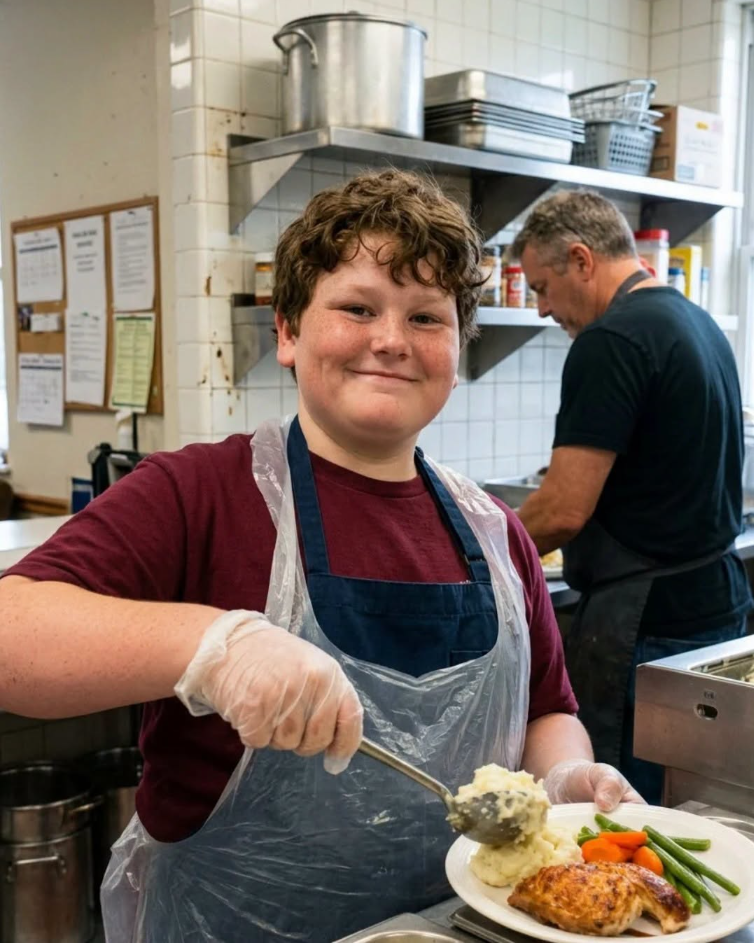
The volunteer later reached out to a local outreach program. Its community center had a dining hall big enough for the event, and the kitchen could provide meals over several sittings. With sufficient volunteers, the coordinator explained, three hundred guests was possible. Noah immediately seized on the number. “Three hundred dinners?” The coordinator nodded. “That’s our workable target.” “Then we need really good food.” Macaroni and cheese mattered to him, and chocolate cake was essential. For a change, our conversations revolved around menus and guests instead of appointments and treatment. I welcomed every minute of it.
Still, there was one thing I couldn’t explain. Noah kept checking his backpack, where he had tucked a small keepsake box. Whenever I came near enough to see inside, he pulled the zipper shut. “What are you hiding?” I asked him. “Nothing.” “Then why the secret?” His grin arrived quickly. “Maybe I’m planning your birthday.” “My birthday’s six months away.” “Exactly! I’m organized.” He made me laugh, as he had intended. But the backpack remained closed. Whatever was inside that box, he wasn’t ready to show it to me, and the birthday joke did nothing to change that.
Noah came home between appointments while the preparations continued over several weeks. The adults took responsibility for cooking arrangements and food safety. My son concentrated on the choices that were his to make, including the napkins. He insisted on yellow. “White looks like hospital paper,” he explained. I understood immediately. During one visit to the community center, the kitchen manager called me over to sign allergy paperwork. I followed her toward the serving counter, leaving Noah with the coordinator. His backpack stood between his shoes. While the manager explained the forms, I glanced across the dining hall toward him.
Noah had taken something from the little box and was showing it to the coordinator. She listened closely, then opened her folder. They were too far away for me to hear a word. The manager drew my attention back to the last signature line, and I finished signing. By the time I returned, Noah was closing his backpack. The coordinator slipped a note beneath her clipboard. “What did I miss?” I asked. Noah shifted the strap. “Napkin business.” The coordinator smiled. “Highly confidential napkin business.” I looked from one to the other, but neither explained. I assumed they were arranging another surprise for the dinner.
On the drive home, however, Noah was quieter than usual. He kept the backpack in his arms instead of setting it aside. When we reached our driveway, I touched his shoulder. “You seem quiet.” “Just tired.” His grip tightened around the bag. For a moment, I thought he might tell me what had happened with the coordinator, but he looked toward the house instead. “Can we get pizza?” I wanted to ask again. Yet treatment had already taken so many decisions away from him that I hesitated to take this small piece of privacy too.
“Only if you order something besides plain cheese.” He gave me a weary smile. “Absolutely not.” I ordered the pizza he wanted. He managed two slices on the couch and fell asleep before the movie finished, still holding the backpack beneath his arm. Whatever he had shown the coordinator remained with him. I let him sleep. His tiredness wasn’t unusual, and neither was my worry, but the sight of that bag tucked so firmly against him stayed in my mind. It had become part of the dinner preparations that he wouldn’t let me share.
At his next appointment, the doctors approved a carefully controlled visit to the event. Noah would need to stay away from crowded serving areas, leave the hot food to others, and go home when he became tired. He listened through the instructions without interrupting. Then he lifted his hand. “Can I still distribute napkins?” The nurse smiled. “With the precautions we’ve discussed.” “Excellent.” He turned toward me with the satisfaction of someone whose most important responsibility had survived the discussion. “Official napkin manager.” I laughed. He had found his job, even within all the restrictions.
Later, I caught him studying a folded scrap of paper on his blanket. It looked old, with a faint brown mark on one corner. As soon as he noticed me, he put it away. “What’s that?” “Just something I kept.” “From where?” He paused before answering. “A long time ago.” Before I could ask anything else, his phone rang. He picked it up immediately. “Hi, Daniel.” I stopped near the doorway. The name meant nothing to me. Noah lowered his voice, and I moved into the kitchen, telling myself that he deserved some room to have a conversation without me listening.
I wasn’t trying to overhear him. I had stepped away because I wanted him to have that privacy, even with the questions already gathering in my mind. Then one sentence carried clearly enough from the other room to make my hand stop against the counter. It wasn’t the name Daniel that held me still now. It was the request my son made to someone I had never met, about something he had taken such care to keep hidden. “Please don’t tell my mom yet.”
PART 2 — The Man at the Door
I remained by the kitchen counter, waiting. From the other room, Noah continued the conversation in his lowered voice. “I want to do it myself.” A nervous laugh followed. “Yeah, I know.” When he hung up, I went back to him. “Who’s Daniel?” “A guy from the outreach program.” “Why haven’t I met him?” He rubbed his forehead. “You might.” It wasn’t much of an explanation. Between the box, the old piece of paper, and this unfamiliar man, I now knew there was something about the dinner Noah had deliberately kept from me.
I sat beside him and took his hand. Whatever he wasn’t telling me, I could see he was tired. “We can change things if you’re tired, honey.” He immediately shook his head. “Don’t cancel it, Mom.” “I wasn’t going to.” “Promise?” “I promise.” His shoulders eased back into the pillow. The dinner mattered enough to frighten him at the thought of losing it. I had wanted to reassure him, and I had, but I still had no idea who Daniel was beyond the few words Noah had offered. My son wasn’t ready to give me more.
On the morning of the event, Noah woke early after hardly sleeping. I hadn’t slept much either. He pulled on his favorite blue sweatshirt, then went through his backpack three separate times. “Do you have everything?” I asked. “Probably.” “Water bottle?” “Yes.” “Mask?” “Yes, Mom.” “Your secret collection of stolen hospital socks?” That earned me a grin. “That’s in another bag.” I kissed his forehead, and he allowed it. Underneath the ordinary exchange, I could see how much he wanted the day to go well. Soon we were on our way to the community center.
Volunteers were already setting out the tables when we arrived. Roasted chicken and warm bread scented the kitchen, and large trays stood ready behind the serving counter. Noah paused just inside the doorway, counting the tables arranged for the guests. “All this?” The coordinator smiled at him. “All this.” He took in the room before looking back toward the entrance. Then he checked his phone. I noticed both movements. I had noticed too much lately not to. But I said nothing. There would be time to ask questions; for now, people were preparing to make his wish happen.
The first guests soon began arriving. A man stopped to inspect the desserts with obvious interest. “Chocolate cake?!” Noah nodded, proud of that particular decision. “That was my idea.” “Good decision, kid.” My son laughed. After weeks of talking about the meal, he could finally see people walking in to eat it. He helped arrange napkins at a separate station while I remained nearby. The coordinator watched his breaks, and whenever the dining hall became crowded, we moved aside. He wasn’t allowed to do everything he wanted, but he could still welcome people in his own way.
Naturally, Noah objected whenever it was time to sit down. Then someone gave him a piece of cake, and the break became more acceptable. “Quality control,” he explained. I rolled my eyes. “Very important work.” He ate half before asking about the next group of guests. His interest kept moving back toward the dinner, even while his body needed rest. I stayed close, grateful that the coordinator was helping me watch his limits. He had waited weeks for this afternoon, and I wanted him to enjoy it without pushing himself beyond what the doctors had approved.
Throughout the afternoon, he continued glancing toward the entrance. It wasn’t constant, but it happened often enough that I couldn’t dismiss it. “Expecting somebody?” I asked. He shook his head, then gave me a different answer. “Maybe.” “That’s not an answer.” “It’s the best one I’ve got, Mom.” I let the subject drop. The phone call returned to my mind, along with the note the coordinator had hidden beneath her clipboard. Whatever Noah was waiting for, he still wanted to handle it himself. Meanwhile, guests kept arriving, and the kitchen volunteers continued their steady work.
An older woman thanked him for the napkins. Noah straightened them into another careful stack. “They’re just napkins.” She smiled at him. “They’re useful, son.” He handed her one more. “Then take two.” It was such a small exchange, but I watched his face as he offered it. He had asked for tables and chairs, a proper dinner, and dessert. Here were the people he had imagined, accepting the things he had been able to give them. His job might have looked minor beside the work in the kitchen, but he was determined to do it properly.
By late afternoon, exhaustion had caught up with him. He sat beside me with the backpack pressed against his knees, rubbing his fingers along its zipper. The coordinator came over carrying her clipboard. “We’ve served 300 guests.” Noah lifted his head. “Exactly?” “Three hundred served.” His smile was so wide that I nearly cried. He leaned against my shoulder. “Did we do good, Mom?” “We did wonderful, sweetheart.” Then he yawned. “Can I have more cake?” “After some water.” He groaned. “You’re impossible.” I gave him the bottle, and he drank before turning his attention toward the entrance once more.
This time, his fingers stopped moving on the zipper. A man had entered wearing a dark suit beneath a long black coat. He searched the room until he saw Noah, then walked toward our table. My son went pale and tightened his hold on the backpack. “Clarice?” the man asked. I stood. “Yes?” “I’m Daniel.” I looked down at Noah before turning back to the stranger. “Is everything okay?” Daniel lifted both hands. “Yes. Noah isn’t in trouble.” I didn’t sit. He glanced at my son, then faced me again. “He hasn’t told you the truth, has he?”
I pulled out the chair beside Noah. “What truth?” “Noah asked the coordinator not to tell you.” I turned to my son. “When did you speak with her?” He rubbed the zipper again, keeping his eyes on his hands. “During that planning visit.” He paused. “You were meeting the kitchen manager.” The memory came back clearly: Noah opening the little box, the coordinator listening, the note slipping out of sight just before I returned. I had believed they were arranging a harmless surprise. Now the man from the phone call was standing in front of me, waiting for Noah to explain.
Daniel looked at him. “I’m sorry. That sounded worse than I intended.” He drew out a chair. “May I sit?” I nodded, and he settled across from us. His apology did little to answer the question he had raised, but he wasn’t treating Noah as though he had done anything wrong. My son still held the backpack close. After all those weeks of keeping it zipped whenever I came near, he finally had the person he had been waiting for beside him. I waited too, with my hand resting against the metal chair.
Daniel asked, “Do you remember a man who shared his sandwich?” The chair’s edge pressed into my palm. A memory rose so quickly that the dining hall seemed to fall away around it: a park bench on a cold afternoon, my little boy hungry beside me, and a stranger in a worn brown jacket. I hadn’t expected anyone in that room to know about that day. Certainly not the man sitting opposite me in a dark suit. I looked at him, searching for the connection. “Michael?” I whispered. Daniel nodded. “He was my brother.”
Noah began opening his backpack. The zipper snagged twice beneath his fingers before he managed to draw it back. He reached inside and brought out the little keepsake box I had watched him protect for weeks. I understood now that the mystery wasn’t simply part of planning the dinner, but I still couldn’t see how my son had carried that afternoon into this room. Daniel sat across from us. The meal was over. Three hundred people had been served. And Noah was finally preparing to show me the thing he had refused to let me see.
“Mom, there’s something I never told you.” He opened the box. Inside was a folded paper napkin protected by a clear plastic sleeve. Its edges had turned yellow, and a faint brown stain marked one corner. It was the old piece of paper I had seen on his blanket, the thing he had tucked away before answering Daniel’s call. Now he held it where I could see it properly. “Remember the park, Mom?” I looked from him to Daniel, then back at the napkin. “Of course.” But I didn’t yet know why my son had kept it for four years.
PART 3 — What Half a Sandwich Could Become
Four years earlier, keeping up with the rent had been difficult enough. That afternoon, I had packed the last sandwich for Noah because there wasn’t enough bread to make another one for myself. I told him I had already eaten. He was eight, and I believed he had accepted the explanation. We were sitting on a park bench when a stranger came toward us in a worn brown jacket. He offered to share half his sandwich. I refused. Even now, sitting across from his brother, I could remember refusing something I had needed.
The stranger set the food between us anyway. “My name’s Michael,” he said. He pointed toward the road beyond the park. “I volunteer at the outreach center across town.” Then he looked at my empty hands. “I know what hunger looks like.” He pushed the sandwich a little closer. “There’s enough.” Eventually, I ate it. I had remembered the food and the relief of accepting it, along with the man who had made it possible. What I hadn’t known was that Noah had taken something away from that bench too, something he could hold on to.
My son carefully lifted the clear sleeve from the keepsake box. “Michael wrapped the sandwich in this.” I stared at the folded napkin. “You kept it?” He nodded. “I knew you hadn’t eaten, Mom.” I took the sleeve between my fingers. For four years, I had believed that part of the afternoon belonged only to me: the small lie about having eaten, the effort to make sure he had enough. “Why didn’t you say anything?” Noah’s answer was quiet and direct. “You looked sad enough already.”
I pulled him against me, and he leaned into the embrace. He had been eight years old, hungry himself, and he had still noticed what I thought I had hidden. Then he whispered, “That’s why I picked the dinner.” I closed my eyes. For weeks, I had tried to understand why he had passed over the ocean and every experience he might have chosen for himself. He had already given me his answer in the hospital: he wanted to do something for somebody else. Only now did I understand which act of kindness he had been remembering.
Noah had kept that afternoon with him for four years without telling me. The napkin had stayed in its sleeve, then inside the little box he carried in his backpack. While I watched him choose yellow napkins and insist on dessert, he had been thinking about a man who once shared his lunch with us. Across the table, Daniel folded his hands. “Michael was my older brother.” His attention moved across the dining hall. He had come to hear about a part of Michael’s life he hadn’t known, just as I was learning something about my son.
“He lost his apartment years ago.” Daniel rubbed his thumb over his knuckles. “For a while, he stayed in temporary housing.” I thought of the brown jacket Michael had worn when he approached our bench. I had known nothing about where he lived or what he had been going through. He had seen that I was hungry and offered me food. Daniel continued, “Eventually, he found somewhere permanent.” He nodded toward the serving counter. “But he’d volunteered here before losing his home.” His fingers touched the edge of the table. “Afterward, he kept coming back.”
Noah lifted his head. “That’s where they remembered him.” Daniel nodded. “The coordinator contacted me after Noah asked about Michael.” At last, the conversation I had seen from across the dining hall made sense. Noah hadn’t been showing her a birthday plan or discussing a surprise for the meal. He had brought the napkin and asked about the man who had wrapped a sandwich in it. The coordinator had listened, then taken the steps that eventually brought Daniel to our table. My son had been trying to find a connection to Michael while keeping that search from me.
“She arranged a video call between us,” Daniel explained. He rested his hands on his knees. “Noah told me about his wish.” My son rubbed his eyes. “I asked her to find you.” I remembered hearing the unfamiliar name over the phone and stopping beside the doorway. Daniel was no longer just someone from the outreach program. He was Michael’s brother, the person the coordinator had found when Noah asked for help. What had sounded so secretive from the kitchen was part of something my son wanted to tell me himself.
Daniel pressed his fingers against something in his coat pocket. “Michael died last year.” I lowered my eyes. “I’m sorry.” He looked toward the napkin. “I never knew about that sandwich.” There was something I had never told Noah either, something that came back as I held the clear sleeve. “I went back,” I admitted. Noah frowned. “Where?” “To the park.” I smoothed the sleeve against the tabletop. “The next day, I packed Michael lunch.” Daniel leaned closer as I spoke. Until then, neither of them had known that I had tried to find him again.
“I waited beside that same bench,” I recalled. My finger traced the napkin’s yellowed edge through the plastic. “But he never came.” I looked at Noah. “I tried again the following afternoon.” The bench had remained empty that day too. I had taken lunch back to the place where Michael fed me, hoping to offer him something in return, but I never saw him there again. Noah stared at me. “You remembered him too?” “Every time I packed your school lunch.” He wiped his cheek against the sleeve of his blue sweatshirt.
“I thought you’d forgotten.” I shook my head. “Not for a single day.” We had carried the same memory without knowing that the other still held it. Noah had kept the napkin; I had remembered Michael whenever I made my son’s lunch. There had been so many meals between that park bench and this dining hall, yet neither of us had spoken about what happened. Now the old napkin lay on the table between us, and three hundred dinners had been served because my son hadn’t forgotten the half sandwich someone shared when we needed it.
Daniel looked down at his hands, then reached into his coat pocket. He took out a handwritten recipe card. “Michael used this when he volunteered.” The pencil marks were dark and uneven. He passed the card to Noah. “He liked making sandwiches for people.” My son examined the ingredients, giving them the same seriousness he had brought to choosing the dinner menu. “Does this have mustard?” Daniel laughed. “Michael hated mustard.” Noah approved immediately. “Good. He had excellent taste.” After everything Daniel had just told us, the familiar sound of my son making a joke was welcome.
“I think he would’ve loved today’s dinner,” Daniel said. Noah looked at the empty cake plate in front of him. “Even the dessert?” “Especially that.” The dinner had started with a wish made in a hospital room, but its beginning went further back than I had understood. Michael hadn’t known that my eight-year-old was watching so closely. I hadn’t known that Noah would preserve a napkin or remember the feeling of being offered food. Daniel hadn’t known about the sandwich at all. By the end of the afternoon, we had finally told one another.
A few weeks later, Noah had another hospital appointment. We came home tired, and that afternoon he asked for sandwiches. We tried Michael’s recipe together. Noah took issue with the bread. “Too chewy.” “Then stop eating it.” “I’m evaluating it, Mom.” He took another bite. The recipe card had given us something of Michael’s to use, rather than only a memory to revisit. My son’s evaluation didn’t stop him from eating. While he worked through his sandwich, I packed an extra one in a separate container. He watched me put the lid on it.
“Who’s that for?” “The outreach program, if they’ll accept it.” I placed the container in the refrigerator. “We’ll check their donation rules first.” Noah nodded, then looked toward the sandwich I had set aside. “Michael only gave us half.” I put the container beside his lunch. “It was enough that day, sweetheart.” He considered that before pushing his empty plate toward me. “Speaking of enough, can I have another?” I reached for the bread. “Of course.” There was no need for him to pretend he wasn’t hungry, and no reason for me to put the bread away yet.
As I made his next sandwich, the extra container remained beside his lunch in the refrigerator. We still had to find out whether the outreach program could accept it. I couldn’t promise that our way of sharing food would look exactly like Michael’s, or like the dinner Noah had wished for. “We can ask what they need.” My son had started with a memory I thought he had forgotten and turned it into three hundred meals. Now, with Michael’s recipe in our kitchen, he was already asking about what might come after this afternoon. “Can we make more next time?”