PART 2
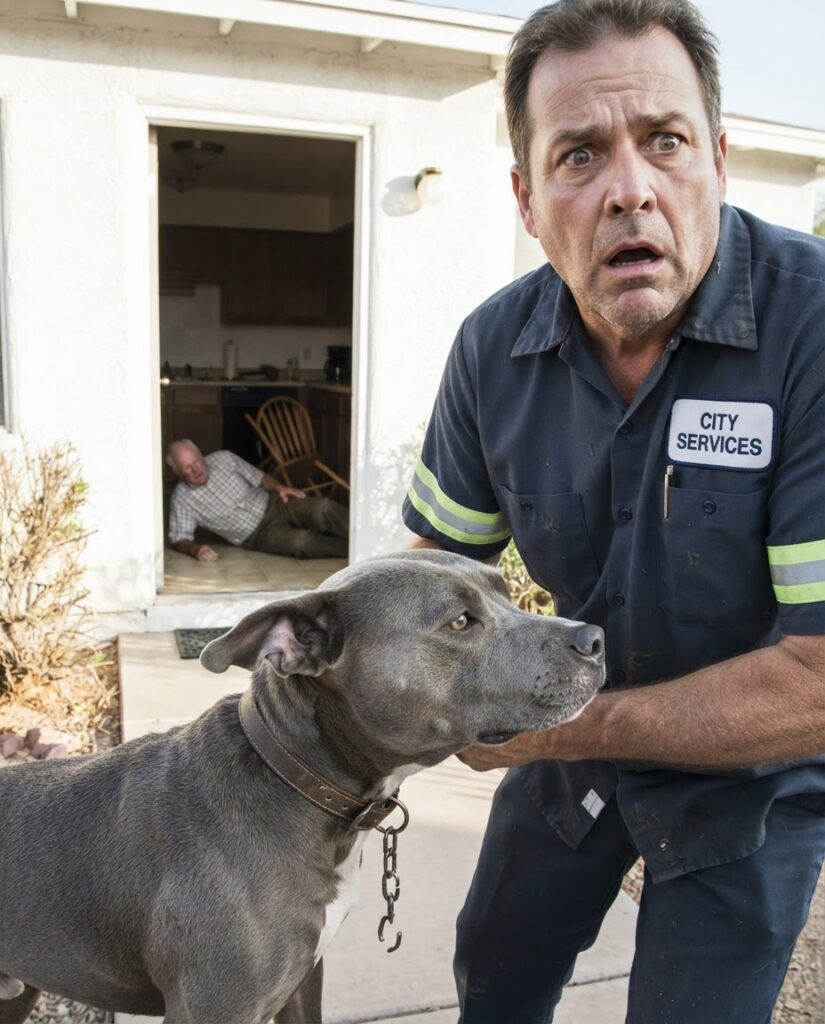
I dropped to my knees next to him.
“Sir? Sir, can you hear me?” His skin was burning hot and dry. His lips were cracked. But when I put my fingers on his neck, I felt a pulse. Weak. But there.
He opened his eyes a tiny bit.
“Water,” he whispered.
I called 911. Then I ran to my truck, grabbed my ice-water jug, and soaked a dish towel. I put it on his forehead and held a cup to his lips.
Odin lay down next to him and put his head on the old man’s chest.
The paramedics arrived in seven minutes. They said his body temperature was 106. Heat stroke. They said he’d probably fallen two or three days earlier. He couldn’t reach his phone. His air conditioner had broken. Nobody had come.
Except his dog.
“That dog broke a steel chain,” one of the paramedics said, shaking his head. “That’s not easy. He must have been pulling on it for days.”
At the hospital, they told me the old man’s name was Wilhelm Brantley. He was eighty-seven. A widower. No children.
He’d been in the hospital for two days when I went to visit him on my lunch break.
He was sitting up in bed. When he saw me, he squinted.
“You’re the garbage man.”
“Yes, sir.”
“You’re the one who left water for my dog.”
“Yes, sir. I’m sorry I stopped.”
He shook his head.
“I watched you through the window every morning,” he said. “I couldn’t walk out there anymore. My legs are too bad. I couldn’t bend down to fill his bowl. My neighbor used to help, but she moved away in June.”
His eyes filled with tears.
“I was ashamed. I didn’t want anyone to know I couldn’t take care of him. So I just hid inside and watched you do it.”
I didn’t know what to say.
“Then you stopped coming,” he said. “And Odin just sat there every morning, waiting for you.”
When I got back to work that afternoon, Lennon was waiting at my truck with his arms crossed.
“Cyril, you stopped on Palo Verde for forty-five minutes this morning. You’re done.”
Before I could say anything, his phone rang.
It was the city sanitation director. The paramedics had told the local news. The news had called the city.
Lennon listened for a long time. His face turned red.
When he hung up, he didn’t look at me.
“The director wants to give you an award,” he mumbled. “And she wants me to apologize.”
He did. Not very well. But he did.
Mr. Brantley spent nine days in the hospital. When he was ready to go home, he called me.
“Cyril, I can’t take care of Odin anymore. I’m moving to an assisted living place. They don’t allow big dogs.”
He paused.
“Would you take him? He already loves you.”
Odin lives with me now. He sleeps on my couch. He has his own water bowl in every room of the house.
Every Sunday, I take him to visit Mr. Brantley. As soon as we walk through the door, Odin runs straight to him and puts his head in his lap.
And the city made a new rule for all its sanitation drivers. If you see an animal or a person in danger on your route, you stop. As long as it takes.
They call it the Odin Rule.
THE END.