Bobbie Kane has poured coffee at the Harbor Diner in Oceanside for twenty-two years. For nine of those years, she watched an elderly Marine keep a place for someone who never came. This is the story of two cups, a photograph she had never seen, and a promise made fifty-six years earlier.
Two Coffees, Booth 4
For nine years in a row, an elderly Marine walked into my diner every Veterans Day, ordered two cups of coffee, and left one untouched on the opposite side of the table. I always paid his bill. This year, he didn’t come. Instead, a young Marine in dress blues walked in and handed me an envelope.
“He said you’d want to know who the second coffee was for.”
My name is Roberta Kane, though most people call me Bobbie. I’m fifty-eight, and I’ve worked at the Harbor Diner in Oceanside, California, for twenty-two years. Oceanside is a Marine Corps town. Camp Pendleton is a short drive away, and seeing Marines in uniform here is as ordinary as seeing fishermen carrying in their morning catch.
Nine years ago, on November 11th, an elderly gentleman came through our doors at precisely seven in the morning and settled into Booth 4. He had a gray crew cut, a Marine Corps baseball cap, and a Vietnam service ribbon on his jacket.
“Two coffees, please, ma’am. Black.”
I brought them over. He slid one cup toward the empty seat across from him and never touched it. For three hours he stayed in that booth, gazing through the window, now and then taking a slow sip from his own cup. When he finally stood to leave, his hands were trembling. I told him his coffee was on the house. “Thank you for your service, sir.”
He studied my name tag for several seconds. “Thank you, Roberta.” Then he walked out.
He came back the next Veterans Day, and the next. Every November 11th, without exception, he took the same booth and ordered the same two coffees: one for himself, one for someone who never arrived. His name was Cyrus Lambert. That was all he ever told me about himself. Every year I sat across from him for a few minutes, and every year I covered his bill.
My father served in the Marines too. He died in Vietnam when I was three months old. I never knew his voice, his favorite food, or what made him laugh. All I had was one photograph of him in uniform, holding me in a hospital blanket. Maybe that’s why I never minded sitting with Mr. Lambert. Watching him quietly keep a place for someone who wasn’t there made me feel closer to the father I’d never known.
Chad
Last spring, the diner’s owner retired, and his son, Chad, took over. Chad was thirty-one, wore a headset around his neck, and couldn’t discuss anything without mentioning “table turnover.”
On Veterans Day morning, I set up Booth 4 as always: two cups, one coffee pot. Chad noticed. “Who’s that for?”
“Mr. Lambert. He comes every year.”
“The old guy who sits for three hours and orders two coffees? I heard about him.” He rolled his eyes. “Three hours. One booth. Zero tip. That’s a cheapskate, Bobbie, not a customer.”
“I pay his bill.”
“That’s the problem.” He folded his arms. “This is a restaurant, not a museum for old soldiers. If he comes in, he orders food or he leaves. And you’re not paying for anybody. That comes out of your paycheck from now on.”
I didn’t argue. I’d worked under plenty of managers, and most didn’t last. I poured the coffee and waited. Seven o’clock passed, then seven-thirty, then eight. Mr. Lambert didn’t appear.
The Young Marine
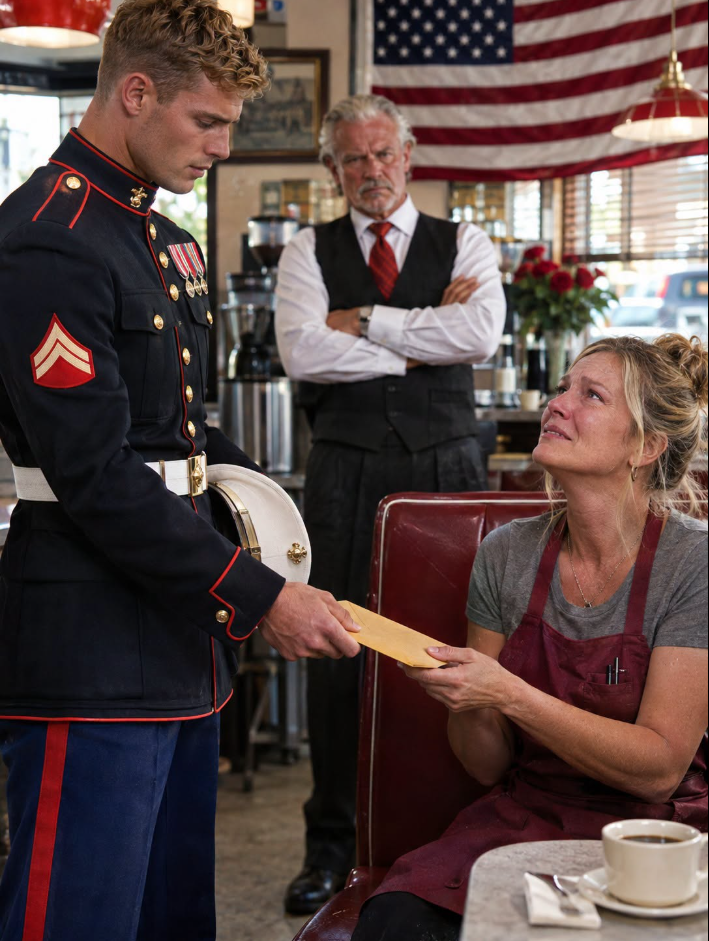
At 8:15, the bell above the door rang. A tall young man in Marine Corps dress blues stepped in, his white cover tucked under one arm, every button gleaming. The whole diner went quiet. He scanned the room until he found my name tag and walked straight to me.
“Ma’am, are you Roberta Kane?”
“Yes.”
“I’m Corporal Devin Lambert. Cyrus Lambert was my grandfather.”
Was.
“He passed away in September,” he said softly. “He made me promise to come here today, in uniform, and give you this.” He held out a thick, worn envelope with my name on it in shaky handwriting.
Chad came over with his practiced manager’s smile. “Sir, we have a fifteen-minute booth limit during the holiday rush.”
The young Marine didn’t even turn. “Ma’am, my grandfather told me something before he died.” He looked straight into my eyes. “He said you’d want to know who the second coffee was for.”
For nine years I had watched that untouched cup sit across from Mr. Lambert, wondering who he was waiting for. My fingers trembled as I opened the envelope. Inside were a handwritten letter, an old photograph, and a folded document bearing the seal of the United States Marine Corps.
I looked at the photograph first, and my knees nearly gave way. Two young Marines stood side by side outside a military tent. One was Cyrus Lambert. The other was my father.
I had studied his face in a single hospital photograph for fifty-five years. This time he wasn’t holding a baby. He was laughing, his arm draped over Cyrus’s shoulder, both men impossibly young.
“Where did he get this?” I whispered.
Devin pulled out a chair for me. “He kept it in a small wooden box in his bedroom, with his medals. He said it was the most important photograph he owned.”
Chad had stopped smiling. For the first time since taking over, he seemed to sense that something important was happening.
The Letter
I unfolded the letter. The handwriting was uneven but unmistakably deliberate.
Dear Roberta,
If Devin has kept his promise, then I’m no longer there to order my two coffees. I’m sorry I couldn’t come this year.
There are things I’ve carried for more than fifty years, and I should have told you sooner.
Your father, Daniel Kane, was my closest friend in Vietnam.
I stopped. Daniel. I had heard that name countless times from my mother, but in Cyrus’s handwriting it felt different.
We met during our first months overseas. He was younger than I was, always smiling, always talking about the little girl he was going to meet when he came home. He showed me your photograph before you were even born. He carried it everywhere. He called you his little miracle.
Tears ran down my cheeks. My father had known about me. I’d spent my life wondering whether he had thought of me at all, and here he had carried a picture of me before I had ever opened my eyes.
On November 11th, fifty-six years ago, your father and I made a promise. We would come home, meet our families, and sit together for coffee every Veterans Day. Two coffees. No matter where life took us. We joked that we’d be old men someday, complaining about our knees and drinking terrible coffee.
I made it home. Daniel didn’t.
My hand covered my mouth. The diner seemed to disappear. All I could see was that photograph: one young man who came home, and one who never got the chance.
After the telegram arrived, I wrote to your mother. I wanted to tell her everything, but she was grieving, and I didn’t know how to explain what happened. I never received a reply. Years passed. I married, raised a family, and became a grandfather. But I never forgot Daniel.
When I learned you had grown up in Oceanside and were working at the Harbor Diner, I finally found you.
I froze and read the sentence again. He had known who I was from the beginning.
I recognized your name the first morning I walked into that diner. I recognized your eyes, too. You have your father’s eyes.
For nine years this man had sat across from me, knowing whose daughter I was, and I never knew.
The second coffee was for Daniel. I know it sounds foolish to some people, an old man ordering coffee for someone who has been gone for decades. But every Veterans Day I wanted to keep the promise we made when we were young. I never drank his coffee because it wasn’t mine to drink.
I began sobbing, not quietly or politely, but the kind of crying that comes from a place that has waited more than half a century for an answer. Devin gently put a hand on my shoulder.
Roberta, your father didn’t die alone. I was there. I held his hand. His last thoughts were of you and your mother. He asked me to make sure you knew he loved you. He hoped you would grow up knowing he had wanted nothing more than to come home and hold you.
I couldn’t save him. But I could keep his memory alive.
Thank you for sitting with an old Marine every year. You never asked why I ordered two coffees. You never made me explain my silence. You simply let me remember my friend. For nine years you gave me a place where I could keep a promise.
Now, if you don’t mind, I’d like you to do one thing for me. Next Veterans Day, order two coffees. Sit in Booth 4. Tell your father whatever you’ve wanted to tell him all these years. And please don’t let his empty chair make you feel alone.
With gratitude,
Cyrus Lambert
The Story I Waited Fifty-Eight Years to Hear
I folded the letter carefully, my whole body shaking. Devin waited until I looked up. “He talked about you all the time, ma’am. He knew your birthday. He knew you’d worked here twenty-two years. He even knew you take your coffee with two sugars on the morning shift.”
“He remembered that?”
He smiled sadly. “He said you reminded him of your father. Not just your eyes. Your kindness. The way you treated people when you thought nobody was watching.”
I looked at the photograph again. “Did he ever talk about that last day?”
“He told me everything.” He sat across from me and told me the story I’d waited fifty-eight years to hear.
My father and Cyrus had been stationed together for several months, brothers in every way that mattered. They shared food, letters from home, photographs, and plans for the lives they’d build after returning. My father talked constantly about my mother: her laugh, the way she tucked her hair behind her ear, how she always worried about him. When he learned I was on the way, he became almost impossible to be around, not from unhappiness but from excitement. Cyrus teased him endlessly. My father once spent an entire evening trying to decide what toy to buy a daughter who hadn’t even been born.
“He wanted to be there for you,” Devin said. “He’d already picked out a name, and he carried your photograph in his uniform pocket. He told my grandfather he was having a daughter. He said he wanted to teach her to ride a bicycle, take her fishing, and walk her down the aisle someday.”
I closed my eyes. All those ordinary things other daughters take for granted, and my father had imagined them before he ever held me.
“Then what happened?”
Devin took a breath. “It was during a difficult operation. Things happened very fast. Your father helped get several men to safety before he was fatally wounded. He was still conscious when my grandfather reached him. He asked him to take care of the photograph, and to tell you he loved you.”
I gripped the edge of the table. “Did he say anything else?”
“He said, ‘Tell my little girl that I was coming home.’”
Neither of us spoke. I covered my face. For fifty-eight years I had thought of my father as a photograph, a name on a memorial, a story told in fragments. Now he was a young man with dreams, a man who’d worried about choosing the right toy, who had imagined teaching me to ride a bike. He had never met me, and somehow I had been one of the most important people in his world.
Across the diner, customers wiped their eyes. An elderly man by the window took off his cap. A young couple held hands. The cook had stepped out of the kitchen. Chad stood behind the counter, uncomfortable. At last he came over. “Bobbie, I…”
“No, Chad. You didn’t know.”
He glanced at the envelope, then at Devin. “Would you like me to bring something else for the Marine?”
“No, thank you, sir,” Devin said. “I’m here for my grandfather’s promise.”
Chad nodded. After a moment he looked at me. “Take the booth as long as you need.” It wasn’t an apology, but it was the first time I’d heard him speak without mentioning a fifteen-minute limit.
The Wooden Box
Devin reached into his uniform pocket. “My grandfather asked me to give you this separately.” He handed me a small wooden box, old, with worn corners and a brass latch. Inside were photographs, folded letters, several military medals, and at the bottom a small envelope addressed to my mother, Eleanor Kane.
“Did my mother know about all this?”
Devin hesitated. “My grandfather always believed he’d sent her a letter. He never knew why she didn’t answer.”
The paper had yellowed, but the writing was clear. Cyrus had written to my mother months after my father’s death, explaining that he’d been with Daniel at the end and promising to help in any way he could. But there was a second page: a letter my father had written before his final deployment and never mailed. At the top it read: For Eleanor and our little girl.
I had never seen my father’s handwriting. Not once in fifty-eight years. The first line read: My beautiful girls,
If you’re holding this letter, it means I haven’t made it home yet. I hope that’s not the case. I hope I’m sitting beside you, laughing about how worried I was while you were reading this.
Eleanor, thank you for loving me. Thank you for giving me a reason to look forward to tomorrow.
And to my little girl, I hope you grow up knowing that you were loved before the world ever had a chance to meet you.
I don’t know what kind of woman you’ll become. Maybe you’ll be brave. Maybe you’ll be stubborn. Maybe you’ll laugh too loudly and ask too many questions. I hope you do all those things.
I hope you never make yourself smaller to make someone else comfortable. I hope you stand up for what is right. And I hope you always remember that being kind is never a weakness.
If I could ask for one thing, it would be that you live a full life. Don’t spend it waiting for someone who isn’t coming home. Don’t let my absence become the center of your world.
Go to school. Fall in love. Make mistakes. Have children if you want them. Travel. Laugh. Dance. Grow old.
And whenever you see a Marine, remember that somewhere there is a family waiting for that person to come home.
I love you both more than I can ever explain.
Your husband and your father,
Daniel
I couldn’t read the last line through my tears. I had spent decades wondering what my father would have said to me if he’d lived. Now I knew. He would have told me to live: not to spend my life grieving, not to let an empty chair define me, but to make the most of the life he’d wanted so badly to share.
“Why didn’t your grandfather give me these sooner?” I asked.
Devin lowered his eyes. “He wanted to. But he was afraid of opening a wound you’d spent your whole life trying to close.”
“He could never have hurt me by telling me my father loved me.”
“I know that now. He knew it too. That’s why he finally asked me to come. He also said there was something to tell you about the coffee. Every year he imagined your father sitting across from him. But after he met you, the empty chair didn’t feel quite so empty anymore. He said you had unknowingly become part of their promise. Whenever you sat with him, it felt like Daniel had come home for a little while.”
I covered my mouth. For nine years I had thought I was doing something kind for a lonely old Marine. I hadn’t understood that he was giving me something too: nine years of knowing my father had been loved by someone who never forgot him.
I looked at the two coffees. One was untouched, the other gone cold. I pushed a fresh cup toward Devin. “Would you like some coffee?”
“Yes, ma’am. I’d like that.”
For the first time in nine years, two people sat in Booth 4, and I wasn’t looking at an empty chair. I was listening to someone who’d inherited the memories of the man who kept my father’s promise.
Booth 4
We sat nearly two hours. Devin told me about his grandfather’s last months: how Cyrus kept his old uniform pressed, spent afternoons looking through photographs, and still grew emotional whenever someone mentioned Vietnam. He’d been proud when Devin enlisted. “He said I was carrying on something that began long before I was born.”
“What did your grandfather think of Veterans Day?”
“He said it wasn’t a holiday about being thanked. It was a day to remember the people who didn’t come home, and the people who spent the rest of their lives remembering them.”
Before leaving, Devin straightened his uniform. “My grandfather wanted me to take a picture of Booth 4 today, as proof his promise was still being kept.” A customer offered to take it. Devin stood beside me holding the photograph of Cyrus and my father, the two cups on the table. The camera clicked.
I hugged him. “Tell your grandfather I finally understand.”
“I wish I could, ma’am.”
“Then tell him anyway.”
“I will.”
Back at the counter, Chad was waiting. “Bobbie, I owe you an apology. I thought I was looking at a customer who wasn’t spending enough. I didn’t understand what that booth meant.”
“Sometimes people come into a restaurant for more than food, Chad.”
“I understand that now. Would you mind if we made that booth available every Veterans Day? No time limit. Coffee on the house for any veteran who comes in.”
He seemed sincere. “That would be nice.”
A few weeks later a package arrived at the diner: a framed photograph of Cyrus and my father and a small brass plaque. BOOTH 4. IN HONOR OF CYRUS LAMBERT AND DANIEL KANE. TWO MARINES. ONE PROMISE. NINE YEARS OF REMEMBRANCE. LEST WE FORGET. Chad said to hang it right above the booth, and we did.
People began asking about the photograph. Veterans stopped to read the plaque. A retired Marine named Walter started coming every Wednesday and always sat in Booth 4. A young veteran named Michael began bringing his grandfather there whenever they visited. Sometimes they talked for hours, sometimes they drank their coffee in silence. Nobody rushed them, and nobody mentioned table turnover.
Eventually we started a Veterans Day tradition. Booth 4 is reserved for veterans and their families, and the first two coffees are free: one for the person sitting there, and one for someone they wish could still sit beside them. Some leave the second cup untouched. Others share it with family. A few just hold the cup between their hands. Nobody is asked to explain.
A Little Boy and a Photograph
The next Veterans Day, I arrived before sunrise with my father’s letter in my purse and the photograph in my hands. I set two fresh cups on the table and sat down. My father was smiling. Cyrus was smiling. They looked so young.
I ran my finger over my father’s face. “Happy Veterans Day, Dad. I finally know you wanted to come home. I know you loved me.” My eyes filled. “I hope I made you proud.”
The bell rang. A young woman came in holding the hand of a little boy, no more than six. “Excuse me, ma’am. Is this Booth 4?”
“Yes, sweetheart.”
She glanced at the photograph above the booth. “My husband served in the Marines. He passed away last year. My son has been asking if there’s somewhere he can go on Veterans Day to remember his father.”
The boy held a small folded photograph. “Would you like to sit with me?” I asked. She nodded, and I pulled out the chair beside me. The boy looked at the two cups. “Are those both yours?”
“No, honey. One is for me. The other is for someone I love.”
“Where is he?”
“He’s not here anymore. But I still remember him.”
He thought about that and climbed into the chair. “My daddy isn’t here either.”
“I know, sweetheart.”
He set his photograph on the table: a young Marine holding a baby in a blue blanket. His mother nodded. “That’s his father.”
“Your daddy must have loved you very much.”
“He said he’d always be my hero.”
“Then he always will be.”
I told him about Cyrus and Daniel, two friends who promised to meet every Veterans Day, and how even after one was gone, the other kept coming. The boy listened carefully, then looked at the empty chair. “Can we put Daddy’s picture there?”
“Of course.”
He set it in front of the untouched cup. And I understood why Cyrus had done what he did for nine years. It wasn’t because he believed his friend would walk through the door, or because he couldn’t accept that Daniel was gone. It was because love doesn’t always need someone physically present to keep its place. Sometimes remembering is the only way to keep a promise.
I lifted my coffee. “To the ones who came home, and to the ones who never got the chance.”
The little boy raised his hand, holding his mother’s fingers. “To Daddy.”
“To Daddy.”
For the first time, the second coffee didn’t feel like a symbol of loss. It felt like a promise that love can survive even the longest absence.
Every November 11th
Cyrus Lambert spent nine years ordering two coffees for a friend he never stopped missing. He thought he was keeping Daniel’s memory alive. But he gave a daughter the chance to know her father, a grandson the chance to understand his grandfather’s heart, and one ordinary booth in a California diner a purpose: a place where people can remember without being asked to explain their grief.
I still work at the Harbor Diner. Every November 11th I arrive before sunrise and prepare two coffees: one for me, and one for the man whose photograph I carried in my heart long before I knew his name. Sometimes I imagine Cyrus sitting across from my father again, both of them young, laughing about the terrible coffee and the promises they made.
Some people leave this world. But the love they leave behind keeps finding its way home. And every Veterans Day, at Booth 4, we save them a seat.