My younger brother Caleb slapped his knee and laughed. Across the Thanksgiving living room, my father stared at him, my mother went rigid, and my girlfriend Margot looked at me with an expression that said she’d heard enough.
Four years earlier, that exact accusation had cost me my family.
I set my coffee cup down.
“Because you put them there,” I said.
Caleb’s grin flickered.
“Come on, Dean. It’s ancient history.”
But there was nothing ancient about it to me.
I’m Dean Harlo, 32, an electrical contractor in North Carolina. Until that Thanksgiving, I hadn’t shared a room with my parents or Caleb in four years.
They had decided I was a liar, a drunk driver, and someone they no longer wanted as a son.
All because of my father’s Ford F-150.
Growing up, Dad believed showing up on time mattered more than talking about feelings. Mom kept the peace, even when somebody got hurt. Caleb, four years younger than me, could smile his way out of anything.
I was the one who fixed things and never made a fuss.
The night it happened, I was 28, finishing a long electrical job at a strip mall forty-five minutes outside town. I’d been rewiring a panel and didn’t get home until around eleven.
When I checked my phone, there were nine missed calls.
I called Mom first.
“How could you do this to your father?” she demanded before I could say hello.
Dad’s beloved truck had been found in a ditch off Route 9, passenger side smashed, airbags deployed. Caleb told them I’d borrowed it, driven after drinking, and lost control near a bridge.
He claimed he’d spent the evening at a friend’s house.
I drove straight to my parents’ kitchen.
Dad stood with his arms crossed. Mom sat at the table, mascara streaking her cheeks. Caleb was on the couch under a blanket, looking frightened.
“I wasn’t driving,” I said. “I was working.”
Dad didn’t ask where. He asked something else.
“Then why were my keys in your coat pocket?”
I reached inside the jacket I’d left hanging by their front door that morning. The spare truck keys were there.
I looked toward Caleb.
He stared at the floor.
“I don’t know how they got there. Call Greg Moyer, the general contractor. He’ll tell you I worked until ten-thirty.”
Dad shook his head.
“Caleb already told us everything.”
“He’s lying.”
Mom gasped as though I’d insulted her.
“Your brother was terrified, Dean. Why would he make that up?”
I looked at Caleb again.
“Cal. Tell them the truth.”
His eyes were red. He pulled the blanket tighter.
“I already did.”
Dad ordered me out. Mom didn’t intervene. Caleb never looked up.
They didn’t call my boss. They didn’t examine my timestamped work order. They didn’t ask for the gas station receipt from my drive home.
There was proof I was somewhere else.
They weren’t interested.
Within days, Dad was telling people at church I’d wrecked his truck while drinking and blamed my little brother. Mom stopped answering my calls. Caleb blocked my number.
I spent my first months afterward sleeping poorly, working constantly, and wondering how twenty-eight years of showing up for that family could disappear in one night.
Eventually, I earned my contractor’s license and opened Dean Harlo Electric. I hired employees. I made a life that didn’t depend on anyone believing me.
I kept one thing, though: a folder with my work order, receipt, and phone records.
Some nights I opened it just to remind myself the night had happened the way I remembered.
Then I met Margot, a nurse with a dry sense of humor and an unwillingness to let me pretend I was fine.
She knew the entire story. She never told me to forgive anyone.
My uncle Ray was the only relative who kept checking in.
Three weeks before Thanksgiving, he invited us to dinner at his ranch house overlooking a pond.
“Your parents will be here,” he warned. “Caleb too.”
I nearly refused.
But Margot sat across from me and waited. She would support either choice.
So I went.
Mom gave me a careful smile when I entered. Dad stood from his football game and nodded.
Four missing years reduced to one stiff gesture.
Caleb met me on the back deck, beer in hand.
“Big brother! Long time!”
He hugged me. I couldn’t hug him back.
Dinner was strained but civil. Ray kept conversation moving. Mom kept glancing at me. Dad complimented the turkey. Caleb kept drinking.
Afterward, with pie and coffee in the living room and football still playing on television, Caleb switched to whiskey.
He leaned toward Margot.
“Hey, has Dean ever told you about the time he wrecked Dad’s truck?”
Every conversation stopped.
“Come on, Cal,” Dad warned.
But Caleb was already enjoying his audience.
“He borrows the truck, right? He’s been drinking. Takes that curve on Route 9 too fast. Straight into the ditch! Airbags and everything!”
“Caleb,” I said.
“And the best part? He comes home and says he wasn’t even driving!”
He laughed and slapped his knee.
“Dude, we found the keys in your coat!”
That was when I set down my coffee.
“Because you put them there.”
Margot’s face hardened. Mom covered her mouth. Dad stopped watching me and looked directly at Caleb.
For the first time, my brother seemed unsure what to say.
“It’s ancient history,” he muttered. “I’m just—”
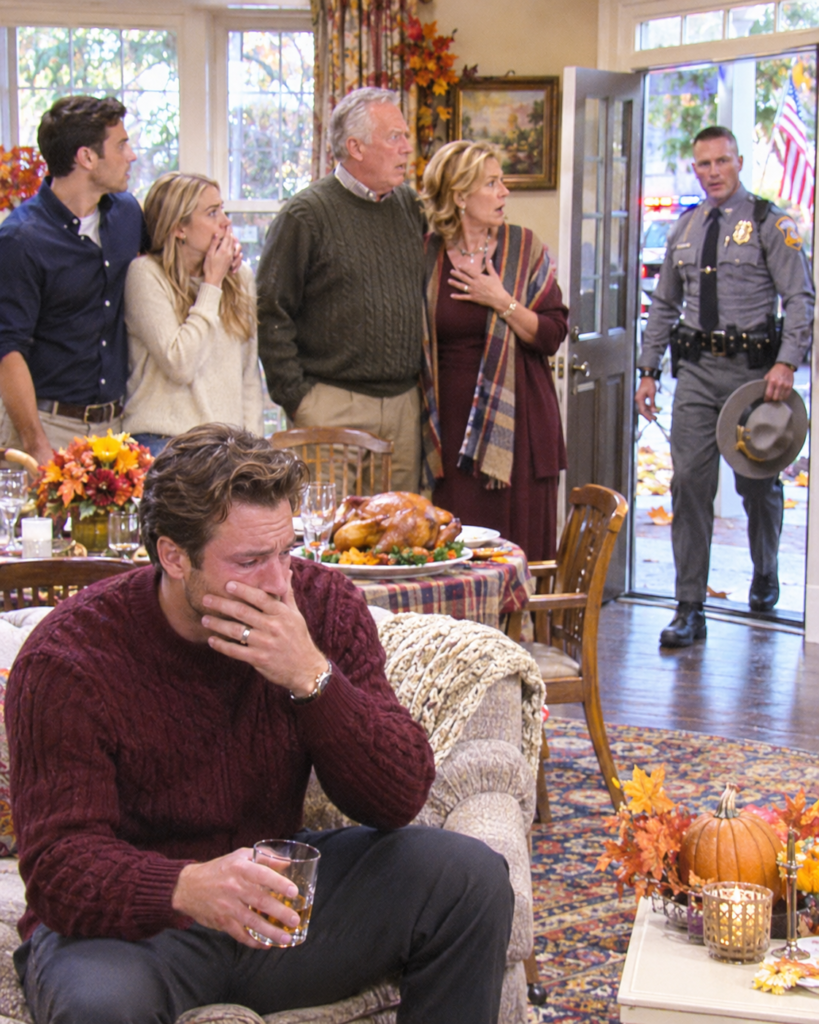
The doorbell rang.
Ray went to answer it. We heard low voices in the hallway, then footsteps coming toward us.
A uniformed man entered with a campaign hat under his arm.
“Sorry to interrupt your holiday. I’m Trooper Haynes with the North Carolina State Highway Patrol.”
His eyes moved around the room.
“I’m looking for the registered owner of a 2017 Ford F-150. North Carolina plate ending in 724.”
My father slowly stood.
“That’s me. But I sold that truck after the accident.”
The trooper nodded.
“Yes, sir. I’m here about that accident. We’ve recently obtained new evidence, and I have some questions.”
I turned toward Caleb.
His whiskey glass was still in his hand.
PART 2
For several seconds, nobody moved.
Trooper Haynes took a small notebook from his uniform pocket.
“Mr. Harlo, I’d like to speak with you about the accident involving your Ford F-150 on Route 9 four years ago.”
Dad frowned.
“I already gave a statement back then. My insurance handled everything. What’s changed?”
The trooper glanced at Caleb.
“Your insurance company isn’t the reason we’re here, sir. A vehicle recovery company recently contacted our department after discovering something unusual during an inventory of an impounded vehicle.”
Caleb lowered his whiskey glass.
“What vehicle?” Dad asked.
“A 2017 Ford F-150.”
Dad’s face tightened.
“That’s impossible. I sold that truck years ago.”
“Yes, sir. But before it was sold, several photographs were taken during its inspection. Those photographs were recently recovered from an old evidence archive.”
Trooper Haynes opened his notebook.
“One photograph shows a partial fingerprint on the passenger-side door handle. Another shows a distinctive scrape on the steering column.”
He paused.
“More importantly, the original accident report indicated that the driver’s airbag had blood residue on it. At the time, the department couldn’t identify the source because no one had reported an injury.”
Dad looked confused.
“Caleb told us Dean was driving.”
The trooper nodded slowly.
“That’s precisely why I wanted to revisit the case.”
Caleb shifted in his chair.
“I don’t understand what this has to do with me.”
Trooper Haynes looked directly at him.
“Mr. Caleb Harlo, were you driving that truck the night it crashed?”
The room went completely silent.
Caleb laughed nervously.
“What? No. Dean was driving. Everybody knows that.”
“Interesting.”
The trooper reached into his folder and removed a printed photograph.
“This is a picture taken by a homeowner who lived near the accident site. It was originally submitted as part of an unrelated property damage claim.”
He placed it on the coffee table.
The photograph showed Dad’s truck in the ditch.
But there was something else.
A man stood beside the driver’s door, holding his head. His face wasn’t perfectly clear, but his clothes were unmistakable.
A dark hoodie.
A pair of white sneakers.
And a silver watch.
I recognized the watch immediately.
It belonged to Caleb.
Mom leaned forward.
“That’s…”
She couldn’t finish.
Caleb grabbed the photograph.
“That could be anybody!”
“Please put that down,” the trooper said firmly.
Caleb dropped it.
Dad stared at the picture, then at his youngest son.
“Caleb, why were you wearing your watch that night?”
My brother’s jaw tightened.
“I don’t remember.”
I almost laughed.
Four years ago, I had begged them to listen to me.
Now the truth was sitting on their coffee table, and suddenly nobody wanted to speak.
Trooper Haynes turned toward me.
“Mr. Harlo, do you remember where you were that evening?”
I nodded.
“Working at the Westbrook Shopping Center. I was rewiring an electrical panel for Greg Moyer.”
“Do you still have documentation?”
I looked at Margot.
She reached for my hand.
“I have everything,” I answered.
I went to my truck and returned with the folder I’d carried for four years.
Inside were the original work order, the gas station receipt, phone records, and a signed statement from Greg.
I placed them in front of the trooper.
“These are copies. The originals are at my office.”
He examined them carefully.
“Your records are consistent with the timeline in our investigation.”
Dad picked up the work order.
His eyes moved across the page.
Then he stopped.
The date.
The time.
The signature.
He looked at me.
“You had this all along?”
I stared at him.
“I told you that night.”
Mom started crying.
“Dean, sweetheart…”
I pulled my hand away from the table.
“Don’t.”
She froze.
I had spent four years imagining this moment. I thought I’d scream. I thought I’d demand apologies. I thought seeing them finally understand would make me feel whole again.
Instead, I felt tired.
Trooper Haynes closed his notebook.
“We have additional evidence we need to verify, and I’d like everyone to avoid discussing the details of this investigation with one another until we’ve completed our interviews.”
He turned toward Caleb.
“I’d appreciate it if you came down to the station tomorrow morning.”
Caleb stood abruptly.
“This is ridiculous! You’re treating me like a criminal because of some blurry photograph?”
The trooper remained calm.
“I’m asking you to cooperate with an investigation. That’s all.”
Then Caleb made a mistake.
He looked at Dad and shouted:
“Why are you all acting like I killed somebody? I only crashed the stupid truck!”
Nobody breathed.
Dad’s face went white.
Mom covered her mouth.
And Trooper Haynes slowly raised his eyes.
“Thank you, Mr. Harlo. That’s an important statement.”
Caleb realized what he’d said.
“I mean… I didn’t…”
But it was too late.
For the first time in four years, my brother had stopped pretending.
And everyone in that room had heard him.
PART 3 — THE END
The next morning, my phone rang at 8:17.
It was Uncle Ray.
“Dean, your father wants to see you.”
I was standing in my office, reviewing invoices for a commercial electrical project.
“Why?”
“He hasn’t slept. Neither has your mother.”
I looked through the glass wall at my employees preparing for the day.
“That’s unfortunate.”
“Son, I know they hurt you. But they’re your parents.”
I closed my eyes.
“Ray, I spent four years trying to get them to believe me. They had one chance to ask questions, and they chose Caleb.”
Ray went quiet.
Then he said something I didn’t expect.
“Your father found something else last night.”
“What?”
“He went through Caleb’s old room. There’s a box under the bed.”
I felt my stomach tighten.
“What’s in it?”
“I think you should see it yourself.”
An hour later, I arrived at my parents’ house.
Dad opened the door.
He looked older than I remembered. His eyes were swollen, and his shoulders seemed to have lost their usual strength.
Mom sat at the kitchen table.
Neither of them knew how to greet me.
Dad placed a cardboard box on the table.
“Your mother found this while cleaning out Caleb’s old things.”
Inside were several old photographs, receipts, and a small envelope.
I recognized the handwriting on the envelope.
Caleb’s.
Dad opened it.
Inside was a folded piece of paper.
It was a handwritten statement.
The first line made my stomach turn.
“I know Dean didn’t drive the truck.”
I read it twice.
The statement was dated three days after the accident.
Caleb had written that he’d taken Dad’s truck without permission to meet friends. He’d been drinking, lost control on the curve, and crashed into the ditch.
He’d climbed out through the passenger side because the driver’s door was jammed.
Then he’d taken the spare keys from the truck and slipped them into my coat when he returned to the house.
He admitted he’d told our parents I was driving because he was afraid Dad would kick him out.
At the bottom, he’d written:
“Dean always gets blamed for everything anyway. They’ll believe me.”
My hands began to shake.
I looked at Dad.
“You knew?”
He shook his head.
“No. I swear, Dean. I never saw this.”
Mom started crying.
“I found it yesterday. Your father wanted to call the police immediately, but…”
“But what?” I asked.
She looked down.
“We were afraid.”
I stared at her.
“Afraid of what?”
“Of losing Caleb.”
I felt something inside me go completely still.
“You were afraid of losing him, so you were willing to lose me?”
Neither answered.
Dad pulled out a chair.
“Son, I don’t know how to explain what we did.”
“Then don’t explain it.”
He swallowed.
“I was wrong.”
It was the first time I’d ever heard my father say those words.
He continued.
“I should have called your employer. I should have checked your records. I should have listened to you. Instead, I chose the story that was easiest to believe.”
I looked at the handwritten confession.
“Because Caleb cried?”
Dad nodded.
“And because I thought you were strong enough to handle being blamed.”
I let out a bitter breath.
“That’s what you thought being strong meant? That I could survive whatever you did to me?”
He had no answer.
Mom reached across the table.
“Please forgive us.”
I stepped back.
“I don’t know if I can.”
Then my phone rang.
It was Trooper Haynes.
“Dean, we’ve completed another part of the investigation. Your brother has been interviewed, and he admitted to taking the truck and falsely accusing you.”
I closed my eyes.
“What happens now?”
“He’s being charged in connection with the original accident and the false report. We’ll also be reviewing the insurance claim and the evidence of the deliberate misrepresentation.”
I thanked him and ended the call.
Dad looked at me.
“He’s really going to face charges?”
“Yes.”
Mom began sobbing.
“He’s still your brother.”
I looked at her.
“And I was still your son.”
She stopped crying.
For once, there was nothing she could say.
The insurance company reopened its review of the old claim. The false accusation was formally corrected, and the records that had followed me for years were finally set straight.
Dad’s truck had been sold long ago, but the financial consequences of Caleb’s actions were no longer being placed on my name.
Caleb sent me a message from his attorney’s office.
It was only three sentences.
“I’m sorry, Dean. I was scared, and I let you take the blame. I know I ruined everything.”
I read it.
Then I put my phone down.
I didn’t respond.
Not because I wanted revenge.
Because an apology didn’t erase four years of birthdays I spent alone, holidays I avoided, and nights wondering why my own parents had found it so easy to believe the worst about me.
A month later, Dad called.
“Would you come over for dinner sometime? Just us. No arguments. No excuses.”
I looked at Margot, who was sitting beside me on the couch.
She didn’t tell me what to do.
That was one of the reasons I loved her.
“Maybe,” I told him. “But things won’t go back to how they were.”
“I understand.”
“I’m not going to pretend nothing happened. And I’m not going to be responsible for making everyone feel better about what they did.”
Dad was quiet.
Then he said, “You shouldn’t have to.”
It wasn’t forgiveness.
But it was the first honest conversation we’d had in years.
I hadn’t expected a state trooper to knock on the door.
I hadn’t expected my brother to confess.
And I certainly hadn’t expected my father to discover that the son he’d disowned had been telling the truth all along.
But the biggest lesson wasn’t about the truck, the investigation, or the handwritten confession.
It was about the people who had watched me defend myself and decided my pain was less important than protecting their favorite son.
A year later, Margot and I hosted Thanksgiving at our own home.
There were twelve people around the table. My employees, a few friends, Uncle Ray, and two neighbors we’d grown close to.
My father had asked whether he could come.
I told him he was welcome, provided he understood that rebuilding trust would take time.
He arrived early and helped carry groceries inside.
Mom brought a homemade pie.
Neither mentioned the past.
Neither expected me to pretend it hadn’t happened.
As we sat down to eat, Dad raised his glass.
“To family,” he said.
I looked around the table.
Then I raised mine.
“To the people who believe you before the evidence becomes impossible to ignore.”
Nobody laughed.
Dad lowered his eyes.
And for the first time, I didn’t feel like the son who had been kicked out of his own family.
I felt like a man who had finally built one of his own.
Because sometimes the truth doesn’t arrive with an apology.
Sometimes it arrives four years late, wearing a state trooper’s uniform, knocking on the front door.
And sometimes the greatest victory isn’t watching the people who hurt you suffer.
It’s realizing you no longer need their permission to live a good life.