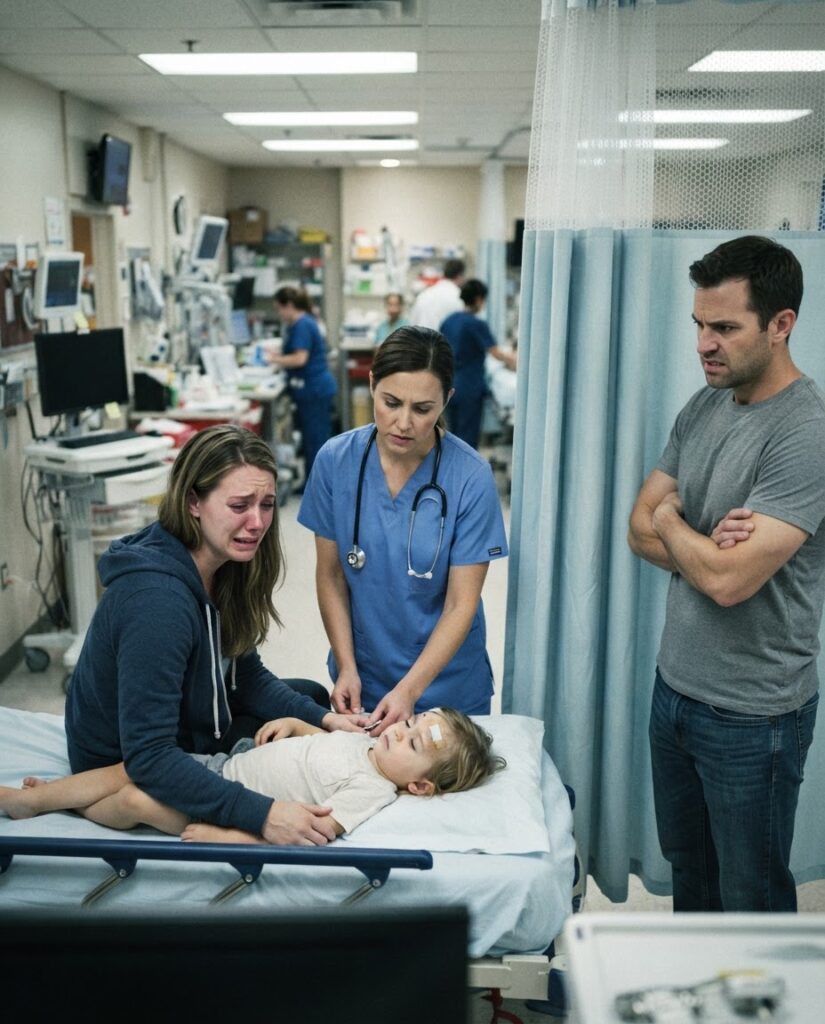
“That morning.”
“What time?”
“Seven twelve. Maybe seven fifteen.”
“And how was she?”
“Completely normal.”
“Eating?”
“Yes.”
“Walking?”
“Yes.”
“Talking?”
“Yes.”
“Any vomiting? Sleepiness? Difficulty standing?”
“No.”
“Any illness?”
“No.”
He wrote something down.
“What happened after you left?”
“My husband had the day off. He was supposed to take her to daycare.”
The doctor stopped writing for half a second.
Then continued.
“Do you know whether he did?”
“I assumed he did.”
Behind us, a monitor beeped twice.
Somebody pushed a cart past the doorway with one wheel squeaking every few feet.
The normal sounds of the hospital felt impossible.
How could people be walking around?
How could phones be ringing?
How could someone be discussing lunch at the nurses’ station when my entire world had just narrowed to a bed with cartoon sheets?
The curtain moved.
My husband stepped through.
“There you are.”
He said it casually.
Like I had wandered away from him in a grocery store.
“They’re making this sound worse than it is.”
The doctor looked at him.
“What time did your daughter fall?”
“Four.”
The answer came immediately.
“What was she doing before that?”
“Playing.”
“Where?”
“Kitchen.”
“With what?”
My husband looked at me.
Not at the doctor.
Me.
Then he smiled.
That careful little smile.
The one he used around teachers.
Neighbors.
My coworkers.
Anyone he wanted to convince that he was the reasonable one.
“You know how toddlers are,” he said. “She climbs on everything.”
The doctor didn’t smile.
“What was she playing with?”
My husband rubbed the back of his neck.
“Coloring. She was coloring at the table.”
My daughter hated coloring.
Not disliked it.
Hated it.
She would scribble for thirty seconds, shove every crayon back into the box, then drag all four dining chairs into a crooked line across the kitchen.
She called it her train.
That tiny, pointless habit hit me so hard I stopped breathing.
The chairs.
That morning, before I left, I had pushed every chair beneath the table.
When I returned home, one chair was lying on its side beside the counter.
The chair my husband claimed she had fallen from.
I looked at him.
“Did you take her to daycare?”
His jaw tightened.
“No.”
“Why?”
“She seemed tired.”
The doctor looked up.
I said, “You told me she fell at four.”
“She was tired before that.”
“How long before?”
“I don’t know.”
“How long?”
He reached for my arm.
“Don’t do this right now. She needs us calm.”
I stepped away.
His hand closed on empty air.
A nurse entered carrying a sealed plastic bag.
She asked my husband to wait outside while they prepared my daughter for imaging.
He didn’t like that.
He didn’t shout.
Of course he didn’t.
He never shouted when strangers were watching.
Instead, he lowered his voice and told the nurse I was exhausted.
He said I tended to panic.
He mentioned pressure at my job.
He said I probably wasn’t processing things correctly.
The nurse listened.
Then said, “Sir, please wait outside.”
His smile disappeared.
Only for a second.
Then he left.
I stayed with my daughter until they wheeled her toward imaging.
Her blue sock had twisted around her ankle.
I fixed it.
Then fixed it again.
Then smoothed the dinosaur printed near her toes even though there was nothing wrong with it.
The doors closed.
And suddenly I had nothing to do with my hands.
Sometime later, the doctor returned.
Another woman came with him.
She wore hospital scrubs and an identification badge turned backward against her chest.
My husband stood immediately.
“So we can take her home now?”
“No,” the doctor said.
One word.
My husband’s phone stopped moving in his hand.
The doctor asked him, “Did you contact anyone after the fall?”
“My wife.”
“Anyone before your wife?”
“No.”
The woman beside the doctor spoke.
“Was anybody else inside the apartment today?”
My husband laughed once.
“No. Why would anyone be there?”
His phone lit up.
He turned it facedown so fast that every person in the room noticed.
He swallowed.
“My mother.”
Nobody had asked.
A minute later, he said he needed coffee.
The doctor watched him walk toward the elevators.
Then he looked at me.
“There’s something we need to discuss without him in the room.”
He opened the family-room door at the end of the hall.
I followed him inside alone.
The woman in scrubs came with us.
The door closed.
The doctor sat across from me.
He didn’t soften what he was about to say.
“The scan shows bleeding around your daughter’s brain.”
I stared at him.
The room disappeared.
I heard the words individually.
Bleeding.
Around.
Brain.
But they refused to become a sentence.
“She fell off a chair.”
My voice sounded distant.
The doctor glanced at the woman beside him.
“We’re concerned that the timeline we were given does not match what we’re seeing.”
“How can you know?”
“We can’t determine an exact minute from a scan. But her symptoms, the degree of lethargy, and the way the injury is presenting make a very recent event less likely.”
“How much earlier?”
“Potentially hours.”
I covered my mouth.
The woman leaned forward.
“My name is Rachel. I’m part of the hospital’s child protection team.”
The words child protection made every hair on my arms rise.
“No.”
It came out automatically.
“No, he said she fell.”
Rachel nodded carefully.
“We understand what he said.”
“He wouldn’t—”
I stopped.
Wouldn’t what?
Wouldn’t hurt her?
Wouldn’t lie?
Wouldn’t let her remain barely conscious while he scrolled through his phone?
I could no longer finish the sentence.
Rachel asked, “Has she had unexplained injuries before?”
“No.”
Then I remembered a bruise.
Three weeks earlier.
High on her upper arm.
My husband said she had caught herself between the crib rail and the wall while climbing.
Except she no longer slept in a crib.
We had changed to a toddler bed months before.
Why had I not noticed that?
My stomach turned.
“There was a bruise.”
Rachel waited.
I told her.
Then I remembered another thing.
A Saturday when my daughter screamed whenever I tried to brush her hair.
My husband said she was being difficult.
A week when she suddenly cried if I left the room.
A daycare teacher had joked that she had become “extra attached to Mommy lately.”
Each memory arrived like something falling from a shelf.
Small.
Ordinary.
Harmless when viewed alone.
Terrifying when placed together.
The doctor said, “Your daughter needs to remain here. A specialist is reviewing the scans now.”
“Is she going to die?”
My voice broke on the last word.
He leaned toward me.
“She is receiving treatment. Right now, she is stable. That matters.”
Stable.
I held onto that word with both hands.
Rachel asked, “Do you feel safe going home with your husband?”
I almost laughed.
Not because anything was funny.
Because the question seemed ridiculous.
We had been married six years.
We shared bills.
Christmas mornings.
Dentist appointments.
A mortgage application we had abandoned when interest rates climbed.
He remembered how I took my coffee.
He knew which side of the bed I slept on.
How could one sentence turn someone familiar into a stranger?
“I don’t know.”
Rachel nodded.
“That’s an acceptable answer.”
There was a knock at the door.
A nurse entered.
She looked directly at Rachel.
“Security is asking for you.”
Rachel stood.
“Why?”
The nurse looked at me.
Then away.
“Her husband is trying to leave.”
My chair scraped backward.
“What?”
We reached the hallway as two security officers stepped in front of the elevator.
My husband stood there holding his keys.
“I’m going home to get clothes.”
I stared at him.
“Our daughter has bleeding in her brain and you’re going home?”
He froze.
The doctor had not told him yet.
I saw it in his face.
Not grief.
Calculation.
For one terrible second, he looked less like a father hearing that his child had a serious injury and more like a man trying to understand what someone else knew.
Then he recovered.
“What are you talking about?”
I moved toward him.
“What happened this morning?”
“I told you.”
“No. You told me four o’clock.”
“That’s when she fell.”
“The doctors say she was hurt earlier.”
“They don’t know that.”
His answer came too fast.
Rachel looked at him.
“We haven’t discussed the imaging findings with you yet.”
Silence.
My husband blinked.
Once.
Then he turned toward her.
“Well, obviously my wife just did.”
But he had said they don’t know that before I had explained what the doctor told me.
I saw Rachel notice.
I saw the doctor notice.
And most importantly, I saw my husband realize that they had noticed.
His phone vibrated again.
This time I saw the name.
Mom.
His mother.
He rejected the call.
Rachel asked him to return to the treatment room.
He said he wanted a lawyer.
Nobody had accused him of anything yet.
He wanted a lawyer anyway.
Within twenty minutes, two police officers arrived.
One stayed with him.
The other spoke to me.
I repeated everything.
Seven twelve.
Dinosaur pajamas.
Blue cup.
Daycare.
The phone call at 4:17.
The chair.
The coloring lie.
The fact that he had not called an ambulance.
The officer asked whether we had cameras inside the apartment.
“No.”
Then I stopped.
“The baby monitor.”
“What about it?”
“We have an old monitor in her bedroom.”
“Does it record?”
“I don’t know. Maybe short clips. It sends movement alerts.”
My husband had installed it when our daughter was an infant.
We barely looked at it anymore.
I pulled out my phone.
The app was still there.
I hadn’t opened it in months.
My password failed.
I tried again.
Failed.
My hands were shaking too badly.
The officer took the phone only after asking permission and let me type slowly.
The app opened.
There were dozens of old motion thumbnails.
Then yesterday.
Then today.
7:03 a.m.
My daughter running into her bedroom in dinosaur pajamas.
Normal.
8:41.
Her father carrying laundry past the doorway.
9:18.
Empty room.
10:06.
My daughter entered crying.
No sound at first.
Just a thumbnail.
I tapped it.
A twelve-second clip opened.
She was backing into the room.
Her father followed her.
His voice came through the tiny speaker.
“Stop running away from me.”
The clip ended.
My chest tightened.
The next alert was 10:08.
My daughter was on the floor beside the bed.
My husband stood over her.
Not touching her.
Not in the clip.
But she was crying harder.
The next recording began three minutes later.
I heard him say, “If you climb up there again, you’re going to get hurt.”
Then a crash sounded from somewhere outside the camera’s view.
The image shook.
My daughter screamed.
The clip ended.
There was no recording at four.
There was nothing after 10:11 except my husband entering the bedroom alone at 12:32 and again at 2:14.
Both times, he looked toward something outside the frame.
Then left.
The officer asked me not to play anything else.
He took screenshots of the timestamps.
My knees gave way.
Rachel caught my elbow before I hit the wall.
Ten eleven.
My husband had called me after four.
Almost six hours.
Six hours.
My child had been injured for almost six hours while I answered emails, ate half a sandwich at my desk, laughed at a coworker’s joke, and believed my daughter was safe with her father.
I vomited into a hospital trash can.
When I looked up, my husband was watching from the opposite side of the hallway.
His face had gone gray.
He knew.
He knew exactly what was on that monitor.
“Give me your phone,” he said.
I actually stared at him.
“What?”
“That’s private. Give it to me.”
The officer stepped between us.
My husband’s voice sharpened.
“That’s my house. Those recordings belong to me too.”
“No,” I said.
It was the first time my voice didn’t shake.
“No.”
He stared at me as if I had betrayed him.
Then he said the sentence that ended our marriage.
“You weren’t there. You don’t know what she was like.”
I stopped breathing.
The officer became very still.
Rachel asked, “What was she like?”
My husband realized what he had said.
He shook his head.
“That’s not what I meant.”
“What did you mean?”
“She was having a tantrum.”
I whispered, “She’s two.”
“Almost three.”
As if that mattered.
As if an extra few months made whatever happened understandable.
He started talking faster.
She was difficult.
She refused breakfast.
She wouldn’t get dressed.
She screamed when he tried to take her to daycare.
She climbed on the furniture.
She kicked.
She threw things.
Each sentence sounded less like an explanation and more like an accusation against a toddler.
Then Rachel asked one simple question.
“If she was injured around ten, why did you tell your wife it happened at four?”
He stopped talking.
That was the end of his story.
Not legally.
Not officially.
But for me, it ended there.
The police separated us completely.
I was taken back to my daughter.
She looked impossibly small beneath the hospital blanket.
There was tape on her hand holding the IV in place.
I sat beside her and whispered every silly thing I could think of.
The blue cup was waiting.
Her stuffed rabbit was waiting.
Her daycare teacher would probably let her be line leader again.
The kitchen train could take over the whole apartment if she wanted.
I promised things I had no authority to promise.
That she would be okay.
That nobody would scare her again.
That Mommy was there.
Hours passed.
A pediatric specialist finally told me the bleeding was serious but controlled.
They would continue monitoring her closely.
She had responded to treatment.
Her neurological signs were improving.
When she opened her eyes properly for the first time, she looked at me.
Not through me.
At me.
“Mommy?”
One word.
I broke.
I lowered my face against the edge of the bed and cried so hard a nurse had to pull a chair closer before I collapsed.
My daughter lifted one taped hand and touched my hair.
Then she whispered, “Home?”
“No, baby.”
I kissed her fingers.
“Not yet.”
Her lip trembled.
“Daddy mad?”
Every piece of me went cold.
I looked at the nurse.
She had heard it too.
I forced my voice to stay gentle.
“Why was Daddy mad?”
My daughter closed her eyes.
“Chair.”
That was all she said.
Just chair.
But it was enough for the nurse to document.
Later that night, a detective came to speak with me.
My husband was no longer in the hallway.
“Where is he?”
The detective didn’t answer immediately.
Then he said, “He’s being interviewed.”
He placed a clear evidence bag on the table.
Inside was a phone.
My husband’s phone.
The one he had kept turning facedown.
Investigators had obtained permission to preserve the device after he agreed to an interview.
There were messages.
Not to me.
To his mother.
The detective couldn’t show me everything yet, but he read three timestamps.
10:24 a.m.
12:07 p.m.
3:39 p.m.
My husband had contacted his mother three separate times before calling me.
The first message said our daughter had hit her head and “wouldn’t stop sleeping.”
His mother had told him to watch her.
At 12:07, he wrote that she was “still out of it.”
His mother asked whether he had called me.
He replied:
Not yet. She’ll freak out.
At 3:39, he sent another message.
What do I tell her?
His mother answered:
Say she just fell.
Four minutes later, she sent another.
Make sure the kitchen looks like it happened there.
I thought about the chair.
The one lying on its side when I came home.
The chair that had been neatly beneath the table at seven twelve.
I sat so still the detective asked whether I needed water.
“No.”
My voice sounded unfamiliar.
“What really happened?”
“We’re still investigating.”
“Did he hurt her?”
“We don’t have the complete sequence yet.”
The baby monitor showed the bedroom.
The chair had supposedly been in the kitchen.
There was no camera there.
For two days, that missing space tortured me.
What happened between 10:08 and 10:11?
What caused the crash?
Why had my daughter said Daddy mad?
Then the answer came from somewhere none of us expected.
Our apartment building had replaced the hallway security system three months earlier.
One camera pointed directly at our door.
At 9:56 that morning, my husband stepped into the hallway carrying a daycare backpack.
My daughter followed him.
She was crying.
He crouched.
The camera had no audio.
He pointed back inside.
She shook her head.
He grabbed her wrist.
Not violently enough for a stranger passing by to stop.
But hard enough that she stumbled.
They went back into the apartment.
At 10:13, our downstairs neighbor opened her door.
She later told police she had heard a heavy impact from above.
She remembered the time because she had been joining a video call for work.
A few minutes later, she heard a child crying.
Then nothing.
At 10:31, my husband opened our apartment door.
He looked down both directions of the hallway.
Then shut it again.
He never took our daughter to daycare.
He never called emergency services.
He never called me.
He waited.
The police later told me they believed the chair had not fallen over until much later.
My husband had moved it.
He had built the scene before I arrived.
That was why the chair was beside the counter.
That was why he chose four o’clock.
He needed the injury to appear recent.
He needed me to believe I had simply come home shortly after an accident.
He almost succeeded.
Almost.
My daughter stayed in the hospital for six days.
By the fourth, she was demanding the blue cup again.
A nurse found one in the pediatric kitchen.
I had to turn toward the window so my daughter wouldn’t see me cry.
My husband was prohibited from contacting us.
His mother called me thirty-two times.
I answered once.
She immediately said, “You’re destroying his life over an accident.”
I listened.
I didn’t interrupt.
She said toddlers fall.
She said hospitals overreact.
She said her son had panicked.
She said he had delayed calling because he knew I would blame him.
Then she made the mistake of saying:
“We only moved the chair because we thought you’d understand it better if it looked like a normal fall.”
We.
I put the phone on speaker.
The detective sitting across from me heard every word.
His mother stopped speaking.
“Are you recording me?”
I said nothing.
She hung up.
After that, investigators obtained her messages too.
The story became clearer.
Our daughter had been upset about daycare.
She kept running away while my husband tried to dress her.
He became angry.
He had admitted during his interview that he grabbed her.
He insisted he had only tried to stop her from climbing.
He claimed she pulled away.
She fell.
The exact movement remained disputed.
But one fact did not.
He knew immediately that she had struck her head.
He knew she became abnormally sleepy.
He contacted his mother.
He waited.
And waited.
And waited.
Then, as afternoon became evening and he knew I would soon return from work, he staged the chair.
He called me.
He said she had just fallen.
He said she had gone to sleep.
The prosecutor later told me something I will never forget.
The initial injury mattered.
But the hours afterward mattered too.
Every minute he chose secrecy over medical care.
Every message.
Every lie.
Every time he looked at our daughter and decided protecting himself was more urgent than protecting her.
For months, I tortured myself with one question.
How had I not known?
I replayed our marriage.
The jokes about me being dramatic.
The way he corrected me in front of people.
The way he could make my certainty feel like confusion.
The way he always remained calm during arguments until I became emotional, then pointed to my emotion as proof that I was unreasonable.
None of it had looked like this.
Not then.
Maybe that was the part I had to learn to live with.
Sometimes the warning is not a monster standing in the doorway.
Sometimes it is a person who has trained everyone around him to trust his calm voice more than someone else’s fear.
Our daughter recovered slowly.
For weeks, loud noises made her cry.
She refused to sit on dining chairs.
At home—my new home—she ate meals at a tiny plastic table.
I let her.
I stopped caring about what toddlers were “supposed” to do.
Months later, she climbed onto a regular chair by herself.
She looked at me first.
“Safe?”
I swallowed.
“Yes.”
She sat.
Nothing happened.
She smiled.
Then demanded the blue cup.
I gave it to her.
The criminal case took longer.
Cases always do.
There were hearings.
Interviews.
Reports.
Expert opinions.
Words like timeline and mechanism and delayed treatment became part of my vocabulary.
My husband’s attorney argued that he had panicked.
That he had made terrible decisions under stress.
That the injury began as an accident.
The prosecution focused on everything that followed.
The monitor clips.
The hallway camera.
The messages.
The staged chair.
His changing account.
His mother’s instructions.
And the six hours my daughter lay injured while he worried about what story to tell.
I attended every hearing I was allowed to attend.
Not because I enjoyed seeing him.
I didn’t.
For a long time, I couldn’t even look directly at him.
I went because I wanted one person in that courtroom to remember that the evidence wasn’t just evidence.
The timestamps were my daughter’s morning.
10:24 was a little girl who needed a doctor.
12:07 was lunchtime she never ate.
3:39 was nearly an entire day gone.
4:17 was when he finally called me.
Numbers looked clinical on paper.
They were not clinical to me.
They were hours of my daughter’s life.
The final time I saw my husband outside a courtroom, he tried to speak to me through his attorney.
He wanted me to know he had never meant for things to go this far.
I sent one response.
Neither had our daughter.
I filed for divorce.
I never returned to that apartment alone.
My sister and two police officers came with me to collect our things.
The kitchen looked almost exactly as it had that evening.
Four chairs.
A counter.
A refrigerator covered in alphabet magnets.
For several seconds, I couldn’t move.
Then I saw the blue plastic cup inside the drying rack.
I picked it up.
My sister asked if I was okay.
“No.”
It was the truth.
But I put the cup in the box anyway.
Before leaving, I pushed all four chairs beneath the table.
Straight.
Exactly where they had been at seven twelve that morning.
Then I closed the door.
A year later, my daughter barely remembered the hospital.
Children are strange that way.
Merciful sometimes.
She remembered the dinosaur socks.
She remembered getting popsicles.
She remembered a nurse who made gloves into balloons.
She didn’t remember the doctor who asked the question that changed our lives.
Why does your husband say this happened at four when your daughter’s condition suggests it happened much earlier?
I remember.
I think I always will.
Because there are moments when your entire life divides itself into before and after.
Before that question, I thought I had rushed my daughter to the emergency room because of a terrible accident.
After it, I began to understand that I had carried her out of something much more dangerous.
A lie.
A lie constructed hour by hour while she lay there unable to tell me what had happened.
People later called me strong.
I never liked that word.
There was nothing strong about the way my hands shook in the hospital.
Nothing strong about sleeping on the floor beside my daughter’s bed for months afterward.
Nothing strong about checking her breathing three times every night.
I was terrified.
I just kept moving anyway.
Maybe that is what strength actually looks like sometimes.
Not fearlessness.
Movement.
One step.
Then another.
My daughter is older now.
She still prefers blue.
She still hates coloring.
And she still rearranges furniture whenever she thinks a room is boring.
The first time she dragged our dining chairs into a crooked line in our new kitchen, my heart stopped.
She climbed into the front chair.
“Mommy.”
I looked at her.
“This is the train.”
For one second, I saw everything again.
The hospital.
The monitor.
The fallen chair.
His phone turning facedown.
The doctor’s expression.
Then my daughter patted the chair behind her.
“You coming?”
I sat down.
“Where are we going?”
She thought about it very seriously.
“To the moon.”
So I sat behind my little girl in a crooked kitchen-chair train and let her take me to the moon.
And for the first time since that afternoon, a chair was only a chair again.