PART 1 — The Dog Who Kept Waiting at the Door
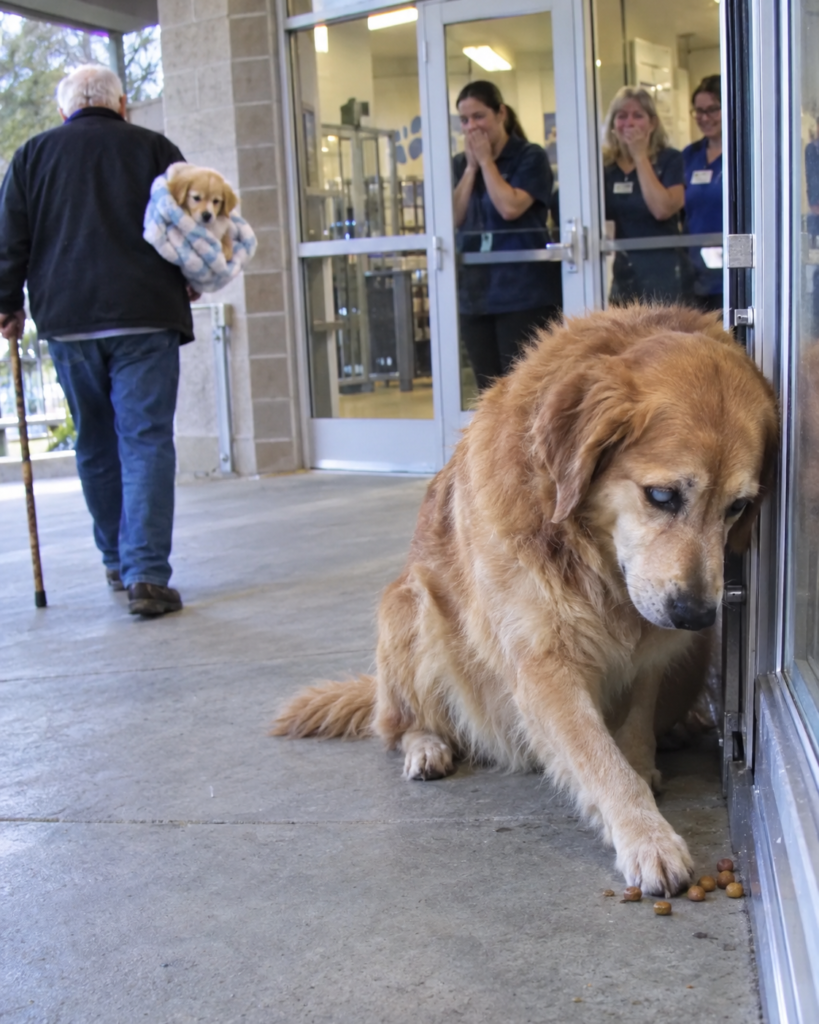
The last puppy left our shelter in the arms of a seventy-six-year-old widower, and his one-eyed mother stayed at the kennel door long after his scent had disappeared down the hallway.
By the next morning, Willow was still there.
Her nose was pressed beneath the narrow metal seam.
Three pieces of kibble lay beside her front paw.
At first, I thought she had spilled them.
Then I watched her pick up another piece from her bowl, carry it carefully across the kennel, place it beside the door, and lie down again.
As though Pip might come back hungry.
I had worked around abandoned, surrendered, injured, frightened, and grieving dogs long enough to know how easily humans misunderstand silence.
We see a dog who doesn’t bark and decide she’s calm.
We see a dog who doesn’t fight and decide she’s accepted what’s happening.
We see a dog lying quietly beside a kennel door and tell ourselves she has adjusted.
Willow taught me otherwise.
She was about six years old, a honey-gold retriever mix with a pale crescent of white on her chest and the beginning of silver around her muzzle. She had the heavy feathering of a Golden Retriever around her tail, though she was smaller and leaner than most purebreds.
And she had one good eye.
Her left eye had been badly damaged sometime before she came to us. By the time our veterinarian examined her, the injury was old. The eye had healed beneath a smooth blue-gray scar and no longer caused pain, but Willow would never see from that side again.
The right eye was warm brown.
Watchful.
Careful.
Always counting.
Especially puppies.
Willow had arrived at our Portland-area shelter eleven weeks earlier through an overcrowded rural rescue transfer. Nobody knew much about her history.
No microchip.
No collar.
No medical records.
Only Willow and five puppies.
She had been underweight when she arrived, but every puppy was round and strong because she had apparently given everything she had to them.
That was the first thing I learned about her.
Willow always noticed what someone else needed before she noticed herself.
She wasn’t affectionate in the way visitors expected a Golden-looking dog to be.
She didn’t leap against the kennel door.
She didn’t wag her entire body when strangers entered.
She didn’t shove her head beneath your hand demanding scratches.
Instead, she watched.
If you approached from her right side, where she could see you, she usually stayed still.
If you came from the left without speaking, she startled hard enough that her entire body twisted toward you.
Nobody at the shelter blamed her.
We simply learned.
“Willow, coming in.”
“Hey, sweetheart. It’s me.”
“Moving past your left side.”
Within a week, every technician automatically announced themselves before entering her kennel.
The puppies never had to.
She knew exactly where they were.
A tiny squeak from the bedding and Willow’s head lifted.
A food dish scraped and she looked.
A latch clicked and she immediately counted five moving bodies with her good eye.
If a puppy disappeared behind a blanket, Willow would stand until she found it.
She never seemed completely relaxed unless all five were within sight or reach.
Then adoption season began.
The first puppy left on a Tuesday.
A family with two teenagers named him Moose.
Willow followed him to the kennel door and listened until the carrier disappeared down the hall.
Then she returned to the remaining four.
The second puppy left two days later.
Then another.
Then another.
Every time, Willow performed the same ritual.
Follow.
Listen.
Wait.
Return.
She never barked.
Never scratched.
Never fought.
That silence made it easier for everyone.
Maybe even for me.
“She understands,” one volunteer said after puppy number four left.
I remember looking at Willow standing beside the door.
“No,” I said.
But I wasn’t sure what she understood.
The final puppy was Pip.
He was the smallest male of the litter, golden like Willow, with white toes and a slightly ridiculous habit of tripping over his own ears when he ran too fast.
Pip had inherited all of Willow’s patience and none of her suspicion.
He trusted everybody.
He trusted the floor.
He trusted doors.
He trusted shoelaces.
He once fell asleep halfway inside a cardboard enrichment box because apparently the thought of backing out was too exhausting.
His adopter was Arthur Bell.
Arthur was seventy-six and lived alone in a small one-story house about forty minutes from the shelter.
He had lost his wife, Ruth, two years earlier.
He told me that during his first visit while filling out his paperwork.
Not dramatically.
Not as though he wanted sympathy.
He simply wrote “widowed” on the form and said, “The house has been too quiet.”
He walked with a wooden cane polished smooth at the handle from years of use.
His knees were bad.
He had a slight tremor in his left hand.
And he asked more questions about Pip than almost any adopter I’d met that month.
How much exercise?
How often should he eat?
What food?
How large might he get?
Would puppy classes help?
Could he handle stairs?
What vaccinations remained?
What signs of illness should Arthur watch for?
During their second meeting, I opened the visitation room and expected Arthur to sit in the chair.
Instead, he looked at the floor.
“Think I can get down there without embarrassing myself?”
I smiled.
“I can help you back up.”
“That’s what I’m afraid of.”
Still, he lowered himself carefully beside the wall.
Pip ignored him.
For nearly ten minutes.
Arthur didn’t call.
Didn’t clap.
Didn’t offer treats.
He just waited.
Pip chewed a blanket corner.
Drank water.
Attacked his own tail.
Then crossed the room, climbed onto the toe of Arthur’s rain-darkened boot, curled himself into a ridiculous little ball, and fell asleep.
Arthur stared down at him.
His expression changed so quietly I almost looked away.
“Ruth would’ve liked you,” he whispered.
Through the glass wall separating the visitation room from the nursery corridor, Willow watched.
Arthur happened to be sitting on her sighted side.
She could see him clearly.
I noticed something then.
Willow’s ears were lowered.
Her body was tense.
But she had not retreated to the back wall.
Most strangers made her put distance between herself and the kennel door.
Arthur didn’t.
For some reason, she remained close.
Three days later, Pip went home.
Arthur arrived with a new blue collar, an embarrassingly large bag of puppy supplies, and a folded blanket from his house so Pip would have a familiar scent during the drive.
He signed every document carefully.
Asked every question again.
Then I placed Pip in his arms.
Willow stood immediately.
Pip saw her through the kennel bars and squirmed.
For one second, his nose touched hers.
Then Arthur turned toward the hallway.
Willow walked after them.
The kennel door stopped her.
I expected her to return to her bed after a minute.
She didn’t.
Arthur and Pip passed the laundry room.
Willow listened.
They passed reception.
Her ears shifted forward.
The front door opened.
Closed.
A truck started outside.
Willow lowered herself beside the kennel door.
And waited.
At closing time she was still there.
Behind her sat two clean stainless-steel bowls.
One oversized bed.
One battered gray blanket that had once held six bodies.
Without the puppies, the nursery kennel looked twice its normal size.
I crouched on Willow’s good side.
“They’re gone, sweetheart.”
Her brown eye moved toward me.
Then back to the door.
I went home thinking she would adjust by morning.
I was wrong.
When I arrived the next day, Willow was lying in exactly the same place.
And beside her nose were four pieces of food.
Over the next several days, she developed a routine that broke something in all of us.
She waited until the shelter became quiet before eating.
She slept beside the kennel door instead of on her bed.
Every time footsteps entered the corridor, her head rose.
If they stopped nearby, she stood.
If they continued past her kennel, she slowly lowered herself again.
And sometimes, Willow carried pieces of kibble from her bowl and placed them beneath the metal seam.
The first time one of our younger volunteers noticed, she whispered, “Why is she doing that?”
Nobody answered.
Because there was no scientific way for me to say what it looked like.
It looked like a mother leaving food where her babies had disappeared.
Our veterinarian examined Willow again.
Her temperature was normal.
Her heart sounded good.
The blind eye remained comfortable.
No infection.
No new pain.
No obvious physical reason for the change.
“She’s medically okay,” the vet told me.
That phrase followed me all afternoon.
Medically okay.
Technically safe.
Physically stable.
Sometimes those are not the same thing as okay.
We had one possibility left.
A family had submitted an application for Willow before Pip was adopted.
They lived in a large house with a fenced yard. They had owned dogs before. Their references were good.
The mother had met Willow twice.
The father once.
They understood that she was blind in one eye.
They told me they wanted an adult dog rather than a puppy.
For a few days, I began allowing myself to imagine Willow leaving.
Not forgetting her puppies.
I didn’t expect that.
But leaving the kennel.
Having grass.
Having windows.
Having someone’s kitchen floor to sleep on.
Maybe learning that footsteps didn’t always mean someone she loved was disappearing.
Friday morning, the family’s email arrived.
I opened it at 11:46.
The first sentence was polite.
By the third, I already understood.
They had spoken with relatives.
Their grandchildren visited frequently.
Someone had become concerned that a dog with limited vision might be easily startled.
They didn’t want to create a dangerous situation.
They didn’t feel their household was the right fit.
They were sorry.
They hoped Willow found a wonderful home.
Nobody had lied.
Nobody had been cruel.
Their concerns weren’t ridiculous.
A dog with vision loss does require consideration.
I told myself all of that while reading the email twice.
It didn’t make the empty nursery kennel look any smaller.
Willow was lying beside the door again.
I glanced at the adoption board.
Four weeks earlier, five puppy names had been written beneath hers.
Now only WILLOW remained.
I started typing a reply.
Thank you for letting us know—
Willow stood.
Not gradually.
Instantly.
Her ears lifted.
She turned toward the lobby.
“What is it?”
She didn’t look at me.
A vehicle had entered the parking lot nearly an hour before we opened.
Through the rain-streaked front windows, I saw an old dark green pickup stop near the entrance.
The driver’s door opened.
A wooden cane appeared.
Then Arthur Bell climbed out.
For one terrible second, I thought something had happened to Pip.
I ran toward the lobby.
Arthur was moving slowly across the wet pavement.
Cane in one hand.
Something tucked beneath his other arm.
Gray fabric.
I stopped.
It was the old puppy blanket.
The one Pip had slept on at the shelter.
I unlocked the front door before Arthur could knock.
“Is Pip okay?”
Arthur blinked.
“Oh. Yes. Pip’s fine.”
My lungs finally worked again.
“Then what happened?”
Arthur looked past me toward the kennel hallway.
“Nothing happened.”
Rain clung to the shoulders of his jacket.
He shifted the blanket beneath his arm.
“I came about Willow.”
I stared at him.
Arthur didn’t ask if he could visit her.
He didn’t ask whether she had been adopted.
He said, “I need you to tell me what my house would have to change before you’d consider letting her come home too.”
Behind me, somewhere beyond two closed doors and forty feet of hallway, Willow began scratching softly at the kennel seam.
And for the first time since Pip left, she made a sound.
One short bark.
PART 2 — What Arthur Had Seen
I must have stood in the doorway too long because Arthur finally raised his eyebrows.
“That’s usually the part where you either tell me I’m crazy or invite me inside.”
I stepped back immediately.
“Come in.”
He wiped his boots carefully on the mat.
The gray blanket remained tucked beneath his arm.
Up close, I could smell laundry detergent and something faintly puppy-like.
Arthur noticed me looking at it.
“Pip sleeps on this.”
“That was Willow’s nursery blanket.”
“I know.”
Something in the way he said it made me wait.
Arthur rested both hands on the curved top of his cane.
“I washed it once,” he said. “Pip spent half the night wandering the house looking for it. So now I apparently own a blanket that smells like wet dog and stale crackers.”
Despite myself, I laughed.
Arthur smiled.
Then his expression became serious again.
“I called yesterday.”
I remembered.
One of our reception volunteers had mentioned speaking with him.
“You asked how Willow was doing.”
“Your young man at the desk said she was still available. He was careful not to tell me much else.”
“We can’t disclose everything about an animal’s situation to previous adopters.”
“He did his job.”
Arthur glanced toward the hallway.
“But I heard her.”
My smile disappeared.
“Heard her?”
“Through the phone. There was barking in the background. Then he said, ‘Willow, easy.’”
Arthur looked at the blanket again.
“I knew the name.”
I led him into the small consultation room beside reception.
Arthur lowered himself into a chair.
I sat across from him.
“I need to understand something,” I said. “When you adopted Pip, you never mentioned wanting two dogs.”
“I didn’t.”
“And now?”
Arthur took a breath.
“Now I know more than I knew then.”
That sentence changed the conversation.
He told me about Pip’s first night.
The puppy had explored every room of the house except the bedroom Arthur once shared with Ruth.
Pip slept beside the couch.
At 2:13 in the morning, Arthur woke to whining.
He found Pip standing beside the front door.
Arthur took him outside.
Pip relieved himself, sniffed the porch, then refused to come back in for several minutes.
“He just stared at the driveway,” Arthur said.
“That’s normal for a puppy in a new environment.”
“I figured.”
The next day, Pip carried the gray blanket into the hallway.
The day after that, he dragged it toward the kitchen.
On the third evening, Arthur caught him lying on it and making tiny suckling motions in his sleep.
That was normal too.
What bothered Arthur was not Pip.
It was the picture he kept remembering.
Willow standing behind the kennel door while Arthur carried away the last of her puppies.
“I know dogs don’t think like us,” Arthur said. “I’m not pretending she’s sitting back there writing tragedy poems.”
I almost smiled.
“But she watched me leave with him.”
“She did.”
“And I keep wondering whether she thinks I took him.”
I hesitated.
“We can’t know exactly what she thinks.”
“No. But you know what she does.”
That stopped me.
Arthur’s gaze was steady.
“So tell me.”
I told him.
Not everything dramatically.
Just the facts.
She had spent the night at the kennel door.
She had become quieter.
She was eating late.
She watched every person passing the corridor.
Then I told him about the kibble.
Arthur’s hand tightened around his cane.
“She carries food to the door?”
“Sometimes.”
“For the puppies?”
“I can’t say that.”
He looked at me.
“I didn’t ask what you could prove.”
Neither of us spoke for a few seconds.
Finally Arthur rubbed his thumb across the cane handle.
“My wife used to do that.”
I frowned.
“Carry food to doors?”
He smiled sadly.
“No. Keep taking care of people after there was nobody left to take care of.”
Ruth had been a school cafeteria manager.
Arthur told me she worked at the same elementary school for thirty-one years.
When they retired, she continued packing lunches before remembering they no longer had anywhere to go.
Later, when their daughter moved across the country and their grandchildren were grown, Ruth still cooked enough food for six people every Thanksgiving.
After she died, Arthur said, he found labels in the freezer.
SOUP—ARTHUR.
CHILI—ARTHUR.
STEW—ARTHUR.
Even near the end, when cancer made standing painful, Ruth had kept making sure he would eat after she was gone.
Arthur looked down.
“That doesn’t make Willow Ruth. I’m not confused about that.”
“I didn’t think you were.”
“But I recognize waiting when I see it.”
He glanced toward the hallway again.
“And I recognize a house with too much empty space.”
I leaned back.
Arthur’s application had been approved for one puppy, not for an adult dog with special handling needs.
There were legitimate questions.
Could he safely manage two dogs?
Pip would become larger.
Willow needed predictable approaches because of her blind side.
Arthur used a cane.
His yard fencing had been approved for Pip, but Willow might require additional environmental accommodations.
This wasn’t a sentimental movie where I could place a dog into someone’s arms because everyone in the room was crying.
My responsibility was Willow’s long-term safety.
Arthur seemed to know what I was thinking.
“That’s why I’m asking what has to change.”
He didn’t say, Give me the dog.
He said, Tell me what to fix.
I pulled Willow’s behavior notes from the cabinet.
“First, we need to know how she reacts to Pip now.”
Arthur nodded.
“If that goes well, we’d need another home assessment.”
“Fine.”
“We may recommend visual markers or textures around the house.”
“Fine.”
“She’ll need a predictable layout. Furniture shouldn’t be moved constantly.”
Arthur almost laughed.
“I haven’t moved my couch since 1998.”
I continued.
“We’d want to look at tripping hazards. Especially because Pip will be underfoot too.”
“Fair.”
“She needs people to announce themselves if they approach from her blind side.”
Arthur tapped his cane gently against the floor.
“What if she learns that sound means I’m coming?”
I paused.
“Actually, that could help.”
“What else?”
I studied him.
“Arthur, two dogs cost more.”
“I have a pension.”
“Veterinary care—”
“I have savings.”
“Pip is going to be a lot of work.”
“I’ve discovered that.”
For the first time his voice sharpened slightly.
“At four this morning.”
I smiled.
Arthur didn’t.
“I found him eating the corner of a phone book.”
“Nobody has phone books anymore.”
“I do.”
“Apparently Pip knows why.”
That finally made Arthur laugh.
The tension broke.
But one issue remained.
“Arthur, adopting Willow because you feel guilty about taking Pip wouldn’t be enough.”
His expression changed.
“I don’t feel guilty about taking Pip.”
“Then why come back?”
Arthur took his time answering.
“Because I thought I wanted one small dog to make my house less quiet.”
He looked down at his hands.
“Then I got home and realized maybe I had been choosing based on what was easiest for me.”
I said nothing.
“I saw Willow watching us leave. I noticed it that day. I told myself she’d have another family.”
He swallowed.
“Yesterday, when I called and learned she didn’t, I couldn’t stop thinking about her.”
Arthur touched the folded blanket.
“And maybe I’m too old to waste time pretending you don’t know when something is unfinished.”
I closed Willow’s folder.
“Let’s see what she thinks.”
We walked down the nursery corridor.
Before we turned the final corner, I asked Arthur to stop.
Willow was standing at her door.
Her brown eye fixed on the hallway.
Her tail was low.
Not wagging.
Arthur whispered, “She knows.”
I wasn’t sure whether it was his voice, his scent, or Pip’s smell on the blanket.
Maybe all three.
I unlocked the kennel.
“Stay where she can see you.”
Arthur moved to Willow’s right.
He didn’t reach for her.
Didn’t call.
He lowered himself onto the bench outside the kennel instead.
Then he placed the gray blanket on his lap.
Willow stared.
Her nose lifted.
One step.
Stop.
Another.
Her entire body trembled once.
Then she reached the doorway.
Arthur remained perfectly still.
Willow sniffed the blanket.
Once.
Twice.
Suddenly her breathing changed.
Fast.
Deep.
Urgent.
She pushed her nose into the fabric.
Arthur’s mouth tightened.
Willow sniffed harder.
Her tail began moving.
Not the broad, frantic wag visitors wanted from shelter dogs.
Just one careful sweep.
Then another.
She pressed her face against the blanket.
Arthur turned away.
I pretended not to notice him wiping his eyes.
Willow picked up one corner of the blanket.
For a few seconds, she simply held it.
Then she backed into the kennel, pulling it with her.
She carried it to the same spot beside the door where she had been leaving food.
Placed it down.
Circled once.
And lay on top of it.
Arthur whispered, “Well.”
I crouched beside him.
“That’s a pretty clear opinion.”
He looked at me.
“When can you inspect my house?”
“Tomorrow morning.”
Arthur nodded.
Then he surprised me.
“Bring a list.”
“What kind?”
“Everything that’s wrong.”
“Arthur—”
“I mean it. Don’t spare my feelings because I’m old.”
He looked toward Willow.
“I’ve had seventy-six years to arrange things for myself.”
His voice softened.
“I can spend one afternoon arranging them for her.”
That evening, Willow ate her entire dinner before closing time.
She didn’t sleep on the bed.
She slept on Pip’s blanket beside the kennel door.
But something had changed.
For the first time in a week, she wasn’t facing the hallway.
She was curled toward the blanket.
And when I left for the night, there wasn’t a single piece of kibble beneath the door.
PART 3 — A House Prepared for a Dog Who Could Only See Half of It
Arthur’s house sat at the end of a narrow road lined with wet cedar trees and old mailboxes.
The rain had stopped overnight.
By ten the next morning, weak sunlight had begun breaking through the Oregon clouds.
I pulled into Arthur’s driveway expecting to find the same house our original adoption inspector had described.
Instead, I found Arthur standing on the front porch beside three rolls of nonslip runner, a box of night-lights, six foam corner guards, and what appeared to be enough baby gates to contain a small army.
Pip sat beside him chewing cardboard.
“You’ve been shopping,” I said.
Arthur pointed his cane at Pip.
“He helped.”
Pip proudly ripped another piece from the box.
“I can see that.”
Arthur had asked one of his neighbors to drive him to a pet supply store the previous afternoon.
Apparently he had walked in carrying my preliminary recommendations and announced to an employee, “I need to make half my house easier for a dog who sees half the world.”
The employee had taken him seriously.
Maybe too seriously.
I picked up a package of reflective stair tape.
“You don’t need all of this.”
“Good. I kept the receipt.”
Inside, the house was warm and quiet.
Family photographs covered one wall.
Arthur and Ruth younger.
Arthur and Ruth older.
Two children.
Several grandchildren.
Christmases.
Camping trips.
A wedding.
On the mantel sat a photograph of Ruth laughing while holding a Golden Retriever that had apparently died years earlier.
Pip followed me through the living room, periodically attacking my shoelaces.
The house itself was nearly ideal for Willow.
Single level.
Few stairs.
Wide hallways.
Fenced backyard.
No major clutter.
Arthur had already removed a narrow side table from the entrance because he worried Willow could strike it with her blind side.
He had placed textured mats near each exterior door.
“Different surfaces can help her map important locations,” I explained.
Arthur tapped each one with his cane.
“This one means front door. This one means backyard.”
“Exactly.”
He looked pleased.
At the kitchen, I saw two feeding stations.
One for Pip.
One placed several feet away.
“You already bought Willow bowls?”
Arthur shrugged.
“They were on sale.”
I pretended to believe him.
The real challenge was the living room.
Arthur’s recliner sat beside a low coffee table with hard wooden corners.
Pip already knew to move around it.
Willow would learn.
But until she did, we’d need to reduce the chances of collision.
Arthur and I moved the coffee table closer to the wall.
He protested when I tried to lift it alone.
“I may use a cane, but I’m not decorative.”
“You have two artificial knees.”
“One and a half.”
I stared at him.
“One replacement. One that’s threatening to become one.”
“That is not better.”
Pip raced between us carrying one of Arthur’s slippers.
“You’re raising a criminal.”
“He’s young.”
“He’s stealing your shoe.”
“He’s exploring.”
“He just ran under the dining table.”
“Very advanced exploration.”
The more time I spent with Arthur, the more I understood why Pip had chosen his boot during that first meeting.
Arthur never rushed.
That mattered to Willow.
He didn’t fill silence because it made him uncomfortable.
That mattered too.
And the cane I had initially worried about might become one of Willow’s most useful cues.
Tap.
Step.
Tap.
Step.
Arthur’s movement announced itself.
No surprises.
No silent approach from the blind side.
Before leaving, I inspected the backyard.
The fence was secure.
There was enough room for exercise without requiring long walks on Arthur’s difficult days.
The covered porch offered shade and shelter.
I wrote several final recommendations.
Supervise Willow and Pip carefully during the transition.
Separate feeding initially.
Maintain predictable furniture placement.
Provide Willow with her own sleeping area.
Approach from her right side whenever practical.
Use verbal cues before touching her from the left.
Arthur read the page.
Then looked at me.
“So?”
“So you pass.”
His shoulders dropped.
I hadn’t realized how tense he was.
“That means she’s mine?”
“Not quite.”
His face fell.
“We still need to do an extended meeting between Willow and Pip. If that goes well, we can finalize.”
“When?”
“This afternoon.”
Arthur checked his watch.
“What am I supposed to do for four hours?”
I nodded toward Pip.
“Protect your phone book.”
The reunion happened in our fenced outdoor introduction area behind the shelter.
Arthur brought Pip at three.
The puppy bounded from the truck like he hadn’t seen civilization in years instead of twenty minutes.
Willow was already waiting with me.
I had fitted her with a secure harness and leash.
She sniffed the air.
Then Pip came around the corner.
Everything stopped.
Pip saw Willow.
Willow saw Pip.
For one second, neither moved.
Then Pip made a sound halfway between a whine and a squeal.
He launched himself forward.
Arthur nearly lost the leash.
“Pip!”
Willow’s ears shot forward.
Her tail rose.
Pip reached her.
He climbed directly beneath her neck.
Willow sniffed him so fast her nose moved from his ears to his shoulders to his sides to his paws as though conducting an inventory.
One.
Two.
Three.
Four.
All there.
Pip rolled onto his back.
Willow stood over him.
Then she licked his face.
Once.
That was all.
But everybody watching through the shelter windows started crying.
Including our veterinarian.
Including two technicians.
Including the receptionist who had sworn ten minutes earlier that she “didn’t cry over adoption stuff anymore.”
Arthur stood beside me.
His fingers gripped the cane handle.
“I was worried she wouldn’t remember him.”
“She remembers.”
Pip jumped up and began running circles around Willow.
For the first few minutes, she tolerated him.
Then he bit her tail.
Willow turned and gave one sharp correction.
Pip froze.
Arthur looked alarmed.
“Was that bad?”
“No.”
Pip waited two seconds.
Then attempted to bite her tail again.
“That’s bad,” Arthur said.
“For his decision-making skills, yes.”
Willow corrected him again.
This time Pip chose a stick.
Arthur sighed with relief.
Watching them together taught us something important.
Willow loved Pip.
But she didn’t need to be his nursing mother forever.
She wasn’t frantic.
She wasn’t possessive.
She didn’t panic when he moved away.
Instead, once she had inspected him and understood that he was safe, her body gradually softened.
She sniffed the yard.
Accepted a treat.
Then did something I had not seen her do since her puppies began leaving.
She lay in the sun.
Not beside a door.
Not facing an exit.
Just on the grass.
Pip collapsed against her front legs and started chewing the stick.
Willow closed her good eye.
Arthur slowly lowered himself onto the bench.
He sat beside me for a long time.
Finally he said, “She looks tired.”
“She probably is.”
“From today?”
I watched Willow sleeping in the sunlight.
“No.”
Arthur understood.
“From all of it.”
I nodded.
After almost an hour, we returned inside to complete the adoption paperwork.
Willow refused to leave the gray blanket behind, so I carried it to the lobby.
Arthur signed page after page.
Emergency contact.
Veterinarian agreement.
Microchip update.
Medical disclosure.
Vision impairment acknowledgement.
Behavior notes.
When we reached the final page, Arthur stopped.
His pen hovered.
“What?”
He smiled faintly.
“I remember signing this for Pip.”
“You’re getting efficient.”
“That’s one word.”
He signed.
ARTHUR BELL.
Then I stamped the paper.
ADOPTED.
I expected that to be the emotional moment.
It wasn’t.
The emotional moment came ten minutes later.
Arthur opened the rear door of his truck.
Pip’s secured crate was on one side.
Beside it was a padded space with a harness tether for Willow.
Arthur had bought it that morning.
He had lined the seat with the old gray blanket.
Willow approached the truck.
Then stopped.
Vehicles were difficult for her because she couldn’t judge movement on the left.
I stood on her sighted side.
Arthur waited near the door.
“Take your time,” he said.
Willow looked inside.
Pip whined from his crate.
Her ears lifted.
She placed one paw on the running board.
Then another.
I helped support her harness as she climbed.
Once inside, she turned.
For a moment she looked directly at me.
I had seen that expression hundreds of times from shelter dogs leaving.
Confusion.
Hope.
Fear.
Sometimes all three.
I touched her chest.
“You’re okay.”
Arthur closed the door carefully.
He walked around the truck.
Then stopped beside me.
“I’ll bring them back to visit.”
“You don’t have to.”
“I know.”
He looked toward Willow.
“That’s the difference.”
Arthur climbed behind the wheel.
The truck started.
I stepped back.
Through the side window, I could see Willow turning toward Pip’s crate.
The puppy pressed his nose through the bars.
Willow touched him through the opening.
Then Arthur’s truck rolled slowly toward the exit.
I stood in the parking lot until it disappeared.
When I returned to the nursery, Willow’s kennel was empty.
No dog beside the door.
No blanket.
No food pieces.
I should have felt happy.
I did.
But empty kennels have a strange way of holding the shape of whoever lived there.
I washed Willow’s bowls.
Removed her identification card.
Folded her unused bed.
Then I found something beneath the edge of the kennel door.
One final piece of kibble.
I held it in my palm.
For a second, I almost cried again.
Then I laughed.
Because wherever Willow was going now, Pip was already there.
She didn’t need to save it anymore.
PART 4 — The First Night
At 8:17 that evening, my phone rang.
Arthur.
My stomach dropped.
I answered before the second ring.
“What’s wrong?”
Arthur was quiet.
Then he said, “You people really need to warn adopters.”
“About what?”
“Apparently having two dogs means neither one believes the other should receive something first.”
I exhaled.
“What happened?”
“I gave Willow a biscuit.”
“And?”
“Pip screamed as though I’d disinherited him.”
Despite myself, I laughed.
“So I gave Pip one.”
“Reasonable.”
“Then Willow looked at me like she’d just discovered corruption in government.”
“Also reasonable.”
Arthur lowered his voice.
“She’s doing fine.”
I leaned against my kitchen counter.
“Really?”
“Better than I expected.”
He told me they had arrived home shortly after five.
Pip exploded out of the truck.
Willow climbed down much more slowly.
Arthur let her stand in the driveway for several minutes before leading her inside.
The textured mat at the doorway made her hesitate.
Then she entered.
She spent almost twenty minutes mapping the living room.
Wall.
Chair.
Couch.
Hallway.
Kitchen.
Back to couch.
Arthur didn’t guide her unless she approached an obstacle on her blind side.
He simply walked nearby, tapping his cane.
“She started following the sound,” he said.
“Already?”
“I think so.”
They reached the kitchen.
Willow found the water bowl.
Then Pip found Willow’s water bowl.
Then Willow drank from Pip’s.
Arthur gave up on enforcing ownership.
Afterward, Pip ran through the back door.
Willow stopped at the threshold.
Arthur called her name.
She looked toward him.
Then he tapped his cane twice against the porch.
Willow followed.
“She walked the fence line twice,” Arthur said. “Then she sat under Ruth’s apple tree.”
Something tightened in my chest.
“How did that feel?”
Arthur didn’t answer immediately.
“Different.”
I knew what he meant.
Not replacement.
Different.
There is an important distinction between filling an absence and allowing something new to live beside it.
Arthur had lost Ruth.
Willow had lost every puppy one after another.
Pip had lost his familiar nursery.
Nobody’s grief canceled anyone else’s.
But maybe a home didn’t have to erase grief to become full again.
“Where is Willow now?” I asked.
“That’s why I called.”
My body tensed again.
“What happened?”
“Nothing bad.”
Arthur sounded almost embarrassed.
“She’s standing at the front door.”
My heart sank.
“Waiting?”
“I think so.”
“For Pip?”
“He’s asleep beside me.”
I closed my eyes.
Willow had spent days waiting at our kennel door because that was where her puppies disappeared.
Now she was doing it again.
Arthur said quietly, “What should I do?”
“Don’t force her away.”
“Okay.”
“Let her investigate.”
“Okay.”
“Then create another reason for her to choose a different place.”
“Food?”
“Maybe. Or the blanket.”
Silence.
Then Arthur said, “I’ve got a better idea.”
“What?”
“I’ll call you tomorrow.”
Before I could ask, he hung up.
Arthur did call the following morning.
At 6:42.
I answered half asleep.
“Arthur?”
“I fixed the door.”
I sat up.
“What does that mean?”
“Not literally.”
Apparently, after our call, Arthur had taken the old gray blanket and placed it beside his recliner.
Then he sat down.
Pip slept near his feet.
Arthur turned on the television.
Willow stayed beside the front door.
Ten minutes.
Twenty.
Forty.
Arthur didn’t call her.
Didn’t lure her.
Didn’t close her into another room.
He simply waited.
Then he began reading aloud.
“Reading?”
“The newspaper.”
“Why?”
“Ruth used to make me read articles to her when her eyesight got bad.”
His voice softened.
“Figured Willow might as well know what kind of economy she’s living in.”
I laughed.
“Did it work?”
“After about an hour.”
Willow left the door.
She crossed the living room.
Stopped near the blanket.
Sniffed Pip.
Then lay down.
Not on top of him.
Not even touching him.
Just close enough to know where he was.
Arthur read until he realized both dogs were asleep.
Then he fell asleep in his chair too.
At 1:30 in the morning, he woke.
Willow was still there.
For the first time since her final puppy left, she had chosen to sleep somewhere that was not beside an exit.
Over the next week, Arthur called every day.
Sometimes with questions.
Sometimes with complaints that were clearly disguised pride.
“Pip learned to open the laundry basket.”
“Willow taught him?”
“No. Willow has standards.”
Another day:
“Willow doesn’t like the vacuum.”
“Most dogs don’t.”
“She stood behind me.”
“That’s good. She trusts you.”
Silence.
“Yeah.”
On Wednesday, Arthur discovered that Willow liked scrambled eggs.
On Thursday, he discovered she could hear a cheese wrapper from three rooms away.
By Friday, Willow had learned the cane.
Tap-tap meant Arthur was approaching.
One slow tap beside her bed meant he was there.
A scrape near the back door meant outside.
Arthur began speaking before passing her blind side even when she was asleep.
“Left side, Willow.”
“Coming past.”
“It’s me.”
She stopped startling.
Not completely.
But noticeably.
Pip helped too.
If Arthur entered a room, Pip usually greeted him so noisily that Willow had plenty of warning.
The puppy became a living alarm system.
Two weeks later, Arthur brought both dogs back for a veterinary recheck.
Pip had gained four pounds.
Willow had gained two.
But the first thing I noticed wasn’t her weight.
It was her tail.
Willow walked into the shelter with Arthur on her right and Pip bouncing on her left.
Her tail was up.
Not tucked.
Not dragging.
When we reached the nursery corridor, she stopped.
I held my breath.
Willow looked toward her old kennel.
The door was open.
A new mother dog occupied the space now with three small black puppies.
Willow stared.
One of the puppies squeaked.
Her ears moved forward.
Arthur’s hand tightened around the leash.
For a moment I wondered if we had made a mistake bringing her back.
Willow stepped toward the kennel.
Then stopped.
She sniffed.
The mother dog inside watched her cautiously.
Willow looked at the puppies.
Then she looked at Pip.
He was sitting beside Arthur’s boot, attempting to eat his leash.
Willow walked back to him.
She nudged his shoulder.
Then continued down the hallway.
That was all.
No panic.
No crying.
No waiting.
I followed them into the exam room.
Our veterinarian checked Willow’s weight, coat, teeth, joints, and eye.
Everything looked good.
Then she turned toward Arthur.
“How are you doing?”
Arthur blinked.
“I’m not the patient.”
“You’re seventy-six with a puppy.”
“Fair point.”
He admitted that the first week had been exhausting.
Pip woke early.
Willow woke whenever Pip moved.
Arthur’s knees hated standing in the yard at five in the morning.
But one of Arthur’s neighbors had started joining him for short walks.
His daughter had ordered a waist-attached leash so he wouldn’t have to manage both his cane and Willow’s lead in one hand.
His grandson visited on weekends to help with longer exercise sessions.
The system wasn’t perfect.
It was real.
And real mattered more.
Before Arthur left, he handed me an envelope.
“What’s this?”
“Pictures.”
Inside were printed photographs.
Pip asleep upside down on the couch.
Willow standing under the apple tree.
Pip stealing Arthur’s slipper.
Willow watching from the kitchen.
Then one image stopped me.
Arthur had fallen asleep in his recliner.
Pip was curled across his feet.
Willow was lying beside the chair on the gray blanket.
Her head rested against Arthur’s cane.
“Who took this?”
“My neighbor.”
I looked more closely.
Willow’s good eye was closed.
Her blind side faced the room.
Completely exposed.
Vulnerable.
Relaxed.
Dogs with limited vision often position themselves carefully because they know where the world can surprise them.
But in that photograph, Willow had placed her blind side toward the open room.
She was trusting Arthur to be there.
“Can we copy this for the adoption board?” I asked.
Arthur shook his head.
I looked disappointed.
Then he smiled.
“Keep that one.”
After they left, I pinned the picture where Willow’s name had once been written.
Beneath it I wrote one sentence:
SOMETIMES THE RIGHT HOME COMES BACK.
I thought that was the ending.
It wasn’t.
Because three months later, Arthur called the shelter again.
And this time, when I heard his voice, he was crying.
PART 5 — The Door Willow No Longer Needed to Watch
“Arthur?”
I stood so quickly my chair rolled backward.
“Arthur, what happened?”
For several seconds, he couldn’t answer.
My mind went immediately to Pip.
A car.
An accident.
Illness.
Willow.
Finally Arthur said, “They’re fine.”
I closed my eyes.
“You cannot start a phone call crying and then say they’re fine.”
“I’m sorry.”
“What happened?”
“I found something this morning.”
His voice broke again.
Not grief.
Something else.
“Can you come by after work?”
“Tell me what you found.”
“No.”
“Arthur.”
“You’ll understand better if you see it.”
I arrived at his house shortly after six.
The season had changed.
The Oregon rain had softened into a pale spring evening.
Arthur’s apple tree was beginning to flower.
Pip, now much larger and far less coordinated, nearly knocked me backward when Arthur opened the door.
“Your criminal has grown.”
Arthur pointed at him.
“He ate the television remote.”
“Advanced exploration?”
“I regret ever saying that.”
Willow appeared behind him.
I barely recognized her.
Her coat had thickened.
Her ribs no longer showed.
The fur around her neck was full and soft.
The scarred eye was exactly the same, but it no longer seemed to be the first thing you noticed.
What you noticed was her posture.
She stood comfortably in the doorway.
She looked directly at me with her good eye.
Then her tail began wagging.
I crouched.
“Hi, Willow.”
She approached.
Sniffed my hand.
Then did something she had never done at the shelter.
She leaned against me.
Not hard.
Just enough to place her shoulder against my knee.
I looked at Arthur.
“She’s never done that with me.”
“She does it now.”
My throat tightened.
Arthur led me through the living room.
Very little had changed.
Same couch.
Same chair.
Same family pictures.
Same cane tapping against the floor.
But the house no longer felt quiet.
A basket of dog toys occupied one corner.
Pip had apparently murdered a stuffed raccoon near the fireplace.
Two leashes hung beside the door.
Willow’s bed sat near Arthur’s recliner.
The gray nursery blanket was folded across it.
“You said you found something.”
Arthur nodded.
“Back here.”
He led me toward the kitchen.
At the entrance to the hallway, he stopped.
“Watch Willow.”
Arthur picked up Pip’s leash.
Pip immediately exploded into excitement.
He ran toward the door.
Willow followed.
Arthur put on his jacket.
The dogs waited.
Then Arthur set the leash down again.
“I’m not going anywhere.”
Pip looked betrayed.
Willow turned.
She walked away from the door.
I waited.
“What am I looking at?”
Arthur smiled.
“She doesn’t wait there anymore.”
I looked toward Willow.
She had returned to her bed.
“Arthur—”
“This morning I realized I hadn’t seen her sleeping beside the front door in weeks.”
He walked to the kitchen counter.
“And then I found this.”
Beside Willow’s food bowl was a single piece of kibble.
My chest tightened.
Arthur shook his head quickly.
“No. Not what you’re thinking.”
He crouched as far as his knees allowed and picked it up.
Then he walked toward Willow’s bed.
Pip followed.
Arthur placed the kibble near Willow.
She sniffed it.
Then looked at Pip.
Pip ate it.
Arthur laughed.
“That’s what I found.”
I still didn’t understand.
“So Pip steals her food.”
“Constantly.”
“Arthur, that’s not exactly emotionally groundbreaking.”
He shook his head.
“She carried it there.”
I went still.
“The kibble?”
“From her bowl.”
“You’re sure?”
“I watched her.”
He sat in the recliner.
“She picked up three pieces this morning and carried them over here.”
Exactly as she used to do at the shelter.
My eyes moved toward the front door.
Arthur knew what I was thinking.
“She didn’t take them to the door.”
No.
Willow had carried the food to her bed.
To Pip.
Not to the place where someone had disappeared.
To the place where someone remained.
I covered my mouth.
Arthur’s eyes filled again.
“That’s why I called.”
For eleven weeks, Willow had raised five puppies.
Then she watched four leave.
Then Pip.
At the shelter, she had carried food to the kennel seam because that was the last place she had seen them.
I would never claim to know the exact thoughts behind that behavior.
Dogs don’t tell their stories using our language.
But they tell them.
In posture.
Routine.
Distance.
Trust.
In where they sleep.
In what they guard.
In what they stop guarding.
And sometimes in where they carry a piece of food.
Willow climbed onto her bed.
Pip immediately squeezed beside her despite having his own expensive bed three feet away.
Willow gave me the resigned expression of every mother who has ever discovered that personal space is temporary.
Arthur sat beside them.
“I almost didn’t come back for her.”
I looked at him.
“Why?”
“Because I thought people would think I was being sentimental.”
“You are sentimental.”
“Terribly.”
He smiled.
“But that’s not what I mean.”
He rested both hands over the top of his cane.
“I kept telling myself she’d get another adopter. Someone younger. Someone with a bigger yard. Someone better.”
I shook my head.
“Better according to whom?”
“Exactly.”
He looked toward Willow.
“I think people spend too much time imagining perfect homes.”
I knew where he was going.
Arthur’s house wasn’t perfect.
He was seventy-six.
His knees were bad.
Pip was energetic.
Willow was partially blind.
Sometimes his grandson had to walk both dogs.
Sometimes his neighbor took Pip when Arthur had medical appointments.
Sometimes Arthur left his cane in the wrong place and Willow had to find him by voice.
It wasn’t perfect.
It was committed.
There is a difference.
Arthur looked at me.
“You know the strangest part?”
“What?”
“I went to your shelter because I was lonely.”
He glanced at Willow and Pip.
“I thought adopting Pip would fix that.”
“Did he?”
“Not the way I expected.”
He stared at the photograph of Ruth on the mantel.
“I still miss her.”
His voice softened.
“Every morning.”
I nodded.
“But now there’s somebody waiting in the kitchen.”
Pip sneezed.
Arthur smiled.
“Usually because they’ve destroyed something.”
Willow rested her head on Pip’s back.
Arthur’s face changed.
“You don’t stop missing what’s gone just because something good arrives.”
That sentence stayed with me.
Because Arthur was right.
Willow hadn’t needed us to erase her puppies.
Arthur hadn’t needed Pip or Willow to erase Ruth.
Healing wasn’t forgetting.
It wasn’t replacing.
Sometimes healing was simply discovering that loving what remained did not betray what had been lost.
Before I left, Arthur handed me another photograph.
It showed him sitting beneath the apple tree.
Willow lay beside his chair.
Pip was half asleep across the grass.
On the back Arthur had written a date.
Then beneath it:
Ruth would’ve liked them.
I kept that photograph too.
Months passed.
Arthur kept his promise to visit.
Every few weeks, the old green truck appeared in our parking lot.
Pip always entered the shelter as though returning to a stadium full of fans.
Willow entered differently.
Quietly.
Confidently.
She sniffed familiar corners.
Accepted treats from staff.
Sometimes she looked toward the nursery.
But she never walked to her old kennel door.
Not once.
One afternoon, almost a year after her adoption, Arthur brought Willow in alone for a vaccination appointment.
Pip was at home recovering from what Arthur described as “a disagreement with a bee.”
While the veterinarian prepared the vaccine, Willow and I waited in the hallway.
A family passed us carrying a newly adopted puppy.
The little dog whined.
Willow’s ears lifted.
For just a moment, she watched them.
The family disappeared through the lobby.
The front door opened.
Closed.
I looked down.
Years earlier—though it had only been months—Willow would have followed.
She would have pressed her nose beneath a door.
She would have waited for footsteps to return.
Instead, Willow looked up at Arthur.
Arthur tapped his cane.
“Come on, girl.”
Willow turned away from the lobby.
And followed him.
That was when I finally understood what had changed.
Willow had once spent her entire life keeping track of who might disappear.
Now she knew who was taking her home.
Arthur opened the truck door outside.
Willow climbed into her usual place.
Her blind side faced the window.
Her good eye watched Arthur walk slowly around the front of the vehicle.
Tap.
Step.
Tap.
Step.
When he appeared beside the driver’s door, Willow’s tail moved.
I stood beneath the shelter awning as Arthur started the truck.
He rolled down the window.
“Same time next month?”
“Only if Pip loses another argument with wildlife.”
Arthur laughed.
Then Willow leaned across the seat.
Her nose appeared beside him.
I raised my hand.
“Bye, Willow.”
The truck pulled away.
This time, watching it disappear felt nothing like the day Arthur had taken Pip.
Because Willow wasn’t standing behind a kennel door listening to someone she loved leave.
She was inside the truck.
Going with him.
People sometimes ask me whether Willow understood that Arthur had come back specifically for her.
I don’t know.
There are parts of animals we should respect enough not to translate into convenient human sentences.
I can’t tell you what Willow believed.
I can only tell you what happened.
A mother watched five puppies leave.
After the last one disappeared, she slept beside the door.
She carried food there.
She listened for footsteps.
The family considering her decided they couldn’t take the risk of adopting a partially blind dog.
And on the same day, a seventy-six-year-old widower drove through the rain carrying a puppy blanket.
He didn’t ask us to ignore Willow’s needs.
He asked what his house needed to become.
He moved furniture.
Added textured mats.
Learned how to approach her blind side.
Changed his routines.
Asked his neighbors for help.
Let Willow choose when to leave the door.
And eventually, she did.
Years in shelter work taught me that people usually think adoption begins when a dog goes home.
Sometimes it begins earlier.
Sometimes it begins when a person stops asking whether an animal will fit conveniently into the life they already have and starts asking what they are willing to change to make that life fit both of them.
Arthur thought he was returning for Pip’s mother.
I think, in some quiet way, he was also returning for himself.
Two creatures had spent too long living beside absences.
One had been waiting beside a kennel door.
The other had been sitting alone in a house where his wife’s chair was still empty.
Neither could give the other back what they had lost.
That wasn’t what they needed.
They needed somewhere safe to carry the love that remained.
And the last time I visited Arthur’s house, Willow was asleep beneath the apple tree while Pip sprawled beside her.
Arthur sat nearby reading the newspaper aloud.
His cane rested against the chair.
The old gray puppy blanket had been washed so many times it was nearly white.
Nobody was watching the driveway.
Nobody was waiting beside the door.
And Willow’s food bowl was empty.