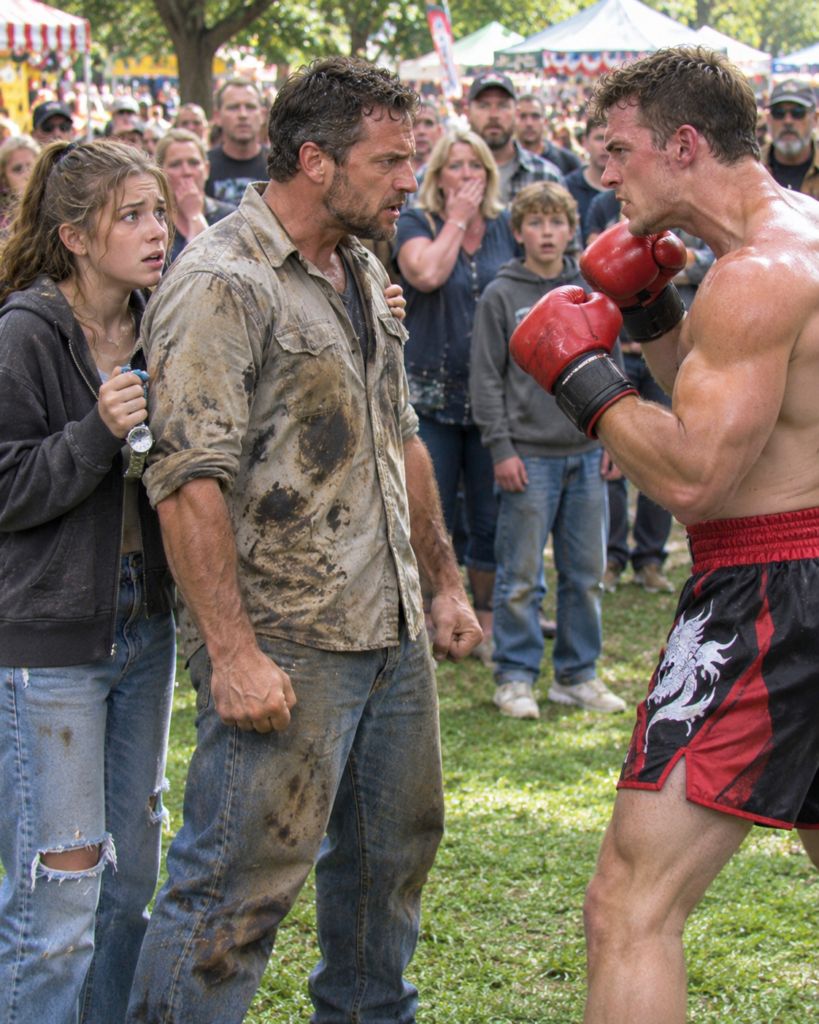
My 16-year-old daughter watched in horror as the town’s arrogant 23-year-old kickboxing champion threw his sparring gloves at my oil-stained boots in the middle of a crowded park.
He laughed, promising to put me on my knees in front of her if I refused to fight him.
He thought my silence meant fear, completely unaware of the dangerous life I’d spent 11 years hiding.
I calmly took off my watch, handed it to my terrified daughter, and stepped onto the grass.
“I’m going to drop you on your knees in front of your daughter.”
The words echoed across the crowded community park. Dozens of families, neighbors, and friends froze, turning to look at the center of the grass.
Standing there was Travis Kessler, a 23-year-old state kickboxing champion, surrounded by four of his gym buddies.
And standing across from him was me—a 40-year-old single father in oil-stained jeans, holding a half-eaten corn dog I’d just bought for my sixteen-year-old daughter, Tessa.
Travis had just thrown a pair of heavy sparring gloves at my boots.
His father, Roland Kessler, had recently moved to our small Washington town and immediately started treating the locals like peasants. Roland had a massive freight company and believed money erased all consequences.
Because of that, his son Travis had never been told “no.”
Travis treated the town like his personal kingdom. He and his friends revved their engines at 2 AM, blocked driveways, and bullied anyone who asked them to keep it down.
I had ignored them.
I ran a motorcycle repair shop, raised my daughter alone, and lived a quiet life by choice.
But Travis mistook my silence for cowardice.
It escalated when Tessa was outside polishing a vintage bike I was restoring. Travis walked by, made a remark she didn’t hear through her headphones, and responded by ripping the headphones off her neck and shoving her into the heavy metal frame of the bike.
I had walked out of the garage, set my tools down, and stepped between them.
I looked the kid in the eye and told him, very calmly, never to touch her again.
Travis had laughed in my face. He looked at my worn-out work shirt and calloused hands and assumed I was a nobody.
A few days later, he returned with a bigger crowd, trying to provoke me again.
When he grabbed me by the collar, I simply shifted my weight, closed my hand around his wrist, and put him on his knees on the concrete in under three seconds.
No punch thrown.
I just let him go and walked away.
Travis told his friends I got “lucky.”
His billionaire father came to my shop the next day, threatening to ruin my business if I ever embarrassed his son again.
And now, here we were at the town festival.
Travis was desperate to prove his dominance in front of an audience.
He looked at Tessa and sneered.
“Your father only acts tough when nobody’s watching. Step up, old man.”
I looked at my daughter.
For eleven years, I had hidden a very specific part of my past from her.
I had hidden the encrypted phone in my workbench.
I had hidden my title as the President of the Black Ridge motorcycle chapter.
I had spent a decade mastering the absolute discipline of walking away from violence, just so she could have peace.
But Travis had crossed the line.
I unclipped my leather watch, the metal still warm from my skin.
I handed it to Tessa.
“Step back,” I told her quietly.
I stepped out onto the open grass. I stopped a few feet from the arrogant champion and gave him one final warning.
“After today, you stay away from my daughter.”
Travis grinned, rolling his broad shoulders. He bounced on his toes and lunged forward.
He was incredibly fast.
He threw a brutal left jab, immediately followed by a right cross, and pivoted into a bone-breaking low kick aimed straight at my leg.
The crowd gasped and flinched back, waiting for the impact to shatter my knee.
Travis’s shin sliced toward my knee with enough force to buckle a fence post.
I moved half a step.
His kick missed by an inch.
Before his foot touched the ground, I caught his shoulder, turned with his momentum, and sent him stumbling past me.
The crowd went silent.
Travis spun around, face burning.
“Lucky again.”
He charged harder.
Jab. Cross. Hook.
I slipped each strike without throwing one of my own.
To everyone watching, it probably looked strange.
To me, it felt painfully familiar.
Eleven years vanished.
Cold warehouses. Midnight rides. Men twice Travis’s size trying to prove something before realizing too late who they had challenged.
Travis roared and launched another kick.
This time, I stepped inside.
My forearm jammed his thigh. My hand caught his wrist. One turn, one shift of weight, and the state champion hit the grass flat on his back.
His friends stopped laughing.
Travis scrambled up, humiliated.
Then he made his mistake.
He glanced at Tessa.
“I’ll deal with her after I deal with you.”
Something inside me went still.
I crossed the distance before he finished smiling.
His punch never landed.
I redirected his arm, swept his leg, and dropped him onto both knees.
Exactly where he had promised to put me.
Gasps rippled across the park.
I held him there without striking him.
“Listen carefully,” I whispered. “You don’t threaten my daughter.”
Travis struggled, but I tightened the hold just enough to remind him he wasn’t getting free.
Then a slow clap came from behind the crowd.
Roland Kessler stepped onto the grass wearing an expensive gray suit.
Beside him stood two sheriff’s deputies.
Roland smiled.
“There. Everyone saw it. Assault.”
Tessa’s face drained of color.
Travis started laughing from his knees.
It had been a trap.
Roland hadn’t come to watch his son win.
He had come to destroy me legally.
One deputy reached for his handcuffs.
Then my workbench phone—the encrypted one I hadn’t touched in years—began ringing inside Tessa’s backpack.
She stared at me.
I stared at the screen.
Only three words appeared.
BLACK RIDGE ARRIVES.
And beyond the festival gates, dozens of motorcycle engines suddenly thundered to life.
The first motorcycle rolled through the festival gates.
Then another.
Then ten more.
Within seconds, the peaceful community park was filled with the deep thunder of approaching engines. Conversations stopped. Children clutched their parents’ hands. People stepped away from the entrance as a long line of black motorcycles entered the grounds.
Tessa stood frozen, clutching my watch in one hand and the encrypted phone in the other.
“Dad…” she whispered. “Who are these people?”
I looked at her.
“People I haven’t seen in a very long time.”
The motorcycles stopped in perfect formation along the edge of the grass.
Their riders dismounted.
Black leather vests. Silver insignias. Weathered faces. Men and women who looked like they had lived through things most people couldn’t imagine.
At the front stood a massive man with a gray beard and a scar running from his left eyebrow to his jaw.
He removed his helmet.
“President,” he called out.
The entire group fell silent.
I hadn’t heard that title spoken aloud in eleven years.
The man walked toward me, ignoring the stunned crowd.
His name was Marcus Hale.
My former vice president.
The man who had stood beside me through eleven years of dangerous operations, long nights, and decisions that had nearly cost us everything.
He looked at Travis on his knees.
Then he looked at the deputy reaching for my wrist.
“Take your hand off him.”
The deputy stiffened.
“Sir, step back. We’re dealing with an assault.”
Marcus glanced at Roland.
“Interesting. Because from where we’re standing, it looks like your son threatened a sixteen-year-old girl, attacked her father, and now you’re trying to have the victim arrested.”
Roland laughed nervously.
“You people need to leave. This is a private matter.”
Marcus smiled without warmth.
“Then you’ll have no problem explaining why your company has been paying certain people to make this man’s life difficult.”
Roland’s expression changed.
For the first time that afternoon, the billionaire looked uncertain.
I released Travis and stepped away.
The deputy immediately grabbed my arm.
“Turn around. Hands behind your back.”
I didn’t resist.
“That’s fine,” I said calmly. “But before you do that, I’d suggest you check your department’s email.”
The deputy frowned.
“What?”
“An evidence package was sent twelve minutes ago. It includes footage from the garage, recordings of the threats made at my business, and the messages your friend Roland sent to his security contractor.”
Roland suddenly stopped smiling.
“That’s fabricated!”
I looked at him.
“Then you should have nothing to worry about.”
Marcus reached into his vest and handed the deputy a small envelope.
“There’s also a witness statement from the man your son paid to damage this father’s motorcycle shop.”
The deputy opened it.
His expression changed as he read.
Behind him, a second deputy pulled out his phone.
“Sergeant,” he said quietly. “You need to see this.”
Within minutes, the atmosphere had completely changed.
The footage showed Travis and two friends vandalizing my garage after midnight. Another recording captured Roland offering a contractor money to intimidate me and force my business to close.
But that wasn’t the worst part.
There was a recording of Roland speaking to someone inside the sheriff’s department.
He was discussing how to manufacture an assault charge against me.
The deputy slowly looked up.
“Mr. Kessler, I’m going to need you to come with us.”
Roland’s face turned red.
“Do you know who I am?”
“Yes, sir,” the deputy replied. “That’s why you’re coming with us.”
Travis finally understood what was happening.
“Dad! Do something!”
Roland didn’t answer.
For the first time in his life, he couldn’t buy his way out of the consequences.
Then Travis looked at me.
“You set this up!”
I shook my head.
“No, Travis. You did. Every threat, every assault, every decision to hurt someone weaker than you was yours.”
He looked around desperately.
His friends had already stepped away from him.
One of them quietly removed his gym jacket.
I turned toward Tessa.
She was still staring at the motorcycles.
“Are they dangerous?” she asked.
I looked at the men and women standing behind Marcus.
“They’ve made mistakes,” I said. “But they’ve also spent years protecting people who couldn’t protect themselves.”
Marcus approached us.
“Boss, we’ve been waiting eleven years for you to call.”
I glanced at the phone.
“I didn’t call.”
He smiled.
“We know. The emergency signal activated when the phone received the threat alert. We promised we’d come if that ever happened.”
Tessa looked at me.
“Eleven years? Dad, what does he mean?”
I took a deep breath.
This was the conversation I’d avoided for more than a decade.
I sat on the edge of a nearby picnic table and motioned for her to sit beside me.
“Before I opened the repair shop, I was the president of Black Ridge. We weren’t just a motorcycle club. We had chapters across several states, and we worked with local authorities to help recover stolen bikes, protect vulnerable families, and expose criminal operations.”
“Then why did you leave?”
I looked down at my oil-stained hands.
“Because your mother died, and I realized I had spent too many years living a life that could eventually take me away from you.”
Her eyes filled with tears.
“You never told me.”
“I know.”
“Did you think I wouldn’t understand?”
“No. I thought you deserved a childhood without worrying about the things I’d seen.”
She looked at the men standing beside their motorcycles.
Then she looked back at me.
“I don’t need you to be someone else, Dad. I just need you to be my dad.”
Those words hurt more than anything Travis could have done to me.
I pulled her into my arms.
“I’m still your dad. That will never change.”
Three weeks later, the town learned the full truth.
Roland Kessler was facing multiple investigations involving witness intimidation, attempted evidence fabrication, and illegal payments to a local contractor. Travis lost his state championship eligibility pending the investigation and was expelled from his kickboxing gym.
Several other victims came forward.
People who had been too frightened to speak finally found the courage to tell their stories.
And my motorcycle shop?
It became busier than ever.
Not because of publicity, but because the community had finally realized the quiet mechanic they’d known for years had never been weak.
He had simply chosen peace.
One Saturday morning, Marcus stopped by with a familiar black leather vest.
He placed it on my workbench.
The silver Black Ridge insignia was still there.
“Your chair is waiting,” he said.
I looked at it for a long moment.
Then I shook my head.
“Not anymore, brother. My priorities have changed.”
He nodded.
“I figured.”
After he left, Tessa walked into the garage carrying two cups of coffee.
She noticed the vest.
“Are you going back?”
I smiled.
“No. I’ve already found what I was looking for.”
She raised an eyebrow.
“What?”
I pointed toward her.
“You.”
She laughed and handed me my coffee.
Outside, the morning sunlight spilled across the motorcycles lined up along the driveway.
For eleven years, I had believed that protecting my daughter meant burying my past.
But that day, I finally understood something.
I didn’t have to become the man I used to be to protect the people I loved.
I only had to remember the man I’d always been.
A father.
And no title, no championship belt, and no amount of money would ever make anyone more powerful than that.