Part 2:
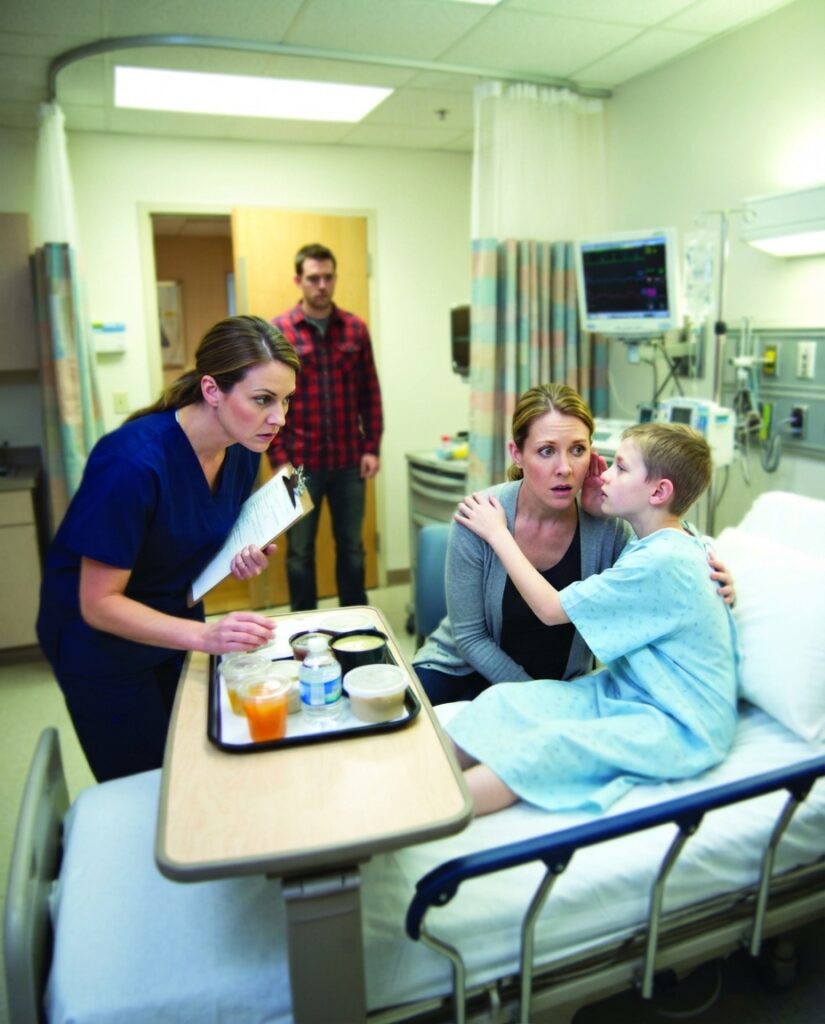
The security supervisor pressed play, and my husband’s explanation changed before the clip even finished.
The video showed him waiting until my footsteps disappeared down the hallway.
Then he walked back to my son’s tray.
The nurse watched without saying a word as the room filled with the sound of the monitor and the quiet movement of the hospital hallway outside.
My husband immediately said the angle was misleading. He said anyone could make something look suspicious if they wanted to.
But the supervisor did not look convinced.
He pulled up the next clip from another time I had left the room.
Same pattern.
My husband waited.
He checked the doorway.
Then he touched the sealed cups.
My son squeezed my hand so tightly his small fingers shook.
That was when I realized this was not just about what had happened in that hospital room.
It was about how long my son had been carrying something he was too afraid to say.
The nurse asked my husband one question: “Why did you keep insisting she leave?”
For the first time, he stopped answering immediately.
He looked at my son instead.
And my son looked away.
My husband tried a different explanation. He said he was only trying to help because I was overwhelmed. He said he was protecting our family from my anxiety.
But the nurse noticed something I hadn’t.
Every time he talked about protecting the family, he was really talking about controlling the room.
The pharmacist returned with the medication review and confirmed again that nothing in my son’s chart explained his reaction to the drinks.
Then my son quietly said something that made everyone stop.
He said there was one more place his father had done it.
Not the hospital.
Not just home.
A place where he thought nobody would question him.
The nurse lowered herself beside the bed and asked my son to tell only what he remembered.
No guessing.
No pressure.
Just the truth.
My son looked at me, then at the sealed cup sitting untouched on the counter.
And he finally told us why he had been afraid to speak sooner.
Part 3:
The room went completely still as my son pressed his cheek against my arm, his small voice trembling beneath the low hum of the heart monitor. He looked past the nurse, past the security guard, directly at his father.
“The thermos,” he whispered, his grip tightening on my sleeve until his knuckles turned white. “In the car. The silver one dad takes to my soccer practices.”
My husband’s posture snapped straight. The rehearsed composure he had maintained since the nurse first spotted the pinholes began to fracture. “He’s confused,” my husband said, his voice rising sharply, dropping the calm, measured tone he used whenever he wanted to make me look unreasonable. “He’s dehydrated and delirious. You’re letting a sick child dictate a police investigation!”
“He isn’t talking to police yet, sir. He’s talking to us,” the nurse replied without breaking eye contact with my son. She signaled to the security supervisor, who immediately stepped between my husband and the bed, creating a firm, physical barrier.
My mind raced backward through the last six months—the unexplained fatigue after weekend games, the nights my son complained of sudden dizziness after drinking the water his father had insisted on packing, the times I had brushed it off as heat exhaustion or stress. Every piece of my son’s failing health began to rearrange itself into a terrifying, deliberate picture.
“He put it in my water before the matches,” my son continued, his chest heaving with silent sobs. “He told me it was special vitamins to make me play better. But every time I drank it, my head felt heavy. And then… when I asked to stop playing, he told me I was just lazy. He said if I told you, you’d think I was weak and leave us.”
The room seemed to lose all air. The psychological weight of what my husband had been doing settled heavily over the room. It wasn’t just physical sedation; it was a systematic effort to break our son’s spirit, to create a dependent, failing child that only he could control, while convincing me I was failing as a mother for not seeing it sooner.
“That silver thermos is in the back of the SUV right now,” I said, my voice eerily calm as the numbness gave way to absolute clarity. I turned to the security guard. “I give you full permission to check my vehicle. The keys are in my bag.”
“You can’t do that,” my husband snapped, taking a step toward me, but the guard held his ground, placing a heavy hand on his shoulder. “It’s my car too. You’re overreacting, just like you always do!”
“No,” I said, looking him dead in the eye for the first time in years without an ounce of self-doubt. “I am finally reacting.”
Within twenty minutes, local law enforcement arrived at the hospital room. The nurse had already bagged the punctured liquid lids from the lunch tray as evidence, documenting the exact physical state of the unopened meals. The officers took my husband out into the hallway to question him separately, his angry protests echoing down the quiet corridor until the double doors swung shut.
A female officer stayed in the room, gently recording my son’s statement while a pediatric specialist was brought in to perform a comprehensive toxicology screen—something the hospital hadn’t run earlier because they had assumed his symptoms were viral.
As the needle was prepared for the blood draw, my son flinched, but he didn’t hide. He held my hand, looking into my eyes.
“I’m sorry, Mom,” he whispered, tears finally spilling over his lashes. “He said you were too tired to deal with me.”
“You never have to apologize for protecting yourself, sweetie,” I murmured, kissing his forehead, holding back my own tears so he could see only strength in me. “You saved your own life today. And you saved mine.”
The toxicologist’s preliminary report returned late that night. The fluids contained high concentrations of a prescription sedative—one that had been prescribed to my husband months ago for insomnia, which he had claimed to have lost. It was a medication that, when administered continuously in small doses to a child, caused chronic lethargy, nausea, severe abdominal distress, and cognitive fog.
He wasn’t trying to kill our son outright. He was keeping him sick—sick enough to keep me locked in a state of perpetual anxiety, isolated from my job, fully dependent on my husband’s ‘support,’ and too exhausted to question where our marriage was going.
The formal arrest took place in the hospital lobby. I watched from the third-floor window as they led him to the back of a cruiser in handcuffs. He didn’t look back.
The next morning, the sun broke through the heavy hospital blinds, illuminating a tray of fresh food that had been brought up under strict protocol—sealed directly in front of me by the head dietician.
My son sat up in bed. For the first time in weeks, the dark circles under his eyes seemed lighter. He looked at the bowl of warm oatmeal, then looked at me.
“Is it safe?” he asked softly.
I picked up the spoon, took a small bite myself, and smiled at him. “It’s completely safe. We’re both safe now.”
He took the spoon from my hand and ate.
The battle ahead would be long—court dates, custody battles, and healing the deep emotional scars left behind by a man who was supposed to protect us. But as I watched my son finish his meal, the steady beep of the heart monitor felt less like a warning, and more like the rhythm of our new beginning.
Epilogue:
Two years later, the silence in our house no longer felt like a threat.
It was a bright Saturday morning, and the smell of toasted bread and fresh fruit filled the kitchen—a room that had once been a battleground of quiet terror and unaddressed anxiety.
My son was sitting at the wooden dining table, his hair still wet from a morning shower, flipping through a notebook filled with sketch ideas for his art club. The dark circles under his eyes were completely gone, replaced by the healthy color of a boy who slept deeply, woke up hungry, and lived without fear.
The criminal trial had ended eight months ago. The forensic evidence—the pin-punctured seals, the surveillance footage, the laboratory reports analyzing the silver thermos, and the medical records—had left my ex-husband’s defense team with no ground to stand on. He was currently serving a multi-year sentence for child endangerment and poisoning, stripped of all parental rights, and barred by a permanent restraining order.
The process had been exhausting. There were depositions, psychological evaluations, and agonizing afternoons spent in cold courtroom corridors. But through every step, I remained beside my son, making sure he knew his voice was the powerful force that had finally freed us both.
A soft knock at the front door broke the morning quiet. It was the mail carrier dropping off a small package—a set of professional sketch pens my son had been saving up for.
He unboxed them eagerly, immediately uncapping a fine-tip marker to draw on the clean white page. As I set a glass of fresh orange juice beside his arm, he looked up at me, his eyes clear and calm.
He didn’t inspect the glass. He didn’t check the rim or look for tiny punctures. He simply smiled, picked up the glass, and took a drink.
“Thanks, Mom,” he said softly.
I leaned down and kissed the top of his head, resting my hand on his shoulder. “Always, sweetie.”
We had built a new life from the ground up, grounded in absolute trust and transparency. The hospital monitor that had beeped incessantly two years ago was a distant memory, replaced now by the simple, steady rhythm of a peaceful home. We were no longer surviving; we were finally living.