PART 2
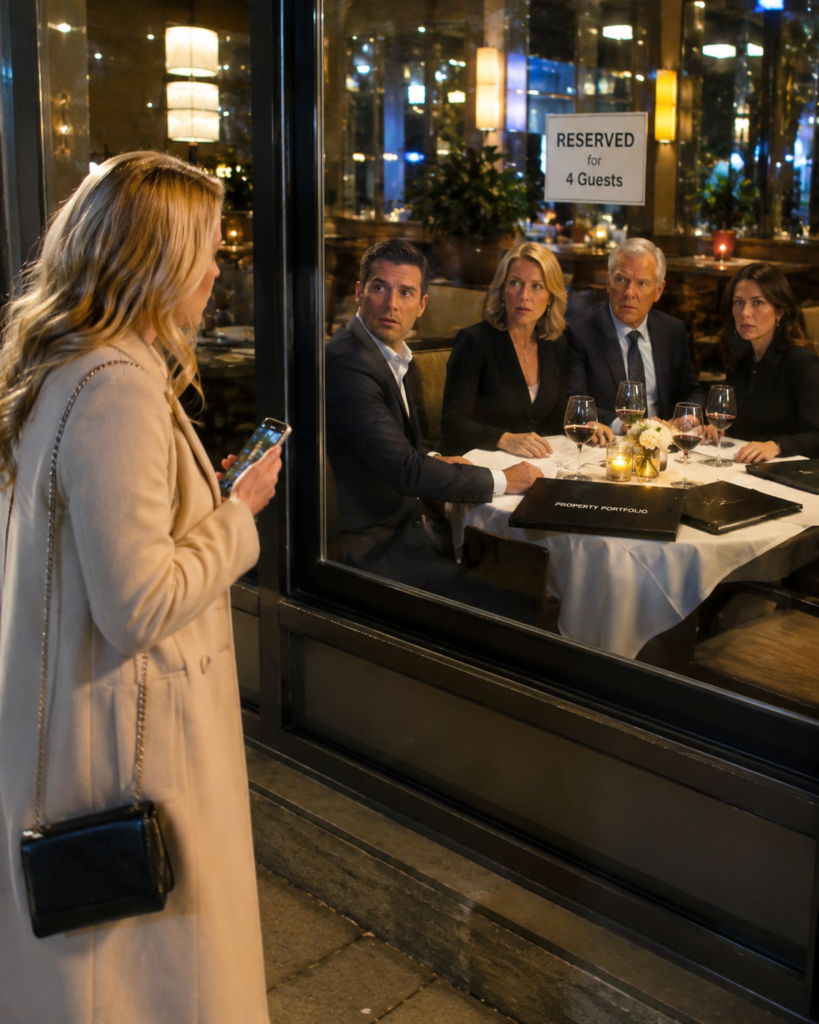
I did not find another woman at our anniversary restaurant. I found my husband, his sister Maren, her husband, and a realtor.
The realtor had a folder open between them. Grant stood when he saw me.
“Eliza.”
I looked at the four place settings. “So this is the dinner you canceled.”
Maren closed her eyes. The realtor began gathering papers.
I said, “Please don’t. I want to know what house we’re selling.”
Grant answered. “The lake cabin.”
That closed one question and opened a much worse one.
The cabin on Lake Cumberland had belonged to Grant and Maren’s father. When he died, he left it equally to both children.
Legally, it was theirs. Emotionally, I had spent twenty-four summers there.
Our children learned to swim from that dock. I painted the kitchen twice. Grant and I celebrated anniversaries there when money was tight.
For years, Maren had wanted to sell. I always asked Grant to wait.
Then the roof estimate came in. Twenty-six thousand dollars.
The septic system was also near the end of its life.
Maren said quietly, “I can’t keep paying half for a place I use six days a year.”
I looked at Grant. “Why didn’t you tell me?”
“I did.”
He had.
Three months earlier, he mentioned the roof over breakfast. I said, “We are not selling Dad’s place over a roof.” Then I left for work.
Two weeks later he tried again. I said we could discuss it after summer.
Apparently “after summer” had become my way of ending conversations I did not want.
That did not excuse this dinner.
Grant admitted he told Maren they would meet with a realtor first, get real numbers, then bring the decision to me.
“Bring the decision to me?”
He heard it too late.
Maren said, “Eliza, I thought you knew we were meeting.”
I believed her.
Then she added something I did not expect.
“I’ve been afraid to bring this up around you since Owen moved away.”
Our youngest son had taken a job in Oregon the previous year.
The cabin had become the place I kept talking about everyone “coming back to.”
Maren had noticed before I had.
The cabin was no longer only a property problem. I had been using it as proof that our family still had a center.
Grant had hidden the sale conversation because he was tired of fighting that grief.
Neither of us had actually been talking about the roof.
PART 3 – ENDING
I did not stay for dinner.
That was my first decision.
Grant followed me onto the sidewalk.
“Eliza.”
I kept walking until we were far enough from the restaurant windows that Maren and Todd would not have to pretend they weren’t watching.
Grant said:
“I know this looks bad.”
“It doesn’t look bad.”
He waited.
“It is bad.”
He accepted that.
Good.
I asked:
“When were you going to tell me?”
“Tonight.”
I laughed.
“After you canceled our anniversary?”
“No. Tomorrow.”
“That’s better?”
“No.”
At least he had stopped trying to win individual sentences.
I leaned against a stone planter.
“Why Bell & Vine?”
He looked embarrassed.
“The realtor was only in town tonight. Maren suggested someplace near her hotel.”
“And you already had a reservation.”
“Yes.”
“So you changed our table for two into their table for four.”
He nodded.
That detail hurt more than it should have.
Not because restaurants are sacred.
Because changing the number was easy.
Two became four.
Wife disappeared.
Business conversation took her place.
Grant said:
“I should have canceled and booked somewhere else.”
“That is not the lesson.”
“I know.”
“Do you?”
He looked at me.
“The lesson is you knew I would object, so you decided to collect enough information that my objection would become harder.”
He didn’t answer.
That was answer enough.
Then he said:
“Every time I bring up selling, you shut the conversation down.”
“Because I don’t want to sell.”
“Maren does.”
That stopped me.
Of course.
Grant and Maren each owned half.
I had spent years talking as though keeping the cabin required only my emotional permission.
“What does she actually want?”
“Out.”
“Because of money?”
“Partly.”
Maren and Todd were not struggling.
That mattered.
No secret foreclosure.
No giant medical debt.
No emergency.
She simply no longer wanted to spend thousands every year maintaining a property she rarely used.
Her children lived in Texas and Virginia.
Neither cared about keeping it.
Todd preferred camping.
Maren had started resenting every storm because storms meant somebody needed to drive to Kentucky and check the roof.
Grant said:
“She told me last Christmas she wanted to sell her share.”
“I never heard that.”
“Because she told me.”
“Why not me?”
He hesitated.
“Because the last time she mentioned selling, you said Frank would be heartbroken.”
I remembered.
I had said it.
At Thanksgiving.
Maren had gone quiet.
I thought the subject was finished.
Apparently she thought I had made her dead father a witness for the prosecution.
That was unfair.
I knew it immediately.
I said:
“I shouldn’t have said that.”
Grant nodded.
Then I looked at him.
“Still doesn’t make your lie okay.”
“I know.”
Good.
We drove home separately.
That mattered too.
I needed one hour without processing marriage beside the person I was angry with.
At home, Grant slept in the guest room.
Not because I ordered him there.
He chose it.
Another useful distinction.
The next morning, I went to work.
Grant did too.
We did not solve the cabin before coffee.
That would have been ridiculous.
That evening, Maren called me.
I almost declined.
Then answered.
She started:
“I’m sorry about yesterday.”
“I don’t think the secret meeting was your idea.”
“It partly was.”
Fair.
She had pushed Grant to meet Carol because another roofing season was coming and she wanted actual numbers.
She genuinely believed I knew there would be a meeting, just not the exact evening.
Grant had told her:
“I’ll talk to Eliza.”
He had not said:
“Eliza agreed.”
Important difference.
Maren said:
“I don’t hate the cabin.”
“I know.”
“I hate feeling trapped by loving Dad.”
That sentence sounded familiar.
She told me she had wanted to sell three years earlier.
Then every conversation became memory.
Dad built the dock.
Dad loved mornings there.
Dad wanted the grandchildren to have it.
All true.
But Frank had also complained about property taxes.
Sworn at the septic pump.
Threatened to sell twice after the roof leaked.
Dead people become more sentimental than they were alive.
Maren laughed when she said that.
So did I.
I asked:
“Do you need your half of the money?”
“No.”
That made the problem clearer.
She did not need rescue.
She wanted freedom from ownership.
I had been treating those as the same thing.
“What if Grant bought you out?”
“He mentioned it.”
“Can we afford that?”
“You should ask Grant.”
Good answer.
I did.
We could.
Technically.
It would mean using a large portion of our liquid savings and then paying for the roof, septic system, insurance, taxes, dock repairs, and whatever came next.
I looked at the spreadsheet.
For the first time, I let the numbers finish speaking before I brought up Frank.
The cabin cost more each year than I had admitted.
Not ruinous.
Enough.
Then Grant said:
“I don’t want to buy Maren out.”
I looked at him.
That surprised me more than the numbers.
“You don’t?”
“No.”
“Why?”
He took a long time.
Then:
“Because I’m tired too.”
I sat back.
He loved the cabin.
He also dreaded it.
Every spring:
Open the water.
Check the dock.
Call the insurance company.
Clean gutters.
Every fall:
Drain lines.
Shut everything down.
Drive three hours each way because somebody had to do it.
I had done some of that.
Grant had done most.
Another invisible division of labor hiding beneath sentiment.
“I thought you wanted to keep it.”
“I wanted you not to be hurt.”
There it was.
Not the same thing.
I asked:
“So you lied about dinner because you were protecting me?”
“No.”
He shook his head.
“I lied because I was avoiding you.”
Better.
Ugly.
Accurate.
We did not decide that night.
Instead, two weekends later, Grant and I drove to the cabin.
No Maren.
No realtor.
No children.
Just us.
The place looked smaller than I remembered.
Maybe family homes do that when children leave them.
The bunk room still had two twin beds.
Owen’s old Louisville Cardinals cap was hanging from one post.
I touched it.
Then immediately felt foolish.
He was twenty-seven and living in Portland.
He owned other hats.
Grant opened the kitchen cabinets.
Three chipped mugs.
A dozen plastic plates.
Canned soup that had expired the previous winter.
I said:
“We’ve turned this place into a museum.”
Grant leaned against the counter.
“You have.”
I looked at him.
He winced.
“Sorry.”
“No.”
I looked around again.
“You’re right.”
That did not mean I wanted to sell.
It meant I finally understood what I was protecting.
Not the building.
Possibility.
The idea that one summer our daughter would bring her family.
Owen would fly in.
Everyone would occupy the same rooms again.
Life would reverse direction for a weekend.
Maybe that would happen once.
Maybe not.
Keeping a property did not create the people.
That was harder to admit.
Grant and I called both children that evening.
Not to ask whether we should sell.
That would have transferred the decision again.
We asked:
“Is there anything here you actually want?”
Our daughter wanted Frank’s old tackle box.
Owen wanted the ridiculous metal coffee percolator from the stove.
I almost laughed.
“You hated that coffee.”
“Grandpa loved it.”
Fair.
Neither wanted furniture.
Neither wanted ownership.
Neither said:
Please don’t sell our childhood.
That story had mostly been mine.
We agreed to list the cabin.
Not immediately.
Maren gave us six weeks to clear personal things before photographs.
No rush.
No punishment.
Grant called Carol.
This time I was in the room.
I did not need legal approval over his inherited property.
I did need marriage-level honesty when its costs and meaning had occupied our life for twenty-five years.
Grant seemed to understand the distinction now.
The cabin took four months to sell.
Not overnight.
The first offer fell through after inspection.
I almost treated that as a sign from Frank.
Then caught myself.
The second buyers were a couple with two young boys.
I never met them.
That was probably better.
At closing, Grant and Maren divided the proceeds.
Grant’s share stayed in his separate inherited-property account until we spoke with our financial adviser.
That had always been the legal structure.
I had never paid much attention before.
The marriage did not need ownership blurred to prove closeness.
The week after closing, a cardboard box arrived from Owen.
Inside was the old percolator.
I called him.
“You were supposed to take this.”
“I changed my mind.”
“Why?”
“My apartment stove is induction.”
I laughed.
Of course.
“What am I supposed to do with it?”
“Make terrible coffee.”
I put it in a cabinet.
Not on display.
A kitchen object.
Not a shrine.
Grant and I eventually celebrated our twenty-fifth anniversary three months late.
Not at Bell & Vine.
Neither of us wanted to go back yet.
We chose a little Italian place near our house.
No history attached.
When we arrived, the hostess looked at Grant.
“Reservation?”
He gave our name.
She checked the tablet.
“Table for two?”
Grant opened his mouth.
Then looked at me.
Not dramatically.
Just waiting.
I said:
“Two.”
She picked up the menus.
We followed her.