My mother forced my six-year-old adopted daughter to scrub everyone’s dirty dishes on Christmas while her “real” granddaughters opened expensive presents in the next room. When I confronted her, my father said Renata needed to remember she wasn’t really one of us. But when I reached for a mysterious envelope from a law firm, Mom screamed, “Mauricio, don’t open that!”
And the terror in her eyes told me this was about something far darker than family favoritism.
I heard my mother’s voice before I entered the kitchen.
“Scrub harder, little one. You’re not here to decorate.”
I stopped in the doorway.
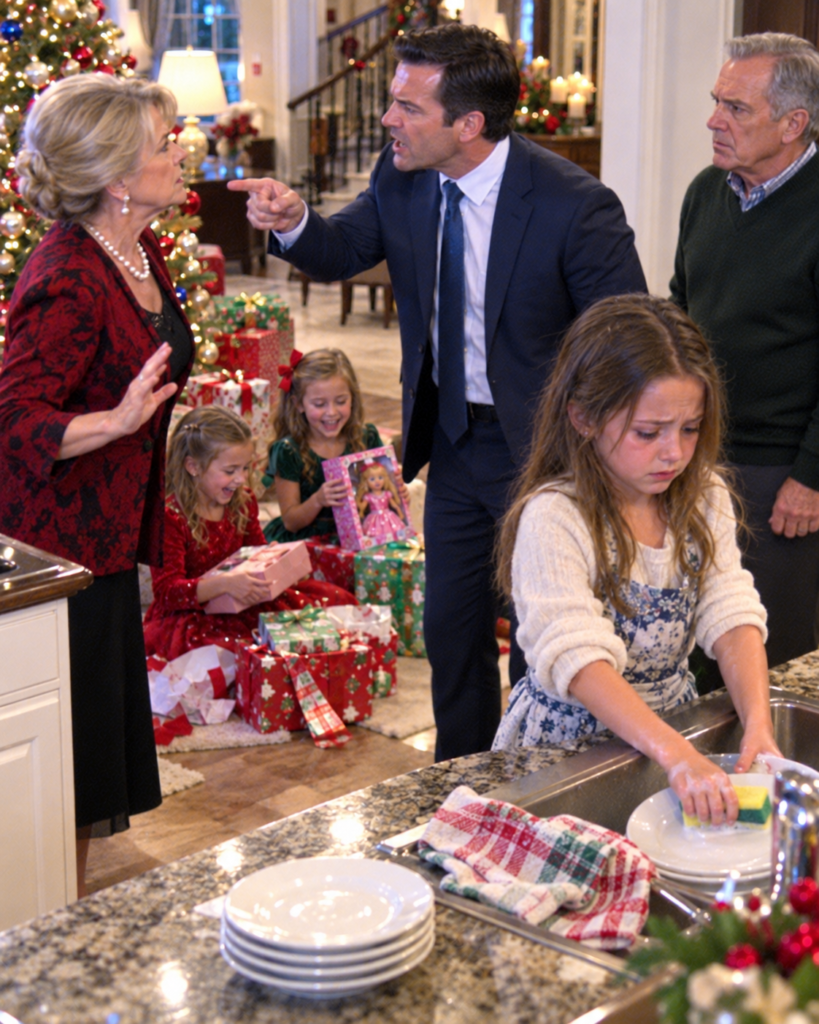
My daughter Renata stood on a wooden stool, struggling to wash a mountain of greasy dishes. Her sleeves were soaked, her tiny hands red from the hot water.
Across the hallway, her cousins Sofia and Emma were laughing beneath the Christmas tree, surrounded by expensive presents.
“Renata.”
She turned.
“Daddy!”
The relief in her voice nearly broke me.
My name is Mauricio DeLuca. Powerful men have lowered their voices around me, but nothing had ever made me feel as helpless as seeing my little girl standing at that sink.
I looked at my mother.
“Why is my daughter washing everyone’s dishes?”
Carmen continued polishing a crystal glass.
“No one lives for free here.”
“She’s six.”
“She’s old enough to learn responsibility.”
My father appeared behind her.
“Mauricio, don’t make a scene.”
“Then explain why Sofia and Emma are opening presents while Renata works.”
He glanced at my daughter.
“Paola’s girls are our real granddaughters. Renata needs to understand the difference.”
The room went silent.
I had adopted Renata when she was two.
My family had always whispered about bloodlines and inheritance.
But I thought they understood one thing.
Renata was my daughter.
She climbed down from the stool and wrapped her arms around my leg.
“Daddy, did I do something bad?”
I lifted her immediately.
“No, sweetheart. You did nothing wrong.”
Then I remembered the drawing folded inside my coat.
Renata had drawn our entire family.
Grandma. Grandpa. Sofia. Emma. Me.
But she had drawn herself standing far away from everyone else.
I had thought it was childish imagination.
Now I understood.
Or at least I thought I did.
Because as I carried her toward the hallway, I noticed the closed door of my private study.
A sealed envelope from a law firm had arrived that morning.
I hadn’t opened it.
The letter mentioned Renata’s adoption records and requested an urgent private meeting.
Until that moment, I’d assumed it was routine paperwork.
Now I wasn’t so sure.
I reached for the study door.
Behind me, my mother suddenly shouted.
“Mauricio, don’t open that!”
I turned.
Her crystal glass was trembling in her hand.
My father had gone completely pale.
“Why?” I asked.
Neither answered.
Then Renata leaned toward my ear.
“Daddy?”
“Yes, sweetheart?”
“Grandma already opened that letter.”
My blood ran cold.
I looked at Carmen.
And for the first time, she couldn’t meet my eyes.
I closed the study door behind us and placed Renata gently on the sofa.
“Sweetheart, did Grandma say anything about the letter?”
She nodded.
“She said if you read it, you might not want me anymore.”
My chest tightened.
I kissed her forehead.
“Nothing in that envelope could ever change who you are to me.”
Then I broke the seal.
Inside were adoption records, a photograph, and a letter from attorney Samuel Price. The first sentence made my hands tremble.
Mr. DeLuca, new evidence suggests your daughter’s biological mother was deliberately misidentified.
I looked at Carmen.
“What does this mean?”
My father stepped forward.
“Mauricio, put it away.”
I ignored him and unfolded the photograph.
A young woman stood outside our family estate, holding a newborn wrapped in a pink blanket.
I recognized her immediately.
Elena Rossi.
My former fiancée.
The woman my parents claimed had abandoned me seven years earlier.
My mother sank into a chair.
“Elena had a baby?” I whispered.
Carmen began crying.
“We thought we were protecting you.”
I turned to the next page. The lawyer had included a copy of Elena’s final letter, written shortly before her death.
Please tell Mauricio our daughter deserves to know her father.
My heart pounded.
Renata looked up at me.
“Daddy, why are you crying?”
I pulled her close, unable to speak.
For four years, I had believed I was raising someone else’s child.
But the letter claimed Renata was mine.
Then my phone rang.
Samuel Price.
“Mr. DeLuca,” he said urgently, “have you opened the envelope?”
“Yes.”
“Then listen carefully. Your parents weren’t the only people involved in hiding Renata’s identity.”
I stared at Carmen.
The attorney continued.
“Someone recently requested that Renata’s adoption be overturned. And the person who filed that petition claims to be her biological mother.”
My breath stopped.
“Elena is dead.”
There was a long silence.
“Mr. DeLuca,” he said, “that’s exactly what your parents told us seven years ago.”
PART 2
For several seconds, I couldn’t move.
The words Samuel had just spoken seemed to echo through my study.
That’s exactly what your parents told us seven years ago.
I looked down at Renata.
She was sitting beside me, holding the little stuffed rabbit she had received for Christmas. Her eyes moved between my face and the adults standing in the room.
She didn’t understand what was happening.
And I prayed she wouldn’t have to understand it anytime soon.
I lifted the phone closer to my ear.
“Samuel, I want you to explain everything. Slowly. And I want the truth this time.”
He exhaled.
“Seven years ago, Elena Rossi gave birth to a baby girl at St. Mary’s Hospital. The hospital records initially listed you as the father. However, three days later, a woman identifying herself as Elena’s legal representative submitted documents claiming that Elena had died during childbirth and that the baby had no surviving father.”
“That’s impossible. I never received any notification.”
“I know. Your signature appears on a document acknowledging that you had been informed of the situation, but our preliminary investigation suggests it was forged.”
I turned toward my father.
His face had lost every trace of color.
“Who signed it?” I asked.
Samuel hesitated.
“Your father.”
I slowly lowered the phone.
My father looked at me.
“Mauricio, listen—”
“Don’t.”
My voice was quiet, but it stopped him.
I turned back to Samuel.
“What happened to the baby?”
“According to the records, she was placed in temporary care before being transferred to an adoption agency. Four months later, you received information about an abandoned child who needed a permanent home.”
I looked at Renata.
Four years ago, I had walked into a small adoption office and seen a little girl sitting alone with a stuffed rabbit.
She had enormous brown eyes and a habit of holding her breath whenever an adult approached.
The social worker told me she had been abandoned shortly after birth.
I remembered asking whether anyone had ever come looking for her.
The answer had been no.
I remembered signing the adoption papers.
I remembered bringing her home.
And I remembered the first night she slept in my arms without waking up crying.
I had thought I was giving a lonely child a family.
I had never imagined that someone had deliberately placed my own daughter in front of me while keeping the truth hidden.
“Samuel,” I whispered, “are you telling me Renata is Elena’s daughter?”
“Yes. The DNA evidence included in the latest filing strongly supports that conclusion. We are arranging an independent confirmation, but there is something else.”
“What?”
“The woman who filed the petition claims Elena is alive.”
I stared at the phone.
“Who filed it?”
“Her name is Elena Rossi.”
I felt the floor shift beneath me.
“No. I saw her funeral announcement. My parents showed me the death certificate.”
“Mr. DeLuca, the death certificate we located appears to contain inconsistencies. The hospital where Elena supposedly died has no matching patient record.”
I closed my eyes.
For seven years, I had mourned a woman who might never have died.
I had believed she abandoned me.
I had believed she chose to disappear.
I had even hated myself for not being able to save her.
And all that time, my parents had apparently known something I didn’t.
I ended the call after arranging an immediate meeting with Samuel.
Then I turned toward my father.
“Tell me what you did.”
He rubbed his forehead.
“You don’t understand the circumstances.”
“Then explain them.”
My mother suddenly stepped forward.
“Mauricio, your father made a terrible decision, but he did it for the family.”
I looked at her.
“You made a six-year-old girl wash dishes while her cousins opened Christmas presents. Don’t tell me anything about family.”
Carmen flinched.
My father finally spoke.
“Elena was never suitable for you.”
I stared at him.
“What?”
“She came from an ordinary family. She had no connections, no money, and no understanding of the responsibilities that came with marrying into this family.”
I almost laughed.
Not because anything was funny.
Because I suddenly understood how little my parents had ever known me.
“You separated me from the woman I loved because she wasn’t wealthy enough?”
My father shook his head.
“It was more complicated.”
“Then make it simple.”
He looked at Carmen.
She began crying again.
Finally, my father sat down.
“Elena became pregnant. When she told us, we offered to arrange everything privately. We told her the child would have a better future if she stayed away from you.”
My hands tightened.
“You offered her money?”
“She refused.”
“How much?”
“Five hundred thousand dollars.”
My stomach turned.
“And when she refused?”
My mother answered this time.
“She threatened to tell you everything. She said she would take the baby and come to you.”
I looked at her.
“So you stopped her.”
“We were trying to prevent a scandal.”
“You stole my daughter.”
My father stood.
“Watch your words.”
“No. You watch yours.”
I stepped closer.
“You forged my signature. You falsified records. You told me the mother of my child was dead. You allowed me to adopt my own daughter without telling me who she was.”
My voice broke.
“And then you treated her like she was nothing.”
My mother covered her mouth.
I continued.
“Was that part of your plan, too? Making sure she never felt welcome in this family?”
Carmen shook her head.
“We never expected you to become so attached.”
For a moment, I couldn’t breathe.
So attached.
As if loving Renata had been an inconvenience.
As if the little girl sleeping in my house, calling me Daddy, and drawing pictures of us together was somehow a mistake.
I turned away.
“Get out.”
My father looked offended.
“This is our home.”
I stared at him.
“No. This is my house. I purchased it, and I pay every bill. You and Mother are guests here.”
“Mauricio—”
“You have ten minutes to leave.”
My mother began sobbing.
“But it’s Christmas.”
I looked toward Renata.
She was watching us silently.
“Yes,” I said. “It is Christmas. And my daughter deserves to spend it somewhere she doesn’t have to earn her place.”
My father reached for his coat.
But before he could leave, Renata spoke.
“Grandpa?”
He stopped.
She held her rabbit against her chest.
“Am I still allowed to be in the family picture?”
Nobody moved.
My father looked at her.
My mother began crying harder.
I knelt beside Renata.
“You don’t have to ask anyone for permission to belong, sweetheart.”
She looked at me.
“Even if I’m not a real granddaughter?”
My throat tightened.
I held her face gently between my hands.
“You are my real daughter. That’s the only thing that matters.”
Then I picked her up and carried her upstairs.
I didn’t look back.
That evening, I put Renata to bed.
She had fallen asleep holding my hand, but every time I tried to move away, her little fingers tightened around mine.
I stayed beside her for nearly an hour.
When I finally went downstairs, my phone showed seventeen missed calls from my mother.
There were also three messages from my father.
The first said I was overreacting.
The second said I was allowing an outsider to destroy our family.
The third was different.
If you meet Elena, you will regret what you discover.
I read it twice.
Then I forwarded it to Samuel.
He replied almost immediately.
Do not respond. I have something you need to see.
Twenty minutes later, he arrived at my house carrying a thick leather folder.
I brought him into my study.
He placed the folder on the desk and opened it.
Inside were hospital records, bank statements, adoption documents, and photographs.
“Where did you get these?” I asked.
“An independent investigator recovered them from an archive connected to the original adoption agency.”
He pointed to a bank statement.
“Seven years ago, a company controlled by your father transferred $500,000 into an account belonging to an intermediary. The money was subsequently divided between two recipients.”
I leaned closer.
“One was the hospital administrator who processed the false death certificate.”
“And the other?”
Samuel looked at me.
“Your mother.”
I felt sick.
“Why would she receive money?”
“We believe she was involved in arranging the transfer of the baby into the adoption system.”
I stared at the documents.
There was another photograph.
It showed Carmen standing outside a hospital entrance, holding a baby carrier.
The date was visible in the corner.
December 18.
Renata’s birthday.
My mother had been there.
She had held my daughter before I ever knew she existed.
“Did she know who the baby was?”
Samuel nodded.
“The records suggest she knew from the beginning.”
I sat down.
For four years, Carmen had visited my house.
She had brought Renata birthday cakes.
She had watched her learn to walk.
She had taken photographs of her first day at school.
And every time she looked into that little girl’s face, she knew exactly whose child she was.
“Why?” I whispered.
Samuel closed the folder.
“There’s one more document.”
He handed me a photocopy of a letter.
The handwriting was unfamiliar.
The date was seven years earlier.
To Mr. and Mrs. DeLuca,
I have done what you asked. The hospital records have been altered, and the child has been transferred to the adoption agency.
However, Elena knows the truth. She has not accepted the money, and she has threatened to return.
You should understand that this situation may not remain hidden forever.
There was no signature.
But Samuel pointed to the bottom of the page.
A handwritten notation appeared beneath the letter.
Payment completed. Ensure the child never returns to the family under her mother’s name.
I felt something inside me break.
“Who wrote this?”
“We’re still investigating. But we found a second letter.”
He handed it to me.
This one had a signature.
Carmen DeLuca.
I stared at my mother’s name.
Then I heard footsteps behind me.
Renata stood in the doorway wearing her pink pajamas.
“Daddy?”
I immediately folded the paper.
“What are you doing awake, sweetheart?”
She rubbed her eyes.
“I had a bad dream.”
I walked toward her and lifted her into my arms.
“What happened?”
She rested her head on my shoulder.
“I dreamed Grandma was taking me away.”
I held her tighter.
“No one is taking you anywhere.”
She was quiet for a moment.
Then she whispered something that made my heart stop.
“Daddy, if my first mommy comes back, will you still love me?”
I looked at Samuel.
He quietly gathered his papers and stepped out of the room.
I carried Renata to the sofa and sat down.
I brushed the hair away from her forehead.
“Sweetheart, listen to me. Love isn’t something that runs out because another person comes into your life.”
She looked uncertain.
I continued.
“You can love your first mommy. You can want to know her. You can miss her. And you can still be my daughter. Nothing changes that.”
“Promise?”
I kissed her forehead.
“Forever.”
She rested her head against my chest.
A few minutes later, she fell asleep.
I sat there holding her, staring at the closed study door.
For the first time in years, I understood that I wasn’t simply fighting to uncover the truth about Elena.
I was fighting to protect a little girl who had already been abandoned once.
And I would never allow anyone to make her feel unwanted again.
The following morning, Samuel called.
“Elena wants to meet you.”
I stood by the kitchen window.
“Where?”
“An address in Westbrook. She requested that Renata not be present for the first meeting.”
I looked toward the living room.
Renata was coloring at the coffee table.
“What does she want?”
“To explain why she disappeared.”
I was silent.
Then I asked the question that had haunted me all night.
“Does she know Renata is with me?”
“Yes. She’s been trying to contact you for months.”
“Why didn’t she contact me directly?”
Samuel hesitated.
“Because someone threatened her.”
My blood ran cold.
“Who?”
“We have reason to believe your father knew she was alive and had people monitoring her movements.”
I looked down at my phone.
Another message from my father had arrived.
You are making a mistake. Some secrets should remain buried.
I deleted nothing.
Instead, I sent a screenshot to Samuel.
Then I looked at my daughter.
“Sweetheart, would you like to visit the aquarium tomorrow?”
Her face brightened.
“Really?”
“Really.”
She ran toward me and wrapped her arms around my waist.
I smiled.
But inside, I was preparing to meet a woman I had spent seven years believing was dead.
A woman who had given birth to my daughter.
A woman whose disappearance had shaped my entire life.
And I had no idea whether I would leave that meeting with answers or with even more questions.
The address Samuel gave me belonged to a small house on a quiet residential street.
It wasn’t the kind of place I expected Elena to live.
There were no security gates, no expensive cars, and no elaborate landscaping.
Just a modest white house with a small garden and a wooden bench beneath the window.
I parked outside.
For several minutes, I couldn’t bring myself to get out.
Then the front door opened.
A woman stepped onto the porch.
Her hair was shorter.
Her face was thinner.
There were faint lines around her eyes that hadn’t been there seven years earlier.
But I recognized her immediately.
Elena.
She took one step toward me.
“Mauricio.”
My name sounded different coming from her.
I stood beside the car, unable to move.
“You’re alive.”
Tears filled her eyes.
“Yes.”
I looked at her.
“Why?”
She lowered her head.
“I tried to come back.”
“Seven years, Elena. Seven years.”
“I know.”
“You let me believe you were dead.”
“I didn’t have a choice.”
I laughed bitterly.
“You always had a choice. You could have called me. You could have written. You could have sent someone.”
“I did.”
I stopped.
“What?”
She wiped her eyes.
“I sent letters. I called your office. I went to your father’s house twice. Every time, someone told me you didn’t want to hear from me.”
“That isn’t true.”
“I know that now.”
She reached into her coat and pulled out a small envelope.
It was old and worn.
On the front was my name.
Mauricio.
“I wrote this the night I left the hospital.”
She handed it to me.
My hands trembled as I opened it.
My love,
Our daughter is beautiful. She has your eyes and the same little wrinkle between her eyebrows when she sleeps.
Your parents have told me you don’t want us. I don’t believe them, but they have taken everything from me. They say I will never see our daughter again if I try to contact you.
I am afraid, Mauricio. But I need you to know that I never abandoned her.
Please find her.
Please don’t let her grow up believing she wasn’t wanted.
I lowered the letter.
Elena was crying.
I couldn’t speak.
Then she said something that made me look up.
“I didn’t know they had placed her with you.”
I stared at her.
“What?”
“I knew they had taken her. I knew they had arranged an adoption. But I was told the family who adopted her lived overseas. I spent years trying to locate her.”
She swallowed.
“Last year, I found an old photograph from the adoption agency. I recognized your name on a document in the background.”
My heart pounded.
“You found out I was raising her?”
“Yes.”
“Why didn’t you come immediately?”
“Because your father sent me a message.”
She pulled another paper from her bag.
It was a printed email.
The sender’s address belonged to a company connected to my father’s business.
The message contained a photograph of Renata leaving school.
Underneath it were four words.
Stay away from her.
I felt my hands turn cold.
Elena continued.
“He said if I tried to contact you or the child, he would have me arrested for kidnapping. He claimed the adoption was legal and that I had no rights.”
I looked at the photograph.
It had been taken outside Renata’s school.
Someone had been watching her.
For how long?
“Why did you file the petition now?”
Elena took a shaky breath.
“Because I received a letter from the adoption agency saying someone had requested to change Renata’s original records. I thought they were finally correcting the truth.”
She looked at me.
“I never wanted to take her away from you, Mauricio.”
I stared at her.
“You don’t know what she has been through.”
“I know.”
“No, you don’t.”
My voice rose.
“She asks me every night whether I still love her. She thinks she has to earn her place in this family. My mother made her wash dishes on Christmas while her cousins opened presents.”
Elena covered her mouth.
“What?”
“She told Renata she wasn’t a real granddaughter.”
Elena began to cry.
I looked away.
For a moment, neither of us spoke.
Then she asked quietly:
“Can I see her?”
I closed my eyes.
I had imagined this moment countless times.
But in every version, Elena was a memory.
Now she was standing in front of me, asking to meet the little girl I had raised as my own.
“I need to think about it.”
She nodded.
“Of course.”
I turned toward my car.
Then she spoke again.
“Mauricio?”
I stopped.
“I never stopped loving you.”
I looked back at her.
“I never stopped looking for you,” she added. “Not for one day.”
I wanted to believe her.
But seven years of lies stood between us.
“I need the truth first,” I said.
And I drove away.
That afternoon, Samuel called with an update.
“We found the person who handled the original paperwork.”
“Who?”
“Your father’s former private secretary. Her name is Patricia Wells.”
“Can we speak to her?”
“She has agreed to meet us. Apparently, she kept copies of several documents because she was afraid your father would eventually deny everything.”
“Where is she?”
“She’s waiting at my office.”
I looked at Renata, who was sitting on the floor building a tower of wooden blocks.
“I’ll be there in thirty minutes.”
When I arrived, Patricia was sitting across from Samuel.
She was in her late fifties, with silver hair and a nervous expression.
She stood as soon as I entered.
“Mr. DeLuca.”
“Please. Tell me everything.”
She looked at Samuel before opening a folder.
“I worked for your father for fourteen years. Seven years ago, he instructed me to arrange a series of private transfers and prepare documents concerning Miss Rossi.”
“What exactly did he tell you?”
“That she had died during childbirth.”
“Did you believe him?”
“At first, yes. But then I received instructions to alter the hospital records. I became suspicious.”
She placed several documents on the table.
“One of these is a copy of the original birth registration.”
I picked it up.
There it was.
The child’s name had been entered as Baby Girl Rossi.
The father’s name was listed as Mauricio DeLuca.
My name.
My signature wasn’t there because I had never been informed.
Patricia continued.
“Your father wanted the child removed from the family records. He said she would create complications with the inheritance.”
I looked at her.
“What inheritance?”
She hesitated.
“Your grandfather’s estate.”
Samuel leaned forward.
“Explain.”
Patricia opened another folder.
“Your grandfather established a family trust before he died. It included a provision protecting the direct descendants of the DeLuca family.”
I frowned.
“Renata?”
Patricia nodded.
“Your grandfather knew Elena was pregnant. He had met her several times. He was very fond of her.”
I remembered my grandfather.
He had been the only person in my family who never cared about money or appearances.
He had once told me that a family’s greatest inheritance wasn’t its wealth.
It was the people who carried its name forward.
Patricia continued.
“He revised the trust shortly before his death. If you had a child, that child would receive a substantial portion of the estate.”
“How substantial?”
Samuel answered.
“Approximately twenty-two million dollars, including the family investment portfolio and two properties.”
I stared at him.
“Twenty-two million?”
Patricia nodded.
“Your father believed Elena’s child would eventually have a legal claim to that inheritance. He wanted the child removed from the records before the trust could be activated.”
My stomach turned.
“So he stole my daughter for money?”
Patricia lowered her eyes.
“He believed he was protecting the family fortune.”
I stood up.
“That’s enough.”
But Patricia wasn’t finished.
“There is something else.”
I stopped.
She removed a small audio recorder from her bag.
“Your father asked me to destroy this recording. I couldn’t.”
Samuel connected it to his laptop.
A familiar voice filled the room.
My father’s voice.
The girl must never know who she is. If Mauricio discovers the truth, everything will collapse.
Then Carmen’s voice.
What if he finds her?
My father replied:
Then make sure he believes the child isn’t his.
The recording continued.
And Elena?
My father laughed quietly.
She’ll disappear. She has nowhere to go.
I closed my eyes.
Then came the final sentence.
The important thing is that the child never becomes an heir.
The recording stopped.
For several seconds, nobody spoke.
I looked at Samuel.
“Make copies of everything.”
“Already done.”
“Send the original to the authorities. I want the forged documents investigated, the hospital records corrected, and every person involved held accountable.”
Samuel nodded.
“What about your parents?”
I looked through the office window.
Outside, the world continued as if nothing had happened.
People walked past coffee shops.
Cars stopped at traffic lights.
Children laughed on the sidewalk.
And somewhere in the middle of all that ordinary life, a little girl was waiting for her father to come home.
“My parents made their choices,” I said.
“Now they’ll live with them.”
That evening, I returned home.
Renata ran toward me as soon as I opened the door.
“Daddy!”
I lifted her.
“How was your day?”
“I made you a picture!”
She showed me a drawing.
It was a house.
There were three people standing outside.
A little girl.
A man.
And a woman.
I looked at her.
“Who’s the woman, sweetheart?”
She shrugged.
“I don’t know yet. Maybe the mommy from my dream.”
I swallowed.
“Would you like to meet her someday?”
Renata looked down at her drawing.
“Will she be angry that I already have a daddy?”
I kissed her forehead.
“No, sweetheart. I think she’ll be very happy that you have someone who loves you.”
She thought about that.
Then she asked:
“Can I have two mommies and one daddy?”
I smiled through the ache in my chest.
“If that’s what makes you happy, then yes.”
She wrapped her arms around my neck.
“Okay.”
And for the first time since the envelope arrived, I felt a little hope.
But the worst confrontation was still waiting.
Because the next morning, my father called and demanded that I bring Renata to the family estate.
He said he wanted to apologize.
I almost refused.
Then he added:
“Your grandfather’s lawyer will be there. We need to settle the inheritance before Elena makes another move.”
I understood immediately.
My father still wasn’t thinking about Renata.
He was thinking about the money.
And that was the moment I decided the next meeting would happen on my terms.
PART 3 — THE FINAL TRUTH
The following morning, I arrived at the DeLuca estate with Samuel.
I did not bring Renata.
She was spending the morning with a trusted friend while I handled the final legal matters.
I had no intention of exposing her to another argument.
My father was waiting in the main dining room.
Carmen sat beside him, dressed elegantly as if she were attending a business meeting.
Across from them stood a man in a dark suit.
I recognized him as Mr. Harrison, my grandfather’s longtime attorney.
My father gestured toward an empty chair.
“Sit down, Mauricio.”
I remained standing.
“What do you want?”
He sighed.
“This hostility is unnecessary.”
I looked at him.
“You forged my signature, concealed my daughter, falsified her mother’s death, and arranged for a six-year-old child to be treated like a servant in your house.”
I paused.
“And you think the problem is hostility?”
Carmen began crying.
“Mauricio, please. We made mistakes.”
I turned toward her.
“You didn’t make one mistake. You made hundreds of decisions. Every single one of them protected your money and your reputation.”
My father struck the table.
“Enough!”
I didn’t move.
He pointed at Samuel.
“You brought a lawyer into a private family matter.”
Samuel opened his briefcase.
“Mr. DeLuca, this is no longer a private family matter. There are allegations of fraud, forgery, financial misconduct, and interference with legal adoption records.”
My father looked at him.
“You have no authority to accuse me of anything.”
Samuel placed several documents on the table.
“Then perhaps you would like to explain these.”
The first document was the original birth registration.
The second was the forged death certificate.
The third was the bank transfer showing the $500,000 payment.
The fourth was the recording transcript.
My father stared at the papers.
His expression changed.
For the first time, he looked frightened.
Carmen reached for the documents.
But I pulled them away.
“Don’t touch them.”
My father leaned back.
“You don’t understand what you’re doing.”
“Then explain it to me.”
He looked toward Mr. Harrison.
“Tell him what will happen if this goes to court.”
Mr. Harrison adjusted his glasses.
“Mr. DeLuca, the trust was established by your father. Its provisions are very clear. Any attempt to conceal or disinherit a direct descendant through fraud may trigger an independent review of the trustees’ actions.”
My father frowned.
“What does that mean?”
“It means the beneficiaries may request that the current trustees be removed.”
Silence.
Samuel placed another document on the table.
“And based on the evidence recovered so far, we have grounds to request an immediate freeze on certain trust distributions pending investigation.”
My father stood abruptly.
“You cannot do that!”
Mr. Harrison remained calm.
“We can petition the court, and we intend to.”
My father looked at me.
“You would destroy everything your grandfather built?”
I stared at him.
“No. You tried to destroy it.”
He shook his head.
“You have no idea how much money is involved.”
I took a slow breath.
“Twenty-two million dollars?”
He said nothing.
“That’s what Renata was entitled to, wasn’t it?”
My mother lowered her head.
I continued.
“You were willing to let me believe my daughter had been abandoned. You were willing to let her grow up without knowing her mother. And when she finally came into this house, you couldn’t even let her sit beside her cousins at Christmas.”
My father clenched his jaw.
“She was adopted. We had no obligation to treat her as an heir.”
Mr. Harrison spoke before I could answer.
“That is incorrect.”
He opened a leather folder.
“Your grandfather’s trust specifically defines a biological descendant as a beneficiary regardless of the parents’ marital status or the child’s place of residence. Furthermore, the subsequent adoption does not erase her biological identity or her rights under the trust.”
My father stared at him.
Mr. Harrison continued.
“Renata was entitled to her inheritance from the moment she was born.”
Carmen began sobbing.
I looked at her.
“You knew.”
She shook her head.
“Mauricio—”
“You knew who she was when you held her at the hospital. You knew who she was when I brought her home. You knew who she was when she called you Grandma.”
Her shoulders trembled.
“And still, you made her feel like she didn’t belong.”
She covered her face.
“I was afraid.”
“Of what?”
“Your father said if we told you, you would leave the family business. He said Elena would take you away from us. He said the inheritance would be divided, and everything your grandfather built would be lost.”
I stared at her.
“So you chose money over your granddaughter.”
Carmen didn’t answer.
I looked at my father.
“And you chose control over your son.”
He stepped closer.
“You’re my only son. Everything I did was for you.”
I shook my head.
“No. Everything you did was for yourself.”
He looked at me with something close to hatred.
“You’ll come crawling back when you realize how much you’ve lost.”
I turned toward the door.
“I’ve already lost seven years with my daughter. I won’t lose another day.”
Then I stopped.
“There is one more thing.”
My father looked up.
“From this moment forward, you and Mother are not permitted to contact Renata without my written consent and legal approval. You will not visit her school. You will not approach her home. You will not send messages through relatives.”
Carmen looked horrified.
“You can’t keep us away from our granddaughter!”
I turned to her.
“You should have remembered that before you made her feel like a stranger.”
I walked out.
Samuel followed.
Behind us, I heard my father shouting my name.
But I didn’t turn around.
The legal investigation lasted several months.
The hospital administrator was eventually questioned.
Patricia provided sworn testimony.
The original adoption records were corrected, and an independent DNA test confirmed what the evidence had already suggested.
Renata was Elena’s biological daughter.
And mine.
The investigation also uncovered years of financial transfers connected to the false records.
My father had used several shell companies to move money through accounts controlled by former business associates.
Carmen had received payments for her role in coordinating the original arrangements.
Both were eventually named in the civil proceedings.
My father was removed from his position overseeing the family trust.
The court appointed an independent administrator to protect Renata’s inheritance.
The trust was restored according to my grandfather’s original wishes.
But none of that was the part I cared about most.
The most important thing happened on an ordinary Tuesday afternoon.
Renata met Elena.
I chose a quiet garden near the river.
There were no reporters, no lawyers, and no relatives.
Just the three of us.
Elena arrived early.
She stood beside a wooden bench holding a small gift bag.
When Renata saw her, she stopped walking.
I knelt beside my daughter.
“Sweetheart, remember the woman I told you about?”
Renata nodded.
“She’s my first mommy?”
“Yes.”
Elena’s eyes filled with tears.
She slowly lowered herself to Renata’s height.
“Hello, sweetheart.”
Renata stared at her.
“Are you Elena?”
Elena smiled.
“Yes. But you can call me whatever feels comfortable.”
Renata looked at me.
I nodded.
Then she asked the question I had been dreading.
“Why didn’t you come when I was little?”
Elena closed her eyes for a moment.
When she opened them, tears were running down her cheeks.
“I tried, sweetheart. I tried so many times. Some people told me I couldn’t find you. Other people told me you were far away. I never stopped looking.”
Renata held her stuffed rabbit.
“Were you sad?”
Elena nodded.
“Every day.”
“Did you cry?”
“More than I can explain.”
Renata looked down.
Then she asked:
“Did you know I liked rabbits?”
Elena laughed softly through her tears.
“No. But I brought you something.”
She opened the gift bag.
Inside was a small silver bracelet with a tiny rabbit charm.
Renata looked at it.
“It’s pretty.”
Elena smiled.
“I thought you might like it.”
Renata hesitated.
Then she stepped closer.
“Can I hug you?”
Elena covered her mouth.
“Of course, sweetheart.”
Renata wrapped her little arms around Elena’s neck.
Elena held her as if she were afraid the world might take her away again.
I stood a few feet away, watching them.
I had imagined feeling jealous.
I had imagined feeling replaced.
But all I felt was relief.
My daughter was meeting a woman who had spent years searching for her.
And that woman wasn’t trying to erase me.
She was simply trying to become part of her daughter’s life.
After a few minutes, Renata stepped back.
She looked at Elena.
“Do you know what I call my daddy?”
Elena smiled.
“What?”
“Daddy.”
Elena glanced at me.
“I think that’s a wonderful name.”
Renata took my hand.
Then she took Elena’s.
“Can we get ice cream?”
I laughed.
“Yes, sweetheart.”
Elena wiped her tears.
“I’d love that.”
And the three of us walked toward the little café across the garden.
It wasn’t a perfect beginning.
But it was a beginning.
Over the following months, Elena became part of Renata’s life.
We started slowly.
A visit every weekend.
A phone call before bedtime.
A birthday celebration.
A trip to the zoo.
Sometimes Renata called her Elena.
Sometimes she called her Mommy Elena.
She was never forced to choose.
I also learned the truth about the years Elena had spent away.
She had lived in three different cities.
She had worked in a small bookstore, then as an office assistant.
She had never remarried.
She had kept every photograph she could find from the days before Renata was taken.
And every year, on Renata’s birthday, she bought a small cake.
She would place one candle on top and sit beside it.
Not because she believed her daughter would magically appear.
But because she wanted to remember the day she became a mother.
When I learned that, I sat alone in my car for nearly twenty minutes.
I thought about the birthdays I had celebrated with Renata.
The pink cakes.
The balloons.
The little dresses.
The photographs.
And I realized Elena had been celebrating the same child from a distance, with nothing but hope.
I couldn’t give her back those years.
But I could make sure she didn’t lose another one.
My parents eventually requested a meeting.
I refused several times.
Then Carmen sent a handwritten letter.
It was addressed to Renata.
I didn’t open it immediately.
I consulted Samuel, who advised that any communication should be handled carefully while the legal restrictions remained in place.
The letter was reviewed through the proper legal process.
It contained an apology.
Carmen wrote that she had been wrong to treat Renata differently.
She admitted that she had allowed her fear of losing the family fortune to turn into cruelty.
She said she regretted every word she had spoken on Christmas.
But the final paragraph was what made me stop.
I hope one day she understands that I loved her, even when I failed to show it.
I read the sentence twice.
Then I folded the letter.
Love was not a magical word that erased what someone had done.
And an apology did not automatically restore trust.
I decided that if Renata ever wanted a relationship with her grandparents, it would happen gradually, with professional guidance and appropriate boundaries.
Not because my parents demanded it.
Not because of the inheritance.
And certainly not because Christmas was approaching.
Because my daughter deserved to feel safe.
Almost a year after that terrible Christmas, we celebrated Renata’s seventh birthday.
The house was filled with balloons.
Elena brought a strawberry cake.
Samuel came by briefly with a small present.
And Renata’s friends from school filled the garden with laughter.
There were no expensive gifts meant to impress anyone.
No comparisons.
No whispered conversations about bloodlines.
Just a little girl surrounded by people who wanted her there.
When it was time to cut the cake, Renata stood beside me.
“Daddy?”
“Yes, sweetheart?”
“Can I make a wish?”
“Of course.”
She closed her eyes.
Her little hands came together.
Then she blew out the candles.
Later that evening, after everyone had left, she brought me a folded piece of paper.
It was another family drawing.
This time, there were three people standing beneath a bright yellow sun.
Me.
Elena.
And Renata.
All holding hands.
Above us, she had written three names.
DADDY.
MOMMY ELENA.
RENATA.
I stared at it for a long time.
“Do you like it?” she asked.
I swallowed.
“I love it.”
She smiled.
Then she pointed to something in the corner.
“Look, Daddy. I drew Grandma and Grandpa, too.”
I looked closer.
There were two small figures standing outside the house.
They weren’t holding anyone’s hand.
But they were there.
“Why did you put them over there?” I asked gently.
Renata shrugged.
“Because they have to learn to be nice before they can come inside.”
I looked at my daughter.
For a moment, I didn’t know whether to laugh or cry.
Then I kissed the top of her head.
“That sounds fair, sweetheart.”
She ran upstairs to put on her pajamas.
I remained in the kitchen, holding the drawing.
For a long time, I had believed the worst thing my parents had done was steal my daughter from me.
I was wrong.
The worst thing was teaching a little girl that love had conditions.
That belonging depended on blood.
That a place at the family table had to be earned.
They had taken seven years of truth from us.
But they had not taken the most important thing.
The chance to love Renata.
And I would spend the rest of my life making sure she never questioned that love again.
A few weeks later, I visited my grandfather’s grave.
I brought a photograph of Renata’s birthday.
I placed it beside the flowers.
“She’s beautiful,” I whispered.
I told him everything.
About Elena.
About the false records.
About the inheritance.
About the Christmas morning when my daughter had stood on a stool washing dishes while her cousins opened presents.
I told him that his trust had finally been restored.
But most importantly, I told him that Renata was happy.
Before leaving, I noticed a small inscription on the gravestone.
It was something my grandfather had chosen himself.
Family is not what we inherit. It is what we protect.
I stood there for a long time.
Then I smiled.
Because I finally understood what he had meant.
My parents had spent their lives protecting a fortune.
My grandfather had spent his protecting the people who would inherit it.
And Renata had taught me something neither of them understood.
A family isn’t made real by a shared name, a birth certificate, or a bank account.
It’s made real by the person who kneels beside a frightened child and tells her she has done nothing wrong.
It’s made real by the person who stays.
That night, when I tucked Renata into bed, she reached for my hand.
“Daddy?”
“Yes?”
“Am I your little girl forever?”
I leaned down and kissed her forehead.
“Forever and ever.”
She smiled sleepily.
“Even when I’m old?”
“Especially then.”
She giggled.
Then she closed her eyes.
I sat beside her until her breathing became slow and peaceful.
Outside, the Christmas decorations from the previous year had long since been packed away.
But I remembered that morning clearly.
The cold kitchen.
The dirty dishes.
My mother’s cruel words.
My father’s expression.
And the little girl who had asked whether she was still allowed in the family picture.
I looked at Renata sleeping peacefully.
Then I whispered the promise I wished I had been able to give her on that terrible Christmas morning.
“You never had to earn your place, sweetheart. You were always home.”
And this time, there was no one in the world who could take that away from her.