For thirty years, my military father praised my enlisted brother as if he were a decorated combat hero while barely noticing every promotion I earned. When I boarded my brother’s ship for an unannounced inspection, he laughed at me and mocked my uniform in front of the entire crew. Then my subordinate spoke five chilling words that destroyed his confidence—and his career—in an instant… The pier at San Diego Naval Base smelled of saltwater, diesel fuel, and burnt coffee. The gray hull of the USS Sterett towered beside the gangway as chains clattered somewhere overhead in the damp morning air.
I had endured rougher seas and colder rooms. What exhausted me was family.
My younger brother, Brandon, enlisted straight out of high school, and my father treated it as the proudest moment of his life. Retired Army Sergeant Major Owens told every neighbor who would listen that Brandon was continuing the family legacy.
When I graduated with honors, Dad called it “nice.” When I received my first command, he asked if the position came with an office. When he saw the photograph with two stars resting on my shoulders, he said, “I guess they hand out titles differently these days.”
I learned not to argue during dinner. I learned not to justify every promotion. I learned to let people underestimate me until their own assumptions became their problem.
At 0810 that morning, my inspection orders had already been logged. My name appeared on the visitor manifest. The watch desk had my scheduled arrival time, staff paperwork, and safety checklist.
There was absolutely nothing casual about my reason for being there.
Brandon simply had not taken the time to find out.
“You’ve got some nerve showing up here dressed in that costume, Sandra,” he called from behind me. “Does Mom know you stole her best ironing board to put those fake creases in your sleeves?”
Several sailors laughed.
Brandon had always known how to disguise cruelty as humor, leaving everyone around him to decide whether staying quiet meant respect or simply protecting themselves.
I stopped at the base of the gangway.
Then his hand came down on my shoulder.
Not a tap. A firm grip.
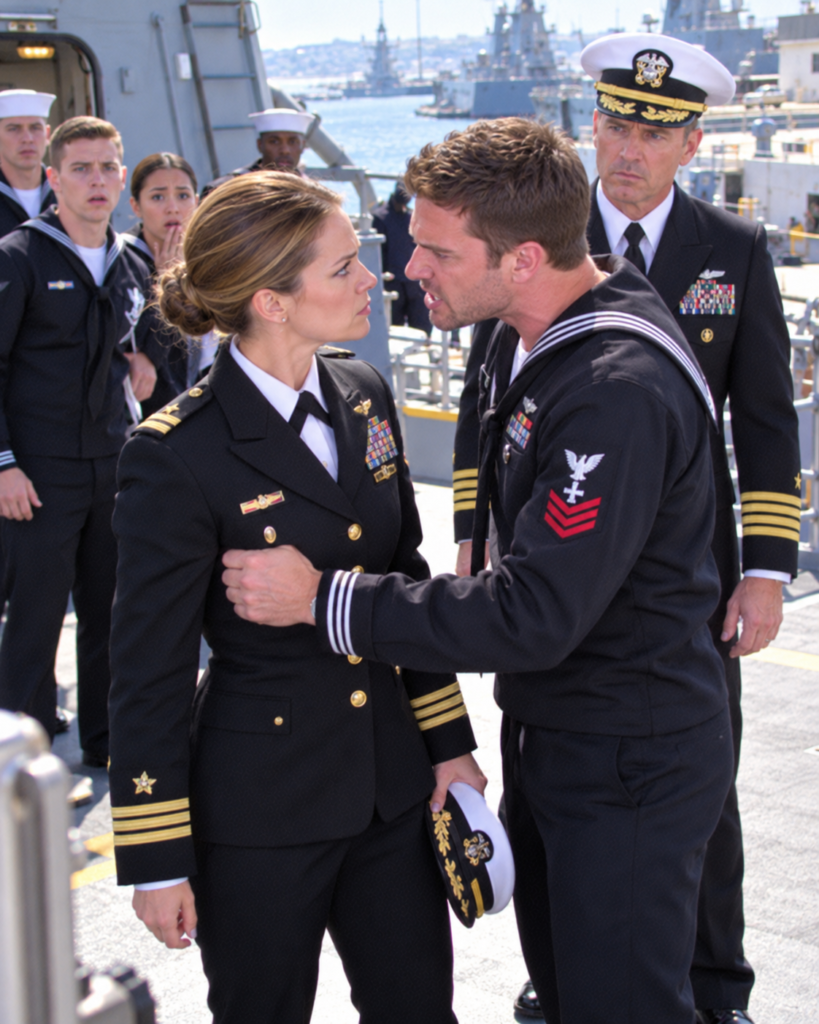
He seized my sleeve over the gold braid and turned me around hard enough that my heels clicked sharply against the concrete.
“The guys are laughing, Sis,” he said. “They think this is some kind of Halloween joke. Why are you here? Trying to find a husband, or are you just playing dress-up because you want to feel important?”
A low whistle sounded behind him. Someone laughed again. A young sailor carrying a clipboard lowered his eyes toward the papers in his hands.
I kept my voice steady.
“Take your hand off me, Petty Officer.”
Brandon blinked before smiling.
“Or what? You’re going to report me to the PTA?”
He pushed my shoulder backward just enough to make sure everyone standing nearby noticed.
His fingers creased the sleeve I had carefully pressed at 5:30 that morning in my hotel room while my phone rested facedown beside three missed calls from Dad.
I already knew what those calls would have been about.
Be easy on your brother.
Don’t embarrass him.
He’s sensitive about your career.
Sensitive was the word my family used whenever Brandon made jokes about my medals. Sensitive was the word they used when Dad introduced me as “our Sandra—she works around officers” while proudly referring to Brandon as “my Navy man.” Sensitive was the excuse that kept demanding I make myself smaller so he could feel bigger.
“Go back to your office,” Brandon said, tightening his hand around my sleeve. “Before you create trouble for both of us.”
Then the hatch above us opened.
Metal scraped against metal.
A one-star admiral stepped out into the daylight, and the sailor following behind him almost walked straight into his back when he suddenly stopped.
The admiral looked at me.
Then at Brandon’s hand.
Then at the sailors gathered on the pier watching us.
His expression turned hard.
Brandon still had half a smile on his face. He had spent his entire life believing confidence could carry him through anything, especially whenever I was the person standing opposite him.
The admiral began walking down the gangway without taking his eyes away from Brandon’s fingers.
One step.
Then another.
And Brandon finally looked up as the admiral took one more step toward us.
PART 2: The admiral stopped three feet from Brandon. The laughter on the pier disappeared so quickly that Sandra could hear the distant clang of a chain against the ship’s hull. Brandon slowly released her sleeve, but it was already too late. The admiral had seen everything.
“Petty Officer, step away from her,” he said.
Brandon immediately straightened. “Yes, sir.” His voice had lost the confidence it carried only seconds earlier. Sandra adjusted her sleeve without saying a word, refusing to give him the satisfaction of seeing how much the humiliation had affected her.
The admiral looked at Sandra and gave a precise nod. “Ma’am, your inspection team is waiting aboard.” Brandon’s eyes widened. His mouth opened slightly as he looked from the admiral to his sister.
“Inspection team?” he repeated.
Sandra finally met his stare. “Yes, Brandon. I’m not here as your sister.”
The words seemed to hit him harder than any reprimand could have. She stepped toward the gangway while the admiral followed beside her, and every sailor on the pier suddenly became very interested in standing perfectly still.
Then a commander emerged from the hatch carrying a folder. He stopped when he saw Sandra and immediately handed it to her. “Admiral, the preliminary findings are ready. Captain Owens has been notified.”
Brandon stared at the folder. His face changed when he saw the inspection seal across its cover.
“You’re conducting the inspection?” he asked.
Sandra nodded. “I am.”
For thirty years, her father had told everyone Brandon was the one carrying the family legacy. But standing there beneath the gray morning sky, Sandra realized something she had never allowed herself to admit: she had spent years trying to earn recognition from people who had already decided she didn’t deserve it.
She turned toward the ship.
Behind her, Brandon whispered, “Dad never said you were coming.”
Sandra paused at the bottom of the gangway.
“He wasn’t supposed to.”
Then the commander leaned toward her and quietly said five words that made Brandon’s face go completely pale:
**“Your brother is under investigation.”**
The words hung in the damp air like frozen iron, settling heavy over the salt spray of the pier. Commander Harris did not raise his voice, yet every syllable cut through the silence with merciless clarity.
Brandon’s face lost every shred of color, turning the sickly shade of bleached sailcloth under the San Diego sun. The confident smirk that had defined his features for three decades melted into raw, uncomprehending terror.
I did not flinch, nor did I allow my gaze to waver from the gray horizon across the bay. Years of training held my spine straight, locking every instinct of sorrow behind cold, polished discipline.
Rear Admiral Miller stood beside me, his jaw set like stone as his sharp eyes bored directly into my brother. The surrounding sailors remained frozen in place, their breathing shallow, terrified to move even an inch.
“Follow me aboard, Admiral Owens,” Miller said quietly, extending a gloved hand toward the gangway’s ascent. “The wardroom has been cleared, and your staff awaits your formal briefing regarding the supply manifests.”
I stepped past Brandon without a word, the crisp fabric of my dress blues whispering against the steel railings. He reached out reflexively, as if to touch my arm again, but stopped when Miller glared at him.
“Don’t touch her, Petty Officer,” Miller warned softly, his tone vibrating with dangerous authority. “You have already committed an offense that could cost you your stripes before this morning reaches noon.”
Brandon’s hand dropped limp to his side, his knuckles trembling against his dark trousers. He looked desperately at the sailors who had laughed with him earlier, but none of them would meet his eyes now.
We climbed the steep incline toward the quarterdeck, leaving the whisperings of the pier behind our ascending boots. With every step upward, the weight of our family’s bitter history seemed to press harder against my chest.
Thirty years of Sunday dinners, thirty years of Dad raising toasts to his brave enlisted son, vanished into air. None of those boastful stories could change the cold reality waiting inside the locked binders of this warship.
At the quarterdeck, the officer of the deck rendered a crisp, textbook salute that snapped against the wind. “Rear Admiral, Sterett arriving,” the boatswain’s pipe trilled shrilly, echoing over the ship’s public address system.
The honor guard presented arms, their movements sharp and synchronized, honoring the two silver stars gleaming on my collar. Brandon stood down on the concrete below, forced to endure the formal ceremony he had dismissed as dress-up.
I returned the salute with measured precision, acknowledging the crew before turning toward the narrow interior passage. Commander Harris fell into step immediately behind me, the thick manila investigation folder tucked tightly beneath his left arm.
The interior corridors smelled of fresh gray paint, hydraulic fluid, and the unmistakable metallic warmth of running machinery. It was an environment I knew better than my childhood home, having spent decades mastering its intricate demands.
We entered the spacious conference space of the wardroom, where four senior staff officers rose immediately to attention. On the polished table sat multiple stacks of requisition logs, maintenance records, and signed transfer receipts.
“Be seated, gentlemen,” I said calmly, taking my place at the head of the long conference table. “Commander Harris, outline the primary discrepancies uncovered by the Naval Criminal Investigative Service over the past quarter.”
Harris opened the thick folder, spreading out several flagged documents stamped with bright red classification warnings. The fluorescent lights overhead buzzed faintly, casting harsh shadows across the official signatures lining the bottom pages.
“Over eighteen months, critical propulsion components vanished from the ship’s primary supply locker,” Harris began evenly. “High-value titanium valves and specialized circuit cards were marked as destroyed during routine maintenance cycles but never discarded.”
“Instead, these parts were routed off-base through unauthorized civilian logistics firms located in National City,” he continued. “The primary signature authorizing the false condemned-equipment write-offs belongs directly to Logistics Specialist Second Class Brandon Owens.”
Hearing his name coupled with systemic theft made a quiet ache twist deep within my stomach. I had known Brandon was careless, entitled, and arrogant, but I had never imagined he was fundamentally criminal.
“Has Captain Vance been fully briefed on these findings?” I asked, keeping my tone strictly professional and neutral. “This vessel cannot deploy next month with compromised supply chains or unresolved felony investigations lingering over engineering.”
“The Captain is waiting in his stateroom, ma’am,” Rear Admiral Miller replied from across the table. “He understands the gravity of the situation, especially given the impending multinational exercises scheduled off the coast of Hawaii.”
“Bring him in,” I ordered, placing my hands flat against the cool mahogany surface of the table. “And summon Petty Officer Owens under escort so he can face the documentation bearing his personal authentication code.”
Harris nodded sharply, stepping toward the heavy watertight door to issue the necessary commands to the waiting security detail. Within moments, Captain Vance entered the room, his expression lined with profound exhaustion and visible professional strain.
“Admiral Owens, welcome aboard under these unfortunate circumstances,” Captain Vance said, offering a stiff, respectful bow of his head. “I deeply regret that my department heads failed to identify this systemic vulnerability before your office intervened.”
“Accountability begins at the top, Captain, as you well know,” I answered without raising my voice. “However, our immediate priority is assessing whether these diverted components compromised operational readiness or endangered sailors during sea trials.”
“Engineering inspected every secondary system yesterday, ma’am,” Vance replied quickly, producing his own tablet of reports. “The propulsion plant is secure, but the financial loss and breach of trust are catastrophic for this entire command.”
The door opened once more, and two Master-at-Arms personnel escorted Brandon into the brightly lit room. My brother had removed his white hat, clutching it nervously against his chest like an erring schoolboy caught red-handed.
He glanced around the room, seeing two admirals, a ship captain, and several senior officers staring at him coldly. The reality of his precarious situation finally shattered the protective bubble our father had built around him.
“Petty Officer Owens, stand at attention,” Commander Harris commanded, his voice ringing sharply off the steel bulkheads. Brandon snapped his heels together instantly, his eyes darting frantically between my stars and the thick files before me.
“Do you recognize these maintenance disposition logs, Petty Officer?” I asked, sliding three laminated forms toward his position. My voice carried neither anger nor sibling familiarity; it was the measured tone of a flag officer conducting official business.
Brandon swallowed hard, his throat clicking audibly in the quiet wardroom as he looked down at the paperwork. “Those… those are standard survey sheets, ma’am. I process hundreds of them every single month in supply.”
“You processed these specific sheets through an unmonitored terminal during the night watch,” Harris countered immediately, stepping forward. “Using administrative privileges granted by a junior lieutenant whose credentials you obtained without proper authorization.”
Brandon flinched as if struck across the face, his trembling hands clutching his service cap until the fabric crumpled. “I was just following informal guidance from senior petty officers, ma’am. Everyone shortcuts the disposal procedures to save time.”
“These parts were not short-cut into a dumpster, Brandon,” I said, using his name for the very first time. “They were retrieved from a private storage locker rented under your own personal credit card in Chula Vista.”
The room grew so silent that the hum of the ship’s ventilation fans sounded like a distant roaring waterfall. Brandon’s lips parted, but no sound emerged; his clever excuses, rehearsed for family gatherings, had completely failed him.
“Federal agents secured the facility two hours ago,” Harris added, delivering the decisive blow without an ounce of pity. “They recovered four crates of naval hardware alongside shipping manifests addressed to overseas buyers operating through unlicensed brokers.”
Tears sprang into Brandon’s eyes, spilling over his tanned cheeks as his military posture began to sag completely. “Sandra, please,” he whispered, his voice cracking with pure desperation. “You can’t let them do this to me. Dad will die.”
“You are addressing an Admiral of the United States Navy,” Miller barked sharply, slamming his open hand onto the table. “You will maintain military bearing and observe proper protocol, or you will be removed in irons this second.”
Brandon flinched, snapping his head forward, staring straight ahead at the white bulkhead while tears rolled into his collar. The arrogance that had strutted across the pier half an hour earlier was now utterly, irreparably broken.
“Your actions have disgraced this uniform, this ship, and the service you claimed to honor,” I told him evenly. “Dad’s opinions cannot alter federal statutes, nor can family favoritism shield you from the Uniform Code of Military Justice.”
“Take him to the brig and place him in pre-trial confinement pending formal charges,” Captain Vance ordered the waiting guards. The two Master-at-Arms sailors stepped forward, taking Brandon firmly by each arm and guiding him toward the hatch.
As he reached the doorway, Brandon looked back over his shoulder, his eyes wide with an agonizing mix of sorrow. He realized, too late, that the sister he had mocked for thirty years was the only one who truly understood duty.
The heavy steel door closed behind him with a resonant thud that echoed like a final gavel stroke through the room. I took a slow, deep breath, maintaining my composure before the gathered officers who watched me with quiet respect.
“Let us continue with the material readiness audit,” I said calmly, turning another page in the official operational binder. “We have three divisions to inspect before the afternoon tide, and I expect complete transparency across every single department.”
For the next four hours, we moved methodically through the bowels of the guided-missile destroyer, climbing ladders and checking consoles. Every sailor we encountered snapped to attention, their eyes wide with respect for the uncompromising flag officer inspecting their spaces.
I checked bilge pumps, reviewed radar calibration certificates, and inspected food service sanitation with thorough, practiced professionalism. Nobody watching could have guessed that beneath my ribbons lay the painful wreckage of a lifelong family betrayal.
By 1300 hours, the formal inspection of the USS Sterett was concluded, yielding twelve minor discrepancies and one massive criminal referral. Captain Vance signed the preliminary debrief with solemn gratitude, promising immediate structural reforms throughout his logistics division.
I walked down the gangway into the bright California afternoon, accompanied by Commander Harris and my administrative aide, Lieutenant Chen. The pier was quiet now, the earlier crowd of mocking onlookers long dispersed to their respective work centers.
As we reached my official staff vehicle waiting near the security barrier, my personal phone began to vibrate violently. The caller display showed my father’s name, flashing persistently against the dark screen like a warning beacon in the night.
I settled into the leather seat of the car, nodding to the driver before tapping the screen to answer. “Hello, Dad,” I said, keeping my voice level, preparing myself for the inevitable storm of irrational fury.
“Sandra! What on earth have you done?” Sergeant Major Owens bellowed through the speaker, his voice trembling with unbridled rage. “Brandon called me from a holding cell crying his eyes out! He said you showed up to ruin his life!”
“Brandon ruined his own life, Dad,” I replied softly, watching the naval base pass by through the tinted bulletproof glass. “He was caught stealing critical military hardware and selling it on the black market for tens of thousands of dollars.”
“That’s a lie! A bureaucratic setup!” my father shouted, refusing to accept that his chosen golden son could ever fail. “Someone framed him because he’s an honest enlisted man, and you let your high-and-mighty officer snobs throw him to the wolves!”
“Federal agents found the stolen parts in his personal locker, Dad,” I stated plainly, refusing to indulge his defensive fantasies. “His fingerprints were on the shipping crates, and his bank account received wire transfers directly tied to foreign shell corporations.”
There was a long, stunned pause on the other end of the line, the heavy breathing of an old soldier faltering. Yet his stubborn pride, cultivated over decades of military service, refused to surrender its deeply entrenched prejudices.
“Even if he made a mistake, you’re his sister!” Dad snarled back, shifting from denial to bitter, desperate accusation. “You have two stars on your shoulders! You have the power to squash the paperwork, transfer him quietly, and protect this family!”
“I earned these stars by swearing an oath to the Constitution, not by covering up felonies for relatives,” I answered firmly. “If I intervened to save Brandon from justice, I would be as corrupt and dishonorable as the crime he committed.”
“You always hated him,” my father spat, his voice poisoned with venom that cut deeper than any physical blade could. “You were always jealous of how much people loved him, how easily he connected with real soldiers instead of desk jockeys.”
“I never hated Brandon, Dad,” I whispered, closing my eyes as decades of quiet, unacknowledged achievements flashed before me. “I spent thirty years excelling at every command, hoping that just once you would look at my career with pride.”
“You wanted applause for sitting in air-conditioned offices while real men did the heavy lifting,” he said with brutal cruelty. “Brandon was my legacy. He was the real Owens soldier. And you just destroyed him because your petty ego couldn’t stand it.”
“My office is the United States Navy, Dad, and my duty is clear,” I said, feeling a sudden, unexpected wave of peace. “I am not the one who destroyed your legacy. You built that legacy on a foundation of lies, arrogance, and blind favoritism.”
“Don’t you dare speak to me like that, Sandra!” he barked, slipping into his old drill-instructor cadence from forty years ago. “I am your father! I am a retired Sergeant Major! You will respect my authority in this family!”
“Your authority ends where the law begins,” I replied, my voice dropping to a calm, immovable register of finality. “Brandon will face a general court-martial. He will have competent defense counsel, but he will not receive special favors from me.”
“If you don’t fix this, you are no longer welcome in my house,” my father declared, delivering his ultimate emotional ultimatum. “You will be dead to this family. You won’t have a father, and you won’t have a brother ever again.”
The threat was meant to shatter me, to reduce me to the desperate young girl who once brought home straight-A report cards. But sitting in that car, surrounded by the reality of my own hard-won independence, the threat felt completely hollow.
“Then I suppose this is goodbye, Sergeant Major,” I said quietly, using his rank instead of the title he had forfeit. Before he could unleash another torrent of bitter curses, I tapped the red icon on the screen and ended the call.
I stared at the black glass of the phone, watching my own reflection steady itself under the soft car interior lights. For thirty years, I had carried the exhausting burden of trying to earn love from someone incapable of truly seeing me.
Now, in a single morning, that burden was lifted, cut away by the very standard of integrity my father had falsely preached. I slipped the phone into my pocket, exhaled slowly, and turned my attention back to the work awaiting my command.
Over the next three months, the legal machinery of the military justice system moved forward with relentless, unhurried precision. Brandon’s co-conspirators were rounded up across Southern California, revealing a small but insidious ring of logistics theft that spanned several commands.
Throughout the proceedings, I maintained strict recusal, refusing to read confidential prosecution updates or use my position to influence the trial. My staff handled the matter by the book, ensuring that every piece of evidence was scrutinized without bias or interference.
Letters arrived at my headquarters from distant relatives, filled with scolding lectures about loyalty, forgiveness, and the sacred bonds of blood. I read none of them, having instructed my administrative staff to archive all unsolicited personal correspondence directly into holding files.
My mother, who had remained quiet during the initial storm, finally reached out through a handwritten letter sent from her home. Her words were gentle, tinged with sorrow, acknowledging the bitter truth she had spent a lifetime trying to ignore between her husband.
“Your father cannot look at himself in the mirror,” she wrote with trembling cursive across simple stationery from our hometown. “He sits on the porch in his old uniform jacket, waiting for calls from neighbors who have stopped walking past the yard.”
“He blames you because looking at Brandon means admitting he spent thirty years pouring his pride into a fantasy,” she continued. “I am sorry, Sandra. I should have stood up for your promotions. I should have told him you were extraordinary.”
Reading those words brought a quiet tear to my eye, not of pain, but of closure long overdue from my past. I wrote back simply, assuring her that I loved her, but making it clear I would never apologize for choosing honor.
The court-martial concluded on a rainy Tuesday in December, held inside the austere courtroom at Naval Base Point Loma. Brandon pleaded guilty to multiple counts of conspiracy, larceny of government property, and conduct unbecoming, hoping for a lenient sentencing agreement.
The military judge showed little sympathy for his excuses, noting that the stolen components could have crippled vital systems during deployed operations. Brandon was sentenced to seven years of confinement at the military brig in Fort Leavenworth, forfeiture of pay, and a dishonorable discharge.
When the verdict was read, Brandon wept openly, his head resting against the defense table as his military career ended forever. My father did not attend the sentencing, unable to bear the public humiliation of seeing his prized soldier stripped of his rank.
Six months later, spring arrived across the Potomac as I walked toward the grand auditorium of the Pentagon for my promotion. The President of the United States had approved the nomination list, adding a third gleaming star to my official service record.
The ceremony was attended by dignitaries, cabinet officials, and foreign defense attachés who recognized decades of strategic leadership and unimpeachable ethics. My mother sat in the front row, wearing a simple blue dress, clapping with tears streaming down her smiling face.
My father was not there, having chosen to remain in his quiet house with his fading medals and bitter, unspoken regrets. But for the first time in my entire life, his absence did not leave a hollow ache inside my chest.
As the Secretary of the Navy pinned the third silver star onto my shoulder boards, thunderous applause filled the vast hall. I looked out over the gathered crowd, seeing hundreds of young officers, both men and women, standing tall in crisp uniforms.
They were not serving a family dynasty or chasing the fragile approval of an arrogant father who measured worth by favoritism. They were serving an ideal of honor, sacrifice, and truth that no petty jealousy could ever diminish or tear down.
Later that evening, while reviewing correspondence in my new corner office overlooking the river, a single small envelope caught my attention. It bore no return address, only my formal military title written in shaky, familiar, aging handwriting across the faded paper.
Inside was an old, creased photograph from thirty years ago, showing me standing proudly in my pristine graduation uniform beside my father. On the back, written in pencil that had almost faded completely away, was a single short sentence: “I was wrong.”
I held the photograph for a long moment, looking at the young woman who had fought so hard for an impossible love. I felt no triumph, no desire for vengeance, only the quiet, profound satisfaction of someone who had never compromised her soul.
I set the photograph down upon my desk, placed it inside a small leather journal, and closed the drawer with finality. Then I turned back toward the wide windows, watching the lights of Washington reflect brightly across the dark, enduring river below.