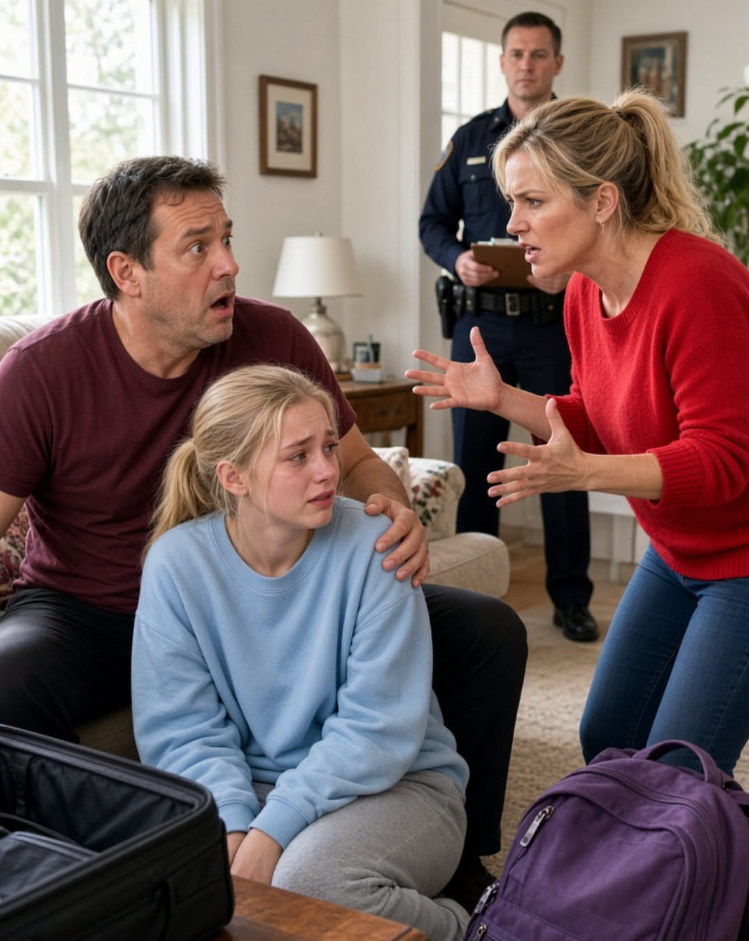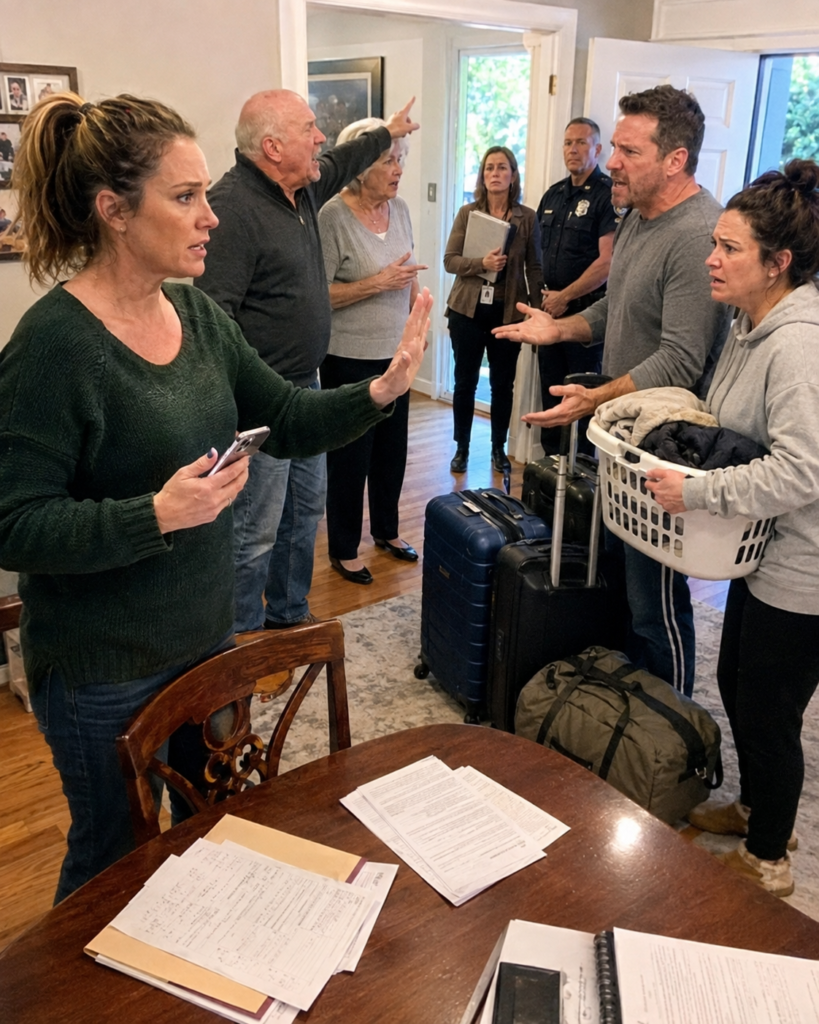
My brother dropped two suitcases against the freshly painted wall of the bungalow I had spent nine years saving for while my mother pointed toward my office and said, “Put the children in there. You don’t need two rooms.” They believed the deed inside my folder was the only thing protecting me.
It was not.
Ryan’s wife, Megan, stood beside a laundry basket overflowing with shoes, a coffee maker, rolled towels, and three bottles of shampoo. Her eyes moved past me toward the hallway, already deciding which cabinets would belong to her.
“Where do we sleep?” she asked.
Not Could we stay?
Not Did anyone ask you?
Where do we sleep?
My father closed the front door behind them.
Mom smoothed the front of her blouse and refused to meet my eyes.
Ryan gave me the exhausted grin he always used when he wanted irresponsibility to appear charming.
“Don’t do the whole face thing, Mara,” he said. “It’s temporary.”
The metal zipper on his duffel scraped across my pale green wall, leaving a black mark almost twelve inches long.
I stared at it.
Nine years of packed lunches instead of restaurant meals.
Nine years without real vacations.
Nine years of wearing shoes until the soles became thin and depositing every bonus instead of spending it.
I had owned the bungalow for fourteen days.
Ryan had been inside for less than fourteen seconds, and he had already marked it.
My name is Mara Mercer. I was thirty-six years old, unmarried, childless, and therefore—in my family’s opinion—permanently available.
I worked as a compliance analyst for a regional bank in Dayton, Ohio. My job involved reviewing documents, tracking suspicious activity, and noticing when details did not match the story someone wanted me to believe.
Those skills had made me successful at work.
At home, I had spent years pretending not to use them.
Mom opened my office door.
My walnut desk sat beneath the window. House manuals, contractor estimates, insurance policies, and mortgage documents were arranged in labeled folders on the shelves.
A framed photograph of me holding the house keys rested beside a small plant.
Mom ignored all of it.
“The children can share this room,” she announced. “Ryan and Megan can have the main bedroom. You can sleep on the sofa until everyone gets settled.”
I turned slowly.
“My bedroom?”
“You’re one person,” she replied. “They’re a family.”
Dad finally spoke.
“Family makes sacrifices.”
Mrs. Alvarez, my next-door neighbor, appeared on the porch carrying a jade plant cutting she had promised me.
Through the open curtain, she could see the luggage.
She could hear every word.
My parents noticed her.
Instead of lowering her voice, Mom raised it.
“We are trying to help two innocent children,” she announced, as though I had dragged my niece and nephew into the street for entertainment.
Ryan leaned against my kitchen counter.
“Our lease ended,” he said. “Dad told us you had room.”
“My lease didn’t end,” Megan corrected quietly. “We were evicted.”
Ryan’s jaw tightened.
Mom shot her a warning look.
There it was.
The first honest sentence anyone had spoken since they entered.
Ryan had not simply reached the end of a lease.
He had missed three months of rent after quitting another job because his supervisor had been “disrespectful.”
My parents had paid his car insurance, purchased the children’s school clothes, and covered emergencies that appeared every time Ryan was expected to face a consequence.
But they had not told me about the eviction.
They had simply decided that my new home would absorb it.
Dad stepped closer.
“We’ve already worked everything out. They’ll contribute when Ryan finds something. You should be grateful we didn’t ask you to give up the entire house.”
I almost laughed.
They were standing in the home I had paid for, telling me to be grateful that they intended to leave me the sofa.
Ryan removed an envelope from his jacket and tossed it onto my dining table.
“See?” he said. “It’s handled.”
I opened it.
Inside was a typed rental agreement listing Ryan Mercer, Megan Mercer, and their two children as occupants of my address.
The rent was one dollar per month.
The term was twelve months, automatically renewing unless both parties agreed to terminate it.
At the bottom was my full name.
Mara Elizabeth Mercer.
Beneath it appeared a signature close enough to mine to fool someone who had never watched me write it.
My parents’ signatures appeared on the witness lines.
Megan stared at the document.
“You told me Mara signed that.”
Ryan ignored her.
Mom folded her arms.
“It’s only paperwork. The children need an address for school.”
Three days earlier, I had received an enrollment-verification letter addressed to Ryan at my bungalow.
That same afternoon, the electric company emailed me about a request to transfer service into his name.
An online renter’s-insurance company had also sent a notice thanking me for confirming that Ryan was an authorized tenant.
I had confirmed nothing.
I had called a property attorney before I called my mother.
Now the folder Mom had ignored rested beneath my hand.
Ryan pushed away from the counter.
“Start clearing the office,” he ordered. “The kids are coming over tonight.”
“No.”
The room went still.
Dad’s face hardened.
“What did you say?”
I looked at Ryan, then Megan, then my parents.
“You asked where you sleep,” I said. “You won’t. Not here.”
Mom’s voice rose immediately.
“You would make your own niece and nephew homeless over a tiny house?”
“I did not evict them.”
“You have no children,” she snapped. “You do not need all this.”
The bungalow had two bedrooms.
One was my bedroom.
The other was my office.
“All this” consisted of eleven hundred square feet, one bathroom, and a small backyard.
But my family had spent so many years using my independence against me that any comfort I earned seemed excessive beside Ryan’s need.
He stepped close enough for me to smell coffee on his breath.
“If you report that agreement, I’ll tell everyone Mom and Dad paid your down payment.”
Another lie.
I had nine years of bank statements proving where every dollar originated.
I did not argue.
I did not cry.
I opened my folder and pressed one contact on my phone.
The doorbell rang before Ryan could speak again.
My attorney stood on the porch with a uniformed officer beside her.
She looked at the suitcases, the forged agreement on my table, and then directly at my brother.
“Mr. Mercer,” she said, “before you unload another bag, you should understand that signature is the reason we’re here.”
My attorney’s name was Priya Shah.
She wore a charcoal suit and carried a slim leather case. Beside her stood Officer Daniel Collins from the Dayton Police Department.
Mrs. Alvarez remained on her porch, the plant cutting still in her hands.
Ryan recovered first.
“This is a family matter.”
Priya stepped inside after I invited her.
“It became a legal matter when someone created a lease using Mara’s forged signature.”
Mom’s expression tightened.
“No one forged anything.”
Priya looked at the agreement.
“Then Mara signed it?”
Mom glanced toward me.
“She would have.”
“That was not the question.”
Dad stepped forward.
“My daughter gave us permission to handle the property while she was working.”
“No,” I said.
He ignored me.
“She is under a lot of stress from buying the house. We were helping her make a sensible decision.”
Officer Collins looked toward me.
“Ms. Mercer, do you own this property?”
“Yes.”
“Did you authorize your brother or parents to create a lease?”
“No.”
“Did you invite Mr. and Mrs. Mercer to move in?”
“No.”
Ryan laughed sharply.
“Of course she’s going to say that now.”
Priya opened her case.
“This is the recorded deed, mortgage statement, closing disclosure, and proof of funds used for the down payment.”
She placed the documents beside the fake lease.
“One owner. One borrower. No family contribution.”
Dad’s face reddened.
“We gave her money over the years.”
“You raised me,” I said. “That did not purchase part of my house.”
Mom pointed toward Priya.
“She is filling your head with legal nonsense.”
“I hired her because someone tried to establish residency in my home without permission.”
Megan sank onto one of my dining chairs.
“What do you mean, establish residency?”
I looked at her.
“The school enrollment letter, utility-transfer request, renter’s-insurance application, and this agreement were submitted before you arrived.”
Her eyes moved toward Ryan.
“You said Mara offered to let us stay.”
“She would have if everyone had stopped making it complicated.”
“You told me she signed the lease.”
Ryan’s expression became defensive.
“It was a formality.”
Priya removed another document.
“This is an occupancy affidavit submitted to the children’s school district. It states that Mara personally granted your family permanent residence at this address.”
Megan stared at it.
Her name was on the form.
So were the children’s.
At the bottom, beside a forged version of my signature, was a line stating that the owner understood false residency claims could lead to criminal penalties.
“I didn’t see that,” Megan whispered.
Ryan waved one hand.
“The kids needed to stay in their school.”
“They attended school in Cincinnati,” I said. “This house is in Dayton.”
Mom answered.
“Dayton has better services.”
“So this was not only about avoiding homelessness.”
No one spoke.
They wanted Ryan’s children enrolled in my district because the school had stronger special-education support and smaller classes.
Those might have been understandable reasons to ask for help.
They were not reasons to forge documents.
Officer Collins reviewed the affidavit.
“Who submitted this?”
Ryan shrugged.
“Probably the school office.”
“The school office did not invent your sister’s signature.”
Mom’s voice became sharp.
“Enough. We are wasting time while children have nowhere to sleep.”
“The children are not here,” I said.
“They are with Megan’s sister until tonight.”
“Then they are safe.”
“That arrangement ends tomorrow.”
“Ryan and Megan need to solve that.”
Mom stared at me as though I had spoken in another language.
For thirty-six years, Ryan’s unsolved problems had automatically become mine.
The idea that he might remain responsible for them seemed almost offensive.
Priya turned to the officer.
“There is more.”
That was the moment my parents’ confidence changed.
They thought the deed was the only thing protecting me.
It was not.
I had security footage from the previous Sunday showing Mom and Dad standing outside my home while I was at the grocery store.
They used the temporary keypad code I had given them on moving day.
The video captured Ryan carrying empty boxes into the garage.
Another recording showed Dad photographing my utility-account information from a folder on the kitchen counter.
The camera above my back entrance recorded Mom saying, “Once the children receive mail here, she won’t be able to put them out quickly.”
Ryan replied, “She’ll give in before that.”
The words played clearly from Priya’s tablet.
Megan covered her mouth.
Dad stared at the floor.
Mom’s face went white.
“You recorded us inside?”
“The security system records entry points and common areas,” I said. “You knew cameras were installed.”
“You spied on your family.”
“You entered my house while I was gone and photographed private documents.”
“We were preparing.”
“For what?”
Mom looked toward Ryan.
He did not rescue her.
Priya played the second clip.
Dad’s voice filled the room.
“We need the utility account moved before Mara realizes what’s happening.”
Then Mom said, “Once Ryan has the lease, school records, and a bill in his name, she’ll have to go through court.”
Mrs. Alvarez remained visible through the front window.
Her expression had changed from curiosity to disbelief.
Megan looked at her husband.
“You knew she didn’t agree.”
Ryan crossed his arms.
“She has space. We needed it.”
“That isn’t an answer.”
“I knew she would overreact.”
“You forged her signature.”
“I did it for the children.”
“You did it because you didn’t pay rent.”
His face hardened.
“You’re my wife. Whose side are you on?”
Megan stood.
“The side where people tell me the truth before moving my children into someone else’s home.”
Mom stepped between them.
“This is not helping.”
Megan turned toward her.
“You told me Mara was embarrassed because she couldn’t admit your money helped buy the house.”
Mom’s mouth tightened.
“You did not need every detail.”
“I needed to know we were trespassing.”
“You are family.”
Megan shook her head.
“That doesn’t make this ours.”
For the first time, someone who had entered carrying luggage understood faster than the people who raised me.
Officer Collins asked Ryan to step away from the table.
“You are not being arrested at this moment,” he said. “But I am documenting the complaint involving the suspected forged lease, false occupancy affidavit, and attempted utility transfer.”
Ryan’s bravado flickered.
“This is insane.”
“You need to remove your belongings and leave the property.”
“I have a lease.”
“The owner disputes the signature, and the electronic records suggest she denied permission before you arrived.”
Dad pointed at me.
“She cannot throw children into the street.”
Officer Collins remained calm.
“The children are not present, no tenancy appears to have been established, and alternative housing currently exists. This is not an emergency lockout.”
Mom turned toward Priya.
“You planned all this.”
“No,” Priya replied. “Mara responded to documents your family submitted.”
“I was trying to keep everyone together.”
I looked at her.
“No. You were trying to put Ryan’s family inside my home before I could stop you.”
Her eyes filled with tears.
“I did what a mother had to do.”
“You have two children.”
The sentence silenced her.
She had spent years calling every sacrifice for Ryan maternal love while treating sacrifices taken from me as natural resources.
Ryan picked up the fake lease.
“This won’t hold up in court anyway.”
Priya extended her hand.
“That document is evidence.”
He hesitated.
Officer Collins said, “Put it down.”
Ryan released it.
Megan began carrying the laundry basket toward the porch.
He stared at her.
“What are you doing?”
“Leaving.”
“We have nowhere to go.”
“My sister said we can stay for a week.”
“A week?”
“That gives us time to find something.”
“With what money?”
She looked at him.
“The money you earned from the job you said you still had.”
The room became quiet again.
I had not known about that lie.
Neither had my parents, judging by their expressions.
“What does she mean?” Dad asked.
Megan’s face crumpled.
“Ryan was fired six weeks ago.”
Mom turned toward him.
“You said your hours were reduced.”
“I was going to find something.”
“You told us the eviction happened because the landlord raised the rent,” Dad said.
Ryan looked toward the suitcases.
“It doesn’t matter now.”
“It matters to me,” Megan said. “You let me pack our children’s things while knowing Mara had never agreed.”
He raised his voice.
“What was I supposed to do?”
“Tell the truth.”
He laughed bitterly.
“Truth doesn’t pay rent.”
“Neither did you.”
The officer stepped between them when Ryan moved closer.
“Everyone needs to remain calm.”
Megan carried the basket outside.
Dad followed her with one suitcase.
Mom stayed in the living room.
Her tears had stopped.
“You’re proud of yourself,” she said to me.
“No.”
“You waited for us to come so you could humiliate your brother.”
“I asked you three days ago whether Ryan had used my address for school enrollment.”
“You accused us.”
“Because I had the letter.”
“You could have discussed it privately.”
“I tried. You told me I was imagining problems.”
She had said exactly that.
Then she told me the utility email was probably spam.
Mom had believed denying the evidence would buy enough time for Ryan to establish a claim.
“I wanted my first weeks here to be peaceful,” I said. “Instead, I had to hire an attorney because my own family was building a paper trail against me.”
Her expression softened briefly.
Then hardened again.
“You have always cared more about documents than people.”
“No. Documents are what protect me when people lie.”
Dad returned for the second suitcase.
He did not look at me.
Ryan remained beside the table.
“I hope you enjoy sitting alone in your precious little house.”
I looked around.
At the black mark on the wall.
At the fake lease.
At the photograph of me holding the keys.
“I will.”
He followed the others outside.
Megan paused beside me.
“I’m sorry.”
“You should have called me.”
“I know.”
“Did you sign anything else?”
She thought for a moment.
“A postal form and the school application. Ryan said you had approved both.”
“Send copies to Priya.”
“I will.”
She glanced toward the driveway where Ryan was arguing with Dad.
“I don’t know what happens now.”
“You make decisions based on what is true.”
Her eyes filled with tears.
“I should have done that earlier.”
“Yes.”
It was not kind to pretend otherwise.
But truth could still be spoken without cruelty.
The minivan left twenty minutes later.
My parents followed in their car.
Officer Collins gave me a report number and advised me to preserve all electronic records.
Priya stayed after everyone was gone.
Mrs. Alvarez finally crossed the lawn and handed me the jade plant.
“I think this house needs something alive in it,” she said.
I began crying then.
Not while Ryan threatened me.
Not while Mom assigned my bedroom.
Not while the officer reviewed the forged papers.
I cried when an almost-stranger handed me a plant and asked for nothing in return.
Mrs. Alvarez placed one arm around my shoulders.
“You did the right thing.”
“It doesn’t feel good.”
“The right thing rarely feels good when someone trained you to feel guilty for doing it.”
The investigation lasted four months.
The school district confirmed that the residency affidavit had been uploaded from Ryan’s email account.
The utility request had been submitted using information photographed from my documents.
The renter’s-insurance application listed my mother as a property representative and included the forged lease.
The postal request had not yet taken effect.
Because Ryan and my parents cooperated after the confrontation, no one had entered into an actual tenancy, and no direct financial loss had occurred, prosecutors offered diversion agreements rather than pursuing felony convictions.
Ryan admitted creating the lease and copying my signature from a birthday card.
Mom and Dad admitted witnessing the document despite knowing I had not signed it.
They paid my legal and security expenses.
They completed community service.
The false forms were withdrawn.
They were prohibited from entering my property without written invitation.
Ryan blamed me for the agreement.
He told relatives I had “criminalized a housing emergency.”
Then Megan filed for legal separation.
The forged lease was not the only reason.
It was simply the event that forced her to examine everything else.
Ryan had hidden debts.
He had borrowed money from their joint account after losing his job.
He had used the children’s school situation to pressure her into moving.
He had even told her that my parents were purchasing the bungalow for all of us and using my credit temporarily.
Megan moved with the children into a small apartment near her sister.
She found full-time work at a dental office.
Ryan took a warehouse job after my father refused to continue covering every bill.
The children remained safe.
That mattered to me.
But I did not become their housing plan.
My parents stopped speaking to me for nearly six months.
Mom told relatives I had chosen an empty office over my niece and nephew.
I sent no public defense.
Priya advised me to preserve the records, not argue with gossip.
Eventually, the truth traveled farther than Mom’s version.
Megan told her parents what happened.
Mrs. Alvarez had witnessed the confrontation.
The school district confirmed the fraudulent address attempt.
Relatives stopped calling.
One aunt apologized.
Another said she had always suspected Ryan took advantage of the family.
I did not reward late honesty with immediate closeness.
During those six months, I repaired the black mark on the wall.
At first, I planned to repaint the entire room.
Then I changed my mind.
I cleaned the scrape but left a faint line visible beneath the new paint.
It reminded me how quickly people could damage something they had not worked to build.
My office remained my office.
I bought a comfortable chair for the corner and placed the jade plant beside the window.
The second bedroom never became a nursery.
It held my desk, books, records, and the work that had helped me purchase the house.
The space was not wasted because no child slept there.
It served the woman who owned it.
Seven months after the confrontation, Dad wrote me a letter.
Mara,
I told myself I was protecting Ryan’s children.
The truth is that I was protecting Ryan from the consequences of being irresponsible.
Your mother and I believed you would complain and then surrender, because that is what you had always done.
We thought your stability made it acceptable to take more from you.
It did not.
I signed as a witness to a document I knew you had not signed.
I am ashamed.
I do not expect you to forgive me quickly.
Dad
Mom’s letter arrived two weeks later.
It was longer.
She admitted that she had called me her capable child because the label made neglect sound like praise.
She wrote that Ryan’s failures frightened her, while my pain felt manageable because I rarely raised my voice.
She had protected the child who created the loudest emergencies.
The quieter child had paid for that protection.
I read both letters.
Then I placed them in the folder beside the fake lease.
Not as weapons.

As reminders that apologies mattered only when they named the harm accurately.
I met Dad for coffee first.
He arrived alone and paid for his own drink.
“I should have asked before bringing anyone into your home,” he said.
“You should have accepted no when I gave it.”
He nodded.
“Yes.”
Mom took longer.
When we finally met, she cried before sitting down.
“I miss you.”
“I missed you while you were standing in my living room.”
Her face crumpled.
“I know.”
We began speaking slowly.
Neither parent received a key.
They were not listed as emergency contacts.
They visited only when invited.
Ryan did not apologize for almost a year.
When he finally came to my door, he rang the bell and waited outside.
He looked tired.
“I got another job,” he said.
“I heard.”
“I’ve been there seven months.”
“That’s good.”
He glanced toward the wall behind me.
“Can I come in?”
“No.”
The answer hurt him.
I saw it.
I did not change it.
He nodded slowly.
“I understand.”
“What did you come to say?”
He looked down at the porch.
“I thought you had more than you needed.”
“I had what I worked for.”
“I know that now.”
“Do you?”
“I’m paying rent again. I see the money leave every month.”
“That is not the same as nine years of saving.”
“No.”
For once, he did not argue.
“I forged your name because I believed family pressure would make the document unnecessary. I thought you would give in before anyone examined it.”
“You were probably right about the old me.”
He looked at me.
“What changed?”
“I bought something I refused to abandon.”
He nodded.
“I’m sorry, Mara.”
I believed he was sorry.
I did not invite him inside.
Forgiveness could begin on a porch.
Access had to be earned separately.
Two years after the day the suitcases struck my wall, I hosted a small housewarming dinner.
It was later than most people hold housewarmings, but the house had not felt fully mine until then.
Mrs. Alvarez came carrying homemade bread.
Priya brought wine.
Megan attended with the children after asking in advance.
My niece and nephew played in the backyard and never entered my office without permission.
Dad came alone.
Mom arrived with flowers and asked where she should place them.
Ryan was not invited.
He accepted that without sending angry messages.
After dinner, my niece stood in the office doorway.
“Aunt Mara, is this the room Grandma said we were going to sleep in?”
The adults became quiet.
“Yes.”
“Were you mad at us?”
“No.”
“Then why couldn’t we stay?”
I crouched beside her.
“Because grown-ups made a plan involving my home without asking me. That was not your fault.”
She considered this.
“Mom says people have to ask before using things.”
“Your mom is right.”
“Can I look at your books?”
“Yes. Thank you for asking.”
She entered carefully.
That small moment meant more than any apology.
A child had learned in seconds what several adults had resisted for years.
Consent did not become cruel simply because the answer was no.
After everyone left, I stood alone in the living room.
The bungalow was quiet.
Not lonely.
Quiet.
The plant Mrs. Alvarez had given me had grown so large that I moved it into a clay pot near the window.
The mortgage folders remained in my office.
The deed remained secure.
But the deed was never the only thing protecting me.
I had bank statements.
Camera footage.
Utility records.
An attorney.
A witness next door.
And the courage to stop treating my family’s demands as emergencies I was required to solve.
My mother believed I did not need two rooms because I had no children.
Ryan believed an empty room was proof that his family had a greater claim.
Dad believed sacrifice moved automatically from the most responsible person toward the least responsible one.
They were wrong.
A room does not become available simply because someone else wants it.
A home does not become communal because relatives arrive carrying suitcases.
And a woman does not owe away everything she worked for simply because she built it alone.
I spent nine years saving for that bungalow.
My brother marked the wall in fourteen seconds.
The line could be painted over.
The lesson could not.
Love without respect becomes entitlement.
Help without limits becomes expectation.
And family members who forge your name are not asking for shelter.
They are trying to replace your decision with their own.
They arrived believing I would sleep on the sofa while they took over my home.
Instead, they left with their luggage, a police report, and the first boundary I had ever refused to negotiate.
The bungalow was small.
But once they were gone, it contained something my family had never allowed me before.
Enough room to say no—and remain exactly where I belonged.
THE END.