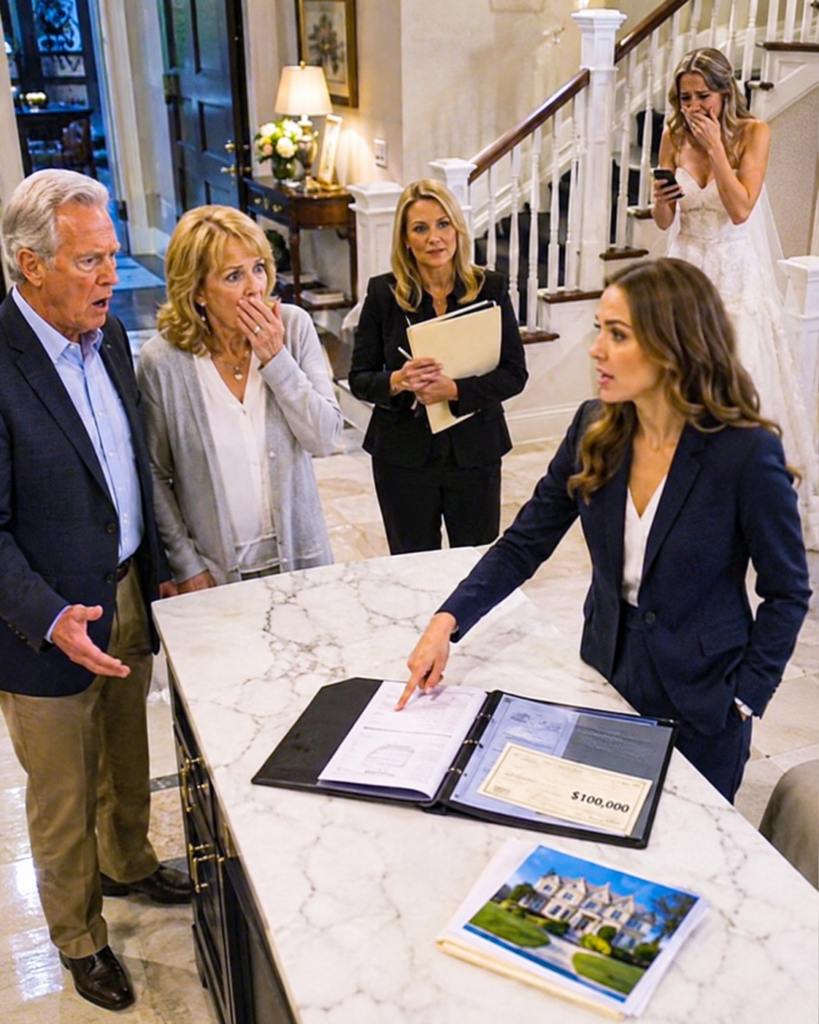
PART 1: The Christmas Eve Betrayal
At exactly 6:30 on Christmas Eve, my husband called seventeen times within twelve minutes.
I left the ringer on. Sitting on a wooden stool beside my butcher-block island, I wrapped my fingers around a ceramic mug with a chipped rim and watched my phone tremble against the quartz countertop.
His name appeared, disappeared into voicemail, and immediately returned. Each vibration pushed the phone slightly across the counter, resembling an insect desperately trying to escape a glass enclosure.
For the first time in twenty-seven years, I wasn’t spending Christmas Eve in my mother-in-law Patricia’s enormous suburban kitchen in Upper Arlington, surrounded by the biting odor of burned roasting pans and artificial pine cleaner.
I wasn’t arranging linen napkins inside silver holders. I wasn’t comforting somebody else’s crying toddler while Daniel’s older brother, Mike, stumbled through his third bourbon before dinner had even begun.
Instead, I was home.
I wore a faded charcoal sweatshirt, thick wool socks, and a silence so unfamiliar that it almost felt alive.
Beyond the windows, dry Midwestern snow slowly covered our neighborhood.
From the street, our home looked like the perfect example of middle-class stability. Daniel worked in corporate logistics, negotiating freight routes for a major conglomerate. I managed financial records for a respected downtown legal and accounting firm. Together, we had raised our daughter, Emily, into a responsible young woman.
But nobody outside our family understood the price I paid for every holiday.
There were Patricia’s carefully disguised insults, the endless complaints, and Daniel’s habit of leaning against a doorway with a beer while casually announcing, “Rebecca gets flustered. She brings a heavy energy to the room.”
For twenty-seven years, I had financed their celebrations, handled the arrangements, and absorbed their criticism.
Everything changed on a rainy Tuesday in November.
Daniel entered our kitchen, loosened his work collar, and casually explained that Patricia believed I should “sit this Christmas out.”
“You get anxious, you run yourself ragged,” he had said, his tone deliberately casual, the way one speaks to an irrational child. “Everyone walks on eggshells. Mom just said… maybe we could have a peaceful Christmas this year. Without your stress. Just stay home.”
He delivered those words as though excluding his wife from Christmas was a perfectly reasonable request.
They weren’t worried about my exhaustion.
They wanted the benefits of everything I provided without having to acknowledge the woman paying for it.
Something inside me went completely still.
Fine.
If they wanted Christmas without me, they could experience precisely that.
I canceled the $1,500 catering order, withdrew the reservation for the private dining room at The Dublin Grill, and canceled the bakery arrangements.
Then I stopped organizing anything.
I gave them exactly what they requested.
Now, sitting alone on Christmas Eve, I watched another unanswered call disappear into voicemail.
Something about Daniel’s frantic persistence told me this wasn’t simply an argument over dinner.
When his voicemail notification appeared, I pressed the speaker button.
His voice filled the kitchen, stripped of its usual confidence. He sounded breathless, frantic, and genuinely terrified.
“Rebecca? Where the hell are you? Pick up your phone! We’re at the Grill and our reservation is gone. Rebecca, Richard Sterling is here. Richard Sterling! My CEO! Mom and I invited him to prove I have the family stability for the VP promotion, and there is no table, no food, nothing! You are ruining my career! Pick up!”
I stared at the phone.
Richard Sterling.
Daniel’s CEO.
My husband had intended to turn the expensive Christmas celebration I organized and financed into a demonstration of his supposed family stability.
He wanted to impress his employer and secure a promotion.
And he had planned to accomplish it while deliberately excluding me from the dinner.
Apparently, my money and labor were welcome.
My presence wasn’t.
I didn’t put on my coat or reach for my car keys.
Instead, I retrieved an accordion folder from beneath the island. Inside were receipts and financial records accumulated throughout twenty-seven years of holiday celebrations.
Then my laptop chimed.
A new email appeared with an urgent red warning from my bank’s fraud department.
I opened it.
Fraud Alert: Suspicious transaction attempted on Visa ending in 4102. Amount: $10,500.00. Merchant: Oakhaven Fine Jewelers.
For a moment, I couldn’t move.
I hadn’t authorized any jewelry purchase.
I hadn’t even been shopping.
I grabbed my purse, opened my leather wallet, and examined the compartment where my Visa normally sat.
Empty.
The physical card was missing.
And only one person had been inside my bedroom while I slept the previous night.
Daniel.
The realization made my chest tighten.
My husband hadn’t merely tried to humiliate me in front of his family.
He had taken my credit card and attempted to spend $10,500 without permission.
Perhaps he intended to buy Patricia an extravagant gift. Perhaps the jewelry was meant for his CEO’s wife, a desperate attempt to rescue the dinner disaster.
Whatever his reason, he had decided that stealing from me was an acceptable way to protect himself.
I called the bank’s fraud department, ignoring the twenty-two missed calls from Daniel and Patricia.
Within three minutes, the transaction was blocked, my card permanently disabled, and a formal theft report added to the account.
That night, sleep never came.
I remained at the dining table, surrounded by tax returns, bank statements, and legal paperwork from my firm.
One question kept circling through my thoughts.
If Daniel could steal my credit card while I slept nearby, what else had he concealed?
For years, he had insisted we maintain separate personal spending accounts, sharing only the account used for our mortgage and essential household bills.
I had accepted that arrangement.
Now I examined the joint account with the precision of someone who had spent her career investigating financial discrepancies.
I followed electronic transfers, compared transaction dates, and checked public county records through my work portal.
I already knew Daniel had withdrawn $4,000 from our savings in September.
But at 4:13 in the morning, I discovered something far worse.
Six months earlier, Daniel had forged my electronic signature on a substantial, high-interest commercial loan for Mike’s struggling logistics company.
He had named me as a co-guarantor.
Worse, he had pledged the equity in our house as security.
The same house whose down payment had come from my earnings.
Mike’s reckless gambling debts had been concealed as business expenses, and Daniel had used our home to support them.
If Mike defaulted, creditors could pursue the property.
My home.
Everything I had worked to protect.
I stared at the documents until the numbers blurred.
Then the front doorbell rang.
When I opened the door, Emily stood outside in a maroon puffer jacket, snow clinging to her boots. Her eyes were red and swollen with worry.
“Mom,” she breathed, stepping inside and kicking off her snow-caked boots. “Dad called me at six this morning. He sounded like a maniac. He said you had a psychotic break, ruined his promotion, and that you’re trying to destroy the family. He said Richard Sterling walked out of the restaurant in disgust. What is happening?”
My heart ached.
Daniel wasn’t satisfied with blaming me for his career disaster. He was prepared to poison our daughter’s opinion of me as well.
“Come into the kitchen, sweetheart,” I said gently. “Sit down. It’s time you learned how this family actually operates.”
I showed Emily everything.
Seven years of detailed Christmas expenses.
The bank’s alert concerning the attempted $10,500 jewelry purchase.
And finally, the documents showing the commercial lien against our home.
I didn’t shout or exaggerate.
The paperwork spoke for itself.
Emily covered her face as tears shook her shoulders.
“He stole from you. He put our house in danger. Why didn’t you tell me, Mom?”
“Because I believed that keeping a family together meant swallowing the glass so nobody else would get cut,” I said softly. “But all it did was make them comfortable with bleeding me dry.”
Before she could respond, the front door slammed open so violently that it struck the entryway wall.
Daniel stood in the foyer, his coat hanging open, his tie loosened, and his bloodshot eyes blazing with panic.
He stormed toward the kitchen.
“You locked my card!” he screamed, his voice cracking as he lunged into the kitchen. “You locked the damn card! Do you know what you’ve done? Sterling fired me! He fired me right there in the restaurant parking lot for being a chaotic, unreliable liability! My career is over, and it is entirely your fault!”
He struck the quartz island with both fists.
His face hovered inches from mine, his breath carrying stale coffee and desperation.
“You are going to fix this, Rebecca,” he hissed, his eyes wide and unhinged. “You are going to call Sterling, you are going to tell him you had a medical emergency, and you are going to beg him to give me my job back. Or so help me God…”
I looked directly into his furious eyes.
And for the first time in our marriage, his threats no longer frightened me.
PART 2: The Family Tribunal
“Or so help you God, what, Daniel?” I asked, my voice eerily calm, cutting through his hysteria like a scalpel.
I remained motionless, studying the man I had married.
His familiar arrogance had deteriorated into the frantic rage of someone finally facing consequences he could no longer control.
“Dad, stop it!” Emily shouted, standing up from the table. “I know everything. I know about the jewelry. I know about the house.”
Daniel stopped abruptly.
His gaze moved between our daughter and the documents scattered across the table.
The anger drained from his face, replaced by unmistakable fear.
“No. No, she’s twisting it, Emmy. She’s crazy.”
His phone vibrated.
He checked the screen and swallowed.
“It’s Mom. She wants a family meeting. Tomorrow. New Year’s Day at noon. We are going to settle this.”
He straightened, attempting to recover his authority.
“You will be there, Rebecca. You owe this family an explanation.”
Then he hurried out before I could respond.
On New Year’s Day, the sky hung low and gray over the neighborhood. Overnight freezing rain had covered everything in a fragile layer of ice.
My accordion folder rested on the passenger seat of my Honda Civic.
Inside were certified tax records, commercial loan documents, and a legal strategy I had carefully prepared during the previous forty-eight hours with my firm’s senior partner.
Patricia’s house was unbearably warm when I arrived.
The family had assembled in her velvet-draped living room like a tribunal waiting to pronounce judgment.
Patricia occupied her wingback chair with the rigid authority of a queen.
Daniel’s sister Carol sat stiffly on the sofa. Mike leaned against the mantel, looking exhausted and hostile. Daniel paced beside the window.
“You’re late,” Patricia announced, her voice cracking the heavy silence. “Sit down in that chair, Rebecca. We have been very patient with you, but what you did on Christmas Eve was an act of premeditated malice. You humiliated my son in front of his employer. You are destroying this family.”
I remained standing.
Crossing to the mahogany coffee table, I placed my folder on its polished surface and opened the brass clasp.
The sharp click seemed unusually loud.
“Let’s talk about destroying the family, Patricia,” I said.
I removed the bank’s fraud notification.
“At two in the morning on Christmas, Daniel crept into my bedroom, stole my physical credit card from my purse, and attempted to purchase ten thousand, five hundred dollars’ worth of jewelry at Oakhaven. It’s a Class D felony in this state.”
Carol gasped.
Mike’s coffee mug slipped from his hand and landed against the hearth with a dull thump.
Daniel surged forward.
“I was trying to buy a gift for Sterling’s wife to save my job! A job that pays for your life!”
“A job you lost because you lied to your boss about your competence, just like you lied to me,” I countered, not breaking eye contact. I turned to Patricia. “Did you know your son is a thief, Patricia?”
Her cheeks darkened to an angry crimson.
She could feel control of the conversation slipping away.
So she reached for the weapon that had worked against me for decades.
Patricia pressed a hand dramatically against her chest.
Her eyes rolled upward, a strained gasp escaped her lips, and she collapsed sideways in the wingback chair.
One arm dangled over the armrest.
“Mom!” Carol shrieked, dropping to her knees. “Mom! She’s having a heart attack! Look what you did, Rebecca! You killed her!”
Mike shouted in outrage.
Daniel stood frozen.
But I didn’t scream or rush forward.
I took out my phone, called 9-1-1, and activated the speaker.
“911, what is your emergency?” the dispatcher answered.
“Yes, I need an ambulance at 442 Elmwood Drive,” I said, my voice dripping with absolute, terrifying boredom. “My mother-in-law is claiming to have a cardiac event. However, please inform the paramedics that I have her medical records from her physical last Tuesday—which I organized and paid for. Her EKG was flawless. She has no history of heart disease. She is likely experiencing acid reflux, or she is simply engaging in theatrical manipulation to avoid accountability. But please send a bus anyway. We wouldn’t want to risk it.”
Patricia’s eyes immediately opened.
She sat upright, glaring at me with undisguised hatred.
“Cancel the ambulance,” Patricia hissed, her voice venomous and entirely healthy.
“I’ll wait outside for them,” I told the dispatcher, and hung up.
Nobody spoke.
The woman who had controlled family disputes through guilt and manufactured emergencies had just lost her most reliable advantage.
Daniel couldn’t bear it.
With a furious scream, he rushed toward the coffee table, his fists clenched, determined to seize the folder and destroy the evidence.
But he never reached it.
Emily stepped into his path.
She was holding a large ceramic mug filled with scalding black coffee from the kitchen.
In one decisive movement, she threw the boiling coffee onto the floor between his feet.
The mug shattered.
Hot liquid and broken ceramic splashed against Daniel’s trousers and shins.
He cried out and stumbled backward, clutching his legs.
“Don’t you take another step toward her!” Emily screamed, her voice tearing through the room. She pulled her phone from her coat pocket, the screen glowing bright red with an active voice memo. “I have recorded every second of this conversation! If anyone touches her, this audio goes to the police, and I will personally send it to the HR department of whatever company Dad tries to work for next!”
Daniel sank onto the sofa, sobbing into his hands.
Patricia withdrew into her chair, suddenly looking older and considerably less powerful.
I glanced at Emily.
My courageous daughter had finally seen the truth.
Then I opened the folder again.
“Emily, thank you,” I said softly.
I turned toward Mike, whose eyes remained fixed on the shattered ceramic.
“Your brother didn’t just steal a credit card, Mike,” I said, my voice echoing in the paralyzed room. I pulled out the commercial loan paperwork, highlighting the forged signature in bright yellow. “Daniel forged my signature to leverage the equity of my house to back your failing business.”
Mike’s face turned gray.
“Rebecca… I didn’t know he forged it. I swear to God. I thought you guys agreed to help me out.”
“It doesn’t matter what you thought, Mike. What matters is the law,” I said, stepping around the coffee spill, placing a crisp, legal folio onto the table.
“Because I am the one who filed the LLC paperwork for your company five years ago, and because I have been doing your corporate taxes for free, I noticed a fatal structural flaw in your operating agreement last year. A flaw I conveniently forgot to mention.”
Mike stared at me.
“What do you mean?”
“I mean,” I said, tapping the folio, “that the intellectual property, the domain names, and the primary vendor contracts for your logistics firm were registered under a holding shell to protect you from liability. A shell company that I incorporated. Under my name.”
The entire room seemed to stop breathing.
Carol sat motionless.
Daniel raised his head, struggling to understand what he had just heard.
“I own the scaffolding of your entire business, Mike,” I stated with absolute, glacial calm. “If I dissolve that shell company tomorrow, you lose your client lists, your web infrastructure, and your primary distribution contracts. You will be bankrupt before Friday.”
Mike buried his face in his hands.
“Please, Rebecca. It’s my livelihood. It’s how I feed my kids.”
“And the house Daniel mortgaged is where I sleep,” I shot back, devoid of mercy. “Here is my ultimatum. You have seven days to refinance that commercial loan under your own name and remove my house from the collateral. Furthermore, you will repay the four thousand dollars Daniel stole from my savings to give to you. If you fail, I dissolve the shell. Your company dies, and I hand Daniel’s forgery over to the district attorney.”
The silence afterward was suffocating.
For twenty-seven years, these people had treated my generosity as something they were entitled to receive.
Now they were discovering that the woman they had dismissed understood every financial weakness they had tried to hide.
I turned toward Daniel.
He looked emptied of the confidence he had carried into my kitchen.
“As for you,” I said, zipping the folder shut. “I have already filed for divorce. My lawyer will be serving you tomorrow. You are jobless, you are a thief, and you are no longer my problem. You wanted a peaceful life without my ‘heavy energy.’ You now have the rest of your life to enjoy the silence.”
I tucked the folder beneath my arm.
Patricia refused to meet my eyes. She stared through the window, her carefully maintained family kingdom collapsing around her.
“Emily, let’s go,” I said.
Together, we left the oppressive warmth of the house and stepped into the sharp winter air.
The sky had cleared to a brilliant blue.
Beside my car, Emily wrapped her arms around my neck and pressed her face into my shoulder.
“I’m so proud of you, Mom,” she whispered.
I embraced her, feeling the protective armor I had carried for twenty-seven years finally begin to break apart.
After climbing into my Honda, I started the engine and glanced once toward Patricia’s house in the rearview mirror.
It seemed smaller than before.
Less threatening.
Nothing more than bricks surrounding a family held together by deception.
I drove away without looking back.
But ending a marriage built on twenty-seven years of obligation wasn’t as simple as leaving that driveway.
The real consequences were only beginning.
PART 3: The Ledger Finally Closed
Life doesn’t conclude with a dramatic confrontation and a perfectly timed curtain falling.
There is no triumphant music to make the exhausting practical details of dismantling a nearly three-decade marriage disappear.
The following year became an unforgiving lesson in legal and financial separation.
Mike faced the possibility of losing his business, and the threat finally forced him to act.
On the sixth day of my seven-day deadline, he secured refinancing through a high-risk lender.
The commercial loan was transferred, and my house was removed from the collateral.
He also began repaying the $4,000 Daniel had taken from our savings.
Three hundred dollars arrived on the first day of each month.
For once, a member of Daniel’s family was returning money instead of expecting me to provide it.
Daniel’s professional collapse proved equally severe.
Richard Sterling had blacklisted him within the regional logistics industry, making it impossible for him to find another corporate position comparable to the one he had lost.
Eventually, he accepted a mid-level dispatch job in a neighboring county.
The man who once believed his career entitled him to command everyone around him was now dealing with the consequences of his own behavior.
Our divorce became final in October.
Daniel retained his golf clubs.
I kept our house, my retirement savings, and something far more important than either.
My dignity.
Patricia never contacted me to apologize.
I hadn’t expected her to.
Through Emily, I eventually learned that Carol had assumed responsibility for the Miller family’s holiday meals.
Apparently, their celebrations now revolved around store-bought potato salad and tearful, passive-aggressive complaints.
I felt no urge to intervene.
Their Christmas arrangements were no longer my responsibility.
Then December returned.
The familiar gray skies and bitter winds swept across our neighborhood, bringing another holiday season.
But this Christmas Eve felt entirely different.
My kitchen carried the gentle scent of lemon oil and beeswax rather than the overwhelming smells of complicated holiday preparations.
A modest five-foot Scotch pine stood in the corner of the living room.
It had cost forty dollars.
There were no elaborate decorations demanding hours of work, no expensive catering orders to coordinate, and no relatives waiting to criticize whatever I provided.
At six o’clock, Emily arrived with her partner, Sarah.
The three of us shared roast chicken, plain boiled potatoes, and dark winter ale served in ordinary pint glasses.
Nobody argued about where to sit.
Nobody expected me to manage an endless procession of dishes.
There weren’t thirty-two individually wrapped presents lined against the wall like another enormous administrative assignment.
We simply ate together.
We talked.
And we enjoyed one another’s company.
At ten that evening, after Emily and Sarah had gone home, I switched off the overhead lights.
Only the small white bulbs decorating the Scotch pine remained illuminated.
Their gentle glow softened the dark living room.
I settled into my armchair and drew a knitted blanket across my knees.
My thoughts drifted toward the woman I had been exactly one year earlier.
I remembered sitting in the kitchen, listening to seventeen frantic phone calls while decades of manufactured guilt still weighed heavily on my mind.
Back then, canceling Christmas dinner had seemed like an act of rebellion.
I believed I was declaring war against people who had spent years taking advantage of me.
But in the quiet of my living room, I finally understood something.
War had never been what I wanted.
I wanted peace.
And genuine peace doesn’t come from satisfying people whose demands never end.
It cannot be purchased with savings, endless work, or years of sacrificing your own happiness for approval that is always conditional.
Peace begins when you stop accepting responsibilities that never belonged to you.
For twenty-seven years, I had convinced myself that being a good wife meant enduring whatever Daniel and his family demanded.
I had confused keeping everyone comfortable with keeping the family together.
I had mistaken silence for strength.
And I had believed that if I worked hard enough, gave generously enough, and tolerated enough humiliation, they might eventually appreciate me.
They never did.
But sitting in my peaceful home, I realized I no longer needed them to.
My eyes moved toward the small wooden angel hanging near the top of the Christmas tree.
It remained perfectly still beneath the warm lights.
I smiled, breathed in the cool winter air, and gently closed my eyes.
For twenty-seven years, Christmas had been something I survived.
That night, for the first time in nearly three decades, Christmas was simply home.