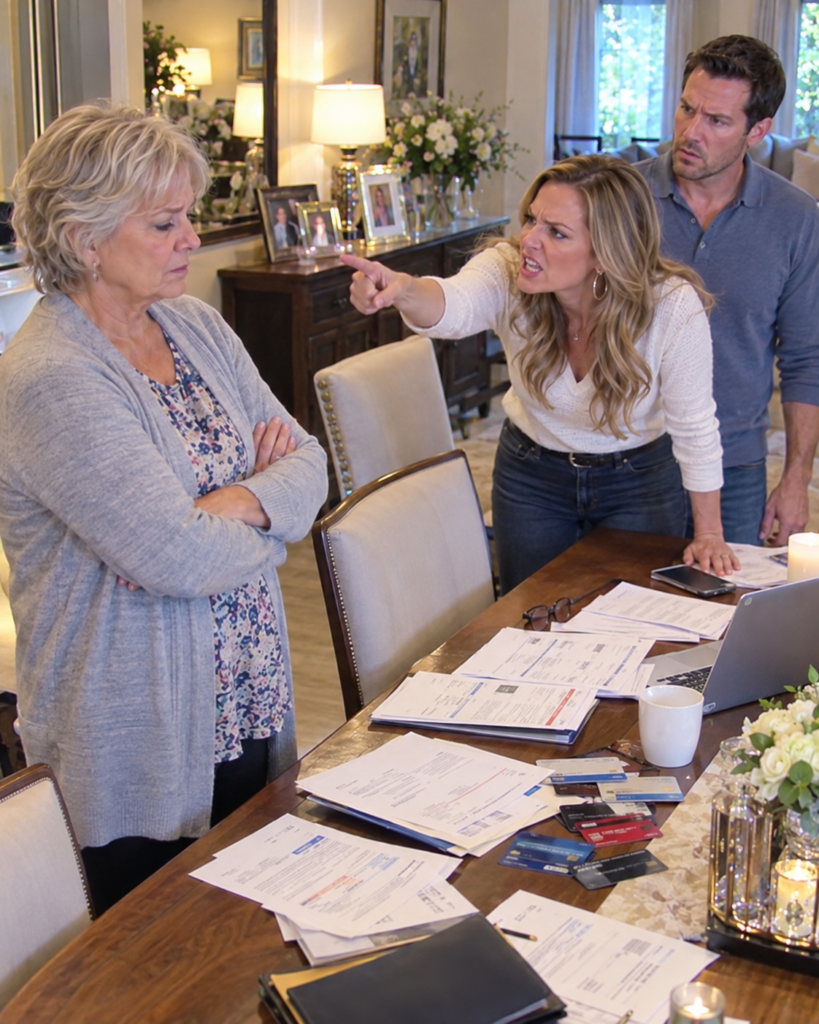
“You’re financially irresponsible, Evelyn. Sell this house before you ruin everyone,” my daughter-in-law announced across my kitchen table. My son Michael nodded as if she’d made a reasonable suggestion. I said nothing, but that night I canceled thirty-one automatic payments I’d been making for them. By seven the next morning, their internet service was suspended, and two credit cards stopped working. My phone rang while I was watering the roses. Vanessa, my daughter-in-law, was screaming, “What have you done to us?” I finally had an answer ready.
I’m sixty-four and live in Raleigh, North Carolina, in the house my late husband and I paid off together. Michael is thirty-seven; Vanessa is thirty-five. They earn decent salaries, but for four years I’d quietly covered expenses they always promised to take over.
It began when Michael was laid off. I paid their car insurance and grocery bills until he found work. Then came their phone plan, utility deposits, student-loan installments, streaming services, and minimum payments on debts they insisted were temporary.
Yesterday Vanessa arrived carrying listings for retirement apartments. She wanted me to sell my three-bedroom home and give them the proceeds as a down payment on a larger house. When I refused, she called me selfish, incompetent, and incapable of managing money.
“Your father would be ashamed,” Michael added. He knew exactly how much that sentence would hurt. I’d spent twenty-six years helping my husband restore this place, and Michael was asking me to surrender it so he could purchase a home with a swimming pool.
After they left, I opened the budgeting spreadsheet they’d never bothered to see. Thirty-one recurring transfers and card charges were attached to their household, totaling nearly four thousand dollars monthly. I canceled future automatic payments and removed them as authorized users from my credit accounts.
Their broadband account was also in my name. I requested a service suspension effective early morning, then sent them a written list of bills they’d need to arrange themselves. Their own bank accounts remained untouched; I had simply stopped financing their lifestyle.
When Vanessa called, I put the phone on speaker.
“Our cards were declined at breakfast,” she shouted. “And there’s no internet!”
I explained that the cards belonged to accounts I owned and the broadband service was registered to me. She demanded I fix everything immediately.
Then Michael grabbed the phone.
“Mom, you’re destroying our lives over one conversation!” he yelled.
I looked at my husband’s photograph on the mantel and replied,
“No, Michael. I’m letting you pay for the life you chose.”
Then someone knocked at my front door.
A real estate agent stood on my porch, carrying a tablet and measuring equipment. Vanessa had arranged a property valuation, claiming I’d agreed to sell. I explained that I hadn’t authorized anything, and the embarrassed agent immediately left. My daughter-in-law had been planning my future without even asking me.
An hour later, Michael arrived with Vanessa and a stack of unpaid bills. They demanded that I reinstate every payment before their accounts became overdue. I invited them inside but left the front door open, determined not to repeat another conversation behind closed doors.
Vanessa waved a car-loan statement at me. She claimed I had promised to pay until the vehicle was fully owned. I produced our messages from two years earlier, where she’d agreed to assume the installments after receiving her promotion. She had received that promotion eighteen months ago.
I explained that stopping an automatic payment did not erase their debts or instantly disconnect every service. Their electricity, insurance, and loans still existed, with due dates they needed to meet. Only the internet subscription under my name was suspended, and their authorized-user credit cards had been disabled.
Michael looked at the spreadsheet I’d printed. There were thirty-one lines: insurance premiums, phone charges, car installments, credit-card minimums, subscriptions, and small recurring household expenses. He was stunned by the total. Vanessa accused me of exaggerating until I showed her the bank statements.
Over forty-six months, I’d spent more than one hundred and forty thousand dollars helping them. Some months had been cheaper, but the pattern was undeniable. Meanwhile, they had taken two vacations abroad and leased a luxury SUV without asking whether my retirement savings could withstand their choices.
“Why didn’t you tell us you were struggling?” Michael asked.
I reminded him of the three conversations where I’d requested a repayment plan. Each time, Vanessa had accused me of trying to control them, and he had promised to discuss it later. Later had never arrived.
Vanessa announced that she’d contact a lawyer because I had damaged their credit. I told her my attorney could review any allegation. Then I slid across the notice I’d drafted: future support was ending, and they had thirty days to transfer any essential services in my name to accounts they controlled.
Michael studied the paper, then admitted he had believed my pension was much larger. I told him my pension was modest and that I’d been drawing down savings to keep them comfortable. Vanessa stared at the floor for the first time. Neither offered an apology.
After they left, Michael sent a message asking for copies of every bill and account deadline. I sent the spreadsheet and service-provider contacts, but no money. That evening he called again, speaking more quietly.
“Mom,” he said, “I had no idea how close you were to running out.”
I wanted to believe Michael’s concern was genuine, but apologies required more than frightened words. I told him I would discuss practical steps, not another request for money. He agreed to meet me alone at the public library, where neither of us could easily turn the conversation into shouting.
Michael arrived with a notebook and a list of their actual household expenses. For the first time, he’d calculated what maintaining their lifestyle cost. Their combined income was enough for necessities, but luxury payments, credit-card balances, and impulse purchases consumed almost everything left over each month.
I suggested he speak with a nonprofit credit counselor and contact creditors before any missed payments occurred. He scheduled appointments and began transferring the phone and internet services into his name. I gave him account information he legitimately needed, but I didn’t co-sign a single new obligation.
Vanessa refused to attend the first counseling session. She told relatives I had cut off her family because I disliked her. When my sister asked for an explanation, I showed her the budget and the apartment listings Vanessa had brought. My sister said, “They’re treating your house like an inheritance you’re supposed to hand over early.”
A week later, Michael told me he and Vanessa had canceled the SUV lease after negotiating an early termination and reviewing the cost. They sold unused electronics, paused their vacations, and arranged realistic payment schedules. Some decisions were expensive, but their accounts were finally their responsibility.
Vanessa appeared at my door again the following Sunday. This time she came without property listings or threats. She apologized for calling me irresponsible and admitted she’d assumed I had unlimited money because I never complained. I accepted the apology without offering to resume a single payment.
I also changed the locks after retrieving the spare key I’d previously given them. That decision upset Michael, but I explained that my home was not an extension of theirs. They could visit when invited, and I would gladly share meals. They could no longer make decisions about my property.
Over the next three months, I rebuilt my emergency savings and stopped checking my phone in fear of another financial request. I planted roses along the back fence and repaired the porch swing my husband had loved. For the first time since his death, the house felt entirely peaceful.
Michael eventually thanked me for drawing a line. He said their budget meetings were uncomfortable but necessary, and he was embarrassed he’d allowed the burden to become invisible. Vanessa was still learning to accept limits, but she had stopped asking me to finance their purchases. That was progress enough.
One evening, Michael visited and found me reading on the porch. He asked whether I might someday leave him the house. I smiled and said,
“Someday you’ll learn what my will says. Today, this is my home.”
I had spent years paying thirty-one bills to keep the peace. Canceling them finally brought it back.
PART 2 — THE FINAL CHAPTER
Michael stopped smiling when I told him the house was still mine.
For a moment, he stood beside the porch steps with his hands buried in his pockets. The evening breeze moved through the roses behind him.
Then he said something that made me close my book.
“Vanessa thinks you’ve changed your will.”
I studied his face.
“Is that why you came?”
“No.”
His answer came too quickly.
I waited.
Finally, he sat on the bottom step.
“She found a real estate listing,” he admitted. “A smaller house. Something we could actually afford now.”
“That sounds sensible.”
“It is. But the lender needs a larger down payment than we have.”
There it was.
Three months of quiet. Three months of learning to answer my telephone without bracing myself.
And we were back at my front door.
“How much?” I asked.
“Twenty-five thousand.”
I laid my book on the little table beside my chair.
Michael turned toward me immediately.
“I’m not asking you to give it to us. It would be a loan.”
“The other payments were supposed to be temporary, too.”
He lowered his eyes.
“We’d sign something this time.”
I could hear how badly he wanted those words to matter.
But I remembered the messages. The promises made after promotions, after bonuses, after vacations they somehow managed to afford while I postponed replacing my water heater.
“No, Michael.”
He stared at the garden.
Then, quietly, he said, “I told her you’d say that.”
“Then you should have let that be the answer.”
He stayed another minute before leaving.
He did not hug me goodbye.
That hurt more than I wanted it to.
But I left my book on the porch table, went inside, and made dinner.
For once, I allowed someone else to be disappointed without treating it as an emergency.
Two days later, my sister called.
“Evelyn, did you agree to guarantee a mortgage?”
I set down my coffee.
“No. Why?”
“Vanessa told your niece you were helping them buy a house. She said the paperwork was practically finished.”
For several seconds, I heard only the refrigerator humming.
“What paperwork?”
“That’s what I thought you should ask.”
I called Michael.
He answered on the fourth ring.
“Did you tell anyone I agreed to help you?”
Silence.
“Michael.”
“Vanessa thought you might reconsider.”
“That is not what I asked.”
“No,” he said. “You haven’t agreed.”
“Then make sure everyone involved knows that.”
“Mom, we haven’t done anything.”
“Good. Keep it that way.”
After hanging up, I called the attorney who had handled my husband’s estate.
Her name was Ruth Bennett. She listened without interrupting.
When I finished, she asked, “Have you signed anything?”
“No.”
“Given anyone permission to act for you?”
“No.”
“Then let’s put your position in writing.”
We also reviewed the documents I had neglected since my husband died: my will, my financial records, and the arrangements I wanted if I became ill.
It was uncomfortable work.
It was also the first time in years that I spent an entire afternoon planning for my own future.
Vanessa arrived Saturday morning.
Michael followed her up the path carrying a blue folder.
I saw it through the kitchen window.
For a moment, I considered pretending I wasn’t home.
Then I dried my hands and opened the door.
“We need to clear something up,” Vanessa said.
“Yes,” I replied. “We do.”
They sat at the kitchen table where she had once called me financially irresponsible.
This time, I brought no coffee.
Michael placed the folder between us.
“It’s an option the broker explained,” he said.
Vanessa leaned forward.
“You wouldn’t have to give us any cash.”
I looked at the folder but did not touch it.
“What would I have to give you?”
“Nothing,” she said. “You’d just use the equity in this house.”
I looked at Michael.
He stared at the table.
“Explain it to me,” I said.
Vanessa sighed, already impatient.
“You have a paid-off property sitting here. There are ways to borrow against it. We would make the payments.”
“And if you didn’t?”
“We would.”
“And if Michael lost his job again?”
Neither answered.
I pushed the folder toward them.
“No.”
Vanessa’s mouth tightened.
“You haven’t even read it.”
“I understand enough to know I’m not borrowing against my home for your down payment.”
“It’s twenty-five thousand dollars, Evelyn. You’re acting as if we’re asking for everything.”
I stood and walked to the cabinet beside the refrigerator.
Inside was the printed spreadsheet I had kept after canceling their payments.
I laid it beside the blue folder.
“One hundred and forty thousand dollars,” I said. “That is what I already gave you.”
Michael flinched.
Vanessa looked away.
“I didn’t ask for it back,” I continued. “I didn’t send you a bill. I asked you to stop spending my retirement.”
“We’re trying to build a future,” Vanessa said.
“So am I.”
She gave a short, disbelieving laugh.
“You’re sixty-four.”
The room became very quiet.
Michael lifted his head.
Vanessa seemed to realize what she had said, but she pressed on.
“I mean, your major expenses are over. We still have our whole lives ahead of us.”
I rested my hand on the back of my chair.
“My husband thought he had years ahead of him, too.”
Michael closed his eyes.
“He put off a trip to the coast because we needed a new roof,” I said. “The next year, he was too sick to travel. After he died, I kept putting things off because the two of you needed something.”
My voice shook.
I let it.
“I need savings if I become ill. I need a house I can afford to maintain. And if I want to spend a week looking at the ocean, I would like to do it without checking whether your car payment has cleared first.”
Michael looked at me then.
Really looked.
But Vanessa reached for the folder.
“Fine,” she said. “We should go.”
She stood so quickly that the chair scraped against the floor.
At the doorway, she turned.
“Just remember this when you need us.”
Michael did not move.
“Take it back,” he said.
She stared at him.
“What?”
“What you just said.”
“Oh, please. She knows I’m upset.”
“Then be upset. Don’t threaten her.”
Vanessa’s face flushed.
“Are you seriously taking her side?”
He looked down at the spreadsheet.
“I should have listened to her years ago.”
Vanessa left alone.
Michael stayed at my kitchen table with his coat still on.
For a long time, neither of us spoke.
Then he pulled the spreadsheet closer.
“I knew you were paying some things,” he said. “I kept telling myself you liked helping.”
“I did like helping.”
He nodded, his eyes wet.
“That made it easier, didn’t it?”
I sat across from him.
“Yes.”
He pressed his palms together.
“I remembered something when you mentioned Dad. The summer after he died, you asked if I could help repair the porch railing.”
I remembered.
He had said he was busy.
Two days later, he posted photographs from a weekend away.
“I told myself you’d hire someone,” he said.
“I did.”
“With the money you were supposed to keep for yourself.”
I did not answer.
He covered his face.
“I said he would be ashamed of you.”
The words sounded worse in the quiet kitchen than they had during the argument.
“Yes,” I said.
Michael began to cry.
I had comforted him through broken toys, bad dreams, school disappointments, and the death of his father.
This time, I stayed in my chair.
Eventually, he lowered his hands.
“I’m sorry, Mom.”
“I believe you’re sorry.”
“But that doesn’t fix it.”
“No.”
He nodded.
For the first time, he did not ask me to make the moment easier for him.
I did not receive a sudden repayment.
There was no miraculous change in their finances.
They withdrew from the house purchase and renewed the lease on their apartment.
Michael returned to the credit counselor with Vanessa. They made decisions they should have made years earlier, and some of them were painful.
He called occasionally to tell me how things were going.
I listened.
When he mentioned an unexpected bill, I waited.
Slowly, he learned to finish those conversations without asking for money.
Six weeks after the visit with the blue folder, he came over carrying a toolbox.
“The porch railing,” he said. “If you still want help.”
I stepped aside.
He worked through the afternoon.
When he finished, he showed me the loose bracket he had replaced and waited while I tested the rail.
It held.
I thanked him.
Then we ate sandwiches on the porch.
He asked about my roses.
He stayed for the answer.
Vanessa wrote to me in November.
The envelope contained two pages.
I read them at the kitchen table.
She apologized for trying to arrange the valuation, for pressuring me to borrow against the house, and for what she had said at the door.
Near the end, she wrote:
I kept thinking about what you could give us. I stopped thinking about what you needed to keep.
I folded the letter and left it beside my plate.
The next morning, I called her.
“Thank you for writing.”
She was quiet.
“Did you read all of it?”
“Yes.”
“I don’t expect everything to go back to how it was.”
“It won’t.”
“I know.”
That was the first conversation between us in a long time that did not leave me exhausted.
At Christmas, they invited me to their apartment.
I almost declined.
Then Michael said, “You don’t have to bring anything. We’ve got dinner.”
So I brought a small tin of cookies because I wanted to.
Their apartment was modest. The dining chairs didn’t match, and Michael burned the first batch of rolls.
Vanessa laughed when he opened the oven.
I watched him laugh, too.
For years, I had helped pay for a life they could not comfortably live. Now, in a smaller room with a table full of simple food, they seemed able to breathe.
After dinner, Michael handed me an envelope.
Inside was a check for two hundred dollars.
“This isn’t much,” he said.
I looked at him.
“We’ve set up a monthly amount. It may take a long time.”
“You need to keep your own bills current.”
“We are.”
Vanessa nodded from beside him.
“We put it in the budget.”
I held the check carefully.
Two hundred dollars would not restore my retirement.
But they had remembered without being reminded.
I thanked them and put it in my purse.
The following spring, I booked a week at the coast.
One room. A little balcony. A clear view of the water.
Michael drove me to the station.
As he lifted my suitcase from the trunk, he smiled.
“Dad would’ve liked this.”
For once, hearing his father mentioned did not feel like someone pressing on a bruise.
“Yes,” I said. “He would.”
Michael hugged me before I boarded.
“Call when you get there.”
“I will.”
“And Mom?”
I turned.
“Have a good time.”
There was no request after it.
No bill waiting to be discussed.
Just my son, standing on the platform, wishing me well.
That evening, I sat on my balcony with a cup of tea and listened to the ocean.
My phone stayed inside.
Back in Raleigh, the roses would need watering when I returned. The porch railing was sturdy. The house was paid for.
And for the first time in years, I had come somewhere simply because I wanted to be there.
I stayed outside until the stars appeared.
THE END