PART 2
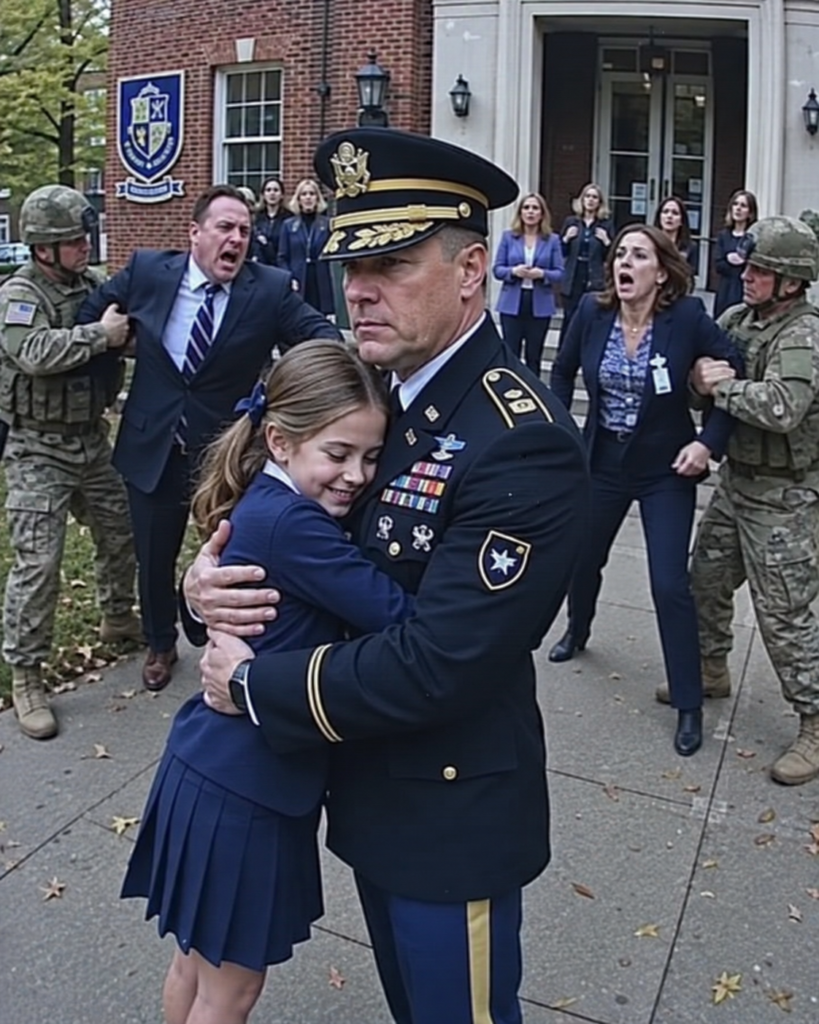
Principal Halloway’s eyes moved from my phone to my face, searching for some sign that I was bluffing.
He found none.
Mrs. Gable unfolded her arms. The confidence that had seemed carved into her posture moments earlier began to slip, replaced by a nervous stiffness.
“You cannot involve the Army in a private school matter,” Halloway said.
“I’m not involving the Army as an institution,” I replied. “I’m requesting guidance from legal counsel because the threats you made may affect my security clearance, my family, and my ability to fulfill official responsibilities.”
That was not the whole reason, but it was enough.
I had learned long ago that people revealed themselves when they believed they were losing control. Some raised their voices. Some became charming. Others reached for every connection they had.
Halloway chose charm.
“Colonel Carter,” he said, his tone suddenly respectful, “perhaps we all reacted too quickly.”
My daughter shifted in my arms when she heard him use my rank.
Emma lifted her tear-streaked face and looked at me.
“You’re a colonel?” she whispered.
The question hurt more than I expected.
I had spent years protecting her from the weight of my career. She knew I worked for the Army, of course, but I had avoided explaining how many people answered to me or how often decisions followed my signature.
“I’m your dad,” I told her softly. “That’s what matters right now.”
Her fingers tightened around my shirt.
Across the desk, Mrs. Gable stared at me as though I had become a different person. I had not. The only thing that had changed was her understanding of what I could do.
That distinction mattered.
“I want the storage room preserved exactly as it was when I found Emma,” I said. “No one enters it. No one removes anything. I also want copies of the hallway security footage and all written records involving my daughter.”
Halloway’s expression closed again.
“School recordings are confidential.”
“So are student records. That does not mean they can be altered or destroyed.”
“I would never suggest such a thing.”
“I didn’t say you would.”
The silence between us grew heavy.
Emma rested her head against my shoulder. She was exhausted, but I could still feel small tremors moving through her. I wanted to take her home, make hot chocolate, and sit beside her until the fear left her eyes.
Yet leaving immediately would give Halloway time to shape the story.
I lowered Emma gently into the chair beside me and knelt so we were eye level.
“Can you wait here for one minute while I make a call?”
She glanced toward Mrs. Gable.
“Will she stay?”
The question changed the room.
Mrs. Gable’s face lost its color.
I looked at Halloway. “Mrs. Gable should leave the office.”
“She is part of this discussion,” he replied.
“My daughter is frightened of her.”
“I’m not frightened,” Emma said quickly, though her voice shook. “I just don’t want her near the door.”
I placed my hand over hers.
“You don’t have to prove anything.”
Halloway hesitated before gesturing toward the hallway.
Mrs. Gable seemed ready to argue, but something in his expression stopped her. She walked out without speaking. When the door closed, Emma released a breath she had been holding.
That single breath told me more than any report could.
I called Major Leah Benton, an attorney assigned to the installation’s legal office. We had worked together on difficult personnel cases, and I trusted her judgment because she did not confuse authority with entitlement.
She answered on the second ring.
“Sir?”
“I need guidance concerning an incident involving Emma.”
Her voice changed immediately. “Is she safe?”
“She is with me. Physically, she appears unharmed, but I found her locked inside a dark storage room at school. Her teacher admitted placing her there. The principal threatened expulsion and retaliation if I reported it.”
Leah was silent for half a second.
“Have you contacted local law enforcement?”
“Not yet.”
“Do that now. Do not negotiate. Preserve every recording and send copies somewhere secure. I’ll contact the appropriate family advocacy liaison and give you the state reporting information.”
Halloway listened from behind his desk. The polished confidence had vanished.
Leah continued. “Do not present this as a military dispute. You’re a parent reporting suspected mistreatment. Your rank is irrelevant to whether the school followed the law.”
“That was my intention.”
“I know. And, sir?”
“Yes?”
“Take Emma home as soon as the initial report is made. She needs to feel that the day belongs to her again, not to these people.”
I looked at my daughter.
She was tracing a scratch on the wooden armrest with one finger, pretending not to listen.
“Understood.”
After ending the call, I contacted the city’s nonemergency police line and requested an officer. Then I called the state child protection reporting service, followed by the Department of Education’s independent school division.
Each call was calm. Each required facts rather than anger.
By the time I finished, Halloway had risen from his chair.
“There is no need to turn this into a spectacle.”
“This became serious when a child was locked in a room.”
“You heard one version of events.”
“I heard Mrs. Gable’s version. She called it her method.”
His jaw tightened.
“That statement was made under pressure.”
“Pressure does not invent beliefs. It reveals them.”
Emma looked up at me, and I regretted the sharpness in my voice. She had already seen too much conflict.
I crouched beside her again.
“Would you like to wait outside with me?”
She nodded.
As we approached the door, Halloway spoke behind us.
“Colonel Carter, you should know that your daughter’s scholarship is reviewed annually.”
I stopped.
Emma’s hand went still inside mine.
There it was again: not a direct threat, but a carefully placed reminder.
I turned slowly.
“My daughter does not have a scholarship.”
For the first time that afternoon, Principal Halloway looked genuinely confused.
“Of course she does.”
“I pay full tuition.”
He stared at me, then opened a drawer and removed a folder. After scanning the first page, he frowned.
“That cannot be correct.”
“What does the file say?”
He closed it too quickly.
“An administrative coding error.”
I stepped closer. “Show me.”
“Student financial records are not relevant.”
“They became relevant when you used them to intimidate us.”
He held the folder against the desk. His eyes shifted toward the computer screen, then toward the closed office door.
Emma tugged my sleeve.
“Dad, I want to go home.”
That decided it.
The financial discrepancy could wait. Her sense of safety could not.
“We will discuss the records later,” I told Halloway. “Do not contact Emma directly. Any communication goes through me.”
We stepped into the hallway.
Mrs. Gable was gone.
A receptionist sat behind the front desk, typing with both hands despite the fact that her computer screen displayed an empty document. Near the entrance, a gray-haired custodian stood beside a cleaning cart.
He watched Emma with quiet concern.
When our eyes met, he gave the smallest nod toward the far end of the corridor.
It was not greeting. It was direction.
Before I could respond, the front doors opened and two police officers entered. One was a young patrol officer whose nameplate read Diaz. The other was Sergeant Anne Mercer, whom I knew only through community safety meetings.
Halloway emerged behind us wearing an expression of solemn cooperation.
“Officers,” he said, “thank you for coming. This appears to be an unfortunate misunderstanding.”
Sergeant Mercer looked at Emma and then at me.
“Mr. Carter, did you make the report?”
“Yes.”
“We’ll speak somewhere private.”
Halloway gestured toward his office. “Please use my conference area.”
“I’d prefer a neutral room,” Mercer said.
The receptionist offered the library, which had already emptied for the day.
I walked there with Emma while Officer Diaz remained in the hallway. Halloway started to follow, but Mercer stopped him.
“We’ll speak with you separately.”
Inside the library, late sunlight stretched across rows of low shelves. Colorful paper birds hung from the ceiling, turning slowly in the air-conditioning.
Emma sat beside me at a round table.
Sergeant Mercer removed her notebook but did not open it immediately.
“Emma,” she said, “my name is Anne. Your dad told us you had a frightening afternoon. You are not in trouble.”
Emma looked at me before answering.
“I know.”
“Would you rather tell me what happened with your dad here, or would you like another trusted adult present?”
“My dad can stay.”
Mercer nodded.
She asked simple questions. What class had Emma been in? What happened before she entered the room? Who closed the door? Could she open it from inside?
Emma’s answers came slowly.
The class had been completing timed multiplication worksheets. Emma had not finished before the timer rang. Mrs. Gable told her she was delaying everyone and ordered her to stand beside the chalkboard.
A few students laughed.
Emma had tried not to cry.
Then Mrs. Gable asked why she had not practiced. Emma explained that she had practiced with me, but numbers sometimes moved around when she became nervous.
I knew what she meant. We were waiting for an educational assessment after her pediatrician suggested she might have a learning difference affecting numerical processing.
Mrs. Gable called it an excuse.
“She said I was acting helpless because people feel sorry for children without mothers,” Emma whispered.
My hands tightened beneath the table.
Mercer noticed, but her voice remained gentle.
“What happened next?”
“I told her not to talk about my mom.”
Emma’s mother, Claire, had died five years earlier after a sudden illness. Emma remembered only fragments: Claire singing while washing dishes, the scent of lavender lotion, the silver bracelet she wore on Sundays.
“What did Mrs. Gable do when you said that?” Mercer asked.
“She grabbed my arm and took me into the hall.”
“Did she hurt you?”
Emma looked down.
“She squeezed hard.”
“Then what?”
“She opened the storage room and said I could come out when I was ready to apologize.”
“Did she say how long that would be?”
Emma shook her head.
“I said I was sorry right away, but she closed the door.”
The paper birds continued turning overhead.
“Was the light on?” Mercer asked.
“It went off when the door shut.”
“Could you reach the switch?”
“I couldn’t find it.”
“How long were you inside?”
“I don’t know.”
Emma’s eyes filled again.
“I counted to a thousand twice, but I think I skipped numbers.”
I put my arm around her.
“You did nothing wrong.”
She leaned against me, and for a moment she looked much younger than eight.
Mercer finally opened her notebook.
“Emma, did anyone come near the door while you were inside?”
Emma thought carefully.
“Mr. Lewis did.”
“The custodian?”
“I heard his keys. He tried the handle, but Mrs. Gable told him I was taking a test and nobody could interrupt.”
My mind returned to the custodian’s nod in the hallway.
“Did you call out?” I asked.
“I was scared she would get angrier.”
Mercer wrote something down.
After the interview, she asked permission to photograph the faint red marks on Emma’s upper arm. Emma agreed only after I explained exactly what would happen.
When we returned to the corridor, Officer Diaz was speaking with the custodian.
Mr. Lewis held his cap in both hands.
Halloway stood several feet away, watching them with visible irritation.
The moment Diaz finished, Mr. Lewis approached me.
“I’m sorry,” he said.
“You tried to check the room.”
“Not hard enough.”
His voice carried the weight of someone who had repeated that sentence to himself.
“You could not know what was happening,” I said.
He glanced toward Halloway.
“I knew something wasn’t right.”
Before he could continue, Diaz called him back to clarify part of his statement.
Mrs. Gable had still not returned.
Halloway claimed she had gone home because she felt ill. Sergeant Mercer informed him that an officer would contact her immediately.
Then Mercer inspected the storage room.
I stayed outside with Emma, but from the doorway I saw shelves crowded with athletic cones, folded mats, boxes of paper, and cleaning supplies. There was no interior handle on the door, only a flat metal plate.
The light switch was outside in the corridor.
Mercer tested the door twice.
Each time, it locked automatically when it closed.
“This room should not be used for student supervision,” she said.
“It isn’t,” Halloway replied. “Today was an isolated lapse in judgment.”
Mr. Lewis looked at him sharply.
Mercer noticed.
“Something to add, sir?”
The custodian hesitated.
Halloway’s gaze settled on him.
“No,” Lewis said at last. “Not here.”
I recognized fear when I saw it. It did not make him weak. It meant he believed the consequences of speaking could reach beyond his job.
Sergeant Mercer gave him her card.
“You can call me privately.”
Halloway insisted that the security system had malfunctioned that morning and no footage was available. Officer Diaz requested a written statement from the technology contractor confirming the outage.
“That may take several days,” Halloway said.
“Then the system itself should not be touched until our investigator examines it,” Mercer replied.
The principal’s polite expression became strained.
Emma and I were finally allowed to leave shortly before five.
Outside, the air smelled of cut grass and approaching rain. Parents’ cars were gone, and the school’s stone buildings looked peaceful in the fading light.
Appearances had protected the place for a long time.
I buckled Emma into the back seat.
She stared through the window while I walked around the car. When I sat behind the wheel, she spoke before I could start the engine.
“Are they going to expel me?”
“No.”
“How do you know?”
“Because you did not do anything that deserves punishment.”
“That doesn’t mean they won’t.”
Her answer was too perceptive for a child her age.
I turned in my seat.
“You’re right. Sometimes adults make unfair choices. But you will not face them alone.”
She studied my face.
“Will you make them let me stay?”
I had expected her to want nothing more to do with the school.
“Do you want to stay?”
“My friends are there.”
The simplicity of it broke through my assumptions. To me, the school had become a place of danger and deception. To Emma, it was also where Maya traded sandwiches with her, where Noah saved her a seat at assembly, and where the librarian let her borrow two extra books.
“I don’t know what will happen yet,” I admitted. “But your opinion matters.”
She nodded, though uncertainty remained in her eyes.
At home, we made grilled cheese sandwiches and tomato soup. Emma ate only half before asking whether she could sleep in my room.
“Of course.”
I found an old camping mattress and placed it beside my bed. We watched a nature documentary until she fell asleep with one hand curled around the edge of my blanket.
Only then did I listen to the recordings again.
Halloway’s threats were clear. Mrs. Gable’s admission was unmistakable. Yet the moment that held my attention was his claim that Emma received financial aid.
I opened my tuition records.
Every payment had been transferred directly from my account. There were no reductions, grants, or scholarship credits.
At 9:17, an email arrived from the school’s automated system.
The subject line read: Updated Enrollment Documentation.
When I opened it, I found a newly generated statement showing that Emma had received a “Founders’ Family Scholarship” for the past three years.
The listed amount was substantial.
According to the document, I had paid only a fraction of her tuition.
That was demonstrably false.
I downloaded the file, saved copies, and compared its creation data with older statements. It had been generated seventeen minutes after we left campus.
Someone was manufacturing a financial history.
But why?
My phone rang.
The number was blocked.
I answered without speaking.
For several seconds, I heard only breathing.
Then a man said, “Check your daughter’s first enrollment application.”
The voice was low and hurried.
“Who is this?”
“The scholarship is not about money.”
The call ended.
I tried calling back, but the number could not be reached.
I went to the cabinet where I kept Emma’s school records. Her original application was in a blue folder labeled with the year she entered kindergarten.
Nothing looked unusual.
I reviewed every page: emergency contacts, medical information, previous preschool records, family details.
On the final page, beneath my signature, another signature appeared in faded blue ink.
Claire Carter.
I stared at it until the letters seemed to shift.
Claire had been dead for nearly two years when Emma enrolled.
The signature resembled hers, but not perfectly. The first letter leaned too far right, and the final stroke lacked the small upward curve Claire always made.
Someone had forged my wife’s name.
I photographed the page and called Leah Benton.
She answered immediately.
“This is more complicated than the incident at school,” I told her.
I explained the altered tuition statement and the forged application.
“Do you know who submitted the original paperwork?” she asked.
“I did. At least, I believed I did.”
“Was any portion completed by the school?”
“They gave me a packet during an open house. I filled it out at home and returned it.”
“Could Claire’s signature have been added afterward?”
“Yes.”
Leah exhaled slowly.
“Do not confront the principal about this tonight. Send me copies, then secure the originals.”
“What could a fake scholarship accomplish?”
“It could conceal payments, redirect funds, or create the appearance that your family owed the school a debt. It might also be entirely unrelated to finances.”
“That anonymous caller said it was not about money.”
“You received a call?”
I told her what the man had said.
“Someone inside the school may be trying to help,” she said, “or trying to lead you toward a particular conclusion.”
I looked at Emma sleeping on the mattress.
“Either way, they know our records.”
“Which means you should assume they know more about your family than you expected.”
After the call, I moved the documents into a small fireproof case and locked it in my home office.
Sleep did not come easily.
I kept thinking about Claire’s forged signature.
She had been a music teacher before Emma was born. Warm, patient, and capable of remembering every child’s favorite song, she had believed schools were built on trust.
She would have been furious about what happened to Emma.
She also would have warned me not to let anger replace judgment.
Near midnight, I opened an old box of Claire’s belongings. I found birthday cards, appointment notes, photographs, and a stack of letters tied with green ribbon.
I was not searching for anything specific. I only needed to see her real handwriting.
The forged signature was close enough to fool someone who had seen her name on documents. It was not close enough to fool me.
At the bottom of the box lay a school brochure.
Westbridge Academy.
Emma’s school.
The brochure was dated nine years earlier, before Emma was born.
A handwritten note covered the back.
Daniel,
I visited Westbridge today. The campus is beautiful, but something felt wrong. I’ll explain when you’re home. Please remind me.
Love, Claire.
I read it three times.
I had been deployed during that period. Claire and I spoke whenever communications allowed, but conversations were often rushed and interrupted. I could not remember her mentioning Westbridge.
Why had she visited?
The next morning, Emma woke before sunrise.
For a moment, she looked confused by the camping mattress. Then memory returned, and her expression tightened.
“You don’t have to go to school today,” I said.
“Am I suspended?”
“No. I’m keeping you home.”
She considered that distinction.
“Can Maya know I’m okay?”
“We can call her mother after breakfast.”
While pancakes cooked, Emma sat at the counter drawing a house with a red roof. Beside it she drew three people: herself, me, and a woman in a yellow dress.
I had not seen her draw Claire in years.
“That’s Mom,” she said without looking up.
“I thought so.”
“Mrs. Gable said I use Mom to get attention.”
I turned off the stove.
“Missing someone is not a performance.”
“She said everybody loses people.”
“Everybody experiences sadness. That does not make your sadness less important.”
Emma colored the dress more firmly.
“Did Mom know my school?”
The question startled me.
“Why do you ask?”
“She came there once.”
My heartbeat slowed.
“How do you know?”
Emma reached into the pocket of her cardigan, the same one she had worn the previous day, and removed a folded square of paper.
“I found this in the storage room.”
She handed it to me.
It was a torn piece of sheet music, yellowed at the edges. Several notes had been circled in pencil.
At the bottom, in Claire’s unmistakable handwriting, were four words:
For Emma, when she’s ready.
“Where exactly did you find this?” I asked.
“Under the shelf. I saw it when I was sitting on the floor.”
“Did you show anyone?”
She shook her head.
“I thought Mrs. Gable would take it.”
I sat beside her, holding the paper carefully.
The melody consisted of only eight measures. Claire used to write short compositions for her students, often hiding messages in the note names.
I read the circled sequence.
B. A. D. G. E.
Badge.
The final three circled notes were C, A, and B.
“Badge cabinet,” I whispered.
Emma’s eyes widened.
“At school?”
“I don’t know.”
Before I could examine it further, the doorbell rang.
Through the window, I saw Sergeant Mercer standing on the porch with Mr. Lewis, the custodian.
Lewis clutched a large brown envelope.
I let them inside.
Emma stayed in the kitchen while we spoke in the living room. Mercer explained that Lewis had contacted her before dawn and requested to give a formal statement away from campus.
“I should have spoken yesterday,” Lewis said. “But my wife works in the school office. Halloway has threatened both our jobs before.”
“Why?” I asked.
“Because we noticed things.”
He placed the envelope on the coffee table.
Inside were printed maintenance requests dating back six years. Several concerned the storage room lock. Teachers had repeatedly reported that the door could trap someone inside.
Each repair request had been marked completed.
Lewis shook his head.
“I never repaired it because the principal kept canceling the work order.”
“Why would he do that?” Mercer asked.
“He said the room needed to remain secure.”
“Were other students placed inside?”
Lewis looked toward the kitchen, making sure Emma could not hear.
“I know of three.”
The room seemed to narrow around us.
“Did you report it?” I asked.
“To Halloway. He said the teachers were using a supervised reflection space. I believed him at first.”
“What changed?”
“A boy had an asthma attack in there two years ago.”
Mercer leaned forward.
“Was emergency care called?”
“No. His parents were told he became ill during recess.”
“Do you know his name?”
Lewis nodded.
“Owen Price.”
The name was familiar. Owen had left Westbridge abruptly in second grade. Parents were told his family had moved.
“They did not move,” Lewis said. “They signed an agreement and transferred him.”
He pulled another item from the envelope: a photograph of a wooden cabinet filled with old school badges, medals, and commemorative pins.
My eyes fixed on it.
“Where is this cabinet?”
“In the archives room behind the auditorium.”
I showed him Claire’s sheet music.
His face changed the moment he saw the handwriting.
“You knew my wife?”
“Not personally.”
“But you recognize this?”
Lewis sat back, troubled.
“Nine years ago, Mrs. Carter visited Westbridge with a state arts education committee. They were reviewing grant programs. She asked questions about missing music funds.”
I could barely process his words.
“What happened?”
“She found records that didn’t match. The school claimed scholarships had been awarded to families who never received them. Your wife wanted to report it.”
“Did she?”
“I don’t know. A week later, Principal Halloway told the staff the review had ended.”
Claire had never told me.
Or perhaps she had tried, and distance had swallowed the conversation before it began.
“Why would she hide a message in sheet music?” Mercer asked.
Lewis looked at the photograph.
“The badge cabinet used to belong to the music department. There’s a locked compartment underneath.”
“Do you have access?”
“Not anymore. Halloway changed the archives keys last year.”
Mercer stood.
“We will obtain lawful access. No one is going there alone.”
Her warning was directed at me.
“I understand.”
She gathered the documents for evidence, allowing me to photograph each page first. Before leaving, Lewis paused near the front door.
“There is something else,” he said. “Yesterday, before Mrs. Gable took Emma into the hallway, she received a message.”
“From whom?”
“I could not see the sender. But I heard her tell Halloway that the Carter girl had found something.”
I looked toward the kitchen.
Emma was still drawing, unaware that three adults were discussing a secret she had carried home in her pocket.
“What could she have found before entering the storage room?” I asked.
Lewis shook his head.
“That is what frightened them.”
After they left, I sat beside Emma.
“Did you find anything at school before Mrs. Gable punished you?”
She stopped coloring.
For several seconds, she said nothing.
Then she opened her pencil case and removed a small brass key taped beneath the inner flap.
“I found it in a library book,” she said. “The book had Mom’s name inside.”
I took the key.
A tiny shield was engraved on one side.
A school badge.
“Which book?”
Emma swallowed.
“It was about a girl whose mother left clues for her. Mrs. Gable saw me reading it. She asked where I got the key, but I said I didn’t know what she meant.”
“Why didn’t you tell me yesterday?”
“I thought you already had too many things to fix.”
I pulled her gently into my arms.
“You are never one more thing to fix.”
She pressed her face against my shoulder.
Over her head, I looked at Claire’s message, the brass key, and the old Westbridge brochure.
The school had not selected Emma by chance.
Someone had placed her mother’s signature on the application, created a false scholarship, and ensured my daughter entered the same institution Claire had once investigated.
Perhaps it had been done to monitor our family.
Perhaps someone had hoped Emma would eventually find what Claire left behind.
My phone chimed.
An email had arrived from an address made entirely of numbers.
There was no message, only one attached photograph.
It showed the locked compartment beneath the badge cabinet, its door standing open. Inside sat a blue folder bearing Claire’s name.
Across the folder rested a recent photograph of Emma walking into school on her first day of kindergarten.
On the back, written in black ink, was a sentence:
Daniel Carter still believes Claire’s death was an illness.
I stared at the words until the room seemed to tilt.
Then another message appeared.
Do not trust the person who gave you the key.
I looked down at Emma.
She was no longer holding the brass key.
The front door, which I was certain I had locked, stood slightly open.
PART 3(END)
For one suspended second, I could hear nothing but the soft creak of the front door moving in the morning breeze.
The brass key was gone.
Emma stood beside me, her small hand still half-open where it had rested moments earlier. Her face had drained of color.
“Dad,” she whispered, “I didn’t drop it.”
I crossed the room in three strides and pushed the door fully open.
The porch was empty.
Beyond it, our quiet street stretched beneath a pale morning sky. A delivery truck turned at the far intersection. Mrs. Patel from across the road was watering the flowers beside her steps. Nothing moved near the hedges or driveway.
I checked behind the porch columns, then walked quickly around the side of the house. The gate remained latched. No footprints marked the narrow strip of damp soil beneath the windows.
Whoever had opened the door had either left without being seen or had never stepped fully inside.
When I returned to the living room, Emma had not moved.
She was staring at the place where the key had been.
“Did you see anyone?” I asked gently.
She shook her head.
“Did someone touch your hand?”
“No.”
“Did you put the key somewhere?”
“No. I was holding it, and then you looked at the door.”
Her voice cracked.
“I’m sorry.”
I knelt in front of her.
“You have nothing to be sorry for.”
“But I lost Mom’s key.”
“You didn’t lose anything on purpose.”
“What if it was important?”
“It was important,” I said, “but you are more important.”
Her eyes filled.
I pulled her against me, feeling how quickly her heart was beating. For the past two days, adults had placed burdens on her that no child should have carried. Mrs. Gable had made her believe difficulty was failure. Halloway had made her believe belonging could be taken away. Now an unknown person had reached into the safety of our home and left her frightened again.
That was the part I could not accept.
Not because I believed I could control every danger, but because Emma had begun to think she was responsible for preventing them.
I held her at arm’s length.
“Listen to me. Secrets kept by adults are not yours to protect. Problems created by adults are not yours to solve. Your job is to tell me the truth and let me help.”
She wiped her cheek with the back of her hand.
“What if telling makes things worse?”
The question silenced me.
Children did not invent fears like that without learning them somewhere.
“Did someone tell you not to talk about the key?” I asked.
Emma looked toward the kitchen.
Not at me.
“Emma?”
“At school,” she said quietly, “someone left me a note.”
“When?”
“Last week.”
“What did it say?”
She slipped her fingers into the cuff of her cardigan, twisting the fabric.
“It said, ‘Some things belong to your mother. Don’t let your father take them until you understand.’”
A cold uneasiness settled over me.
“Do you still have the note?”
She shook her head.
“I tore it up.”
“Why didn’t you tell me?”
“Because it said you might send me away if you knew.”
The sentence struck with such force that I had to look down.
“Send you where?”
“To Aunt Rachel.”
Claire’s younger sister lived in Oregon. Emma loved her, but I had never suggested sending Emma to live with her. Not once.
“Whoever wrote that note lied to you.”
“I know that now.”
“How?”
“Because yesterday you believed me.”
Her answer broke something open inside me.
Emma had not been testing whether I could find the truth. She had been testing whether the truth would cost her my love.
I drew her close again.
“There is nothing you can tell me that would make me stop being your father.”
“What if I make a bad choice?”
“Then we talk about it. We learn. We repair what we can.”
“What if it is a very bad choice?”
“You still come home to me.”
She leaned into my shoulder.
Outside, Mrs. Patel called good morning to someone passing on the sidewalk. The ordinary sound made the open door feel even more unsettling.
I closed and locked it, then called Sergeant Mercer.
She answered immediately.
“Is Emma safe?”
“Yes, but someone may have entered my house.”
I explained the missing key, the open door, and the anonymous email. Mercer instructed us not to touch the handle or porch rail again. She and Officer Diaz arrived twelve minutes later.
This time, they came without lights or sirens.
Diaz photographed the entryway while Mercer checked the windows and listened as Emma described what happened. She asked questions carefully, never suggesting that Emma was mistaken.
“Was the key warm or cold when you held it?” Mercer asked.
Emma frowned, thinking.
“Cold at first.”
“And before it disappeared?”
“I don’t know.”
“Did you hear any sound?”
Emma closed her eyes.
“The curtain moved.”
We all looked toward the narrow window beside the door.
A linen curtain hung there, still now.
Mercer examined the frame.
“The window is locked,” she said.
Diaz crouched near the floor.
“There’s something under the cabinet.”
He reached beneath the narrow entry table and pulled out a folded white card using a gloved hand.
My name was written across the front.
Daniel.
The handwriting was not Claire’s.
Mercer opened it.
Inside was one sentence.
The key was never meant for the cabinet.
No signature. No explanation.
Emma gripped my sleeve.
“Then what does it open?”
“I don’t know,” I said.
Mercer placed the card into an evidence sleeve.
“Whoever left this wanted you to know the key was gone.”
“Or wanted us to believe it was gone,” Diaz said.
I looked at him.
“What do you mean?”
He pointed toward the carpet beside the entry table. A small brass-colored fleck caught the light.
“Looks like paint.”
Mercer’s expression sharpened.
“The key may have been a copy. Or a prop.”
Emma stared at the evidence sleeve.
“So Mom didn’t leave it?”
“We don’t know yet,” I told her.
She gave me a frustrated look.
Adults often used those words to protect children from frightening possibilities. Emma had heard them enough to recognize their shape.
“I’m tired of not knowing,” she said.
“So am I.”
The honesty surprised her.
I sat beside her on the couch.
“But not knowing does not mean we are helpless. It means we move carefully.”
Mercer finished taking our statements and arranged for a patrol car to pass the house throughout the day. She also recommended that we stay elsewhere until the locks and security system could be inspected.
“I have a guest room,” she added, almost reluctantly. “My husband is away visiting his father, and my daughter is at college. You would have privacy.”
The offer touched me, but I shook my head.
“My sister-in-law has an apartment nearby when she visits for work. It is empty this week.”
“Does anyone know the address?”
“Only family.”
Mercer looked toward Emma.
“Family can be exactly what you need right now.”
I called Rachel.
She answered with sleep in her voice despite the time difference.
“Daniel? Is Emma okay?”
The concern came so quickly that I realized how long I had waited to involve her.
“She’s safe. But something happened at school.”
By the time I finished explaining, Rachel was no longer sleepy.
“I’m flying in.”
“You don’t have to.”
“Yes, I do.”
“Rachel—”
“She is Claire’s daughter, and she is my family. Stop treating help like a weakness.”
The words carried no anger, only weary affection.
Claire had said something similar many times.
I looked at Emma, who was watching me closely.
“All right,” I said. “Come.”
Rachel arrived that evening with one suitcase, an oversized handbag, and the same bright red scarf she had worn to every winter holiday for ten years.
Emma ran to her in the airport terminal.
Rachel dropped the suitcase and opened her arms.
“My favorite person,” she said, lifting Emma despite the fact that Emma’s feet nearly reached the floor now.
“You say that to Dad too.”
“No, I tell your dad he is my favorite difficult person.”
Emma laughed.
It was the first unguarded sound she had made since the storage room.
I stood a few feet away, watching them.
Rachel looked so much like Claire around the eyes that grief sometimes arrived before I could prepare for it. The resemblance was strongest when she smiled, but there were differences too. Rachel moved quickly, spoke directly, and wore emotion openly. Claire had been quieter, arranging her feelings carefully before sharing them.
Rachel set Emma down and hugged me.
“You look terrible,” she said.
“Thank you.”
“You’re welcome.”
Then her expression softened.
“You should have called me yesterday.”
“I know.”
That was enough for now.
At Rachel’s apartment, we ate takeout noodles around a small kitchen table. Emma told her about the false scholarship, the music notes, and the key.
She left out the storage room at first.
Then, halfway through dinner, she set down her fork.
“Mrs. Gable said Mom was an excuse.”
Rachel became completely still.
I expected anger. Instead, she reached across the table and placed her hand over Emma’s.
“Your mother was many things,” she said. “She was brave. She was stubborn. She sang the wrong words to nearly every song on the radio.”
“She did?”
“Confidently.”
Emma smiled.
“But she was never an excuse,” Rachel continued. “She was part of your life, even when you were too young to remember everything.”
“Dad doesn’t talk about her much.”
The words were not accusation, but they landed like one.
Rachel looked at me.
I had spent years telling myself I was protecting Emma from grief. In truth, I had also been protecting myself from conversations I did not know how to survive.
“You’re right,” I said.
Emma waited.
“I thought talking about Mom might make you sad.”
“I’m already sad sometimes.”
“I know.”
“And when nobody talks about her, it feels like I’m the only one who remembers she was real.”
Rachel lowered her eyes.
I reached across the table.
“You should never have felt that way.”
Emma took my hand.
“Can we talk about her now?”
“Yes.”
“Even if it makes you sad?”
“Yes.”
That night, Rachel opened a photo album on the living room floor.
We told stories until Emma fell asleep against my side.
I told her about Claire getting lost on the way to our first date and arriving forty minutes late with a paper map covered in angry circles. Rachel told her how Claire once tried to bake a birthday cake shaped like a piano and created something that looked more like a black-and-white canoe.
Emma laughed until tears gathered at the corners of her eyes.
Then she asked the question I had feared.
“How did Mom die?”
I looked at Rachel.
We had told Emma the simple truth when she was younger: Claire became very sick, and the doctors could not make her better.
But Emma was no longer four.
“She had a heart infection,” I said. “It became serious very quickly.”
“Did she know she was going to die?”
My throat tightened.
“Not at first.”
“Did you?”
“No.”
That answer remained one of the most painful truths of my life.
Claire had felt tired for weeks. She blamed work, then a lingering cold. By the time she went to the hospital, the infection had damaged a valve in her heart.
Everything happened within days.
I had been at her bedside when she died.
At least, that was what I had always believed I understood.
Rachel closed the album.
“Emma, your mother loved you from the moment she knew you were coming.”
“Did she leave me anything?”
I thought of the sheet music and the hidden folder.
“Probably more than we know.”
Rachel watched me carefully.
After Emma went to bed, she closed the bedroom door and returned to the living room.
“What are you not telling her?”
I showed her the anonymous photograph and the message about Claire’s death.
Rachel read it twice.
Her face did not change immediately.
That frightened me more than shock would have.
“What?” I asked.
She set the phone down.
“Claire called me three days before she went to the hospital.”
“You never told me that.”
“You were overseas.”
“I spoke to her during those three days.”
“She did not want you distracted.”
“Distracted by what?”
Rachel walked to the window.
“She said someone had been following her.”
The room seemed to tilt around that sentence.
“Who?”
“She didn’t know.”
“And you said nothing?”
“I begged her to call the police. She said she had no proof.”
“You should have told me.”
“I know.”
The regret in her voice prevented my anger from becoming accusation.
Rachel folded her arms tightly.
“She also said she had discovered something involving a school grant. She thought people had been using children’s names to move money through charitable accounts.”
“Westbridge.”
“She never said the name.”
“She visited Westbridge.”
Rachel turned.
“How do you know?”
I showed her the brochure and Claire’s handwritten note.
Rachel pressed her fingers against her lips.
“She told me she had hidden copies of the records somewhere safe. She said if anything happened, I should find a man named Thomas.”
“Thomas who?”
“She would not tell me.”
“Why?”
“She said names were dangerous if written down.”
I stood and began pacing.
“This makes no sense. Claire was a music teacher, not an investigator.”
“She was serving on a state arts committee.”
“I know that now.”
“She started noticing that certain grant recipients appeared in reports but not in classrooms. Instruments were supposedly purchased, yet schools never received them. Scholarships were assigned to students whose parents knew nothing about them.”
“Like Emma.”
Rachel nodded.
“Claire believed someone was creating false beneficiaries.”
“Why use Emma after Claire died?”
“I don’t know.”
My phone rang.
Sergeant Mercer.
“We obtained authorization to secure the archives room,” she said. “The compartment in the badge cabinet was empty.”
“The photograph showed a folder.”
“I know.”
“Someone removed it.”
“Possibly. But there is something else. The lock on the compartment does not match the brass key Emma found.”
The note had told the truth.
The key was never meant for the cabinet.
“Did you find anything?”
“An indentation in the dust where a folder had been. And a small label stuck behind the drawer.”
“What did it say?”
“C-17.”
The designation meant nothing to me.
Rachel, however, had gone pale.
I ended the call.
“You recognize it.”
She did not answer.
“Rachel.”
“Claire used letters and numbers for storage boxes.”
“What was C-17?”
“I don’t know exactly. After she died, most of her committee papers disappeared.”
“From where?”
“Her studio.”
I stared at her.
Claire’s studio had been a small room above the detached garage of our former house. After her funeral, Rachel and I packed it together.
Nothing had appeared disturbed.
“What do you mean disappeared?”
“I found an index card in her desk. It listed boxes C-1 through C-18. But only six boxes were in the room.”
“Why didn’t you tell me?”
“Because I thought you had taken the others.”
“And I assumed you had.”
For years, each of us had believed the other was protecting Claire’s missing papers.
Someone else had removed them.
Rachel sat down slowly.
“C-17 might still exist.”
“Where?”
“Claire rented a safe-deposit box.”
I felt my pulse quicken.
“She never told me.”
“She opened it under her maiden name.”
“How do you know?”
“She asked me to be the secondary contact.”
“Then why have you never opened it?”
“I tried after she died. The bank said the box had already been closed.”
“By whom?”
“They would not tell me.”
“Did you show them the death certificate?”
“Yes. They said the account holder had appeared in person and ended the rental.”
I stared at her.
“That is impossible.”
“I know.”
“When?”
Rachel’s voice dropped.
“Six weeks after Claire died.”
The next morning, Mercer arranged a meeting with a financial crimes investigator named David Chen. He was quiet, methodical, and careful not to promise answers before seeing evidence.
We met at the police station while Rachel stayed with Emma.
Chen reviewed the forged scholarship statement, the enrollment application, and the photograph of the folder.
“Fraud involving educational charities can remain hidden for years,” he said. “A school can report assistance it never actually provides, then move matching funds through related organizations.”
“Would Emma’s name be useful?”
“Yes. A real student creates a believable paper trail.”
“Why forge Claire’s signature?”
“To show parental consent. Or to connect the application to an older file already bearing her name.”
He enlarged the photograph of the blue folder.
“There’s a symbol here.”
I leaned closer.
Near the bottom corner was a faint silver mark shaped like a tree with seven branches.
I had seen it before.
Not at Westbridge.
On Claire’s silver bracelet.
She wore it on Sundays, and Emma remembered it clearly.
“What does it mean?” Chen asked.
“I don’t know.”
I called Rachel.
She answered after one ring.
“The tree on Claire’s bracelet,” I said. “Where did she get it?”
There was a pause.
“Our grandmother gave it to her.”
“What did it represent?”
“A family organization.”
“What kind of organization?”
“I’m not sure. Grandmother called it the Seven Branches Society. I thought it was some old scholarship club.”
“Did Westbridge have a connection to it?”
“I don’t know.”
Chen searched public records while we spoke.
The Seven Branches Society had been established nearly seventy years earlier as a charitable trust supporting music education, widowed parents, and children of military families.
Its current listed partner organizations included Westbridge Academy.
One of its trustees was Principal Halloway.
Another was a name I recognized immediately.
Thomas Vale.
The man Claire had told Rachel to find.
Chen located an address.
Thomas Vale lived less than three miles from Rachel’s apartment.
Mercer insisted on accompanying me.
The house stood at the end of a narrow lane, partly hidden by cedar trees. It was modest and carefully maintained, with wind chimes hanging beside the porch.
A man in his late sixties answered the door.
He had silver hair, tired eyes, and a wooden cane.
When he saw me, he did not ask who I was.
“You have Claire’s eyes when you’re angry,” he said.
Mercer shifted beside me.
“You knew my wife.”
Thomas looked past us toward the road.
“You should come inside.”
His living room smelled of coffee and old books. Photographs covered the walls: orchestras, school choirs, children holding instruments.
One photograph showed Claire at twenty years old beside Thomas.
“Who are you?” I asked.
“I was her professor.”
“Rachel said Claire told her to find you.”
“She did.”
“Why?”
“Because she trusted me with part of what she discovered.”
“Part?”
Thomas lowered himself into a chair.
“Claire learned that the Seven Branches Society had been compromised. Money intended for vulnerable families was being redirected through schools and private foundations.”
“By Halloway?”
“He was involved, but he was not in charge.”
“Who was?”
Thomas studied me.
“Claire never proved it.”
“Did she believe her life was in danger?”
“She believed someone wanted to frighten her.”
“That is not what I asked.”
Thomas looked toward the photographs.
“Yes.”
The answer settled between us.
Mercer leaned forward.
“Do you have evidence related to her death?”
“No.”
“Then why did someone tell Daniel it was not an illness?”
“Because people confuse suspicious timing with proof.”
His response was careful.
Too careful.
I placed the photograph of the blue folder on the table.
“Where is this?”
Thomas’s hand tightened around his cane.
“You should not have that image.”
“Where is the folder?”
“I don’t know.”
“What does C-17 mean?”
He closed his eyes briefly.
“It was Claire’s witness file.”
“Witness to what?”
“Not what. Who.”
My chest tightened.
Thomas stood and walked slowly toward a bookshelf. From behind a row of music journals, he removed a sealed envelope.
Claire’s handwriting covered the front.
For Daniel, when Emma is old enough.
I reached for it.
Thomas did not release it.
“She did not want you to read this while grief controlled your decisions.”
“My wife has been gone five years.”
“And grief does not follow calendars.”
Mercer stepped closer.
“Mr. Vale, if that envelope contains evidence related to criminal conduct, you cannot continue withholding it.”
Thomas let go.
My name trembled slightly in Claire’s handwriting.
I opened the envelope.
Inside was a letter and a photograph.
The photograph showed Claire standing outside Westbridge beside a woman I had never seen. Between them was a young girl of perhaps seven or eight.
On the back, Claire had written:
The first Emma Carter.
I read the words again.
“What does this mean?”
Thomas sat down.
“Read the letter.”
My hands felt strangely unsteady as I unfolded it.
Daniel,
If you are reading this, then I was not able to explain everything myself. I need you to begin with one truth: I never wanted our daughter involved in this.
Years before Emma was born, another child used her name.
She was placed on scholarship documents as Emma Carter because her real identity had to be protected. I helped her mother leave a dangerous situation. Westbridge and the Seven Branches Society promised confidentiality.
Later, I discovered they continued using the false identity to claim funds long after the girl was gone.
When our Emma was born, someone connected the records.
I believed I could correct it quietly.
I was wrong.
Do not assume everyone at Westbridge is your enemy. Someone there protected the records because they believed the truth would someday matter.
Find the girl in the photograph.
She knows why our daughter was chosen.
The letter ended there.
No name.
No address.
Only Claire’s signature.
I looked at Thomas.
“Who was the girl?”
“I knew her only as Lily.”
“Where is she now?”
“I don’t know.”
“Who was her mother?”
Thomas hesitated.
Then he pointed toward the woman in the photograph.
“She worked at Westbridge.”
“As what?”
“A music teacher.”
I studied the woman’s face.
She had dark hair, a calm smile, and one hand resting protectively on the girl’s shoulder.
Something about her seemed familiar.
Not because I had met her, but because I had seen her features reflected in someone else.
The door behind us opened.
Rachel stepped into the room.
Emma stood beside her.
I rose sharply.
“You were supposed to stay at the apartment.”
“Emma remembered where she had seen the tree symbol,” Rachel said.
Emma held up her library book.
Embossed faintly beneath the dust jacket was the same seven-branched tree.
Thomas stared at the book.
“That should not exist.”
Emma opened it to the inside cover.
A library card pocket had been glued there. Behind it was a narrow strip of paper containing an address and a date.
Tomorrow’s date.
Beneath it were six handwritten words:
Bring Emma. She deserves her real name.
Rachel looked at the photograph in my hand.
Then she saw the woman standing beside the first Emma Carter.
Her breath caught.
“Daniel,” she whispered.
“What?”
She took the picture, staring at it with widening eyes.
“I know this woman.”
“From where?”
Rachel looked at Thomas, but he lowered his gaze.
“Tell him,” she said.
Thomas said nothing.
“Tell me what?” I demanded.
Rachel turned the photograph over.
“Her name was Evelyn.”
“That means nothing to me.”
“It should.”
Her eyes filled with an emotion I could not identify—fear, sorrow, and something close to relief.
“Evelyn was our mother’s youngest sister.”
I stared at her.
“Claire’s aunt?”
Rachel nodded.
“She disappeared when Claire was a child. Our family was told she had died.”
The room went silent.
Emma moved closer to me.
I looked again at the young girl in the photograph—the first child who had carried my daughter’s name.
“Then Lily was Claire’s cousin,” I said.
Thomas raised his eyes.
“No.”
The single word changed the air in the room.
Rachel went still.
Thomas looked at Emma, then at me.
“Lily was not Claire’s cousin.”
He reached into his shirt pocket and removed a second photograph, worn soft at the edges.
It showed Claire several years before we met, holding the same little girl in her arms.
On the back, someone had written:
Claire and her daughter, Lily.
I could not breathe.
“That is impossible,” I said.
Thomas’s eyes were filled with quiet sorrow.
“Daniel, before Claire married you, she had a child.”
Emma’s fingers closed around mine.
The mystery of Westbridge was no longer only about stolen money, forged records, or a hidden scholarship.
Somewhere in the world, my wife’s first daughter might still be alive.
And tomorrow, someone expected us to meet her