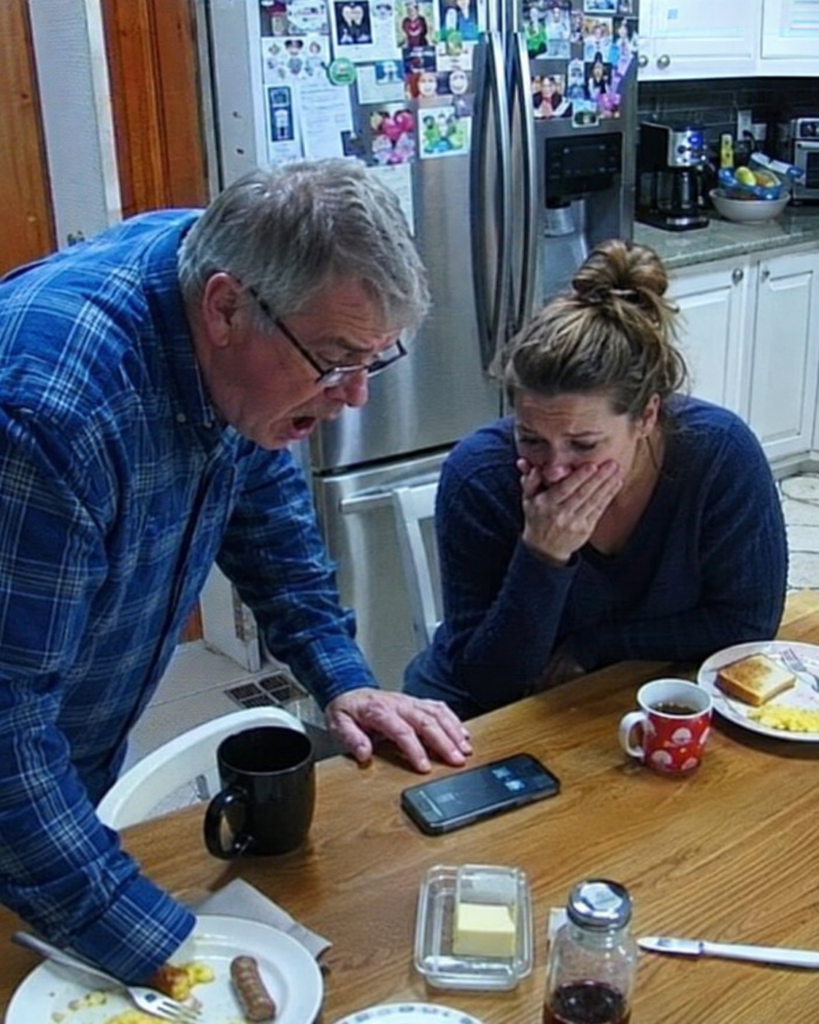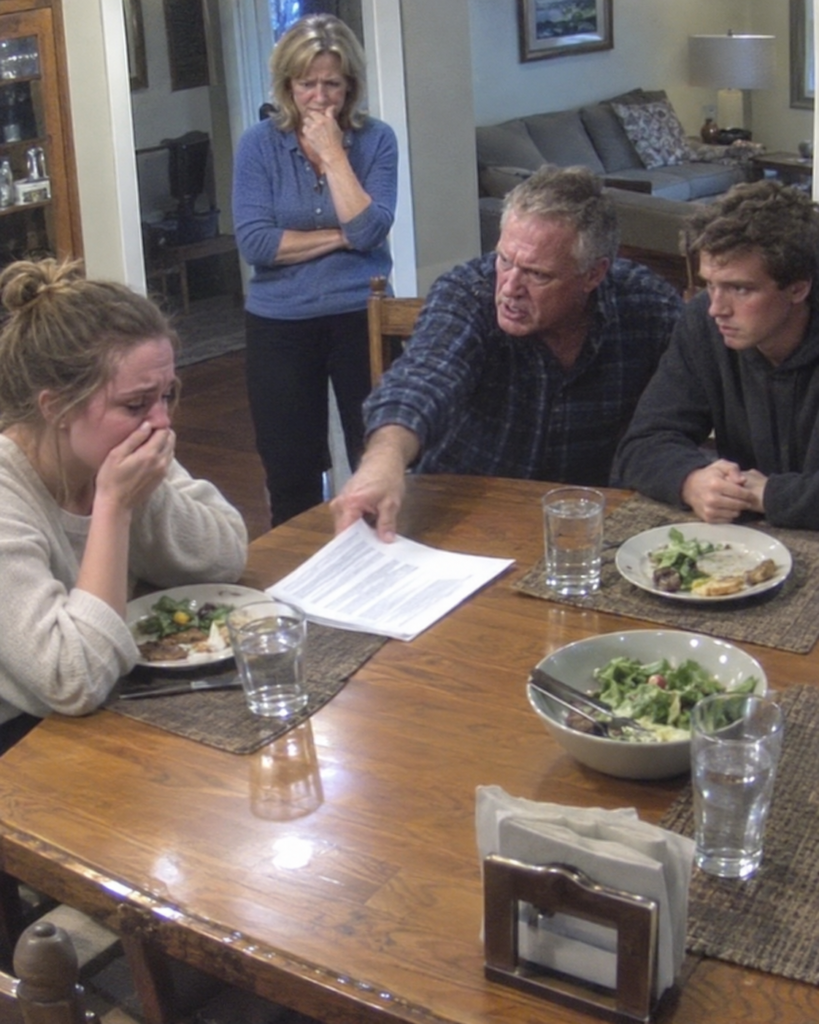
My father slid a form across the dinner table and told me to empty the savings account I had spent ten years building. My brother needed $240,000, and saying no would cost me my place in the family. I kept my hands in my lap while my mother waited for my answer. Then I asked one question nobody wanted to hear:
“What is Kevin putting toward this?”
The paper had stopped against my water glass. Across my parents’ kitchen in Columbus, Ohio, the oven clock ticked over to another minute. My father, Arthur, pressed his finger against the signature line.
“We can discuss your brother later. Right now, we need you to help.”
Kevin leaned back in his chair. My mother, Evelyn, straightened the serving spoon beside the potatoes. Nobody answered my question.
At thirty-eight, I had spent twelve years helping struggling businesses get their operations under control. But at my parents’ table, my judgment mattered only when it came with an offer to pay.
Six years earlier, Dad had called because Vance Logistics couldn’t reliably make payroll. Suppliers were waiting months for payment. Orders disappeared between the warehouse shelves and the loading dock.
I remembered sitting at this same table with his invoices spread around my coffee cup.
“I don’t know what else to do, Tina,” he had admitted.
So I helped. Evenings after my consulting work, I untangled inventory records and called suppliers. I kept copies of every agreement, every change, every arrangement that allowed the warehouse to keep moving. I never took a salary.
Once the business recovered, Dad started telling people that he and Kevin had turned it around. I would be standing nearby, holding the dish towel Mom had handed me, listening to a version of those years that barely included me.
When I mentioned it to her once, she lowered her voice.
“Your father has his pride. You should be happy you can support the men in this family.”
Now she wouldn’t look at the document in front of me.
Kevin’s showroom had been open for six months. Before he signed the lease, I had reviewed his numbers and warned him that expensive displays wouldn’t make up for slow sales. Sixty days without enough customers could leave him unable to cover the bills.
Dad had dismissed my concerns over Sunday dinner.
“You understand spreadsheets,” he’d said. “You don’t understand entrepreneurial courage.”
Now the showroom’s inventory wasn’t selling, the vendor wanted its $240,000, and apparently my savings were the missing ingredient in Kevin’s courage.
Dad tapped the paper again.
“You have the money.”
“I have a business reserve.”
“It’s sitting in an account, Tina.”
“It covers my company’s obligations. It’s there for emergencies.”
“This is an emergency.”
I looked at Kevin. He was watching me with the impatience of someone waiting for a cashier to correct a mistake.
That account represented years of seventy-hour workweeks. It held the money that let me pay my own bills when clients paid late, and the breathing room I had worked hard to give myself. Nobody had asked what would happen to my firm if I emptied it.
“I warned you about the showroom,” I said.
Kevin leaned forward. “Here we go.”
“I’m asking what the plan is after the balance gets paid.”
“The plan is to keep the business open,” Dad said.
“And when the next payment comes due?”
Mom picked up her water glass, then set it down without drinking. For a moment, I thought she might speak. Instead, she smoothed the napkin on her lap.
I put both feet flat on the floor. My fingers were trembling, so I rested them against the edge of the table.
“No,” I said. “I can help you work through the numbers. I’m not emptying my reserve.”
Kevin brought his hands down hard enough to rattle the silverware.
“You’ve always been jealous that I’m willing to do something bigger.”
Dad stood beside my chair.
“If you don’t help your brother now, Tina, you’ll regret it.”
I waited for Mom to look at me. She didn’t.
I pushed the unsigned paper back across the table and picked up my keys.
At home, I opened the audit report I still needed to finish. I read the same paragraph three times while the refrigerator hummed behind me.
At 7:14 p.m., my phone vibrated against the kitchen counter. Dad’s message filled the screen:
“I disown you. You are no longer part of this family. Direct all communication to my attorney.”
I read it twice.
Then I started typing an explanation—everything I had done, everything that money meant, everything he already knew. I stopped before sending it. My hand shook as I deleted the paragraph and replaced it with one word:
“Okay.”
Then I opened the folder I had maintained for six years, the one with my father’s company name on it.
The folder opened to six years of agreements, invoices, and messages I had saved because someone needed to keep track. I scrolled past documents dated on weekends. Late evenings. A Christmas Eve when everyone else had finished dinner while I sat at this counter correcting a supplier payment.
For years, I had called those things favors. Looking at them together, I could see how much of my own life I had arranged around keeping theirs comfortable.
My father’s message was still open beside the laptop. I wanted him to call. That was the part I hated admitting. Even then, I would have listened if he had said he was sorry.
The phone stayed silent.
I saved his message with the business records and began reviewing the arrangements one by one. Some obligations remained mine. Others continued only because I had kept agreeing to them. I read carefully. I wasn’t going to let one terrible evening turn into another decision I regretted.
By midnight, I had canceled the voluntary transfers and submitted the notices I was entitled to send. I kept copies of everything. Then I closed the laptop.
I slept badly. The next morning, I reached for my phone before remembering there was no explanation left to write.
Thursday evening, exactly forty-eight hours after Dad’s message, Mom called.
For a moment, I watched her name on the screen and hoped she was calling about me.
“Tina,” she said when I answered. “Your father needs you to fix something.”
I sat down. “Does he want to speak to me?”
“He wants everything back the way it was.”
She still hadn’t asked whether I was all right.
Behind her, I heard hurried voices and a door closing. Then she lowered her voice:
“Tina, what exactly did you stop paying for?”
Part 2
“Tina, what exactly did you stop paying for?”
Mom’s voice carried a thin, frantic edge I hadn’t heard in years. Across the line, I could hear the muffled sound of my father shouting in the background, followed by the frantic clattering of keyboard keys.
“I didn’t stop paying for anything that belonged to me, Mom,” I said quietly, leaning my back against my kitchen counter. “I simply withdrew my personal credentials and canceled the voluntary credit guarantees I’d been extending to Vance Logistics.”
“Your father is at his desk right now and the software won’t open! The main supplier in Chicago halted tomorrow morning’s shipment. They said the secondary guarantor removed their backing last night at midnight!”
“That guarantor was my consulting firm,” I replied, keeping my tone steady despite the rapid pounding in my chest. “I signed that personal indemnity agreement three years ago when Dad was about to lose the freight line. It was renewed annually. I submitted the formal rescission notice to the lender last night.”
“You can’t do that!” Mom hissed, her voice dropping to a harsh whisper. “That’s your father’s livelihood! He built that company!”
“He built it, Mom. But I kept it breathing.” I swallowed hard. “And since Dad disowned me on Tuesday night and directed all communication to his attorney, I am simply treating Vance Logistics as an arms-length entity. My firm cannot carry uncompensated liability for a company whose leadership considers me an outsider.”
Silence stretched over the line. For five seconds, the only sound was Evelyn’s shallow breathing.
“You’re doing this out of spite,” she said softly, her tone shifting from panic to cold disappointment. “Because your father asked you to help your brother.”
“I’m doing this because I was fired from a family I was working eighty hours a week to support,” I said. “If Dad’s attorney wishes to discuss the terms of my formal separation from Vance Logistics’ operational management, he has my email.”
I hung up before she could respond.
My hands were shaking violently. I set the phone face-down on the wooden counter and forced myself to take three deep breaths. The apartment was completely silent except for the low hum of the refrigerator.
For six years, I had maintained a shadow infrastructure for Vance Logistics. Dad believed he was a master strategist, but he had never understood the mechanics of modern supply chain software or vendor credit lines. Every month, I had quietly reconciled their delinquent invoices, leveraged my own business credit to secure favorable terms with fuel suppliers, and manually overridden inventory glitches that would have otherwise triggered massive breach-of-contract penalties.
I had done it because I thought love meant making yourself useful. I thought being indispensable would eventually look like being loved.
At 8:30 p.m., my phone buzzed again. It wasn’t my mother or father. It was Kevin.
I picked up on the third ring. “Hello, Kevin.”
“What the hell is wrong with you, Tina?!” Kevin exploded into the receiver. “Dad is having a goddamn heart attack over here! The banks froze the working capital line! I was supposed to draw down $40,000 tonight to cover the advance lease payment on the showroom’s new display floor!”
“Is Dad in the hospital?” I asked, my voice dropping.
“No, but he’s sitting on the couch clutching his chest and red as a beet!” Kevin yelled. “You blew up the family business over a personal grudge! You knew the whole ecosystem relied on your firm’s credit backing!”
“Kevin,” I said, standing up straight. “Did you know that your showroom’s floor-plan loan was cross-collateralized with Vance Logistics’ primary equipment lease?”
He paused, caught off guard. “What?”
“Dad used Vance Logistics’ trucks as collateral to back your retail showroom lease six months ago,” I said, looking at the spreadsheet open on my laptop. “He didn’t tell you, and he certainly didn’t tell the bank that those trucks were already pledged under a secondary agreement that I was personally guaranteeing. When I pulled my guarantee, the bank ran an automated asset check. They realized the equipment was double-pledged. They froze the lines because Dad committed loan fraud.”
The silence on Kevin’s end was absolute.
“He… he told me the bank approved me on my own credit,” Kevin stammered, the bravado suddenly draining from his voice.
“You don’t have credit, Kevin. You have a thirty percent profit margin loss and an expensive floor space in downtown Columbus,” I said gently, without malice. “Dad was trying to force me to give you $240,000 from my savings to cover the fraud before the quarterly audit next week.”
“Tina…” Kevin’s voice sounded small, like the teenage boy who used to ask me to hide his bad report cards from Dad. “What am I supposed to do? The vendor is coming on Monday to repossess the inventory.”
“You need to close the showroom, Kevin,” I said softly. “Cut your losses, liquidate the display stock, and get a job that pays you a predictable salary. And Dad needs to call a defense attorney, not a business lawyer.”
“Come back over here, please,” Kevin pleaded. “Just sit down with Dad. You can fix this. You always fix this.”
I looked at the framed photo on my desk—a picture of me at twenty-six, standing outside my first tiny office space, beaming with pride. I remembered how Dad had looked at that photo and said, “It’s a nice little hobby, Tina, but real business happens in the dirt.”
“I can’t fix a fire that someone keeps lighting on purpose, Kevin,” I said. “Goodnight.”
I ended the call and blocked Kevin’s number for the night.
That weekend, the storm raged quietly across Columbus. My mother left three voicemails, ranging from tears to bitter accusations that I was ruining my father’s health. Dad sent a single, formal email from his personal account stating that he was consulting legal counsel regarding my “unauthorized interference with company operations.”
I didn’t reply to any of it. Instead, I spent Saturday and Sunday working on my own clients’ accounts. For the first time in six years, my weekend wasn’t consumed by emergency freight reroutes or late-night payroll balances for Vance Logistics.
On Monday morning, I walked into my office in downtown Columbus. My assistant, Sarah, looked up from her desk with a sympathetic expression.
“Arthur Vance is sitting in your conference room,” she said quietly. “He’s been here since 7:30 a.m. I told him you weren’t in yet, but he refused to leave.”
I took a slow breath, adjusting my blazer. “Did he bring anyone with him?”
“No. Just a briefcase.”
“Thanks, Sarah. Bring us two coffees, please.”
I opened the glass door to the conference room. My father was sitting at the head of the long oak table—the same spot he always took whenever he visited my office. But he looked different. His shoulders were slumped, the deep lines around his mouth carved deeper by sleepless nights. The imposing man who had pressed his finger against the paper six nights ago looked suddenly, frail and old.
He didn’t look up immediately when I walked in. He was staring at the sleek, minimalist artwork on my wall.
“You built a nice firm here,” he said quietly, his voice raspy.
“Thank you,” I said, sitting down three chairs away from him, keeping a deliberate distance. “Sarah is bringing coffee.”
“I don’t want coffee,” he snapped habits dying hard, though his tone lacked its usual thunder. He ran a heavy hand over his face. “The bank served a notice of default this morning, Tina. Vance Logistics has seventy-two hours to cure the guarantee deficit or they repossess the four main haulers.”
“I know,” I said softly. “I received a copy of the bank’s notification as the former guarantor.”
Dad looked at me, his blue eyes clouded with a mix of anger and desperate confusion. “How could you do this to me? I am your father. Everything I did, I did to keep this family together. To build something for you and Kevin.”
“You didn’t build it for me, Dad,” I said, my voice steady and free of anger. “You built it for Kevin. You used me as the engine to keep it running, but you never let me sit in the car.”
“That’s not true!” he insisted, leaning forward. “I gave you your start! I taught you how to read a balance sheet!”
“You asked me to fix your mistakes when I was twenty-six because you were embarrassed,” I corrected him calmly. “And I did it because I wanted you to be proud of me. But over twelve years, you turned my competence into an expectation, and my sacrifice into a requirement.”
He stared at me, his jaw working as if trying to find an argument that would hold weight. “If the business goes under, your mother and I lose the house. It’s cross-collateralized.”
The words hit me like a physical blow. I felt the cold knot tightening in my stomach. “You put the family house on the line for Kevin’s showroom?”
Dad looked down at his hands. “Kevin had a vision, Tina. He just needed time. A father supports his son.”
“And what about his daughter?” I asked, the words spilling out before I could stop them. “Who supports her when she works seventy hours a week? Who protects her savings account when she’s spent ten years building a cushion so she never has to ask anyone for a handout?”
Dad didn’t answer. He couldn’t.
“I won’t let you lose the house,” I said after a long, agonized silence. “Not Mom. But I am not giving you $240,000 for Kevin’s business, and I am not reinstating my personal guarantee for Vance Logistics.”
He lifted his head sharply. “Then how do we save the house?”
“You liquidate Vance Logistics,” I said clearly. “You sell the asset fleet to a third-party broker—I already drafted three valuation offers from reputable logistics buyers over the weekend. The proceeds will cover the primary bank debt and clear the mortgage lien on the house. You will have enough left over to retire modestly.”
Dad’s face turned pale. “Sell… sell the company? That company has my name on the door!”
“It’s the only way out that doesn’t end in bankruptcy court or criminal charges for double-pledging assets, Dad,” I said. “It’s over.”
Part 3
The sale of Vance Logistics took nine agonizing weeks.
During that time, the family dynamic shattered into distinct, bitter pieces. Kevin refused to speak to me entirely after his showroom was forced into voluntary liquidation. He moved into a small rental apartment and took a mid-level sales job at a local car dealership—a job he felt was beneath him, for which he blamed me entirely.
Mom called me occasionally, but our conversations were stripped of warmth. They were functional, polite, and hollow. She treated me like an efficient stranger who had managed an uncomfortable medical procedure for the family—necessary, perhaps, but impossible to love in the aftermath.
Dad signed the final acquisition papers in a neutral law office in mid-November.
I sat across the table from him as the closing documents were distributed. When he placed his signature on the final deed of transfer, selling the fleet and the name Vance Logistics to a Midwest freight conglomerate, he didn’t look at me once. He signed his name, placed the pen down with deliberate care, and walked out of the room without saying goodbye.
The bank debt was cleared. The lien on my parents’ home was lifted. My savings account remained intact.
Technically, I had won. I had protected my business, saved my parents from financial ruin, and established a boundary that could never be crossed again.
But victory in a family war feels remarkably like grief.
A month later, on a cold, overcast Christmas Eve in Columbus, I sat alone at my kitchen island.
Outside, light snow was beginning to dust the balcony railing. In years past, this was the night I would spend three hours in my parents’ home, sitting at the dining table with a cold cup of coffee, fixing last-minute tax filings or contractor disputes for Dad while Mom passed around plates of cookies and Kevin talked about his latest ambitious plans.
Tonight, my phone was completely silent.
There was no invitation to dinner. No awkward text from Mom asking what time I would arrive. The severance was complete. I had given them back their financial independence, and in return, they had given me my complete isolation.
I poured a glass of red wine and opened my laptop. Out of habit, I clicked on the folder labeled Vance Logistics.
Six years of records. Thousands of files. Invoices, tax returns, emergency loan applications, balance sheets, and text messages. A digital monument to a decade of trying to earn a father’s love through balance sheets.
I highlighted the entire folder.
My thumb hovered over the delete key for a long time. My chest felt tight, a dull ache rising in my throat. I realized then that a part of me had kept those files not just for legal protection, but as proof—proof that I was a good daughter, proof that I had mattered, proof that I was the reason they had survived as long as they did.
But holding onto the proof was keeping me tethered to the pain.
I pressed Shift + Delete.
A dialogue box popped up on the screen: Are you sure you want to permanently delete this folder and all its contents?
I looked out the window at the quiet, snowy street below. I thought about the seventy-hour workweeks, the dismissive comments over Sunday dinners, the way Dad had pressed his finger against that form, and the cold single word he had sent me in a text message.
I clicked Yes.
The progress bar flashed briefly and vanished. The folder was gone.
A sudden, deep breath rushed into my lungs—the first clean, unburdened breath I felt like I had taken in years. The house was quiet, but for the first time, the silence didn’t feel lonely. It felt like space. Space that belonged entirely to me.
My phone illuminated on the counter.
I looked down, my heart giving a small, instinctive flutter. It was a text message from an unknown number.
I picked it up and opened the screen.
“Tina, it’s Kevin. Mom told me you cleared the remaining vendor balance on the showroom equipment out of the asset sale proceeds so I wouldn’t get sued personally. You didn’t have to do that.”
I stared at the message. A second text popped up immediately after.
“I’m sorry about what I said at dinner that night. Merry Christmas.”
I sat with the message for a long time, watching the snow fall outside. I didn’t feel a sudden rush of joy, nor did I feel the urge to invite him over or pretend that everything was fixed. The damage was real, and the scars would remain.
But a door had been closed, and a tiny window had been left cracked open—on my terms.
I set the phone down without replying right away. I took a sip of my wine, pulled a warm throw blanket over my shoulders, and leaned back against the couch, listening to the quiet rustle of the winter wind outside.
For ten years, I had been the foundation holding up someone else’s house.
Tonight, I was finally living in my own.