My son brought his new girlfriend home for Thanksgiving.
She seemed too perfect.
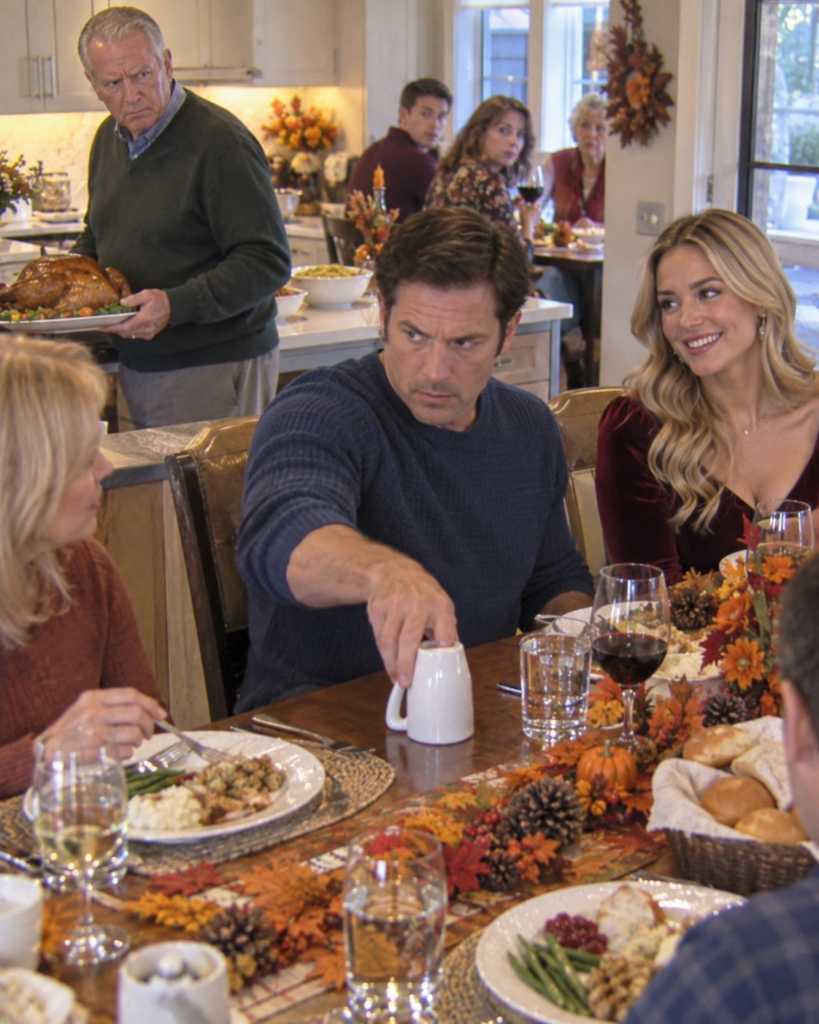
Then he set his mug upside down on the table. “Dad, that was our signal. Something’s very wrong.”
My son set his coffee mug upside down on the Thanksgiving table.
That was all.
No scream. No note. No shaking hands. Just a plain white mug with a chipped blue rim, placed mouth-down beside Donna’s old turkey platter, the handle turned toward me like the hand of a clock pointing at trouble.
Nobody else noticed.
My sister-in-law Carol was busy arguing with my brother Jim about whether the Lions would blow the game before halftime. Carol’s kids were stealing deviled eggs off the counter. The oven fan rattled the way it had rattled since 2009, pushing out the smell of roasted turkey, sage, butter, and onions.
In the living room, Vanessa laughed at something Daniel had said, that warm, easy laugh of hers that seemed to make every person in the room feel like they had just told the funniest joke of their life.
I stood by the sink with a carving fork in my hand, staring at that upside-down mug.
Fifteen years earlier, when Daniel was twelve, we made a signal.
I was still working for the county sheriff’s department then. Homicide at first, later financial crimes. Daniel hated being obvious about needing help. He was the kind of kid who would bleed through his sock before admitting his shoes were too tight.
So I told him, “If you ever need me and can’t say it out loud, turn your cup upside down. I’ll know.”
We practiced it once at a diner outside Mesa. He thought it was spy-movie nonsense and rolled his eyes, but he did it anyway, flipping his orange juice glass over while Donna pretended not to see.
I leaned across the table and whispered, “Agent Callahan, message received.”
He laughed so hard milk came out his nose.
We never used it much.
Once when he was fourteen and some older boys had cornered him after baseball practice.
Once when he was sixteen and a girl’s father had been drinking too much at a barbecue.
Once when he was nineteen, home from college, too ashamed to say he had failed a class.
And now.
Now he was twenty-eight, broad-shouldered, quiet, with his mother’s brown eyes and my bad habit of hiding fear under stillness. He stood near the kitchen island in a faded ASU sweatshirt, pouring coffee like nothing had happened.
Then he flipped the mug right side up, filled it, and carried it back to Vanessa.
The whole thing lasted maybe two seconds.
But two seconds can break a day wide open.
I watched him sit beside her. She touched his wrist before he even settled into the chair. A light touch. Casual. Possessive if you were trained to notice that sort of thing. Her nails were pale pink. Her bracelet made a soft ticking sound when she moved.
Daniel smiled at her, but it didn’t reach his eyes.
I picked up the turkey knife.
“Robert,” Carol called, “you okay over there?”
“Fine,” I said.
My voice sounded normal. That surprised me.
I carved the bird. I passed plates. I told Jim the same story about a drunk suspect stealing a patrol horse that I told every Thanksgiving. Vanessa laughed at exactly the right moments. Daniel ate half a dinner roll and moved mashed potatoes around his plate.
My goal for the next hour was simple: keep the room calm.
The conflict was harder: every fatherly instinct in me wanted to drag my son into the garage and demand the truth.
But that mug meant he couldn’t talk in front of her.
So I waited.
Outside, a cold desert wind pushed dead leaves against the sliding glass door. Inside, the house looked almost happy again. Donna’s pumpkin candles burned on the mantel. The good plates were out. Football noise rolled through the walls. For the first time in four years, the chairs around my table were full.
And sitting beside my son was the woman everyone already loved.
Vanessa Morfield. Thirty-three. Wealth management consultant. Soft Southern accent when she wanted it. Perfect at making people feel chosen.
At least, that was what I knew then.
When dinner ended, she offered to help with dishes. Carol told me in a whisper, “Don’t mess this up, Robert. She’s lovely.”
I smiled.
Then I saw Daniel in the hallway, looking toward the garage door.
Not walking. Not waving. Just looking.
I put down a wet plate, dried my hands, and followed him.
The garage smelled like dust, motor oil, and old cardboard. Daniel stood beside my workbench, staring at the toolbox he used to sit on as a boy.
I shut the door behind me.
His face changed the instant the latch clicked.
Whatever mask he had worn all morning fell away, and my son looked at me with a fear I had not seen in him since childhood.
“Dad,” he whispered, “I think I brought something terrible into your house.”
Part 2: Beneath the Surface
The garage door seals out the hum of the television, but it cannot block the cold. Dust motes dance in the fluorescent light above my workbench, settling on old jars of screws, half-empty cans of stain, and the small wooden toolbox Daniel built when he was nine.
Daniel stands with his back to me, shoulders tight, staring at that box. His breathing is shallow, ragged.
“Daniel,” I say, keeping my voice low, dropping into the steady register I used during negotiations. “Talk to me.”
He doesn’t turn around immediately. He grips the edge of the workbench until his knuckles turn white. “She doesn’t know I remembered the signal. She thinks… she thinks I’m completely spun out. That I don’t know what’s real anymore.”
“Who is she, Daniel?”
He finally turns. The light hits his face, revealing dark circles beneath his eyes that I hadn’t noticed under the soft yellow lamps of the dining room. His expression isn’t just fearful—it’s broken.
“Her name isn’t Vanessa Morfield,” he says softly. “Or maybe it is, legally. But she isn’t a wealth manager from Atlanta, Dad. She’s… she’s the woman who took everything from Julian.”
The name sits cold in the space between us. Julian was Daniel’s best friend from college. Two years ago, Julian died by suicide after a sudden, ruinous financial collapse and a quiet, brutal spiral that no one understood at the time.
“Explain,” I say.
“After Julian died, I couldn’t let it go,” Daniel whispers, his voice trembling. “The timeline didn’t make sense. Julian was smart, cautious. Then out of nowhere, he transferred his life savings into three unregistered off-shore trusts, cut off his family, and vanished into a house in the hills. Three months later, he was gone.”
Daniel takes a shaky breath, pressing his palms against his temples. “Six months ago, I started seeing Vanessa. She approached me at a charity dinner in Phoenix. She was warm, brilliant, empathetic. She listened to me talk about Julian. She comforted me. I thought… God, Dad, I thought I was the luckiest guy in the world.”
He looks up at me, eyes filled with tears. “Then last week, I was looking for my passport in her desk while she was in the shower. I found a hidden partition in her briefcase. Inside were three passports—different names, same face. And a thick binder. I opened it, Dad. It had full background files on Julian. On his family. On his bank accounts.”
He steps closer, his voice dropping to a harsh whisper. “And the next section in the binder was on me. My bank accounts. My mother’s death certificate. The deed to this house. Everything you own, Dad. She didn’t find me by accident. She spent two years hunting me down.”
My stomach turns to stone. The former investigator in me takes over, calculating timelines, motives, entry points. “Did she see you look at the binder?”
“I tried to act normal,” Daniel says, tears spilling over. “I put it back. But the next morning, my laptop crashed. My phone started glitching. Small things started disappearing from my apartment. Then two days ago, I woke up feeling dizzy, like I’d been drugged. She was standing at the end of the bed, smiling, holding a cup of tea, asking if I was feeling ‘confused again.’ She started telling me I was misremembering things. That Julian had never existed. That I was having a breakdown.”
He pulls his sweatshirt sleeve back. Deep, fresh purple bruises ring his wrist—not from violence, but from tight, deliberate restraint.
“She’s isolating me,” Daniel chokes out. “She told me if I canceled Thanksgiving, she’d have me admitted for psychiatric observation. She brought me here to see if I’d crack, or if I’d try to tell you. She’s monitoring my phone. She has my location. Dad… she’s systematic. She destroys people from the inside out, takes their assets, and leaves them so broken no one believes them when they say they were robbed.”
I step forward, placing both hands firmly on his shoulders. The cold calculation of my old profession burns away, leaving only the fierce, terrifying clarity of a father protecting his child.
“Look at me, Daniel,” I command quietly.
He looks up, his eyes wide.
“You are not crazy. You are not misremembering. You brought her into my house, and now we are going to finish this.”
“We can’t just call the police, Dad,” Daniel says desperately. “I tried calling a friend in the Phoenix PD yesterday. The call dropped. Ten minutes later, Vanessa casually mentioned how sad it was when officers got investigated for internal misconduct. She has leverage on people. She has resources.”
“I’m not calling the Phoenix PD,” I say, my voice dead calm. “I’m calling the men I used to work with in the county task force. But first, we go back inside. We sit at that table. We let her think her plan is working.”
“Dad, she’s dangerous—”
“So am I,” I say softly. “She just doesn’t know it yet.”
Part 3: The Empty Chair
We walk back into the hallway together. Daniel pulls his mask back on—the tight, stoic smile, the slightly slouched shoulders. I wipe my hands on a kitchen towel and step into the dining room.
Vanessa is standing near the mantelpiece, holding one of Donna’s silver picture frames. It’s a photograph of Daniel and me taken the summer after his mother died, fishing on the Salt River.
She turns as we enter. Her smile is luminous, effortlessly beautiful.
“There you two are,” she says softly, her Southern lilt perfectly pitched. “I was beginning to think you were hiding from dish duty.”
“Just showing Daniel the new generator in the garage,” I say smoothly, walking past her to clear the final pie plates from the table. “ Desert winters get rough on the power lines.”
“Oh, absolutely,” she says, placing the frame back down with meticulous precision—a fraction of an inch to the left of where it had been. “Robert, your home is so lovely. Daniel talks about you constantly. He admires you so much.”
She walks over to Daniel, reaching up to smooth the collar of his sweatshirt. Her hand rests lightly against his neck—right over his carotid artery. A subtle, silent threat. Daniel doesn’t flinch, but I see the pulse in his jaw jump.
“We should probably get heading back to Phoenix soon, sweetheart,” she says, looking into Daniel’s eyes. “You know how tired you’ve been getting in the evenings lately. We don’t want you getting… overwhelmed.”
“Actually,” I say, placing the pie knife down with a quiet clink, “I was hoping you’d stay for coffee, Vanessa. I have a few old photo albums in my study I’d love to show you. From my county sheriff days.”
Her eyes flicker—just a micro-second of stillness, the reaction of a predator sensing a trap. Then the warm smile returns.
“Oh, I’d love that,” she says. “But Daniel really needs his rest. His doctor mentioned—”
“My doctor didn’t mention anything, Vanessa,” Daniel says quietly. His voice isn’t loud, but the tremor is gone.
Vanessa turns her head slowly to look at him. The warmth in her eyes cools instantly, replaced by a flat, clinical distance. “Daniel, darling, we talked about this. You’re forgetting your medication cycle again.”
“No,” I say, stepping between her and the hallway exit. “He isn’t.”
The room goes dead silent. In the living room, my brother Jim and Carol are watching the game, unaware of the shift in the air.
Vanessa looks at me, her expression slowly shifting from gentle concern to cold evaluation. She doesn’t panic. She simply reassesses.
“Robert,” she says softly, her voice dropping the Southern cadence entirely, revealing a crisp, accentless precision. “You’re a retired investigator. You know how messy family misunderstandings can get. Daniel has been under an immense amount of stress since Julian’s anniversary. He’s projecting.”
“You picked the wrong family, Vanessa,” I say quietly. “Or whatever name you used in Denver six years ago when Arthur Vance lost his estate. Or in Santa Fe three years ago.”
That hits. Her breath hitches—just once.
“I spent thirty years reading people who think they’re the smartest room in the building,” I continue, taking a step closer. “You rely on speed, isolation, and shame. You find grieving men, slip into their lives, weaponize their doubts, and drain them while they think they’re losing their minds. But you made a mistake coming into my house.”
Vanessa steps back toward her handbag on the sideboard. Her hand moves casually toward the strap.
“Don’t,” I say sharply.
She freezes.
“My phone has been recording our conversation since I stepped out of the garage,” I say lied—though it doesn’t matter, because outside, the crunch of tires on gravel announces two black sedans pulling up the driveway.
The headlights sweep through the living room blinds, casting long, sharp shadows across the wall.
Vanessa’s face transforms completely. The beauty remains, but the humanity drains out of it entirely. She looks at Daniel, then at me, her gaze dead and calculating.
“You think this stops anything?” she whispers, her voice as smooth as ice. “You have no idea how many entities hold Daniel’s signature right now. You have no idea what he signed while he was ‘confused.’”
“We’ll sort that out in court,” I say. “With the federal task force sitting in my driveway.”
The front doorbell rings. Jim gets up from the couch, calling out, “Robert, somebody’s at the door!”
“I’ll get it, Jim,” I call back, keeping my eyes fixed on Vanessa.
She doesn’t run. She doesn’t scream. She slowly lifts her designer handbag, pulls her coat over her shoulders, and smoothes her hair.
“Happy Thanksgiving, Robert,” she says quietly.
Two officers in plain clothes step into the hallway, led by my former partner, Marcus. He takes one look at Vanessa, then at me.
“Robert,” Marcus says, nodding once. “We ran the prints from the glass you texted me from the kitchen. Matches an active Interpol red notice out of Chicago. Let’s go, ma’am.”
As Marcus places her under arrest and reads her her rights, Vanessa walks out the front door without looking back once. She moves with the eerie calm of someone who has done this before, and who fully expects to find another open door somewhere else.
The house empties out two hours later. Jim and Carol leave quietly after realizing the truth of what almost happened. The noise of the football game is gone. The oven fan is finally shut off.
Daniel sits at the kitchen island, a mug of black coffee between his hands. The house is completely still.
I walk over, pick up my own mug, and sit down beside him.
For a long time, neither of us speaks. The desert wind outside sweeps dead leaves against the sliding glass door, a quiet, restless sound in the night.
“I was so close to believing her, Dad,” Daniel whispers, staring into his coffee. “If I hadn’t turned that cup over… I think by Christmas I would have been gone.”
I reach out and place my hand over his trembling fingers.
“You remembered the signal,” I say gently. “That’s all that mattered.”
He looks up at me, the tightness in his shoulders finally dissolving, tears slipping down his face—not of fear, but of relief.
He turns his coffee mug right side up, takes a small sip, and sets it down firmly on the wood.
“Agent Callahan,” he says, his voice small, breaking, but whole. “Message received.”
“Message received, son,” I reply. “Now let’s eat some pie.”