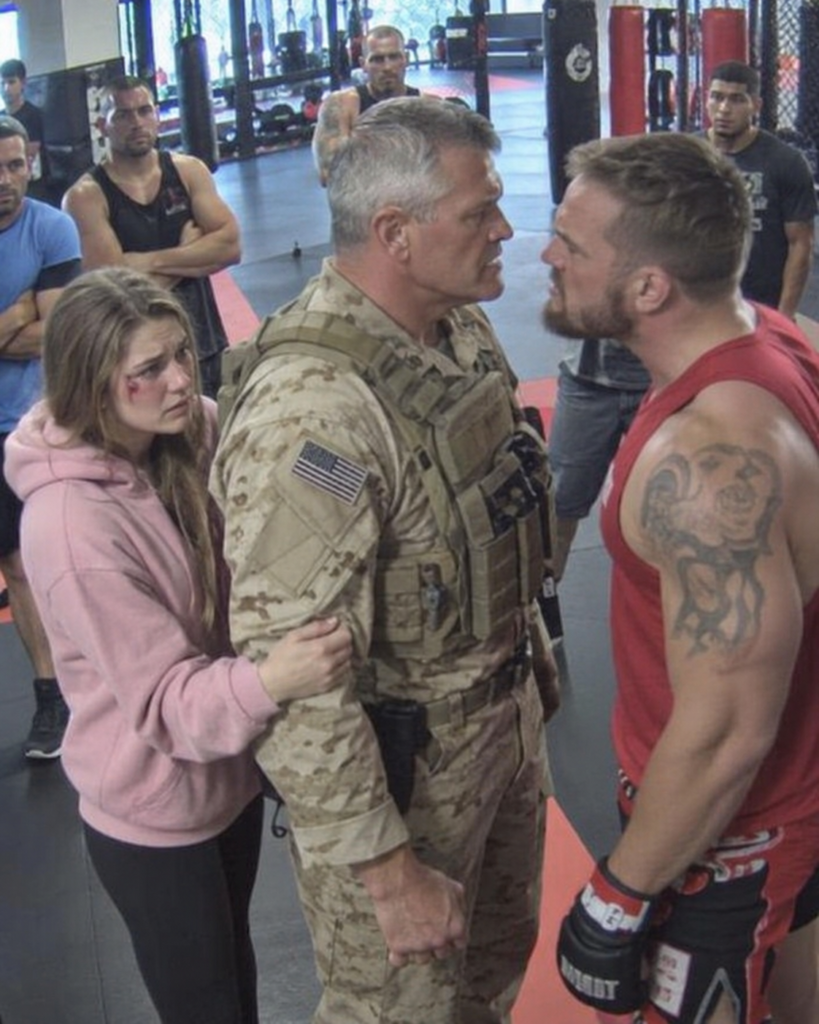
Dustin laughed.
“Come on, Ray.”
“I said back up.”
Something in his voice made them listen.
The man blocking the door stepped aside.
One of Dustin’s friends lowered his hands.
Dustin’s smile vanished.
“You’re serious?”
Ray rubbed his jaw.
“I was stationed at Camp Lejeune for a while. Different unit. Everybody heard about Carter.”
I sighed.
That was exactly the kind of reputation I had spent twenty years trying to leave behind.
Not because I was ashamed of serving.
I was proud of that.
But there were stories that grew larger every time they were retold. A training incident became a fight. A fight became ten men. Ten men became an entire bar.
Men enjoyed legends because legends were simpler than people.
The truth was less impressive.
I had been good at teaching frightened young Marines how to stay calm when someone stronger, faster, or more aggressive came at them.
That was all.
I looked at Ray.
“If you really heard about me, then you know I didn’t come here to prove anything.”
His eyes moved toward Dustin.
“I believe you.”
Dustin shook his head.
“This is ridiculous.”
I took one step toward him.
He straightened.
I stopped well outside arm’s reach.
“My daughter is in the hospital.”
For the first time, he looked uncomfortable.
Only for a second.
Then the smirk returned.
“I told you. She fell.”
“Maybe she did.”
That surprised him.
It surprised everyone.
I could almost hear the younger version of myself objecting.
But standing there, with anger burning so hot that my hands felt cold, I finally understood something.
If I touched Dustin, I would give him exactly what he needed.
A story.
He would become the victim.
I would become the unstable father.
And Marcy—already frightened, already uncertain—would be dragged into a mess that belonged to us instead of being allowed to make decisions about her own life.
So I turned to Ray.
“Do you have security cameras?”
His face tightened.
Dustin immediately looked at him.
“Ray.”
That one word told me more than Dustin intended.
Ray hesitated.
“Front entrance. Hallway. Main floor.”
“Locker rooms?”
“No.”
“What about the office?”
Ray nodded slowly.
“There’s one covering the corridor.”
Dustin stepped between us.
“Why are you answering him?”
Ray looked at him.
“Because his daughter is in the hospital.”
“She fell down the stairs.”
“Then cameras shouldn’t bother you.”
Dustin’s expression hardened.
I watched him carefully.
Not as a fighter.
As a father looking for the truth.
He glanced toward the hallway leading to the offices.
Just once.
But I saw it.
So did Ray.
“What happened here tonight?” I asked.
“Nothing,” Dustin said.
“I didn’t say tonight.”
His face changed again.
That was the first crack.
Small.
Almost invisible.
But it was there.
Ray folded his arms.
“Dustin.”
“What?”
“When was Marcy here last?”
Dustin scoffed.
“Ask her.”
“I’m asking you.”
“Couple days ago.”
I remembered my wife mentioning that Marcy had stopped by our house two evenings earlier around ten. She had seemed tired. Quiet.
She claimed she had been working late.
But Marcy worked at a dental office that closed at six.
At the time, I had noticed the inconsistency and told myself adults were entitled to privacy.
Now I wondered what she had been trying to keep from us.
Ray walked toward the office.
Dustin grabbed his arm.
“Don’t.”
Nobody moved.
Ray looked down at Dustin’s hand.
“Take your hand off me.”
Dustin released him.
“Those recordings are gym property.”
“And I own the gym.”
The room went still.
That was new information.
I had assumed Dustin’s uncle owned the place.
Apparently I had assumed wrong.
Ray continued down the hallway.
I followed.
Dustin followed me.
His friends stayed where they were.
Inside the cramped office, Ray sat behind a desk and woke the computer.
A stack of membership forms sat beside an old coffee mug. A framed photograph showed Ray standing beside a teenage boy in wrestling headgear.
His son, probably.
There were medals on the wall, but they were dusty.
Real achievements usually did not need constant polishing.
Ray opened the security program.
“What day?” he asked.
I thought about Marcy’s visit.
“Two nights ago.”
Dustin leaned against the doorframe.
“This is a waste of time.”
Nobody answered.
Ray scrolled through footage.
People entered and left.
Men carried duffel bags.
A woman cleaned the front desk.
At 8:47 p.m., Marcy appeared.
My heart tightened.
She looked normal.
Jeans.
Blue sweater.
Her hair pulled back.
She walked through the gym toward the office corridor.
Three minutes later, Dustin followed.
Then nothing.
For almost forty minutes.
At 9:31, Marcy emerged.
She was walking quickly.
Dustin came behind her.
The camera had no audio.
That somehow made the footage worse.
You could see the argument without hearing it.
Marcy turned.
Dustin said something.
She answered.
He stepped closer.
Marcy stepped back.
Then Ray froze the video.
“There.”
At first I did not understand.
Then I saw it.
Marcy was holding something.
A folder.
Thin.
Dark blue.
She clutched it against her chest.
Dustin reached for it.
Marcy pulled it away.
The footage skipped.
Ray frowned.
“What happened?”
He rewound.
Same thing.
Marcy stepped back.
The image froze for two seconds.
Then resumed.
Now the folder was gone.
Marcy was leaving.
Dustin stood watching her.
I leaned closer.
“Why did it skip?”
Ray stared at the screen.
“It shouldn’t.”
“Can recordings be edited?”
“Not from this computer.”
Dustin laughed too loudly.
“There. Nothing happened.”
Ray looked at him.
“Who has administrator access?”
Dustin’s smile disappeared.
Ray answered his own question.
“Me and your uncle.”
That changed the room.
I turned toward Dustin.
“What was in the folder?”
“I don’t know what you’re talking about.”
“You tried to take it from her.”
“You can’t even see that.”
“I can see enough.”
He pushed away from the doorway.
“You came here looking for something to blame on me.”
“No,” I said. “I came here angry.”
That stopped him.
“And that was my mistake.”
He stared.
I continued.
“My daughter asked me not to make this worse. I didn’t listen. I drove here because I thought protecting her meant confronting you.”
Ray watched me closely.
“And now?” he asked.
“Now I’m going to the hospital.”
Dustin gave a short laugh.
“You finally figured it out.”
“Yes.”
I faced him.
“I did.”
Whatever insult he expected never came.
I walked past him.
That bothered him more than anger would have.
Ray followed me into the main gym.
“Jack.”
I stopped.
He lowered his voice.
“There’s something else.”
Dustin looked over.
Ray waited until we were near the entrance.
“Your daughter talked to me last week.”
“About what?”
“She asked questions about the business.”
I frowned.
“What business?”
Ray looked uncomfortable.
“The gym.”
“What kind of questions?”
“Ownership. Insurance. Accounts. Who handled payments.”
“Why?”
“She wouldn’t say.”
Dustin approached.
“Ray, shut up.”
Ray ignored him.
“She asked whether I knew why some membership payments were appearing twice.”
I looked at him.
“What does that mean?”
“I don’t know yet.”
Dustin swore under his breath.
Ray’s eyes sharpened.
“Actually, Dustin, your reaction is making me think I should find out.”
Dustin’s confidence had begun slipping.
Not collapsing.
Just thinning around the edges.
And suddenly I understood that whatever was happening with Marcy might be more complicated than I realized.
She had not simply been afraid.
She had been investigating something.
Or trying to understand something.
I drove to the hospital with a knot in my stomach.
My wife, Ellen, was sitting beside Marcy’s bed when I arrived.
The room smelled like antiseptic and burnt coffee.
Marcy looked small beneath the white blanket.
Not helpless.
Just tired.
There is a difference.
Ellen stood.
“Where were you?”
I looked at Marcy.
She knew.
Her eyes closed.
“Oh, Dad.”
“I didn’t touch him.”
Her eyes opened again.
“You went there?”
“Yes.”
Ellen stared at me.
“Jack.”
“I know.”
I pulled a chair closer.
“I made the wrong decision.”
That was difficult to say.
Not because I had trouble admitting mistakes.
Because I could see how much my mistake had frightened my daughter.
Marcy looked toward the window.
“I asked you not to.”
“You did.”
“And you went anyway.”
“Yes.”
Silence filled the room.
Then I said the words I should have said from the beginning.
“I’m sorry.”
She looked at me.
Not relieved.
Not immediately forgiving.
Just listening.
“I thought being your father meant I had to fix this,” I continued. “But you’re thirty-one years old. You get to decide what happens next. I’ll help however you want. Or I’ll stay out of it if that’s what you need.”
Ellen sat beside her.
Marcy blinked quickly.
Then she whispered, “I don’t want you out of it.”
My throat tightened.
“I just don’t want you doing something that gets you hurt.”
“I won’t.”
“You promise?”
“Yes.”
She studied my face.
“You really didn’t hit him?”
“No.”
For the first time that night, the faintest smile touched her face.
“Good.”
I leaned back.
“There’s something I need to ask you.”
Her smile disappeared.
“Were you at the gym Tuesday night?”
She looked at me sharply.
“How do you know?”
“Security camera.”
Her hand tightened around the blanket.
Ellen turned.
“Marcy?”
Marcy stared at the wall.
Then she said, “I wasn’t going to tell you.”
“Tell us what?”
She took a long breath.
“I think Dustin has been stealing money from the gym.”
That was not what I expected.
Ellen frowned.
“How would you know that?”
Marcy worked in billing at the dental office.
Numbers made sense to her in ways they never had to me.
She could look at a statement and notice a three-dollar discrepancy from six months earlier.
“I helped him with his taxes last spring,” she said. “He had receipts everywhere. Deposits, sponsorship checks, cash payments. Nothing matched.”
“Why were you helping with his taxes?”
“He asked.”
She looked embarrassed.
“I thought he trusted me.”
There was more pain in those words than anger.
“So I started organizing everything,” she continued. “Then I noticed deposits from the gym going into an account that wasn’t Ray’s business account.”
“Whose account?”
“I don’t know.”
“What was in the folder?”
Her eyes snapped back to mine.
“You saw that?”
“Yes.”
“Copies of deposit slips.”
Ellen took her hand.
“Do you still have them?”
Marcy shook her head.
“Dustin took the folder.”
“When?”
“Tuesday.”
She hesitated.
Then added, “But I made copies.”
I stared.
“Where?”
For the first time, something almost like determination appeared in her tired expression.
“At your house.”
Ellen and I exchanged a look.
“Where at our house?” I asked.
“In the garage.”
I thought of my workshop.
My tools.
Stacks of lumber.
Drawers nobody opened except me.
“Where?”
“In your red toolbox. Bottom drawer.”
Despite everything, I nearly smiled.
“That’s the one place your mother refuses to look.”
Ellen gave me a tired glare.
“Because every drawer is full of screws you insist have different purposes.”
“They do have different purposes.”
Marcy laughed.
A quiet laugh.
But real.
And hearing it again felt like opening a window in a closed room.
Then her expression turned serious.
“There’s something else.”
“What?”
“The account receiving the money wasn’t Dustin’s.”
“His uncle?”
“No.”
She shook her head.
“That’s what I thought at first.”
My stomach tightened.
“Whose was it?”
“I don’t know. It was registered to an LLC.”
“What name?”
She hesitated.
“Mercer Athletic Consulting.”
Ray Mercer.
The coach who had just told me he owned the gym.
The coach who claimed he knew nothing about missing money.
I sat back slowly.
Maybe Ray had been helping me.
Maybe he had been protecting himself.
Maybe both things were true.
People were rarely one thing.
Marcy looked from me to Ellen.
“That’s why I was at the gym Tuesday. I confronted Ray.”
That surprised me more than anything.
“What did he say?”
“He said he had never heard of the company.”
“Did you believe him?”
“I don’t know.”
She swallowed.
“But after I left his office, Dustin was waiting in the hallway.”
I remembered the footage.
The missing seconds.
“The camera skipped,” I said.
Marcy stared.
“What?”
“Two seconds were missing.”
Her face went pale.
Then she whispered something that made Ellen grip her hand tighter.
“Dad… there shouldn’t only be two seconds missing.”
“What do you mean?”
Marcy looked straight at me.
“Because I wasn’t alone in that hallway.”
The room seemed to grow colder.
“Who was with you?”
She shook her head.
“I never saw his face.”
“What man?”
“He came out of Ray’s office right before Dustin did. He had an envelope in his hand. Dustin called him Mr. Vale.”
The name meant nothing to me.
But Ellen suddenly went still.
I turned toward my wife.
She was staring at Marcy.
“Did you say Vale?”
“Yes.”
Ellen’s face had changed.
Not fear.
Recognition.
The same expression Ray had worn when he heard my name.
I looked at her.
“You know him?”
Ellen took a long breath.
Then she looked at me and said quietly, “Jack, I think I know exactly who he is.”
PART 3
Ellen waited until the nurse finished checking Marcy’s blood pressure before she explained.
“His first name is Thomas,” she said.
“Thomas Vale?” I asked.
She nodded.
“You know him from where?”
Ellen looked almost embarrassed that she had not mentioned it sooner.
“From the bank.”
That made no sense at first.
Ellen had worked for the same regional bank for twenty-three years before retiring.
She had started as a teller and eventually managed loan documentation for small businesses.
“What does a banker have to do with an MMA gym?”
“Thomas wasn’t a banker. He was an accountant who worked with several businesses that borrowed through us.”
Marcy frowned.
“Did he work with Ray?”
“I don’t remember Ray Mercer’s name. But Thomas handled paperwork for fitness centers, restaurants, construction companies. Mostly family-owned places.”
“And?”
Ellen folded her hands.
“There were complaints.”
“What kind?”
“Nothing dramatic. Paperwork that arrived late. Numbers that had to be corrected. Business owners insisting they had signed documents they later claimed they had never seen.”
“Was he charged with anything?”
“No.”
“So maybe it was sloppy accounting.”
“Maybe.”
But Ellen did not sound convinced.
I had been married to her thirty-four years.
I knew the difference between Ellen being uncertain and Ellen choosing her words carefully.
“What aren’t you saying?”
She sighed.
“One business owner came into my office crying.”
Marcy shifted against her pillow.
Ellen continued.
“She and her husband owned a small restaurant. She said money had disappeared from one of their accounts. Thomas told them it was a bookkeeping mistake.”
“What happened?”
“They closed six months later.”
“Because of him?”
“I don’t know.”
That answer mattered.
We had all spent enough time assuming things.
I nodded.
“So we don’t know what Vale is doing. We only know Marcy saw him leaving Ray’s office.”
“Right.”
“And there are financial records connected to a company using Ray’s name.”
“Right.”
Marcy looked between us.
“What do we do?”
The old instinct rose immediately.
Go back to the gym.
Find Ray.
Demand answers.
But I remembered the promise I had made.
I looked at my daughter.
“What do you want to do?”
She thought for a while.
“I want to understand what I found.”
“Then we start there.”
The next morning, Marcy was discharged with instructions to rest and follow up with her doctor.
She came home with us.
I did not ask her about Dustin during the drive.
Neither did Ellen.
Some silences are uncomfortable because nobody knows what to say.
Others are protective.
This was the second kind.
At home, Ellen made tea.
Marcy settled on the couch with a blanket.
I went into the garage.
The red toolbox stood beneath my workbench exactly where it had been for twelve years.
I opened the bottom drawer.
Sockets.
Sandpaper.
An old level.
No envelope.
I moved everything.
Nothing.
My first reaction was alarm.
My second was suspicion.
My third was more useful.
I called Marcy.
She came to the garage doorway.
“It’s gone.”
She stared at the drawer.
“That’s impossible.”
“Did anyone know you put it here?”
“No.”
“Think carefully.”
She closed her eyes.
“I told nobody.”
“What about Dustin?”
“No.”
“Did he ever come into the garage?”
“A few times.”
“When?”
“Months ago.”
I sat on the stool.
Something bothered me.
The toolbox had not been forced.
Our house had not been disturbed.
I was meticulous with tools. If someone had searched the garage, I probably would have noticed something out of place.
Unless the person already knew where to look.
Marcy suddenly stepped inside.
“Wait.”
She reached behind a stack of old cabinet hinges near the back of the drawer.
Her fingers touched something taped underneath.
A small flash drive.
She pulled it free.
I stared.
“You didn’t mention that.”
“I forgot.”
“You forgot you taped a flash drive to my toolbox?”
She gave me a sheepish look.
“I had a lot happening.”
Fair enough.
“What’s on it?”
“Pictures of everything.”
That was my daughter.
Paper copies could vanish.
So she had photographed them.
We brought the flash drive into the kitchen.
My laptop was ancient enough that opening the files took several minutes.
Marcy sat beside me.
Ellen stood behind us.
There were forty-seven photographs.
Deposit slips.
Account summaries.
Invoices.
Checks.
A spreadsheet Marcy had created herself.
At first it looked like meaningless numbers.
Then she explained.
“See these membership payments?”
“Yes.”
“They go into the gym’s main account.”
She clicked another image.
“These are sponsorship deposits.”
“And they don’t?”
“Not all of them.”
Some sponsorship money went into a second account.
Mercer Athletic Consulting.
“What does the company do?”
“I searched the state business registry,” Marcy said. “It exists, but it was only created eleven months ago.”
“Who owns it?”
“That information wasn’t public.”
Ellen pointed at the screen.
“What’s this?”
A check.
Twenty-eight thousand dollars.
From Mercer Athletic Consulting to something called Blue Harbor Promotions.
Marcy shook her head.
“I couldn’t identify it.”
I wrote the name down.
Years in the military taught me that complicated problems often became manageable once you stopped trying to solve everything at once.
We had three questions.
Who controlled Mercer Athletic Consulting?
What was Blue Harbor Promotions?
And why had Thomas Vale been meeting with Ray?
Before we could decide which question came first, Marcy’s phone buzzed.
She looked at the screen.
Her face changed.
“Dustin?”
She nodded.
“What does it say?”
She read silently.
Then handed me the phone.
I did not open anything else.
The message was simple.
I’m not coming to your parents’ house. I won’t bother you. I just need to explain something when you’re ready.
No threats.
No anger.
That almost made it more complicated.
Marcy stared at the floor.
“He’s never said that before.”
“What?”
“When you’re ready.”
Ellen sat beside her.
“You don’t have to answer.”
“I know.”
Marcy looked at me.
“What do you think?”
I could have told her exactly what I thought.
I could have listed every reason she should never speak to him again.
Instead I asked, “What do you think?”
She was quiet.
“I think I’m not ready.”
“Then that’s your answer.”
She typed.
I’m not ready to talk. Please don’t contact me again unless I contact you first.
She stared at the message for almost a minute before sending it.
Then she set the phone facedown.
Nothing happened.
No immediate response.
No pounding on the door.
No catastrophe.
Just a boundary, sent in twelve words.
Marcy exhaled.
“That felt strange.”
“Good strange or bad strange?”
“I don’t know yet.”
That afternoon, Ray called me.
I almost ignored it.
Then I remembered that avoiding people rarely produced information.
“Carter.”
“It’s Ray.”
“I know.”
He paused.
“I found the missing footage.”
I sat straighter.
“How?”
“The system keeps backups for seven days.”
“Why didn’t you mention that last night?”
“Because I forgot.”
I almost laughed.
Apparently everyone in my life had forgotten something important in the last twelve hours.
“What does it show?”
“I think you should see it.”
“Send it.”
“I’d rather explain.”
“No.”
Silence.
Then Ray said, “Fair.”
Ten minutes later, a video arrived.
I called Marcy into the kitchen.
“You don’t have to watch.”
“I want to.”
We played it.
The hallway appeared.
Marcy came out of Ray’s office.
Then another man followed.
Mid-fifties.
Dark suit.
Silver hair.
He carried a large envelope.
Marcy moved aside to let him pass.
Dustin approached from the gym floor.
He noticed the man.
“Mr. Vale.”
No audio.
But the lip movement matched what Marcy remembered.
Vale stopped.
Dustin said something.
Vale answered.
Then Dustin turned toward Marcy.
He reached for the blue folder.
She pulled it away.
They argued.
And then came the missing two seconds.
Dustin grabbed the folder.
Not Marcy.
The folder.
She tried to hold on.
It tore open.
Papers scattered.
Vale bent down.
For one second, he looked directly toward the security camera.
Then the footage resumed from what we had already seen.
Dustin now held the folder.
Marcy left.
No physical attack.
No dramatic hidden incident.
Just missing evidence.
That was important.
Because truth did not need exaggeration.
I called Ray.
“You saw it?”
“Yes.”
“I didn’t delete it.”
“Do you know who did?”
“I checked access logs.”
“And?”
“Vale.”
Marcy and I exchanged a look.
“He has system access?”
“He shouldn’t.”
“Then how did he use it?”
“That’s the problem.”
Ray sounded exhausted.
“Jack, I think someone has been using my credentials.”
“Why?”
“I don’t know.”
“What is Mercer Athletic Consulting?”
Silence.
Long enough to answer the question.
“Ray?”
“I found out this morning.”
“And?”
“It’s mine.”
Marcy sat forward.
“He lied to me.”
Ray heard her voice.
“Marcy?”
“Yes.”
“I didn’t know it existed.”
She stared at the phone.
“How can a company belong to you without you knowing?”
“Because someone filed it using my information.”
“That doesn’t make sense.”
“No,” he said. “It doesn’t.”
Ray explained.
Five years earlier, when he opened the gym, his older brother had helped arrange the financing.
That brother was Dustin’s uncle, Frank.
There it was.
The local crime figure I had heard about.
But even that description turned out to be oversimplified.
Frank Mercer was not some movie gangster controlling half the city.
He owned a towing company, two warehouses, and several rental properties.
He had been investigated twice for financial irregularities and charged with nothing.
People feared him mostly because Frank enjoyed letting people believe he had more influence than he actually did.
Ray had accepted his help because banks would not loan him enough money.
Over time, Frank became increasingly involved.
“He doesn’t own the gym,” Ray said. “But he acts like he does.”
“And Vale?”
“Frank’s accountant.”
That connected almost everything.
Almost.
“What does Blue Harbor Promotions do?”
Ray went silent again.
“Where did you hear that name?”
“We have a check.”
Another pause.
“Ray?”
“Blue Harbor is Dustin’s management company.”
Marcy stood so fast that her chair scraped the floor.
“What?”
“Dustin owns it?”
“No. Frank does.”
Now the structure was becoming clear.
Money came into the gym.
Some of it moved to a company using Ray’s name.
Then money moved from that company into Dustin’s management operation.
It could be legal.
It could be fraud.
We did not know.
But someone had gone to considerable trouble to disguise the path.
Ray said he wanted to meet.
Not at the gym.
Not alone.
“I already called my attorney,” he added. “And an accountant who doesn’t know my brother.”
That was the first sensible thing anyone had said about the money.
We met that evening in a quiet diner near the courthouse.
Marcy stayed home with Ellen.
Ray brought his attorney, a woman named Susan Patel.
I liked her immediately because she had no interest in legends.
She shook my hand.
“Mr. Carter.”
“Jack.”
“Ray says you’re intimidating.”
Ray frowned.
“I did not say that.”
Susan opened a folder.
“He used significantly more words, but that was the summary.”
For the first time since entering Dustin’s gym, I laughed.
Then Susan became serious.
“We have enough irregularities here that Ray is freezing access to the business accounts and commissioning a forensic audit.”
“Can Frank stop him?”
“No.”
“Can Vale?”
“No.”
“Dustin?”
She almost smiled.
“Definitely no.”
“What happens next?”
“We follow the money.”
No threats.
No fights.
No dramatic retaliation.
Just records.
Signatures.
Dates.
The kind of things men like Frank often underestimated because paper looked harmless.
Before we left, Ray stopped me in the parking lot.
“There’s something you should know about Dustin.”
I waited.
“He wasn’t always like this.”
I felt my patience thin.
“That doesn’t matter to Marcy.”
“No. It doesn’t.”
Ray looked toward the diner windows.
“But I think you should know why he’s terrified of Frank.”
“Terrified?”
Ray nodded.
“Dustin’s father died when he was fifteen. Frank raised him after that. Paid for everything. Training. Apartment. Car. Career.”
“That sounds generous.”
“It wasn’t free.”
Nothing ever was.
Ray shoved his hands into his jacket pockets.
“Dustin owes Frank money.”
“How much?”
“I don’t know.”
“For what?”
“Everything.”
That sounded impossible.
Then I remembered sponsorships.
Fight purses.
Management companies.
Maybe Dustin had never been Frank’s partner.
Maybe he had been another business asset.
That did not excuse anything.
But it explained something.
When I got home, Marcy was at the kitchen table.
Ellen had gone upstairs.
“How did it go?” she asked.
I told her everything.
She listened quietly.
When I reached the part about Dustin owing Frank, she looked away.
“He told me once that his uncle owned him.”
I frowned.
“What did you think he meant?”
“I thought he was being dramatic.”
She rubbed her thumb along the edge of her mug.
“Dad, I need to tell you something else.”
I sat down.
“I knew more about the money than I told you.”
“How much more?”
“A lot.”
She disappeared upstairs.
When she returned, she carried her laptop.
She opened a spreadsheet.
Hundreds of entries filled the screen.
Payments.
Dates.
Transfers.
Notes.
“How long have you been tracking this?”
“Three months.”
I stared at her.
“Why?”
“Because I thought if I could prove Frank was cheating Dustin, Dustin would finally leave him.”
There it was.
The hidden truth beneath everything.
Marcy had not been investigating for herself.
She had been trying to save someone who had convinced her his problems could be solved if she worked hard enough.
“I thought if Frank was gone,” she said, “Dustin would become who he used to be.”
I hated hearing the hope in her voice.
Not because hope was foolish.
Because hope could keep good people standing in the wrong doorway for years.
“Marcy.”
“I know.”
She looked at me.
“I know now.”
I reached across the table.
She took my hand.
“You can care about why somebody became who they are,” I said, “without making it your responsibility to change them.”
Tears filled her eyes.
“I really loved him.”
“I know.”
“What if part of me still does?”
“Then part of you still does.”
She gave a shaky laugh.
“That’s not very helpful.”
“It’s honest.”
She squeezed my hand.
“You can love somebody and still decide they shouldn’t have access to your life.”
She was quiet for a long time.
Then she nodded.
Her laptop chimed.
An email had arrived.
No sender name.
Just an address neither of us recognized.
The subject line contained five words.
You should see the original.
Marcy looked at me.
“Original what?”
She opened it.
There was one attachment.
A scanned contract.
Twelve pages.
At first, neither of us understood.
Then Marcy reached page eight.
Her hand stopped on the mouse.
The contract transferred a percentage of the gym’s revenue to Mercer Athletic Consulting.
Ray’s signature appeared at the bottom.
But beside the signature was a date.
Ray had supposedly signed the agreement three years earlier.
The company had only existed for eleven months.
“That’s impossible,” Marcy whispered.
I looked at the sender again.
No name.
No explanation.
Then another message arrived from the same address.
This one contained only a sentence.
Ask Ray where the original loan agreement is.
I called Ray immediately.
He answered on the second ring.
“Jack?”
“Where is the original loan agreement for the gym?”
Silence.
Then I heard him exhale.
“I don’t know.”
“What do you mean you don’t know?”
“My brother kept the originals.”
“Can you get them?”
“No.”
“Why?”
Another pause.
“Because Frank called me twenty minutes ago.”
I looked at Marcy.
“What did he say?”
“He said he wants to meet tomorrow.”
“About the audit?”
“No.”
Ray’s voice lowered.
“He said he wants to give the gym back.”
I frowned.
“It’s already yours.”
“That’s exactly what I told him.”
“And?”
“He said, ‘Not the part you don’t know about.’”
PART 4 – ENDING
By the next morning, I understood why years in uniform had taught me to distrust simple stories.
They were almost always incomplete.
The dangerous man was sometimes frightened.
The helpful man sometimes had secrets.
The person you believed needed rescuing sometimes needed something entirely different.
And the daughter I had spent days trying to protect was beginning to remind me that she had more strength than I had given her credit for.
Ray met Frank with Susan Patel present.
I did not go.
That surprised everyone, including me.
Marcy asked why.
“Because this part belongs to Ray.”
We were sitting on the back porch.
A cool morning breeze moved through the maple tree.
Marcy wore one of Ellen’s oversized sweaters and held a cup of coffee in both hands.
“What if Frank threatens him?”
“Then Susan documents it.”
“What if he refuses to cooperate?”
“Then they handle it legally.”
“What if—”
I smiled.
“Marcy.”
She stopped.
“You’re doing what I did.”
“What?”
“Trying to control everything because uncertainty feels worse.”
She considered that.
“I don’t like when you’re right.”
“Neither does your mother.”
Ellen opened the screen door behind us.
“I heard that.”
“I assumed you would.”
She brought out toast.
For a few minutes, we ate without talking about Dustin, Frank, the gym, money, or anything else that had consumed our lives.
Ellen complained about a squirrel raiding the bird feeder.
Marcy told us about a patient at work who had accidentally worn two different shoes to an appointment.
I told them I had once gone through half a morning with a carpenter’s pencil behind each ear while searching for one.
Normal conversation felt almost extravagant.
Around noon, Ray called.
He sounded stunned.
“Frank brought the original agreement.”
“And?”
“It’s worse than I thought.”
We put the call on speaker.
Ray explained.
When he started the gym, the bank had approved only part of the money he needed.
Frank supplied the rest.
Ray remembered signing a private loan agreement.
What he did not remember—because he claimed he had never seen it—was an attached management clause.
The clause gave one of Frank’s companies control over certain revenue if Ray missed repayment milestones.
“Did you miss them?” I asked.
“No.”
Susan’s voice came through the speaker.
“That appears to be why the accounting became complicated.”
Marcy leaned closer.
“What do you mean?”
“Someone altered the payment records to make Ray appear delinquent.”
My daughter looked at me.
“So Mercer Athletic Consulting…”
“Was created later as a vehicle to collect money under an agreement that appears to predate the company itself,” Susan said.
“That makes no sense.”
“Legally, it raises significant questions.”
I admired attorneys who could make alarming things sound like weather reports.
“What did Frank say?” I asked.
Ray laughed once without humor.
“He blamed Vale.”
“Do you believe him?”
“No.”
Good.
Ray was learning.
Susan continued.
“We have referred the records to the appropriate financial investigators and Ray’s bank. We’re not drawing conclusions beyond what the documents show.”
That was exactly how it should be.
Facts first.
Stories later.
“What does this mean for Dustin?” Marcy asked.
Ray became quiet.
“Frank admitted that some of the money went toward Dustin’s career.”
Marcy looked down.
“Did Dustin know?”
“I asked.”
“And?”
“He knew Frank was moving money. He says he didn’t know where it came from.”
“Do you believe him?”
Another pause.
“I don’t know.”
That answer no longer frustrated me.
Sometimes not knowing was the beginning of wisdom.
After the call ended, Marcy sat at the kitchen table staring at her coffee.
“You’re wondering whether Dustin knew,” I said.
“Yes.”
“What would it change?”
She looked surprised.
“I don’t know.”
“That’s worth thinking about.”
She considered it.
“If he knew, then I was wrong about him.”
“And if he didn’t?”
“Then I was wrong about why everything was happening.”
I shook my head.
“No.”
She frowned.
“What?”
“You’re trying to turn new information into a verdict about yourself.”
She stared.
“Whether Dustin knew about the money doesn’t change what happened between you two. It doesn’t change what you need now.”
She looked toward the window.
“I keep thinking if I understand everything, I’ll know how to feel.”
Ellen sat beside her.
“Feelings rarely wait for paperwork.”
Marcy smiled faintly.
That afternoon she asked us to drive her back to her apartment.
Not because she planned to stay.
Because she wanted clothes, her work laptop, and a ceramic bowl her grandmother had given her.
Ellen suggested I remain in the car.
I agreed.
Old Jack Carter was making progress.
The apartment complex looked exactly as it always had.
Children rode bicycles along the sidewalk.
Someone was washing a pickup truck.
A woman walked a tiny dog wearing a sweater that appeared to cost more than my boots.
Nothing about the world announced that our family had changed.
Marcy and Ellen went inside.
Twenty minutes later, they returned with two bags and a box.
Marcy climbed into the passenger seat.
“That’s it?”
“For now.”
“You okay?”
She nodded.
Then looked toward the apartment.
“I thought leaving would feel bigger.”
“Most important decisions don’t come with music.”
She laughed.
“Was that supposed to be profound?”
“No. I heard it in a movie.”
“You watch terrible movies.”
“That is your mother’s influence.”
From the back seat Ellen said, “I’m reconsidering supporting either of you.”
We drove home.
That evening, Marcy received another message from Dustin.
She showed it to us.
I won’t contact you after this. I told Ray what I know. I’m sorry for everything. You deserved better from me.
Marcy read it twice.
Then she put the phone down.
“You don’t have to answer,” Ellen said.
“I know.”
She waited almost an hour.
Then she wrote back.
I hope you get your life sorted out. I’m moving forward with mine. Please respect that.
Dustin did not respond.
Days passed.
Then a week.
Then two.
The world, surprisingly, kept moving.
Marcy returned to work part-time before returning full-time.
She began seeing a counselor recommended by her doctor—not because anyone thought she was weak, but because she said she wanted a place where every conversation did not automatically turn into a family meeting.
I approved.
Ellen approved.
Marcy told us our approval was unnecessary.
That made me laugh.
She was right.
Again.
Meanwhile, the financial investigation expanded.
No one arrived at our house with dramatic revelations.
There were no secret meetings in dark parking lots.
Real investigations are mostly emails, interviews, forms, and people waiting for someone in another office to answer a question.
Ray temporarily removed Dustin from the gym’s training staff.
He also changed every password, replaced the accounting software, and hired an outside bookkeeper.
Frank stopped coming around.
Thomas Vale hired an attorney.
Months later, investigators concluded that documents had been altered and funds had been routed improperly through accounts connected to Frank’s businesses.
The details became part of a legal process that moved slowly.
I learned not to ask Ray for updates.
He would tell me if something mattered.
One Saturday morning, about four months after everything began, someone knocked on our front door.
I was sanding a cabinet in the garage.
Ellen called me inside.
Dustin stood on the porch.
For one second, every old instinct returned.
My shoulders tightened.
My hands went still.
Then I noticed his posture.
No gym clothes.
No swagger.
He wore jeans and a plain gray jacket.
He stood several feet back from the door.
“I know she asked me not to contact her.”
“Then why are you here?”
“I’m not asking to see Marcy.”
That mattered.
“What do you want?”
He held out an envelope.
“I found something that belongs to her.”
I did not take it immediately.
“What?”
“The original folder.”
My breath caught.
He continued.
“Frank had it in a file box at the warehouse.”
“How did you get it?”
“He gave me permission to take my things when I stopped working for him.”
“You stopped?”
Dustin nodded.
“I should have done it years ago.”
I took the envelope.
He looked exhausted.
Not defeated.
Just quieter.
“I’m not asking you to forgive me,” he said.
“That’s not mine to give.”
“I know.”
He looked toward the driveway.
“I wanted to tell you something, though.”
I waited.
“When you came into the gym, I wanted you to swing at me.”
That surprised me.
“Why?”
“Because then everything would have been simple.”
I understood immediately.
“You could tell yourself I was the problem.”
He nodded.
“If you hit me, then I could hate you. Marcy could blame you. I wouldn’t have to look at myself.”
He gave a small, embarrassed laugh.
“When you walked away, it made me furious.”
“That was not why I did it.”
“I know.”
He looked toward the house.
“Tell Marcy I’m sorry.”
“No.”
He looked at me.
“If you want her to know something, write it down. Give it to Ray. If she wants it, she’ll read it.”
He nodded.
“That’s fair.”
He walked away.
I watched him cross the yard.
There was a time when I would have wanted some grand moment.
An apology.
A punishment.
A declaration.
Instead, all I felt was tired.
And strangely relieved.
Marcy came downstairs twenty minutes later.
“Who was here?”
I put the envelope on the table.
“Dustin.”
She stopped.
Ellen looked at me sharply.
“He didn’t ask to see her.”
Marcy stared at the envelope.
“What’s that?”
“Your folder.”
She approached slowly.
“He had it?”
“Frank did.”
Marcy opened it.
The deposit slips were still inside.
So were her handwritten notes.
She touched the pages almost carefully.
“I spent so much time on this.”
“I know.”
She closed the folder.
Then, unexpectedly, she laughed.
“What?”
“I don’t need it anymore.”
She slid it across the table toward me.
“What should I do with it?”
“Give it to Ray’s lawyer if she needs it.”
“And if she doesn’t?”
Marcy thought.
“Recycle it.”
That was the moment I knew she was truly moving forward.
Not when she left the apartment.
Not when she sent Dustin the message.
Not when the investigation began.
When a folder that had once represented her desperate hope of fixing someone else became nothing more than paper.
Six months later, Ray invited us to the gym.
I almost declined.
Then Marcy surprised me.
“I want to go.”
The place looked different.
Same heavy bags.
Same cage.
Same smell of disinfectant and effort.
But Ray had repainted the front wall.
Bright.
Clean.
A new sign hung near reception.
MERCER COMMUNITY ATHLETICS.
“What happened to the old name?” I asked.
Ray shrugged.
“Needed a fresh start.”
A group of teenagers trained on the mats.
Two women practiced basic self-defense drills with an instructor.
At the far end, a class for older adults worked through balance exercises.
Marcy smiled.
“This is nice.”
Ray nodded.
“We’re trying.”
He introduced us to his son from the photograph.
Evan was twenty, studying physical therapy at a community college.
He shook my hand.
“My dad says you’re terrifying.”
Ray sighed.
“I never said that.”
Apparently Susan had permanently damaged his reputation.
We stayed for coffee.
Nobody mentioned Frank until I asked.
Ray said the legal case was still ongoing.
Frank had sold one warehouse and withdrawn from several businesses.
Thomas Vale had lost clients.
Dustin was training at another gym two towns away.
“He’s working construction too,” Ray said.
Marcy nodded.
Nothing more.
That was enough.
On the way home, she asked me to stop at a small house with a FOR RENT sign.
I looked at her.
“What’s this?”
“I have an appointment.”
“With who?”
“The landlord.”
Ellen smiled.
She already knew.
“You’re moving?”
Marcy nodded.
“Not tomorrow. Maybe next month.”
For one moment I felt an irrational urge to object.
Our house had been full again.
Coffee in the mornings.
Her shoes beside the door.
Arguments about television.
Her laugh drifting from the kitchen.
I had grown used to having my daughter home.
Then I remembered what I had promised in the hospital.
Her life was hers.
“That’s a nice porch,” I said.
She smiled.
“You’re not going to inspect the foundation?”
“I absolutely am.”
“Dad.”
“I’m a carpenter. I have standards.”
The landlord turned out to be a retired teacher named Mrs. Hanley who lived next door.
The house was small but bright.
Two bedrooms.
Hardwood floors.
A kitchen with yellow cabinets.
Marcy stood by the living room window.
Sunlight fell across her face.
“What do you think?” Ellen asked.
Marcy looked around.
“I think I could be happy here.”
Those words stayed with me.
Not safe.
Not protected.
Happy.
There is a difference.
We helped her move three weeks later.
Ray loaned us his truck.
Evan helped carry boxes.
Ellen brought enough kitchen supplies for a family of twelve.
I repaired a loose porch step despite repeated instructions not to turn move-in day into a construction project.
At sunset, we sat on Marcy’s new porch eating pizza from paper plates.
She had hung wind chimes by the door.
They made a soft sound whenever the breeze moved through.
Ellen leaned against my shoulder.
Marcy sat across from us.
“You know,” she said, “for someone who spent years teaching Marines, you’re surprisingly bad at listening.”
I nodded.
“That’s fair.”
“But you got better.”
“I had a good instructor.”
She smiled.
A few minutes later, Ellen carried the plates inside.
Marcy and I stayed on the porch.
“Dad?”
“Yeah?”
“Thank you.”
“For the porch step?”
“No.”
She looked toward the street.
“For eventually letting me make my own choices.”
I swallowed.
“I should have done that sooner.”
“You were scared.”
“So were you.”
“Yeah.”
We sat quietly.
Then she said, “I used to think being strong meant never needing anyone.”
I looked at her.
“And now?”
“Now I think it means knowing who you can trust when you do.”
That was better than anything I had taught in fifteen years of classrooms and training halls.
I reached over.
She took my hand.
The sun lowered behind the houses.
Somewhere down the block, a dog barked.
A neighbor watered flowers.
The wind chimes moved again.
There was no dramatic ending.
No final fight.
No moment where every wrong thing became right.
Some problems were still being sorted out.
Some questions would probably never be answered completely.
Dustin had choices to make.
Ray had a business to rebuild.
Marcy had a life to rediscover.
And I had learned that protecting someone you love does not always mean standing between them and danger.
Sometimes it means standing beside them while they find their own way forward.
I spent years teaching people how to fight.
My daughter taught me something harder.
When to stop fighting.
When to listen.
And when love means trusting the person beside you to choose the next step for themselves.
As darkness settled over Marcy’s new home, she stood and opened the front door.
“You two staying for dessert?”
Ellen called from the kitchen.
“I bought pie.”
I looked at my daughter.
“What kind?”
“Apple.”
I stood.
“Well, obviously we can’t leave now.”
Marcy rolled her eyes.
And then she laughed.
The same laugh I remembered from years before.
Only this time it sounded different.
Not because she had gone back to who she used to be.
Because she was becoming someone new.
And for the first time in a long while, none of us were afraid of what came next.