My name is Brooke Merritt, and I’m 35. Six days after we buried my mother, my brother changed the locks on the house I grew up in and set my daughter’s things on the porch in the rain. Norah’s sneakers were soaked through. Her stuffed rabbit was face down in a puddle. And Garrett stood in the doorway—our father’s doorway, the doorway of a house that’s been in this family since 1890—and told me I was nobody. “The land stays with the Merritt son,” he said. “Girls marry out. You should have learned that a long time ago.”
He said more after that. He said I should enjoy being homeless. He said he’d made sure I’d get nothing. But here’s what Garrett didn’t count on: there was one final section to that will. And when the lawyer read it out loud, when he announced my net worth to a room full of people who’d spent my entire life calling me the leftover child, my brother hit the floor.
Welcome back to Hidden Family Revenge, the channel where quiet people finally get the last word and the paperwork does the shouting. If a family ever made you feel like the spare child, the one they forgot to count, this one’s for you. Drop a comment telling me where you’re watching from and what time it is, and be sure to subscribe.
Now, let me take you back to Marietta, Ohio. Population 8,000, give or take, where the Merritt name still means something. Or at least it used to. Marietta sits where the Muskingum meets the Ohio River. It’s the kind of town where people know your grandfather’s name and your credit score and which pew you sit in on Sundays.
The Merritts helped build half the houses on Front Street. My great-grandfather started the shop, Merritt and Son Woodworks, in 1947, and the sign still hangs on Third Street in hand-carved walnut. My father, Tom Merritt, ran that shop for 31 years. He was good with his hands and terrible with his daughter. I say daughter because there was only one: me. And then there was Garrett, six years older, the firstborn son, the one whose name fit the sign.
Growing up, the division was simple. Garrett went to the shop after school. I went to the kitchen with my mother, Ruth. Garrett learned to joint boards and read blueprints. I learned to make casseroles and keep quiet. My father had a phrase he repeated like a prayer. Every Thanksgiving, every property tax season, every time someone asked about the business: “The land stays with the Merritt son. Girls marry out.”
He said it the way you’d say the sun rises in the east. Not cruel, just fact. Ruth would press her lips together and pass the potatoes. I’d stare at my plate and count the peas.
When I was 15, I asked my father if I could work in the shop on Saturdays. He looked at me like I’d asked to rewire the house.
“What for?” he said. “You’re not staying.”
I left Marietta three years later with a duffel bag and a flat carpenter’s pencil my father had given me when I was nine, the kind carpenters use with the wide graphite. He’d tucked it behind my ear one afternoon and said, “There. Now you look like a Merritt.”
It was the only time he ever said that to me.
I put myself through Ohio State for an accounting degree, then earned a master’s in forensic accounting, the kind of work where you follow money through shell companies and fake invoices until you find the person who thought they were smarter than the spreadsheet. I was good at it. Really good.
By 26, I was working at a firm in Columbus, pulling apart fraud cases that made the evening news. By 29, I’d started my own shop, Merritt Forensic Group. Three employees, then eight, then 22. I built it in a rented office above a sandwich place on High Street, and I built it alone.
Garrett called my work “the calculator job.” My father called it “something to do until you settle down.” Ruth, my mother, just asked if I was eating enough. Nobody in Marietta knew what forensic accounting was, and nobody cared to learn.
At family dinners, when Garrett talked about the shop expansion or his plan to flip spec houses, my father leaned in and nodded. When I mentioned closing a seven-figure fraud case for a Fortune 500 client, he’d say, “That’s nice, Brooke. Pass the rolls.”
So I stopped mentioning it. I stopped bringing up the firm, the clients, the growth. I kept the carpenter’s pencil in the inside pocket of my bag, a flat rectangle of cedar and graphite that smelled like the shop, like sawdust and my father’s hands. I carried it everywhere. Not because I missed him exactly, but because it reminded me what a Merritt was supposed to look like, and how quietly I’d become one.
Anyway, by the time I sold a majority stake in the firm in 2023, my net worth was north of $5 million. My family thought I rented a one-bedroom apartment and drove a Honda because I couldn’t afford better.
I drove a Honda because I liked it.
Nobody ever asked.
My father died 14 months ago. Heart attack. He was standing at the planer in the shop on a Tuesday morning, running a piece of white oak through the blades, and his heart just stopped. The paramedics said he was gone before he hit the floor.
I got the call at my desk in Columbus. Gwen, my business partner, drove me to Marietta because my hands wouldn’t stop shaking long enough to grip a steering wheel.
When I arrived, Garrett was already holding court in the living room, accepting condolences, shaking hands with men from the Rotary Club. He’d put on a blazer. He looked like a man who’d been rehearsing for this role his entire life.
I handled everything else: the funeral home arrangements, the death certificates, the insurance calls, the church bulletin. Ruth was too hollowed out to function, and Garrett was too busy being the grieving son in public to do any of the grieving-son work in private.
I didn’t complain. That’s my flaw, if you want to call it that. I see a gap and I fill it. I see a job nobody wants and I take it. Over-responsibility, my therapist calls it—the compulsion to carry everything yourself because nobody taught you it was safe to put things down.
After the funeral, I noticed something. Ruth had a meeting with Raymond Voss, my parents’ estate attorney, at his office on Third Street. She went alone. She came back quieter than usual, but steadier, like someone who’d made a decision.
I asked if everything was okay. She patted my hand.
“Your father’s affairs are complicated,” she said. “Voss is sorting it out.”
I didn’t push. I should have, but I had Norah to get back to and a firm to run and a mother who seemed like she wanted to carry this one thing by herself. So I let her.
Ruth had a stroke six weeks ago. She was sitting in the garden, pulling weeds from the flower bed she’d kept up since I was born, and something in her brain gave way. The neighbor found her face down in the marigolds. She died at Marietta Memorial three hours later.
I was in the car within 20 minutes of the call. Norah sat in the back seat watching the Ohio farmland blur past the window, not saying anything because seven-year-olds can feel when something is too big for words.
The funeral was at First Congregational, the church where four generations of Merritts had been baptized and buried. A hundred people came. Garrett gave the eulogy. He stood at the pulpit in a charcoal suit—Tom Ford, if I had to guess—and spoke for 12 minutes.
He talked about carrying the family name. He talked about the shop. He talked about what it meant to be a Merritt son, standing where his father and grandfather had stood. He mentioned Ruth’s cooking. He mentioned her garden.
He did not mention that she’d spent the last 14 months alone in that house, managing a grief she shouldn’t have had to manage by herself.
He did not mention me at all.
Afterward, in the fellowship hall, Aunt Carol, Ruth’s younger sister, pulled me aside and squeezed my arm.
“Beautiful service,” she said. “Your father would have been proud of Garrett.”
I almost laughed. I didn’t.
At the coat rack, as I was helping Norah into her jacket, a man in a gray wool suit appeared beside me. Raymond Voss, 66 years old, dry as chalk dust, the kind of lawyer who measures words like a pharmacist measures pills.
“Stay in town,” he said quietly. “Your father made changes to the will after Garrett’s troubles. You’ll want to hear them. Both of you together.”
Then he nodded once and walked away.
Six days after the funeral, Garrett called me. I was in the kitchen of my parents’ house—my mother’s house—making oatmeal for Norah. The morning light came through the window over the sink the way it always had, flat and golden, catching the dust motes above the counter.
“I need you out by Friday,” Garrett said.
No preamble. No how are you? Just the demand, like a contractor giving a deadline.
“Excuse me?”
“The house, Brooke. It’s mine. Dad made that clear for 30 years. Probate is a formality. Voss will confirm it. I need you and the kid out so Sloan and I can start the renovation.”
The kid.
He called my daughter the kid.
“We haven’t had the reading yet.”
“There’s nothing to read. You know the rule. The land stays with the Merritt son. You left. I stayed. End of discussion.”
I could hear Sloan in the background, her voice a bright, sharp thing.
“Tell her Friday at the latest, babe.”
I gripped the counter. Norah was watching me from the table, spoon halfway to her mouth.
“I’m not leaving until Voss reads the will.”
“Then you’ll leave with nothing,” Garrett said.
And then—and I want you to hear this exactly, because he said it like he’d practiced it, like it was a line in a script he’d been writing in his head for years—he said, “Hope you enjoy being homeless, Brooke. I made sure you get nothing.”
He hung up.
I set the phone on the counter, face down. I finished making the oatmeal. I sat across from my daughter and I ate because that’s what you do when someone tries to take the ground out from under you.
You plant your feet and you eat your breakfast.
When I tried my key on the front door that evening, the lock had already been changed. The brass key on its cracked leather fob, the one my father gave me at 18, saying, “For when you come home,” turned in the cylinder and caught dead.
The boxes were on the porch by the time I walked around back. Three cardboard moving boxes, the cheap kind from the hardware store on Pike Street. Norah’s clothes, my suitcase, Ruth’s recipe tin—the one she’d promised me, the one with index cards in her handwriting going back 40 years.
All of it was sitting in half an inch of rainwater on the wooden planks where my mother used to drink her morning coffee.
Sloan opened the front door. She was wearing a cream cashmere wrap and holding a glass of Sancerre like she was hosting a gallery opening.
“Oh,” she said, looking at me the way you’d look at a courier who showed up at the wrong address. “You’re still here.”
“Where’s Norah’s room?” I asked. “Where are her books?”
“Garrett packed everything that was yours or hers. This isn’t really her home, Brooke. She’s visited, what, four times?”
She said it like geography was the measure of belonging, like a seven-year-old needed to earn her place in her own grandmother’s house.
I felt something lock into position behind my ribs. Not anger exactly.
Clarity.
I walked to the car, loaded the boxes into the trunk, buckled Norah into her booster seat, then came back to the porch. Sloan was still standing there, sipping her wine, watching me like a show.
“You can keep the locks,” I said. “You can keep every room in this house. But you will not speak about my daughter again. Not to me, not to Garrett, not to anyone in this town. That’s not a request.”
Sloan’s smile thinned. She stepped back inside and closed the door.
I got in the car. Norah was holding her damp stuffed rabbit against her chest.
“Where are we going, Mom?” she asked.
I didn’t have an answer yet.
I just drove.
We ended up at the Riverview Motel on Route 7, a mile outside town, $49 a night. Two double beds, a microwave, and a window that looked out over the parking lot toward the river.
Norah thought it was an adventure. She bounced on the bed and asked if we could order pizza. I said yes because I couldn’t say anything else without my voice cracking.
I sat on the edge of the other bed and stared at my phone. I had a condo in Columbus. I had a life there, a good one. I could pack Norah up, drive two hours west, and never set foot in Marietta again.
Let Garrett have the house. Let him have the sign and the shop and the whole crumbling kingdom. I didn’t need it.
I’d built my own.
But Voss had said, “Stay. Your father made changes.” And Ruth, my mother, had met with Voss alone after the first funeral and come back looking like a woman who’d set something down she’d been carrying for decades.
I owed it to her to hear whatever this was.
And honestly—and I’ll be straight with you here—Marietta was the only place Norah had ever seen her grandparents. The backyard with the marigolds. The river path where my father used to take me fishing on Saturday mornings, back before he decided I wasn’t worth the time. The 18 acres behind the property, down by the water, where the old boat house sat under a canopy of sycamores.
Norah loved that land. She called it the river place.
So I stayed. Not to fight. Not to win anything.
I stayed because Voss asked, because my mother would have wanted me to hear it, and because my daughter deserved to know this town the way I used to, before the Merritt name became something that only counted if you were born male.
Raymond Voss’s office was on the second floor of a limestone building on Third Street, three doors down from the shop. The stairwell smelled like old paper and lemon oil. His desk was walnut, built by my grandfather. The bookshelves behind him held 40 years of Ohio Revised Code and a framed photo of him shaking hands with my father at some Rotary dinner in the ’90s.
“Sit down, Brooke,” he said, gesturing to the leather chair across from him.
He didn’t do small talk. I liked that about him.
“The formal reading is next Thursday. Both you and Garrett are required to be present.”
“Required?”
“Your father’s will has a provision that can only be administered with both children in attendance. I’m the executor. Those are the terms.”
I leaned forward. “Voss, what did my father change?”
He folded his hands on the desk, the way careful people do when they’re choosing words.
“After your brother’s business difficulties, after your father co-signed certain obligations and restructured certain debts, Tom revised a section of his will. He added a condition to the disposition of a specific asset.”
“Which asset?”
“The back acres. The 18 acres along the river, including the boat house.”
My chest tightened.
The river place.
“What kind of condition?”
“The kind that requires both beneficiaries to submit a verified financial statement before the asset can be awarded. Your father wanted proof—documented, certified proof—that whoever receives that land can hold it without leveraging it, mortgaging it, or losing it to creditors.”
He paused.
“Your father learned something, Brooke. Late, but he learned it.”
“What did he learn?”
Voss picked up a pen, a heavy silver thing engraved along the side, and tapped it once on the desk.
“That the loudest person in the room isn’t always the one you should trust with the keys.”
He stood.
“Thursday. 10:00 a.m. Bring documentation.”
Garrett and Sloan moved into the house within 48 hours. By the weekend, they’d ripped out Ruth’s kitchen cabinets, the ones my grandfather had built—solid maple, dovetail joints—and replaced them with flat-pack modernist things from a catalog.
Sloan posted photos to Instagram: New chapter, honoring the legacy by making it ours.
Seventy-two likes.
I drove past the shop on Monday and saw a hand-lettered sign taped to the window: Estate sale. Tools and equipment. Everything must go.
My father’s tools. His draw knives. His hand planes. Thirty years of carefully maintained steel, each piece oiled and hung in order on the pegboard wall.
Garrett was selling them off like yard-sale junk.
I parked across the street and sat there for 10 minutes, engine running, watching strangers walk out carrying my father’s chisels in plastic bags.
I almost drove away.
Almost.
Then I saw it shoved against the back wall behind a stack of scrap lumber. My father’s toolbox, the old green metal one with the dented lid and the brass latch.
The will had specifically left it to me.
Personal hand tools and toolbox to Brooke.
The only thing my name was attached to.
I walked in. Garrett was at the counter counting cash. He looked up.
“You’re not welcome here.”
“That toolbox is mine,” I said. “Dad’s will lists it. You know that.”
He stared at me for a long beat. Then he shrugged.
“Take it. It’s junk anyway. Just like everything else he left you.”
The toolbox was heavier than I expected. I carried it to the car with both arms and set it in the trunk next to Norah’s car seat.
Something shifted inside when I put it down.
A metallic scrape, like an object sliding against the tin lining.
I didn’t open it yet.
I wish I had.
I want to pause here because I know some of you have held a box like this. The only thing a parent left you while someone else took the house. If that’s you, tell me in the comments what was in your box. A ring, a Bible, a set of measuring cups. I want to hear it.
And if this story is landing, subscribe so the algorithm stops burying it.
Okay, back to that toolbox—and the woman who showed up at my motel room three days later.
Aunt Carol showed up at the Riverview Motel on a Wednesday evening, unannounced, with a Tupperware container of potato soup and an agenda. She was 63, Ruth’s younger sister, a retired school secretary who’d lived in Belpre her whole life.
She wore a fleece vest and orthopedic shoes and an expression that was trying very hard to look sympathetic.
“I heard about the house,” she said, settling onto the edge of the bed like she owned the room.
Norah was doing homework at the little desk. Carol glanced at her once, then turned back to me.
“Brooke, honey, I know this feels unfair, but you need to understand. This is how it’s always been. Your father’s father did the same thing. My father did the same thing. Boys keep the land. Girls marry out.”
There it was.
The family catechism, straight from the book of Tom Merritt.
“Carol, I’m not married,” I said. “I have a seven-year-old daughter sleeping in a motel room because my brother threw our things in the rain.”
“And that’s terrible. It is. But fighting it will only make things worse.”
She leaned forward.
“I gave up my share of your grandfather’s farm. Forty acres. I signed it over to my brother because that’s what was expected. And you know what? I survived. You will, too.”
She said it like survival was the ceiling. Like a woman’s highest ambition should be to endure the theft with grace.
“Did you want those 40 acres, Carol?”
She blinked.
For half a second, something honest moved across her face. A flicker of old anger, old loss, the kind that calcifies into acceptance because the alternative is too heavy.
“It doesn’t matter what I wanted,” she said. “It matters what works.”
She left the soup. She left her advice. And she left me sitting in that motel room, understanding for the first time that Carol wasn’t just enabling the tradition.
She was its oldest casualty.
The next morning, I set up my laptop on the motel desk, made a pot of terrible coffee from the in-room machine, and went back to being Brooke Merritt, CPA, CFE, founder of a forensic accounting practice that had billed $14 million in fees last fiscal year.
Norah sat on the bed watching cartoons with the volume low while I reviewed a fraud referral from a manufacturing company in Akron.
Numbers steadied me. They always had.
Numbers don’t play favorites. They don’t care if you’re a son or a daughter. They just tell you what’s true.
At noon, I called Gwen Avery, my partner at the firm. Technically, she was the managing partner now since I’d sold my majority stake, but I’d kept an advisory role and a meaningful equity position.
“How’s small-town life treating you?” she asked.
“My brother sold my father’s tools, and my aunt brought me potato soup and a lecture about knowing my place.”
“Charming. Do they still think you’re a bookkeeper?”
“They think I’m a bookkeeper who can’t afford her own apartment.”
Gwen was quiet for a beat.
Then she said, “Brooke, do they even know what you’re worth?”
I looked out the window at the parking lot. My Honda Civic sat between a pickup truck and a minivan.
No one in Marietta had ever seen the inside of my portfolio.
No one had ever asked.
“They never asked,” I said.
“And you never told them?”
“No.”
“Why?”
I thought about it. The honest answer was complicated. Pride, stubbornness, the leftover sting of being told my work was a hobby.
But the simplest answer was this: “Because I shouldn’t have to prove my value to people who decided I had none before I was old enough to talk.”
Gwen let out a long breath.
“Fair enough. But Brooke, if there’s a reading and if something’s at stake, you might have to show those numbers whether you want to or not.”
Two days before the reading, I drove past the house on Maple Lane to check on Ruth’s garden. Old habit. The marigolds were already dying. Nobody was watering them.
But that’s not what stopped me.
There was a man on the front porch, mid-40s, wearing a polo shirt with a bank logo on the chest. He was speaking to Garrett through the screen door, and Garrett’s voice had a pitch I’d never heard before.
Tight. Defensive. Almost pleading.
“The estate will cover it,” Garrett was saying. “Once probate clears, I’ll have access to everything. You’ll get your payment.”
“Mr. Merritt, this notice is the third we’ve sent. The balance on the second mortgage is past due by—”
“I said the estate will cover it.”
Garrett saw me parked at the curb, and his expression shifted from panic to fury in about two seconds. He stepped out, slammed the screen door, and the banker retreated to his sedan without finishing his sentence.
I didn’t wave.
I didn’t speak.
I just watched.
A second mortgage on the house Garrett was already treating as his personal property. On the house he’d thrown me out of. On the house he claimed was worth fighting for.
Something my father always said came back to me. One of his less terrible sayings: “A man who borrows against his foundation is a man standing on a trapdoor.”
I’d assumed Tom was talking about the shop, about keeping the business debt-free.
But sitting in my car, watching the banker’s sedan disappear down Maple Lane, I started to wonder if my father had been talking about Garrett all along.
I drove back to the motel.
I didn’t open the toolbox that night, either.
Something told me I should wait until I was ready for whatever was inside, but I was running out of reasons to wait.
The night before the reading, I finally opened it.
Norah was asleep. The motel room was quiet except for the hum of the mini-fridge and the occasional truck passing on Route 7. I set the green metal box on the bed and unlatched the brass clasp.
Inside were a coping saw, a small block plane, a set of marking gauges, and beneath them, tucked against the tin lining like someone had placed them there deliberately, three things that changed everything.
The first was the carpenter’s pencil.
Not just any pencil. This one had been sharpened recently, and on the flat side, scratched in my father’s cramped handwriting, were the letters: TM to BM.
Tom Merritt to Brooke Merritt.
An arrow. A transfer.
Like he was passing something forward.
The second was a brass key, the same general shape as the one on my leather fob, the one that no longer opened the front door. But this key was different. Smaller. Older.
I turned it over in my hand and saw a tag wired to the bow, the kind of metal tag you’d find on a storage locker.
Stamped into it: Boat house. Back acres.
Not the house key.
Never the house key.
This was the key to the boat house on the 18 acres along the river. The place my father used to take me fishing. The place Norah called the river place.
The third thing was a folded document.
I opened it with hands that were steadier than they should have been, given what I was looking at.
It was a lien notice from First Federal Savings. A second mortgage on the house at 14 Maple Lane, dated three years ago, for $340,000.
My father’s signature was at the bottom.
In the margin, in pencil, he’d written seven words: Brooke, ask Voss about the back acres.
I read it twice.
Then I picked up my phone and called Voss at 11 p.m.
He answered on the second ring like he’d been waiting.
“You found the lien notice?” Voss said.
Not a question.
“$340,000,” I said. “On the house.”
“Your father took a second mortgage three years ago to cover your brother’s debts. Garrett’s spec-home venture collapsed. He’d overextended on two properties in Williamstown, borrowed from private lenders at predatory rates. He was facing personal bankruptcy. Your father co-signed the original loans and then refinanced everything against the house to consolidate.”
I sat on the motel bed and pressed the phone against my ear.
“So the house Garrett just kicked me out of is encumbered?”
“Heavily. The equity is negligible. The shop building carries a separate lien, smaller, about $40,000 from a supplier Garrett never paid. Together, the homestead parcel your brother is set to inherit comes with roughly $380,000 in secured debt against maybe $400,000 in asset value.”
“He’s inheriting a break-even.”
“If he’s lucky. If the market holds, which, given the current rate environment, is not guaranteed.”
I looked at the lien notice in my hand, my father’s handwriting in the margin, and thought about the back acres.
“The 18 acres along the river?”
“Are the only unencumbered asset in the estate. No liens. No mortgages. Current appraised value, approximately $1.1 million. Your father knew that if he left it outright to Garrett, it would be leveraged within a year. So he added the condition I mentioned. Both children submit verified financial statements, and the land passes to whichever child can demonstrate the ability to hold it debt-free.”
“Dead-hand control.”
“I knew the term. I’d seen it in estate cases.”
“Exactly. It’s enforceable. Ohio probate courts uphold conditional bequests routinely.”
He paused.
“Your father learned something, Brooke. The hard way. But he learned it.”
I hung up and sat there for a long time, holding the brass key in one hand and the pencil in the other.
Voss called both of us the next morning to explain the requirement.
Garrett’s reaction was immediate and loud. I could hear him through the phone even though Voss had us on separate lines.
“A financial statement? Fine. Happy to. I’ve got nothing to hide.”
He did have something to hide.
He had $380,000 of something to hide.
But Garrett had spent his whole life believing that confidence was the same as competence, and this was no different. He submitted his verified statement to Voss by noon.
Then he called me.
“Just so you know,” he said, and I could hear the grin in his voice, “I already turned in my paperwork. The land is mine by sundown tomorrow. I stayed. I ran the shop. I carried the name. A piece of paper isn’t going to change 30 years of Dad telling the whole town who his heir was.”
“Okay.”
“Bring your little pay stub, Brooke, or your W-2, or whatever it is calculator people file. It doesn’t matter. Dad’s condition was a formality. He knew I’d qualify. He just wanted it on record.”
“Okay,” I said again.
“Is that all you’re going to say?”
“Okay. What would you like me to say, Garrett?”
Silence.
Then he said, “I’d like you to say you understand that the land, all of it, was always supposed to be mine. That’s how this family works. That’s how it’s always worked.”
I looked at Norah, who was drawing a picture of a river at the motel desk with a green crayon.
“I understand exactly how this family works,” I said.
“I’ll see you tomorrow.”
I hung up and called Gwen.
“I need a verified financial statement by 5:00 p.m. today. Full portfolio. CPA-certified. Net worth summary on the front page.”
“You’re doing this?”
“I’m doing the last thing my father ever asked me to do.”
“I’ll have it in three hours.”
That night, after Norah fell asleep, I sat in the motel parking lot with the engine off and the windows down, listening to the river.
The Ohio was half a mile away, but on still nights you could hear it. A low, constant sound, like the town breathing.
I didn’t need the 18 acres. I had money. I had a career. I had a daughter who was healthy and smart and who’d be fine whether we lived in Columbus or on the moon.
The rational part of my brain, the forensic-accountant part, the part that ran cost-benefit analyses for a living, said, Walk away. Let Garrett have the land. Let him mortgage it, lose it, watch it get auctioned off by a bank. None of that was my problem.
But the other part—the part that remembered Saturday mornings on the riverbank, my father showing me how to tie a clinch knot, the way the sycamores turned gold in October, the sound the boat house door made when it opened on its rusted hinges—that part wouldn’t let go.
My father had written my initials on a pencil.
He’d put a key to the boat house in the toolbox he left me.
He’d written “Ask Voss” in the margin of a lien notice and tucked it where only I would find it.
Those weren’t accidents.
Those were instructions from a man who’d spent his whole life believing the wrong thing and had finally, too late, started to see it.
I picked up my phone and texted Gwen: Send the statement to Voss.
She replied in under a minute.
Already done. $5.83 million. Certified by Kowalski and Associates, independent CPA. You’re on record.
I looked at the river.
I wasn’t doing this to beat Garrett.
I was doing the last thing my father ever asked me to do.
If that also happened to prove him wrong about everything he’d ever said about daughters, well, numbers don’t lie.
The morning of the reading, Sloan showed up at my motel room at 7 a.m. She was dressed like she was going to brunch: silk blouse, linen trousers, a Tory Burch tote that probably cost more than my monthly motel bill.
She had a manila envelope in her hand.
“Can we talk?” she said, leaning against the doorframe with a smile that was trying very hard to look warm. “Woman to woman.”
I let her in because I wanted to hear what she’d say.
Norah was brushing her teeth in the bathroom. Sloan sat on the edge of the bed and opened the envelope.
“This is a quitclaim deed,” she said, sliding it across the comforter. “Garrett asked me to bring it. You sign this, you release any claim to the estate, the house, the land, everything. And in exchange, Garrett will give you $15,000 and all of Ruth’s personal photos.”
I looked at the document. Four pages. Crisp. Printed. Already notarized on Garrett’s side.
He’d had a lawyer prepare this.
He’d planned it.
“$15,000,” I said. “And photos.”
“It’s generous, Brooke. Given that the will clearly favors Garrett, you’d spend more than that on legal fees trying to contest it. This way, everyone walks away clean. No drama. No hard feelings.”
“No hard feelings,” I repeated. “Your husband threw my daughter’s sneakers in the rain.”
Sloan’s smile didn’t waver, but her eyes did.
“Garrett can be impulsive, but he means well. He’s under a lot of pressure right now.”
“I’m sure he is.”
I folded the quitclaim and slid it back into the envelope.
“I don’t sign things I haven’t had time to review,” I said. “And I don’t sign things under pressure in motel rooms. If Garrett has an offer, he can present it through Voss.”
Sloan stood up. The warmth was gone.
“You’re making this harder than it needs to be.”
“Maybe,” I said. “Or maybe I’m just making it honest.”
She left without the envelope.
I threw it in the trash.
Gwen called at 8:30.
“Statements delivered to Voss’s office. Certified, sealed, the whole package. Kowalski signed off personally.”
“Thank you.”
Her voice shifted.
“Brooke, careful. When they open that envelope in a room full of people who think you’re broke, you know what’s going to happen, right?”
I knew.
I’d run the scenario in my head a dozen times. The forensic accountant in me had already mapped the reactions. Garrett’s disbelief. Sloan’s panic. Carol’s confusion.
The numbers on that statement told a story none of them had ever bothered to read.
Net worth: $5,830,000.
Broken down, $2.4 million from the firm sale. $1.9 million in diversified index holdings. $1.1 million in commercial real estate—two small office buildings in Columbus I’d bought and managed myself. $430,000 in retirement accounts and cash reserves.
I’d built every dollar of it.
No inheritance. No family money. No husband’s income.
Just 17 years of being very good at something my family called a hobby.
“I know what’s going to happen,” I said.
“Are you ready for it?”
I looked at Norah, who was sitting on the bed, braiding the ears of her stuffed rabbit with the focused intensity only a seven-year-old can muster.
This child had slept in a motel for two weeks because her uncle decided she didn’t belong in her grandmother’s house. She’d heard Sloan say, “This isn’t really her home.” She’d packed her own backpack without being asked because she was already learning that being a Merritt girl meant carrying your own weight.
“I’m ready.”
“Good. Call me after. And Brooke?”
“Yeah?”
“Make them say the number out loud.”
I almost smiled.
Almost.
Quick honesty check before the reading. People kept telling me to sign and walk away. Keep the peace. Accept my place. Maybe someone’s telling you that right now about your own situation, your own family, your own inheritance, your own worth.
So tell me, would you have signed that quitclaim? Comment yes or no, and hit subscribe, because the next room I walked into is the one I’d been waiting 17 years to sit in.
Let’s go.
Voss’s office. Thursday, 10:00 a.m.
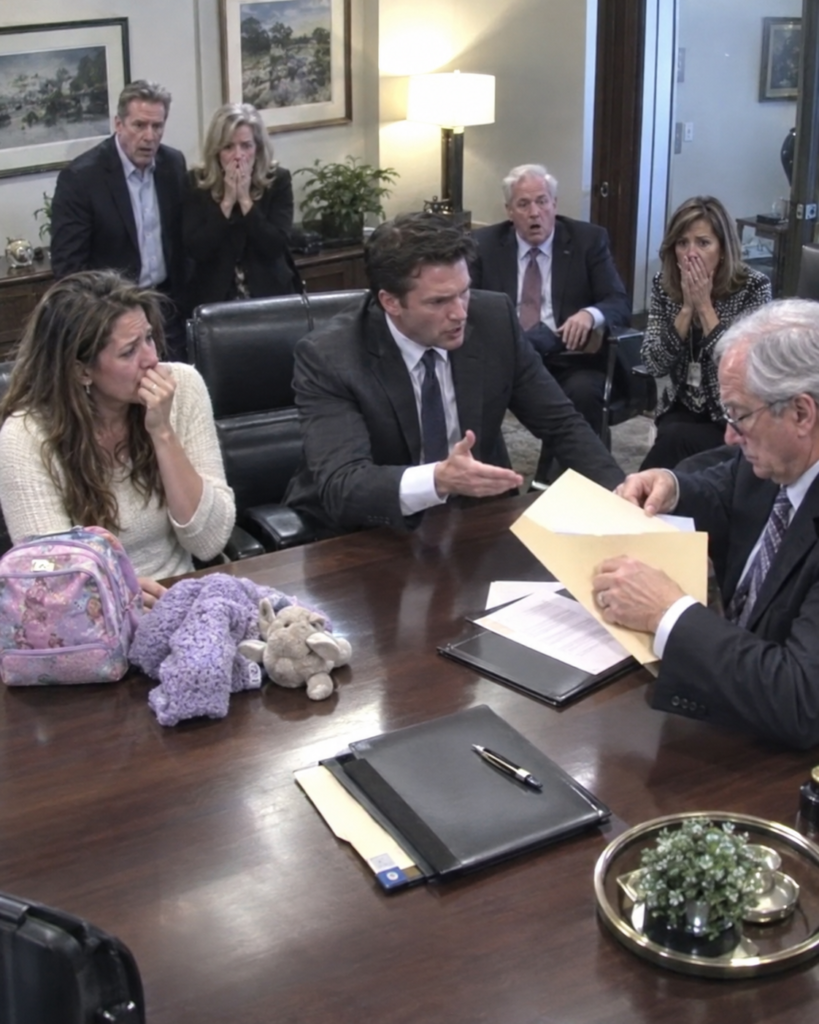
The conference room smelled like lemon polish and old leather. A walnut table my grandfather had built sat in the center. Six chairs around it, a pitcher of water, and two folders placed precisely at the head where Voss would sit.
Garrett arrived first. Charcoal suit, pocket square, Rolex catching the overhead light. He pulled out a chair and sat like a man about to accept an award.
Sloan came in behind him, phone already out, probably composing a caption for later.
Carol arrived next, clutching her purse strap with both hands, wearing the same fleece vest she’d worn to the motel. She nodded at me once and sat as far from Garrett as the table allowed.
I took the chair across from my brother.
Norah was with a sitter at the motel. I decided she didn’t need to see this, whatever this turned out to be.
In my bag, next to the carpenter’s pencil, I felt the weight of the brass key.
And sitting there in that room with the morning light falling across the table, I suddenly understood something I’d missed for 20 years.
The key my father gave me at 18, the one I’d carried on the cracked leather fob, the one I’d tried in the front-door lock the night Garrett changed it, had never been a house key.
It was too small. Too old.
The teeth were wrong.
It was the boat house key.
The key to the river place.
My father had given me the key to the 18 acres when I was 18 years old, and I’d spent 17 years thinking it was something else entirely.
Voss entered, closed the door, and took his seat. He placed his hands flat on the two folders.
“We’ll begin with your father’s will,” he said. “Then we’ll address the final section.”
Garrett smiled.
I did not.
Voss opened the first folder.
“Last will and testament of Thomas Edward Merritt, revised 18 months ago, witnessed and notarized in Washington County, Ohio.”
He read the standard provisions—debts, funeral expenses, executor appointment—in the flat, measured tone of a man who’d done this a thousand times.
Then he reached the distribution.
“To my son, Garrett Thomas Merritt, I leave the following: the residential property at 14 Maple Lane, Marietta, Ohio, including all structures; the commercial property at 312 Third Street known as Merritt and Son Woodworks, including all fixtures and remaining inventory; and all real property comprising the homestead parcel as recorded in Washington County deed records.”
Garrett leaned back.
He didn’t smile.
He did something worse.
He nodded slowly, like a king confirming what he already knew.
“To my daughter, Brooke Ellen Merritt, I leave my personal hand tools and toolbox.”
That was it.
One line.
Thirty-five years of being Tom Merritt’s daughter, reduced to a green metal box and a set of chisels.
Carol exhaled softly.
Sloan was already typing on her phone.
Garrett turned to me.
“The land stays with the Merritt son,” he said.
And the phrase rang through that room like a bell he’d been waiting his whole life to strike.
“I’m sorry it had to be this way, Brooke, but Dad made his choice.”
He always made his choice.
I said nothing.
I looked at Voss.
Voss looked back at me with an expression that was almost—almost—the ghost of patience.
“Mr. Merritt,” Voss said. “We’re not finished.”
Garrett waved a hand.
“What’s left? She got the toolbox. I got the house. It’s done.”
“It is not done.”
Voss closed the first folder and placed his hand on the second.
“Your father’s will contains one final section, and I am required by the terms of the document to read it aloud to both of you before any asset can transfer.”
Garrett’s confidence didn’t crack.
It hardened.
He stood up. Actually stood up from his chair like he was about to give a toast at his own coronation and looked around the room.
“A final section,” he repeated. “Fine. Read it. But let’s be clear about what’s happening here.”
He pointed at me.
“My sister left this family when she was 18 years old. She moved to Columbus. She got a job pushing numbers. She didn’t run the shop. She didn’t maintain the property. She didn’t carry the name. I did all of that. Every year. Every holiday. Every time a pipe burst or a roof leaked or Dad needed someone to co-sign a—”
He stopped.
Caught himself.
“I stayed,” he finished. “And she left. That’s the math. That’s always been the math.”
Then he turned to me with the full weight of 41 years of entitlement behind his eyes.
“Hope you enjoy being homeless, Brooke. I made sure you get nothing.”
The same words.
The same script.
He’d said it on the phone six days ago. He was saying it again now in front of witnesses, like repetition could make it true.
Sloan nodded along. Carol stared at the table.
Voss waited.
He waited the way a man waits who has read the next page and knows what’s coming.
When Garrett sat down, Voss opened the second folder.
“The final section of Thomas Merritt’s will concerns the disposition of a parcel not included in the homestead grant. Specifically, 18 acres of unencumbered riverfront land in Washington County, including the structure known as the boat house, appraised at $1.1 million.”
Garrett blinked.
Sloan’s phone stopped moving.
Carol looked up.
“This parcel,” Voss continued, “is subject to a conditional bequest. Your father attached a condition that I am now required to administer.”
Voss pulled a single page from the folder.
I recognized the paper. Heavy cream stock, the kind they use for legal instruments that are meant to last.
“I’ll read your father’s words exactly as written,” Voss said.
He adjusted his glasses.
“‘I, Thomas Edward Merritt, being of sound mind, do hereby direct that the 18-acre riverfront parcel, Washington County parcel number 04-117-20, including all structures thereon, shall not be distributed as part of the homestead grant. This land has been in the Merritt family for four generations. I have watched it held, improved, and honored. I have also watched other assets in this family leveraged, mortgaged, and nearly lost. I will not watch this land go the same way.’”
Garrett shifted in his chair.
Voss continued.
“‘Therefore, I direct my executor to require each of my children to submit a verified financial statement prepared and certified by an independent CPA demonstrating their current net worth and debt obligations. The 18-acre parcel shall pass to whichever child demonstrates the financial capacity to hold this land free and clear without mortgaging it, leveraging it, or placing any encumbrance upon it for a minimum period of 10 years.’”
Voss paused.
The room was silent except for the clock on the wall.
“‘If neither child meets this standard, the land shall be sold and the proceeds donated to the Washington County Land Conservancy.’”
He looked up, then finished.
“‘I have spent my life believing that land passes to the son. I was wrong. Land doesn’t go to the loudest. It goes to whoever can hold it.’”
That last line—I felt it land in my chest like a stone dropped into still water.
My father, the man who told me at 15 that I wasn’t staying, the man who never once asked about my work, had written those words in a lawyer’s office alone, knowing he was putting them on paper for the rest of time.
Carol made a small sound.
Garrett said nothing.
Voss set the page down.
“Both financial statements have been submitted. I will now review them.”
He opened two sealed envelopes side by side.
He read Garrett’s first.
“Garrett Thomas Merritt. Verified financial statement prepared by Henderson Accounting, Parkersburg, West Virginia.”
He scanned the page.
“Total assets. Residential property at 14 Maple Lane, estimated value: $410,000. Commercial property at 312 Third Street, estimated value: $95,000. Vehicle and personal accounts totaling $11,400.”
He paused.
“Total liabilities. Second mortgage on 14 Maple Lane, balance: $298,000. Supplier lien on 312 Third Street, balance: $42,000. Outstanding personal loans from private lenders, balance: $87,000. Credit-card obligations: $31,000.”
The numbers hung in the air like smoke.
“Net worth,” Voss said, his voice flat and precise. “Negative $41,600.”
Garrett’s jaw locked.
Sloan’s hand found his arm and gripped it.
“That’s temporary,” Garrett said. “The business is recovering. Those debts are being restructured. Once the estate settles and I sell a few—”
“Mr. Merritt.”
Voss’s voice was quiet, but final.
“The condition requires demonstrated capacity at the time of filing, not projected future capacity, not optimistic forecasts. Your statement shows insolvency. The house is worth approximately $400,000. The house carries approximately $340,000 in secured debt that you co-created and your father absorbed.”
He looked straight at Garrett.
“You didn’t inherit an asset, Mr. Merritt. You inherited a lien.”
Garrett looked at me for the first time since the funeral.
Maybe for the first time in years, he actually looked at me.
Not through me.
Not past me.
At me.
And I saw something I’d never seen in my brother’s face before.
Fear.
Not of me.
Of the number. Of the math. Of the simple, merciless arithmetic that said his entire life had been built on a foundation made of someone else’s money, and now the balance was due.
“Read hers,” he said hoarsely. “Read my sister’s.”
Voss picked up the second envelope.
“Brooke Ellen Merritt. Verified financial statement prepared by Kowalski and Associates, independent CPA, Columbus, Ohio.”
He turned the page.
The room was so quiet I could hear Carol breathing.
“Total assets.”
He read each line the way he read everything— evenly, without emphasis, like a man reading a weather report.
“Equity stake in Merritt Forensic Group, post-sale: $2.4 million. Diversified investment portfolio: $1.9 million. Commercial real estate holdings, two properties, Columbus metropolitan area: $1.1 million. Retirement accounts: $280,000. Cash and liquid reserves: $150,000.”
Sloan made a sound.
Not a word.
A sound.
Something between a gasp and a swallow, like the air had been punched out of her.
“Total liabilities,” Voss continued. “Zero. No outstanding debts, no mortgages, no liens, no encumbrances of any kind.”
He set the page down.
“Net worth: $5,830,000.”
The number sat in the room like a detonation nobody heard coming.
$5.83 million.
Every dollar earned.
Every dollar mine.
Garrett stared at me. His mouth opened, closed, opened again.
Nothing came out.
Carol pressed her hand over her mouth.
Sloan had gone completely still, her phone forgotten in her lap, her face the color of old paper.
I didn’t speak.
I didn’t need to.
I placed my hand on the carpenter’s pencil in my bag—TM to BM—and waited.
“By the terms of your father’s conditional bequest,” Voss said, “Brooke Merritt is the only qualifying beneficiary. The 18-acre riverfront parcel, including the boat house, passes to Brooke.”
He looked at Garrett.
“Mr. Merritt, do you have any questions?”
Garrett’s hands were flat on the table, fingers spread like he was trying to hold himself to the surface of the earth. His face was white. His breathing was shallow and wrong.
“Five,” he whispered. “Five million?”
“$5.83 million,” Voss corrected, because Raymond Voss was a man who believed in precision.
And then my brother’s eyes rolled back and he went down.
He hit the chair on the way down. The chair hit the table. A glass of water toppled and rolled across the walnut surface my grandfather had built 60 years ago, water pooling around the folders like a slow tide.
Sloan screamed, a short, sharp thing, more surprise than grief, and lunged toward him.
Carol stood up so fast her purse fell to the floor, coins scattering across the hardwood.
Voss’s assistant was already on the phone.
“He’s breathing,” she said, kneeling beside him, two fingers on his wrist. “Pulse is rapid but steady. Likely vasovagal syncope.”
I stayed in my chair.
I didn’t move.
I didn’t gloat.
I didn’t feel triumph or satisfaction or any of the things you might expect me to feel watching the man who’d put my daughter’s shoes in the rain collapse on the floor of a lawyer’s office because a piece of paper told him the truth about his sister.
I felt tired.
I felt the specific exhaustion of a woman who’d spent 35 years being underestimated and had just watched the estimate come due.
Sloan was fanning Garrett with a folder. Carol was standing against the wall, both hands pressed to her cheeks, staring at nothing.
Voss sat at the head of the table, hands folded, waiting with the patience of a man who had seen people faint before and would see them faint again.
I reached into my bag and took out the brass key on its cracked leather fob.
I set it on the table next to the pooling water, next to the folders, next to the wreckage of my brother’s certainty.
The boat house key.
The key to the river place.
The key my father gave me at 18.
The day I left, he’d said, “For when you come home.”
I’d come home.
And the land had come with me.
The paramedics arrived in 11 minutes. By then, Garrett was sitting up in a chair, a cold compress on his forehead, Sloan hovering beside him like a bodyguard who’d been caught sleeping.
The EMTs checked his blood pressure, shone a light in his eyes, and recommended he see his doctor. He refused transport.
Of course he did.
Merritt men don’t ride in ambulances.
When the paramedics left, Garrett looked at me across the table with an expression I’d never seen on him.
Not anger.
Not confidence.
Something raw and crumbling, like a wall with the plaster stripped away.
“You knew,” he said. “You sat there and you knew.”
“I knew I’d built a career. I knew I’d earned my money. I didn’t know it would matter in this room until a week ago.”
“You hid it. You let us—you let me—”
“I let you what?”
“You wanted me to look like a fool.”
“You looked like whatever you chose to look like, Garrett. I didn’t make a single choice for you.”
His jaw trembled.
Then the self-pity arrived.
Right on schedule.
“I stayed, Brooke. I stayed and I ran the shop and I did everything Dad asked. I gave up—I gave everything to this family. And now I’m underwater and you’re sitting on $6 million. And the land is—”
“The land is going to someone who won’t lose it.”
That wasn’t me.
That was Carol.
Everyone turned.
She was still standing against the wall, arms crossed, tears running quietly into the lines around her mouth.
“I gave up 40 acres,” she said, her voice thin. “I gave them to my brother because that was the rule. Boys keep the land.”
She looked at Garrett.
“And it ate my life, Garrett. That rule ate my whole life.”
She wiped her face with the back of her hand.
“Your father was wrong. My father was wrong. And I was wrong for telling Brooke to accept it.”
She looked at me.
“I’m sorry,” she said.
And I believed she meant it.
But meaning it and having done something about it were two different things, and Carol knew that as well as I did.
Three months later, the house on Maple Lane went into foreclosure. Garrett couldn’t cover the second mortgage, the one my father had taken out to save him, and the bank filed the notice in November.
Sloan moved out two weeks before the sheriff’s sale. She took the flat-pack cabinets she’d installed over my grandfather’s originals. She left the stained-glass transom above the front door because it was too heavy to carry.
Garrett contested the conditional bequest. His lawyer filed the motion.
Voss responded with the will, the condition, the verified statements, and an eight-page brief on Ohio case law regarding dead-hand control.
The motion was dismissed in 16 days.
The judge’s ruling was one paragraph long. It ended with: “The testator’s condition is clear, lawful, and enforceable.”
Garrett stopped calling me after that.
Carol sent me a card at Christmas.
No message.
Just her name.
I didn’t reply, but I didn’t throw it away either.
Some debts take longer to settle than others.
In January, I drove Norah down to the river place for the first time since the reading. The sycamores were bare, the river was high and gray, and the boat house door stuck on its hinges the way it always had.
I used the brass key.
It turned smooth and easy, like it had been waiting.
Inside were my father’s fishing rods, a folding chair, a coffee can full of hooks and sinkers, and the smell of cedar.
The same cedar from the shop.
From the toolbox.
From every Saturday morning I’d spent here as a girl before my father decided I wasn’t worth the time.
Norah ran down to the water’s edge and threw rocks while I sat on the boat house steps and sharpened the carpenter’s pencil with a pocketknife.
TM to BM.
I drew a line on a scrap of wood.
The first line of a plan for a small workshop I’d build here for Norah, so she’d have a place where her name meant something.
“Hope you enjoy being homeless,” Garrett had said.
I looked at 18 acres of unencumbered riverfront land and thought, I am home.
Worth isn’t handed to whoever’s loudest or whoever stayed or whoever was born with the right name in the right body.
Worth is measured by what you can carry on your own.
And my father learned that too late to say it to my face, but right in time to write it down.
That’s my story: a green metal toolbox, 18 acres, and a brother who found out too late what “nothing” really meant.
If a family ever told you you’d amount to nothing, told you the land, the name, the legacy wasn’t yours to hold, go build something only you can carry, then come tell me about it.