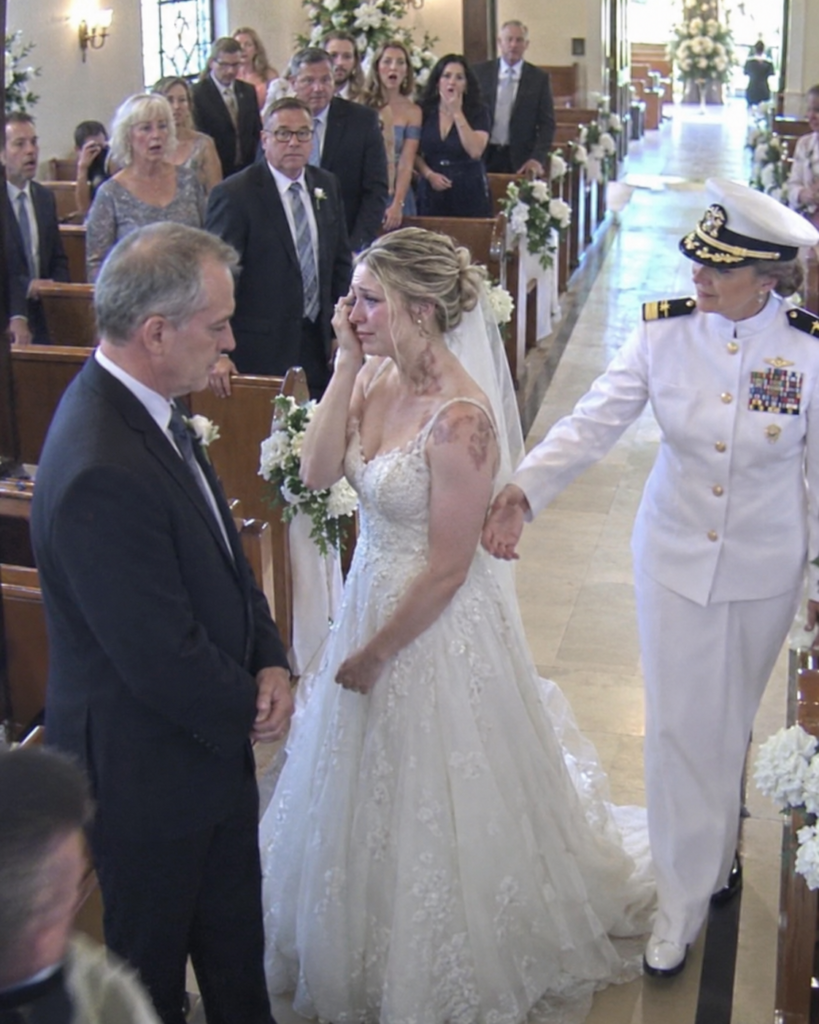
The moment my father’s eyes locked onto the scars curling across my neck and shoulder, I knew something inside him had already snapped. He took one slow step backward as if my wounds were something shameful, not something earned. “I’m not walking a woman who looks like that down the aisle,” he said, his voice cold enough to freeze the entire chapel.
My chest tightened. My vision blurred. Just as I thought the worst humiliation of my life had arrived…
The chapel doors SWUNG open with a force that made every head turn.
My name is Lieutenant Sarah Mitchell. I spent four years serving my country, three of them in active combat zones. The scars my father couldn’t bear to look at came from a suicide bombing that killed three people beside me.
I survived by inches.
A medic named Davis dragged me through smoke and falling debris while shrapnel struck the ground around us. For months afterward, I could still feel his hands gripping my vest whenever I closed my eyes.
My father knew every detail. He had visited me during recovery, sat beside my hospital bed, and watched nurses change the bandages along my neck and shoulder.
But once I came home, he stopped treating the scars like proof that I had survived.
He wanted them covered in family photos. He asked me to wear higher collars to church. When Daniel proposed, my father congratulated us—and then quietly asked whether my wedding dress could hide “the worst parts.”
I chose a modest gown, but the raised scar tissue along my neck remained visible. At the back of the chapel, while the music began and guests turned toward the aisle, my father stared at my skin instead of looking at me.
Then he refused to take my arm.
For years, I had imagined walking toward Daniel with my father beside me. Instead, I stood holding my bouquet while the man who raised me acted as though I had ruined his day simply by showing up in my own body.
Before I could answer him, Admiral Helen Cross entered through the open doors in her immaculate white dress uniform. Her heels struck the marble floor in calm, measured steps as she walked directly toward us.
She did not glance at my father.
She looked at my scars without pity, then met my eyes.
“Your father may be uncomfortable with your scars, Lieutenant,” she said, “but I know exactly how you earned every single one of them.”
An officer near the aisle stood first. Then another. The enlisted sailors rose, followed by the veterans and the rest of the guests.
The applause rolled through the chapel, but Admiral Cross never turned the moment into a performance. She simply held out her arm.
“It would be my honor.”
My hand trembled when I placed it against her sleeve. Together, we started down the aisle while my father remained near the entrance, crushing the wedding program into a tight square.
Daniel waited at the altar with tears in his eyes. He smiled at me—not at the dress, not around the scars, and not because the room was watching.
At me.
When we reached the front, Admiral Cross leaned close enough that only I could hear her.
“The investigation file landed on my desk this morning,” she whispered.
My fingers tightened around the bouquet.
“Is the evidence enough?”
She gave one small nod. “Enough to change everything.”
I looked back toward the chapel doors. My father’s face had gone pale, and the program was now crushed inside his fist.
That was when I understood the admiral had not come only to walk me down the aisle.
She had come because the investigation led directly to my father.
Admiral Cross did not explain anything else until Daniel and I had exchanged our vows.
The moment the ceremony ended, she guided us into the small room beside the chapel. My father followed without being invited, still gripping the folded wedding program.
The admiral placed a thin file on the table and opened it to an access report from my sealed recovery records. Someone had requested photographs of my injuries, treatment notes, and the private statements I had given after the bombing.
The request had been submitted three weeks earlier.
My father’s name was on it.
He stared at the page and shook his head.
“I had a right to know what she was hiding. I’m her father.”
“She wasn’t hiding anything,” Daniel said. His voice stayed controlled, but his hand closed around mine. “You were looking for something you could use against her.”
My father finally admitted he had wanted the photographs sent to the woman altering my dress. He said he needed proof that the gown would cover every scar before the wedding pictures were taken.
That explanation was cruel enough.
But Admiral Cross turned one more page.
The access request had not stopped with photographs. It also included an authorization bearing my forged signature—permission to release my full medical history to an outside account I had never seen.
I looked at my father.
“Who owns that account?”
For the first time all day, he could not meet my eyes.
Admiral Cross slid a complaint form toward me. Filing it would turn the inquiry into a formal investigation, and there would be no quietly fixing it afterward.
I picked up the pen.
My father stepped forward.
“Sarah, before you sign that, you need to understand something. I wasn’t the only person who used that account.”
Then he looked past me—directly at someone standing in the chapel doorway.
PART 2 — THE SECRET BEHIND MY FATHER’S BETRAYAL
I turned toward the chapel doorway.
My younger sister, Emily, stood there in her pale blue bridesmaid dress, her face drained of color. She was clutching her phone so tightly that her knuckles had turned white.
For a moment, nobody spoke.
Then my father did something I had never seen him do before.
He looked afraid of his own daughter.
“Emily,” he whispered. “I told you to wait outside.”
She didn’t move.
Instead, she looked at me, and tears began rolling down her cheeks.
“I’m sorry, Sarah.”
Those two words made my stomach twist.
I had spent years making excuses for Emily. When our father criticized my scars, she stayed silent. When he asked me to cover my neck during family gatherings, she pretended not to hear. When I returned from rehabilitation and struggled to sleep through the night, she complained that my nightmares were making everyone uncomfortable.
I had always believed she was simply too young to understand.
But Emily was twenty-eight years old.
And she had just admitted she knew something.
“What did you do?” I asked.
She lowered her eyes.
My father immediately stepped between us.
“Don’t interrogate your sister on your wedding day. You’ve made enough of a scene already.”
Admiral Helen Cross closed the folder with a sharp snap.
“Mr. Mitchell, I strongly suggest you stop speaking before you make your situation considerably worse.”
He glared at her.
“You have no authority over my family.”
“No,” the admiral replied. “But I have authority over the military records you attempted to access illegally. And the investigators handling this matter have already secured evidence connecting your account to several unauthorized transactions.”
My father’s expression changed.
Transactions?
I looked at the admiral.
“What transactions?”
She opened the folder again and removed a printed bank transfer record.
“An outside company received payments totaling eighty-four thousand dollars over the past six months. Some of those payments were made shortly after someone attempted to access your protected medical records.”
I stared at the number.
Eighty-four thousand dollars.
“Who paid them?”
“The money came from an account jointly controlled by your father and your sister.”
I turned to Emily.
She began shaking her head.
“I didn’t know what he was planning at first.”
My father seized her wrist.
“Stop talking.”
She pulled away from him.
“No!”
The word rang through the little room.
Everyone froze.
Emily wiped her cheeks with the back of her hand.
“You told me it was a private investigation. You said Sarah had been exaggerating what happened overseas, and you wanted to prove she was unstable before she made another decision that embarrassed the family.”
I felt as though the floor had tilted beneath my feet.
“Unstable?”
My father looked at me.
“Sarah, listen to me. You know how difficult things became after you returned. You were angry all the time. You couldn’t sleep. You barely spoke to anyone. I was worried about you.”
“Then why didn’t you ask me how I was doing?”
He opened his mouth but said nothing.
I continued, my voice trembling.
“Why didn’t you sit beside me and ask me what I needed? Why did you ask a stranger to obtain my medical records?”
“Because I knew you wouldn’t tell me the truth!”
The words exploded out of him.
For a moment, I saw the father I remembered from childhood—the man who believed his judgment was always right and that everyone else existed to confirm it.
Then he pointed at my neck.
“Look at what happened to you, Sarah! I watched my daughter come home covered in scars. I watched people stare at her. I watched our family become the subject of whispers. Do you have any idea what that did to me?”
I couldn’t believe what I was hearing.
“What it did to you?”
My voice broke.
“I was the one who nearly died.”
He looked away.
And in that instant, I finally understood something I had spent years refusing to accept.
My father wasn’t ashamed because I had been injured.
He was ashamed because my injuries reminded him that he couldn’t control everything.
My survival had forced him to face a world where his daughter could suffer, change, and become someone he no longer understood.
Instead of learning to love the person I had become, he had tried to erase the evidence.
Admiral Cross pushed another document across the table.
“This is the authorization your daughter allegedly signed. The investigators have reason to believe the signature was forged. They also found messages discussing how the information might be used.”
Daniel leaned over the table.
“Used for what?”
The admiral hesitated.
Then she looked directly at my father.
“To challenge Lieutenant Mitchell’s credibility and interfere with a confidential military benefits review.”
My blood ran cold.
I had recently been selected for a specialized advisory position involving military personnel wounded in combat. The appointment came with access to sensitive administrative matters and a substantial increase in compensation.
I had told my family very little about the position because I wanted to celebrate the achievement quietly.
My father, however, had somehow learned about it.
“Why would you want to interfere with my career?” I asked.
He rubbed his forehead.
“Your grandfather left money for this family. You know that.”
I frowned.
“My grandfather died five years ago.”
“He established a trust before he died. The family business was supposed to benefit everyone.”
My grandfather, Thomas Mitchell, had built a successful medical supply company before retiring. My father had managed the business for years, and I had assumed the family trust was a straightforward arrangement.
I had never been interested in fighting over money.
Apparently, someone else had been.
“The trust contains a provision,” my father continued. “If a beneficiary becomes unable to manage her affairs, the trustee can temporarily restrict certain distributions until the situation is reviewed.”
I stared at him.
“You thought you could use my medical records to make me look incapable of managing my affairs?”
He said nothing.
Emily finally spoke.
“He wanted the trustee to delay your distribution. He said you were going to receive enough money to leave the family behind permanently.”
I laughed once, without humor.
“Leave the family behind? I live three states away. I pay my own bills. I never asked any of you for a single dollar.”
“You were going to receive nearly two million dollars,” my father snapped. “And you were going to spend it however you pleased.”
There it was.
Not concern.
Not protection.
Money.
Admiral Cross stood.
“The financial portion of this matter will be handled by the appropriate authorities. The unauthorized access to military medical records will be investigated separately. Lieutenant Mitchell, you are under no obligation to sign anything today.”
She turned toward my father.
“And you are not entitled to her private records simply because you are related to her.”
My father looked at me with desperate eyes.
“Sarah, please. Think about what this will do to your mother. Think about what people will say. Today is your wedding day. We can resolve this privately.”
I looked down at the complaint form.
For years, I had believed that keeping the peace was the same thing as keeping my family together.
I had swallowed insults because my mother cried whenever we argued. I had forgiven Emily because she was my little sister. I had accepted my father’s demands because I thought that, eventually, he would recognize how hard I had fought to survive.
But every time I made an excuse for them, I gave them another opportunity to hurt me.
I picked up the pen.
My father stepped toward me.
“Sarah, don’t.”
Daniel moved between us.
“She’s made her decision.”
I signed the complaint.
My hand was shaking, but my signature was clear.
For several seconds, my father stared at the paper as though I had just destroyed something precious.
Then he whispered the words that hurt more than any insult he had ever thrown at me.
“After everything I’ve done for you, this is how you repay me?”
I looked at him.
“No, Dad. This is what happens when you finally have to answer for what you’ve done to me.”
He left the room without another word.
Emily remained behind.
And for the first time in my life, I didn’t chase after either of them.
I returned to my wedding reception with my husband.
I had a life to begin.
And I refused to let their secrets become the foundation of it.
PART 3 — THE DAY THE TRUTH FINALLY CAME OUT
Three weeks after my wedding, I received a phone call from an investigator.
His name was Robert Hayes, and he had been assigned to the financial portion of the case.
“Lieutenant Mitchell,” he said, “we’ve uncovered something you should know about your father’s outside account.”
I sat down at the kitchen table.
Daniel was across from me, sorting through wedding photographs.
“What did you find?”
“The company that received the payments was registered under the name of a consulting business. However, we traced the account to an individual who had previously worked with your father’s attorney.”
My fingers tightened around the phone.
“What was the company supposed to do?”
“According to the messages we’ve reviewed, it was hired to obtain your medical information and prepare a report questioning your fitness to receive certain trust distributions.”
I closed my eyes.
“Did my sister know?”
“She knew more than she initially admitted. We’re still determining the extent of her involvement.”
After the call ended, I sat silently for a long time.
Daniel came over and placed a hand on my shoulder.
“You don’t have to carry this alone.”
“I know.”
But knowing something and believing it were two different things.
For years, I had carried the weight of my father’s disappointment as if it were another piece of shrapnel lodged beneath my skin.
I had convinced myself that if I worked hard enough, served honorably enough, and became successful enough, he would finally look at me with pride.
Now I understood that no achievement could satisfy someone who had already decided what he wanted me to be.
Two days later, my mother called.
I almost let it go to voicemail.
Almost.
“Sarah,” she said when I answered, “your father is devastated.”
I looked out the kitchen window at the morning sunlight.
“Is he devastated because he betrayed me, or because I reported it?”
My mother began crying.
“You know your father. He doesn’t handle embarrassment well.”
I closed my eyes.
“Mom, I spent four years in the military. I survived an attack that killed people standing beside me. I spent months learning how to sleep without waking up screaming. And when I finally came home, my own father told me my scars were embarrassing.”
“That’s not fair.”
“No,” I replied quietly. “It wasn’t.”
She sniffed.
“He was trying to protect the family.”
“From what?”
There was a long silence.
Then she whispered, “From losing the trust money.”
I felt something inside me go still.
“How long have you known?”
“I didn’t know about the forged signature.”
“That wasn’t my question.”
My mother didn’t answer.
She didn’t need to.
I ended the call.
For the first time, I stopped asking myself whether I had been too harsh with my family.
I began asking why I had spent so many years being gentle with people who weren’t gentle with me.
Two months later, I attended a formal hearing concerning my grandfather’s estate.
I hadn’t wanted a public fight. I hadn’t wanted to drag family secrets into a courtroom or have strangers examine the ugliest moments of my life.
But the investigators had uncovered evidence that the attempted release of my medical records was connected to a larger effort to influence the administration of the trust.
My father’s attorney had withdrawn from representing him after investigators requested communications related to the disputed authorization.
The hearing was held in a quiet courthouse outside Richmond, Virginia.
I arrived wearing a simple navy suit. My scars remained visible above the collar.
I had stopped choosing clothes based on whether they made other people comfortable.
Daniel sat beside me.
Across the room, my father looked older than I remembered. His hair had gone almost completely gray, and his shoulders seemed to sag beneath his suit.
Emily sat behind him.
She wouldn’t look at me.
The trustee’s attorney presented the relevant documents, including the disputed authorization, payment records, and correspondence describing plans to challenge my ability to manage my own affairs.
Then came the evidence that changed everything.
My grandfather had anticipated that disagreements might arise among his heirs. His estate documents contained explicit protections against attempts to manipulate a beneficiary’s access to her inheritance through unsupported claims about medical fitness.
The trustee confirmed that I had never been declared incapable of managing my affairs, and the submitted documents did not establish any legitimate basis for restricting my distribution.
The attorney then addressed my father’s claim that he had acted to protect the family.
“Mr. Mitchell’s personal concerns, whatever they may have been, did not authorize him to obtain protected medical information or submit documents bearing a disputed signature.”
My father shifted in his seat.
When he was given the opportunity to speak, he stood and faced the hearing officer.
“I was worried about my daughter,” he said. “I thought she was making decisions that would hurt everyone.”
The hearing officer studied him.
“Did your daughter ask you to investigate her medical condition?”
“No.”
“Did she authorize you to release her medical records to an outside company?”
My father hesitated.
“No.”
“Then what gave you the right to do so?”
He looked toward me.
For a moment, I thought he might finally apologize.
Instead, he said, “I’m her father.”
The hearing officer’s expression didn’t change.
“That is a family relationship, Mr. Mitchell. It is not legal authorization.”
The words landed heavily in the room.
My father sat down.
The trustee confirmed that my inheritance would be administered according to my grandfather’s instructions, without the restrictions my father had sought.
The disputed financial transactions were referred for further review, and the alleged forgery remained subject to the appropriate investigation.
There was no dramatic announcement that every question had been answered.
There was something better.
The facts had been documented.
My father’s explanation had not erased them.
And my future would no longer depend on his approval.
When the hearing ended, Emily approached me in the courthouse hallway.
“Sarah, can we talk?”
Daniel glanced at me.
I nodded.
He stepped away, leaving us alone.
Emily looked down at her hands.
“I didn’t know he was going to use your records against you when I first agreed to help.”
“What did you think you were helping him do?”
She swallowed.
“He told me you were going to take the money and cut everyone off. He said you thought you were better than us because you had a military career.”
I stared at her.
“I never said that.”
“I know.”
Her voice cracked.
“After the payments started, I realized something was wrong. I saw the authorization with your signature, and I knew it didn’t look right. But Dad said it was already too late to stop.”
“You could have called me.”
“I was afraid.”
“So was I.”
She looked up.
I continued.
“I was afraid every time I came home and wondered whether you would stare at my scars. I was afraid every time Dad made another cruel remark and Mom asked me to ignore it. I was afraid that if I stood up for myself, I would lose my family.”
Tears filled her eyes.
“I never wanted you to get hurt.”
“But you let it happen.”
She covered her mouth.
I wanted to hug her. A part of me still remembered the little girl who used to climb into my bed during thunderstorms.
But love and trust were not the same thing.
“I can’t tell you that everything is forgiven,” I said. “Not today. Maybe not for a long time.”
She nodded, crying.
“I understand.”
“Do you?”
She looked at me.
“I think I’m beginning to.”
I walked away before either of us could mistake that conversation for a reconciliation.
Some wounds needed time.
Others needed distance.
And some required both.
My Father’s Last Attempt
Six months after the wedding, my father sent me a letter.
Not an email. Not a text message.
A handwritten letter on cream-colored stationery.
I recognized his handwriting immediately.
He wrote about the family business, my grandfather’s trust, and the pressure he had been under. He described his fear of losing control and his belief that he was protecting what our family had built.
Near the end, he finally addressed the wedding.
He wrote that when he saw my scars, he remembered the phone call informing him that I had been critically injured. He remembered sitting beside my hospital bed, terrified that I might die.
He admitted that he had never learned how to live with the memory of almost losing me.
But then came the sentence that told me he still didn’t understand.
“I hope someday you can forgive me for reacting badly to something that frightened me.”
I read it twice.
He had described his fear in detail.
He had described his embarrassment, his anxiety, and his concerns about the family.
But he hadn’t once acknowledged what it had been like for me to survive.
He still wanted my forgiveness without fully facing my pain.
I placed the letter in a drawer.
I didn’t tear it up.
I didn’t send an angry reply.
I simply refused to let it decide what happened next.
A week later, my mother called to tell me that my father wanted to attend a family dinner and hoped I would come.
I declined.
“He’s your father,” she said.
“I know.”
“He won’t be around forever.”
“Neither will I, Mom. That’s why I’m choosing to spend my life with people who understand that it matters.”
She went quiet.
Then she asked, “What are we supposed to tell everyone about the wedding?”
I looked at the framed photograph on our living room wall.
It showed Daniel and me standing beneath the chapel’s stained-glass windows. Admiral Cross stood beside us, her uniform immaculate, her expression warm.
My scars were visible.
I was smiling.
“Tell them the truth,” I said.
And for once, I meant it.
One Year Later
On the first anniversary of our wedding, Daniel and I returned to the chapel.
We hadn’t planned anything elaborate. We wanted a quiet morning, a few photographs, and lunch at the little restaurant where we’d celebrated after the ceremony.
As we stepped inside, a woman approached us.
She was a young veteran named Rachel, perhaps twenty-five, with a small scar running from her jaw to her collarbone.
She recognized me from a photograph Admiral Cross had shared during a veterans’ support event.
“Lieutenant Mitchell?”
“Sarah is fine.”
Rachel smiled nervously.
“I wanted to thank you.”
“For what?”
“For not covering your scars at your wedding.”
I blinked.
She touched the edge of her collar.
“I’ve been wearing scarves everywhere since I got home. I don’t like people staring. My fiancé says he doesn’t care, but I still feel like everyone sees the injury before they see me.”
I remembered standing at the entrance to the chapel, holding my bouquet while my father refused to take my arm.
I remembered the shame I had felt.
And I remembered the moment Admiral Cross extended hers.
I stepped closer to Rachel.
“Your scars are part of your story,” I told her. “But they don’t have to be the first thing you love about yourself. And they don’t have to be something you hide to make other people comfortable.”
Her eyes filled with tears.
“What if my family doesn’t understand?”
I thought about my father.
About the letter.
About the years I had spent trying to earn a kind of acceptance that always came with conditions.
“Then give them a chance to learn,” I said. “But don’t make your worth depend on whether they do.”
Rachel hugged me.
When she stepped away, Daniel slipped his hand into mine.
Outside, sunlight poured through the chapel windows.
For the first time in years, I felt no urge to explain myself to anyone.
I had survived the bombing.
I had survived the recovery.
I had survived the humiliation of discovering that the people I loved most had tried to use my suffering against me.
And I had survived the painful truth that some people could love you and still hurt you in ways you could never excuse.
I didn’t know whether my father would ever understand what he had done.
I didn’t know whether Emily would eventually earn back my trust.
Those answers belonged to the future.
What I knew was that I no longer needed them to move forward.
Epilogue — The Woman Who Walked Anyway
Three years later, I was promoted to captain and began working with a program supporting service members returning from combat injuries.
I spoke at hospitals, rehabilitation centers, and military family events. I met people who had lost limbs, people who carried scars beneath their clothes, and people whose injuries were invisible to everyone around them.
I told them what I wished someone had told me when I first came home.
“You do not owe anyone a more comfortable version of your survival.”
Daniel remained beside me through every difficult day. He never treated my scars as something that needed to be explained, softened, or hidden.
Admiral Cross became a trusted mentor, and Rachel eventually became one of the program’s most passionate advocates.
As for my family, the years brought no magical transformation.
Emily began making amends in small, consistent ways. She stopped asking for immediate forgiveness and started respecting my boundaries. We spoke occasionally, carefully rebuilding what had been broken.
My father and I remained distant.
He sent birthday cards. Sometimes he asked whether I would meet him for coffee.
I didn’t always answer.
I had finally learned that setting boundaries wasn’t the same as seeking revenge.
I wasn’t trying to punish him.
I was protecting the life I had fought so hard to reclaim.
On a quiet Sunday morning, I stood in front of our bedroom mirror and adjusted the collar of my dress.
The scars along my neck and shoulder caught the sunlight.
I traced one raised line with my fingertips.
Once, I had looked at those marks and wondered whether they had made me less worthy of being loved.
Now I saw something else.
Proof that I had survived a day I wasn’t supposed to survive.
Proof that I had continued living when the future seemed impossible.
Proof that no one—not even my own father—could decide that my scars made me less deserving of dignity.
Daniel appeared in the doorway.
“Ready?”
I smiled.
“Ready.”
He held out his arm.
I took it.
And together, we walked toward the door.
Not because I needed someone to rescue me.
Not because I needed the world to applaud.
But because I had finally learned that the woman who deserved to walk down that aisle had been standing there all along.
She was never the shameful thing in that chapel.
She was the survivor.
And she had every right to be seen.