Part 1: The Weight of Expectations
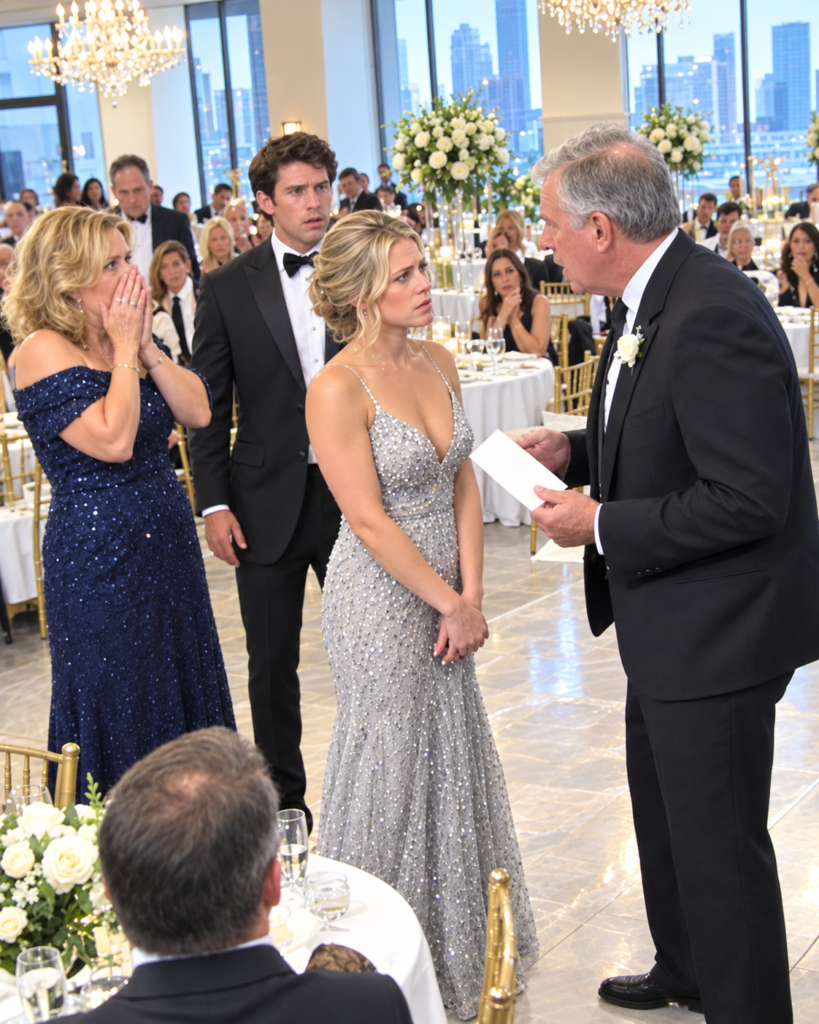
The ballroom air was thick with the scent of white roses and champagne.
Nearly two hundred people stood in quiet suspense.
My mother stared at the grandfather with a look of sudden panic.
My father looked like he wanted the floor to open up beneath him.
Pop adjusted his glasses slowly.
He did not raise his voice.
The silence in the room became absolute.
“You think you can rewrite history tonight, Deborah,” Pop said softly.
“You think Robert’s past is a weapon you can use.”
Mom tried to find her voice.
“Dad, you don’t understand—”
“I understand entirely,” Pop interrupted.
He looked down at the weathered paper on the white tablecloth.
“I understand that thirty years ago, Robert’s business was drowning.”
My father flinched.
I stood completely still, watching the unfold of a secret I had only ever suspected.
Part 2: The Document on the Table
Pop smoothed out the creases of the old contract.
“When Robert lost his primary commercial contract,” Pop read aloud, his voice steady, “he didn’t go to a bank.”
The guests shifted uneasily in their seats.
“He came to me.”
Mom’s face turned completely pale.
“Dad, please, not in front of everyone,” she whispered, her composure entirely shattered.
Pop looked up, his eyes sharp.
“You wanted to talk about fairness, didn’t you?”
“You wanted to strip Vanessa of what she built because she is single.”
“You claimed she owes this family her hard work.”
“So let’s talk about what this family actually owes.”
He pointed a finger at the signatures at the bottom of the page.
“Every penny Robert used to save his company back then didn’t come from nowhere.”
“It came from my retirement fund.”
Part 3: The Conditions of the Past
The room gasped softly.
Several relatives murmured among themselves.
Brooke stared at our father in absolute disbelief.
“Dad?” Brooke whispered. “Is that true?”
Robert could not meet her eyes.
He stared down at the floor, his shoulders slumping under the weight of decades of pride.
Pop continued reading from the agreement.
“And not only did I bail him out,” Pop said, “we signed a legal lien.”
“A lien on what?” Mom choked out, her voice trembling.
“On the very house you currently live in,” Pop replied calmly.
“The house you bought, expanded, and lived in all these years.”
“The house that was never fully yours to begin with.”
Mom stumbled back a step, catching the edge of a decorated table.
The glass of champagne in her hand rattled violently against the china.
Part 4: The Reality Check
I watched my mother realize the full scope of her mistake.
She had tried to use a decades-old ghost as a weapon.
She had assumed nobody would ever call her bluff.
She had underestimated her own father.
“You threatened Vanessa with exposure,” Pop said, his tone icy.
“You thought her success was an insult to your favoritism.”
“You thought you could bully her into handing over a five-million-dollar property she earned entirely on her own.”
“While Brooke knew nothing about your greedy little scheme.”
Brooke turned to Mom with tears in her eyes.
“You tried to steal her home?” Brooke asked, her voice cracking. “At my wedding?”
Mom stammered, unable to form a coherent defense.
“I… we just wanted to secure your future, Brooke—”
“By stealing someone else’s?” Brooke shouted, the emotion finally breaking through her.
Part 5: The Sister’s Stand
Brooke stood up from her seat at the head table.
Her wedding dress rustled sharply in the quiet room.
She walked over to where I was standing and grabbed my arm.
“Vanessa,” Brooke said, her voice shaking with anger and embarrassment.
“I am so, so sorry.”
“I swear to you, I knew nothing about this.”
“I didn’t ask for a penthouse.”
“I didn’t ask for any of this.”
I looked at my younger sister and saw the genuine shame in her eyes.
I placed my hand over hers.
“I know you didn’t, Brooke,” I said softly.
“This isn’t your fault.”
The guests watched our interaction with rapt attention.
The fairy-tale wedding had turned into a public reckoning.
Part 6: The Ultimatum
Pop folded the document slowly and placed it back inside his jacket pocket.
He looked directly at my parents.
“You have two choices tonight,” Pop said, his voice ringing clearly across the ballroom.
“Option one: You apologize to Vanessa right here, right now, in front of everyone.”
“And you drop this absurd demand forever.”
“Option two?” Mom asked weakly, terrified of the answer.
“Option two,” Pop said coldly, “is I call my lawyer tomorrow morning.”
“We execute the default clause on that thirty-year-old loan.”
“And by Monday afternoon, you two will be packing your bags because that house belongs to me.”
The threat hung in the air like a guillotine blade.
Dad finally raised his head.
He looked old.
He looked defeated.
He looked at me with a plea in his eyes that he had never shown me before.
Part 7: The Public Apology
Silence stretched for what felt like an eternity.
The string quartet had stopped playing entirely long ago.
Mom looked around the room, realizing every single eye was locked onto her.
Her social standing, her pride, her illusion of control—everything was crumbling.
She swallowed hard.
She took a shaky breath.
“Vanessa,” Mom whispered, the word tasting like ash in her mouth.
“Speak up, Deborah,” Pop commanded. “The guests want to hear it.”
Mom closed her eyes in humiliation.
“I’m sorry,” she said louder, her voice trembling.
“I was wrong.”
“I had no right to ask for your penthouse.”
“Please forgive me.”
Dad looked at me next.
“I’m sorry too, Vanessa,” he muttered, staring at the floorboards. “We crossed a line.”
Part 8: The Resolution
I looked at my parents.
I felt no rush of victory.
Just a quiet, heavy sense of closure.
“Apology accepted,” I said clearly.
“But let one thing be crystal clear to both of you.”
“I built my life, my company, and my home with my own two hands.”
“If you ever try to pull something like this again, there won’t be a grandfather here to save you.”
I turned to Brooke and Tyler.
“Congratulations on your wedding,” I smiled softly, my tone softening for my sister.
“I genuinely wish you both a lifetime of happiness.”
Then I picked up my small clutch from the chair.
I turned around and walked down the central aisle between the stunned guests.
The heavy ballroom doors opened automatically as I approached.
Part 9: Out Into the Night
The cool night air of downtown Charlotte hit my face instantly.
Above me, the city skyline glittered against the dark sky.
Somewhere up there, past the glowing office towers and the busy streets, sat my penthouse.
Floor-to-ceiling windows.
A small office facing the skyline.
One deed.
One name.
Mine.
I pulled my coat tighter around my shoulders and began walking toward home, completely free.
Part 10: The Phone Call That Changed Everything
By the time I reached my penthouse, it was nearly midnight.
The elevator doors opened directly into my private foyer, revealing the familiar glow of the city beyond my floor-to-ceiling windows. Charlotte stretched beneath me in a sea of lights, beautiful and indifferent to the family drama that had unfolded less than an hour earlier.
I slipped off my heels, set my clutch on the kitchen island, and poured myself a glass of water.
For the first time that evening, I allowed myself to breathe.
I should have felt triumphant.
My parents had been exposed in front of nearly two hundred people. My grandfather had defended me when they tried to take everything I had worked for. Brooke had finally seen the truth about our parents’ favoritism.
But instead of satisfaction, I felt exhausted.
My phone vibrated against the marble countertop.
Brooke.
I stared at her name for several seconds before answering.
“Vanessa?”
Her voice was small and fragile.
“Are you home?”
“Yes.”
“Can I come over?”
I glanced at the clock.
“It’s your wedding night, Brooke.”
“I know.” She paused. “But Tyler and I aren’t going to the hotel yet. We left the reception early, and I can’t stop thinking about what happened.”
I closed my eyes.
“Of course you can come.”
Twenty-five minutes later, the elevator doors opened again.
Brooke stepped out, still wearing her wedding dress. Her makeup had smudged beneath her eyes, and she was carrying her shoes in one hand. Tyler followed behind her, his tie loosened and his expression unusually serious.
I led them to the living room.
Brooke stood in the middle of the room, looking around at the elegant furniture, the artwork, and the enormous windows overlooking the city.
Then she turned toward me.
“I never understood why Mom was always so angry about your success.”
I leaned against the kitchen island.
“She wasn’t angry about my success, Brooke. She was angry that she couldn’t control it.”
Brooke’s eyes filled with tears.
“She told me you were selfish.”
“She told me that you had more money than you knew what to do with, that you never helped the family, and that you thought you were better than everyone else.”
I gave a quiet, humorless laugh.
“Of course she did.”
“She said you had no reason to keep this place all to yourself when I was about to start a family.”
Tyler stepped forward.
“Vanessa, I need you to know something. Brooke and I have never wanted your penthouse. We have our own plans. We’ve already put a deposit on a house outside the city.”
I looked at him carefully.
“Then why did my parents believe they could demand my home at your wedding?”
Neither of them answered.
Finally, Brooke whispered, “Because they told me they were going to ask you for help with our future. They never said anything about taking your penthouse.”
“What exactly did they tell you?”
She reached into the small purse hanging from her wrist and pulled out her phone.
“Mom sent me a message three days ago. She said you had agreed to make a generous contribution to our marriage, and that she and Dad would handle the details.”
My stomach tightened.
“Show me.”
Brooke unlocked her phone and handed it to me.
The message was brief.
Don’t worry about the house, sweetheart. Your father and I will make sure Vanessa does the right thing. She owes this family more than she realizes.
I read it twice.
Then I handed the phone back.
“She never spoke to me about helping you buy a house.”
“I know that now,” Brooke said quickly. “I swear, Vanessa, I didn’t know what they were planning.”
“I believe you.”
She started crying.
“I hate that you had to stand there while everyone watched. I hate that Mom made my wedding into something so ugly.”
I reached for her hand.
“Your wedding isn’t defined by what happened in that ballroom. It’s defined by the promises you and Tyler made to each other.”
“But what if everyone remembers this?”
“Then they’ll remember the night you discovered the truth and chose not to defend it.”
Brooke looked at me through her tears.
“And what about you? Are you going to forgive them?”
I glanced toward the windows.
“I already accepted their apology. That doesn’t mean I have to pretend nothing happened.”
Tyler nodded slowly.
“That’s fair.”
For a moment, none of us spoke.
Then Brooke’s phone vibrated.
She looked down at the screen, and all the color drained from her face.
“What is it?” I asked.
She turned the phone toward me.
It was a message from our mother.
Your grandfather has humiliated us enough. Tell Vanessa that if she has any decency left, she’ll fix this before Monday. Your father’s business partners have already started asking questions.
I stared at the words.
There it was.
Not an apology.
Not remorse.
Not even an attempt to repair what they had done.
Only another demand.
I handed the phone back to Brooke.
“Now you know.”
She shook her head in disbelief.
“They haven’t learned anything.”
“No,” I replied quietly. “They’ve only learned that their actions have consequences.”
I walked to the windows and looked down at the city.
For thirty-four years, I had tried to earn my parents’ approval. I had built a company, worked through sleepless nights, and purchased a home that represented every sacrifice I had made.
Somewhere along the way, I had convinced myself that if I became successful enough, they would finally be proud of me.
But success had never been the missing piece.
Their approval had always come with conditions.
And tonight, I had finally stopped trying to meet them.
Brooke approached me and wrapped her arms around me.
“I’m sorry I didn’t see it sooner.”
I hugged her back.
“You don’t owe me an apology for what they did.”
She pulled away and wiped her eyes.
“Then promise me something.”
“What?”
“If they ever try to make you feel guilty for protecting what belongs to you, don’t let them.”
I smiled faintly.
“That’s a promise I can keep.”
After Brooke and Tyler left, I returned to the kitchen.
I picked up my phone and called the one person I knew could give me an answer without emotion clouding the facts.
My grandfather’s attorney.
He answered on the fourth ring.
“Vanessa? It’s late. Is everything all right?”
“I need to ask you something about the loan agreement between my grandfather and my father.”
There was a pause.
“Did something happen tonight?”
“My parents tried to force me to give Brooke my penthouse. Pop stopped them by revealing the agreement.”
Another pause followed.
Then the attorney said something that made me straighten.
“Vanessa, there is something you should know. Your grandfather asked me to review that agreement six months ago. He suspected your parents might eventually use their financial problems to pressure you.”
My grip tightened around the phone.
“Financial problems?”
“Your father’s company has been struggling for quite some time. I cannot discuss every detail without reviewing the relevant documents, but the situation is more serious than your parents have admitted.”
I felt a chill move through me.
“How serious?”
“Serious enough that your grandfather wanted to ensure his interests were protected. He also wanted to make sure nobody could use the old loan as an excuse to claim ownership of your assets.”
I looked toward the framed photograph on my bookshelf.
It showed Pop and me standing outside my office on the day my company signed its largest contract.
He had been smiling more proudly than I had ever seen my father smile.
“Can you send me a copy of everything I am legally entitled to review?”
“Certainly. But I recommend we meet in person tomorrow morning.”
“Why?”
His answer was quiet.
“Because the original agreement contains a provision your parents may have forgotten.”
I swallowed.
“What provision?”
“The one that determines what happens if your father’s company defaults and he attempts to transfer or conceal assets to avoid his obligations.”
I stood motionless in the middle of my penthouse.
My parents had spent the evening trying to take my home.
And they might have much bigger problems waiting for them than they realized.
Part 11: The Secret Behind the Five Million Dollars
At nine the next morning, I walked into my grandfather’s attorney’s office.
His name was Richard Coleman. He had represented Pop for more than thirty years, and he possessed the sort of calm expression that made people confess things they had never intended to reveal.
He greeted me, offered me coffee, and placed a thick folder on the conference table.
“I want to be clear about something before we begin,” Richard said. “Your grandfather’s agreement with your father is a separate matter from your penthouse. You purchased your property independently, and nothing in that old loan automatically gives your parents a claim to it.”
“I understand.”
“Good. We should also separate what we know from what we suspect.”
He opened the folder.
Inside were copies of the original loan agreement, payment records, correspondence, and several documents bearing my father’s signature.
Richard pointed to the first page.
“Thirty years ago, your grandfather lent Robert a substantial sum to keep his company from collapsing. The agreement required repayment under specific conditions and gave your grandfather a secured interest in certain assets, including the family home.”
“And my parents told everyone that they built their wealth themselves.”
Richard gave me a measured look.
“Your father did build a business. That is true. But your grandfather took a considerable risk to keep that business alive. The question is whether Robert honored the terms of their agreement.”
He turned to the payment records.
“Several scheduled payments were made over the years. Others were disputed. Your grandfather agreed to extensions, and there were subsequent amendments. We are still reviewing the final balance and the enforceability of certain provisions.”
“So Pop wasn’t simply threatening them at the wedding.”
“No. But any enforcement must follow the law and the actual terms of the agreement.”
I nodded.
That was exactly why I had come to Richard.
I didn’t want revenge based on a dramatic speech.
I wanted the truth.
He turned another page.
“There is something else. Your father recently approached your grandfather about refinancing the remaining obligation. During that conversation, he mentioned that you might be willing to provide financial assistance.”
I stared at him.
“He used my name?”
“He suggested that your financial position made you a potential source of support.”
I felt anger rise in my chest, but I kept my voice steady.
“Did Pop tell him I would help?”
“No. Your grandfather told him to speak to you directly, and only if you were willing.”
That sounded like Pop.
He would defend me, but he wouldn’t make my decisions for me.
Richard continued.
“Your mother then contacted your grandfather separately. According to his notes, she argued that your penthouse represented an unnecessary concentration of wealth in one person’s hands, while your sister would soon need a home for her future family.”
I let out a slow breath.
“So they turned a financial request into a family obligation.”
“That appears to be what happened.”
I looked at the folder.
“Can they legally take my penthouse?”
“Based on the documents you’ve provided and the ownership records we reviewed, there is no apparent basis for that demand. If they believe otherwise, they can present their evidence through the appropriate legal process. But you are under no obligation to transfer your property simply because they are your parents.”
For the first time since the wedding, I felt the tension leave my shoulders.
“Then I want everything documented. Every request, every threat, every communication about my property.”
Richard nodded.
“That is sensible.”
He slid another document across the table.
“Your grandfather also asked me to prepare a written clarification of the boundaries between his financial arrangements with Robert and your independent assets. It isn’t an inheritance document, and it doesn’t give you any special authority over your parents. It simply records the facts and protects against future confusion.”
I signed the acknowledgment that I had received the documents.
Then I asked the question that had been sitting in my mind all night.
“Why didn’t Pop tell me about the loan years ago?”
Richard leaned back.
“Because he wanted you to build your own life without feeling responsible for your father’s mistakes. He also hoped Robert would resolve the matter privately.”
I looked down at the old agreement.
For years, I had thought Pop’s quiet affection meant he was staying out of our family conflicts.
Now I understood that he had been watching carefully, waiting until he could intervene without taking away my ability to stand on my own.
“What happens now?” I asked.
“That depends on your father. He can work with us to resolve the outstanding financial issues. He can dispute the agreement if he believes he has a legal basis. What he cannot reasonably expect is for you to surrender your property to solve a problem you did not create.”
I thanked Richard and left his office.
Outside, the morning sun reflected off the glass towers of downtown Charlotte.
My phone rang before I reached the elevator.
Dad.
I considered letting it go to voicemail.
Instead, I answered.
“Vanessa.”
His voice sounded strained.
“We need to talk.”
“About what?”
“Your grandfather has been calling my business partners. People are asking questions about the old loan. I need you to explain what you told him.”
I stopped walking.
“I didn’t tell Pop anything about your business. He already knew about the loan.”
“Well, now everyone thinks I’m some kind of dishonest businessman.”
“Then explain the agreement to them.”
He exhaled sharply.
“You don’t understand how business works.”
“You’re right about one thing, Dad. I don’t understand why you thought my penthouse would solve your problems.”
He fell silent.
Then his voice hardened.
“You could have helped your sister without turning this into a public humiliation.”
“I didn’t turn anything into a public humiliation. You and Mom chose to demand my home at her wedding.”
“We were trying to secure Brooke’s future.”
“Brooke already told me she never asked for my penthouse.”
Another silence.
I could almost hear him searching for a new argument.
Finally, he said, “Your mother is devastated.”
I closed my eyes briefly.
“Is she devastated because she hurt me, or because Pop exposed what she was trying to do?”
“How can you talk about your mother that way?”
“How can you ask your daughter to give away a five-million-dollar home and then accuse her of cruelty for saying no?”
He said nothing.
I continued.
“I will not transfer my penthouse. I will not sign anything related to your business. And I will not provide money under pressure. If you need to resolve the loan, work with Richard and Pop.”
“You’re abandoning your own family.”
“No, Dad. I’m refusing to become responsible for your decisions.”
I ended the call.
My hands were trembling, but my voice had remained steady.
For the first time, I had said no without immediately trying to soften it.
I expected the calls to stop.
They didn’t.
By noon, Mom had sent me four messages.
The first accused me of humiliating her.
The second reminded me of everything she claimed to have sacrificed while raising me.
The third said Brooke would suffer because I had refused to help.
The fourth simply read:
You will regret turning your back on us.
I saved every message.
Then I put my phone away and went back to work.
My company had employees depending on me. Clients waiting for decisions. Projects that mattered far more than my parents’ opinions.
For the next three days, I refused to let the drama consume my life.
On Thursday afternoon, Brooke called.
“Vanessa, I need to tell you something.”
“What’s wrong?”
“Mom came to our house.”
I sat up straight.
“Why?”
“She wanted Tyler and me to convince you to change your mind. She said you were punishing the entire family because of one misunderstanding.”
I sighed.
“What did you tell her?”
Brooke’s answer came without hesitation.
“I told her that if she wanted to talk about my future, she needed to stop using your money as if it belonged to me.”
I smiled despite myself.
“What did she say?”
“She called me ungrateful. Then she left.”
“Are you okay?”
“Yes. Actually, I’m better than I expected.”
She paused.
“Tyler says something I think you need to hear.”
“What?”
“He says we can love our parents without agreeing to everything they do.”
I looked out over the city.
“Tyler sounds like a wise man.”
“He also says our future is our responsibility. Not yours.”
I felt a lump form in my throat.
“Brooke, I’m proud of you.”
“Really?”
“Really.”
After we hung up, I stood beside the window for a long time.
I had spent years fearing that setting boundaries would destroy my family.
But the truth was becoming painfully clear.
The family I had been trying to preserve had depended on my willingness to remain silent.
And once I stopped doing that, the people who truly loved me began to stand beside me.
That evening, Richard called with an update.
“We’ve reviewed additional records,” he said. “Your grandfather would like to meet with you and your father to discuss a possible resolution.”
“Is the agreement enforceable?”
“We have a strong basis to believe that certain provisions remain enforceable, but there are questions that need to be resolved. We should avoid making assumptions until the review is complete.”
“When is the meeting?”
“Monday morning.”
I looked at my calendar.
“Tell Pop I’ll be there.”
Then Richard added one final sentence.
“There is another issue. Your father has asked whether you would be willing to purchase a portion of his company’s assets.”
I frowned.
“Why would I do that?”
“He says he wants to protect the business from further financial pressure. I told him that any proposal would need to be independent of the family dispute.”
I felt a cold clarity settle over me.
First, they had demanded my home.
Now, they were hoping I would use my money to rescue the business.
I didn’t know whether my father was trying to save a company he had built or simply searching for another way to avoid facing his obligations.
But I knew one thing.
I would not make a decision until I understood every detail.
“Send me the proposal,” I told Richard. “I’ll review it with my own financial and legal advisers. And if I decide to invest, it will be because the business makes sense—not because my parents expect it.”
“Understood.”
I ended the call and turned off the lights in my office.
The city glittered beyond the windows.
For the first time in my life, I wasn’t waiting for my family to decide whether I deserved what I had earned.
I was deciding what I was willing to give.
And that made all the difference.
Part 12: The Home That Was Never for Sale
Monday morning arrived beneath a gray Carolina sky.
I entered Richard Coleman’s conference room at precisely nine o’clock.
My grandfather was already seated at the head of the table. He wore a navy suit, a white shirt, and the familiar expression of a man who had spent his life learning that patience was often more powerful than anger.
My father sat opposite him.
Mom was beside Dad, holding a leather handbag tightly against her lap.
When I entered, neither of them spoke.
Pop rose from his chair and kissed my cheek.
“Good morning, sweetheart.”
“Good morning, Pop.”
He pulled out a chair for me.
“Did you have breakfast?”
I almost laughed.
Of all the things that had happened over the past few days, his concern about breakfast was the one that nearly made me cry.
“Yes, Pop.”
“Good. These meetings are easier on a full stomach.”
Richard cleared his throat and began.
“Today’s purpose is to review the outstanding loan agreement, establish the facts, and discuss possible next steps. We are not here to debate Vanessa’s ownership of her penthouse. That matter is separate.”
Mom shifted in her seat.
“Of course,” she said quickly. “We never intended to take anything from Vanessa.”
I looked at her.
“You stood in front of nearly two hundred people and demanded that I hand over my home.”
Her cheeks flushed.
“We were emotional.”
“You had a plan. You told Brooke you would handle the details before the wedding.”
Mom opened her mouth, then closed it again.
Dad leaned forward.
“Can we please focus on the financial matter?”
Pop regarded him steadily.
“That is precisely why we are here, Robert. For once, I would like you to address the financial matter without turning it into someone else’s responsibility.”
Richard placed the original agreement on the table.
He explained the relevant terms, the payments that had been made, the disputed balance, and the provisions that required further legal review.
Nothing was exaggerated.
Nothing was hidden behind threats.
It was a careful, uncomfortable examination of the truth.
Dad listened with his jaw clenched.
When Richard finished, Pop spoke.
“I helped you because you were my son-in-law and because I believed your business had a future. I did not expect you to spend the rest of your life kneeling before me. I expected you to honor your word.”
Dad stared at the papers.
“I never denied that you helped me.”
“No,” Pop replied. “You simply behaved as if the help had never happened.”
Mom interjected.
“Robert worked incredibly hard to build that company. You make it sound as if everything he has belongs to you.”
“I never said everything he has belongs to me,” Pop answered. “I said he made an agreement with me. There is a difference.”
He turned toward her.
“And you made a different mistake. You decided that Vanessa’s success gave you the right to dictate what she should do with it.”
Mom’s eyes filled with tears.
“I was trying to protect my family.”
Pop’s expression softened slightly, but his voice remained firm.
“Then you should have protected the relationships you already had instead of treating one daughter as a resource and the other as a beneficiary.”
The words struck the room like a bell.
I watched Mom lower her gaze.
For the first time, she seemed to understand that Pop’s anger wasn’t simply about money.
It was about the way she had treated us.
Richard explained the possible options for resolving the loan. The final amount and the available remedies would depend on the remaining documentation and the applicable legal requirements.
Dad could negotiate a repayment arrangement.
He could seek independent legal advice and challenge any provision he believed was unenforceable.
Or he could refuse to cooperate and allow the dispute to proceed through the proper channels.
Nobody could promise him an easy outcome.
But nobody was asking him to surrender his dignity.
Only to take responsibility.
When Richard finished, Dad rubbed his forehead.
“I can’t pay the full balance immediately.”
Pop nodded.
“I didn’t expect you to produce the money this morning.”
“Then what do you want from me?”
“Honesty. A realistic plan. And no more attempts to solve your problems by taking from your daughters.”
Dad looked at me.
For a moment, I saw the father I remembered from childhood—the man who had taught me to ride a bicycle, who had carried me on his shoulders at the county fair, who had once told me that I could become anything I wanted.
Then I remembered the man at the wedding.
The man who had stood beside my mother while she demanded my home.
Both were the same person.
That was the hardest part to accept.
“Dad,” I said quietly, “I want your business to survive if it can survive honestly. I don’t want you to lose your home because of a misunderstanding or an agreement nobody has properly reviewed.”
He looked at me with cautious hope.
“But I will not give you my penthouse. I will not pretend your actions at the wedding were acceptable. And I will not pay your debts simply because we’re related.”
His shoulders dropped.
“I understand.”
I held his gaze.
“Do you?”
He hesitated.
Then he nodded.
“I think I’m beginning to.”
Mom reached for a tissue.
“Vanessa, I know we handled everything terribly. I know that. But I hope you understand that parents sometimes worry about their children.”
“I do understand that, Mom.”
She looked up.
“Then why can’t we move forward?”
“Because worrying about Brooke’s future didn’t require taking away mine.”
She flinched.
I continued.
“You could have asked me whether I wanted to help her. You could have told me about Dad’s financial problems. You could have invited me into a conversation and allowed me to make my own decision.”
My voice trembled, but I kept going.
“Instead, you decided what I owed everyone. You announced it at Brooke’s wedding and expected me to obey.”
Mom wiped her eyes.
“I thought you’d say yes.”
That admission hurt more than any accusation.
Not because she had expected me to be generous.
But because she had never considered that I might have the right to refuse.
Pop reached across the table and placed his hand over mine.
“That is enough for today,” he said.
Richard agreed to coordinate the next steps regarding the loan and arrange for the relevant documents to be reviewed by the appropriate advisers.
The meeting ended without a dramatic victory.
No one was arrested.
No one was thrown out of a house.
No miraculous fortune appeared to solve the family’s problems.
There were simply documents, obligations, difficult conversations, and decisions that could no longer be postponed.
And for the first time, those decisions belonged to the people who had created the problems.
As we walked toward the elevator, Dad approached me.
“Vanessa.”
I stopped.
He looked uncomfortable, as though he had forgotten how to speak to me without asking for something.
“I owe you an apology. A real one.”
I waited.
“I shouldn’t have supported your mother at the wedding. I shouldn’t have let my financial problems become your burden. And I shouldn’t have acted as though your home was something I could distribute.”
His eyes glistened.
“I was ashamed of the position I was in, and instead of admitting it, I tried to make you responsible for fixing it.”
For a moment, neither of us moved.
“Thank you for telling me the truth,” I said.
He nodded.
“Can we start over?”
I took a slow breath.
“We can start by being honest with each other. But rebuilding trust will take time.”
He accepted that answer without arguing.
It wasn’t a perfect reconciliation.
It was something more realistic.
A beginning.
Three months later, Brooke and Tyler moved into their new home.
It was a charming two-story house with a white porch, a small backyard, and enough room for the family they hoped to build together.
I visited on a bright Saturday afternoon.
Brooke greeted me at the door wearing jeans and an oversized sweater. Her wedding dress was packed away in a protective garment bag upstairs, waiting for a day when the memory of the reception would no longer hurt.
Tyler was in the backyard assembling a patio table.
“Welcome to our very ordinary house,” Brooke announced with a grin.
I stepped inside.
“It’s perfect.”
And it was.
Not because it was luxurious.
Not because it had a spectacular view.
But because every part of it belonged to the life Brooke and Tyler had chosen for themselves.
Nobody had demanded it from another person.
Nobody had been forced to surrender something they had earned.
They had built it together.
During lunch, Brooke told me that our parents had started attending counseling.
“They’re still struggling,” she admitted. “Dad is working with his advisers on the company, and Mom is trying to understand why she keeps comparing us.”
“That’s a good place to start.”
“She told me something last week that surprised me.”
“What?”
“She said she always assumed you’d be fine because you never asked anyone for help.”
I looked down at my plate.
“That’s not the same as never needing help.”
“I know. I told her that.”
Brooke reached across the table.
“I’m sorry you had to be the strong one all the time.”
I squeezed her hand.
“You don’t have to apologize for that either.”
She smiled sadly.
“I guess we’re both learning.”
Later that afternoon, my parents arrived.
For a moment, I wondered whether the visit would turn into another uncomfortable conversation about money.
But Dad brought a small potted magnolia tree for Brooke’s backyard, and Mom carried a homemade cake.
They didn’t mention the penthouse.
They didn’t ask about my finances.
They didn’t suggest that I should contribute to anything.
Instead, Dad helped Tyler level the patio table while Mom asked Brooke about the curtains she planned to hang in the living room.
The conversations were awkward at first.
There were long pauses and occasional moments when Mom seemed ready to offer advice nobody had requested.
But she caught herself.
And when she did, she listened instead.
Before I left, she approached me beside the front door.
“Vanessa, can I say something?”
“Of course.”
She clasped her hands together.
“I’ve spent a lot of time thinking about the wedding. I keep remembering the way everyone looked at you when we demanded the penthouse.”
She swallowed.
“I thought I was protecting Brooke. But I was treating you as if your life belonged to the family. I never stopped to consider how cruel that was.”
I remained quiet.
“I am sorry,” she continued. “Not because your grandfather threatened to enforce the loan. Not because people found out what happened. I’m sorry because I hurt my daughter.”
For the first time, I believed she understood at least part of what she had done.
“Thank you for saying that, Mom.”
She looked at me hopefully.
“Will you forgive me?”
“I want us to have a relationship. But forgiveness doesn’t mean forgetting, and it doesn’t mean returning to the way things were.”
She nodded slowly.
“I understand.”
“I hope we can build something better.”
She reached for my hand.
“So do I.”
It wasn’t a grand emotional embrace.
There was no sudden transformation, no promise that the past would disappear.
There was only a small moment of honesty between two people who had finally stopped pretending.
For now, that was enough.
That evening, I returned to my penthouse.
The elevator opened onto the familiar marble foyer, and the city unfolded beyond the windows.
I walked into my office and opened the drawer where I kept the deed to the property.
The document was exactly where I had left it.
My name appeared on the ownership records.
No asterisk.
No family condition.
No invisible obligation.
I placed the document back in its folder and closed the drawer.
Then I walked to the windows.
The lights of Charlotte shimmered across the horizon, reflecting off the glass towers and the winding roads below.
I thought about the girl I had been at twenty-two, working two jobs while building the foundation of my company.
I remembered the nights I had fallen asleep at my desk, the contracts I had nearly lost, the mistakes I had corrected, and the moments when giving up would have been easier than continuing.
This penthouse wasn’t simply worth five million dollars.
It represented every time I had chosen to keep going when nobody was watching.
It represented the life I had built when I finally stopped waiting for someone else to tell me I was worthy.
And I no longer felt guilty for protecting it.
My phone buzzed.
A message from Pop appeared on the screen.
Your grandmother always said a home is more than the walls around you. It’s the place where you can finally be yourself. I hope you remember that, sweetheart.
I smiled and typed back.
I do, Pop. Thank you for reminding me.
A second message arrived.
And one more thing. I’m proud of you.
I stared at those four words until my eyes began to sting.
For years, I had wanted to hear them from my parents.
I had believed that if I worked hard enough, sacrificed enough, and gave enough, they would eventually say the same thing.
But I had learned something important.
Love that requires you to surrender yourself is not the kind of love you should spend your life chasing.
And family does not give anyone the right to take what you have earned.
Sometimes, the bravest thing you can do is stop explaining why you deserve to keep what is yours.
Sometimes, the most loving thing you can do is say no.
And sometimes, the home you spend your whole life building becomes truly yours only when you stop allowing other people to decide what you must give away.
I turned off the lights in my office and walked into the living room.
Outside, the city continued to shine.
Inside, everything was quiet.
My home.
My life.
My choice.
And for the first time, I didn’t need anyone’s permission to enjoy any of it.
THE END