The wineglasses chimed around my parents’ dining table as if someone had just announced a birth, a promotion, or a winning lottery ticket. My sister Vanessa sat at the head of the table beneath the brass chandelier, glowing with satisfaction while candlelight flashed across the diamond on her left hand. She had been talking for ten minutes about the wedding budget, but no one seemed tired of hearing it. My mother leaned toward her with the rapt attention of a campaign adviser. My father carved another slice of roast and nodded at all the right moments. Vanessa’s fiancé, Derek Morrison, sat beside her with one hand around his wineglass and the other resting stiffly on his knee.
“So, as I was saying,” Vanessa continued, swirling her champagne, “I found the perfect solution to the budget crisis.”
She paused until every face turned toward her.
“Maya’s savings account had exactly what we needed.”
My fork stopped above my plate.
For a second, the only thing I heard was the quiet tick of the old clock in the hallway. Then my mother smiled and patted Vanessa’s hand as though she had solved a difficult family problem through courage and ingenuity.
I lowered my fork carefully.
“Could you repeat that?”
Vanessa laughed through her nose. “Don’t play innocent. The account at Northern Trust. The one you barely touch.”
I kept my eyes on her. Eight years of federal banking investigations had taught me that silence made careless people nervous. It also made them fill empty space with details they would never have offered if I interrupted.
My mother shifted in her chair. “It really was the most practical solution, Maya.”
“How so?”
“You live in that tiny apartment,” she said. “You drive that old Honda. You clearly weren’t investing in anything important. Vanessa’s wedding is a once-in-a-lifetime event.”
Vanessa lifted her glass slightly, accepting the endorsement.
I looked from my mother to my sister. “How did you access my account?”
My voice was level and professional, the same tone I used when interviewing bank executives about unexplained transfers and weak authorization controls. Vanessa’s smile thinned. She had expected outrage, tears, perhaps a dramatic accusation she could dismiss as jealousy. Calm made the room less comfortable.
She exchanged a glance with Mom.
“Mom still had your old account information from college,” Vanessa said. “We used it to set up the transfer. It wasn’t complicated.”
“Don’t be dramatic,” Mom added. “We’re family.”
“I see.”
I picked up my water, took one sip, and set the glass back on its coaster.
“How much did you transfer?”
“Forty-seven thousand dollars,” Vanessa said proudly.
The number hung over the table.
She continued before anyone could react. “It covered the ballroom upgrade, the last alterations on my dress, and the honeymoon suite in Bali. The planner says everything is going to look spectacular.”
My father finally spoke from the opposite end of the table.
“Maya, your sister deserves this. She’s worked hard planning the wedding.”
I looked at him. “I’m thirty-two, Dad.”
He frowned, confused by the answer.
My mother stepped in. “And Vanessa is twenty-eight. You have plenty of time to rebuild your savings. She needs the money now.”
“What exactly was I saving for?” I asked.
“That’s what we’ve been wondering,” Vanessa said. “You don’t have a boyfriend. You’re not buying a house. You just let money sit there doing nothing.”
I smiled faintly, but not because anything was funny. None of them knew the purpose of that account. They had never asked enough questions about my work to understand what kind of accounts I managed or why certain balances remained untouched for months.
Beside Vanessa, Derek shifted in his chair.
“Maybe we should have asked Maya first,” he said.
Vanessa turned to him. “Oh, please. It’s family money.”
“It was in her name.”
“She would have said yes anyway. I just saved us the awkward conversation.”
“Would I have?” I asked.
My mother answered immediately. “Of course you would have. You’re a good sister, and family helps family. We’ve always shared everything.”
Shared.
The word brought back a series of memories so familiar they barely felt separate anymore. My high school graduation money had become Vanessa’s spring break trip after Mom explained that I was “more responsible” and could earn it back. My first car had become Vanessa’s car when she decided she liked it better. Part of my college fund had been redirected to her sorority expenses because she needed “networking opportunities.”
Whenever I objected, I was selfish. Whenever I surrendered, my surrender became proof that the arrangement had been reasonable.
I folded my hands in my lap.
“When is the wedding?”
Vanessa’s face lit up. She mistook the question for acceptance.
“Saturday. Four days away. You’re still coming, right? I know you’ve been busy with work, but you have to be there.”
“I wouldn’t miss it.”
“Good.” She leaned forward. “And the venue is the Grandmont Estate. That’s what your money paid for—the upgrade from the garden pavilion to the Grand Ballroom.”
She spoke faster as her excitement returned.
“Two hundred guests. A twelve-piece orchestra. Roses imported from Ecuador. The planner found these crystal centerpieces that catch the light from the chandeliers. Derek’s family is going to be so impressed.”
Derek’s mother, Patricia Morrison, had been listening from across the table. She was a composed woman in her late fifties with silver-blond hair, a tailored navy dress, and the kind of posture that made even silence look deliberate.
“It does sound lovely,” Patricia said. “Though I admit I’m surprised you had access to Maya’s account. That seems unusual.”
My mother jumped in before Vanessa could answer.
“Our family is very close. We don’t keep secrets from one another.”
Patricia’s eyebrows rose a fraction.
“Not like some families,” Mom continued. “We share everything. Maya understands that Vanessa’s happiness is the family’s happiness.”
Patricia looked at me. I saw concern in her face, but also caution. She was a guest at my parents’ table, and she knew Vanessa was four days from marrying her son.
I stood and folded my napkin beside my plate.
“This has been illuminating. I should go. I have an early morning.”
Vanessa tipped her head. “Still working that boring bank job?”
“Yes.”
“What is it you do again? Process paperwork?”
“Something like that.”
She gave Derek a look that invited him to share the joke. He did not.
I picked up my purse. “Congratulations on the wedding, Vanessa.”
Her smile returned. “Thank you.”
“I hope everything goes exactly as planned.”
My mother rose and wrapped her arms around me. Her perfume was powdery and sweet, the same scent she had worn to every school ceremony and family Christmas I could remember.
“Don’t be upset, sweetheart,” she murmured. “This is for the best. And who knows? Maybe you’ll meet someone at the wedding. We seated you with some of Derek’s single colleagues.”
I stepped back. “How thoughtful.”
Vanessa called after me, “Two o’clock sharp on Saturday. Don’t be late.”
“I’ll be there.”
I walked through the living room, past framed photographs in which Vanessa somehow occupied the center even when the event had been mine. The front door closed behind me with a soft click.
Outside, the evening air was cold enough to sting. My old Honda sat under the porch light. It was mechanically perfect, paid off, and intentionally unremarkable. My family saw it as evidence that I had failed to move forward. I saw it as a reliable car that attracted no attention.
Before I reached it, my phone vibrated.
The message was from Agent Harrison, my colleague on the Northern Trust investigation.
WIRE TRANSFER FLAGGED IN NORTHERN TRUST SYSTEM. UNAUTHORIZED ACCESS PATTERN MATCHES CASE PARAMETERS. NEED VERIFICATION.
I stopped beside the driver’s door and looked back at the house. Through the dining-room window, I could see Vanessa holding her phone toward Mom, probably showing her another photograph of the ballroom.
I typed my reply.
VERIFIED. SUBJECT IS A FAMILY MEMBER. PROCEEDING WITH SCHEDULED PROTOCOL.
Harrison answered almost immediately.
CONFIRMED. TEAM MOBILIZES FRIDAY EVENING. VENUE SECURED FOR SATURDAY MORNING.
I read the words twice, slipped the phone into my coat pocket, and drove home.
The “tiny apartment” my mother had mocked was a modern downtown loft I had purchased for cash three years earlier. It occupied the corner of a restored brick building overlooking the river, with floor-to-ceiling windows, walnut floors, and a secure underground garage.
I had never invited my family over. They assumed I rented a studio because I never corrected them.
Inside, I set my purse on the kitchen island, opened my laptop, and signed into a protected federal network.
The Northern Trust account Vanessa had accessed was not my personal savings account. It was a monitored account maintained for my work with the Federal Banking Inspection Division, a joint Treasury and FBI task force focused on financial crimes and institutional security failures.
The forty-seven thousand dollars was federal monitoring money.
For eighteen months, my team had been examining weaknesses in Northern Trust’s internal authorization systems. The bank claimed that outdated permissions were automatically removed, identity credentials were continuously refreshed, and no former account delegate could initiate transfers after access was revoked.
Our evidence suggested otherwise.
Seven months earlier, an elderly customer reported that an estranged nephew had transferred money using authorization records that should have expired years before. A small-business owner discovered that a former partner could still move funds long after being removed from the company. Several other cases had shown the same pattern, but the bank dismissed each one as customer error.
My mother’s old access information should not have worked. The transfer should have triggered identity verification, a fresh authorization request, and an immediate security review.
Instead, the system accepted stale credentials and released federal funds to wedding vendors.
Vanessa had not only confessed to taking the money. She had given us a live demonstration of the exact systemic failure Northern Trust insisted did not exist.
I opened the incident file and began documenting the timeline: access attempt, authorization pathway, transfer amount, recipient accounts, family admission, and potential third-party exposure.
My phone rang at 9:14 p.m.
Director Walsh, my supervisor at the Treasury Department, spoke without preamble.
“Maya, I heard about the flag. Are you all right?”
“I’m fine, sir.”
“Your own family accessed the account?”
“Yes. My mother retained outdated account information. My sister used it to transfer forty-seven thousand dollars to multiple vendors connected to her wedding.”
There was a pause.
“They knew it was a federal monitoring account?”
“No. They believed it was my personal savings.”
“That does not improve the situation.”
“No, sir.”
“Have you filed the required reports?”
“They were submitted before I left my parents’ driveway.”
Another pause, shorter this time.
“The venue is the Grandmont Estate,” I continued. “It appears to be the largest recipient. The event is Saturday afternoon. I have requested coordination with the FBI fraud unit for Saturday morning.”
“Maya, you understand your mother and sister will be questioned.”
“I understand.”
“This will become personal very quickly.”
“It became personal when they accessed the account. My responsibility is unchanged.”
He exhaled slowly.
“All right. I’ll authorize the operation, but you will not lead the interviews. Harrison takes primary. You may be present as the account inspector.”
“Understood.”
“And Maya?”
“Yes, sir?”
“Document everything. Family relationships create complications, but they do not create exemptions.”
“I know.”
After the call ended, I remained at the kitchen island, looking out over the city lights. My reflection in the glass looked calm.
That was useful.
Calm kept facts in order.
Friday morning, I reported to the Federal Reserve building as usual. My office was not a teller station or a branch cubicle. It was on a secured floor behind two badge checkpoints, where analysts, attorneys, auditors, and federal agents reviewed financial records that could shut down institutions or reshape national policy.
My title was Senior Inspector, Treasury Department Financial Crimes Division. I held a level-four security clearance and had testified before Congress twice about banking security failures.
My family believed I processed forms at a local bank.
When I received the position eight years earlier, fresh from a master’s program in forensic accounting at MIT, my mother had smiled and said, “That’s nice, dear. Maybe you’ll work your way up to manager someday.”
I had not corrected her.
I had not told them about MIT, either. They thought I had attended a state school because Vanessa had been applying to colleges at the same time and Mom did not want my acceptance to “overshadow her journey.”
At 10:20, Harrison stopped beside my desk carrying a thin folder and a paper cup of coffee.
“The Grandmont Estate is cooperating fully,” he said. “Once they heard the phrase federal investigation, they offered access to contracts, payment logs, cameras, and vendor files.”
“That was fast.”
“Apparently your sister has been difficult with their staff.”
“That sounds like Vanessa.”
He opened the folder. “The venue coordinator flagged several contract terms. Your sister demanded that every deposit be nonrefundable and every payment be made in advance by cash or wire transfer. No credit cards.”
I looked up sharply. “That is unusual.”
“That’s what we thought. The venue says other clients have requested similar terms, but Vanessa is the first whose funding source came from a monitored account.”
“You think the venue is involved in something larger?”
“Too early to say. It may be nothing more than a demanding bride trying to prevent cancellation. But we’re expanding the scope until we know.”
He handed me the folder.
“Saturday entry is set for eight-thirty. We secure the estate before vendors complete setup. Harrison leads interviews. You observe.”
“Understood.”
“Are you sure you want to be there?”
“Yes.”
He studied me for a moment, then nodded. “Eight-thirty.”
Friday evening, my mother called while I was reviewing account logs.
“Maya, sweetie, I just wanted to make sure you’re not upset about the money situation.”
“I understand the situation perfectly.”
“Good. Vanessa was worried you might make a scene at the wedding.”
“I won’t make a scene.”
“You promise?”
“I promise everything will proceed according to protocol.”
“Protocol?” She laughed uneasily. “What an odd way to say it. Anyway, the rehearsal dinner is tonight, but I know you’re too busy with work. We’ll see you tomorrow at two sharp. Don’t be late.”
“I’ll be there early.”
“Oh. Well, that’s sweet. Maybe you can help with last-minute preparations.”
“Something like that.”
She ended the call sounding relieved.
I returned to the transfer logs.
Saturday arrived cool and clear, the kind of October morning wedding planners describe as perfect. Sunlight reflected off the towers downtown while I dressed in my usual professional uniform: a tailored navy suit, a crisp white shirt, low black heels, and the credentials badge I normally kept secured in my desk drawer.
I clipped the badge inside my jacket, checked the incident file on my tablet, and left at 7:55.
The Grandmont Estate stood forty minutes outside the city on a wooded hill above the Potomac. The mansion had white columns, broad stone steps, and acres of manicured gardens wrapped in low morning mist.
An American flag moved gently above the circular drive.
I arrived at 8:47 a.m.
Catering trucks and florist vans already crowded the service entrance. Through the ballroom’s tall windows, I could see staff positioning linen-covered tables beneath crystal chandeliers. Tall metal stands waited for the imported roses. Musicians’ cases had begun to collect near a side door.
Three black SUVs were parked near the main entrance.
Agent Harrison met me on the steps with six federal agents, two FBI financial-crimes specialists, and a Treasury attorney. Everyone wore dark suits or windbreakers with credentials visible.
“Morning, Inspector Chin,” Harrison said.
“Morning.”
“Ready?”
“Yes.”
The venue coordinator approached before we entered. Margaret Ellis was a polished woman in her forties wearing a charcoal dress, practical shoes, and an expression of disciplined panic.
“The bride arrived about fifteen minutes ago,” she said. “She’s in the bridal suite with her bridesmaids and mother.”
“We’ll speak with her,” Harrison said. “First, we secure the venue and preserve the transaction records. No one leaves until initial interviews are complete.”
Margaret swallowed and nodded.
“I should mention something,” she said. “When I told Miss Chin there was a problem with the payment, she became extremely aggressive. She said we were trying to sabotage her wedding and threatened to sue for breach of contract.”
“What problem?” I asked.
Margaret glanced at my badge before answering.
“Our bank flagged the wire transfer this morning. The funds were placed on hold pending verification. I tried to explain that we needed confirmation of the source, but she refused to listen.”
Harrison and I exchanged a look.
Northern Trust’s security controls had finally reacted, nearly four days after the unauthorized transfer. Late was not the same as effective, but the hold preserved part of the money and strengthened the record.
“Show us the payment office first,” Harrison said.
For the next twenty minutes, agents photographed contracts, copied transfer confirmations, and preserved access logs. The Treasury attorney served formal notices to the venue’s finance manager. Another team moved quietly through the estate, speaking with security personnel and positioning agents at every exit.
The process was controlled, professional, and almost silent.
Upstairs, Vanessa was anything but silent.
We heard her before we reached the bridal suite.
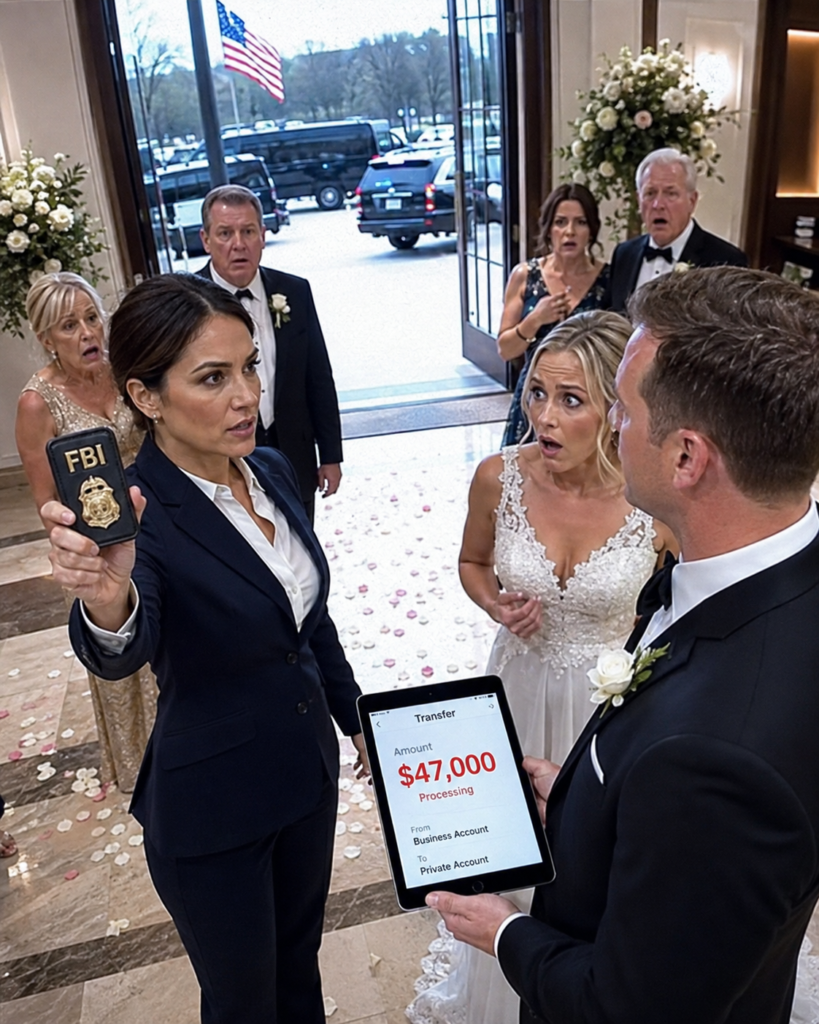
“I don’t care what your bank says,” she shouted from behind the closed door. “The money is mine. I transferred it legally from a family account. This is my wedding day, and if you think some computer error is going to ruin it, you are out of your mind.”
Harrison stopped in front of the door and knocked three times.
The door swung open so hard it struck the wall.
Vanessa stood there in her wedding dress, flushed with anger. The gown was an elaborate structure of silk, lace, and hand-sewn beading, with a fitted bodice and a train spread across the carpet behind her.
Her hair had been arranged in glossy waves. One makeup artist stood frozen beside a bright mirror. Four bridesmaids in pale blue robes stared from the sofa.
“What now?” Vanessa snapped. “I already told you people—”
She saw Harrison’s badge.
Her mouth remained open, but the rest of the sentence disappeared.
“Miss Vanessa Chin,” Harrison said. “I’m Special Agent Daniel Harrison with the FBI financial-crimes team. These are representatives of the Treasury Department’s Banking Inspection Division. We need to speak with you about a wire transfer initiated from Northern Trust Bank on Tuesday evening.”
My mother appeared behind Vanessa wearing a lavender dressing robe, one earring in place and the other held between two fingers.
“What is this?” she demanded. “What’s happening?”
Then she saw me behind Harrison.
Her face changed.
“Maya? Why are you dressed like that?”
Her eyes dropped to the credentials clipped to my jacket.
“Why do you have a badge?”
“Mrs. Chin,” Harrison said, “we need to speak with you and your daughter about unauthorized access to a federal monitoring account.”
“Federal monitoring account?” Vanessa’s voice rose. “It was Maya’s savings account.”
I stepped forward.
“No,” I said quietly. “It was an account maintained by the Treasury Department for an active investigation into banking security failures.”
Vanessa stared at me.
“The money you transferred was federal property.”
Color drained from her face so quickly that the makeup artist reached toward her elbow.
“You work for the government?”
“I’m a senior inspector with the Treasury Department’s Financial Crimes Division. I’ve held the position for eight years.”
My mother grabbed the doorframe.
“But you said you worked at a bank.”
“I said I investigated banking operations. You decided that meant I processed paperwork.”
“You never told us.”
“You never asked.”
Harrison raised his tablet.
“Miss Chin and Mrs. Chin, you will need to accompany us for formal questioning regarding the unauthorized transfer.”
Vanessa’s breathing became shallow. “I didn’t know. How was I supposed to know it was government money? It was just sitting there.”
“That is one of the issues under investigation,” I said. “You should never have been able to access the account with outdated credentials. Northern Trust’s failure to stop you is serious. Your decision to initiate the transfer is a separate matter.”
“I thought it was hers.”
“You believed it belonged to someone else, and you took it without permission.”
Three bridesmaids had moved into the doorway behind her. Their expressions shifted between fear, disbelief, and the fascinated horror of people who knew they were witnessing a story that would be repeated for years.
My mother shook her head rapidly.
“Maya, tell them this is a misunderstanding. Tell them you gave us permission.”
“I did not.”
“You would have.”
“That is not permission.”
“Tell them,” she insisted. “You can fix this.”
“I learned about the transfer when Vanessa announced it at dinner on Tuesday. I filed the required federal reports from the driveway.”
My mother stared at me as though I had spoken in another language.
“You filed reports on your own family?”
“I filed reports on an unauthorized transfer of federal funds. The relationship of the people involved does not change the reporting requirement.”
Harrison gestured toward the hall.
“We have interview rooms prepared in the conference center.”
“But the wedding,” Vanessa said.
Her voice broke on the last word.
“The guests will start arriving in a few hours. Derek is already on his way. You can’t do this now.”
“The venue is secured as part of an active federal investigation,” Harrison said. “No event will take place here today.”
At that moment, two more agents appeared at the far end of the hall, speaking with catering managers. Through the windows below, I saw a florist van being redirected from the service drive. A quartet carrying instrument cases stopped at the entrance while an agent checked their names.
Vanessa looked past us toward the staircase as if she could see the entire wedding being dismantled from where she stood.
Patricia Morrison came quickly down the hallway.
“What on earth is happening?” she demanded. “Security won’t let anyone into the ballroom, and there are federal agents outside.”
She stopped at the bridal-suite door.
Her gaze moved from Harrison to Vanessa, then settled on my badge.
“Maya?”
“Mrs. Morrison,” I said, “there has been a significant development concerning the funding source for this event. The venue is part of an active federal investigation.”
Patricia’s face tightened. “What funding source?”
“My sister and mother accessed a federal monitoring account without authorization. The funds used to pay the venue and several vendors were obtained unlawfully.”
Patricia turned slowly toward Vanessa.
“You took federal money?”
“I didn’t know it was federal money,” Vanessa said. Tears had begun to gather along her lower lashes. “I thought it was Maya’s.”
Patricia’s expression became colder.
“You took forty-seven thousand dollars from your sister?”
“She wasn’t using it.”
“That is not an answer.”
“It was for the wedding.”
“You should have asked before taking money that did not belong to you, regardless of whose name was on the account.”
Footsteps sounded from the stairwell. My father entered the hall carrying his suit jacket over one arm.
“What is all this commotion?” he asked. “Vanessa, why are you crying? The wedding doesn’t start for hours.”
Then he saw the badges.
He stopped.
“Mr. Chin,” Harrison said, “your wife and daughter are being detained for questioning regarding the unauthorized transfer of federal funds. Were you involved in accessing the account or authorizing the transfer?”
My father’s mouth opened, but no sound came out. He looked at my mother, then Vanessa, and finally at me.
For perhaps the first time in years, he looked directly at me rather than through me.
“Maya, what is happening?”
“Vanessa and Mom transferred forty-seven thousand dollars from a federal monitoring account. I am the inspector responsible for that account.”
He stared at my credentials.
“But you work at a bank.”
“I investigate financial crimes involving banks.”
“You process paperwork.”
“There is paperwork involved. I also have a master’s degree in forensic accounting from MIT, a level-four security clearance, and eight years with the Treasury Department. I have testified before Congress twice.”
My father lowered his jacket.
“MIT?”
“Yes.”
Vanessa leaned against the doorframe. The skirt of her wedding dress folded beneath her.
“This isn’t real,” she whispered. “This can’t be real.”
Derek appeared at the end of the hallway in dark trousers and a white shirt, his tie hanging loose around his neck.
“Vanessa?” he called. “What’s wrong?”
He slowed when he saw the agents.
“Why is the FBI here?”
Patricia moved toward her son.
“Derek, we need to talk privately.”
“No,” Vanessa said. “Tell him this is a mistake.”
Harrison began explaining the situation in concise, neutral terms. Unauthorized access. Federal funds. Secured venue. Formal interviews. Potential charges pending review by the U.S. Attorney’s Office.
Derek listened without interrupting. His face changed with each sentence.
Harrison then turned back to Vanessa and my mother.
“You are not under formal arrest at this time, but because of the seriousness of the matter, I am advising you of your rights before questioning. You have the right to remain silent. Anything you say may be used in federal proceedings. You have the right to consult an attorney.”
Vanessa began crying. Mascara tracked down her cheeks and disappeared into the lace at her neckline.
One bridesmaid covered her mouth. Another began crying too, though she had not said a word about the stolen money.
An agent approached Harrison with a document pouch.
“Sir, we confirmed the venue’s payment records. The Northern Trust transfer was flagged during standard fraud screening. The receiving bank has frozen the unsettled portion. Northern Trust has acknowledged the authorization failure and is preserving system logs.”
“Document every step,” Harrison said. “This will be central to the security case.”
My mother seemed to hear those words more clearly than anything else.
“Maya, please,” she said. “You can’t do this to your sister. We made a mistake. We’ll return the money. We’ll apologize. Just make it go away.”
“I cannot make it go away.”
“You’re our daughter.”
“That does not give you access to federal accounts.”
“This is family.”
“It stopped being a private family dispute the moment you used outdated credentials to enter an account you did not own. It became a federal matter when you transferred government funds.”
My mother’s lips trembled.
“Doesn’t being your mother mean anything?”
“It means I am disappointed. It means I am hurt that you believed my work, my choices, and my property were so unimportant that you could take from me without asking. It does not mean I can ignore the law.”
I held her gaze.
“No one is above it, Mom. Not even family.”
Derek had stepped aside with Patricia. They spoke in low voices for several minutes while Vanessa watched them, growing more frantic with every second.
Finally, Derek returned.
“Vanessa,” he said, “is it true? You took the money from Maya?”
“It wasn’t stealing. It was family money.”
“It was in an account you didn’t own.”
“She wasn’t using it.”
“That still doesn’t make it yours.”
“I did it for us,” Vanessa said. “For our wedding. For our future.”
Derek looked at the federal agents, then at the half-finished bridal suite, then back at her.
“I need time to think.”
“Think about what?” Vanessa’s voice rose sharply. “The wedding starts in five hours.”
“There is no wedding.”
The words were quiet, but they struck harder than shouting.
Vanessa blinked.
“We can fix this. We can go somewhere else. We can call another venue.”
“No,” Derek said. “We can’t. And even if we could, I’m not sure I want to marry someone who would take forty-seven thousand dollars from her own sister and then blame everyone else when it goes wrong.”
Vanessa stared at him in disbelief.
Patricia stepped forward. “Derek, we should leave. Vanessa and her family need to deal with the investigation.”
As Derek turned away, Vanessa reached for him, but the heavy skirt slowed her. Her hand closed on empty air.
“Derek!”
He did not turn around.
Vanessa’s knees gave way. She sank to the carpet in the middle of her wedding dress, the expensive train spreading around her like a collapsed white sail. Her sobs filled the hallway.
Harrison motioned to two female agents.
“Please escort Miss Chin and Mrs. Chin to the conference rooms. Be respectful, but make sure they understand the seriousness of the process.”
My mother looked at me one last time before the agents guided her away.
There was accusation in her face, but beneath it, for the first time, there was fear.
My father remained near the stairwell, frozen.
“You really did all this?” he asked after the hallway had quieted. “Over money?”
“Over an unauthorized transfer of federal funds.”
“She’s your sister.”
“If a stranger had accessed the same account, would you expect me to ignore it because enforcement was inconvenient?”
He had no answer.
“I love all of you,” I said. “But love does not mean enabling illegal behavior. It does not mean pretending nothing happened because the people responsible share my last name.”
“Her life is ruined.”
“No. Her wedding day is ruined. What happens to her life depends on what she chooses from this point forward.”
Behind us, staff members dismantled arrangements that had been completed only minutes earlier. Florists carried unopened boxes back to their vans. A musician rolled a cello case toward the exit. Venue employees pulled white linen from tables while agents photographed invoices.
Vanessa had built the day around spectacle.
Now the spectacle was its collapse.
I walked past my father toward the conference center.
The interviews lasted four hours.
Harrison questioned Vanessa first while a female agent recorded the session. I sat behind the observation glass with the Treasury attorney, close enough to confirm technical details but removed from the direct interview as Director Walsh had ordered.
Vanessa moved through the same cycle repeatedly. First she cried. Then she became angry. Then she insisted the account had been “basically family money.”
When Harrison asked whether my name was the only name on the account, she admitted it was. When he asked whether I had authorized the transfer, she admitted I had not. When he asked why she believed she could take the money, her answer never changed.
“Maya wasn’t using it.”
Harrison allowed the silence after that statement to stretch.
“Miss Chin,” he said, “unused property does not become available property.”
Vanessa looked toward the mirrored glass, somehow knowing I was behind it.
“She knew I needed it.”
“She did not know you were taking it.”
“She would have said no just to punish me.”
“You told your family she would have said yes.”
Vanessa’s jaw tightened. The contradiction sat between them.
My mother’s interview followed. She blamed the bank for accepting old credentials, then blamed me for keeping an account that looked personal, then blamed me for failing to explain my career.
Harrison listened without raising his voice.
“Mrs. Chin, did your daughter give you permission to access the account?”
“No.”
“Did she authorize the transfer?”
“No, but she is my daughter.”
“That is not a form of authorization recognized by the bank or by federal law.”
My mother looked down at her hands.
At noon, Northern Trust’s counsel joined by secure video conference. The bank formally acknowledged that its system had accepted outdated delegate credentials and bypassed two required verification steps.
The admission strengthened the institutional case, but it did not erase the actions that had exposed the weakness.

By two o’clock—the exact hour Vanessa should have been walking into the ballroom—agents concluded the initial interviews.
Neither Vanessa nor my mother was formally arrested that day. They received written notices to appear, restrictions on contacting certain financial institutions and vendors, and warnings that the U.S. Attorney’s Office would determine charges after reviewing the evidence.
The frozen funds would be recovered where possible. The rest would have to be repaid.
At minimum, they faced restitution, fines, and probation. More serious charges remained possible.
Northern Trust faced something larger: a federal enforcement action, outside auditing, customer notification requirements, and likely sanctions for security failures that had persisted despite prior warnings.
I stood in the parking lot while my family left in separate cars.
My father drove my mother. She sat in the passenger seat staring straight ahead, hollow-eyed and silent. Vanessa left with one of her bridesmaids, still wearing the wedding dress beneath a borrowed coat.
She did not look at me.
The Grandmont Estate stood behind them with its white columns and empty ballroom. The imported roses remained boxed near the service entrance.
Patricia approached while I was unlocking my Honda.
“Inspector Chin.”
“Mrs. Morrison.”
“I wanted to say that I’m sorry.”
“You have nothing to apologize for.”
“No,” she said crisply. “You did your job. You upheld the law, and you may have saved my son from a very difficult marriage.”
“That was not my intention.”
“I know. That is why it matters.”
She studied me for a moment.
“For what it’s worth, I think you handled today with remarkable discipline. Most people would have either protected their family or tried to humiliate them. You did neither. You protected the investigation.”
“Thank you.”
She reached into her handbag and handed me a business card.
“Derek works in corporate law. His firm regularly hires forensic investigators. I suspect they would be very interested in someone with your credentials, should you ever want a change.”
I accepted the card. “I appreciate that.”
“And I suspect,” she added, “you may want some distance from your family for a while.”
“That is likely.”
As I drove home, my phone filled with messages from colleagues, the director’s office, and attorneys assigned to the Northern Trust matter.
My family remained silent.
Director Walsh called as I entered my parking garage.
“Maya, exemplary work today.”
“Thank you, sir.”
“I know the circumstances were personal. You maintained procedure, preserved evidence, and avoided taking control of interviews where your involvement could have created problems.”
“Harrison handled them well.”
“He did. The bank’s admission will accelerate the enforcement case. This incident may produce the security reforms we have been trying to obtain for more than a year.”
“That is the goal.”
“Take several days off.”
“I’m fine.”
“That was not a suggestion.”
I smiled despite myself. “Understood.”
“One more thing. I’m recommending you for promotion to lead inspector. Your own team.”
I became still.
“You’ve earned it,” he continued. “Today proved what your record already showed. You can handle pressure without losing judgment.”
“Thank you, sir.”
After the call ended, I remained in the driver’s seat with both hands resting on the wheel. The garage was quiet except for the ticking engine.
My phone vibrated again.
The message came from a number I did not recognize.
This is Derek. My mom gave me your number. I wanted to say thank you, and I’m sorry your family put you in that position. You deserved better. If you ever want coffee and a conversation about anything except federal crimes, I’d like that.
I read it twice.
Then I saved the number and replied.
Coffee sounds good. Next week?
His response arrived immediately.
It’s a date. A completely non-wedding-related date.
I laughed alone in the car.
Three days later, my mother called.
I considered letting it ring, but curiosity won.
Her voice sounded smaller than I had ever heard it.
“The U.S. Attorney’s Office contacted us.”
“I know.”
“We have to repay the forty-seven thousand dollars, including the amounts the bank couldn’t recover. Vanessa and I each received twenty-thousand-dollar fines. Two years of probation.”
“I received the report.”
“Vanessa won’t speak to me. She blames me for keeping your account information. Derek ended the engagement. She moved back home and barely leaves her room.”
I said nothing.
“Your father says we should have treated you better,” she continued. “He says we never appreciated what you accomplished.”
“He’s right.”
A long pause followed.
“I didn’t know you went to MIT.”
“No.”
“I didn’t know you worked for the Treasury Department. I didn’t know about Congress or the clearance or any of it.”
“You didn’t know because you never asked.”
Her breath caught.
“I assumed.”
“You assumed I was unsuccessful because I didn’t advertise my success. You assumed I was unimportant because I didn’t demand attention. You assumed my money was available because taking from me had never cost you anything before.”
“Yes,” she whispered. “All of that.”
For once, she did not defend herself.
“I’m sorry, Maya. I am truly sorry. Not because we were caught. Not because of the fines, the probation, or the wedding. I’m sorry because we treated you terribly for years, and you deserved better from us.”
It was the first apology from my mother that did not contain an excuse.
“Thank you for saying it.”
“Is there any chance we can fix this? Fix us?”
“I don’t know. That will take time, and it will require more than words.”
“We’ll do whatever it takes.”
“You, Dad, and Vanessa need to examine the pattern, not only the transfer. My graduation money. My car. My college fund. Every time my boundaries became less important than Vanessa’s wants.”
“We will.”
“I won’t give up on you,” I said. “But I will never accept being treated as lesser again. There will be clear boundaries and real respect. Without both, there will be no relationship.”
“Clear boundaries,” she repeated. “Real respect.”
“Yes.”
“I understand.”
After the call, I stood by the windows of my apartment and looked across the city. The river below reflected the lights of office towers, and my paid-off home was quiet around me.
I thought about the promotion, the team I would build, and the security reforms likely to come from the Northern Trust case. I thought about coffee with Derek and the strange possibility of a future that had opened on the morning Vanessa’s wedding closed.
My family had taken from me because they assumed I possessed little worth protecting.
Instead, they had exposed a federal security failure, lost the wedding, faced legal consequences, and finally confronted the way they had treated me.
I had lost nothing that mattered.
I opened my laptop and began drafting my acceptance remarks for the promotion.
Lead Inspector Maya Chin had a good sound to it.
Across town, in a house filled with regret and consequences, my family was learning what I had known for years: quiet competence does not need applause, and entitlement eventually creates its own evidence.
The wedding that never happened became a federal case study. Northern Trust implemented sweeping authorization reforms, reviewed thousands of legacy access records, and notified customers whose accounts had been exposed by the same weakness.
I returned to work doing what I did best—protecting people’s assets and holding wrongdoers accountable.
Even when the wrongdoers were family.
Especially then.
Because integrity does not begin where loyalty ends.
It begins where excuses do.