PART 1: THE SUNDAY I STOPPED ASKING
After 23 Years of Marriage, My Husband Came Home Sunday Morning in Yesterday’s Shirt—But This Time, I Asked Nothing.
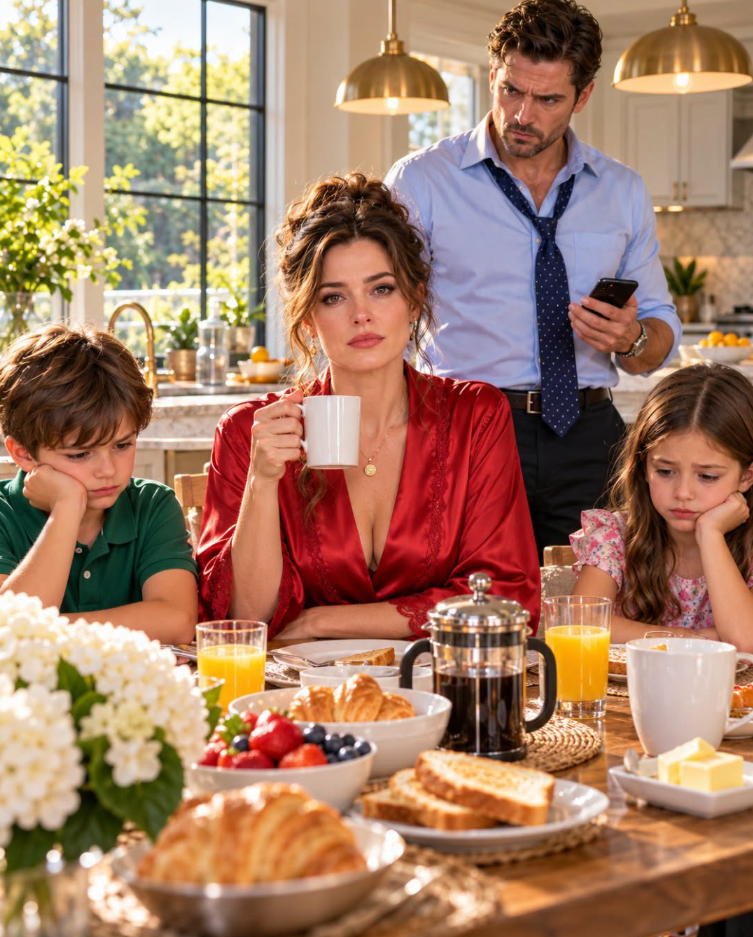
My husband walked into our kitchen shortly after ten on Sunday morning, still wearing the blue shirt he’d put on the previous evening.
Daniel stopped in the doorway.
But I simply continued drinking my coffee.
I looked at him.
“No.”
And that one word frightened him more than every accusation I’d made during the previous year.
Our daughter Emma was sitting across from me when he arrived.
She was twenty-one, completing her final semester at Ohio State, and still came home for Sunday breakfast whenever she could.
Those mornings had always been special.
Emma usually texted around eight to ask whether the coffee was ready.
I’d pretend to be offended by her impatience.
She’d arrive in sweatpants, kick off her shoes near the mudroom, and steal the crispiest piece of bacon before breakfast was served.
That morning, I’d made scrambled eggs with chives and toast with raspberry jam.
Outside, Worthington was enjoying one of those beautiful April mornings when the air smelled of damp soil and freshly cut grass.
I’d opened the kitchen windows.
Emma was telling me about a professor who’d changed the requirements for her final project halfway through the semester.
And I was listening.
Really listening.
A month earlier, half my attention would’ve been elsewhere.
I’d have been wondering where Daniel was.
Whether he was coming home.
Whether he’d answer his phone.
Whether another woman’s name would appear on his screen.
And whether whatever explanation he eventually offered would make any sense.
But that morning, I’d slept until seven-thirty.
I’d showered, watered my herbs, made coffee, and cooked breakfast.
I hadn’t checked the driveway once.
At 10:12, the garage door opened.
Emma stopped speaking for a moment.
A few seconds later, Daniel appeared.
He was fifty-two, tall, and still handsome in the polished way that made acquaintances tell me how fortunate I was.
His dark hair had turned gray around the temples.
And he was wearing the same blue button-down shirt he’d worn when he left Saturday evening.
His eyes moved from Emma to me.
Then to the clock.
Then back again.
“Morning,” he said.
Emma lowered her gaze.
“Morning, Dad.”
I lifted my cup.
“Morning.”
Daniel remained standing.
For almost a year, he’d become accustomed to the same Sunday routine.
He’d arrive late.
I’d ask where he’d been.
He’d offer an explanation.
Sometimes he’d claim he’d slept in the guest room.
Other times, he’d supposedly stayed at Mark’s after poker.
Or helped someone from work.
Occasionally, he’d insist I was imagining things.
And when his excuses became particularly weak, he’d grow angry.
“You don’t trust me.”
“Why does everything have to become an interrogation?”
“Claire, I’m fifty-two years old. I’m allowed to have friends.”
“You make coming home feel like walking into a police station.”
For months, I believed asking questions meant I was fighting for our marriage.
I thought caring where my husband slept was reasonable.
I thought that if I asked enough questions, eventually I’d discover the truth.
But that Sunday, something inside me had changed.
I no longer wanted to investigate.
Daniel placed his keys on the counter.
“You two already ate?”
“There’s more in the skillet,” I said.
He looked toward the stove.
Then back at me.
“You didn’t wait?”
“No.”
He opened a cabinet, then closed it without removing a plate.
I turned toward Emma.
“What happened after your professor changed the deadline?”
She hesitated before continuing.
“He said we could have an extra week, but now everyone’s project depends on everybody else finishing their section.”
“That sounds badly organized.”
“It is.”
Daniel listened from beside the counter.
Finally, he spoke.
“I got in pretty late.”
I spread jam on my toast.
“Okay.”
“I didn’t want to wake you.”
“Okay.”
He frowned.
“You’re not going to ask?”
I looked up.
“Ask what?”
He gave an incredulous laugh.
“What time I got home. Where I was. Who I was with. The usual.”
The usual.
As though my pain had become another Sunday tradition.
Coffee.
Eggs.
Toast.
And Claire questioning her absent husband.
I raised my cup.
“No.”
His expression changed.
I’d known Daniel for twenty-six years.
I recognized that look immediately.
He was searching my face for something that wasn’t there anymore.
“You don’t care?”
I could’ve reassured him.
Instead, I told the truth.
“I don’t think there’s anything useful left for me to ask.”
Emma went still.
Daniel glanced at her.
“This isn’t a conversation for breakfast.”
“I agree,” I said.
Then I returned to our daughter’s story.
Daniel eventually prepared a plate and sat at the far end of the table.
For several minutes, nobody spoke.
But I wasn’t angry.
That was what unsettled him.
Daniel understood anger.
He knew how to argue with it.
He could defend himself, accuse me of overreacting, blame work, or promise things would improve.
He could return with flowers.
Suggest a weekend getaway.
Pretend we’d repaired everything.
But my silence gave him nothing to fight.
After Emma left, Daniel followed me into the laundry room.
“Claire.”
I continued folding a sweater.
“What?”
“Are we okay?”
Once, that question would’ve made me cry.
I’d waited months for him to ask.
Now I simply answered, “No.”
He stared.
“You say that like it doesn’t bother you.”
“It bothered me for a long time.”
“And now?”
I folded another sweater.
“Now I’m tired.”
Daniel stood there, unable to respond.
And as I placed the sweater on the pile, I realized I’d crossed a boundary I hadn’t known existed.
For months, I’d been trying to make my husband come home.
That Sunday, I’d stopped waiting.
But Daniel didn’t understand what had happened.
Not yet.
To understand why, you have to know what our marriage had become during the year before that breakfast.
For most of our twenty-three years together, Daniel had been almost ridiculously predictable.
He ordered the same meal at our favorite Italian restaurant.
Bought the same shaving cream.
Watched Ohio State football every Saturday and complained through every game.
On Sundays, he read the newspaper while I made coffee.
One spoonful of sugar.
A splash of half-and-half.
Never milk.
Never flavored creamer.
Those small habits once made me feel secure.
I believed knowing the ordinary details of someone’s life meant knowing the person.
But eleven months before that quiet Sunday, Daniel’s routines began changing.
At first, the excuses sounded reasonable.
As operations director for a regional building-supply company, he sometimes handled client dinners and unexpected work problems.
Then he joined a golf group.
Mark supposedly began hosting poker nights.
Soon, Saturday evenings became increasingly unpredictable.
The first time Daniel returned after two in the morning, I was waiting on the couch.
He looked annoyed.
“What are you doing awake?”
“Waiting for you.”
“You didn’t have to.”
I remembered those words.
At the time, I thought he was being considerate.
Later, I understood they were a warning.
For months, our conversations followed the same pattern.
“What time did you leave Mark’s?”
“Late.”
“Who was there?”
“The usual people.”
“Why didn’t you answer my text?”
“My phone was in my jacket.”
“How did you get home?”
“I drove.”
“You were drinking.”
“I had two beers.”
“Then why do you smell like wine?”
“Jesus, Claire.”
Somehow, every conversation ended with me defending myself.
I was too suspicious.
Too controlling.
Too insecure.
Too demanding.
Daniel’s unexplained absences became evidence of my supposed flaws.
Then one afternoon, I found a restaurant receipt in his jeans.
Two entrées.
Two glasses of wine.
One shared dessert.
Saturday evening.
9:14 p.m.
The restaurant was in Dublin.
Daniel had told me he’d gone straight to Mark’s house in Westerville.
I photographed the receipt.
Then waited until the following morning.
“Did you go anywhere after Mark’s last night?”
He paused.
“No.”
“You stayed there all night?”
“Until I came home.”
I placed the receipt on the counter.
He looked at it.
Then at me.
“Oh. That.”
He acted as though he’d simply forgotten an unimportant detail.
“That was earlier.”
“You told me you went straight to Mark’s.”
“I forgot.”
“You forgot dinner?”
“Claire, it was work-related.”
“With who?”
A pause.
“Rachel.”
Rachel Morgan.
Forty-five.
Divorced.
A vendor-relations representative I’d met at two company events.
I remembered how attentively she watched Daniel.
And how she’d touched his sleeve at the Christmas party.
“Just Rachel?”
“Yes.”
“Why didn’t you tell me?”
“Because I knew you’d do this.”
“Do what?”
“Turn a work dinner into something.”
“You lied about where you were.”
“I didn’t lie.”
“You said you went straight to Mark’s.”
“I forgot about dinner because it wasn’t important.”
Ten minutes later, we weren’t discussing his dishonesty.
We were discussing my trust issues.
That afternoon, I cried alone in the bathroom.
I believed Emma hadn’t heard.
Months later, she told me she had.
“I almost came down,” she said.
“Why didn’t you?”
“Because I knew you would pretend you were fine if you saw me.”
She was right.
I’d become an expert at pretending everything was normal.
When Daniel missed family dinner, I blamed work.
When he forgot a birthday celebration, I invented a headache.
When he disappeared during Thanksgiving, I claimed he’d been helping a coworker.
I thought I was protecting my marriage.
In reality, I was protecting the appearance of one.
Then Daniel began disabling location sharing on Saturday nights.
We’d used the family location feature for years.
Emma had suggested it when she started driving.
One Saturday, Daniel’s location vanished at 7:15.
“Probably an update,” he said.
It happened again the next weekend.
Then again.
One night, I called at eleven-thirty.
No answer.
At midnight, I texted:
Are you coming home?
Nothing.
At 12:47:
Daniel?
At 1:16:
Please just tell me you’re safe.
Finally, at 1:32, he replied.
I’m fine. Stop worrying.
I stared at those words.
Stop worrying.
As though loving him had become an embarrassing inconvenience.
The next morning, I asked whether he’d been with Rachel.
“Why would you ask that?”
“Because I’m asking.”
“Then no.”
I later discovered he was lying.
But at the time, I accepted his answer because I still needed to believe our marriage could survive.
For months, the pattern continued.
He lied.
I questioned.
He denied.
I investigated.
He minimized.
I cried.
Then he’d become affectionate for a few days.
Bring coffee.
Cook dinner.
Suggest watching a movie.
Touch my back as he passed through the kitchen.
Just enough to make me believe the husband I remembered was still there.
Then Saturday came again.
I kept waiting for the man I loved to return.
Until one Wednesday afternoon, while standing in a grocery store, I received a phone call that changed everything.
It was Emma.
And she was crying.
PART 2: WHEN I STOPPED WAITING, HE STARTED WORRYING
“Mom?”
The sound of Emma’s voice made me grip the shopping cart.
“Nothing. I’m okay.”
She hesitated.
My stomach tightened.
“Where?”
“Easton.”
“With who?”
Silence.
I already knew the answer.
Emma finally said, “Rachel.”
They’d been leaving a restaurant.
Daniel had placed his hand against Rachel’s lower back.
Not casually.
Not professionally.
The gesture was intimate.
They hadn’t noticed Emma.
She watched them cross the parking lot.
Then Rachel reached for Daniel’s hand.
And he took it.
My daughter began crying as she described what she’d seen.
“I’m sorry, Mom.”
“Oh, honey.”
“I didn’t know whether to tell you.”
“You didn’t do anything wrong.”
“I feel like I did.”
Those words hurt more than the affair itself.
For nearly a year, Daniel had made me question my own instincts.
Now his behavior was making our daughter question hers.
I didn’t confront him that evening.
I didn’t demand his phone.
Didn’t contact Rachel.
Didn’t shout.
Instead, I went home.
Cooked spaghetti.
Washed the dishes.
Watched a documentary with Emma.
Then slept in the guest room.
Daniel returned shortly before midnight.
The next morning, he asked why I’d slept there.
“I wanted to.”
He studied me.
“Are you mad?”
“No.”
And for the first time, that answer was almost true.
I’d moved beyond anger.
Four days later, Daniel arrived home after ten on Sunday morning.
And I didn’t ask a single question.
After that breakfast, he became increasingly uneasy.
I stopped asking where he went.
Stopped checking his location.
Stopped waiting for messages.
Stopped leaving the porch light on.
Stopped saving dinner.
Stopped monitoring his phone.
I also stopped managing the countless little responsibilities I’d handled for him throughout our marriage.
His dry cleaning.
His appointments.
His work events.
His reminders.
For twenty-six years, I’d carried much of the invisible work that kept our lives running smoothly.
But I no longer felt like his partner.
And those responsibilities belonged to him.
He first noticed on a Thursday.
He came downstairs wearing a white dress shirt.
“Did you pick up my navy suit?”
I was reading at the kitchen table.
“No.”
He frowned.
“You said you were going to the cleaners.”
“I picked up my things.”
“My suit was there.”
“Yes.”
“So why didn’t you bring it?”
“Because it’s yours.”
He stared at me.
“But you were already there.”
“Yes.”
“Claire, that makes no sense.”
“It makes perfect sense.”
I returned to my book.
Daniel looked genuinely confused.
He’d grown so accustomed to my care that he’d forgotten it was something I chose to give.
The following Saturday, he stood near the front door adjusting his jacket.
“I’m meeting some people.”
Emma and I were choosing a movie.
“Okay.”
He waited.
“Probably be late.”
“Okay.”
Then he added, “We’re going to Dublin.”
He wanted me to ask who would be there.
I didn’t.
“Have fun,” I said.
He stared before leaving.
After the door closed, Emma exhaled.
“That was weird.”
“What?”
“He wanted you to ask.”
“I know.”
“Why?”
“Because when I asked questions, he could tell himself I was jealous.”
“And now?”
“Now he has to wonder why I’m not.”
Emma fell quiet.
Then she asked, “Mom, are you done?”
I looked at her.
“I think so.”
Her eyes filled.
Not because she wanted me to remain unhappy.
But because even necessary endings can hurt.
She reached for my hand.
“I’m sorry.”
“So am I.”
The following Sunday, I woke before seven.
Daniel hadn’t come home.
I made coffee.
Then I reached automatically for his favorite mug.
Dark blue.
Chipped handle.
A Father’s Day gift from Emma when she was nine.
For years, I’d prepared his coffee without thinking.
One spoonful of sugar.
Half-and-half.
Even after arguments.
Even when I was angry.
I stood there holding the mug.
Then quietly returned it to the cabinet.
I poured one cup.
Mine.
When Emma came downstairs, I made coffee for her.
We carried our mugs onto the porch.
And without discussing it, we began a new Sunday tradition.
Sometimes she brought bagels.
Sometimes I made eggs.
Sometimes we talked.
Sometimes we simply enjoyed the morning.
The porch overlooked a maple Daniel had planted when Emma was six.
Fresh leaves were beginning to cover its branches.
For years, my Sundays had revolved around Daniel’s whereabouts.
Now they felt peaceful.
I hadn’t expected that.
I’d assumed emotionally leaving my marriage would make me feel empty.
Instead, I discovered quiet.
And quiet wasn’t the same as loneliness.
Two Sundays later, Daniel arrived around nine.
He found Emma and me on the porch.
“You two having a meeting?”
Emma smiled politely.
“Coffee.”
“There any left?”
“In the pot,” I answered.
He waited.
I remained seated.
Eventually, he went inside and returned with his chipped blue mug.
He took a sip.
Then grimaced.
“Did we run out?”
“Of what?”
“Half-and-half.”
“There’s a new carton behind the orange juice.”
He looked at me.
“You knew?”
“Yes.”
“Why didn’t you say something?”
“You didn’t ask.”
Daniel didn’t find that amusing.
But I wasn’t joking.
He returned to the kitchen and fixed his coffee.
When he came back, he sat opposite us.
Several minutes passed.
Then he announced, “Rachel’s leaving the company.”
I watched the maple branches move in the breeze.
“Okay.”
“She got another position.”
“Okay.”
“You knew?”
“No.”
“You don’t seem surprised.”
“I’m not involved in Rachel’s career.”
He glanced toward Emma.
Then lowered his voice.
“She and I have been talking.”
He was testing me.
Months earlier, I’d have demanded details.
Now I simply said, “I assumed.”
His face changed.
“You assumed what?”
I met his eyes.
“That you’re having an affair.”
Emma closed her eyes.
Daniel placed his mug on the table.
“Claire.”
“What?”
“You can’t just say that in front of Emma.”
“She saw you.”
Silence.
Daniel turned toward our daughter.
“When?” he asked.
“Easton.”
He rubbed his forehead.
“Emma, it wasn’t—”
“Don’t.”
He stopped.
“I don’t want details. I don’t want explanations. I don’t want you telling me I misunderstood what I saw.”
“I wasn’t going to say that.”
“You did it to Mom for months.”
Daniel looked toward me.
I said nothing.
Emma stood.
“I’m going inside.”
Once she was gone, Daniel and I remained on the porch.
“I didn’t want her involved.”
“She became involved when she saw you.”
“I never meant for that to happen.”
I waited.
Finally, he said, “Rachel and I got close.”
I nodded.
“That’s not an explanation.”
“I’m not asking for one.”
He frowned.
“You don’t even want to hear what happened?”
“No.”
“How can you not want to know?”
“Because whatever happened, you chose it,” I said. “Repeatedly.”
He looked away.
“It wasn’t planned.”
“Most damage isn’t.”
“I never stopped caring about you.”
I felt sadness.
But not hope.
“You stopped behaving like you cared.”
Daniel leaned forward.
“Claire, I know I messed up.”
I said nothing.
“Say something.”
“What do you want me to say?”
“Anything.”
He wanted the old argument.
The accusations.
The tears.
The questions.
Anything that proved he could still control the emotional direction of our marriage.
“I spent almost a year talking, Daniel.”
“So now you’re punishing me with silence?”
“No.”
“Then what is this?”
“This is me being finished with the argument.”
That Sunday, Daniel admitted the affair had lasted seven months.
I didn’t ask where they’d met.
How often they’d been together.
Whether he loved Rachel.
I asked only one thing.
“Are you willing to move into the guest room while we figure out what happens next?”
He looked stunned.
“You want me out of our bedroom?”
“Yes.”
“For how long?”
“I don’t know.”
“Claire, you haven’t even heard everything.”
I stood.
“I’ve heard enough.”
For the first time, Daniel was ready to tell me the truth.
And I no longer needed to hear it.
Afterward, something strange happened.
Daniel began asking the questions.
“What are you doing after work?”
“Are you going somewhere?”
“Will you be home for dinner?”
“Who was that texting you?”
“Why are you smiling at your phone?”
I wasn’t keeping secrets.
I was simply rebuilding a life that no longer revolved around him.
On Tuesdays, I attended pottery classes with my sister Megan.
Some Thursdays, I met Emma near campus.
Saturday mornings, I visited the farmers’ market.
Three evenings a week, I walked with our neighbor Lisa.
I also joined the library’s book club.
Nothing dramatic.
Nothing scandalous.
Just ordinary happiness.
And somehow, that disturbed Daniel more than anything else.
One Friday, I came downstairs wearing jeans and a green sweater.
Daniel was sitting in the living room.
“Where are you going?”
“Megan’s.”
“What’s happening at Megan’s?”
“Dinner.”
“Who’s going?”
“Why?”
He looked uncomfortable.
“Just asking.”
“Her neighbors. A couple from work. Some friends.”
“Men?”
I stared at him.
Daniel rubbed his jaw.
“Forget it.”
“No. Say what you mean.”
“I don’t know what you’re doing anymore.”
“I’m living,” I told him.
“That’s not what I meant.”
“I know.”
He stood.
“Claire, I’m trying here.”
“Trying what?”
“To fix things.”
“Daniel, you apologized after you got caught.”
“That’s not fair.”
“What part?”
“I’ve apologized every day.”
“You keep telling me you’re sorry because you want me to feel differently.”
“Of course I want you to feel differently.”
“That isn’t repair.”
He looked at me.
“Then what is?”
“A year ago? Telling the truth without being forced. Coming home. Answering your phone. Choosing your family before I had to compete for basic attention.”
“And now?”
“Now I don’t know.”
I left for Megan’s.
Dinner was wonderful.
We ate baked ziti from mismatched dishes.
Someone brought inexpensive wine.
Her neighbor Paul told a ridiculous story about locking himself outside while taking out the trash.
I laughed until my stomach hurt.
Then I realized something.
Three hours had passed without my thinking about Daniel.
When I returned home, the lights were still on.
Daniel was waiting on the couch.
“You’re awake,” I said.
He checked the clock.
“It’s after eleven.”
“I know.”
“You didn’t answer my text.”
I looked at my phone.
Are you coming home soon?
Sent forty-six minutes earlier.
“I didn’t see it.”
Daniel stared.
“I was worried.”
“I’m fine.”
I started upstairs.
“Claire.”
I stopped.
“This is what it felt like, isn’t it?”
I understood immediately.
The waiting.
The unanswered messages.
The uncertainty.
“Yes.”
He lowered his gaze.
“I hated it.”
“I know.”
“I’m sorry.”
I nodded.
Then went upstairs.
I didn’t feel victorious.
I’d never wanted him to suffer.
I’d wanted him to come home.
Two weeks later, Daniel told me he’d ended his relationship with Rachel.
He announced it on a Sunday morning.
“I told Rachel it was over.”
“All right.”
“That’s it?”
“What do you want me to say?”
“Maybe that it matters.”
“It matters to you.”
“Doesn’t it matter to you?”
“Not in the way you want it to.”
He leaned back.
“I ended it because I want us.”
I looked at him.
“You had us.”
He closed his eyes.
“I know.”
“No. I don’t think you do.”
“Then explain it.”
So I did.
“You think the affair is the thing I need removed. Like Rachel is standing between us, and if she disappears, we go back to normal.”
He remained silent.
“But Rachel wasn’t in our kitchen when you lied to me. She wasn’t holding your phone when you ignored my calls. She didn’t make you tell me I was paranoid. She wasn’t the one who watched me cry and decided my distress was less important than protecting whatever you were doing.”
His eyes reddened.
“I know.”
“You keep saying that.”
“I don’t know what else to say.”
“Maybe there isn’t anything.”
Daniel stared into the yard.
“You really don’t love me anymore.”
I could’ve softened the answer.
Instead, I said, “Not the way I did.”
He looked devastated.
“I kept thinking you were angry.”
“I was.”
“So I thought…”
He rubbed his hands.
“I thought angry meant there was still something.”
“There was.”
He looked up.
“What changed?”
“I got tired of being angry.”
Then he asked, “Is there somebody else?”
“No.”
“You’re sure?”
“There doesn’t have to be another man for me to stop wanting this marriage.”
“I didn’t say there did.”
“You keep asking.”
He looked ashamed.
“I guess it would be easier.”
“For you.”
“Yes.”
There was no other man.
No rival.
No competition.
I’d simply discovered that peace without Daniel felt safer than loving him.
A month later, he rented a furnished apartment ten minutes away.
There was no dramatic confrontation.
No screaming.
No luggage thrown onto the lawn.
He packed his clothes.
I helped label two boxes from his office.
Emma carefully wrapped a framed childhood photograph.
At the door, Daniel held his house key.
“I can leave this?”
I gestured toward the console table.
He placed it in the ceramic bowl.
Then looked at me.
“I never thought we’d get here.”
“I know.”
“Claire.”
“Yes?”
“If I had stopped earlier…”
He couldn’t finish.
And I had no answer that would help.
He walked outside.
I watched his car disappear.
Then I locked the door.
Turned off the porch light.
Went upstairs.
And slept for nine uninterrupted hours.
For the first time in months, I wasn’t waiting for anyone.
PART 3: THE SUNDAY HE FINALLY UNDERSTOOD
Daniel and I remained separated for four months before I filed for divorce.
Some people were surprised.
My sister Megan didn’t.
Emma simply told me, “Whatever you decide, I’m okay.”
I agreed to three sessions.
Not because I believed we would reconcile.
But because after twenty-six years together, I wanted to know whether any part of me still reached for him when we spoke honestly.
During one session, the counselor asked Daniel why he thought I’d emotionally withdrawn.
He spoke for nearly ten minutes.
About Rachel.
The affair.
His absences.
His lies.
My anger.
My distrust.
Then the counselor turned toward me.
I answered, “I withdrew because I finally believed what his behavior had been telling me.”
Daniel looked up.
“What was that?”
“That I could not love him enough to make him choose our marriage.”
He fell silent.
The counselor asked, “And what do you believe now?”
“That I don’t have to.”
For me, that was the end.
The legal process would continue.
But emotionally, my decision had already been made.
By September, Daniel was living in his apartment.
Emma had graduated and accepted a job nearby.
She still came home most Sundays.
Our breakfast tradition continued.
And somehow, it felt more meaningful than before.
One Sunday in early October, Emma and I were eating French toast when Daniel sent a message.
Can I come by for the rest of the garage boxes?
I looked at our daughter.
“Your dad wants to pick up some things.”
She shrugged.
“Okay.”
I told him he could come.
Twenty-five minutes later, the doorbell rang.
Daniel stood outside.
He knocked now.
That small detail hurt more than I expected.
Once, he’d entered this house without a second thought.
Now he waited for permission.
I opened the door.
He noticed the smell of fresh coffee.
“So this is still happening.”
“What?”
“Sunday breakfast.”
Emma looked up from her plate.
“Every week,” she said.
Daniel gave a sad smile.
“I figured.”
I led him to the garage.
We spent twenty minutes sorting old tools, extension cords, golf equipment, and a container filled with cables neither of us could identify.
Ordinary divorce tasks.
Nothing dramatic.
At one point, Daniel discovered an old travel mug.
“Remember this?”
I did.
Emma had painted DAD on it in kindergarten.
Most of the paint had chipped away.
“Yes.”
He added it to his belongings.
When he carried his final boxes through the kitchen, he stopped.
Emma had gone upstairs to answer a phone call.
Two clean plates sat beside the sink.
Two coffee mugs.
Hers and mine.
Daniel looked toward the table.
For years, I’d set a place for him even when he wasn’t home.
A warm plate.
Coffee waiting.
A wife listening for the garage door.
Now there were only two places.
He touched the back of the chair he’d always used.
“You don’t make extra anymore.”
It wasn’t really about French toast.
“No.”
He looked toward the coffee maker.
“Do you ever…”
He stopped.
“Do I ever what?”
“Think I might show up?”
I answered without hesitation.
“No.”
He nodded slowly.
“I deserved that.”
“It wasn’t meant to hurt you.”
“I know.”
He sat down.
I remained standing.
After a moment, he spoke.
“Rachel and I aren’t together.”
I didn’t react.
He gave a tired laugh.
“There it is again.”
“What?”
“That look.”
“What look?”
“Like I’m telling you the weather.”
I leaned against the counter.
“What would you like me to say?”
“I don’t know.”
He looked exhausted.
“Anything.”
He’d asked me for that before.
Anything.
Any response that proved his choices could still move me.
“I’m sorry it didn’t work out,” I said.
He winced.
“That’s worse.”
“I’m not trying to make it worse.”
“I know.”
He studied me.
“Do you want to know why?”
“No.”
That same answer.
The one that had frightened him months earlier.
But now he understood what it meant.
Daniel stared at his hands.
“She wanted a real relationship once I moved out.”
I remained quiet.
“And I guess I realized…”
He stopped.
“Realized what?”
“That what I had with her only worked when it wasn’t my whole life.”
He looked toward the staircase.
“I thought I wanted freedom.”
His voice dropped.
“But once I had an apartment and nobody cared when I came home, it didn’t feel like freedom.”
I understood.
But understanding didn’t mean I wanted him back.
Daniel looked toward our mugs.
“I miss this.”
“Breakfast?”
“All of it.”
He swallowed.
“You asking where I was. You being irritated when I was late. You texting me. You leaving the porch light on.”
I stared at him.
“You hated those things.”
“I thought I did.”
“You complained about them constantly.”
“I know.”
He gave a humorless laugh.
“I think I thought you’d keep doing them forever.”
There it was.
The truth he’d taken so long to recognize.
He’d assumed my care would never end.
That I’d always ask.
Always wait.
Always worry.
Always forgive.
Regardless of how he treated me.
“I thought so too,” I admitted.
Daniel looked up.
“What made you stop?”
I knew the answer.
“Emma.”
He frowned.
“Emma?”
“The day she saw you with Rachel.”
His face changed.
“I hated what you had done to me. But when Emma called and apologized for telling me what she saw, I realized your choices were making our daughter feel responsible for our marriage.”
Daniel closed his eyes.
“She shouldn’t have.”
“I know.”
“That’s on me.”
“Yes.”
For once, he accepted responsibility without trying to defend himself.
It mattered.
Too late for our marriage.
But it still mattered.
“I went to the grocery store after she called,” I continued. “I remember standing there thinking I had spent months trying to make you tell me the truth. And suddenly I realized I didn’t need your confession anymore.”
Daniel looked confused.
“Because she confirmed it.”
“No.”
“Then why?”
“Because I believed myself.”
He fell silent.
For nearly a year, he’d convinced me to doubt my own instincts.
But once I trusted myself again, I no longer needed him to explain reality.
He looked around the kitchen.
“The first Sunday you didn’t ask…”
“I remember.”
“I thought you were trying to scare me.”
“I wasn’t.”
“I know that now.”
He rubbed his face.
“I was standing right there thinking you’d ask who I was with.”
“I knew.”
“I almost told you anyway.”
“I know.”
“How?”
“Because you kept waiting.”
He smiled sadly.
“Yeah.”
For a while, neither of us spoke.
Then Daniel looked at me.
“You know what the worst part is?”
I waited.
“I spent months thinking your questions were proof you didn’t trust me.”
He met my eyes.
“But they were proof you still cared where I was.”
Unexpectedly, tears filled my eyes.
Not because I wanted him back.
But because he’d finally understood something I’d desperately needed him to recognize while our marriage could still be saved.
Daniel saw my tears.
For a brief moment, hope appeared on his face.
I gently shook my head.
“These tears aren’t me changing my mind.”
His shoulders dropped.
“I know.”
And this time, I believed him.
He truly understood.
Emma came downstairs.
She paused when she saw us.
“Everything okay?”
I smiled.
“Yes.”
Daniel stood.
“I should go.”
Emma hugged him.
He held her longer than usual.
When they separated, he whispered, “I’m sorry, Em.”
She nodded.
“I know.”
There was no dramatic forgiveness.
No lecture.
Just a daughter who loved her father without pretending his choices hadn’t hurt her.
Daniel carried his final box toward the door.
Then he turned around.
“Claire?”
“Yes?”
“Sunday breakfast was always my favorite.”
I looked toward the table.
Two plates.
Two mugs.
Raspberry jam.
Emma’s phone beside her napkin.
Morning sunlight falling across the kitchen floor.
“You should have come home for it,” I said.
Daniel lowered his eyes.
Then he left.
That was the Sunday he finally understood.
I didn’t hate him.
I didn’t want revenge.
And I didn’t believe Rachel alone had destroyed our marriage.
He finally recognized that for years, he’d treated my attention as an inconvenience.
And when it disappeared, he realized it had been love.
Our divorce became final the following February.
There was no bitter legal battle.
We divided our finances and belongings.
Daniel kept his retirement account.
I refinanced the house.
We divided our savings.
Emma refused to become a messenger between us.
We respected that.
People sometimes asked whether Daniel and I were friends afterward.
I never knew exactly how to answer.
We were civil.
Sometimes kind.
Still familiar in the way people are after sharing more than two decades together.
But we were no longer married.
Emotionally, that marriage had ended long before the paperwork was signed.
Daniel changed after our separation.
I noticed.
He became more dependable with Emma.
Stopped arriving late to family gatherings.
At Christmas, when he promised to arrive at four, he showed up at 3:50.
When my mother was hospitalized for a minor procedure, he sent a message.
I hope everything goes well. No need to reply.
That final sentence told me more about his growth than any apology.
He wasn’t demanding attention.
He wasn’t expecting reassurance.
He was simply expressing concern.
Once, after Emma’s birthday dinner, Daniel helped clear the table.
For a moment, we moved around the kitchen with the familiarity of people who’d shared decades of ordinary routines.
He opened the dishwasher.
I handed him plates.
He still remembered where everything belonged.
It would’ve been easy to mistake that familiarity for a reason to reunite.
But shared history isn’t always a shared future.
Before leaving, Daniel glanced at the coffee maker.
“Still doing Sunday breakfast?”
“Every week.”
He smiled.
“That’s good.”
This time, he didn’t ask whether there was a place for him.
Perhaps that was another sign he’d changed.
The following year, Emma became engaged.
On the Sunday after she announced it, she brought her fiancé, Ben, to breakfast.
I made eggs.
Ben brought pastries.
Emma prepared the coffee.
At one point, she opened the cabinet and discovered Daniel’s old blue mug.
The chipped one.
I’d forgotten it was still there.
She held it up.
“Dad left this.”
“I know.”
“Do you want me to give it to him?”
I remembered all the mornings I’d automatically prepared his coffee.
One spoonful of sugar.
Half-and-half.
The same small act of love repeated until neither of us recognized it as a choice.
“Sure,” I said.
Emma wrapped the mug in a dish towel and slipped it into her bag.
I thought its absence might make the kitchen feel different.
But it didn’t.
For years, I’d believed the objects around our house somehow preserved our marriage.
His coffee mug.
His newspaper chair.
His jacket by the door.
His shoes in the mudroom.
His key in the ceramic bowl.
But objects don’t sustain a relationship.
People do.
Their choices.
Their honesty.
Their attention.
Their willingness to care.
Sunday breakfast continued.
Sometimes Emma joined me.
Sometimes Megan.
Sometimes I ate alone with the newspaper and the kitchen windows open.
I still bought raspberry jam.
Still brewed more coffee than I needed.
Still enjoyed sitting on the porch when the weather was warm.
The tradition survived.
Only the waiting ended.
And that was the unexpected gift I took from everything that happened.
For almost a year, I’d believed Daniel’s greatest betrayal was making me suspicious.
But eventually, I understood something deeper.
Knowing where he’d been wouldn’t change where our marriage was going.
Once I accepted that, I stopped investigating.
Stopped pleading.
Stopped watching the clock.
Stopped listening for the garage.
Stopped making my peace depend on his return.
People often imagine love ending in a dramatic confrontation.
Sometimes it does.
But mine faded quietly.
In a grocery aisle while my daughter cried on the phone.
In a guest bedroom where I finally slept peacefully.
In the silence after another incomplete explanation.
And finally, on a Sunday morning.
My husband came home after ten, still wearing the shirt he’d worn the night before.
Emma and I were having breakfast.
Daniel stood in the kitchen doorway, waiting for me to question him.
I didn’t.
“You’re not going to ask?” he said.
I sipped my coffee.
“No.”
At first, he thought my silence was punishment.
Eventually, he understood.
My anger had meant I was still fighting for answers.
My questions had meant I still cared.
But my silence meant something he couldn’t undo.
I no longer needed to know where he’d spent the night.
Because I had finally stopped waiting for him to come home.
THE END.