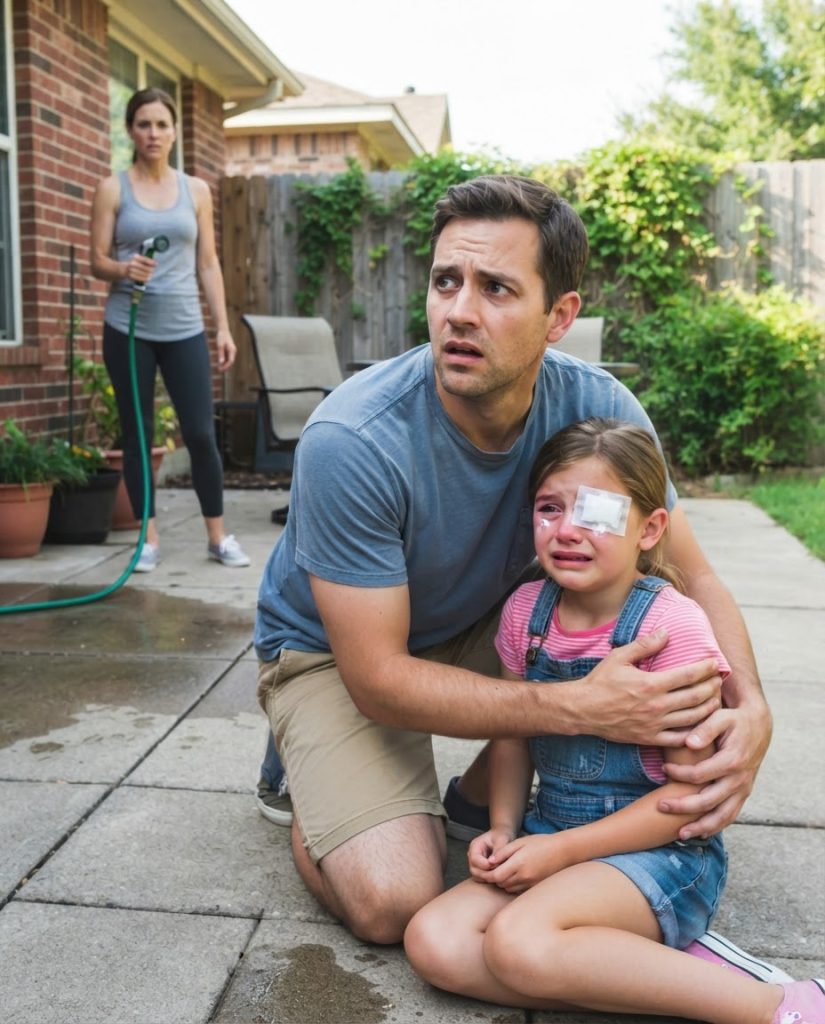
I found my 5 year-old daughter sitting on the patio with gauze over one eye while her stepmother sprayed her with the garden hose. Blood was already showing through the wet bandage, and my daughter was shaking so hard she couldn’t answer me. I found my 5 year-old daughter sitting on the patio with gauze over one eye while her stepmother sprayed her with the garden hose. Blood was already showing through the wet bandage, and my daughter was shaking so hard she couldn’t answer me.
“She got dirty after she fell,” my wife said.
I turned the water off and took my daughter straight to the car. Once the door closed, she whispered, “Mommy, I fell after she started spraying me.”
I locked the doors before I asked another question. My daughter kept both hands around the little towel I’d wrapped over her shoulders, staring through the windshield as if she expected someone to drag her back inside.
“Where were you when she started spraying you?”
“By the flowers.”
“Why was she spraying you?”
Her mouth trembled. “She said I wasn’t listening.”
I wanted to turn around. Every part of me wanted to march back onto that patio and demand an explanation. But my daughter’s bandage was turning darker, and whatever had happened could wait until a doctor had seen her.
At urgent care, the nurse took one look at the soaked gauze and moved us ahead. My wife called three times while we waited. Then came a text:
SHE’S FINE. DON’T MAKE THIS INTO SOMETHING IT ISN’T.
I didn’t answer.
When the doctor removed the gauze, my daughter squeezed my fingers. The cut beside her eyebrow needed stitches. There were also small scrapes along one elbow and both knees, consistent with hitting the patio hard.
The doctor asked how she’d fallen. My daughter looked at me before answering.
“The water made me move backward.”
I felt my grip tighten around the edge of the chair.
“Was the hose on when you fell?” the doctor asked.
She nodded.
“Did someone point it at you?”
Another nod.
I asked the doctor to document exactly what she had said and exactly what he could see. Then I called my sister and asked her to bring clothes for my daughter. We weren’t going home that night.
My wife kept texting.
First she said our daughter had been throwing dirt.
Then she said she’d only rinsed mud from her legs.
Then she said the hose had accidentally swung upward when the child stumbled.
Three explanations in less than an hour.
My daughter heard the phone vibrating and whispered, “Don’t tell her I told you.”
That sentence hurt worse than anything my wife had written.
I crouched beside the exam table. “You’re not in trouble. I need you to tell me what happened before you fell.”
She hesitated, then pointed toward my phone.
“She took a picture first.”
I stopped.
“A picture of what?”
“Me.”
“Before you fell?”
“Yes.”
That changed the shape of the whole afternoon. If my wife had photographed her before the injury, there might be a timestamp showing when the spraying began—and possibly what condition my daughter was in before she hit the ground.
My sister arrived just as the doctor finished the stitches. I handed her my car keys and asked her to stay with my daughter while I made one call from the hallway.
I didn’t call my wife. I called the neighbor whose security camera faced the side of our yard.
He answered on the second ring. I asked whether his camera could see our patio gate. There was a pause, then the sound of him moving through his house.
“Part of it,” he said. “Why?”
I told him not to erase anything from that afternoon.
Another pause. Then his voice changed.
“I already saved it.”
“Saved what?”
“The clip from your yard.”
My stomach dropped.
“Why did you save it?”
“Because I heard your little girl screaming before you got home.”
Part 2
The neighbor sent the CLIP while I was still standing outside the exam room. I watched it once with the sound low, then again with headphones because I needed to be certain I wasn’t filling in anything the camera hadn’t captured.
My daughter was beside the flower bed when my wife came through the patio door holding the hose. The video didn’t show what had happened inside the house, but it showed what happened next clearly enough:
My daughter backed away while the stream followed her.
She raised both arms over her face.
My wife kept the hose pointed toward her.
Then my daughter slipped. Her head struck the edge of a low planter.
The hose stopped only after she was already on the ground. For several seconds my wife stood over her. Then she disappeared into the house and returned with the gauze I’d seen when I arrived.
But the clip contained something my daughter hadn’t mentioned. Before my wife went inside for the bandage, she lifted her phone and aimed it toward the patio.
My daughter had remembered correctly. There had been a picture.
I saved the neighbor’s video in two places and forwarded a copy to my sister. Then I went back into the room, where my daughter was sitting beneath a paper blanket, exhausted.
My phone buzzed again. This time my wife wasn’t explaining the fall. She wrote:
COME HOME. WE NEED TO GET OUR STORIES STRAIGHT BEFORE ANYONE STARTS ASKING QUESTIONS.
I stared at those words until the screen dimmed.
She wasn’t asking what the doctor had said. She wasn’t asking whether my daughter needed stitches. She was worried about the story.
And now I had the CLIP showing exactly why.
Part 3
I took a screenshot of my wife’s message before doing anything else.
COME HOME. WE NEED TO GET OUR STORIES STRAIGHT BEFORE ANYONE STARTS ASKING QUESTIONS.
For the first time that afternoon, I understood that going home wasn’t an option. Not for me. Not for my daughter.
I walked back into the exam room and found her asleep against my sister’s shoulder. One side of her face was swollen, three tiny stitches hidden beneath a fresh strip of gauze.
My sister looked at me. “What happened?”
I handed her the phone.
She watched the neighbor’s clip without speaking. When it ended, she watched it again. Then she read my wife’s message. Her face changed.
“You’re not taking her back there.”
“No.”
“What are you going to do?”
I looked at my daughter. “Whatever keeps her safe.”
The doctor had already documented the injury and my daughter’s explanation. I asked for copies of everything before we left.
Then I made another call. This one was to the police.
I didn’t dramatize anything. I didn’t call my wife names. I didn’t try to tell them what crime I thought had occurred. I simply said I had a five-year-old child with stitches beside her eye, a security recording showing an adult directing a garden hose at her until she fell, and text messages from that adult asking me to “get our stories straight.”
The officer told me to stay where I was.
Twenty minutes later, two officers arrived. My daughter was awake by then.
One of them spoke to me in the hallway while the other waited with a nurse nearby. I showed them the video, the messages, and the photograph of the injury the doctor had taken before stitching it.
The officer watched the clip with his jaw tight. Then he asked the question I had been avoiding.
“Has anything like this happened before?”
I wanted to say no. I almost did. But then I started remembering:
My daughter suddenly refusing baths when my wife was home.
The bruise on her upper arm three weeks earlier that had supposedly come from running into a door.
The night she asked whether she could sleep in my room because she had “been bad.”
Small things. Things I had accepted separately because each one came with an explanation.
Standing in that hallway, they no longer felt separate.
“I don’t know,” I said. “But I think I need to find out.”
That answer nearly broke me. Because a parent is supposed to notice. A parent is supposed to know. But guilt wasn’t going to help my daughter now. Evidence might.
The officers asked the neighbor to preserve the original recording. They photographed my phone screen and took down the urgent care information.
Then one of them asked whether my wife might still have the picture my daughter said she took.
I looked at the newest message on my phone: COME HOME.
“She probably has her phone with her.”
The officer nodded. “Don’t contact her about deleting anything.”
I didn’t. Apparently, I didn’t need to. Because fifteen minutes later another message arrived:
I DELETED THE PHOTO BECAUSE IT LOOKED WORSE THAN IT WAS.
I stared at the screen, then showed it to the officer.
He said only one word: “Save that.”
So I did.
Part 4
My daughter and I stayed at my sister’s house.
That first night, she woke up crying at 2:13 in the morning—not because her stitches hurt, but because she thought she heard water running. I climbed into the guest bed beside her and held her until she fell asleep again.
The next morning, she told me something else.
“She did it before.”
My stomach tightened.
“Sprayed you?”
She shook her head. “Not the hose.”
I didn’t push. I had learned enough in twenty-four hours to understand that children sometimes reveal frightening things in pieces.
So I asked only, “Do you feel safe telling me?”
She nodded.
Then she said my wife sometimes made her stand outside when she was “being annoying.”
“How long?”
“I don’t know.”
“Was I home?”
She shook her head.
“Did she tell you not to tell me?”
My daughter stared down at the blanket. “She said you would be mad at me because I make everything hard.”
I had to turn away for a second. Every instinct in me wanted to promise that nobody would ever hurt her again. But promises like that are too big.
So I gave her one I could keep:
“You can always tell me the truth, even if you think someone will be angry.”
She looked at me carefully.
“Even if it’s about her?”
“Especially then.”
Later that afternoon, an investigator contacted me.
-
The neighbor’s original security file had been collected.
-
The urgent care records had been requested.
-
And my wife had already been interviewed.
According to the investigator, her story kept changing:
-
She claimed she had used the hose only to rinse dirt from my daughter’s shoes.
-
Then she admitted the water had reached her clothes.
-
Then she said my daughter had been “having a tantrum” and backing away on purpose.
Exactly like the texts. But the camera didn’t change.
Three days later, investigators recovered the deleted photo. I wasn’t prepared for it.
My daughter was standing beside the flower bed, soaked from her shoulders down. Her eyes were squeezed shut. One arm covered her face; the other reached outward as though trying to block the water.
Most importantly, the image timestamp was two minutes before the fall captured on the neighbor’s camera.
My wife hadn’t taken a picture after an accident. She had photographed my daughter while it was happening.
That was the moment the last part of my denial disappeared.
Part 5
The following weeks became a blur of interviews, paperwork, temporary orders, appointments, and nights when my daughter wanted the hallway light left on.
I stopped trying to understand why my wife had done it. At first I had obsessed over that question:
Was she angry?
Overwhelmed?
Trying to punish her?
Did she think it was funny?
But eventually I realized something important: The reason did not change what my daughter experienced. And my daughter didn’t need me to understand my wife. She needed me to believe her.
The temporary protection order became longer-term while the case moved forward. My wife was not allowed unsupervised contact with my daughter. I filed for divorce.
When she finally called me through her attorney-approved channel, she cried.
She said everything had been misunderstood.
She said she had loved my daughter.
She said one bad moment shouldn’t destroy a marriage.
Then she said something that told me she still didn’t understand:
“You chose a five-year-old’s version of events over your wife.”
I was quiet for a moment.
“No,” I told her. “I chose the video. The medical records. Your messages. The photograph you deleted.”
Then I added:
“And yes. I chose my daughter.”
That was the last personal conversation we had.
Months later, my daughter’s stitches were gone. A faint line remained beside her eyebrow.
One Saturday morning, we were planting flowers at my sister’s house when she suddenly stopped. She was holding the green garden hose.
For a second, neither of us moved. I saw her fingers tighten around it.
So I walked over and turned the nozzle toward the grass. A soft spray came out. Nothing forceful. Nothing frightening. Just water glittering in the sunlight.
I handed it back to her. She looked at me.
“Can I do it?”
“You control it,” I said.
She pointed the water at the flower bed. Then at the lawn. Then, after a few seconds, she smiled—a real smile, the kind I hadn’t seen for months.
She sprayed my shoes. I jumped backward dramatically. She laughed so hard she almost dropped the hose.
And I laughed too.
Not because what happened had stopped mattering. It still mattered. It always would. But standing there in the sunlight, listening to my daughter laugh while she held the hose in her own hands, I understood something I wish I had understood sooner.
Children don’t always tell you the whole story at once. Sometimes they give you one sentence. Then another:
A whisper in a locked car.
A request not to tell.
A detail about a photograph.
Your job isn’t to interrogate them until the entire truth comes out perfectly. Your job is to make sure they know you are listening when they are finally brave enough to speak.
That afternoon on the patio, I thought I had arrived home in time to find my daughter after an accident. I hadn’t. I had arrived in time to hear the first piece of the truth.
And because I listened, eventually the rest of it had nowhere left to hide.