PART 1
At nineteen, I became the person my younger autistic brother relied on after our parents decided they could no longer care for him. Six years later, I finally found the courage to let him walk into a grocery store on his own. But when a cashier came rushing outside with tears streaming down her face, I was terrified that everything we’d worked toward had fallen apart.
Theo was only nine when our mother asked me to sit with her at the kitchen table and explained that he would be “better somewhere equipped for kids like him.”
I was nineteen, staring at the new wedding ring on her finger, thinking, Equipped? He’s not a dishwasher.
Over the following six years, I taught myself everything I needed to know. His medication routines. The things that overwhelmed his senses. The exact cereal he could manage to eat when everything around him became unbearable.
Yet unfamiliar people still terrified him.
And the bullying at school hadn’t stopped.
One student, Dylan, had been particularly cruel.
On one occasion, Dylan deliberately pushed Theo until he experienced a meltdown. Then he recorded my brother crying and covering his ears, surrounded by scattered broken pencils and ripped notebook paper.
He circulated the recording.
Another student described Theo as “broken.”
It was painfully obvious that our mother wasn’t alone in believing my brother had no place in the world everyone else took for granted.
But I refused to accept that.
We worked on his independence gradually, one manageable task at a time.
The grocery store on Fourth Street became the place where we practiced most often.
We had been regular customers there for years. Mrs. Bennett, who worked at register three, had seen Theo go from sheltering behind my back to handling payments and requesting receipts without assistance.
That Saturday, however, was different.
We weren’t going there for our regular shopping trip. Theo was about to enter the store without me for the very first time.
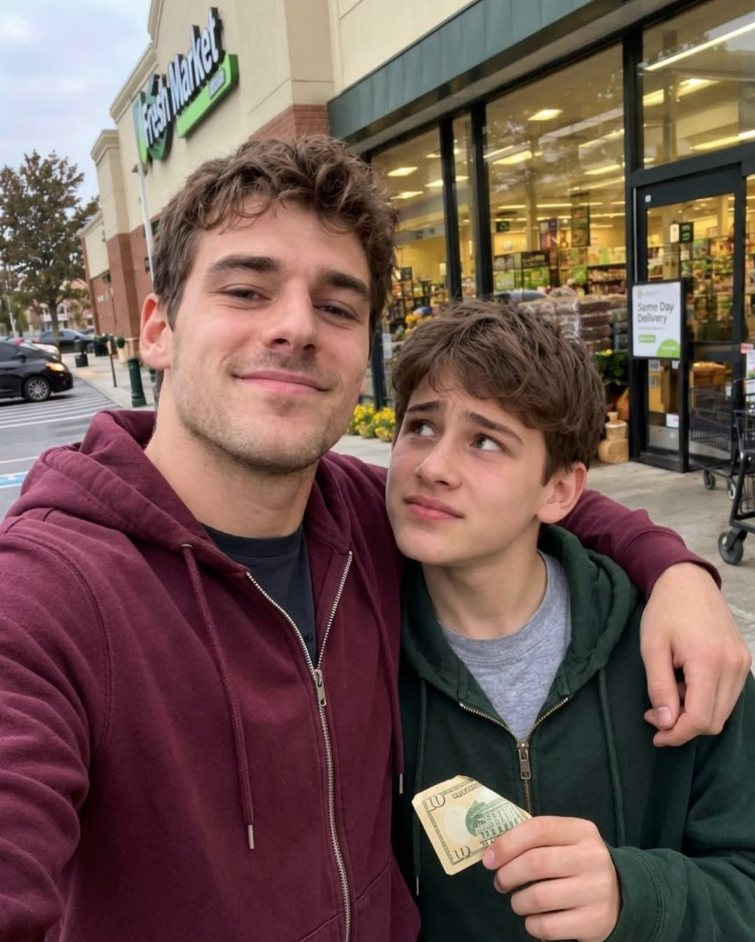
Outside the sliding entrance doors, I placed a ten-dollar bill in his hand.
“Go in, find one chocolate bar, pay at the register, take the receipt, and come straight back. I’ll be right here.”
As usual, he repeated the directions two times.
“Chocolate. Pay. Receipt. Come back.”
“You’ve got it, buddy.”
He struggled to swallow.
Then he straightened his shoulders, looking like a child preparing to step onto a stage, and walked through the entrance.
I watched until the shelves of the first aisle hid him from sight.
We had rehearsed that exact trip for weeks. Still, every instinct told me to follow him. Instead, I remained outside as promised, feeling equally proud and frightened.
Five minutes went by.
Then another five.
I glanced repeatedly at my phone, even though checking it accomplished nothing. Theo didn’t have a phone of his own yet.
When fifteen minutes had passed, Mrs. Bennett suddenly hurried through the doors.
She was crying.
“Marcus! You’re Marcus, aren’t you?”
My stomach seemed to drop straight through the ground.
“Where’s my brother?”
“Come in. Immediately. You need to see what Theo has done.”
I sprinted inside.
As I ran, my imagination filled with every terrible possibility. Someone mocking him. Another meltdown. A shutdown. A panic attack. Perhaps a security officer who had misunderstood his behavior.
Then I reached the registers.
The customers were standing motionless.
And Theo was right in the center of them.
My little brother was kneeling on the freezing tile floor, his hands positioned behind his back. He looked like someone waiting for the police to arrest him.
Tears ran down his cheeks.
Several feet away, a woman stood with a young girl tucked behind her hip. She pointed an accusing finger toward Theo.
“He’s dangerous!” she kept saying. “Keep him away from my daughter!”
“Theo…” I whispered. “What did you do?”
The surrounding shoppers appeared shocked, although none of them looked frightened.
I hurried over and knelt in front of my brother.
“Hey. Hey, bud. It’s me.”
He recoiled slightly before raising his head. His eyes were swollen and red.
“You can get up,” I said softly. “It’s okay. Nobody’s mad at you. Take my hand.”
He stayed where he was.
“Is she still scared?”
“Let’s stand up first.”
Finally, he allowed me to help him stand.
I wrapped my arm around his shoulders. His entire body trembled beneath my hand.
“Somebody tell me what happened,” I said, my tone sharper than I intended.
Mrs. Bennett brushed the tears from her cheeks.
“Her card got declined, honey. She started putting groceries back. The little one was crying over her cereal. And your Theo, he heard all of it.”
“I had ten dollars,” Theo whispered. “I could share.”
For a brief second, I shut my eyes.
“He walked right up to her, nice as can be,” Mrs. Bennett went on. “Held out his money. Then she looked at him and went white as paper. She said she knew who he was.”
I studied the woman’s face again.
Suddenly, I remembered seeing her during a meeting at Theo’s school.
“You’re Dylan’s mother,” I said.
“And you know exactly what your brother is capable of.” Her voice shook, but she didn’t back down. “I saw the video. I saw what he did, breaking things, clearly violent.”
“Your son provoked Theo until he had a meltdown,” I said. “That video shows a kid in extreme distress, and your son thought it was funny.”
“That’s not what my son told me.”
“Of course it isn’t!”
“He was the one who was frightened!” she snapped. “He was afraid that boy would attack him, and now he’s coming at my daughter!”
She squared her shoulders.
“I was protecting my child.” She lifted her chin. “I want the manager. Right now. And I’m making a complaint.”
Theo moved closer against me.
He remained silent, but I could feel the rapid movements of his fingers, flexing again and again as they always did when he became overwhelmed.
“I didn’t mean to be bad,” he said. “She was yelling. Everyone was yelling. I thought if she could see my hands weren’t doing anything, she’d know I wasn’t going to hurt her.”
My fifteen-year-old brother had lowered himself onto a grocery-store floor because he believed that was the only way to convince someone he wasn’t dangerous.
Anger surged through me.
I wanted to confront her. I had more than enough words ready.
But Theo’s breathing had become uneven, and every time someone raised their voice, his body seemed to shrink further into itself.
If I continued arguing, he would suffer far more than I would gain by winning.
When the manager appeared and the woman repeated her accusations, I offered only one response.
“I’ll come back tomorrow, and we’ll talk then.”
Then I brought Theo home.
He hadn’t even managed to buy his chocolate bar.
And the first independent shopping trip we’d spent so long preparing for had become something neither of us would ever forget.
That evening, Theo sat at the edge of his mattress with a blanket covering his knees. His fingers continued moving restlessly.
“I was helping,” he said. “Why did she get mad if I was helping?”
“You did nothing wrong,” I told him. “Nothing.”
“But I didn’t finish.” His hands sped up. “Chocolate, pay, receipt, come back. I only did the first part.”
“That’s not your fault.”
He gave a small nod but continued staring at the floor.
Later, standing alone in the hallway, I blamed myself for allowing him to enter the store.
I knew the woman had caused what happened.
But knowing that couldn’t erase the image of my brother kneeling before a crowd.
The following morning, I returned to the grocery store without Theo.
The manager, a weary-looking man with compassionate eyes, agreed to speak with me immediately.
“I pulled the security footage,” he said. “I also spoke with every employee who saw it.”
My heart began pounding.
“And?”
“Your brother offered her his money,” the manager said. “He never threatened or touched anyone. The footage doesn’t support her complaint. I’m sorry. You’re both welcome here.”
I should have been relieved.
Instead, all I could picture was Theo on his knees, surrounded by strangers.
The manager had confirmed his innocence, but that didn’t undo his humiliation or take away his fear.
I thanked him and started toward the exit.
Before I reached the doors, Mrs. Bennett came out from behind her checkout counter.
“How is he?” she asked.
“Quiet.”
“Poor kid, and after all his hard work…” She sniffed. “Bring him back Thursday, if he’s willing. It should be quiet this time of month. I’ll be at register three.”
I wanted desperately to agree.
But for someone like Theo, returning to a place associated with fear wasn’t as simple as deciding to try again.
“Thank you,” I managed. “I’ll think about it.”
All the way home, I kept remembering how he’d positioned his hands behind his back, desperately trying to appear harmless.
He had obeyed every instruction.
He had tried to do something generous.
And neither had protected him.
For six years, I’d taught him that preparation and practice could make unfamiliar experiences less frightening.
Now I didn’t know how to explain what had happened.
My mother’s words returned to haunt me.
Better somewhere equipped.
For the first time, I wondered whether helping Theo become independent was exposing him to dangers I couldn’t prevent.
The world wasn’t always welcoming.
And I couldn’t force strangers to show him kindness.
When I arrived home, Theo was sitting at the table, arranging his pencils into a neat row.
“The manager says you didn’t do anything wrong,” I said. “He watched the tape. We’re welcome back at the store.”
Theo nodded.
But I couldn’t tell whether he understood, or whether the thought of returning was already making him anxious.
“But you don’t have to go back if you don’t want to. I can do the shopping myself for a while. Easy.”
He kept looking down at his pencils.
For the next two days, I avoided bringing up the grocery store.
Then, on Tuesday evening, Theo appeared in the kitchen doorway, standing rigidly with his arms beside him.
“Did I do it wrong at the store?”
“No,” I said. “No, Theo. You didn’t do anything wrong.”
His forehead creased as he tried to reconcile two things that didn’t make sense together.
“Then why can’t I go again?”
And suddenly, I realized something that frightened me almost as much as what had happened at the store.
Without meaning to, I was beginning to treat a stranger’s cruelty as evidence that my brother wasn’t capable of doing things for himself.
PART 2
I stood in the kitchen, searching for an answer to Theo’s question.
He hadn’t failed his shopping trip because he was incapable of completing it. He had been frightened and humiliated by someone who judged him without understanding what had happened.
Yet I was the one keeping him away from the store.
“You’re right,” I said. “What do you want to do?”
“Go back,” he said. “I like the store. But I’m scared she’ll be there.”
“Mrs. Bennett said she’d be there Thursday. What if we do our usual shopping together?”
“Together,” he said.
That Thursday, we returned for our regular groceries.
At first, I felt cautiously optimistic.
Then we reached the entrance.
Theo stopped just beyond the automatic doors and began searching the store with his eyes.
“Is she here?” he asked.
I scanned the area.
“I don’t see her.”
Normally, Theo would have walked ahead to find his preferred cereal.
This time, he remained right beside me.
When we reached the checkout, his gaze stayed fixed on the floor.
“Good to see you, Theo,” Mrs. Bennett said, speaking as though nothing unusual had happened.
His fingers began repeatedly tightening and relaxing.
I started unloading the groceries onto the conveyor belt.
Theo usually helped me with that task, but now he stood so close that our elbows touched.
I completed the payment.
Mrs. Bennett extended the receipt toward Theo.
He immediately moved behind my back.
So I accepted it instead.
Once we were outside, Theo began flapping his hands and rocking gently on his feet.
“It was wrong. I didn’t do the paying,” he said.
“That’s okay, bud. You can pay next time.”
“I used to do the paying. And receipt-taking.” His face scrunched up. “I’m sorry.”
I turned to face him.
“Theo, it’s okay. Really. That lady… she made this a bit scary for you, didn’t she?”
He nodded.
“So we just take it slow, okay? Remember when we started doing the shopping, and all you did was take the receipt?”
Another nod.
“We’ll start from the beginning again.”
I managed to smile as I said it.
But inside, my heart was breaking.
I couldn’t stop wondering whether my brother would ever feel confident enough to enter that store alone again.
Over the next couple of weeks, we continued practicing.
Gradually, Theo became comfortable accepting the receipt again.
On certain days, he even managed to pay for our groceries.
Every small improvement mattered.
Then, one afternoon, a member of an old school parents’ group sent me a link.
Marcus, have you seen this?
I opened the message.
The preview image showed Dylan’s mother.
Beneath it was a caption:
If you know the young man from the grocery store, help this message reach him.
My stomach tightened immediately.
I went into my bedroom, closed the door, and started the video.
Dylan’s mother was sitting inside a parked car, facing the camera.
“I owe a young man an apology. I recognized him at the grocery store from a video my son had shared at school.”
She exhaled deeply.
“I decided he was dangerous without knowing him. When he approached me, I screamed before I even heard what he was saying.”
I stared at the screen.
“I filed a complaint. The manager reviewed the security footage and explained that the boy had offered me his own money to buy cereal for my daughter. He hadn’t threatened either of us.”
She stopped speaking for a moment and wiped her face.
Then she continued.
“I finally asked my son what happened before he recorded that school video. Dylan admitted he and other boys had mocked this young man. The clip showed his distress, not what caused it. I should have asked years ago.”
I could barely believe what I was hearing.
For years, I’d tried to explain to school employees that Dylan’s recording didn’t show the full story.
I’d told them repeatedly that Theo had been deliberately provoked.
And now, after his mother had publicly accused my brother of being dangerous, Dylan had finally admitted what he’d done.
“I’ve withdrawn my complaint. I’ve told Dylan to remove the video from every account he controls and stop sharing it. I was wrong to call that young man dangerous.”
The woman moved closer toward the camera.
“I can’t undo what I did, but if someone who knows him sees this, please pass along my apology. He doesn’t owe me a response.”
The recording ended.
I sat there without moving.
She had publicly acknowledged her mistake.
And she had admitted that her own son had been responsible for hurting Theo.
Part of me wanted to find my brother immediately and show him every second.
Another part remembered how frightened he’d been when we returned to the store together.
I worried that seeing her face again might bring back everything he’d struggled so hard to overcome.
The following day, I asked Theo whether he wanted to watch the recording.
He said yes.
We sat beside each other and played it.
As soon as Dylan’s mother appeared, his fingers began moving anxiously.
But as she spoke, those movements gradually slowed.
By the time the video finished, his hands were still.
“She knows I wasn’t trying to hurt anyone now.” He nodded.
“She knows.”
“That’s what I was trying to tell her.”
For a moment, I couldn’t speak.
I’d wanted someone to acknowledge the truth for so long.
Now that Theo had finally heard that acknowledgment, I couldn’t tell whether it would help heal what had happened.
A few days afterward, Theo asked me whether Mrs. Bennett continued working on Saturdays.
“Register three?” he added.
I confirmed that she did.
He nodded, and I decided not to ask any more questions.
Several weeks passed.
Then one morning, Theo appeared at our front door, already wearing his shoes.
“Can we go to the store?”
“Sure,” I said. “I’ll grab my keys.”
We traveled to the familiar grocery store on Fourth Street.
But when we reached the automatic entrance, Theo stopped.
He looked toward the doors, then turned to me.
“I want to go in by myself. I still need to do it right. Chocolate. Pay. Receipt. Come back.”
Instantly, I remembered the last time he’d attempted that exact task.
I saw him kneeling on the cold tiles.
I remembered his tears, his shaking hands, and the woman pointing at him.
Fear swept over me.
“We could go in together,” I said.
“We already did that,” Theo replied. “I get the receipts now. I do the paying sometimes. I want to do it right.”
I looked at my little brother.
He had spent weeks rebuilding the confidence someone else had taken from him.
He knew exactly what he wanted to accomplish.
And he understood every step of the plan.
“Do you feel ready?”
“Yes.”
Every protective instinct in my body urged me to accompany him.
But this wasn’t my decision to make for him.
He had already told me he was ready.
So I stepped aside.
“Okay. I’ll wait outside.”
Theo walked through the automatic doors.
This time, I positioned myself where I could watch him through the glass.
I followed his movements with my eyes as he made his way toward the shelves.
He found the same chocolate bar he’d intended to purchase on that first Saturday.
Then he carried it to register three.
Mrs. Bennett greeted him with a smile.
Theo carefully counted out his money.
He completed the payment.
And when she offered him the receipt, he took it.
I watched him turn toward the entrance.
The automatic doors slid open.
My brother stepped outside, holding his chocolate bar in one hand and his receipt in the other.
“How’d it go?” I asked.
Theo lifted his eyes toward mine.
“I got it right.”