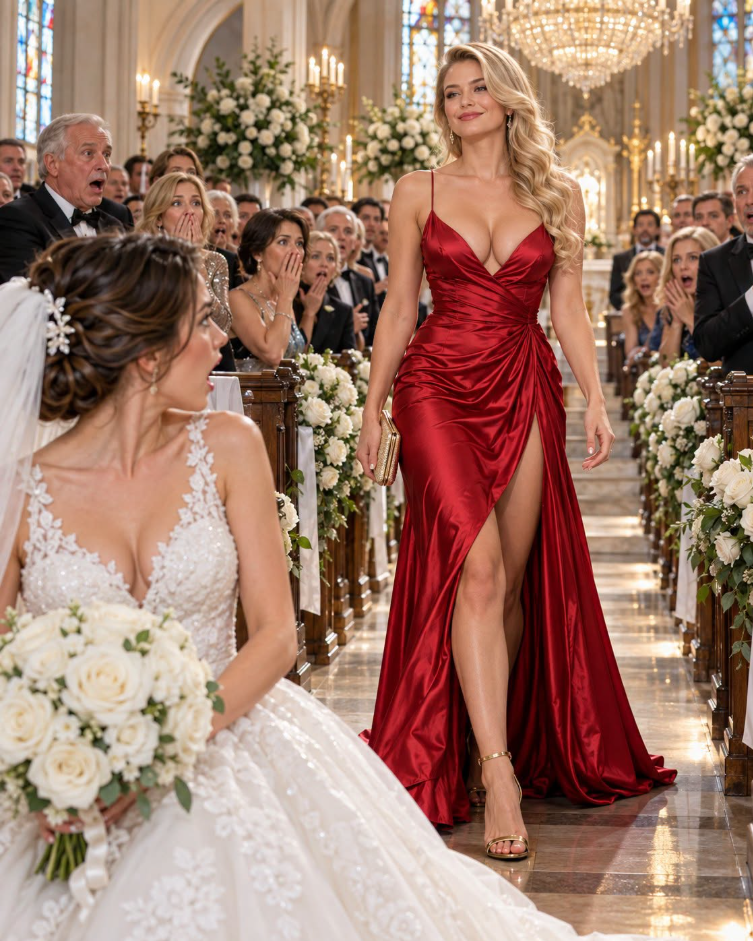
My sister entered my wedding wearing white—not ivory, champagne, or one of those pale shades someone could excuse by blaming the lighting, but unmistakable bridal white. The instant Paige appeared at the back of the chapel, conversations died, my aunt stared openly, and my cousin covered her mouth as though she had just watched a disaster unfold.
“Clara, do you want me to handle this?”
It had.
Brooke stared at me as if I’d lost my mind, but I knew exactly what I was doing. For twenty-nine years, Paige had treated life like a stage and my milestones as opportunities to pull the spotlight toward herself.
At my high-school graduation, she announced her engagement. When I bought my first house, she posted online about how I’d supposedly abandoned our family, and when Ethan proposed to me, she laughed before giving me a warning I never forgot.
“Enjoy it while he still thinks you’re the special one.”
Years earlier, I would have fought back, but eventually I became exhausted by the competition. Mom used to tell me that some people steal other people’s light because they never learned how to create their own, and for years, those words helped me tolerate Paige.
But Mom wasn’t there anymore.
An empty chair waited in the front row with her blue scarf carefully folded across it. She had died eight months before my wedding, leaving behind a silence neither Paige nor I knew how to handle.
I buried myself in work and wedding preparations because staying busy kept grief from swallowing me. Paige handled it differently; she stopped answering my calls, skipped my dress fitting and bridal shower, then told relatives I was too busy creating my perfect life to notice that she had lost her mother too.
Maybe there was some truth to that accusation. I’d been so focused on surviving my own grief that I hadn’t always recognized hers, but grief didn’t erase the years of resentment that had existed between us long before Mom became sick.
So when my wedding planner quietly told me Paige had been calling boutiques looking for something “bridal but technically not a wedding dress,” I knew exactly what she was planning. Instead of confronting her, I made a decision even Ethan didn’t fully understand at first.
I bought the dress myself.
I had it altered to Paige’s measurements and anonymously delivered to her hotel room before the wedding. There was no card explaining who had sent it, only a single note tucked inside the box.
Wear this if you need everyone to look at you.
Paige accepted the invitation.
Now she was walking down my aisle in the exact dress I’d selected for her, pretending not to notice the whispers following her through the chapel. She carried herself with the confidence of someone who believed she’d already won.
Ethan leaned closer as Paige approached.
“Are you okay?”
I looked at the man I was minutes away from marrying. There was no anger in his expression and no desire to create a scene; he was simply worried about me, which was one of the reasons I loved him.
“I’m okay.”
Paige finally reached the front and stopped beside me. Her smile widened as she glanced at my dress, clearly waiting for anger, humiliation, or some other reaction that would prove she’d successfully disrupted my wedding.
“Surprise,” she whispered.
I smiled back.
“Yes. It is.”
For the first time, uncertainty flickered across her face.
Before Paige could say anything else, Pastor Reynolds stepped forward holding a small sealed envelope I’d given him earlier that morning. He cleared his throat, and the remaining whispers disappeared from the chapel.
“Before we begin, Clara has asked for one family matter to be addressed.”
Paige’s smile faded.
I glanced toward Mom’s empty chair and the blue scarf resting across it. For months, I’d wondered whether following her instructions was cruel, compassionate, or somehow both, but now there was no turning back.
Pastor Reynolds looked directly at Paige.
“Your mother left something for you.”
The color drained from my sister’s face.
After Mom died, I’d discovered a cedar box beneath her bed containing two letters, one addressed to me and another intended for Paige. Mine was simple: Mom told me to marry with a clean heart and warned me not to carry bitterness with me to the altar.
Paige’s letter was different.
Mom had hidden it inside the lining of a white silk dress she’d ordered before her illness became too severe. Along with it, she’d left instructions that made almost no sense to me at the time.
If your sister ever wears white to your wedding, don’t stop her. Let her. Then give her this.
I hated those instructions when I first read them because they felt like another request for me to tolerate Paige’s behavior. Eventually, however, I realized Mom hadn’t asked me to prevent what Paige might do; she’d asked me to let Paige reveal it herself.
Pastor Reynolds extended the envelope.
Paige’s hands trembled as she took it.
She had entered my wedding believing the white dress would humiliate me in front of everyone I loved. What she didn’t know was that I’d chosen that dress, sent it to her, and spent months waiting to see whether she’d actually wear it.
Now she had.
And as Paige stared at our mother’s handwriting across the envelope, she finally understood that the white dress hadn’t ruined my plan.
It had completed it.
PART 2: THE LETTER MY MOTHER LEFT FOR MY SISTER
Paige stared at the envelope as though she were afraid to open it. Around us, more than a hundred wedding guests had gone silent, but for the first time since entering the chapel, my sister didn’t seem interested in their attention.
Her fingers trembled as she broke the seal.
“This is ridiculous,” she whispered.
But she opened the letter anyway.
Her eyes moved across the first line, and almost immediately, the confidence vanished from her face. She pressed one hand over her mouth while the paper shook between the fingers of the other.
My sweet Paige, if you are reading this, it means you are hurting louder than you are loving.
My throat tightened as I watched her.
I’d already read my own letter, but I’d never opened Paige’s. Mom had made that condition perfectly clear: whatever she’d written belonged to my sister, and Paige alone had to decide whether anyone else would hear it.
For several seconds, she said nothing.
Ethan gently squeezed my hand.
“You don’t have to continue this,” he whispered.
I looked toward Mom’s empty chair, where the blue scarf remained folded across the seat. Then I looked back at Paige, standing in the white dress she’d chosen to wear as a challenge.
“Yes,” I whispered. “I do.”
Paige swallowed and looked down at the letter again. When she finally began reading aloud, her voice was so quiet that the people in the back rows leaned forward to hear her.
“Mom says she knew the face I made whenever I felt forgotten. She knew I used jokes when I was hurting, and that I learned to say something cruel before anyone could ask what was wrong.”
Paige stopped and looked at me.
There was something in her expression I hadn’t seen in years. Fear.
Not fear that the guests would judge her for wearing white, but fear that our mother had understood exactly why she’d done it.
My father shifted in the front row. For most of our childhood, he’d described Paige as “fire” and me as “water,” as though those labels explained everything about us.
Paige was loud, emotional, impulsive, and impossible to ignore. I learned early that being the quieter daughter made things easier for everyone, so whenever Paige exploded, I was expected to stay calm.
When she made mistakes, I was asked to understand. When she demanded attention, relatives reminded me that I already received plenty.
At the time, I believed those compromises were keeping our family peaceful.
Standing at the altar, I started wondering whether they’d actually helped create the problem instead.
Paige continued reading.
“Mom says we were never supposed to become enemies. She said somewhere along the way, we started competing for love that already belonged to both of us.”
My chest tightened.
For years, I’d built a simple explanation for my sister: Paige was jealous, selfish, and incapable of letting anyone else be happy without turning the moment toward herself.
That explanation wasn’t entirely wrong.
But perhaps it wasn’t complete.
Paige wiped her cheek and kept reading.
“She says if I’m wearing white at your wedding, everyone will assume I wanted to steal your day.”
A nervous breath passed through the chapel.
Paige’s voice grew quieter.
“She says maybe part of me did.”
Nobody moved.
Then she read the next sentence.
“But she thinks another part of me wanted someone to stop me. Someone to notice how lost I’d become.”
Paige broke.
The letter slipped from her fingers and landed on the chapel floor as she covered her face. There was nothing graceful or theatrical about the way she cried; it sounded as though years of anger had finally collapsed beneath their own weight.
For a moment, I remained beside Ethan.
I’d imagined confronting Paige countless times. In some versions, I finally told her everything she’d done to me; in others, she stormed out while everyone watched her humiliation.
I’d never imagined feeling sorry for her.
Slowly, I stepped down from the altar.
That was when Paige finally noticed what I was wearing.
My wedding dress wasn’t white.
It was pale blue.
Mom’s favorite color.
It matched the scarf resting on her empty chair and reminded me of the dresses she wore in the photographs where she looked happiest. Paige had expected to stand beside me in white and force everyone to compare us, but there was nothing to compare.
“Don’t,” Paige whispered as I approached.
I stopped in front of her and picked up the letter.
“I didn’t know,” she said.
“Didn’t know what?”
“That Mom saw me like that.”
I handed the letter back to her.
“She saw both of us.”
Paige shook her head.
“No. She saw you. She always saw you.”
There it was.
The sentence beneath almost every argument we’d ever had.
Paige looked directly at me, no longer caring about the guests surrounding us.
“You were the daughter she was proud of. Clara got good grades. Clara remembered everyone’s birthday. Clara helped when Mom was sick. Clara never caused trouble.”
Her voice cracked, but she continued.
“And I was always the difficult one. Too loud. Too emotional. Too much.”
I could have answered with a list of everything she’d done to me. I could have reminded her of the milestones she’d disrupted, the cruel jokes she’d disguised as humor, or the days she’d disappeared while Mom was dying.
Instead, I told her the truth she’d never considered.
“I needed things too, Paige.”
She blinked.
“I just learned to stop asking.” For the first time that day, my sister had nothing to say.
Then she looked down at the letter again, and her expression shifted.
“There’s more.”
I already knew that.
What I didn’t know was what Mom had written next.
Paige slowly unfolded the second page, silently read the first few lines, then looked at me with tears streaming down her face.
“Clara,” she whispered, “Mom said our family has been doing this for generations.”
She turned the page toward me.
At the top, underlined twice in our mother’s handwriting, were two words I’d never heard her use while she was alive.
Family curse.
PART 3: THE FAMILY CURSE WE NEVER NAMED
Paige stared at the words family curse as though Mom had written something forbidden. Our mother had spent her entire life talking about keeping the peace, forgiving family, and refusing to make scenes, so seeing her describe our history in such harsh terms felt almost impossible.
Paige continued reading, her voice still unsteady. Mom wrote that the women in our family had passed silence from one generation to the next and mistaken endurance for strength, while resentment accumulated beneath everything nobody was willing to discuss.
Our grandmother had stayed silent whenever Grandpa disappeared for days at a time. Mom had remained quiet when Dad’s drinking created problems no one outside the house was supposed to know about, and I’d learned to stay calm whenever Paige hurt me because everyone insisted confronting her would only make things worse.
Paige had developed the opposite survival strategy. Instead of growing quiet, she became louder, sharper, and more demanding whenever she felt ignored, because nobody had ever taught her how to ask for attention without turning it into a competition.
Different reactions, Mom wrote, but the same wound.
Paige’s hands trembled as she reached the final section of the letter.
“Mom says if I want attention, I should learn to ask for love instead. If I want to feel chosen, I should start by choosing someone besides myself.”
She paused and wiped her face before continuing.
“And if I can’t apologize today, she says I should at least tell the truth. She says you’re not my enemy.”
The chapel remained completely silent as Paige lowered the letter. Nobody applauded or rushed forward to comfort her, and for once, I was grateful because this moment didn’t need an audience reacting to it.
Then Paige turned toward our guests.
“I wore this dress to hurt my sister.”
A few people shifted awkwardly in their seats while my father covered his face with one hand. Paige looked terrified, but she continued speaking.
“I told myself Clara deserved it because everyone always loved her more. I thought if I walked into her wedding wearing white, everyone would finally look at me instead.”
She turned toward me.
“But she didn’t steal anything from me. I spent years treating her like she did.”
My eyes burned.
Paige took a shaky breath.
“I’m sorry, Clara.”
I’d imagined hearing those words for years. Whenever Paige ruined something important, I pictured the day she’d finally understand what she’d done and give me the apology I believed would somehow make everything feel fair.
But hearing it didn’t feel like victory.
It felt like finally setting down something heavy I’d carried for so long that I’d forgotten how much it weighed.
I walked toward Mom’s empty chair and picked up her blue scarf. When I returned, Paige stiffened as though she expected me to tell her an apology wasn’t enough.
Instead, I wrapped the scarf around her shoulders.
Against the white silk, the pale blue completely changed the way she looked. She no longer seemed like a woman trying to imitate a bride; she looked like our mother’s daughter, frightened and grieving and finally unable to hide behind anger.
“Stand with me,” I said.
Paige stared at me.
“What?”
“Stand with me.”
She immediately shook her head.
“Clara, I can’t. After what I did, people will think—”
“Let them.”
I wasn’t pretending the past had vanished, and I wasn’t telling Paige that one apology had repaired years of damage. Forgiveness didn’t require me to rewrite what had happened.
“I don’t want us to pretend this never happened,” I told her. “But I don’t want this to be the only thing we remember either.”
Paige looked around the chapel as though waiting for someone to tell her what to do. For most of her life, she’d demanded attention and then blamed everyone else for how they responded, but now nobody offered her an easy answer.
Finally, she nodded.
Brooke stepped forward with a small bouquet she’d kept aside and handed it to Paige. My sister accepted it with a quiet thank-you, and some of the tension in the room finally eased.
Pastor Reynolds returned to his place.
“Shall we begin again?”
And we did.
Dad walked me down the aisle with tears in his eyes, while Paige stood near the altar wearing Mom’s scarf over the white dress. When Dad kissed my forehead, he whispered that Mom would have been proud, and for once, I believed he meant both of his daughters.
The ceremony wasn’t perfect. My voice cracked during my vows, Ethan cried before I did, Paige struggled through half the prayer, and a toddler in the third row loudly asked why everyone was sad.
The chapel laughed.
It was messy, emotional, and nothing like the flawless wedding I’d once imagined, but somehow it felt more honest.
When Ethan and I finally turned toward our guests as husband and wife, sunlight streamed through the stained-glass windows and fell across Paige. The white dress she’d entered wearing as a weapon was now covered by Mom’s blue scarf, and what had started as an attempt to embarrass me had become a confession neither of us could take back.
At the reception, Paige remained unusually quiet. She ate dinner, spoke politely when relatives approached, and didn’t try to make herself the center of another moment.
Then, shortly after dessert was announced, she disappeared.
At first, I assumed she’d finally decided the humiliation was too much and returned to her hotel. I searched the reception hall, checked the hallway, and eventually found her outside behind the venue, sitting alone on the stone steps beneath a string of lights.
Mom’s scarf was still wrapped around her shoulders.
Paige looked up when she heard me approaching.
“I was going to leave,” she admitted.
“I figured.” She slowly rubbed her thumb along the edge of the scarf.
“But then I realized leaving would make everything about me again.”
I sat down beside her, careful not to let my dress catch against the stone. For a moment, we listened to the music drifting through the doors behind us before Paige finally spoke.
“I really did hate you sometimes.”
I stared into the dark garden ahead.
“I know.”
She flinched, but I wasn’t finished.
“Sometimes I hated you too.”
Paige turned toward me, stunned.
It was the first time I’d ever admitted it aloud.
And judging by her expression, that truth frightened her more than anything our mother had written.
PART 4: WHAT WE FINALLY ADMITTED TO EACH OTHER
Paige stared at me after I admitted that I’d hated her too. For years, I’d softened that feeling into safer words like frustration, disappointment, or exhaustion, because admitting hatred made me feel like the cruel sister I’d always believed Paige was.
But that truth had been living inside me for years.
“I deserved that,” she said quietly.
“Sometimes you did,” I replied. “But I don’t want to live there anymore.”
She looked down at Mom’s blue scarf and slowly rubbed the fabric between her fingers. Music drifted through the doors behind us, but neither of us seemed ready to return to the reception.
“I don’t know how to be different,” Paige admitted.
“Neither do I.”
She looked up, genuinely surprised, as though she’d expected me to have some perfect answer simply because I’d always been the responsible sister. That had always been part of our problem: Paige believed being quiet meant I knew what I was doing, while I’d spent most of my life hiding uncertainty because everyone depended on me to stay calm.
“You think I forgave everything because I let you stand beside me?” I asked. “Paige, I’m still angry.”
Her expression tightened, but she didn’t interrupt.
“I’m angry that you made me dread my own wedding. I’m angry about every birthday and milestone you turned into a competition, and I’m angry that you disappeared when Mom was sick and left me wondering whether you’d come back before she died.”
Tears filled Paige’s eyes, but I continued because forgiveness built on another silence would only repeat the same pattern Mom had warned us about.
“I’m angry that even today, some part of me was waiting for you to hurt me.”
Paige cried quietly beside me. I didn’t immediately try to comfort her, because this wasn’t punishment and it wasn’t cruelty; for once, I was letting both of us sit with the truth without rushing to make it easier.
After a while, I reached for her hand.
“But I don’t want anger to be the only thing left between us.”
Paige wiped her face.
“Then what do you want?”
It was a simple question, but I needed a moment before answering. I didn’t want instant closeness or smiling photographs posted online so relatives could congratulate us for becoming sisters again.
“I want honesty,” I said. “I want boundaries, and I think we both need help figuring out why we’ve spent half our lives competing with each other. I don’t want us pretending one letter and one apology fixed everything.”
Paige slowly nodded.
“Therapy?”
“Probably.”
She gave a weak laugh.
“I was hoping you’d say cake.”
“We can have both.”
For the first time since she’d entered the chapel, Paige smiled without trying to prove anything.
Then her expression grew serious again.
“I don’t think I have any light of my own, Clara.”
I studied her face.
“That might be the first lie we need to stop telling.”
Paige looked toward the garden.
“I don’t know who I am if I’m not competing with you.”
The sadness in her voice hurt more than her anger ever had, because I believed her. Some people learn that cruelty earns them attention, while others become so afraid of being invisible that they create noise wherever they go.
Paige had spent her entire life making noise.
“You’re my sister,” I told her. “That’s not everything you are, but maybe that’s where we start.”
She squeezed my hand.
Before either of us could say anything more, the door opened behind us and Ethan stepped outside carrying two plates of wedding cake.
“I’m interrupting something.”
“Yes,” Paige said.
“No,” I answered at exactly the same time.
Ethan laughed and handed us the plates. “I figured emotional breakthroughs require frosting.”
Paige stared at him for a moment before laughing. It wasn’t the sharp, exaggerated laugh she usually used when she wanted everyone nearby to notice her; it was the laugh I remembered from childhood, when we hid beneath the kitchen table and stole cookie dough while Mom pretended not to notice us.
Later that evening, Paige surprised me again. She stood during the reception and tapped her glass.
Every conversation in the room stopped. Several relatives exchanged nervous looks, and I could practically feel everyone thinking the same thing.
Here we go again.
Paige noticed their reaction.
For once, she didn’t punish them for expecting the worst.
“I promise I’ll keep this short,” she said. “Because today isn’t about me.”
A few guests laughed nervously.
Paige looked directly at me.
“For years, I thought my sister had everything I wanted. She had everyone’s approval, a good heart, and now she has a husband who looks at her like she hung the moon.”
Ethan raised his glass toward me, earning a warmer laugh from the room.
“But today I realized Clara didn’t have everything. She just protected what she had better than I did. Even after I walked into her wedding intending to hurt her, she gave me a place beside her.”
My eyes started burning again.
Paige lifted her glass.
“So here’s to my sister and my new brother-in-law. May your marriage have enough truth to survive uncomfortable conversations, and may your home never confuse silence with peace.”
Then she hesitated.
“And I hope someday I become the kind of sister who deserves a seat at your table.”
The room fell quiet.
Paige glanced toward the wedding cake.
“Preferably a small seat. Far away from the cake. With supervision.”
Everyone laughed.
This time, they were laughing with her instead of at her.
I raised my glass.
“To new beginnings.”
And I meant it.
Not perfect beginnings and certainly not easy ones, but something new was enough.
Three months later, Paige sent me a photograph from the parking lot of a therapist’s office.
I almost drove away. Didn’t.
I stared at the message for several seconds before replying.
Proud of you.
She didn’t respond until six hours later.
When her reply finally came, it contained only one sentence.
I cried when you said that.
A month later, Paige asked me to meet her for coffee. There would be no wedding guests, no mother’s letter, and no white dress forcing either of us to tell the truth.
Just the two of us.
And when I arrived, Paige was already sitting at a table with a handwritten list beside her coffee.
She pushed it toward me.
At the top were five words.
Things I owe you apologies for.
I looked down the page and realized the wedding dress wasn’t even first on the list.
PART 5: THE LETTER THAT FINALLY SET US FREE
I looked down at Paige’s handwritten list and realized the wedding dress wasn’t even first.
She had written about my graduation, the birthdays she’d turned into competitions, the comments she’d made about Ethan, and the nine days she’d disappeared while Mom was dying. Near the bottom was the white dress, followed by a sentence she’d underlined twice: I kept hurting you because I thought your happiness proved there was less love left for me.
For several minutes, neither of us spoke. Healing, I discovered, rarely looks like two people running into each other’s arms after one perfect apology; sometimes it looks like two sisters sitting across from each other in a coffee shop, stirring drinks that have already gone cold because neither knows how to begin.
Paige finally started with Mom.
She apologized for leaving me alone during those last difficult weeks and admitted that every hospital visit terrified her. Instead of telling anyone she was scared, she avoided the hospital and then became angry with me for being strong enough to stay.
“I made your strength another reason to resent you,” she said. “That wasn’t fair.”
Then she worked her way down the list, one memory at a time.
I listened.
When she finished, I apologized too—not for having boundaries or for being hurt, but for privately deciding Paige was beyond changing while still congratulating myself for being the kinder sister. Anger had made me feel justified in reducing her to the worst things she’d ever done.
Neither of us left that coffee shop believing everything had been repaired. What changed was that we finally stopped pretending reconciliation required forgetting.
Over the following months, Paige continued therapy, and our relationship slowly improved. Some weeks we spoke several times, while other weeks we needed distance, but she began asking questions instead of assuming what I thought of her.
A year after the wedding, Paige arrived at my baby shower wearing blue.
She hadn’t asked me what color she should wear.
She simply remembered.
She arrived early, helped arrange chairs, carried gifts inside, and somehow managed to offer zero unsolicited opinions about the decorations. When one of our cousins laughed and asked whether Paige had finally retired from wearing white to other people’s celebrations, the room became awkwardly quiet.
Old Paige would have responded with something sharp enough to ruin the afternoon.
Instead, she smiled.
“I’ve retired from bridal crimes.”
Everyone laughed, including me.
Later, Paige found me alone in the kitchen.
“Did that joke bother you?”
“No.”
She studied my face to make sure I meant it before returning to the party.
That question mattered more to me than the joke because it showed Paige hadn’t become perfect; she’d become aware of how her actions affected someone besides herself.
Two years after my wedding, Dad decided to sell the family house.
Paige and I helped him clean the attic, where we discovered boxes filled with Mom’s belongings: recipes written in her looping handwriting, old birthday cards, photographs, scarves, and pieces of a life that had seemed ordinary until she was gone.
At the bottom of a cedar box, Paige found another envelope.
Both our names were written across the front.
Clara and Paige.
We sat on the dusty attic floor before opening it.
The first line made Paige groan.
If you are reading this together, then something in my plan worked.
“She was so dramatic,” Paige said.
I laughed.
“You’re one to talk.”
Paige nudged my shoulder before continuing.
This letter was different from the one at my wedding. Mom wasn’t warning Paige or asking me to forgive her; she was apologizing to both of us.
She wrote that she’d spent too many years trying to maintain peace instead of teaching us how to repair conflict. Whenever Paige became difficult, Mom asked me to be understanding because I was easier to reason with, and whenever I stayed quiet, she praised me for being mature instead of asking what my silence was costing me.
Without intending to, she’d rewarded both patterns.
Paige learned that being louder guaranteed attention.
I learned that needing less made me easier to love.
Mom wrote that children often become what their families repeatedly reward and punish, and by the time she understood what had happened between us, those roles had hardened into personalities.
Paige stopped reading for a moment.
“I spent years thinking she liked you more.”
“I spent years thinking she protected you more.”
We looked at each other.
For the first time, both things could be true without making either of us the villain.
Then Paige reached the final paragraph.
One sentence was underlined in blue ink.
Do not make enemies out of the people who remember where your scars came from.
Paige rested her head against my shoulder.
This time, I didn’t hesitate before letting her.
The attic smelled of cedar, dust, and old cardboard, but the past no longer felt like a room we were trapped inside. It was simply somewhere we’d both lived, and now we finally knew how to leave it.
People still ask about my wedding.
They usually begin with the same question.
“Is it true your sister wore white?”
I always say yes.
Then they ask whether I was furious, and I tell them I was. Forgiveness didn’t erase the humiliation, and Paige’s apology didn’t magically repair every wound she’d caused.
Some relationships should remain behind locked doors, especially when the person outside refuses responsibility and keeps trying to break their way back in. But sometimes the person on the other side stops pushing.
Sometimes they acknowledge what they did, respect the boundary, and begin changing even when nobody is watching or applauding.
In those cases, you don’t have to throw the door wide open.
You can open it slowly.
Just enough to discover whether something different is waiting outside.
My sister walked into my wedding wearing white because she wanted to take my spotlight. I thought the dress was a trap for Paige, but years later, I realized Mom had designed it to trap something else—the jealousy, silence, and resentment our family had carried through generations.
Paige didn’t change overnight, and I didn’t forgive everything overnight either.
What changed was much simpler.
For the first time, my sister admitted she was hurting without trying to hurt me first.
And for the first time, I listened without losing myself.
The white dress wasn’t the end of our relationship.
It was the first moment we stopped pretending.
And sometimes healing doesn’t begin with a perfect apology or a perfect family.
Sometimes it begins when one person finally chooses truth instead of pride, and the other chooses grace without giving up her boundaries.