I dropped my olive-green deployment bag in the hallway and immediately noticed that my framed Coast Guard commendation was leaning against the wall instead of hanging where I had left it.
Someone hadn’t simply visited my house.
The kitchen sink was filled with dirty dishes, a glass coated with dried pink protein powder, and takeout containers beside my coffee machine.
Ultrasound pictures covered my refrigerator beneath decorative lemon magnets.
Harper was standing on a step stool wearing one of my old college T-shirts, taping the trim while occasionally placing a hand over her stomach.
Chase stood beside the window holding a laser measurer.
“If we rotate the crib diagonally, we can fit the changing table near the closet.”
Neither of them noticed me until Harper heard my bag land on the hardwood.
“Oh, good. You’re back.”
She stepped down without showing even a hint of guilt.
“Chase thinks the gray is too cold for a nursery,” she said. “But we need to start moving our boxes in by Friday.”
My bookshelves, logistics manuals, deployment binders, and desk were still in place, but half the room was now covered with paint samples.
Morning fog.
Soft willow.
Baby cloud.
I hadn’t even unpacked yet, and they were already remodeling my house.
Chase gave me a strained smile.
“Good to see you, Naomi,” he said. “We figured it made more sense than throwing money away downtown.”
Their downtown apartment cost more than my mortgage, mostly because Chase liked expensive cars and maintaining the appearance of success.
The Rolex around his wrist fit that image perfectly.
Last Thanksgiving, he had lectured my father about cryptocurrency while borrowing valet money from Harper.
I placed my coffee mug on the dresser.
Nobody said anything.
I looked at his laser measurer, the open cans of paint, and the moving boxes marked Baby Sterling Nursery.
Harper folded her arms.
“You have plenty of room,” she said. “And mom said you’d probably be deploying again next year anyway.”
Mom.
Evelyn Vance had been redistributing pieces of my life to Harper since we were children.
My bedroom became Harper’s dance room because I was supposedly more mature.
My first car became Harper’s emergency transportation.
Even dinners celebrating my promotions somehow turned into celebrations for Harper.
The perfectly measured tape running across my wall made one thing obvious.
This hadn’t been impulsive.
They had planned everything while I was offshore.
Chase slipped the laser measurer into his pocket.
“We’re family,” he said carefully. “Nobody’s trying to make this weird.”
I pulled out my phone.
Harper frowned.
“What are you doing?”
“You have exactly 30 minutes,” I said. “To pack up your tape and get out of my house before I call the police for a home invasion.”
Silence.
The kind of silence that falls when people suddenly realize the rules they had relied upon might no longer work.
Harper laughed nervously.
“You’d be serious.”
I looked at my phone.
6:24 a.m.
“I’m very serious.”
Chase studied my expression, trying to figure out whether I was bluffing.
I wasn’t.
Eight weeks coordinating emergency fuel logistics through tropical storms had taught me that being calm didn’t mean being weak.
Sometimes it meant being prepared.
Harper’s expression hardened.
“You’d really throw out your pregnant sister.”
I raised my coffee.
“How exactly your pregnancy became my mortgage,” I said, “is still a little unclear to me.”
Nobody responded.
That told me everything I needed to know.
The sound of Chase throwing the tape measure into his bag stayed with me throughout the week.
By Sunday evening, I was sitting at my parents’ dining table.
Mom had always used noise to hide tension—ice clinking in glasses, kitchen timers, quiet music.
If the house sounded busy enough, she seemed convinced nobody would notice the conflict underneath it.
She had prepared braised short ribs, my favorite meal growing up, which usually meant either a celebration or an apology she didn’t want to say aloud.
Chase’s Mercedes and Harper’s Lexus were already parked outside when I arrived at 5:52 p.m.
Mom kissed my cheek and handed me a glass of wine before I had even taken off my coat.
“You look tired,” she said.
“I just got back from deployment.”
“Well, don’t talk about storms during dinner. Harper’s stress levels affect the baby.”
Of course.
The dining room appeared almost exactly as it had twenty years earlier.
Thomas, my father, sat quietly at the far end of the table.
His preferred method of handling family conflict was waiting for it to disappear without requiring him to become involved.
Harper was dressed in beige.
Chase stood and shook my hand.
“Naomi,” he said. “Good to see you.”
His watch was different.
Cheaper this time, though still chosen to project success.
Dinner began awkwardly.
Nobody brought up my house or Harper’s attempted move-in.
Instead, Mom filled everyone’s plates while criticizing my lifestyle.
“You’re too skinny. You work too hard. You need softer lighting in your kitchen.”
I let her continue.
Halfway through dinner, Chase cleared his throat and adjusted his watch.
“Our apartment downtown has gotten a little tight lately,” he said casually.
Harper smiled beside him.
“Babies absorb energy,” Chase continued. “And honestly, the city environment just feels stifling.”
Their building had a rooftop pool, concierge service, and valet parking.
Mom immediately joined in.
“Well, Naomi has all that space,” she said brightly. “Four bedrooms for one person is excessive when you think about it.”
I took a sip of wine.
Harper looked straight at me.
“Dad said you might deploy again next year.”
Thomas didn’t deny saying it.
“You don’t even use all that space,” Harper continued. “We need your house for the baby.”
Not could we stay temporarily.
Not could we talk about it.
Need.
Mom smiled as though everything had already been settled.
Naomi would surrender.
Naomi always did.
I looked around the table.
Three people waiting for me to comply.
One man staring silently at his plate.
Finally, I wiped my mouth.
“How exactly does that concern me?”
The room went quiet.
Mom blinked.
“Naomi.” “No,” I said calmly. “I’m trying to understand the logic here.”
Harper’s posture tightened.
“You know what? Forget it.”
“No, seriously.”
I set my napkin down.
“You two chose an apartment you can’t afford. You’re having a baby you apparently don’t have room for. And somehow this becomes my emergency.”
Chase shifted uncomfortably.
“It’s about family.”
“Interesting,” I said, “because usually when people want something from me, they ask before painting my walls.”
Dad glanced up for a moment before lowering his eyes again.
Tears gathered in Harper’s eyes.
“I cannot believe you hate this baby already.”
She had gone directly from a disagreement to accusing me of hating her unborn child.
Mom immediately reached across for her hand.
“Sweetheart, calm down.”
“No,” Harper said, voice cracking dramatically. “She’s acting like we’re strangers.”
Strangers generally respected boundaries better.
I stood, pulled a folded $20 bill from my jacket, and left it beside the wine.
“For dinner,” I said.
Mom stared at the money.
“Naomi, sit back down.”
But I was already walking away.
Behind me, Harper began crying louder.
Chase muttered something under his breath.
Dad stayed silent.
Outside, the cold air sharpened my thoughts.
For the first time that entire week, I didn’t feel exhausted.
I felt alert.
Sunday dinner had shown me something important.
Harper and Chase weren’t embarrassed.
They were desperate.
Embarrassed people soften their requests and negotiate.
Desperate people leap directly into entitlement because they’re running out of time.
At 7:12 the following morning, I sat at my kitchen counter with coffee and two laptops.
The scent of paint still hung in the air upstairs.
I stopped looking at the situation as family drama.
Instead, I approached it like an audit.
County property records.
Credit monitoring.
State business registrations.
My house showed no changes in ownership and no unauthorized liens.
Then I discovered several financial verification requests connected to my address while I had been deployed.
They led back to Sterling Auto Consulting LLC.
Chase’s company.
Underneath the registration was a commercial loan application submitted nineteen days earlier.
Collateralized residential stability verification.
Primary residence: Naomi Vance property address.
I read those words three times.
Chase had claimed my house as his current residence.
The requested loan amount was 85,420,000 in commercial expansion funding and delinquent balance consolidation.
Suddenly, the nursery made sense.
His business records showed declining revenue, debt restructuring, vehicle inventory losses, and two overdue commercial lease payments.
The baby wasn’t the real reason they needed my house.
The baby was packaging.
A credit activity report revealed something else.
Three pieces of certified mail had been signed for while I was offshore.
Not by me.
By Evelyn Vance.
My mother.
One had come from Ridgeway Commercial Lending, another from a collections attorney, and the third from North Harbor Financial Compliance Services.
She had accepted financial correspondence connected to my property without telling me.
I continued digging.
Chase had filed business renewals late twice within eighteen months, and financing was already attached to company inventory.
His commercial loan showed unstable debt-to-income, insufficient liquidity, and conditional approval pending residential verification.
If he could prove stable housing connected to collateral support, he could obtain the loan.
My house wasn’t simply convenient.
It was financially necessary.
Suddenly, Sunday dinner appeared more like a performance.
Harper rubbing her stomach.
Mom talking about the baby.
Chase discussing suburban stability.
Not one of them mentioned the financial crisis beneath it all.
Mom’s texts suddenly looked different.
Hope you girls can work something out.
Harper is under so much stress.
Family supports family.
Never permission.
Never ownership.
In her mind, my house had already been reassigned.
If Chase was desperate enough to falsify residency information, I needed to protect myself before he went further.
I made a list.
Locksmith.
Security cameras.
Mailbox protection.
Attorney consultation.
Credit freeze.
My sister was no longer simply asking for somewhere to live.
They were trying to use my house as a flotation device.
I spent Tuesday changing every password connected to my banking, utilities, mortgage, and security accounts.
By Wednesday, I had accumulated pages of notes and gotten only three hours of sleep.
I didn’t call Mom.
There was nothing useful left to discuss.
Instead, I hired Falcon Ridge Security Solutions.
Victor arrived Thursday morning carrying equipment cases and walked through the property while I explained everything.
“No restraining order yet?” he asked.
“Not yet.”
“Family?”
“Unfortunately.”
He nodded.
By 10:47 a.m., every exterior lock had been removed and cameras were being installed around the property.
For the first time, the house felt completely mine.
No spare keys circulating among family members.
No emergency access for Mom.
No assumptions.
Victor demonstrated the biometric deadbolt.
“Thumbrint access only,” he said. “You can authorize temporary users through the app.”
I laughed.
“My mother’s going to hate this.”
“She’ll survive,” he said.
At 1:18 p.m., I removed Mom from the old security system and deleted her garage keypad access.
Thirty years of automatic access vanished with one click.
Victor finished the installation and left me with one final instruction.
“Anybody shows up unwanted,” he said, “don’t argue through the door. Cameras do the talking for you.”
I signed the $4,217.83 invoice and headed to work downtown.
That afternoon, my phone vibrated.
Motion alert.
Front driveway.
Through heavy rain, a rented U-Haul pulled into my driveway.
Harper climbed out first.
Chase followed behind her.
The truck was loaded with furniture, clothing, storage bins, and blankets.
They genuinely intended to move in.
From my office, I watched Chase walk toward the front door carrying the old key Mom had obviously given him.
He inserted it.
Turned it.
Nothing happened.
He tried again.
Still nothing.
Harper walked up behind him.
“What’s wrong?”
“The lock changed.”
“No, it didn’t.”
“It literally did.”
She took the key and tried it herself.
Nothing.
Rain poured over them.
“You have got to be kidding me.”
Harper began hammering her fists against the door.
“Naomi!”
Bang. Bang. Bang.
“I know you were doing this.”
Across the street, one of my neighbor’s curtains shifted.
I activated the audio feed.
“You are seriously making a pregnant woman stand outside in this weather,” she screamed.
I pressed the intercom button.
Both of them froze.
“You have 5 minutes to remove that truck from my property before I have it towed at your expense.”
Harper stared directly into the camera.
“You can’t do this to family.”
Chase stepped closer.
“Naomi, let’s just talk like adults.”
The man who had falsified residency documents suddenly wanted an adult conversation.
“I’m starting the tow request in 4 minutes,” I said calmly.
Then Mom’s car pulled into the driveway behind the U-Haul.
Of course.
She called me six times afterward.
I ignored every call.
When private guilt stopped working, she switched tactics.
Monday morning, an expensive cream-colored invitation arrived for Harper Sterling’s baby shower at Ashton Gardens Country Club.
At the bottom, Mom had handwritten that Harper needed her sister.
I nearly threw it away.
Then Thomas called.
“You should probably come,” he said quietly. “Why?”
After a moment of silence, he replied.
“Your mother’s been telling people you worked things out.”
I leaned back in my chair.
“What exactly does worked things out mean?”
Another pause followed.
Then she told everyone, “You’re making an announcement about the house.”
Mom had transformed a baby shower into a real-estate press conference.
So I decided to attend.
Saturday arrived cold and bright.
Ashton Gardens looked exactly like the sort of place people hiding debt wanted their lives to resemble.
Stone entrance.
Perfectly trimmed hedges.
White flowers.
Valet parking.
I arrived at 12:56 p.m. wearing dark Coast Guard dress slacks and a fitted black blazer.
No present.
No pastel colors.
Only a thick manila folder.
Inside were loan records, debt notices, residency-fraud documentation, apartment delinquency reports, and eviction warnings from Crestview Luxury Residences.
Harper and Chase were 93 days behind on their rent.
Around forty guests filled the ballroom.
Harper sat near the gifts dressed in pale pink.
Mom hurried toward me the instant she noticed me.
“Oh, good,” she said breathlessly. “You came.”
“I said I would.”
Her eyes dropped to the folder.
“What’s that?”
“Paperwork.”
Across the ballroom, Chase stood beside his parents, Richard and Linda Sterling.
Everything surrounding us projected carefully managed perfection.
Harper opened presents.
Mom circulated among the guests.
Chase smiled far too hard.
Then Evelyn tapped her champagne glass.
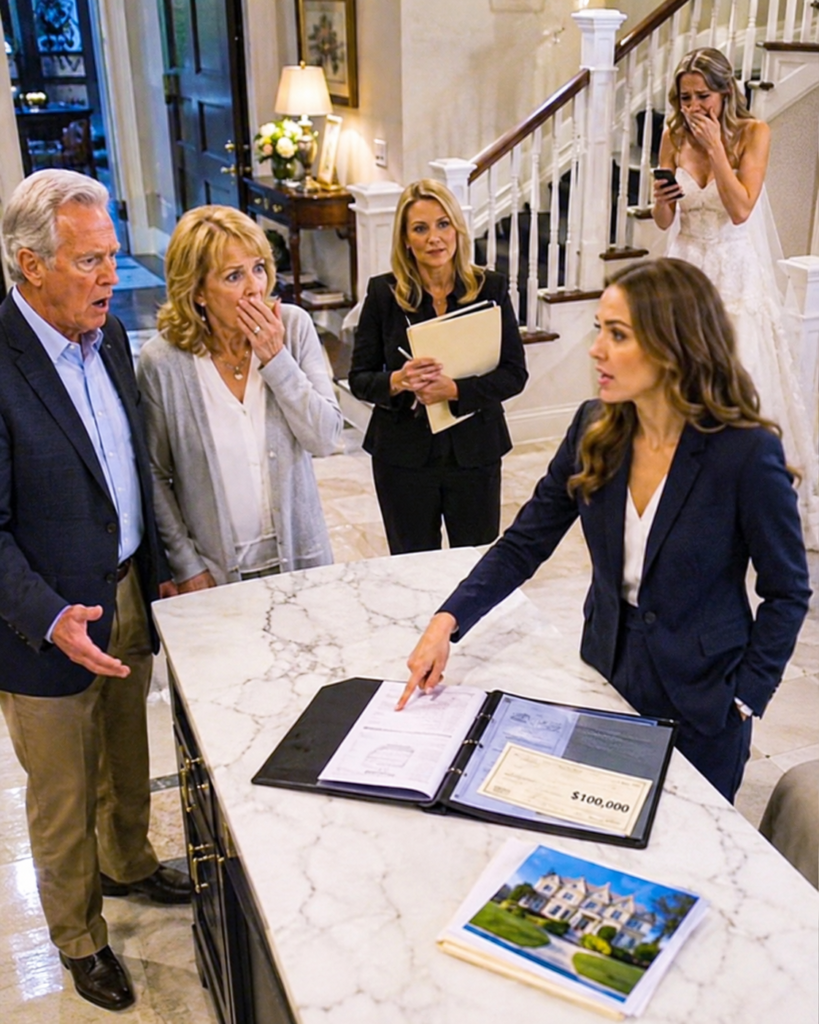
“Everyone,” she announced brightly. “Before dessert, Naomi has a very special surprise announcement about the family’s living arrangements.”
Forty faces turned in my direction.
Harper smiled nervously.
Chase adjusted his jacket.
Mom looked relieved, apparently certain that public pressure would finally make me cooperate.
I picked up the folder and walked toward the microphone.
“My sister wanted a stable foundation for her baby,” I said softly.
Harper smiled too soon.
“But a foundation can’t be built on federal wire fraud.”
The entire room froze.
Even the music stopped.
I opened the folder and placed the first set of documents on the gift table.
Commercial loan application.
False primary residence.
Delinquent debt.
“The document shown here,” I continued calmly, “lists my property as collateral support for an $85,000 commercial rescue loan filed without my authorization.”
Nobody moved.
I pulled out another page.
“This one shows Sterling Auto Consulting currently carrying over $120,000 in combined commercial and personal debt.”
Harper’s face went pale.
Then I produced the eviction notice.
Balance due: $14,88217.
“They’re also being evicted,” I said.
Once again, the room fell completely silent.
Chase looked gray and trapped.
Harper whispered his name, but he had nothing left to perform.
A baby shower had turned into an accounting session.
Guests quietly began stepping away.
Nobody touched the $3,000 dessert spread.
Richard Sterling drew his wife closer.
Linda stared at the eviction notice.
“This can’t possibly be accurate,” she whispered.
Harper remained frozen among the gifts while Chase frantically worked his phone, probably trying to reach lawyers or lenders.
Mom finally reached me.
“Naomi,” she hissed quietly. “What have you done?”
I collected the remaining documents.
“I exposed it.”
“This was a baby shower.”
“No,” I said. “It was a pressure campaign with cupcakes.”
Mom stared around the ballroom in horror as guests began leaving.
Public humiliation frightened her more than the financial evidence.
Behind us, Harper rose unsteadily.
“Mom,” she whispered.
For once, there was nothing theatrical in her voice.
She sounded frightened.
Chase stormed toward me.
“What is wrong with you?” he snapped at me.
The polished businessman was gone.
“You could handle this privately.”
I held his gaze.
“You committed loan fraud privately.”
His expression darkened, but the witnesses surrounding us kept him under control.
Mom stepped between us.
“Everybody just calm down.”
Harper’s crying changed.
It wasn’t performative anymore.
“Chase,” she whispered. “Tell me this isn’t real.”
He gave her no answer.
That told her everything.
“You said the business was fine.”
“It was supposed to recover.”
“Supposed to?”
More guests continued leaving.
Then Mom grabbed my arm.
“Please,” she said.
Her polished composure had disappeared.
“Please just sign the house over temporarily so the bank backs off. Chase could go to prison.”
Finally.
The real request.
Not a nursery.
Not family togetherness.
Asset stabilization.
“Family sacrifice for each other.”
I looked down at the same hands that had signed for my mail and handed Chase my key.
Mom genuinely believed that protecting Harper from consequences was an act of love.
Every crisis had always followed the same pattern.
Harper struggled.
Naomi fixed it.
I looked directly at Mom.
“You spent 30 years teaching Harper she never had to earn anything,” I said.
Her face crumpled.
“You didn’t protect her, Mom. You just made her incompetent.”
Behind her, Harper covered her mouth and cried.
Chase argued into his phone beside the windows.
“No, listen to me. If they freeze the application before underwriting clears—”
Then he suddenly fell silent and lowered the phone.
Whatever he had just heard destroyed the fantasy.
No miracle investor.
No easy recovery.
Only debt, legal consequences, and a baby arriving in five months.
Harper dropped into a banquet chair surrounded by presents.
For the first time, nobody was moving quickly enough to rescue her.
Part of me felt sorry for her.
Not enough to hand over my house, but enough to understand that she had spent her entire life inside a system built to protect her from consequences.
I raised the folder.
“The house is mine,” I said calmly. I looked at Chase.
“The dead is yours.”
Then I turned to Harper.
“Welcome to adulthood.”
Nobody responded.
The remaining guests rushed out as the illusion fell apart.
Chase remained near the windows, staring at his phone.
Harper sat beside the gift table with one hand resting on her stomach.
Mom still had a grip on my arm.
“Naomi,” she whispered again, voice cracking harder this time. “Please.”
Then she suddenly turned toward Dad with renewed hope.
Thomas had spent thirty years choosing silence instead of confrontation.
“Tom,” Evelyn snapped sharply. “Do something.”
He stood near the entrance to the ballroom, watching everything unfold as usual.
Mom pointed at me.
“Fix.”
Not help.
Fix.
As though repairing the damage was somehow my responsibility simply because I refused to finance it.
Thomas finally walked toward Chase and picked up one of the documents.
He silently read it while the remaining staff cleared dishes from the tables.
Chase tried to intervene.
“Tom, I can explain.”
Dad continued reading.
“The market shifted unexpectedly,” Chase continued quickly. “We just needed temporary stability until inventory moved again.”
Thomas finally looked up.
“Did you use my daughter’s address on a federal loan application?”
Chase hesitated.
That hesitation answered the question.
Mom snapped.
“Oh, for God’s sake. This isn’t helping.”
She hurried toward Thomas.
“We can still solve this if Naomi just cooperates for once in her life.”
Cooperates.
I had purchased my house alone at twenty-nine after years of deployments and twelve-hour logistics shifts while Harper and Chase concealed eviction notices behind baby-shower invitations.
Yet somehow, I was the difficult one.
Mom grabbed Dad by the arm.
“You need to make her understand what family means.”
Thomas took off his glasses and folded them.
For the first time, he looked too exhausted to continue pretending.
Mom’s voice became sharper.
“Thomas, say something.”
Finally, he spoke.
“She’s not fixing this, Eevee.”
Mom froze.
Thomas looked at the documents, then at Chase, and finally at his wife.
Because I hadn’t created the problem.
Her expression collapsed.
Thirty years of family dynamics fractured with a single sentence.
Harper cried quietly behind us.
Thomas turned toward Chase.
“Get out of my sight,” he said quietly.
Chase blinked.
“Tom—”
“Before I call the police myself.”
Chase took a step backward.
For the first time, genuine fear appeared on his face.
Harper refused even to look at him.
There was no family shield left between Chase and the consequences.
No Evelyn managing the situation.
No access to my house.
No stable image left for him to hide behind.
He grabbed his coat and walked out.
The ballroom doors closed behind him.
Dad remained there staring at them, looking like a man who had finally begun to understand the cost of decades spent staying silent.
The federal investigation started three weeks later.
There were no dramatic raids.
Only paperwork, certified letters, and phone calls.
One Tuesday at 11:43 p.m., Chase left me a voicemail.
“Naomi, listen. Okay, this thing got bigger than I expected.”
He sounded exhausted.
“They’re asking questions about residency verification now,” he continued. “If you could just confirm—”
I deleted the voicemail before he could finish.
The following morning, I blocked his number.
Harper moved back into my parents’ house two days after the investigation became official because Crestview finally proceeded with the eviction.
Most of the updates came through Thomas.
“Harper’s staying in her old room,” he told me one evening.
I imagined the pale-yellow walls from her high-school years, except now baby brochures and legal notices had replaced prom magazines.
Chase stopped coming around after his second meeting with federal investigators.
At first, Mom continued defending him.
“He was under pressure.”
“The economy hurt everyone.”
“He made mistakes because he wanted to provide.”
That final excuse bothered me the most.
Eventually, when attorneys began using phrases such as document falsification and financial misrepresentation, even Mom had difficulty maintaining her version of events.
One Sunday, Dad called me.
“Your mother keeps saying she doesn’t understand how this happened.”
“And?”
He paused.
“Then I think she’s starting to realize it didn’t happen suddenly.”
That was probably the most direct criticism of Mom I had ever heard him make.
I never went back to my parents’ house after the baby shower.
I didn’t need another family summit disguised as a dinner.
Some relationships don’t end with explosions.
They end with clarity.
By early November, the guest room belonged entirely to me again.
Gray walls.
Books returned to the shelves.
Deployment files neatly organized.
No nursery paint samples.
No decorative lemons.
One rainy evening, I stood there holding my coffee and noticed how different the same room felt.
Not necessarily happier.
Simply honest.
Boundaries don’t always feel warm.
Sometimes they feel quiet.
Sometimes they feel lonely for a while.
But they also allow you to sleep peacefully inside your own home.
One Thursday morning around 8:20, a handwritten envelope from my parents arrived.
I made coffee before opening it.
The letter was carefully worded rather than genuinely accountable.
They wrote that things had become painful, that they loved both of their daughters, that mistakes had been made, and that family should find a way forward.
There was no direct acknowledgment of the house. No acknowledgment of the intercepted mail.
I read the letter once, folded it, and tossed it into the recycling.
I wasn’t angry anymore.
I was done.
That surprised me.
Outside, rain swept through the neighborhood while my kitchen smelled like coffee again.
Home.
Not guilt.
Not obligation.
Mine.
I placed a hand on the biometric deadbolt and turned it.
A crisp click echoed through the house.
That was when I finally understood something Mom never had.
Love without boundaries turns into permission.
And permission eventually turns into entitlement.
Nobody handed me that house.
Nobody rescued me into a stable life.
I built it with deployment checks, missed holidays, long shifts, and years of discipline.
For the first time, it felt completely protected.
Not because I had changed the locks.
Because I had changed.
A few weeks later, I realized the betrayal itself wasn’t what stayed with me.
It was the clarity.
For years, I believed my family respected me because I was responsible.
The truth was that they depended on me because I was responsible.
Those things aren’t always the same.
When you become the dependable person in a family, your competence can begin to feel like public infrastructure.
Your money becomes family money.
Your time becomes availability.
Your calm becomes a place to store everyone else’s chaos.
And the moment you finally protect yourself, suddenly you’re selfish or difficult.
Looking back, nobody had ever respectfully asked me for my house.
Mom presented taking it as sacrifice.
Harper presented it as compassion for the baby.
Chase presented it as practicality.
Different packaging.
The same entitlement.
Family manipulation rarely announces itself honestly.
Nobody says, “I’d like to financially exploit you now.”
Instead, it sounds gentler:
“Family helps family.”
“You have more than enough.”
“Why are you making this difficult?”
“You’d really do this to us.”
Guilt works because decent people don’t want to cause pain.
Responsible people are especially vulnerable because they’re used to solving problems.
I had witnessed it during deployment.
One man nearly drained his retirement account rescuing his brother after a failed business.
Six months later, his brother needed help again.
Then again.
Eventually, both of them were struggling.
You cannot create stability for someone determined to avoid accountability.
Eventually, rescuing becomes maintenance.
And maintenance can destroy the person doing the rescuing too.
That changed the way I saw Harper.
I didn’t hate her.
I was frustrated and disappointed, but I also understood that she had spent her entire life inside a system where consequences disappeared before they could fully reach her.
Late rent became Mom’s emergency.
Bad choices became family discussions.
Financial irresponsibility became stress.
Mom believed she was protecting Harper.
In reality, she was protecting her from learning competence.
Repeated rescue can create dependency disguised as confidence.
That’s why boundaries matter.
Protecting your peace isn’t cruelty.
Refusing to repeatedly finance another adult’s mistakes isn’t cruelty.
Owning the life you worked to build isn’t cruelty.
You’re allowed to say no without presenting a courtroom defense.
I also learned to slow everything down whenever money and emotion appeared together.
Read the documents.
Verify the records.
Protect your credit.
Urgency makes people easier to pressure.
Facts slow manipulation down.
Once I saw the paperwork, the guilt vanished because I was no longer arguing about feelings.
I was looking at reality.
My father taught me another lesson.
He believed silence preserved peace.
It didn’t.
His silence simply allowed dysfunction to continue until the consequences became impossible to ignore.
That’s how many unhealthy families function.
One person creates chaos.
Another enables it.
Everyone else adapts.
Eventually, dysfunction begins to resemble tradition.
After everything ended, the silence in my house initially felt lonely.
No calls from Mom.
No guilt-filled texts.
No emergencies waiting after work.
Then one morning, I realized it wasn’t loneliness.
It was safety.
People raised around chaos can have trouble recognizing peace because peace feels unfamiliar.
My house was calm because nobody inside it was trying to take something from me.
That peace was worth every uncomfortable boundary I had needed to establish.
The experience also taught me that manipulation isn’t always loud.
Sometimes it prepares dinner, asks whether you’ve eaten, hugs you in public, and then quietly pressures you to sacrifice something important.
Mom wasn’t some cartoon villain plotting in the dark.
She genuinely believed maintaining the appearance of a happy family was love.
That was exactly the problem.
Once appearances become more important than truth, destructive decisions can be justified as care.
Our family had always operated through the same pattern.
Harper created chaos.
Mom softened the consequences.
Dad avoided confrontation.
I cleaned everything up.
Everyone had a role.
Mine was stability.
Many families don’t actually resolve dysfunction.
They organize themselves around it.
The reliable child pays, stays composed, and absorbs the pressure because everyone assumes they can handle more.
That role can consume you if you never step outside of it.
Mom called it keeping the peace.
But in our family, peace meant I silently absorbed the discomfort so everyone else could avoid consequences.
That wasn’t peace.
It was maintenance.
Eventually, flexibility turns into expectation.
Expectation becomes entitlement.
Chase taught me something else about appearances.
He spent years constructing the image of stability instead of creating stability itself.
Luxury apartment.
Designer watches.
Tailored suits.
Business talk.
Behind all of it were overdue payments, commercial debt, and eviction notices.
Real stability is usually boring.
Budgets.
Paperwork.
Long hours.
Delayed purchases.
Credit built slowly over time.
Those choices don’t look impressive online, but they’re often the difference between peace and panic later.
Chase performed confidence because eventually performance was all he had left.
That was why documentation mattered.
Facts stabilized the situation.
When emotions are running high, verify before reacting.
Check the records.
Read the contracts.
Protect your identity.
Slow down the decision.
Manipulation thrives on urgency.
Calm makes control more difficult.
My family expected guilt and an emotional response.
Instead, I examined the paperwork.
The performance collapsed quickly.
I also learned that some relationships only function while one person continues sacrificing.
Healthy relationships survive boundaries.
Exploitative relationships often don’t.
The moment I protected my house, I became cold and selfish in their eyes—not because I had suddenly become a worse person, but because my boundaries disrupted a system that had benefited them.
That reaction mattered.
So did understanding the difference between kindness and access. You can love someone without paying their bills.
You can want the best for relatives without handing them the keys to your house.
You can care deeply about family while still protecting your own future.
That isn’t cruelty.
That’s adulthood.
Too many responsible adults wear themselves down trying to earn love through endless sacrifice.
Eventually, dignity has to become more important than approval.
Months later, sitting alone in my living room close to midnight, I finally acknowledged that this story had never truly been about the house.
The house merely exposed the system.
That system had existed long before Chase and his expensive watches, before Harper planned her nursery, before Mom started treating my mortgage like a family resource.
The conflict simply dragged everyone’s roles into the light.
Being the responsible child had shaped me far more than I had understood.
I became fiercely independent.
I automatically solved problems.
I stayed composed because somebody had to.
Eventually, I started confusing being useful with being valuable.
For years, saying no made me feel selfish.
That belief almost cost me my house.
I began thinking about it as emotional debt.
Some families raise one person to believe they are permanently responsible for everyone else’s comfort.
The fixer.
The dependable one.
The person who absorbs all the pressure.
Walking away from that role creates guilt, but guilt doesn’t always mean you’ve done something wrong.
Sometimes it simply means you’ve stopped obeying an unfair expectation.
Once I understood that, I began noticing how often people mistake love for access.
Stop giving them money, and they say you changed.
Stop solving their emergencies, and they say you’re cold.
Stop sacrificing your peace, and they call you difficult.
Sometimes people are more attached to what you provide than they are concerned about your well-being.
Harper was another example of what constant rescuing can create.
For most of my life, I thought of her as spoiled.
Later, I understood that she was also unprepared.
There’s a difference.
Someone who has always been protected from consequences can panic when that protection suddenly disappears.
Watching Harper discover how unstable her life truly was hurt more than I expected.
I didn’t regret exposing Chase.
I would make the same choice again.
But I realized Harper genuinely hadn’t understood how fragile everything around her had become.
I still hope she grows.
I hope becoming a mother makes her stronger and more capable.
But hoping someone becomes better doesn’t mean sacrificing yourself to protect them from the lesson.
Compassion doesn’t require destroying yourself.
You’re allowed to care about someone without drowning alongside them.
There were practical lessons too.
Understand your finances.
Monitor your credit.
Read every contract.
Check property records.
Protect your identity documents.
Don’t give unlimited access to accounts, legal information, or property simply because someone shares your last name.
Trust can create dangerous blind spots.
Patterns matter as well.
Manipulation rarely appears overnight.
Usually, there are years of smaller irresponsible choices, repeated excuses, financial chaos, and charm before the damage becomes impossible to ignore.
If someone repeatedly creates instability, that doesn’t automatically make you responsible for fixing it.
The biggest surprise afterward was how peaceful my life became once I stopped chasing approval.
Some relatives still believe I was too harsh.
That’s fine.
People who benefited from weak boundaries often resent stronger ones because their access changes.
At first, protecting your peace can feel lonely.
Then the loneliness begins to disappear.
What remains is stability.
Real stability.
The kind you can actually sleep inside.
If there’s one thing I hope people take away from this story, it’s that self-respect isn’t cruelty, boundaries aren’t betrayal, and protecting the life you worked to build isn’t selfish.
It makes you an adult.
So if you’re listening to this as someone who has spent years carrying responsibilities that never should have belonged to you, maybe this is your reminder that you can finally put some of that weight down.
You don’t have to destroy yourself just to prove that you love people.
And if this story meant something to you, subscribe to the channel.
There are many people silently carrying emotional debts they never actually owed.
Sometimes hearing the truth spoken aloud is the first step toward finally allowing yourself to live differently.