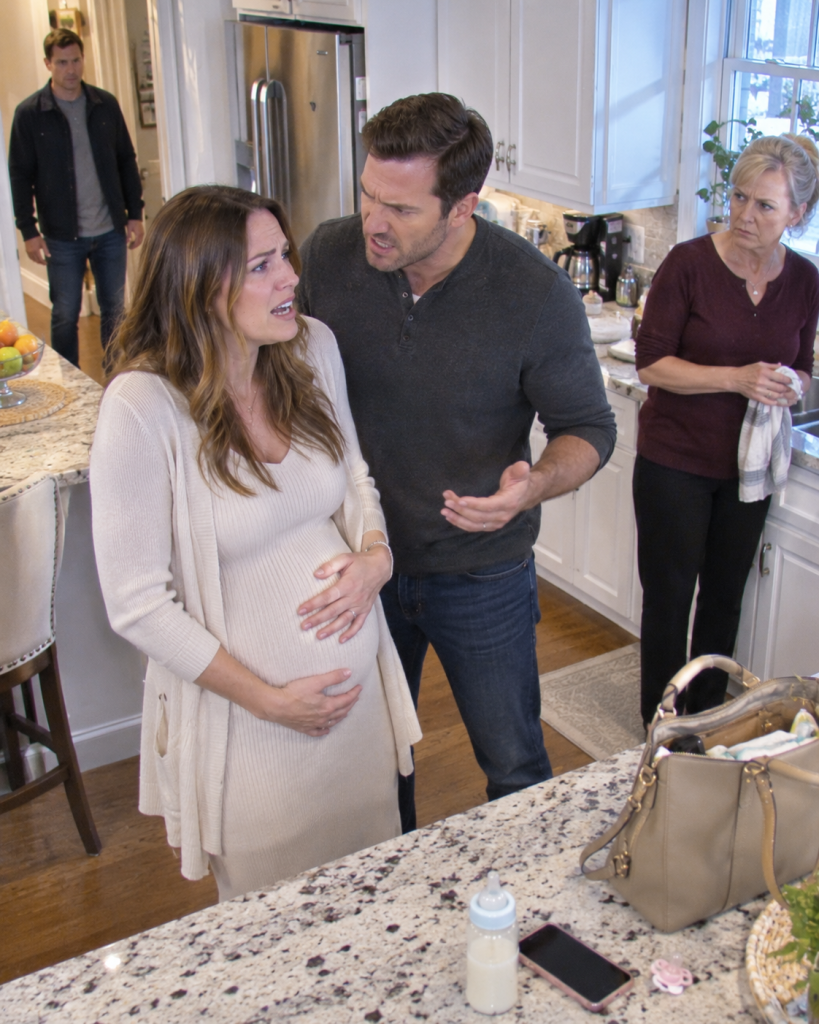
At seven months pregnant, the weight of the child should have been the heaviest thing I carried. Instead, it was the crushing atmosphere of a home that no longer felt like mine, suffocating me room by room, day by day, until breathing felt like a deliberate act of defiance. I knew the argument had gone too far the moment Daniel forced me back against the refrigerator, his grip heavy and uncompromising on my shoulders.
What scared me most wasn’t the initial shock of the physical confrontation or the sudden, cold fury in his eyes. It was the sharp, terrifying spike of pain in my lower abdomen and the sudden, ice-cold fear that something might be terribly wrong with my baby.
Standing just feet away, watching the entire exchange with a look of cold, detached vindication, was Lorraine, Daniel’s mother. She stood beside the kitchen sink, clutching a damp cleaning cloth in her wrinkled hands as though I had somehow orchestrated the entire chaotic situation to inconvenience her.
Lorraine had spent the entire afternoon following me from room to room like a prison warden. She had scrutinized every surface, pointing out nonexistent fingerprints on the stainless steel appliances, imaginary crumbs on the hardwood floors, and a laundry basket sitting in the hallway—one that I had been specifically, explicitly told by my obstetrician not to carry due to my high-risk status.
“Being pregnant doesn’t mean you get to turn into an invalid and stop helping around the house, Claire,” Lorraine had lectured earlier, her voice dripping with a condescending sweetness that made my skin crawl. “In my day, we worked right up until our water broke. A little dusting never hurt anyone.”
I had paused, leaning against the doorframe to catch my breath, and reminded her calmly that my doctor had ordered strict pelvic rest and told me to avoid heavy lifting and excessive bending because I had already started experiencing premature, irregular contractions.
She had merely scoffed, rolling her eyes as if my medical condition was a personal insult directed at her housekeeping standards.
That was when Daniel had walked through the front door, fresh from work, his expression already clouded by the ambient tension that Lorraine manufactured daily. He didn’t ask how I felt. He didn’t look at the sweat beading on my forehead. He only saw his mother looking aggrieved.
Before he could launch into another tirade about my supposed laziness, the exhaustion and the months of pent-up resentment finally broke through my defenses. I looked him dead in the eye and answered:
“If the house isn’t clean enough for you and your mother, Daniel, you are more than welcome to clean it yourself.”
His expression changed instantly, shifting from annoyance to a dark, dangerous rage. He crossed the kitchen floor in two long strides before I could push away from the counter, closing the distance and blocking me completely against the refrigerator door.
“Don’t ever talk to my mother like that again,” he warned, his voice dropping to a low, menacing hiss that vibrated right through my chest. “She is a guest in this house, and you will show her the respect she deserves.”
Lorraine crossed her arms over her chest, leaning her hip against the counter with a smug little smirk playing at the corners of her mouth.
“Apologize to him right now, Claire,” she chimed in, playing the victim with practiced ease. “And apologize to me for your hostile tone.”
I lowered my eyes, staring fixedly at the collar of Daniel’s shirt.
Not because I agreed with them. Not because I was backing down.
Because beneath the fabric of my oversized sweater, my thumb was discretely pressing a pre-programmed emergency shortcut on the side of my smartwatch three times in rapid succession.
Two weeks earlier, following another terrifying argument where Daniel had cornered me in the hallway and smashed a ceramic mug against the wall, I had quietly purchased a small, high-definition security camera and mounted it high in the kitchen corner, disguised behind the pantry molding.
Daniel had noticed it during one of his inspections, of course. He had dismissed it with a wave of his hand, calling me paranoid, dramatic, and hormonal, asking why on earth I needed to spy on my own family.
I hadn’t argued with him. I simply left it there, considering it my only line of defense in a house that was rapidly turning into a fortress of psychological warfare.
Furthermore, I hadn’t just relied on the camera. Over the past month, acting on a quiet, gut-deep instinct that told me things were going to get much worse before they got better, I had spent hours quietly scanning and uploading digital copies of the original house deed, my personal financial records, insurance documents, medical charts, and a chronological log of troubling text messages to a secure, encrypted cloud account that neither Daniel nor Lorraine could access.
“I’m sorry,” I said quietly, keeping my voice submissive and flat.
A second later, a subtle, rhythmic vibration buzzed against my wrist.
Sync complete. The recording of the entire confrontation—audio, video, and timestamp—had uploaded successfully to the secure server.
Daniel let out a harsh breath, stepping back just enough for me to draw a full breath into my lungs. “Good. Now go upstairs and stay there until dinner is ready. You’re making everyone miserable.”
I didn’t argue. I turned and walked away.
That night, long after Daniel’s heavy snoring echoed from the master bedroom and Lorraine’s door clicked shut down the hall, I moved through the dark house like a ghost. I didn’t turn on a single light. Using only the pale glow of my phone screen, I packed my identification, irreplaceable family photographs, a few changes of comfortable clothes, and the heavy canvas bag containing my pre-packed hospital essentials.
I slipped out through the side garage door, got into my car, and drove directly through the quiet, empty streets to St. Catherine’s Medical Center.
The triage nurses took one look at my pale face and the trembling in my hands and rushed me straight back to labor and delivery. The electronic monitors were strapped across my belly immediately.
For twenty agonizing minutes, the room was filled with the rhythmic, galloping sound of static, until the digital sensor locked onto a steady, reassuring beat.
Thump-thump. Thump-thump.
My daughter’s heartbeat was strong and resilient.
The overwhelming wave of relief hit me so hard that I curled into a ball on the hospital bed and sobbed until my throat burned. The attending physician, a kind-grained older woman with sympathetic eyes, confirmed what I already feared: the severe emotional stress and physical constriction of the confrontation had triggered a dangerous spike in uterine activity, resulting in intense early contractions and significant pelvic discomfort. Thankfully, timely intervention and absolute rest stabilized my baby girl, but the doctor made it abundantly clear that returning to that house would be an unacceptable hazard to both of us.
By 3:00 AM, a hospital social worker and an onsite legal advocate sat beside my bed, reviewing the case notes.
“Do you have somewhere safe to stay?” the advocate asked gently, her clipboard resting on her knees. “Do you need us to help you find a women’s shelter or transitional housing?”
Instead of answering her directly, I reached over to the bedside table, unlocked my phone, and opened the secure cloud folder. I played the kitchen security footage, turning the screen toward her.
Within an hour, a nighttime duty detective with the local police precinct had received a direct, encrypted copy of the video file. I also forwarded the older, threatening voice messages Daniel had sent during previous disputes, along with screenshots of text exchanges where he systematically isolated me from my friends and attempted to control my financial access.
My attorney, Maya Reynolds—a formidable family law specialist whom I had quietly retained three weeks prior under the guise of updating my will—was notified by emergency dispatch. Before the first pale streaks of dawn painted the horizon, Maya had drafted and filed an emergency protective order, citing imminent physical danger and medical endangerment to an expectant mother.
Then, during a pre-dawn phone call, Maya dropped another bombshell that made my blood run cold.
“Claire,” Maya said, her voice taut with urgency. “Do you remember those papers Daniel and Lorraine had you sign about six weeks ago? The ones they swore were just standard administrative paperwork for municipal household expense rebates and utility allowances?”
“Yes,” I whispered, gripping the hospital phone tightly. “They said if I didn’t sign them immediately, we’d lose our local tax exemption.”
“Well, I pulled the filing records from the county clerk’s public portal just now,” Maya stated grimly. “That isn’t what those documents say at all. Attached to your signature page is an entirely different legal addendum. It’s a formalized occupancy agreement granting Lorraine permanent, irrevocable life-estate rights to remain in your home, completely independent of Daniel or your marital status. Essentially, they engineered a backdoor transfer of residential occupancy rights right out from under you.”
I sat frozen in the hospital bed, the sterile white sheets suddenly feeling like a straitjacket. “Can they do that?”
“Not legally without full disclosure, independent legal counsel, and an uncompromised chain of custody for the documents,” Maya said firmly. “Someone took your signature page from a completely unrelated document and physical-grafted it onto a predatory property clause. But here’s our saving grace: Do you have the original digital file or email record of the papers you actually signed that afternoon?”
A wave of intense vindication washed over me. “Yes. I scanned the exact pages into my personal laptop the moment they handed them to me, and I emailed the original PDF to you for my estate file that very same afternoon.”
“Brilliant,” Maya breathed, a rare note of triumph in her voice. “Hold onto that thought. By eight o’clock this morning, we are going to pay them a little visit.”
Part 2: The House of Cards
The morning sun was bright and blinding when I pulled my car back onto the familiar residential street. My heart hammered wildly against my ribs, but for the first time in months, the fear was laced with cold, unyielding resolve.
I walked up the front steps, pushed the door open, and stepped into the foyer.
Daniel was sitting lazily at the kitchen island, a ceramic mug of steaming black coffee cradled in his hands. He didn’t even look up when the front door clicked shut, assuming I was crawling back with my tail between my legs after a night spent sleeping in my car or at a friend’s couch.
“Tell Mom you’re sorry for your little drama exhibition last night,” he said, his tone casual, dripping with the arrogant assumption of total domestic dominance. “She’s already making breakfast, and we don’t have time for your tantrums today.”
My phone was recording from deep inside the pocket of my wool coat, the microphone capturing every rustle and inflection.
“I didn’t sleep at a friend’s house last night,” I said evenly, stepping around the island. “I went to the hospital.”
Daniel’s hand froze halfway to his mouth. The coffee sloshed over the rim of the mug.
Lorraine, who had been standing by the stove flipping pancakes, whipped around so fast her spatula clattered against the iron skillet.
“For what nonsense?” she snapped, her voice rising in defensive panic. “We had a routine family argument, Claire. Don’t go crying to outsiders just to get attention.”
“The hospital documented every single detail of what happened,” I replied, my voice chillingly calm. “They recorded the uterine contractions, the physical bruising, and the medical threat your son’s actions posed to his unborn child.”
Daniel stood up so fast his barstool tipped backward, crashing loudly against the tiled floor. He stared at me, his face flushing a mottled, angry crimson. “You told medical professionals about us? Are you out of your mind? You’re airing private family business to strangers?”
“The kitchen camera didn’t need my permission to document it,” I said.
Daniel’s eyes shot upward, darting automatically toward the small black lens hidden above the pantry molding. Realization dawned on him instantly, followed by a blind, animalistic panic.
Lorraine immediately dropped her spatula and lunged backward toward a kitchen stool, her hands trembling.
“It won’t matter what your little spy camera caught,” I said, stepping back toward the exit. “The footage, the audio files, and the medical reports are already backed up securely online. If anything happens to me or my phone today, copies go straight to the county prosecutor and the family court commissioner.”
Lorraine let out a sharp gasp and slowly stepped away from me, as if I carried a contagious disease.
Snapping out of his momentary shock, Daniel lunged forward. Before I could react, he grabbed my overnight bag from the hallway floor and upended it violently. Prenatal vitamins, folded clothes, toiletries, backup chargers, and copies of my medical paperwork scattered across the kitchen tiles like discarded trash.
“You are going to call whoever you spoke to at that hospital right now, and you are going to retract every single lie you told them!” Daniel roared, stepping directly into my personal space, his finger jabbing toward my chest. “You are going to fix this, or so help me god—”
“No,” I interrupted.
For the very first time since the day we married, I didn’t soften the answer. I didn’t hedge, I didn’t apologize, and I didn’t try to manage his fragile ego.
Through the large bay window overlooking the front lawn, an unmarked dark sedan glided down the street and stopped precisely at our curb.
Lorraine noticed the car through the glass, her eyes going wide with sudden dread. “What… what did you do, Claire? Who is that?”
I looked slowly around the kitchen, taking in every familiar detail with a detached, melancholy clarity.
The pale oak cabinets my aunt had chosen when she remodeled the kitchen back in 2012. The French garden doors leading out to the patio. The wide hardwood floors that had absorbed decades of family history.
This house had never belonged to Daniel. It had never belonged to Lorraine.
It had belonged to my maternal aunt. When she passed away three years before I met Daniel, she left the property entirely to me in her clear, unencumbered will. The house had been completely mortgage-free long before Daniel and I ever shared an address. My name—and my name alone—was printed on the official county deed locked away in the safety deposit box.
Yet, from the very first month of our marriage, Daniel had deliberately referred to it as “our house,” subtly linguistic-engineering my inheritance into communal property. And when Lorraine had moved into our guest room six months earlier under the guise of staying “just for two weeks while her apartment complex underwent plumbing repairs,” she had systematically taken over. She rearranged my kitchen drawers, threw away my aunt’s recipe cards, criticized my cooking, and gradually began speaking to guests and neighbors as though she was the matriarchal owner of the estate.
“I finally had Maya review those occupancy papers you tricked me into signing,” I said loudly, cutting through Daniel’s sputtering threats.
Daniel’s face drained of color, the angry flush replaced by a sickly, pallid gray.
He and Lorraine had smugly assured me that I had signed an agreement legally granting her long-term, unevictable occupancy rights in the property. They thought they had legally cornered me, turning me into a tenant in my own ancestral home.
But that wasn’t what happened.
I had signed a standard, innocuous household-expense form regarding local utility rebates. Later, behind my back, a completely different set of predatory legal terms had been physically attached to my signature page using forged bindings.
Maya had both versions side by side on her desk. The fraudulent document wasn’t going to give them what they wanted. It was going to land them in criminal court for fraud and forgery.
A marked police cruiser pulled up directly behind the unmarked sedan, its tires crunching softly against the gravel driveway. Blue and red lights began to pulse softly against the living room curtains, silent and ominous.
Panic officially shattered Lorraine’s facade. She scrambled across the kitchen floor, scooped up my scattered medical papers and legal notifications, and began ripping them furiously in half.
“There!” she screamed, her voice cracking with hysteria as paper scraps fluttered down like confetti. “Now you have nothing! You have no proof of anything!”
I looked down at her with a calm, pitying expression that infuriated her even more.
“Those were just working copies, Lorraine,” I said smoothly. “The originals are already filed with the district court.”
Daniel lost his remaining shred of self-control. He lunged forward again, his hand reaching out to grab my arm, clearly intending to physically drag me away from the door.
I didn’t flinch. I stood my ground right beside the kitchen exit, exactly where Maya had instructed me to wait.
Click.
The front door swung wide open, pulled from the outside by a gloved hand.
“Daniel Mercer!” a sharp, authoritative voice called out from the hallway, echoing off the high ceilings. “Step away from Claire immediately. Keep your hands where we can see them.”
Daniel froze mid-motion, his arm hanging awkwardly in the air.
Detective Marcus Hale stepped into the kitchen, flanked by a uniformed county police officer. And right behind them, carrying a crisp leather portfolio containing the freshly signed court orders, walked Maya Reynolds.
For the first time since Lorraine had dragged her suitcases across my threshold six months ago, neither Daniel nor Lorraine controlled a single second of what was about to happen next.
Part 3: The Reckoning and the Garden
Lorraine immediately scrambled backward, pointing a trembling, accusatory finger directly at my chest as if she could magic away reality through sheer volume.
“She broke into her own home! She brought police here! She started all of this hostility out of nowhere!” Lorraine shrieked, her voice echoing shrilly off the kitchen walls.
Detective Hale didn’t even blink. He stepped past her, offering me a brief, reassuring nod before turning his attention back to Daniel.
Maya remained completely calm, stepping forward with the quiet grace of a predator securing its territory. She addressed the officers and the room at large with absolute authority.
“This is Claire’s separate, protected property, Mrs. Mercer,” Maya stated clearly, pulling a certified copy of the county deed from her portfolio. “Her name is the sole name registered on the title. Neither you nor Mr. Mercer hold any legal ownership or unassailable tenancy rights to this address.”
Lorraine stared at the documents in utter disbelief, her mouth opening and closing like a fish out of water.
Daniel slowly lowered his hands, taking a hesitant step back as the uniformed officer stepped forward to secure the perimeter. The police officers systematically documented the chaotic condition of the kitchen, the scattered belongings across the floor, the shredded copies of the medical records, and the blinking security camera mounted above the pantry.
Then, Maya stepped forward and handed Daniel a thick packet of formal court documents.
It was an emergency ex parte protective order. It explicitly prohibited Daniel from any direct or indirect contact with me, mandated his immediate physical removal from the property, and temporarily barred him from approaching within five hundred yards of the house until the full evidentiary hearing could be scheduled.
Simultaneously, the second officer handed Lorraine a formal notice of immediate tenancy termination and eviction, backed by the district magistrate’s signature due to fraudulent inducement and hostile domestic endangerment.
Lorraine snatched the paper from the officer’s hand, reading the bold legal headings twice with bulging eyes.
“You can’t make me leave!” she shrieked, clutching the paper to her chest like a shield. “I’m family! I have rights! This is an outrage!”
I looked down at her, feeling not an ounce of anger, only a profound, liberating pity.
“Being family, Lorraine, doesn’t mean you get to trample someone’s boundaries, forge their legal documents, and turn their home into a prison,” I said quietly.
Realizing that intimidation and indignation were no longer working, Daniel instantly pivoted to frantic, pathetic excuses.
He stammered, his voice cracking. He babbled about extreme work stress, overwhelming family pressures, marital misunderstandings, and miscommunications blown out of proportion. Then, in the ultimate cowardly retreat, he pointed his finger right back at me, claiming I was unstable, emotional, and vindictive.
I didn’t argue with him. I didn’t raise my voice to match his frantic pitch. I didn’t waste a single breath trying to make him understand.
I simply let the cold, hard evidence speak for itself.
At the formal court hearing two weeks later, Daniel’s defense attorney tried to spin the entire situation as an isolated domestic disagreement exacerbated by normal pregnancy hormones and minor family friction.
Maya stepped up to the podium and systematically dismantled their narrative piece by piece. She presented the kitchen security footage showing the escalation of aggression, the St. Catherine’s hospital records detailing the physical and emotional trauma, the professional counseling notes documenting months of systemic gaslighting, the preserved text messages proving a calculated pattern of isolation, and the forensic document examiner’s report proving beyond a shadow of a doubt that my signature had been fraudulently extracted and spliced onto Lorraine’s occupancy addendum.
The family court judge was scathing in his assessment of Daniel and Lorraine’s conduct.
The protective order was not only extended for a full three years, but Daniel was also mandated to complete a rigorous, court-monitored intervention program for domestic abusers, cover all of my accumulated medical and legal expenses, and maintain absolute radio silence. When Daniel foolishly attempted to send indirect messages through mutual acquaintances a month later, the court slapped him with severe contempt penalties, making it crystal clear that bypassing the order through proxies carried immediate criminal consequences.
The fraudulent property documents became the centerpiece of a separate civil fraud and forgery investigation. Faced with the prospect of felony indictments and undeniable forensic proof, Daniel and Lorraine’s high-priced defense attorneys finally advised them to fold. They completely abandoned all claims to my house. As part of a comprehensive, binding settlement agreement, they also surrendered any right to contest the expedited divorce filings or financial asset divisions.
Lorraine packed her belongings into a cheap set of plastic suitcases and moved out into a small, dreary apartment across town.
For the first few weeks, the silence in the house was deafening. I would sit in the living room and catch myself jumping at imagined footsteps in the hallway, expecting to hear Lorraine’s critical voice or Daniel’s heavy, impatient tread on the stairs.
Then, gradually, something profound shifted within me.
The heavy silence stopped feeling lonely. It began to feel deeply, beautifully peaceful.
Daniel’s employer, a prestigious regional corporate firm, quietly terminated his client-facing executive position after his legal troubles and court filings became public knowledge within professional circles. I didn’t call his office. I didn’t leak court documents to his colleagues. I simply stopped stepping in to protect him from the natural, inevitable consequences of his own toxic decisions.
Four months later, surrounded by pristine white hospital walls and the gentle hum of medical monitors, I gave birth to a stunningly healthy, bright-eyed baby girl.
I named her Hope.
By the time Hope was two months old, I knew beyond a shadow of a doubt that I could never stay in that old house. Too many dark corners, too many kitchen tiles, and too many ghosts were permanently tethered to a life I had permanently left behind.
So, I listed the ancestral home on the market. It sold within forty-eight hours to a young, growing family who would fill its rooms with laughter rather than tension.
Hope and I moved into a sun-drenched, single-level modern bungalow nestled on a quiet, tree-lined street just three blocks away from my sister. The new house had expansive picture windows that flooded every room with natural light, a private, fenced-in backyard with a flourishing vegetable garden, and a quiet, tranquil atmosphere that settled over my soul like a warm blanket.
No one stood over my shoulder criticizing how I folded laundry.
No one pawed through my personal paperwork or audited my private bank accounts.
No one made me feel like I had to apologize for simply existing, taking up space, and breathing air in my own home.
The financial settlement from the sale and divorce provided a secure, unshakeable foundation, allowing me to set up a dedicated college education fund for Hope while I transitioned back into my career on my own terms.
My body healed completely from the physical trauma of the pregnancy and the stress-induced labor. But I quickly realized that the hardest habit to break wasn’t physical at all.
It was my deep-seated psychological reflex to whisper “I’m sorry” every single time someone else behaved badly, rudely, or unreasonably around me.
For years, I had falsely believed that keeping the peace meant keeping my mouth shut. I had operated under the delusion that protecting a broken marriage meant absorbing every cruel remark and keeping every systemic problem hidden behind closed doors. I had convinced myself that being a patient, loving partner meant constantly offering toxic people endless second chances at my own emotional expense.
I didn’t believe any of that nonsense anymore.
On the bright, sunlit morning of Hope’s first birthday, my phone buzzed on the patio table while I watched my daughter chase a golden-retriever puppy across the grass.
It was a brief, cheerful text message from Maya. Daniel’s latest legal petition to prematurely modify and reduce the protective order had been summarily denied by the judge with prejudice. Furthermore, Lorraine’s pathetic, last-ditch civil claim attempting to sue for “grandparent visitation rights and emotional damages” had been instantly thrown out of court for lack of standing.
I read the notification once from start to finish.
Then, with a quiet, satisfying sense of closure, I tapped the screen and deleted the message permanently.
Outside in the vibrant green garden, little Hope was sitting cross-legged on a patterned picnic blanket, laughing hysterically as my sister blew bright, shimmering soap bubbles into the air above her head.
I locked my phone screen, slipped it deep into my pocket, and walked across the grass toward them.
For the first time in my entire adult life, I wasn’t wondering how Daniel would react to my movements. I wasn’t hyper-vigilant about Lorraine’s critical opinions or facial expressions. I wasn’t mentally drafting apologies for things I hadn’t even done wrong.
I simply bent down, scooped my giggling daughter up into my arms, and held her tight against my chest, walking together toward a bright, unclouded future where both of us were finally, unconditionally allowed to feel safe, valued, and free.
And that hard-won peace was worth infinitely more than everything I had ever left behind.