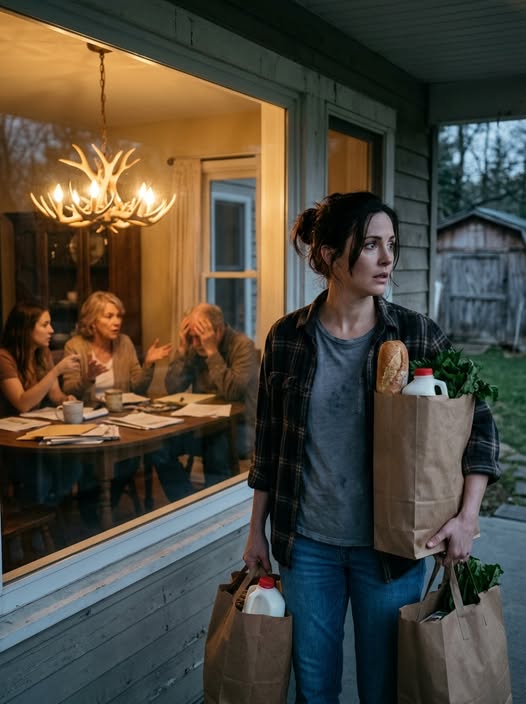
For one entire week, my nine year old daughter sat in a loud, crowded school cafeteria with almost nothing except the painful discomfort of an empty stomach.
While I sat inside a climate controlled office negotiating commercial insurance deductibles and believing my family was completely secure, the same people I was financially supporting were quietly allowing my child to go without proper meals.
It surfaced at exactly five o’clock on a rainy Thursday afternoon in early May.
The refrigerator door was hanging wide open, spilling pale light over three lonely yogurt cups, a half empty carton of eggs, and some dry pasta I was attempting to convince myself to cook.
She was nine years old, but at that moment, with her shoulders curved forward and her chin lowered toward her chest, she seemed incredibly small and vulnerable.
Her tiny fingernails carefully picked at the paper label on an empty water bottle, ripping it into little uneven pieces.
My phone buzzed against the granite countertop, and the caller ID lit up with the word Mom.
I tapped the speaker button while continuing to stare inside the nearly empty refrigerator and said, “Hello, Mom, how are you today?”
“Rachel,” my mother, Brenda, said, her voice carrying that familiar casual tone she always used when trying to manage my life.
“We need to adjust a couple of things moving forward regarding our daily arrangements.”
“What things?” I asked, removing the carton of eggs from the glass shelf.
“The money you send for Penelope’s school lunches,” she stated simply.
I immediately stopped moving, my hand suspended above the cardboard carton.
Every Sunday evening, without fail, I electronically transferred twenty five dollars into my mother’s account, exactly five dollars for each school day.
It was hardly a fortune, but it was a deliberately calculated amount intended to cover Penelope’s breakfast.
On mornings when I had early client meetings, it also covered a hot cafeteria lunch and an afternoon snack before my mother picked her up.
The memo line in my banking app was always exactly the same, clearly stating that the money was for Penelope’s school meals.
“What about it?” I asked, feeling the first faint ripple of unease travel up my spine as I placed the eggs on the counter.
Through the phone speaker, my mother gave a small, controlled sigh.
It was the familiar exhale she always made immediately before announcing something deeply inconsiderate while expecting me to admire her supposed practicality.
“Your daughter’s lunch money is now going to your brother,” she stated calmly without a single hint of hesitation.
“Austin is unemployed right now and needs help.”
My mouth instantly became completely dry, and across the kitchen, the soft crinkling of the plastic water bottle stopped as Penelope’s hands froze.
“What did you just say to me?” I asked, my voice dropping lower as concern settled heavily inside me.
“Austin needs it more right now, Rachel,” she replied with complete certainty.
“Don’t be dramatic about this, because it is only five dollars a day, and Austin desperately needs gas money so he can drive to his job interviews.”
My mind, conditioned by years of calculating insurance premiums and evaluating risk, automatically began working through the simple numbers.
There had been four school days the previous week and four this week, making eight days altogether.
I slowly turned toward Penelope and asked softly, “Bug, when was the last time you ate a hot lunch at school?”
She refused to look up, keeping her gaze fixed on the pile of shredded paper on the counter while pulling her hands deep into the oversized sleeves of her sweater until her fingers disappeared completely.
“Last Monday,” she whispered, barely loud enough to be heard over the refrigerator’s hum.
The kitchen suddenly seemed painfully cold, and my fingers went numb.
That had been almost ten full days earlier, meaning she had gone without proper meals for nearly two complete school weeks.
“They gave me milk twice,” she added, her voice trembling faintly as if she were apologizing for having become an inconvenience to the cafeteria workers.
I left the phone sitting on the counter and slowly stepped toward her, asking gently, “What did you eat on all the other days, Penelope?”
Penelope lifted her shoulders in a small shrug without looking away from the granite and said, “Sometimes Maya would give me half of her turkey sandwich during recess.”
A freezing knot of dread tightened in my stomach and briefly left me unable to speak.
My heart hammered violently against my ribs, yet on the outside, I remained unnaturally still as the full reality of what had happened finally reached me.
“What about breakfast in the mornings?” I asked, moving another step toward her stool.
“I told Grandma that I was not hungry,” she whispered softly.
My mother’s loud voice came through the speaker, completely unaware of the enormous shift taking place inside my kitchen.
“She can easily take crackers to school, Rachel, and she will be completely fine.”
I watched my daughter visibly shrink in front of me, lowering her chin closer to her collarbone as though she wanted to disappear entirely.
“Mom,” I said, pressing both palms flat against the cold granite beside the phone.
“Penelope told you she was not eating, and she told you her cafeteria account was completely empty, so what exactly did you tell her?”
“I told her that she needed to be flexible because family members help each other during difficult times,” Brenda replied without an ounce of concern.
Penelope’s wide brown eyes filled with heavy tears, but she forced them to remain open because she seemed afraid that blinking would make those tears spill down her face.
“Why didn’t you tell me about this right away?” I asked my daughter, my voice cracking under the weight of restrained emotion.
She swallowed hard, making a tiny clicking sound in her throat, and murmured, “Grandma said you were far too busy with work to be bothered by this.”
“You are always busy, Rachel,” my mother chimed in, instantly becoming defensive.
“I am her grandmother, and I try to help this entire family manage every day, so I simply redirected the funds to a thirty four year old man who is having a very difficult time.”
“You took money that was explicitly meant to put nutritious food inside my daughter’s stomach,” I stated, each heavy word tasting bitter as it left my mouth.
“She did not starve to death!” Brenda snapped back through the speaker.
That one sentence changed the course of my life immediately.
Nothing physically shattered, and none of the kitchen lights flickered, but somewhere deep inside me, it felt as though a massive iron door had slammed shut forever, ending years of my compliance.
I picked up the phone and pressed it tightly against my ear.
“Rachel,” my mother warned sternly.
“Do not start an argument over this because I am not in the mood to deal with it, and you always overreact whenever Austin needs a little bit of support.”
I looked directly at Penelope, who was watching me with the heartbreaking expression children wear when trying to decide whether the adults around them are actually willing to protect them.
“Send me a complete list,” I said, my voice unnervingly calm and almost completely emotionless.
“Send me a detailed list of every single lunch payment I transferred to you, along with every matching amount you forwarded to Austin.”
“That is an utterly ridiculous request,” she scoffed.
“Send it to me tonight,” I demanded firmly, “or I am completely stopping all financial support to your house starting right now.”
“I do not report to you, Rachel!” she shouted.
“You certainly do when you redirect money that was meant to feed my child,” I replied coldly.
My mother gave a short, deeply offended laugh before saying, “Fine, go ahead and be selfish, and let us see how far that attitude gets you in life.”
The call went completely silent when she abruptly hung up.
Penelope finally blinked, and one heavy tear slipped down her pale cheek as she asked, “Are you mad at me, Mommy?”
I crossed the kitchen in three long steps and dropped onto my knees beside her stool, taking both of her small hands into mine.
“No, baby, absolutely not, because I should have known about this and checked the online portal myself, so you should never have been put in a position where you had to hide your hunger from me.”
“I just did not want Grandma to get in trouble,” she sobbed softly into the sleeve of her sweater.
I gently held her small, tear stained face between my hands and encouraged her to meet my eyes.
“Listen to me very carefully right now, because adults are entirely responsible for the choices they make, and your only responsibility is to tell me when you are hungry, scared, or hurt, so telling the truth is never going to get someone in trouble.”
She slowly nodded, her lower lip trembling, and whispered, “I was really hungry today, so I took a small pack of graham crackers from Mrs. Gable’s desk, but they were meant for emergencies, which means I stole them.”
“This was an actual emergency,” I firmly assured her while kissing her forehead.
I immediately stood, grabbed my coat and car keys, and drove her directly to a neighborhood diner only two blocks from our house.
She ordered chicken tenders, a huge pile of hot French fries, applesauce, and a large glass of chocolate milk.
When the waitress placed the heavy plate in front of her, Penelope started eating with an urgency that completely shattered my heart.
She ate much too quickly and nearly coughed before noticing that I was watching her with tears filling my eyes, and then she immediately slowed down and glanced at me nervously.
“You do not have to save any of it,” I told her softly, struggling to hold back my emotions.
“You can eat every single bite, and if you are still hungry after this, we will order another plate.”
She nodded, but that newly learned uncertainty was already embedded inside her, causing her to leave one chicken tender untouched along the edge of the plate until the very end, saving it in case the food somehow disappeared again.
Late that evening, after I tucked her into bed and waited until her breathing settled into deep sleep, I carried my laptop to the kitchen table.
I signed into my primary banking application and began carefully reviewing the digital records.
There were eight separate Sunday transfers to my mother for twenty five dollars each, totaling two hundred dollars, and every one contained the identical memo explaining that the money was for Penelope’s school meals.
Then I logged into the school district’s official cafeteria portal and checked the account.
The page loaded slowly, revealing the disturbing reality: no deposits had been made for eleven full school days, leaving her balance at negative four dollars and twenty cents.
I immediately captured screenshots, downloaded the complete transaction record, and converted everything into a PDF.
I saved the file inside a new folder on my desktop titled Penelope Food Fund.
But my investigation was nowhere near finished.
I opened the premium grocery delivery account I had created for my parents eighteen months earlier, when my father, Leonard, retired early because of a serious back injury.
At the time, my mother had insisted that money was impossibly tight, especially after my brother Austin moved back into his childhood bedroom following his third apartment eviction.
I clicked through the full billing history and discovered that the previous month’s grocery total exceeded two thousand eight hundred dollars, while the month before had reached nearly two thousand seven hundred dollars, every cent charged directly to my primary credit card.
Out of pure curiosity, I opened the upcoming Sunday delivery that was already sitting inside their online shopping cart.
The list was astonishingly expensive: four bone in ribeye steaks, three cases of premium energy drinks, two cases of imported beer, a large container of whey protein powder for Austin, and an eighteen dollar artisan cheesecake.
I stared at the glowing screen for a long, silent hour while the full extent of their choices gradually became impossible to deny.
While my young daughter was taking basic graham crackers from a teacher’s desk because she was hungry, I was actively financing my brother’s fitness routine and my parents’ expensive weekend meals.
I did not scream, and I did not smash a single glass.
Instead, I methodically deleted my credit card information from the account, canceled the scheduled delivery, and changed the password to a complicated sequence of random characters.
Then I spent another two hours downloading eighteen complete months of grocery invoices and carefully preserving every piece of evidence.
The conflict had officially started, and what none of them understood was that years of working as an insurance agent had taught me precisely how to document everything.
Part 2: The Architecture of Extraction
My name is Rachel Davis, and I am thirty six years old.
I earn my living evaluating financial risk, calculating percentages of loss, and reading the fine print surrounding human dis@sters, yet for almost ten years, I had intentionally ignored the enormous financial liability sitting at the center of my own private life.
I am the only parent in our household who remembers school permission slip deadlines, schedules pediatric dental visits, tracks rapidly changing shoe sizes, and knows exactly which night the library books need to be returned.
Penelope’s father, Marcus, lives five hours away in Salt Lake City, Utah, with his new wife and their newborn son.
Marcus pays his court ordered child support on the first of every month, calls Penelope every Sunday afternoon, and has her during alternating school breaks.
We certainly are not close friends, but we have developed a functional peace where neither of us ever uses our daughter as leverage against the other.
My family, however, seemed strangely disappointed by the lack of constant conflict.
My mother, Brenda, believed every divorce required a clearly defined villain, and because Marcus refused to play the role of irresponsible father, communicating only through short and polite emails, she regularly assigned that position to me instead.
“You have always had a remarkably difficult time keeping people around you, Rachel,” she had casually told me over an expensive steak dinner that I was paying for shortly after my divorce became final.
That was the familiar pattern in my family: they were perfectly happy to accept my strong work ethic, endless financial help, personal time, and even my vehicle, but they could never accept that providing those things also gave me the right to occasionally say no.
Austin was two years younger than me, a thirty four year old man who had been unemployed seven separate times over the previous six years.
He had quit a stable warehouse job because the floor supervisor was supposedly too strict about the electronic time clock, abandoned an apprenticeship because the required uniform shirt irritated his skin, and lost a delivery job after using the company van to move a friend’s heavy furniture across state lines.
Every time something collapsed, my mother repeated the same familiar script, insisting that he only needed a fresh start, that the world was much too hard on him, and that family always helps family.
The first time I truly recognized this unhealthy pattern had been three years earlier, when I painstakingly saved twelve hundred dollars for new brakes and heavy duty snow tires for my car.
In Idaho, dependable snow tires are an essential safety necessity during difficult winters when the roads can freeze completely.
Mom called me in a complete panic one evening, saying Austin’s electricity had been shut off.
“He has no heat in his apartment, Rachel!” she cried into the receiver.
“He relies entirely on electric heating, which means he is going to freeze!”
“Mom, what happened to his paycheck from the landscaping company?” I asked while staring at my own limited bank balance.
“He has personal expenses, and I have my own expenses to worry about too.”
“Please, Rachel, he is your only brother!” she pleaded loudly.
Against every sensible instinct I possessed, I transferred eight hundred dollars directly to the utility provider and cleared his outstanding account balance.
Two days later, a mutual friend sent me a screenshot from Austin’s social media page showing him wearing an expensive concert wristband at an upscale downtown bar, posing beside a bottle of premium bourbon.
When I confronted my mother with the picture, she offered no apology and immediately produced another excuse.
“He has been feeling so low lately, Rachel, so he really needed one evening out to feel like a normal person again.”
I drove through the entire month of November on tires so worn that my car slid whenever I turned into the office parking lot, repeatedly convincing myself that the sacrifice was only temporary.
The second major incident occurred when Penelope was seven, after my parents offered to keep her during spring break because my office was severely understaffed.
I packed a large suitcase with clothes, her asthma inhalers, favorite storybooks, and an envelope containing eighty dollars in cash labeled Penelope’s Zoo Money.
On Wednesday afternoon, Mom texted me a picture of Penelope sitting stiffly on their living room couch while Austin’s young son, Noah, happily drove a brand new remote control truck across the carpet.
That evening, Penelope called from my parents’ bathroom, speaking in the quiet voice she always used whenever she was desperately trying not to create trouble.
“Mommy,” she whispered softly through the phone.
“What is wrong, Bug?” I asked, setting my work documents aside.
“Grandma spent my zoo money,” she admitted quietly.
“What did she spend it on?” I asked, immediately feeling my frustration rising.
“Noah really wanted that giant remote control truck at the toy store,” she explained.
I firmly closed my office door and asked, “Did you guys at least get to go see the animals at the zoo?”
“No,” she replied sadly.
“Grandma said we needed to stay home because Noah was far too tired after playing with his new truck.”
When I stopped at their house after work to collect Penelope, I immediately demanded the eighty dollars back.
My mother looked genuinely confused by my frustration and dismissively shrugged.
“It all went to the kids, Rachel, so what is the big deal here?” she asked.
“That money was specifically set aside for Penelope’s field trip,” I stated firmly.
Mom casually waved one hand and said, “Oh, come on now, because she is simply learning how to be generous with her cousins, and real family does not keep score like that.”
People usually insist family does not keep score when they are the ones consistently receiving far more than they ever return.
I convinced myself I could manage this financial imbalance if I stayed relentlessly organized, so I established strict rules, labeled every transfer clearly, and paid Austin’s utility providers directly rather than giving him cash.
I mistakenly believed healthy boundaries could be constructed from detailed memo lines inside banking applications, but I was wrong.
The financial burden grew gradually at first, beginning with six hundred dollars every month to help with essential groceries while my father recovered from his back surgery.
Then Mom added expensive household cleaning supplies, then meat prices increased, then Austin moved back into their spare bedroom, and eventually Noah started spending every weekend there.
By the Thursday night when I sat at my kitchen table calculating the cumulative amount, their grocery expenses alone were averaging almost twenty eight hundred dollars each month.
I earned a respectable income as an insurance agent, with a base salary of fifty eight thousand dollars and commercial commissions increasing my overall earnings, but my resources were not unlimited.
After taxes, my mortgage, and Penelope’s expenses, the crushing weight of my family’s requests often left me with less than four hundred dollars in checking before payday, forcing me to postpone my own dental appointments while continuing to purchase Austin’s organic protein powder.
I tolerated the constant financial pressure mainly because my mother held the strongest leverage over my daily routine: childcare.
My insurance agency expected me at my desk by eight every morning, while Penelope’s elementary school did not open until a quarter to eight.
On mornings with early client renewal meetings, Mom drove Penelope to school, and she also collected her in the afternoons, repeatedly reminding me that she and Dad were making my career possible.
For years, I believed her completely, genuinely convinced that I could not function without their daily assistance.
But as I stared at the detailed spreadsheet I had created, showing that I had given them more than sixty seven thousand dollars over the previous eighteen months alone, that long held belief finally collapsed.
I shut my laptop at two o’clock in the morning.
I had successfully canceled the grocery card and gathered all the information I needed, but the most difficult part remained: I had to face the school staff the following morning and prepare for the inevitable flood of messages once my family woke up.
Part 3: The Intercepted Notes
The pressure began at exactly seven o’clock the next morning.
I stood behind Penelope in the main bathroom, gently brushing her hair, when my phone vibrated loudly against the countertop.
Mom was calling, and I immediately ignored it, but two minutes later she called again, followed soon afterward by Austin, then my father.
By twenty minutes after seven, our family group chat was overflowing with an uninterrupted stream of angry notifications.
Mom sent a message saying, “Rachel, we need to talk like rational adults immediately so answer your phone right now.”
Austin typed, “Did you seriously cut off the grocery card this morning? What is your major problem?”
Dad added, “Your mother is extremely upset about this situation, so call her back this instant.”
Mom sent another message claiming, “This sudden decision is messing with your father’s strict dietary needs.”
I did not respond to any of them, instead taking clear screenshots of the entire conversation and saving them inside my documentation folder.
At twenty three minutes after seven, my mother sent a private text saying, “Penelope completely exaggerated what happened because they offered her plenty of food at school.”
I set the hairbrush on the counter, looked at my daughter’s reflection, and asked gently, “Bug, did anyone at the school offer you a full hot lunch this week?”
She shook her head firmly, her brown eyes widening as she answered, “No, Mommy.
The head cafeteria lady, Mrs. Gable, said my account was completely empty, so she gave me a small carton of milk on the first day, but the next day she told me I could not get in the hot food line until I brought money from home.”
“And what exactly did Grandma pack inside your backpack for you?” I asked gently.
Penelope lowered her gaze toward her little hands, visibly em.bar.ras.sed as she admitted, “A four pack of saltine crackers just one time.”
A sudden wave of nausea moved through my stomach as I said, “I am making you fresh eggs right now, because you are going to eat a big breakfast with me today.”
Rather than entering the chaotic morning drop off lane, I parked my Subaru in the visitor lot and walked Penelope directly into the school’s main office.
Bright fluorescent lights hummed overhead as I approached the front desk, where the office manager, Mrs. Miller, was organizing the morning absence notes.
“Good morning, Mrs. Davis,” she said with a warm smile.
“How can I help you today?”
“I need to conduct a complete review of Penelope’s cafeteria account right now,” I said, keeping my voice controlled while making the seriousness of my request unmistakable.
Mrs. Miller entered Penelope’s name into her computer, and her friendly smile vanished, replaced almost immediately by professional concern.
“Oh, I see what you mean.
Mrs. Miller’s expression shifted into one of deep sympathy as she pressed a button on her keyboard, causing the office printer to begin humming.
She pulled a fresh sheet of paper from the printer tray and handed it across the counter.
I examined the official ledger, which showed eleven consecutive denied meal charges, three reduced price emergency milk items, and a bold note stating that formal payment deficiency notices had been sent home inside the student’s backpack on May eighth and May twelfth.
“I never saw a single one of these warning notices,” I said, my voice dropping almost to a whisper, “even though I carefully check her folder every single night.”
Mrs. Miller gently gestured toward Penelope, who was staring silently at the carpet, and explained, “Those notices were physically handed directly to her so she could place them inside her take home folder.”
I turned toward my daughter as frustration gave way to a disturbing realization and asked, “Penelope, where are those yellow warning notes from the school cafeteria?”
“Grandma took them,” Penelope whispered softly toward her shoes.
Goosebumps rose across my arms, and a chill traveled through my entire body despite the warmth of the office.
“She took them directly out of your school bag?”
“She checked my backpack as soon as I got into her car,” Penelope admitted quietly.
“She took the yellow papers out and told me that she would handle the situation, saying I should not bother you with it because you work far too hard.”
Mrs. Miller leaned across the high counter, her voice gentle and protective as she asked, “Penelope, sweetie, did your grandmother specifically tell you not to tell your mother that you were going hungry at school?”
Penelope gave one unhappy nod without raising her gaze.
At that exact moment, the school’s HVAC system started overhead with a heavy click, a small mechanical noise that grounded me in reality and helped me remain composed.
“Mrs. Miller,” I said, straightening my shoulders firmly.
“Please print every single document connected to this account immediately, because I need to complete the paperwork to permanently remove my mother, Brenda, as an authorized contact for my daughter.”
“We can process those forms right now,” Mrs. Miller replied, pulling a fresh stack of administrative papers from a nearby drawer.
“I also want her removed from the authorized pickup list beginning today,” I added firmly.
I signed three separate administrative forms with fast, determined strokes, adding my trusted coworker and close friend, Sarah, as the primary emergency contact while listing Marcus as the authorized secondary parent.
I changed the cafeteria portal password to a complicated code and handed Mrs. Miller my credit card to deposit three hundred dollars directly into Penelope’s meal account.
Before leaving, I looked Mrs. Miller directly in the eyes and said, “I need to ask a very clear, documented question.
Did my daughter go without a standard hot lunch for seven school days because no payments were being made?”
Mrs. Miller paused briefly, clearly recognizing the seriousness of what I was asking, before answering, “Our school district policy is to provide basic emergency items like milk or crackers if an account is severely overdrawn, but according to our official ledger, yes, she did not receive a standard meal for seven days.”
“Please put that exact statement in writing and email it to my personal address,” I requested firmly.
“I will compose that email for you right away,” she promised.
I did not raise my voice or accuse the school employees of deliberately mistreating my child, because they had been following an imperfect bureaucratic policy, so I focused solely on collecting clear, verifiable documentation.
I kissed Penelope’s forehead, promised her a wonderful dinner that evening, and drove directly to my insurance office.
At four minutes after nine, while I was starting my desktop computer, my mother’s first voicemail appeared on my phone.
“Rachel, this situation has gone entirely too far!” she shouted through the receiver.
“The school just sent me an automated message saying my pickup privileges have been completely revoked, but you cannot simply ban me from Penelope’s life over a simple misunderstanding!”
The second voicemail came from Austin, who said, “You know that I am out here trying my best every day, right Rachel? I desperately needed gas money to drive to a job interview, and I needed food, so Mom said you would not mind spotting me a few bucks, so call me back because you are acting completely crazy.”
The third voicemail came from my father, stating, “Your mother simply made a difficult judgment call, Rachel, and families always share their resources, so you are tearing this entire family apart over mere pennies.”
I saved all three recordings directly into my digital evidence folder.
At twenty two minutes after nine, I sent my mother a brief text saying, “Send me the complete bank transfer log for the lunch money by noon today.”
She replied almost instantly, typing, “I do not have to prove my personal accounting methods to my own daughter.”
I immediately responded, “Then do not ever contact me asking for my money ever again.”
At fifteen minutes after ten, my agency manager, a sharp woman named Brenda, gently knocked on my glass office door and asked, “Are you doing alright today, Rachel? You have been staring at that same insurance deductible page for ten minutes straight.”
I looked up and decided to tell her the truth, sharing enough important details to explain why I might require an extended lunch break and why I had changed my emergency contacts.
She listened without interrupting, her expression becoming increasingly concerned as I spoke.
When I finished, she did not offer empty advice about forgiving family, nor did she tell me to calm down and focus on my brother’s emotional difficulties.
Instead, she looked directly at me and said, “Rachel, document every single dollar they have ever taken from you, and do not let any of them step foot inside this office building.”
At twenty seven minutes after twelve, my phone vibrated with a message from my mother containing a screenshot of her bank history.
It displayed multiple electronic transfers between her account and Austin’s, showing amounts including seventy five dollars, fifty dollars, and twenty five dollars, with timestamps matching my Sunday morning deposits.
Beneath the image, she wrote, “See? The money went directly toward basic daily needs, so I have provided the proof you wanted.”
I enlarged the screenshot and could barely believe what appeared on the screen.
One of Austin’s payment request memos clearly said Sports betting app, another read Bar tab, and a third simply stated Pay me back later.
I replied immediately, typing, “You transferred Penelope’s food money directly to Austin for alcohol and online gambling, which your own financial records clearly confirm.”
My mother called within seconds, and I answered while turning on the recording function on my office desk phone.
“Why did you physically take those yellow warning notices out of Penelope’s backpack?” I asked immediately, skipping every usual pleasantry.
“I just did not want to worry you with extra stress,” she stammered, her earlier confidence quickly draining from her voice.
“That is not what happened,” I replied firmly.
“You removed them because you knew you had redirected money that was specifically intended for her meals.”
“I was going to handle the bill, Rachel!” she shouted through the speaker.
“I was fully planning to put the money back as soon as Austin got paid!”
“Austin does not have a job!” I responded.
“Give me the exact date you were planning to replace that money so my daughter could eat a proper meal!”
A thick silence stretched across the phone for several long seconds.
“You are questioning me like I am some kind of criminal!” she finally gasped.
“I am asking you when my young daughter was going to be able to eat a hot meal at school!” I replied.
My mother’s tone changed abruptly, the softer approach disappearing as her frustration became obvious.
“Well, maybe she needs to learn to be a little more grateful for what she has! Some children in this world have absolutely nothing to eat, so going a few days eating crackers builds strong personal character!”
I stared through my office window at the heavy rain hitting the glass and said, “My daughter had plenty of money for food, Mom, because I provided it every week, but you gave it to a grown man.”
“Do you honestly think you are so much better than the rest of us,” she replied sharply, “just because you sit in a fancy corporate office all day?”
“I think Penelope deserves to eat food,” I stated clearly.
I ended the call, feeling an unfamiliar calm settle over me as the image I had maintained of our family finally started collapsing.
That brief peace lasted only twenty minutes before the front desk receptionist called my office extension, sounding deeply concerned.
“Rachel, there is an extremely angry man standing in the main lobby demanding to see you right now, and he is being very loud.”
I immediately rose from my chair and looked through the glass wall toward the front entrance.
My brother Austin was standing there.
Part 4: The Glass House Ambush
Austin stood directly in the middle of our immaculate corporate lobby, looking completely out of place against the professional surroundings.
He wore faded gray sweatpants, a stained black hoodie, and pristine two hundred dollar basketball sneakers, the exact shoes my mother had recently claimed his son desperately needed for the new school year.
I quickly left my private office and intercepted him before he could move farther into the employee hallway, saying, “You need to leave this building right now, Austin.”
He dramatically lifted both hands as though surrendering, giving our nervous receptionist a smooth, practiced smile.
“Hey there, sis, we certainly do not have to make a scene here at your workplace, but you were not answering any of my phone calls.”
“You came to my workplace simply because I stopped providing money,” I said, keeping my voice low and controlled.
“What exactly do you want from me?”
His smile immediately vanished, and he leaned slightly closer, carrying the faint odor of stale beer mixed with inexpensive cologne.
“Mom’s grocery account is completely locked out right now, Rachel.
They tried to place an order this morning and the system kicked them out, so they have no food at home.”
“They received a two hundred and twelve dollar grocery delivery just four days ago,” I replied firmly, “so that food did not simply disappear.”
“Dad needs specific high quality foods for his medical condition,” he answered sharply.
“The Sunday cart order included four expensive ribeye steaks, two cases of beer, and a giant tub of protein powder for you,” I replied without backing down.
“Do not use Dad’s health as a reason for me to continue buying your workout supplements.”
Austin’s face flushed red as he replied, “You always love throwing your money right in our faces, don’t you? You love making the rest of us feel like absolute peasants!”
“I never once mentioned the cost of anything,” I answered steadily, “until you accepted money intended for my young daughter’s school meals so you could spend it at a local bar.”
“She simply skipped a few school lunches!” he replied loudly, stepping closer.
“Kids skip lunch all the time, but you are cutting Mom and Dad off completely just to punish me!”
“I am stopping automatic payments from my personal bank account,” I explained clearly.
“Keeping my own money is not a punishment being inflicted upon you. It is simply a boundary I am choosing to establish.”
He stepped even closer, entering my personal space as he said, “You owe Mom and Dad big time, Rachel.
You owe them for watching Penelope every day, and you would be completely screwed without Mom driving her to school.”
“I paid Mom over three hundred dollars a month for childcare while Penelope was being told to keep important information from me,” I stated firmly.
“That entire arrangement is permanently over as of today.”
His eyes widened with genuine surprise, showing that he had never expected this degree of resistance and apparently believed my reaction would fade after a short time.
“You cannot just take Penelope away from Grandma like this, because she truly loves that kid.”
“She cared for Penelope while allowing her meal money to be redirected toward your online sports gambling,” I stated flatly.
“Get out of my office right now.”
My manager, Brenda, appeared suddenly at the far end of the hallway with her arms folded across her chest, asking, “Is there a serious problem here, Rachel?”
Austin turned his practiced smile toward her and said, “No problem at all, just a minor family misunderstanding that we are settling.”
“No,” I corrected him loudly.
“I asked him to leave the premises immediately, and he is refusing to comply.”
Brenda picked up the heavy lobby telephone while keeping her eyes fixed on Austin and stated, “I am calling building security and the police right now.”
Austin glared at me and muttered, “Are you seriously doing this to your own family over a few stupid bucks?”
“Yes,” I replied without hesitation.
He spun around and walked quickly through the entrance, shoving the heavy glass door hard enough that it bounced against the frame.
At twenty minutes before six that evening, I drove to Penelope’s elementary school to pick her up from the after school care program I had hurriedly enrolled her in earlier that morning.
When she climbed into the back seat, she looked exhausted but unexpectedly peaceful.
“Did you eat a good lunch today?” I asked immediately, watching her through the rearview mirror.
She nodded eagerly and gave me a detailed report, saying, “I had square pizza, baby carrots, sliced peaches, and a carton of chocolate milk.”
“How much of it were you able to eat?” I asked softly.
“I ate every single bit of it,” she answered proudly, before hesitating and picking at the seam of her backpack.
“Mommy, am I still going to Grandma’s house tomorrow morning?”
“No, Bug,” I replied gently.
“I enrolled you in the early morning program right here at the school, so you will eat breakfast in the cafeteria with your classmates and play in the gym until class starts.”
“Is Grandma really mad at us?” she asked quietly.
“She probably is,” I answered honestly.
Penelope nodded slowly and asked, “Are you mad at me too?”
I reached toward the back seat and gently squeezed her knee, saying, “Never, Bug.
Not for a single second, and especially not for being hungry.”
Her entire small body visibly relaxed, and the tension she had been carrying across her shoulders seemed to melt away.
That evening, while I sat on the couch reviewing commercial insurance documents, my phone vibrated continuously with incoming messages.
My mother sent twenty three texts over two hours, claiming Dad’s blood pressure was rising because of my decision, that Austin was emotionally struggling, and that young Noah would notice the missing premium groceries and feel unloved.
She accused me of humiliating her in front of the school employees and claimed grandparents possessed legal visitation rights in our state.
I answered none of them, instead systematically capturing screenshots of each message and adding them to my growing collection of evidence.
Then, at fourteen minutes after eleven that night, she sent the one message that completely reinforced my decision.
She wrote, “I made a necessary judgment call regarding where our family’s money was needed most at that exact moment, and quite honestly, I would do the exact same thing again.”
I read it twice to make absolutely certain I had understood correctly.
My mother had just given me written confirmation that she stood behind her decision to redirect money intended for my daughter’s food.
I captured a clear screenshot, placed it inside the digital folder beside the school documentation and grocery receipts, and finally went to bed.
The largest confrontation was still waiting for Sunday morning.
Part 5: Insufficient Funds
Sunday morning arrived beneath a bright, crisp sunrise over the city.
I woke at seven and found six missed calls on my phone from Mom, Dad, Austin, and then Mom again.
At eleven minutes after seven, Dad left a frantic voicemail saying, “Rachel, your mother is heading to the grocery store right now, so you need to fix the card situation immediately before she reaches the checkout lane and stop this foolish nonsense.”
I changed nothing.
By forty five minutes after eight, Penelope and I were together in our kitchen making fresh pancakes, with her carefully measuring flour while I sliced ripe strawberries.
My phone rang again with Mom’s number on the screen, and I allowed it to go directly to voicemail.
At eighteen minutes after nine, she called again, and knowing exactly where she was, I finally answered, saying, “Hello?”
“Rachel,” she said sharply, her voice filled with anger and echoing slightly as though she were inside a large store.
“They just declined my card at the register!”
“That credit card belongs to me, Mom,” I stated calmly.
“There are dozens of people standing behind me in line, Rachel!” she shouted.
“People from our local community whom I know personally!”
“Then I strongly suggest you step out of the checkout line,” I replied.
“I have a completely full cart of groceries here!” she said.
“The cashier has already scanned all four of the ribeye steaks!”
“I canceled that grocery account on Thursday night,” I explained while turning a pancake on the hot griddle.
“I removed my payment details completely right after you told me that you redirected Penelope’s lunch money to Austin.”
“You need to fix this error right now!” she demanded.
“Open your mobile app and authorize this charge immediately!”
“No,” I answered, the word clear and final.
Mom lowered her voice and asked, “Do you have any idea how incredibly hum!liating this is for me? Standing here at a busy register with a declined card?”
I looked toward Penelope, who was happily arranging strawberry slices into a large smiling face on top of her pancake.
“Penelope stood in her school lunch line with zero money in her account for seven consecutive days while all her friends watched,” I replied, keeping my voice steady.
“That was deeply embarrassing for her, whereas the situation you are facing today resulted from a decision you knowingly made.”
“That is not the exact same thing at all!” she replied angrily.
“You are right,” I agreed.
“Because you are a grown adult who made a choice.”
A cashier’s polite voice drifted faintly through the phone in the background, saying, “Ma’am, do you have another form of payment today? I can suspend this transaction if you need to step aside for a moment.”
Mom covered the microphone, but I could still hear her anxious answer as she said, “Just give me one quick minute, please!”
She returned to the call and pleaded, “Rachel, please, reactivate the card right now! What are your father and I supposed to eat this week?”
“You and Dad receive a reliable monthly retirement pension,” I pointed out, “and Austin is a thirty four year old man who is fully capable of working, so all of you can buy your own groceries.”
“You know our monthly bills!” she argued loudly.
“We cannot afford to pay for this full cart of food!”
“Then you should have considered that financial reality before redirecting twenty five dollars that was specifically meant to feed a nine year old child,” I replied.
She took an uneven breath as she realized emotional pressure was no longer changing my decision, and her desperation rapidly turned into anger.
“I am leaving this grocery store right now, and I am driving straight over to your house so we can settle this matter face to face!”
“Do not come onto my private property,” I warned her firmly.
“You cannot say no to your own mother!” she shouted.
“I just did,” I said, and ended the call.
At thirty one minutes after nine, our family group chat suddenly exploded with rapid notifications.
Mom sent a message stating, “Rachel just purposefully left me stranded and completely humiliated at the grocery store register!”
Austin typed, “This behavior is literal financial a.b.u.s.e, Rachel, and you are seriously sick in the head.”
Dad added, “Fix this situation right now or we are completely done as a family.”
Aunt Linda joined the conversation, asking, “What on earth is going on here? Susan, are you doing okay?”
Austin immediately replied, saying, “She cut off essential financial aid for Mom and Dad all because I borrowed twenty five dollars for gas money.”
I stared at the screen in disbelief.
Borrowed twenty five dollars, he claimed, ignoring the hundreds of dollars redirected over time, the unpaid cafeteria account, and the seven school days when my daughter had gone without a complete meal.
I opened my phone’s file manager and selected the comprehensive PDF containing the official school ledger, screenshots of bank transfers, eighteen months of detailed grocery invoices, and the screenshot where my mother explicitly stated that she would make the same decision again.
I typed one message into the extended family group chat:
“The grocery funding was permanently stopped because Mom deliberately redirected money meant for Penelope’s school lunches to Austin, causing Penelope to go seven full school days without a complete meal.
I have attached the official school records, bank transfer statements, Mom’s written confirmation, and grocery invoices totaling over forty nine thousand dollars that I have paid over the last eighteen months. I will not be discussing this matter any further, and anyone who continues bringing this topic up to me will be blocked.”
I pressed send, watched the large files appear in the group conversation, and switched my phone to silent mode.
At twenty six minutes after ten, Aunt Linda called my direct number, and I answered, saying, “Hello, Aunt Linda.”
“Rachel…” Her voice trembled with obvious shock.
“Did Penelope really go without her lunch at school?”
“Yes, she did,” I confirmed honestly.
“Why on earth didn’t Susan tell any of us about this?” Linda asked.
“She explicitly told the whole family that you were just being extremely stingy with your money.”
“She explicitly instructed Penelope to hide the truth from me,” I explained, “and she physically removed the warning notices sent home by the school cafeteria.”
Aunt Linda remained quiet for a long moment before saying, “I am looking at these bank statements you posted, along with the grocery total… over forty nine thousand dollars?”
“Yes, Aunt Linda, that is the actual total,” I replied softly.
“I had absolutely no idea,” she admitted quietly.
“She told everyone in the family that you barely helped them out at all.”
“That was her version of the situation,” I said.
At twenty six minutes after ten, my father called, and I answered expecting that perhaps he might apologize, but instead he raised his voice at me for the first time in my adult life.
“You just posted private and highly sensitive financial information inside the family group chat!” he shouted through the speaker.
“You made your mother look completely dishonest in front of everyone!”
“I shared official transaction records involving my own personal money,” I replied firmly, “along with her exact written text messages.
If those records reflect badly on her choices, that is a consequence of the decisions she made.”
“She was simply trying to help your brother!” he shouted back.
“He is your family!”
“She took essential food money away from my young daughter!” I replied, my voice shaking with emotion.
“Penelope is my own flesh and blood!”
Dad went completely silent, and behind him I could hear my mother crying.
When he finally spoke again, his voice was cold as he said, “You need to apologize to your mother immediately for embarrassing her like this, and we will be arriving at your house in twenty minutes to get this entire situation sorted out.”
“Do not come to my house,” I stated firmly.
“I am not opening the door for any of you.”
“You cannot keep us away from our own granddaughter!” he shouted.
I ended the call immediately, my hands trembling under the pressure of the confrontation.
I looked toward Penelope, who sat peacefully at the counter finishing breakfast, unaware of the confrontation that might soon reach our home.
I picked up my phone, called the local police department’s non emergency line, and prepared to establish one final boundary.
Part 6: The Siege of Sanctuary
The police dispatcher answered on the second ring, saying, “Police Department, how can I assist you today?”
“Hello,” I said, forcing myself to keep my voice completely steady and controlled.
“I need to put an official request on record regarding a potential security issue.
I have family members who are threatening to come to my private residence to escalate a serious financial dispute, and I have explicitly instructed them through text and phone not to come onto my property.”
“Has there been any physical violence or direct physical thre, ma’am?” the dispatcher asked while I heard her keyboard clicking rapidly in the background.
“No,” I answered truthfully.
“There are no direct thre of physical violence at this moment, but emotions are extremely high, and I have my nine year old child inside the home with me, so I want my clear refusal of entry documented officially.”
She created a formal incident report and read the reference number to me, which I carefully wrote on a yellow sticky note and placed on the granite kitchen counter.
Next, I opened my laptop and composed an urgent email to the family law attorney who had represented me during my divorce.
I wrote three concise paragraphs explaining what had happened, attached the official school documents, and requested immediate preparation of a formal cease and desist letter directing my parents and brother not to contact Penelope’s school or enter my property.
At forty three minutes after ten, I forwarded the same documentation to Marcus, who called only three minutes later.
“Is Penelope completely alright?” he asked immediately, his voice carrying an unusual degree of concern.
“She is completely fine right now, Marcus, and she is eating breakfast,” I assured him.
“Do you need me to drive up there right now?” he offered.
“I can be at your house in five hours.”
“No, I have the situation under control,” I replied calmly.
“I just need you to send a quick email response to the school principal confirming that you fully agree with the safety restrictions I placed on my parents.”
“I will compose and send that email right now,” Marcus promised without hesitation, then paused as frustration entered his voice.
“Rachel… did your mother seriously take her school lunch money just to give it to Austin?”
“Yes, she did,” I confirmed quietly.
He released a heavy breath and said, “Put my name down to pay for half of the new after school program expenses moving forward.”
“Marcus, you already pay your full child support every month,” I reminded him.
“You do not have to pay extra.”
“I know I don’t,” he answered firmly, “but put me down for half anyway, because nobody is going to leave my daughter without proper meals.”
At six minutes after eleven, before I could finish my coffee, a series of extremely heavy knocks thundered through the house as someone repeatedly struck the solid oak front door.
Penelope froze at the kitchen island, her fork suspended halfway to her mouth as her eyes widened with fear.
“Mommy… is that Grandma outside?” she whispered.
“Yes, Bug, it is,” I answered softly, trying to remain as calm as possible.
Another series of violent knocks shook the wooden frame, making the heavy brass knocker rattle against the door.
“Rachel!” my mother shouted from the porch, her voice muffled by the thick wood but edged with anxiety.
“Open this door right now!”
Dad’s deeper voice followed closely behind hers as he called, “We need to talk about this situation right now, Rachel, so stop avoiding us!”
Austin shouted from near the edge of the porch, saying, “You completely embarrassed all of us in front of Aunt Linda, so open the door!”
I walked toward the island and took Penelope’s trembling hand, saying softly, “Come with me into the back room, Bug.”
I quickly guided her down the hallway toward my master bedroom at the rear of the house.
“Are they going to break our windows?” she whispered, her voice shaking as tears formed in her eyes.
“No, sweetie,” I reassured her, crouching until I was directly at eye level.
“How do you know for sure?” she asked anxiously.
“Because the front door is locked, all the windows are securely locked, and I am not going to open them for anyone,” I explained gently.
“We are safe in here.”
I turned on her favorite animated movie, adjusted the television volume, and handed her my noise canceling headphones, saying, “Put these on your ears, Bug, and I will be standing right outside in the hallway the entire time, so I won’t leave you.”
She nodded and placed the headphones over her ears, although her face remained pale from the sudden stress.
That was precisely when I stopped seeing the pounding at my front door as simply another family disagreement.
I looked at my young daughter sitting nervously on my bed, frightened inside the one place where she should have felt entirely safe.
My family had carried their conflict directly into my child’s home.
I pulled my phone from my pocket and immediately dialed 911.
“911, what is your emergency location?” the operator asked calmly.
“I called earlier today and received an official incident report number,” I said, keeping my voice controlled.
“The individuals I reported are currently at my home, repeatedly pounding on my front door and refusing to leave the property.”
The loud knocking continued in the distance, and through the side window I heard Mom shouting, “Are you actively trying to give your father a heart attack, Rachel? Open this door!”
“Officers are currently en route to your location, ma’am,” the dispatcher assured me over the line.
“Please keep all your doors locked and remain inside.”
I stood firmly in the hallway, staring down the corridor toward the front entrance as the metal door handle rattled, but I refused to respond to their shouting or engage in another argument.
Instead, I waited silently.
Twelve long minutes passed before flashing blue and red lights from a police cruiser reflected brightly across my living room windows.
Part 7: The Boundary of Law
I watched carefully through the sheer curtains as two uniformed police officers climbed out of their marked cruiser and crossed my front lawn.
My next door neighbor, Mrs. Gable, stood on her nearby porch holding a green watering can, watching everything unfold with wide eyes.
One officer, a tall man with a serious expression, immediately approached my father near the porch steps, while the second came to the door and knocked with a steady, authoritative rhythm.
“Police department!”
I unlocked the deadbolt and stepped onto the porch, pulling the heavy door closed behind me so nobody could look inside the house.
The crisp morning air touched my face, but I stayed composed.
Mom immediately tried to move toward me, fresh tears marking her face as she cried, “Officer, she is keeping us completely away from our own granddaughter, and she is clearly not thinking rationally!”
“Ma’am, step back immediately,” the officer instructed firmly, raising one hand to stop her.
Then he turned toward me and asked, “Are you the official homeowner at this address?”
“Yes, I am Rachel Davis,” I answered clearly.
Austin scoffed loudly from the driveway, saying, “This is a massive waste of taxpayer money, because we are just trying to talk to my sister about a simple family misunderstanding!”
I ignored him, pulled my phone from my pocket, opened the text conversation, and handed the device directly to the officer nearest me.
“I explicitly asked them in writing not to come to my home today, which I have fully documented right here.”
The officer carefully read the illuminated screen, adjusted his shoulder radio, and read my exact message aloud so everyone on the porch could hear it.
“‘Do not come to my house.’ Well, that instruction seems very clear to me.”
In the cold morning air, I watched my mother’s expression completely change as her anger faded and the seriousness of the situation finally seemed to register.
That moment became one of the most significant parts of everything that happened.
It did not require some dramatic speech from me or another exhausting argument.
All it required was a police officer reading one plain sentence aloud and confirming that my clearly stated boundary mattered.
“Do you want these individuals formally served with an official trespass warning for this property?” the officer asked me directly.
“Yes, I do,” I answered without hesitation.
Mom gasped, pressing both hands against her chest as she cried, “Rachel! You cannot possibly be serious about this!”
I maintained eye contact with the officer and said, “Yes, serve all three of them, because I want it recorded on the official police record.”
He removed a formal notepad from his tactical vest and started completing the carbon copy trespass notices with a black pen while my father silently stared at the porch floor.
Austin, however, stepped toward the second officer and said loudly, “You cannot legally do this to us! Grandparents have established legal rights in this state, so they have every right to see that child!”
The second officer looked directly at him and stated, “Sir, family court matters have absolutely nothing to do with your legal right to remain on private property after the homeowner has explicitly ordered you to leave, so you need to step off this porch immediately.”
Austin stopped, apparently understanding that continuing to escalate the confrontation would only worsen his situation.
Mom pointed a trembling finger toward me and yelled, “You are being completely unreasonable, Rachel! You are choosing legal paperwork over your own flesh and bl00d, and you are doing all of this just to punish us because you are bitter about your past divorce!”
I handed the primary officer the printed PDF containing the official cafeteria ledger and my mother’s written confirmation.
He briefly examined the pages, his expression shifting with surprise, then returned the documents to me.
“This clearly appears to be a complex civil and family dispute,” the officer stated calmly while handing the pink trespass slips directly to my father, “but the property rule is very simple.
You have all been formally ordered to leave this address, so do not return to this property again or further legal consequences may follow.”
Mom stared intensely at me, clearly expecting me to surrender, apologize, and ask for family peace the way I had done countless times before.
Instead, I met her silent stare with one final sentence, saying, “You no longer have access to my daughter, my home, or my financial support, so goodbye.”
The officers remained on the lawn until everyone actually left, and I watched through the window as Austin slammed the door of his sedan hard enough to rattle the glass.
Mom stood on the public sidewalk for several seconds before finally climbing into Dad’s truck, looking toward my bedroom window one last time before I reached out and pulled the living room curtain completely closed.
That afternoon, I did not rest.
I hired a professional locksmith who arrived within the hour, replaced both exterior deadbolts, cleared the garage keypad memory, and programmed a new security code, making the spare emergency key my mother had kept completely useless.
Then I changed all my personal banking passwords, updated the beneficiaries on my life insurance, and officially canceled the mobile phone plan I had been paying for on my father’s behalf, giving the phone company thirty days written notice so he could transfer the line into his own account.
At twenty minutes after four that afternoon, my attorney emailed the finalized cease and desist letter together with the revocation of access document, and ten minutes later, I sent copies by certified mail to their home while forwarding digital versions to their email addresses.
The boundary was no longer another exhausting verbal disagreement.
I now had an official police report number, detailed school records, legal trespass notices, and certified signature receipts.
Everything was formally documented.
Part 8: The Feast of Freedom
The first week of managing everyday life without my mother’s supposedly indispensable help was undeniably hectic and fast paced.
I woke at a quarter to six every morning, giving Penelope enough time to eat a complete breakfast at our kitchen table while I answered work emails on my laptop.
Then I dropped her at the school’s early morning care program at twenty minutes after seven, which, to my complete surprise, cost only fifteen dollars for the entire month.
The comprehensive afternoon program cost another two hundred and forty dollars monthly.
For years, my mother had convinced me that professional childcare was something I could never afford on my salary, but I now realized that claim had kept me unnecessarily dependent on her.
In reality, professional childcare cost considerably less than a single week of groceries for my parents’ household.
On Tuesday afternoon of that first week, Penelope came home from school tightly clutching a small, crumpled paper bag.
“What do you have there, Bug?” I asked while helping her unbutton her winter coat in the hallway.
“These are emergency crackers,” she explained softly.
A tight ache formed inside my chest as I watched her slowly walk into the kitchen and carefully place the paper bag on the bottom shelf of our pantry.
“I don’t need to keep them inside my school backpack anymore,” she stated, looking up at me as though she needed final reassurance.
“No, sweetie,” I said, dropping to my knees and wrapping her tightly in my arms.
“Not anymore, and never again.”
Still, the emotional effects of what had happened stayed with her, and for two straight weeks she asked to check her online cafeteria balance on my phone every morning.
I never told her she was worrying unnecessarily, and I never dismissed her quiet anxiety.
Instead, every morning I opened the application and showed her the glowing green balance: two hundred and eighty six dollars, then two hundred and seventy one dollars, then two hundred and fifty six dollars.
I understood exactly why she needed to see it.
She was simply checking that the security she had finally regained would not suddenly vanish again.
On Friday afternoon, my coworker Sarah collected Penelope from school while I finished reviewing a complicated commercial insurance policy at work.
When I finally arrived home, the entire house smelled wonderfully of toasted butter and melted cheddar cheese, and I found the two of them making grilled cheese sandwiches while dancing to upbeat music in the kitchen.
Penelope was laughing loudly, not with the careful, polite little chuckle she had used at my parents’ house to avoid disturbing Austin or waking Noah, but with a loud and genuinely joyful laugh.
I stood silently in the doorway, leaning against the wooden frame, and simply let that beautiful sound fill the house.
Sarah caught my gaze over Penelope’s head and asked softly, “Are you doing alright, Rachel?”
“Yes,” I answered with a genuine smile.
“I really am.”
The money I was no longer spending on my family’s groceries transformed our finances almost immediately.
Without the burden of financially supporting three additional adults, I easily paid the remaining balance on my credit card, finally scheduled the dental procedure I had postponed twice, and purchased brand new tires for my car.
More importantly, I opened a high yield savings account exclusively for Penelope and made an initial deposit of six hundred dollars, the estimated amount my mother had redirected from her school meal fund during the previous semester.
I sat Penelope at the kitchen table and showed her the new account details, explaining, “This account is for your future, and yours alone.”
“Can Grandma take money out of it?” she asked immediately.
“No, she cannot,” I promised.
“Can Uncle Austin borrow money from it?” she pressed.
“Never,” I assured her firmly.
“Can you take money out of it?” she asked.
“Only if it is to buy something specifically for you, and I will always show you the official store receipt first,” I explained.
She considered my answer carefully for a long moment before smiling broadly and saying, “Okay, Mommy.”
My parents, finally realizing my financial support had permanently ended, tried three separate approaches over the following months to convince me to reconsider.
First came anger.
Mom left hostile voicemails calling me an ungrateful daughter, while Dad accused me of humiliating them throughout the neighborhood.
Austin even sent me a mobile payment request for fourteen hundred dollars with a note reading Family groceries, your fair share, which I immediately declined before blocking his account.
Then came the apologies.
Mom sent a lengthy email claiming she had merely been trying to keep the entire family financially stable during difficult circumstances and insisting that Penelope had never been in serious physical danger, while expressing hope that once I calmed down, I would understand her reasoning.
I responded only once, typing, “An apology that denies the impact of what happened is not a real apology, so do not contact Penelope again.”
Finally came the gift.
Three weeks after the grocery store confrontation, a local delivery driver arrived at my front door carrying a massive white bakery cake decorated with blue icing that read Family Forgives.
I politely refused the delivery, prompting Mom to text me from a temporary phone number complaining about the wasted money, so I blocked that number too.
Aunt Linda eventually told me that Mom had begun purchasing her own groceries from a local discount market while using paper coupons like everyone else.
Austin, suddenly deprived of the same financial safety net, found steady employment with a local construction crew and managed to keep the job, while Dad successfully transferred the mobile phone line into his own name and began paying the monthly bill himself.
Nobody went hungry, and nobody lost their home.
The enormous c@tastrophe they had predicted would occur if I stopped paying turned out to be nothing more than ordinary adult responsibility finally arriving in their lives.
In late June, Penelope’s elementary school hosted an end of year community picnic on the wide green field behind the school building.
Families spread large checkered blankets over the grass while children happily ran between tables with faces sticky from fresh watermelon.
I packed a large cooler full of food, including turkey sandwiches, fresh strawberries, pretzels, string cheese, and two large chocolate chip cookies.
Penelope lifted the cooler lid, stared at the huge pile of fresh food, and laughed softly, saying, “Mommy, there is so much food in here for just the two of us!”
“I know, Bug,” I smiled back at her, “but whatever we cannot finish today, we can easily take back home with us.”
She looked at me for a long moment, her bright brown eyes shining beneath the warm summer sunshine, then reached into the cooler, grabbed a sandwich, and ran off to join her friends on the grass.
She did not ask to check her cafeteria account balance on my phone.
She did not attempt to hide half of her sandwich in her pocket for later.
And she did not ask whether the food truly belonged to her.
I sat comfortably on our picnic blanket, lifted my face toward the warm sunlight, and watched my daughter eat lunch without the uncertainty that had followed her through the previous weeks.
That peace of mind was the only outcome that truly mattered to me in the end.
I no longer needed to know whether my mother sincerely regretted what she had done.
I did not need Austin to suddenly transform into a completely responsible adult, and I certainly did not need the extended family group chat to determine whether I had been right.
My young daughter was eating her food, and she knew without any doubt that her mother would always listen when she spoke.
She knew a hungry child should never feel responsible for protecting an adult from the consequences of that adult’s own choices.
Two months later, a handwritten letter from my mother appeared in my mailbox, stating that she missed Penelope terribly and claiming that all grandparents make mistakes in life, before ending with the familiar reminder that we were family and that I could not erase that bond.
I read the letter once, folded it neatly along its original creases, and placed it safely inside my legal documentation folder, choosing not to send any response.
The firm boundary I had established was not some temporary punishment with an expiration date.
It was a lasting protective decision based entirely on everything I had carefully documented.
My mother had demonstrated that she could witness my daughter’s hunger, minimize its seriousness, conceal important information from me, and still defend the same decision afterward.
For me, genuine family support should protect the most vulnerable person in the room instead of taking resources away from them.
A young child’s school lunch money should never become spending money for an adult, and a mother’s silence should never be confused with peace when that silence teaches her daughter to quietly endure being hungry.