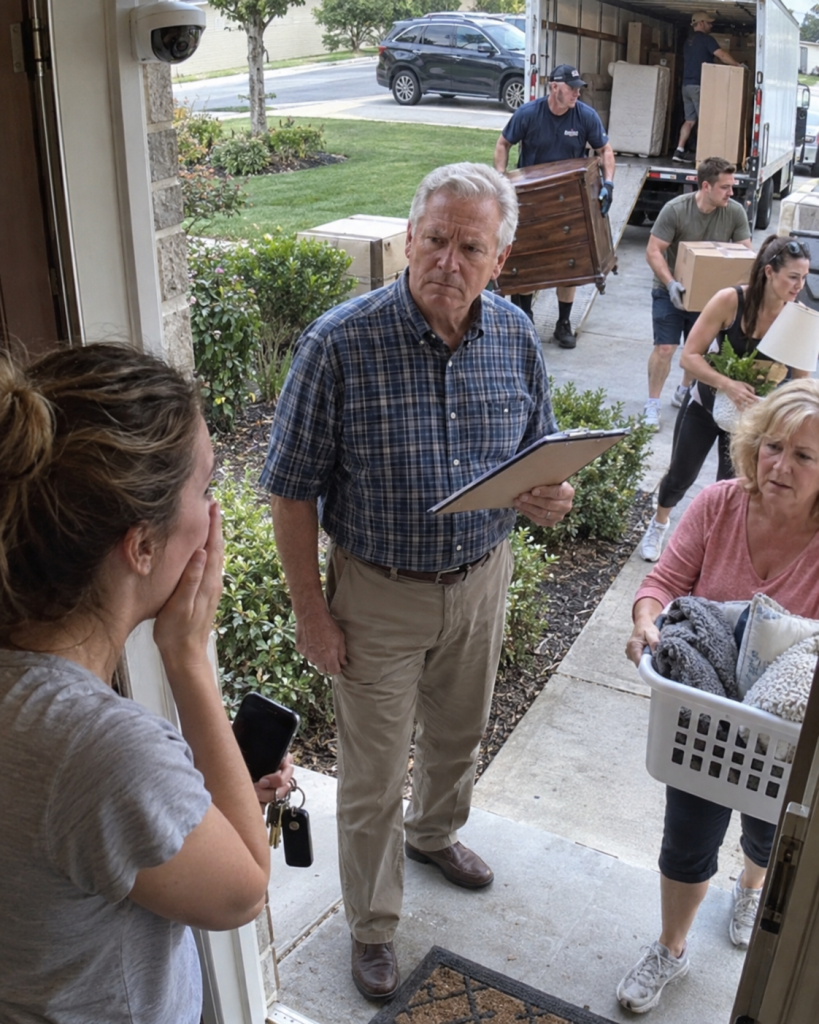
I woke up to the sound of metal scraping concrete.
At first, I thought it was the garbage truck dragging bins along the curb. My bedroom was still gray with early morning light, the kind that made the corners of my house look softer than they really were.
I lay there for three seconds, half awake, one hand under my pillow, listening.
Then came a thud.
Not from the street.
From my driveway.
I sat up so fast the comforter slid to the floor.
My phone was already buzzing on the nightstand.
Doorbell motion. Driveway motion. Front yard motion. Back gate motion.
One alert after another, stacked like an emergency siren in my hand.
When I opened the camera feed, I saw my father standing in my driveway with a clipboard.
Behind him was a moving truck.
My mother was carrying a laundry basket full of towels. My older brother James was lifting one end of a dresser with a man I didn’t recognize.
His wife, Patricia, stood on my porch in leggings and a white puffer vest, holding a tape measure like she had been born to invade people’s homes before breakfast.
For a moment, I just stared.
The house around me was silent except for the low hum of my office servers in the next room and the old heating vent ticking in the wall.
This was my house.
My name on the mortgage.
My coffee mug in the sink.
My half-finished trim in the hallway.
My guitar leaning beside the office door.
And my family was outside treating it like a property they had already inherited from a dead man.
I was not dead.
Not even close.
Two weeks earlier, this had started at dinner in my parents’ kitchen, under the yellow light that made every meal there feel like an interrogation.
My mother, Barbara, had served pot roast and kept asking strange questions about my work schedule.
“So you just sit at your computer all day?” she asked, cutting her carrots into tiny, angry pieces.
“I work, Mom,” I said. “Meetings, code reviews, system design. Same as always.”
“But you don’t go anywhere.”
“That’s what remote means.”
My father, Charles, leaned back in his chair and gave the little snort he used when he thought someone younger was trying to fool him.
“Not like real work where you show up somewhere.”
James stared at his plate.
Patricia gave me a bright, fake smile from across the table.
Their three kids were in the living room, fighting over a tablet with the volume turned up too loud.
I should have known then.
My mother folded her napkin and said, “We’ve been thinking.”
That phrase never brought anything good.
“Since you work from home,” she continued, “you don’t really need all that space. You just need a desk and internet.”
I looked up slowly.
My father cleared his throat.
“James has a real family. Three kids in a two-bedroom apartment. It doesn’t make sense.”
“What doesn’t make sense?” I asked, though my stomach already knew.
My mother smiled like she was offering me dessert.
“You could move into our basement after we finish it. James and Patricia could move into your house.”
I laughed.
Nobody else did.
My fork stayed halfway between my plate and my mouth.
“You’re serious,” I said.
“Don’t make that face,” Mom said. “It’s not like you’re using the house properly.”
Properly.
That word hit harder than it should have.
My three-bedroom colonial was not a mansion.
Sixteen hundred square feet, old floors, a narrow kitchen, a backyard that turned to mud every spring.
But I had bought it myself after years of sixty-hour weeks, late-night deployments, and saving until my social life looked like a canceled subscription.
One room was my office.
One was my music studio, where I recorded tracks for local bands and made a little side income.
The third was mine.
Apparently, to them, that counted as waste.
My father actually pulled out a folded piece of paper with bullet points.
“Resource optimization,” he said.
I remember the smell of pot roast fat cooling on the plate.
I remember James’s knee bouncing under the table.
I remember Patricia asking, too casually, whether my laundry room had space for extra shelving.
I left that dinner believing they were delusional but temporary.
Then Mom started texting me basement paint colors.
Then she asked for my keys.
I stared at the message for almost a full minute.
Mom: We need the house keys so James can start moving some things in.
I typed three different responses.
Deleted all three.
Then I sent one sentence.
Me: No.
The reply came less than thirty seconds later.
Mom: Don’t be difficult.
I laughed out loud.
Not because it was funny.
Because I finally understood.
They weren’t asking.
They were informing me.
I put my phone down and went back to work.
For the next two weeks, I stopped answering their calls.
Every few days, another message appeared.
What color are the walls in the kids’ room?
Does the guest room have a closet?
James wants to know if the garage fits his truck.
Patricia thinks the living room furniture should face the other wall.
They had already moved into my house in their heads.
I ignored every message.
Then, that morning, I heard the metal scraping across my driveway.
Now I was standing in my bedroom, watching my family unload a moving truck onto my property.
My phone buzzed again.
This time, it was a text from my father.
Dad: We’re here. Come downstairs.
I almost smiled.
Instead, I walked to my closet, pulled on jeans and a sweatshirt, and grabbed my house keys.
Then I walked downstairs.
When I opened the front door, my father was already halfway up the porch.
“Good morning,” he said.
I looked past him at the truck.
“No.”
He frowned.
“What?”
“No.”
My mother appeared behind him carrying a box labeled KITCHEN.
She looked genuinely confused.
“Don’t start this first thing in the morning.”
“I didn’t start anything.”
James dropped the dresser onto the driveway with a heavy thud.
“Come on, man,” he said. “We’ve talked about this.”
I looked at him.
“No, we haven’t.”
“Yes, we have.”
“You talked.”
He stared at me.
“I never agreed.”
My father stepped forward.
“Your mother and I made a decision.”
“About my house?”
“About the family.”
I almost laughed again.
“The family doesn’t own my house.”
My mother put the box down.
“You’re being selfish.”
There it was.
The word they always used whenever I refused to sacrifice something for James.
I looked at my brother.
“Where’s your apartment?”
He shrugged.
“We gave notice.”
My stomach dropped.
“You what?”
Patricia stepped onto the porch.
“We’ve already paid the moving company.”
I stared at all four of them.
“You gave up your apartment before I agreed to let you move here?”
Nobody answered.
That silence told me everything.
My father finally said, “We knew you’d come around.”
I nodded slowly.
“That’s incredible.”
“Don’t be dramatic,” Mom said.
“I’m not being dramatic.”
I pulled my phone from my pocket.
“I’ve been recording this entire conversation.”
My father’s face changed.
James looked at Patricia.
Patricia looked at the camera above my garage.
For the first time that morning, nobody spoke.
I pointed toward the street.
“Take everything off my property.”
My father crossed his arms.
“We’re not leaving.”
“Then I’ll call the police.”
Mom laughed.
“You wouldn’t call the police on your own family.”
I looked her directly in the eyes.
“Try me.”
She stopped smiling.
My father stepped closer.
“You’re making a huge mistake.”
“No. I made one two weeks ago.”
“What mistake?”
“Thinking you were only being rude.”
I opened my front door wider.
“You’re trespassing now.”
My father shook his head.
“You don’t understand what you’re doing.”
“I understand perfectly.”
Then James suddenly stepped forward.
“You know what? Fine.”
He pointed at me.
“You always do this.”
“Do what?”
“Act like you’re better than everyone because you bought a house.”
I stared at him.
“I never said I was better than you.”
“You don’t have to.”
His voice cracked.
“You got the good job. You got the house. You work from home. You don’t have kids. You don’t have responsibilities.”
I looked at the moving truck behind him.
“So your solution was to take my house?”
He didn’t answer.
My mother stepped between us.
“James needs stability.”
“And I don’t?”
“You’re single.”
“So?”
“You can start over.”
I felt something inside me go completely still.
That sentence hurt more than anything else they had said.
Because they weren’t seeing me as their son anymore.
They were seeing me as available space.
I reached into my pocket.
“Actually, Mom, Dad, there’s something you should know.”
My father frowned.
“What?”
“I already called someone.”
He scoffed.
“Who?”
I turned toward the street.
A black SUV pulled up.
Then another.
My mother’s face went pale.
A woman in a navy blazer stepped out of the first vehicle.
Behind her was a uniformed police officer.
The woman walked toward me.
“Are you Daniel Carter?”
“Yes.”
She handed me a folder.
“I’m Rachel Morgan, your attorney.”
My father’s expression changed instantly.
“Attorney?”
I opened the folder.
Inside were copies of my deed, mortgage documents, property records, and a certified letter.
I handed the letter to my father.
He read the first paragraph.
Then the second.
His face slowly drained of color.
“What is this?”
“A formal notice.”
“For what?”
“Unauthorized entry and attempted occupation of private property.”
My mother stared at me.
“You hired a lawyer?”
“I hired one after you asked for my keys.”
James stepped forward.
“That’s insane.”
“No.”
I looked at him.
“What’s insane is bringing a moving truck to someone’s house after they told you no.”
The officer stepped onto the driveway.
“Everyone needs to remain calm.”
My father folded the letter.
“This is a family matter.”
The officer looked at him.
“Not anymore.”
Silence.
Then Patricia suddenly burst into tears.
“Where are we supposed to go?”
Nobody answered.
She turned to my mother.
“You said he would let us stay.”
My mother looked away.
James stared at the ground.
And that was when I realized something.
They had never asked me because they didn’t believe they needed my permission.
They had built their entire plan around the assumption that I would eventually surrender.
I looked at the moving truck.
“Unload nothing else.”
The movers hesitated.
Then their supervisor stepped forward.
“We’ve been paid to deliver the furniture.”
I handed him a copy of the notice.
“Then deliver it somewhere else.”
He looked at James.
“Sir?”
James stood there, completely defeated.
“Take it back.”
The movers began loading everything into the truck again.
My mother watched them.
Her face was red with humiliation.
“This isn’t how family treats family.”
I looked at her.
“You’re right.”
She turned toward me.
“Then act like my son.”
“I am.”
I pointed at the house.
“That’s why I’m not letting you destroy what I worked for.”
My father suddenly lowered his voice.
“You’re going to regret this.”
I looked at him.
“No.”
I paused.
“I regret not saying no sooner.”
He stared at me for several seconds.
Then he turned around and walked away.
My mother followed.
James stayed behind.
For a moment, I thought he might apologize.
Instead, he said quietly,
“You really chose a house over your brother.”
I shook my head.
“No, James.”
I looked at him.
“I chose myself.”
He didn’t respond.
He simply walked toward the truck.
I watched them leave.
One by one, the cars disappeared down the street.
The driveway became quiet again.
For the first time in weeks, my house felt like my house.
I went inside.
The coffee mug was still in the sink.
My guitar was still beside the office door.
The unfinished trim was still waiting in the hallway.
Nothing had changed.
And yet everything had changed.
I walked into my office and opened my laptop.
There was one final message from my mother.
I almost deleted it without reading.
But I opened it.
Mom: Your father is furious. James has nowhere to go. If you have any compassion left, you’ll reconsider.
I stared at the screen.
Then I typed my response.
Me: I have compassion. That’s why I didn’t let you become homeless in my house.
I hit send.
Then I blocked her number.
I blocked my father’s too.
I sat there for a long time in the quiet.
A few months later, James found another apartment.
My parents eventually stopped contacting me.
There was no dramatic apology.
No tearful family reunion.
No magical moment when they suddenly understood what they had done.
Instead, there was something better.
Distance.
Peace.
And the freedom to live in the house I had worked so hard to build.
I finished the trim.
I renovated the music room.
I turned the spare bedroom into a guest room.
And one Saturday morning, I stood in the driveway with a cup of coffee, looking at the house in the sunlight.
The same house they had treated like a family resource.
The same house they thought they could simply take because I worked from home.
I smiled.
Then I went inside and locked the door behind me.
Not because I was afraid someone would come in.
But because, finally, I understood something my family had never wanted me to learn.
A boundary isn’t cruel just because someone gets angry when you enforce it.
And sometimes, saying no isn’t the end of a family.
Sometimes, it’s the beginning of your life


