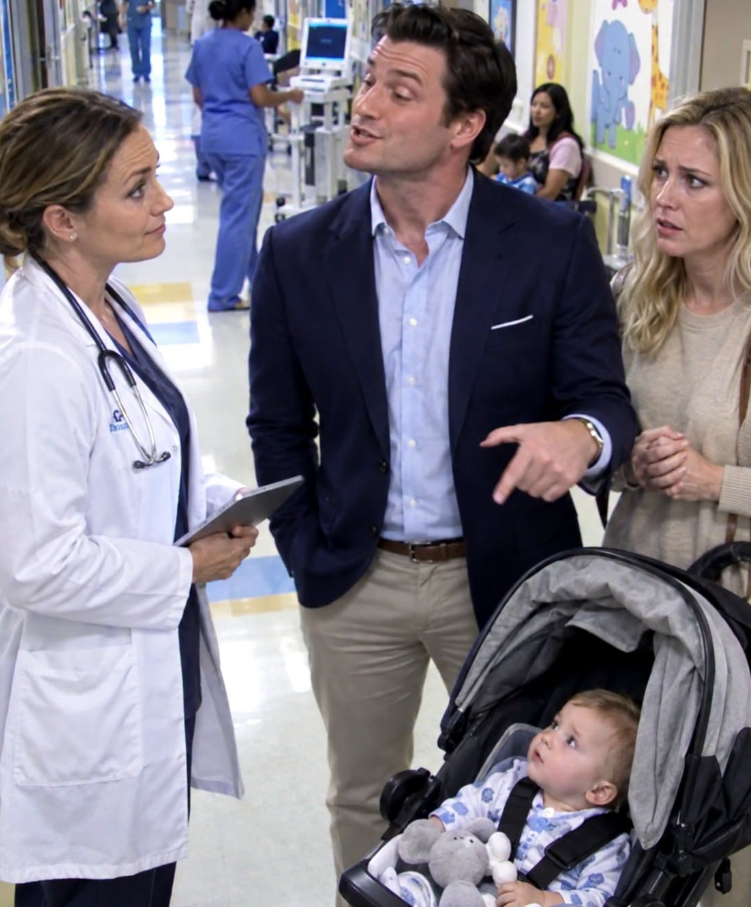
The sound of glass breaking did not belong in a pediatric wing.
It was too sharp, too sudden, too adult for a hallway painted with clouds and cartoon animals. For half a second, everyone froze in that strange silence that follows an accident, when the mind is still catching up to the ears.
Then the baby began to cry.
Not loudly at first. Just a startled, hiccupping whimper that made his little hands curl around the stuffed giraffe in his lap.
Melinda moved first.
She dropped to her knees, reaching for the broken bottle with shaking hands.
“Don’t,” I said automatically.
The doctor in me spoke before the former wife could. Before the betrayed friend could. Before the woman who had spent seven years swallowing disappointment could even breathe.
Melinda stopped.
A thin crescent of milk spread across the polished floor between us, reaching the toe of Connor’s expensive shoe.
A nurse hurried over with a caution sign and paper towels. Another gently moved the stroller back so the baby was away from the glass.
Connor stared at Kenneth Boyd as though my attorney had walked out of the elevator carrying a ghost.
“Kenneth,” I said quietly.
He came toward me with controlled steps, his dark gray suit perfectly pressed, his expression calm in the way only a very experienced attorney’s face could be calm. Kenneth had handled my divorce with the kind of steady professionalism I had desperately needed at the time. He never dramatized anything. Never raised his voice. Never promised revenge.
That was why the sealed folder under his arm made my stomach tighten.
Kenneth stopped beside me.
“Kirsten,” he said. “I’m sorry to come here.”
Connor found his voice. “What is this?”
Kenneth looked at him only briefly. “Mr. Fleming.”
There was no warmth in the greeting.
Melinda remained kneeling on the floor, her hands pressed flat against her thighs, her face pale beneath the soft hospital lights. She looked at Kenneth with recognition, but not surprise. That was what struck me first.
Not surprise.
Recognition.
As if she had been waiting for him to appear.
As if she had spent a long time fearing this exact hallway, this exact moment, this exact sealed folder.
“Melinda,” Kenneth said.
Her eyes filled, but she blinked the tears away. “I didn’t know she worked this wing today.”
Connor’s head snapped toward her. “What are you talking about?”
Kenneth’s gaze stayed on her. “We should speak somewhere private.”
“No,” Connor said quickly. “You don’t get to walk in here and make some scene.”
A bitter laugh nearly rose in my throat. Connor, who had just announced my infertility to strangers in a hospital corridor, was suddenly concerned about scenes.
But I did not laugh.
I looked at the baby.
He had settled now, soothed by the nurse who had bent down to smile at him. His cheeks were wet, his small fingers still clutching the giraffe’s neck. He was beautiful in the effortless, innocent way babies are beautiful. Entirely separate from the adults around him. Entirely undeserving of the tension collecting in the air.
“Kenneth,” I said, lowering my voice, “what is going on?”
He hesitated.
That worried me more than anything.
Kenneth Boyd never hesitated unless the truth needed careful handling.
“I received the final response from the private records request this morning,” he said.
Connor scoffed. “Private records? What records?”
Kenneth looked at him. “Records connected to the fertility clinic.”
The words moved through me like cold water.
For a moment, the hallway disappeared.
The walls. The nurses. The families. Connor’s smug face. Melinda’s trembling hands.
All I could see was a small exam room from years ago. A plastic chair. A box of tissues. Connor sitting beside me with his arms crossed while a specialist gently explained that our last attempt had failed.
Again.
I remembered apologizing.
That was the part that still made me ache. Not the injections, not the surgeries, not the hope that arrived every month dressed as fear.
I remembered apologizing to Connor because I thought my body had made him unhappy.
“What clinic records?” Connor demanded.
Kenneth’s mouth tightened. “This is not the place.”
Connor stepped closer. “You are not talking about my family like this.”
His family.
The word landed exactly where he meant it to.
I felt the sting, but it was duller than it once would have been. A year earlier, that sentence might have opened something in me. Now it only revealed him more clearly.
I turned to the nurse standing near the stroller.
“Could you take them into Consultation Room Three?” I asked.
She nodded. “Of course, Dr. Sinclair.”
Connor frowned. He hated hearing people defer to me. He had always preferred me uncertain.
“This is ridiculous,” he said.
“It’s private,” I replied. “You just asked for that.”
His jaw worked.
For a moment, I thought he would refuse, just to prove that he could. But Melinda stood, slowly, and placed both hands on the stroller handle.
“Connor,” she whispered. “Please.”
Something in her voice unsettled him.
Not guilt.
Fear.
He looked from her to Kenneth, then to me.
“Fine,” he said. “Five minutes.”
We walked down the hallway in a strange procession. Kenneth and I in front. Connor and Melinda behind us with the baby between them. The nurse followed to make sure the path remained clear and no glass had been tracked from the broken bottle.
Inside Consultation Room Three, the light was softer. There was a small round table, four chairs, a box of tissues, a wall-mounted hand sanitizer dispenser, and a mural of a sleepy moon holding a star. I had given difficult news in rooms like this. I had watched parents fall apart in rooms like this. I had learned that truth, no matter how gently offered, always changed the air.
Kenneth closed the door.
The click sounded final.
Connor remained standing. “Start talking.”
“Sit down,” Kenneth said.
“I’m not your client.”
“No,” Kenneth replied. “But your son is present.”
That quiet sentence did what anger would not have done.
Connor glanced at the baby and sat.
Melinda took the chair farthest from him.
I noticed.
Connor noticed too.
His eyes narrowed.
Kenneth placed the sealed folder on the table but did not open it immediately. He looked at me first.
“Kirsten, before I say anything else, I need to remind you that some of this may be upsetting.”
My fingers tightened around the edge of my tablet.
“I understood that when you came to my workplace with a sealed legal folder.”
A faint sadness crossed his face. “Fair enough.”
Connor leaned back. “This is all very dramatic.”
Kenneth finally opened the folder.
The room seemed to shrink around the sound of paper sliding against paper.
“During the divorce,” Kenneth said, “there were unresolved financial discrepancies. Kirsten chose not to pursue them aggressively at the time.”
Connor’s mouth curled. “Because there weren’t any.”
“Because she was exhausted,” Kenneth corrected.
I looked down.
That was true.
At the time, I had wanted the divorce over more than I wanted answers. I was working long shifts. My father was recovering from heart surgery. My marriage had become a house with all the lights off, and I no longer had the strength to search every room.
I had signed papers just to be free.
Kenneth continued. “Several months ago, a routine audit connected to a closed joint account revealed payments made from marital funds to an out-of-state reproductive storage facility.”
My breath caught.
Connor stopped moving.
Melinda closed her eyes.
“What?” I said.
Kenneth slid one paper toward me.
I did not touch it at first.
The logo at the top was unfamiliar, but the language beneath it was not. Cryogenic storage. Embryology transfer. Release authorization.
Medical words. Legal words.
Words from a life I thought had ended.
“Kenneth,” I whispered.
He spoke carefully. “The clinic where you and Connor underwent treatment closed two years ago after merging with a larger network. Some stored genetic materials were transferred to partner facilities. You were never notified.”
“That’s impossible,” I said.
But even as I said it, I knew impossible was not the same as untrue.
Connor’s face had changed.
The arrogance was still there, but it was thinner now. Like paint over a cracked wall.
“Kirsten signed everything,” he said.
Kenneth looked at him. “Did she?”
The silence that followed had weight.
Melinda opened her eyes. “Connor.”
“Be quiet,” he snapped.
The baby flinched.
I saw it. So did Melinda. So did Kenneth.
For the first time, anger warmed me from the inside—not wild anger, not messy anger, but something clean and protective.
“Don’t speak like that in front of him,” I said.
Connor laughed once, sharp and humorless. “Don’t tell me how to talk to my son.”
My son.
Again.
Kenneth removed another page. “The storage facility provided copies of authorization forms. Kirsten’s signature appears on documents approving transfer and release.”
I stared at him.
“My signature appears?”
“Yes.”
“But I never signed anything.”
“I know,” Kenneth said.
The room tilted.
I sat down slowly, though I did not remember choosing to move.
Seven years of appointments. Seven years of prayers I did not say out loud because Connor thought prayer was weakness unless he needed something. Seven years of believing there had been nothing left. No possibility. No hidden doorway. No quiet miracle waiting in a freezer somewhere with my name on it.
I looked at Connor.
He did not look away.
That frightened me more than if he had.
“You knew,” I said.
He rubbed a hand over his mouth. “You’re confused.”
“No.” My voice was soft, but steady. “I’m not.”
Kenneth placed a third paper on the table.
“This,” he said, “is the release authorization dated three months before your divorce was finalized.”
The date glowed on the page.
I remembered that month.
I had been sleeping in the guest room. Connor had told friends we were “working through things.” Melinda had visited often. She had brought soup. She had folded laundry. She had sat beside me on the bathroom floor after I found another box of pregnancy tests I had forgotten to throw away.
My eyes lifted to her.
Melinda looked as though she might crumble.
“You were there,” I said.
Her lips parted, but no sound came.
Connor leaned forward. “Enough. You don’t know what you’re implying.”
Kenneth’s voice remained even. “I know exactly what I’m implying. I’m also stating that the signatures are now being formally challenged.”
Connor’s eyes flashed. “Good luck.”
Then Kenneth said the sentence that made the room stop breathing.
“The child may have been conceived using embryos created by Kirsten and Connor during their marriage.”
Melinda covered her mouth.
I heard the baby babble softly in the stroller, a bright little sound that did not belong beside such a sentence.
My mind refused it.
Then accepted it.
Then refused it again.
“No,” I whispered.
Kenneth looked at me with quiet compassion. “I’m sorry.”
I turned to Melinda.
She was crying now, silently, tears slipping down her cheeks while she stared at the floor.
“Tell me it isn’t true,” I said.
She did not answer.
That was an answer.
Connor stood. “This is absurd. You’re trying to take my child because you couldn’t have one.”
The cruelty was familiar.
But this time, it did not cut the same way.
Because behind it, I heard panic.
Kenneth rose too. “Sit down, Mr. Fleming.”
“You don’t give me orders.”
“No,” Kenneth said. “But I can tell you that leaving this room will not make the court filings disappear.”
Connor froze.
“Court filings?” he repeated.
Kenneth tapped the folder. “Emergency petition. Preservation request. Notice to the clinic network. Request for genetic testing. Request for a temporary order preventing removal of the child from the state until parentage and consent issues are resolved.”
Melinda let out a small sound.
Connor turned on her. “Did you know about this?”
She shook her head quickly, but not convincingly enough.
“Melinda,” I said.
She looked at me then.
For the first time in a year, I saw the girl I had met in college. The one who used to eat cereal out of coffee mugs in my apartment because we were too broke for real bowls. The one who had held my hand when my mother died. The one who knew every private dream I had ever been foolish enough to say aloud.
“I didn’t know at first,” she whispered.
Connor’s face hardened. “Stop talking.”
But she did not stop.
Maybe she was too tired.
Maybe Kenneth’s folder had done what guilt could not.
Maybe seeing me in my lab coat, in my own hallway, still standing, had reminded her that I was not just an obstacle in Connor’s version of the story.
I was a person she had once loved.
“He told me you had signed the release,” she said.
My heart pounded against my ribs. “What release?”
“He said you didn’t want anything connected to the treatments anymore. That it hurt too much. That you wanted the embryos destroyed but he convinced you to donate them anonymously.”
I pressed my palm against the table.
Donate them.
As if they were old furniture. As if they were not pieces of a future I had mourned.
Melinda’s voice broke. “He said there was one option. That we could use them, because they were partly his. He said you agreed because you wanted him to have the family he deserved.”
The room went silent again.
This time, no one even pretended it was empty silence. It was full of every lie Connor had ever told, every softened version of himself he had offered to different women for different purposes.
I looked at him.
“You told her I gave you permission?”
Connor’s nostrils flared. “You abandoned the marriage.”
A strange calm moved over me.
“No,” I said. “You left.”
“You chose your career over us.”
“I paid for half those treatments. I rearranged shifts. I injected medication into my own body between patients. I had procedures and appointments and losses you refused to even discuss unless someone else was watching.” My voice trembled once, then steadied. “Do not rewrite my grief in front of me.”
Melinda started sobbing quietly.
The baby fussed, sensing the room had changed. She reached for him at once, lifting him carefully from the stroller. He settled against her shoulder, his small hand patting her collarbone.
Despite everything, she held him with real tenderness.
That complicated the shape of my anger.
It would have been easier if she were only cruel. Easier if Connor were only a villain and Melinda only a thief. But life had never been that clean.
Connor had built a story for both of us. Perhaps for all three of us.
He had told me I was broken.
He had told Melinda I had given up.
He had told himself he deserved whatever he wanted.
“Kirsten,” Melinda whispered, rocking the baby gently, “I swear I didn’t understand what he had done until after I was pregnant.”
My voice came out raw. “And then?”
She closed her eyes.
That was the second answer.
After a long moment, she said, “Then I was afraid.”
“Of me?”
“Of losing him.” She kissed the baby’s hair and looked ashamed before she even finished the sentence. “Of losing the baby. Of admitting what I had done. Of becoming the person I already knew I was.”
Connor laughed under his breath. “Listen to yourself. You sound ridiculous.”
She looked at him then, and something in her face changed.
Not dramatically. Not with a speech. Just a small, weary shift, like a door unlocking after years of pressure.
“No,” she said. “I sound like someone who is finally telling the truth.”
Connor stared at her.
I had seen him angry before. I had seen his charm sour, his patience evaporate, his affection turn conditional. But I had rarely seen him speechless.
Kenneth used the moment.
“Mr. Fleming,” he said, “you need counsel. Anything you say may become relevant in the civil proceedings, and possibly more.”
“Possibly more?” Connor snapped. “What does that mean?”
“It means forged medical consent forms are not a misunderstanding.”
The word forged landed between us.
Forged.
I looked again at the signature copies.
There was my name, looped and confident.
Almost right.
Not quite.
Someone had copied my signature from somewhere. An old bank form, maybe. A tax return. A consent document from another procedure.
Almost right.
Not quite.
The difference made me shiver.
I had signed so many forms during those years. I had trusted the systems around me. Trusted the clinics. Trusted my husband.
Trust, I was learning, leaves a paper trail when it dies.
A knock sounded at the door.
We all turned.
The nurse from the hallway opened it a few inches. “Dr. Sinclair? I’m sorry. Your meeting starts in five minutes. Dr. Patel said she can cover for you.”
I swallowed.
Work. Patients. The hospital.
The life I had built when everything else collapsed.
“Thank her for me,” I said.
The nurse’s eyes moved once around the room—not curious, just concerned. “Of course.”
When the door closed, I realized my hands were shaking.
I folded them in my lap.
Connor noticed. He latched onto it immediately.
“There it is,” he said softly. “This is what you wanted, isn’t it? To punish me. To punish us because we moved on.”
I looked at the baby in Melinda’s arms.
He had Connor’s eyes.
Maybe mine too.
The thought was unbearable and magnetic at once.
“I don’t know what I want yet,” I said honestly. “I only know what was taken from me.”
Kenneth glanced at me. I knew that honesty would matter later. It mattered now too.
Melinda cried harder.
Connor leaned back, his expression shifting again, searching for a new angle. I had watched him do that for years. When charm failed, he used pity. When pity failed, blame. When blame failed, confusion. When confusion failed, he became the victim.
“You think a judge is going to rip a baby from the only mother he knows?” he said.
Melinda flinched.
I felt the accusation in my chest, because some part of me had already feared it.
“No,” I said. “I don’t.”
He blinked.
“I’m not here to hurt a child,” I continued. “I have spent my entire adult life helping children. I know what trauma does. I know what uncertainty does. I know babies are not property, not prizes, not proof that someone won.”
My voice softened despite myself.
“But he deserves the truth. So do I.”
Kenneth nodded slightly.
Connor looked frustrated by my refusal to become the monster he needed me to be.
“You have no claim,” he said.
Kenneth answered before I could. “That remains to be determined.”
“No,” Connor said. “It doesn’t. Melinda gave birth. I’m the father. End of story.”
“Biology and legal parentage can become complicated when consent is fraudulent,” Kenneth said.
Connor’s face reddened. “You can’t prove fraud.”
Melinda spoke, barely above a whisper.
“I can.”
Connor turned slowly toward her.
The room shifted.
Kenneth’s pen paused.
I stared at Melinda.
She held the baby closer. Her lips trembled, but her voice came clearer the second time.
“I can prove it.”
Connor’s expression emptied. “Careful.”
It was not a threat, exactly. Not loud enough, not dramatic enough. But the room heard it.
Melinda heard it most of all.
She looked down at the little boy in her arms. He had fallen asleep against her shoulder, his lashes damp from crying, his mouth slightly open.
“I found emails,” she said. “After the baby was born.”
Connor stood so fast his chair scraped the floor.
Kenneth moved one step forward. Not aggressively. Just enough.
“What emails?” I asked.
Melinda’s tears fell onto the baby’s blanket.
“From the clinic coordinator. From the storage facility. Messages forwarded to an account Connor thought I didn’t know about.” She looked at me then. “There were scanned documents. Payment confirmations. And a message about your signature needing to match the previous consent form more closely.”
My stomach turned.
Connor’s voice was low. “You went through my email?”
Melinda gave a broken little laugh. “That’s what you care about?”
He said nothing.
“Where are the emails?” Kenneth asked.
“Saved,” Melinda said. “Printed. And with someone else.”
Kenneth’s eyes sharpened. “Who?”
“My sister.”
Connor stared at her as if he no longer recognized her.
For the first time since he had stepped into that hallway with his rehearsed cruelty and proud smile, he looked genuinely afraid.
I should have felt satisfaction.
I did not.
I felt grief, widening into something too large for the small consultation room.
Because if Melinda was telling the truth, this was not only betrayal. It was not only adultery, not only divorce, not only friendship destroyed.
It was the theft of a possible child.
And the child was here now, breathing softly against the shoulder of the woman who had helped take him from me.
The human heart, I thought, was not designed for contradictions this sharp.
“What is his name?” I asked.
The question surprised everyone, including me.
Melinda looked down at the baby.
“Elliot,” she whispered.
Elliot.
A gentle name.
A name Connor would never have chosen on his own. He preferred names that sounded like surnames, names that belonged on office doors and engraved watches. I wondered if Melinda had fought for Elliot. I wondered if she had named him in some private act of softness, some attempt to make one decent choice inside a thousand wrong ones.
“Elliot,” I repeated.
The baby stirred, as if hearing himself.
My throat tightened.
Years ago, before everything went wrong, Connor and I had kept a list of baby names in the notes app on my phone. He had treated it like a joke at first, adding names of athletes and movie characters just to make me roll my eyes.
But I had added one name after a twelve-hour shift in pediatrics, after treating a little boy who gave me a sticker because he said doctors needed bravery too.
Elliot.
I had forgotten that.
No.
I had tried to forget that.
Connor was watching me too closely.
He remembered.
Of course he remembered.
The realization moved through me with quiet horror.
“You chose that name,” I said to Melinda.
She shook her head slowly.
My eyes moved to Connor.
For once, he could not hold my gaze.
“You named him Elliot,” I whispered.
Connor’s silence was enough.
Melinda looked between us, confused. “What?”
I pushed back from the table. “That was my name.”
“Kirsten,” Kenneth said gently.
“No.” I stood because sitting suddenly felt impossible. “That was the name I wanted. Years ago.”
Melinda’s face folded in pain.
“I didn’t know,” she said.
I believed her.
That was the worst part.
I believed her about that.
Connor had not only taken the embryos. He had taken the name too. A private piece of hope from a woman he claimed had never wanted a family badly enough.
He had built his new life out of stolen fragments and then brought it to my workplace like a trophy.
The room blurred.
I turned away, blinking hard.
Through the small window in the door, I could see the pediatric wing continuing around us. Nurses moved with purpose. Parents carried backpacks and juice boxes. A little girl in purple slippers shuffled past holding her father’s hand.
Life did not stop because yours cracked open.
It never had.
“Kirsten,” Melinda said behind me, “I am sorry.”
I did not turn around.
“I know it isn’t enough,” she continued. “I know there isn’t a sentence big enough. But I am sorry.”
There had been a time when her apology would have been the thing I wanted most. I had imagined it in the early months after the divorce, back when pain still made me rehearse conversations in the shower and in traffic and at three in the morning.
I had imagined her admitting everything. Crying. Explaining. Telling me she missed me. Telling me she had made a terrible mistake.
But now the apology arrived carrying a sleeping baby and a folder full of forged signatures.
It felt much too small.
“I don’t know what to do with your apology,” I said.
“That’s fair,” she whispered.
Connor scoffed. “This is pathetic. Both of you.”
Kenneth’s voice cut in, crisp and final. “Mr. Fleming, I strongly advise you to stop speaking.”
Connor pointed at the folder. “You think some paperwork changes reality?”
“Yes,” Kenneth said. “It often does.”
A strange sound escaped me. Not quite a laugh. Not quite a sob.
Connor glared.
Kenneth gathered the documents. “We are not resolving this here. Kirsten, I’ll need to meet with you after your shift if you’re able. If not, tomorrow morning.”
“I’m able,” I said.
Melinda stepped forward. “What happens now?”
Kenneth looked at her carefully. “That depends, in part, on what you choose to do next.”
She swallowed. “I’ll cooperate.”
“No,” Connor said.
She did not look at him.
“I’ll cooperate,” she repeated.
Connor’s face hardened into something cold and familiar. “You have no idea what you’re doing.”
Melinda looked down at Elliot.
“I think I finally do.”
I saw then that she was not brave in the way people are brave in movies. She did not lift her chin dramatically. She did not deliver some perfect line. She looked terrified. Her hands shook. Her eyes were swollen. Her guilt sat plainly on her face.
But she still stood there.
Sometimes courage was only the decision not to lie one more time.
Kenneth handed me a single sheet. “This is the temporary filing summary. Don’t read it all right now unless you want to.”
I almost smiled. “You know me better than that.”
“I do,” he said.
I read it.
Not every word. Just enough.
My name. Connor’s name. The clinic network. Consent irregularities. Preservation of records. Genetic testing. Temporary restrictions.
Then another phrase caught my eye.
Potential third-party involvement.
I looked up.
“Kenneth.”
He knew what I had seen.
“We need to discuss that separately.”
Connor’s eyes darted toward the paper. “What third party?”
Kenneth did not answer.
Melinda, however, went still.
The baby shifted in her arms.
I noticed.
Doctors notice tiny changes.
A tightening jaw. A skipped breath. A flicker of fear.
“Melinda,” I said, “who else knew?”
She closed her eyes.
Connor muttered, “Don’t.”
Kenneth turned fully toward her. “Mrs. Fleming, if someone else assisted in falsifying consent documents, now is the time to say so.”
Mrs. Fleming.
The title landed with an unexpected sting. Not because I wanted Connor back. I did not. The thought felt almost absurd now.
But I had once been Mrs. Fleming. I had once answered to that name in waiting rooms and holiday cards and mortgage documents. I had once thought it meant chosen.
Melinda shifted Elliot to her other shoulder.
“There was someone at the clinic,” she said.
Kenneth’s expression did not change, but I felt his attention sharpen.
“Name?” he asked.
“I don’t know her full name. Connor called her Dana.”
Connor’s face went pale.
Not angry pale.
Afraid pale.
Kenneth wrote the name down. “Dana.”
I frowned.
Something about the name brushed against memory.
A receptionist? A nurse? A coordinator?
During fertility treatment, there had been so many faces. Kind faces. Tired faces. Efficient faces. People who knew the most intimate details of my body while remaining almost strangers.
“Dana Morales?” I asked suddenly.
Kenneth looked at me. “You know her?”
“I don’t know. Maybe. There was a Dana at the first clinic. She handled scheduling sometimes.” I pressed my fingers to my temple. “Dark hair. Silver glasses. She always wore lavender perfume.”
Melinda nodded quickly. “Yes. Connor met her for coffee once. I thought it was about paperwork.”
Connor laughed again, but it sounded thin. “This is insane.”
Kenneth made another note. “Did this Dana request payment?”
Melinda hesitated.
Connor spoke through clenched teeth. “Stop.”
She answered anyway.
“Yes.”
“How much?” Kenneth asked.
“I only saw one transfer. Twenty-five thousand.”
I stared at Connor.
Twenty-five thousand dollars.
During the divorce, he had fought me over the dining table. Over a vacation credit. Over my grandmother’s antique mirror because he claimed it had been purchased during the marriage, even though he had always hated it.
All while hiding twenty-five thousand dollars paid to someone named Dana.
“What account?” Kenneth asked.
“Business account,” Melinda said. “Connor said it was consulting.”
Kenneth nodded once, as if another invisible piece had clicked into place.
Connor’s composure cracked.
“You think this makes you innocent?” he said to Melinda. “You were happy enough when you thought you’d gotten what you wanted.”
She absorbed the words like someone who had heard worse in private.
“No,” she said quietly. “I was never happy. I was relieved, then scared, then ashamed. Those aren’t the same thing.”
The honesty in that sentence stayed with me.
I wanted to hate her cleanly.
I could not.
Not yet.
Maybe not ever.
That did not mean forgiveness. People confused those too often. Forgiveness was not a door someone else got to demand you open. Sometimes it was not even a door. Sometimes it was a wall you stopped throwing yourself against.
“Kirsten,” Kenneth said, “we should end this conversation for now.”
He was right.
My meeting had already begun without me. My patients still needed me. My life outside this room still existed, even if it now felt like it belonged to someone else.
I looked at Elliot one more time.
He slept with one fist tucked beneath his chin.
A year old.
Born after my marriage ended, but possibly created before it did.
My child, perhaps.
Not mine, perhaps.
Both possibilities hurt.
“I won’t make decisions in a hospital room,” I said. “And I won’t make them out of anger.”
Connor’s eyes narrowed. “How noble.”
“No,” I said. “Careful.”
That silenced him.
Kenneth placed a business card on the table in front of Melinda. “Send the emails to this address. Do not forward them from Connor’s devices. Do not alter them. Do not discuss them over text with him.”
Melinda nodded.
Connor picked up the card and flicked it back onto the table. “She isn’t sending you anything.”
Melinda picked it up.
“Yes,” she said. “I am.”
For a moment, I saw the entire balance of their marriage shift. Connor saw it too, and that was why his face changed. It was not the legal folder that frightened him most. It was not Kenneth or the temporary order or even the word forged.
It was losing control of the story.
He had survived by being the narrator.
Now someone else was speaking.
I opened the door.
The hallway seemed too bright.
I stepped out first, then Kenneth. Behind us, Melinda pushed the stroller silently, Elliot awake now and blinking at the ceiling lights. Connor followed last, his phone already in his hand.
At the elevator, Kenneth touched my elbow gently.
“Are you all right?”
“No.”
He nodded. “That’s a reasonable answer.”
I looked down the pediatric corridor, at the nurses’ station where my colleagues were pretending not to watch too obviously.
“I need ten minutes,” I said. “Then I’ll go back to work.”
“Kirsten.”
I met his eyes.
“You don’t have to prove you’re strong by pretending this didn’t happen.”
The words nearly undid me.
Because that was exactly what I had been about to do.
Chart notes. Staff meeting. Patient rounds. Smile. Wash hands. Keep moving.
I had built survival out of competence. It had worked, mostly.
But this was not an ordinary wound.
“I don’t know how to be anything else right now,” I admitted.
Kenneth’s expression softened. “Then be exactly that until you can be something else.”
The elevator doors opened.
Connor stepped inside without looking back.
Melinda paused.
For one fragile second, she and I stood facing each other with Elliot between us.
“I’ll send everything,” she whispered.
I nodded.
“And Kirsten?”
I waited.
“He laughs like you.”
The sentence struck me in a place no legal filing could reach.
Melinda’s eyes filled again.
“I didn’t understand why at first,” she said. “He has this little half laugh, like he’s trying not to smile too much. Connor said I was imagining it.”
I could not speak.
The elevator doors began to close.
Connor reached out impatiently and pressed the button.
Melinda stepped inside.
Elliot looked over her shoulder at me, wide-eyed and solemn, his stuffed giraffe tucked under one arm.
Then the doors shut.
I stood there long after they were gone.
That evening, rain started just as my shift ended.
It came down in fine silver lines against the hospital windows, turning the parking lot lights blurry and soft. I sat in my office with the door closed, still wearing my lab coat, the filing summary spread across my desk.
I had treated four patients after Connor left.
A toddler with asthma.
A six-year-old with a stubborn fever.
A teenager recovering from appendicitis who wanted to know if his scar would look “cool.”
A newborn whose mother cried from exhaustion and relief when I told her the test results were normal.
I had spoken gently. Listened carefully. Washed my hands between rooms. Smiled when needed.
No one knew that beneath my calm voice, one sentence kept repeating.
He laughs like you.
At 7:14 p.m., Kenneth arrived with two coffees and the expression of a man who had more bad news but was trying to deliver it in manageable portions.
“You shouldn’t have caffeine this late,” I said.
“You shouldn’t be reading legal filings alone in your office,” he replied.
I accepted the coffee.
He sat across from me.
For a while, neither of us spoke.
Rain ticked against the window.
Finally, I said, “How long have you suspected?”
Kenneth exhaled. “The financial issue? Months. The embryo release? Only recently. The connection to the child became plausible this morning.”
“Plausible.”
“I won’t use stronger language until testing confirms it.”
“Attorney language.”
“Protective language.”
I leaned back, exhausted. “What happens if it’s true?”
He folded his hands. “Then we deal with a difficult legal and emotional situation very carefully.”
“That sounds like something you say when the actual answer is terrible.”
“The actual answer is complicated,” he said. “You may have claims related to fraud, emotional damages, and consent violations. Parentage is more delicate. Courts focus heavily on the child’s stability.”
“Good.”
Kenneth looked at me.
“I mean it,” I said. “Whatever Connor did, Elliot didn’t do it. I don’t want him turned into evidence with a bedtime routine.”
Something like respect moved through Kenneth’s face.
“That will matter,” he said.
“Will it?”
“Yes. Not always quickly. Not always enough. But it will.”
I rubbed my eyes. “I spent years thinking I couldn’t have a child. Now I may have one who calls someone else mother.”
Kenneth was quiet.
There was no comforting answer.
I appreciated that he did not invent one.
After a moment, he opened another folder.
“This is what I wanted to discuss privately.”
The third-party involvement.
Dana.
He slid a photo across the desk.
It was a grainy image from what looked like a professional directory. A woman in her late forties, dark hair cut to her chin, silver glasses, polite smile.
My stomach tightened.
“Dana Morales,” Kenneth said. “Former administrative coordinator at the fertility clinic. She left shortly after the merger.”
“I remember her.”
“She currently works as an independent patient advocate.”
“Is that legal?”
“Yes, if done properly. But she also appears to have a small consulting company. Connor’s business paid that company twenty-five thousand dollars around the same time the release documents were processed.”
I stared at the photo.
Lavender perfume.
Silver glasses.
A kind voice on the phone.
Mrs. Fleming, I know this process is hard. We’ll take good care of everything.
I had believed her.
“Why would she do it?” I asked.
“Money, perhaps. Loyalty to Connor. Pressure. We don’t know.”
I picked up the photo.
Something about her eyes made memory stir again.
“She knew me,” I said.
Kenneth frowned. “From the clinic.”
“No.” I shook my head slowly. “Before that.”
He waited.
I searched through years of faces. Hospital fundraisers. Medical school events. Fertility seminars. Charity panels. Waiting rooms. Conference badges.
Then it came to me.
“My mother,” I whispered.
Kenneth leaned forward. “What about her?”
“Dana worked for my mother’s oncologist years ago. Not as a nurse. Front desk, maybe billing. I remember because she sent flowers after my mother died.” I looked up. “Why would she later work at my fertility clinic?”
Kenneth’s expression changed.
Not dramatically.
Enough.
“That may be coincidence,” he said.
“But you don’t think it is.”
“I think we need to verify timelines.”
My office felt colder.
I looked at the rain-streaked window.
My mother had died six years before Connor and I started fertility treatments. She had never known how hard we tried. Never sat with me through failed cycles. Never told me whether hope was worth the pain.
But Dana had been there, somewhere at the edges of both losses.
“Could she have had access to my old medical information?” I asked.
“Possibly limited information, depending on her role. But old oncology office records would not explain fertility clinic documents.”
“No,” I said. “But it means she recognized me.”
Kenneth nodded slowly. “That is possible.”
My phone buzzed.
A message appeared from an unknown number.
For a moment, I thought it might be Melinda.
It wasn’t.
The text contained no greeting.
Just a photograph.
I opened it with stiff fingers.
It showed a storage room. Metal tanks. Labels. A gloved hand holding a small white tag close enough for the printed words to be read.
FLEMING/SINCLAIR – EMBRYO SET B
Below the photo was one sentence.
Ask Connor what happened to Set A.
I stopped breathing.
Kenneth stood. “Kirsten?”
I turned the phone toward him.
He read the message once.
Then again.
The rain tapped steadily against the glass behind us.
Set B.
My voice barely rose above a whisper.
“Kenneth… how many embryos were there?”
He did not answer immediately.
And in that silence, I understood something worse than betrayal had been waiting beneath the first secret.
There had been more than one missing future.
PART 3
For a long moment, the rain was the only sound in my office.
It tapped against the window in thin, silver lines, steady and patient, while the message on my phone seemed to burn through the screen.
Ask Connor what happened to Set A.
Kenneth did not reach for the phone right away. He simply stood there, reading the words as if the space between them mattered as much as the message itself.
I could hear the hospital around us. A cart rolling somewhere down the corridor. A soft page over the speaker system. A child laughing in the distance, high and bright, unaware that the world could split open inside one small office.
“Kirsten,” Kenneth said carefully, “do you recognize this number?”
I shook my head.
My thumb hovered over the screen, but I did not type. My hands, the hands that could start an IV in a moving emergency bay and steady a panicked parent with one touch, suddenly felt disconnected from me.
Set B.
There had been enough grief in believing there were no embryos left. Enough pain in thinking every possible future had ended behind clinic doors and failed phone calls.
But this message suggested something else.
Not just theft.
A system.
A sequence.
Set A. Set B.
More than one hidden truth.
Kenneth gently took the phone when I offered it. “We need to preserve this.”
“I know.”
“Don’t reply yet.”
“I know.”
But knowing was not the same as breathing.
I sat down slowly. My coffee had gone cold beside the filing summary. Across the desk, Dana Morales’s photo stared up at me with polite, frozen professionalism.
“Set A,” I whispered. “Kenneth, how many embryos did Connor and I have?”
He sat across from me, placing my phone carefully on the desk between us.
“According to the original clinic records we have so far,” he said, “there were two viable embryo groups documented after your last retrieval.”
I closed my eyes.
Two.
I remembered that retrieval.
The way Connor had been unusually attentive afterward, bringing me ginger tea and telling the nurse he would take excellent care of me. I had cried in the car, not from pain exactly, but from a fragile hope I was afraid to hold too tightly.
Two groups.
Two possibilities.
“What happened to them?” I asked.
Kenneth’s jaw tightened. “The records are inconsistent.”
“Inconsistent is attorney language again.”
“It means someone either made serious administrative mistakes,” he said, “or someone wanted the record to be hard to follow.”
The office seemed smaller than it had minutes before.
I stood and walked to the window because sitting made me feel trapped. Down below, hospital employees hurried through the rain with jackets over their heads and bags tucked under their arms. Everyone was going somewhere. Everyone had a door to open.
I had spent a year believing my life after Connor was a rebuilding. I had bought plants for my apartment. I had taken weekend hikes. I had learned how to sleep diagonally across a bed without apologizing for taking up space. I had become myself again in small, quiet ways.